parking brake Alfa Romeo Giulietta 2013 Owner handbook (in English)
[x] Cancel search | Manufacturer: ALFA ROMEO, Model Year: 2013, Model line: Giulietta, Model: Alfa Romeo Giulietta 2013Pages: 292, PDF Size: 13.06 MB
Page 6 of 292
VERY IMPORTANTREFUELLING
Petrol engines: only refuel with unleaded petrol with
octane rating (RON) not less than 95 in compliance with the
European Standard EN228.
Diesel engines: refuel only with diesel fuel conforming to
the European specification EN590. The use of other products
or mixtures may damage the engine beyond repair and
consequently invalidate the warranty, due to the damage
caused.
STARTING THE ENGINE
Petrol engines: make sure that the handbrake is engaged,
set the gear lever to neutral, fully depress the clutch without
depressing the accelerator, then turn the ignition key to AVV
and release it as soon as the engine has started.
Diesel engines: turn the ignition key to MAR and wait for
the warning lights
and
to go out; then turn the
ignition key to AVV and release it as soon as the engine has
started.
PARKING ON FLAMMABLE MATERIAL
The catalytic converter develops high temperatures during
operation. Do not park the car on grass, dry leaves, pine
needles or other flammable material: fire hazard.
RESPECTING THE ENVIRONMENT
The car is fitted with a system that carries out a continuous
diagnosis of the emission-related components in order to help
protect the environment.
ELECTRICAL ACCESSORIES
If after having purchased the car you decide to add
accessories requiring electricity (with the risk of gradually
draining the battery), contact Alfa Romeo Authorized
Services. They can calculate the overall electric requirement
and check that the car's electric system can support the
required load.
CODE card(for versions/markets, where provided)
Keep it in a safe place, not in the car. We recommend that
you always carry the electronic code provided on the CODE
card with you, in case you need to perform an emergency
start.
SCHEDULED SERVICING
Correct maintenance of the car is essential for ensuring that it
maintains its performance and its safety features, its
environmental friendliness and low running costs for a long
time to come.
THE OWNER MANUAL CONTAINS…
...important information, advice and warnings for correct use,
driving safety and maintenance of your car over time.
Particular attention should be paid to information marked
with the following symbols:
(personal safety)
(environmental protection)
(car integrity).
Page 18 of 292
General failure (amber)(for versions/markets, where provided)
The warning light switches on in the circumstances indicated below.
In these circumstances, contact Alfa Romeo Authorized Services as
soon as possible to eliminate the fault.
Exterior lights failure
See description for the
warning light.
Brake lights failure
See description for “Brake lights failure”.
Fuel cut-off
This warning light comes on when the fuel cut-off inertia switch is
triggered. The display shows the dedicated message.
Start&Stop failure
(for versions/markets, where provided)
The warning light comes on when a failure is detected in the
Start&Stop system.Rain sensor failure
(for versions/markets, where provided)
The warning light comes on when a rain sensor failure is detected.
Parking sensor failure
(for versions/markets, where provided)
See the description for the
warning light.
Dusk sensor failure
(for versions/markets, where provided)
This warning light comes on when a dusk sensor failure is detected.
AFS adaptive lights failure
(for versions/markets, where provided)
The warning light switches on when a fault is detected with the AFS
adaptive lights (see “AFS adaptive lights” paragraph in this section).
The display shows the dedicated message.
Anti-pinch system failure
The warning light comes on when a failure is detected in the electric
window anti-pinch system. The display shows the dedicated message.
Engine oil pressure sensor failure
The warning light turns on when failure is detected in the engine oil
pressure sensor. The display shows the dedicated message.
14GETTING TO
KNOW YOUR CAR
SAFETY
STARTING AND
DRIVING
IN AN EMERGENCY
SERVICING AND
MAINTENANCE
TECHNICAL
SPECIFICATIONS
INDEX
Page 21 of 292
Exterior lights failure
On some versions, the display will show a message + symbol if a fault
is detected in one of the following lights:
❒daytime running lights (DRL)
❒side lights
❒direction indicators
❒rear fog lights
❒number plate lights.
The failure relating to these lights could be: one or more blown bulbs,
a blown protection fuse or a break in the electrical connection.
Brake light failure
On some versions the display will show a message + symbol if a fault
is detected in the brake lights.
The fault may be caused by a blown bulb, a blown protection fuse or
an interruption of the electric connection.
Dusk sensor failure(for versions/markets, where provided)
On some versions the display will show a message + symbol if there is
a fault in the dusk sensor.
Rain sensor failure(for versions/markets, where provided)
On some versions the display will show a message + symbol if there is
a fault in the rain sensor.Parking sensor failure(for versions/markets, where provided)
On some versions the display will show a message + symbol if there is
a fault in the parking sensors.
Display of selected driving mode
(“Alfa DNA” system)(for versions/markets, where provided)
On versions equipped with a "Reconfigurable multifunction display",a
message + symbol associated with the selected driving mode -
“DYNAMIC”, “NATURAL” or “ALL WEATHER” - is shown.
A warning message is shown on the display if one of these driving
modes is not available.
On versions equipped with “Multifunction display”, a letter (d or a)
associated with the selected driving mode is shown together with
a dedicated message.
17GETTING TO
KNOW YOUR CARSAFETY
STARTING AND
DRIVING
IN AN EMERGENCY
SERVICING AND
MAINTENANCE
TECHNICAL
SPECIFICATIONS
INDEX
Page 108 of 292
ENGINE STOPPING FAILURE
CONDITIONSWhen the system is operating, due to comfort, emission control and
safety reasons, the engine does not stop in some conditions, among
which:
❒engine still cold;
❒especially cold outside temperature;
❒battery not sufficiently charged;
❒particulate filter regeneration (DPF) in progress (diesel engines only);
❒driver's door not shut;
❒driver's seat belt not fastened;
❒reverse gear engaged (for example, for parking manoeuvres);
❒for versions equipped with dual zone automatic climate control (for
versions/markets, where provided), if an adequate level of thermal
comfort has not been reached or with MAX-DEF function activation;
❒during the first period of use, to initialise the system.
If the climate comfort is to be favoured, the Start&Stop
system can be deactivated, for a continuous operation of
the climate control system.
ENGINE RESTARTING CONDITIONSDue to comfort, emission control and safety reasons, the engine can
restart automatically without any action by the driver, under special
conditions, such as:
❒battery not sufficiently charged;
❒reduced braking system vacuum (e.g. if the brake pedal is pressed
repeatedly);
❒car moving (e.g. when driving on roads with a gradient);
❒engine stopping by Start&Stop system for over 3 minutes;
❒for versions equipped with dual zone automatic climate control
system (for versions/markets, where provided), if an adequate level
of thermal comfort has not been reached or MAX-DEF function
activation.
With gear engaged, automatic engine restarting is possible only by
fully depressing the clutch pedal. The driver is informed by the
displaying of a message on the display and - for versions/markets,
where provided - by the flashing of the symbol
.
Notes
If the clutch is not pressed, about 3 minutes after the engine stops, the
engine can be restarted only using the ignition key.
In cases when the engine stops and this is not desired, due for example
to the clutch pedal being released sharply with a gear engaged, if the
Start&Stop system is activated, the engine can be restarted by fully
depressing the clutch pedal or by placing the gear lever in neutral.
104GETTING TO
KNOW YOUR CAR
SAFETY
STARTING AND
DRIVING
IN AN EMERGENCY
SERVICING AND
MAINTENANCE
TECHNICAL
SPECIFICATIONS
INDEX
Page 115 of 292
OPERATION WITH TRAILERParking sensor operation is deactivated automatically when the trailer
electric cable plug is fitted into the car tow hook socket. The sensors
are automatically enabled again when the trailer's cable plug is
removed.
The sensor must be free of mud, dirt, snow or ice in order
for the system to work. Be careful not to scratch or damage
the sensors while cleaning them. Avoid using dry, rough
or hard cloths. The sensors should be washed using clean water with
the addition of car shampoo if necessary. When using special washing
equipment such as high pressure jets or steam cleaning, clean the
sensors very quickly keeping the jet more than 10 cm away.When repainting the bumpers or touching up paint in
the sensor area, contact Alfa Romeo Authorized
Services only. Incorrect paint application could affect
the operation of the parking sensors.Parking manoeuvres however are always the driver’s
responsibility. When carrying out such manoeuvres,
always ensure that the manoeuvring area is free of
people (particularly children) and animals. The parking sensor is
designed to assist drivers, who must still never allow their
attention to lapse during potentially dangerous manoeuvres even
if performed at low speed.
GENERAL WARNINGSDuring parking manoeuvres, pay the utmost attention to any obstacles
that could be located above or below the sensors.
Objects located near the rear of the car are not detected under certain
circumstances and could therefore cause damage to the car or be
damaged.
The following conditions may influence the performance of the parking
sensor system:
❒reduced sensor sensitivity and a reduction in the parking assistance
system performance could be due to the presence on the surface of
the sensor of: ice, snow, mud, thick paint
❒the sensors may detect a non-existent obstacle (echo interference)
due to mechanical interference, for example when washing the
car, in rain (strong wind), hail;
❒The signals sent by the sensors can also be altered by the presence
of ultrasonic systems (e.g. pneumatic brake systems or pneumatic
drills) near the vehicle.
❒sensor performance can also be influenced by the position of the
sensors. For example by a change in the ride setting (caused by
the wear of the shock absorbers, suspension), overloading the
vehicle and carrying out specific tuning operations that require the
vehicle to be lowered;
❒The detection of obstacles at the top part of the car may not be
guaranteed because the system detects obstacles that could cause an
impact with the car in the bottom part.
111GETTING TO
KNOW YOUR CARSAFETY
STARTING AND
DRIVING
IN AN EMERGENCY
SERVICING AND
MAINTENANCE
TECHNICAL
SPECIFICATIONS
INDEX
Page 139 of 292
Remember that the brake servo and electromechanical
power steering are not operational until the engine
has been started, therefore much more effort than
usual is required on the brake pedal and steering wheel.Never start the engine by pushing, towing or driving
downhill. These manoeuvres may damage the catalytic
converter.
WARMING UP THE ENGINE JUST
AFTER IT HAS STARTEDProceed as follows:
❒drive off slowly, letting the engine turn at medium revs and without
accelerating abruptly;
❒do not demand maximum performance for the first few kilometres. It
is advisable to wait until the engine coolant temperature indicator
starts moving.STOPPING THE ENGINETurn the ignition key to STOP while the engine is idling.
IMPORTANT After a demanding drive, before turning the engine off
you should allow it to idle to allow the temperature in the engine
compartment to decrease.
A quick burst on the accelerator before stopping the engine
serves absolutely no practical purpose. It wastes fuel and
is especially damaging to turbocharged engines.
PARKINGSwitch off the engine and pull up the handbrake. Engage a gear (1
stif
the car is facing uphill or reverse if it is facing downhill) and leave
the wheels steered to one side.
If the car is parked on a steep slope block the wheels with a wedge or
stone. Always remove the ignition key when leaving the car.
Never leave children unattended in the car. Always
remove the key from the ignition when leaving the car
and take it with you.
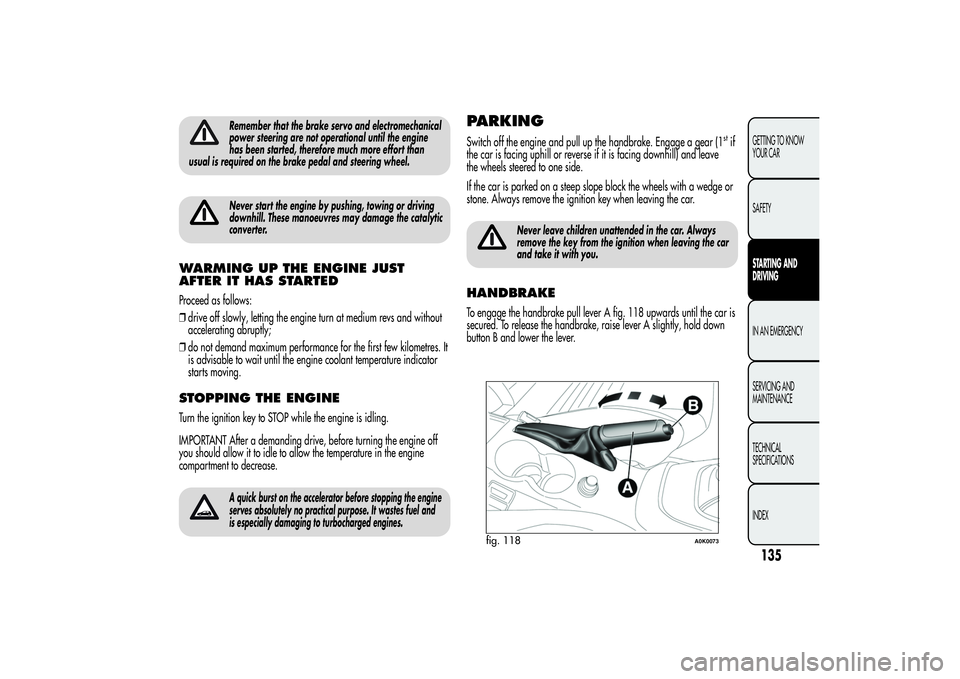
HANDBRAKETo engage the handbrake pull lever A fig. 118 upwards until the car is
secured. To release the handbrake, raise lever A slightly, hold down
button B and lower the lever.
fig. 118
A0K0073
135GETTING TO KNOW
YOUR CAR
SAFETYSTARTING AND
DRIVINGIN AN EMERGENCY
SERVICING AND
MAINTENANCE
TECHNICAL
SPECIFICATIONS
INDEX
Page 216 of 292
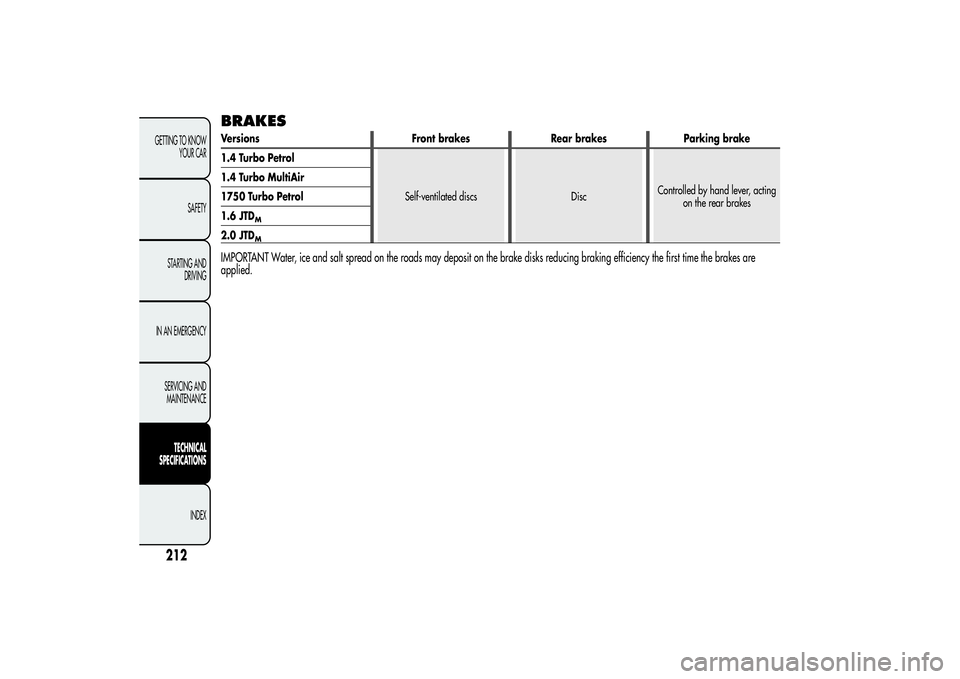
BRAKESVersions Front brakes Rear brakes Parking brake
1.4 Turbo Petrol
Self-ventilated discs DiscControlled by hand lever, acting
on the rear brakes 1.4 Turbo MultiAir
1750 Turbo Petrol
1.6 JTD
M
2.0 JTD
M
IMPORTANT Water, ice and salt spread on the roads may deposit on the brake disks reducing braking efficiency the first time the brakes are
applied.
212GETTING TO KNOW
YOUR CAR
SAFETY
STARTING AND
DRIVING
IN AN EMERGENCY
SERVICING AND
MAINTENANCE
TECHNICAL
SPECIFICATIONS
INDEX
Page 288 of 292
– Front headrests ................................ 44
– Rear head restraints......................... 45
Hill Holder system ................................ 97Identification data
– bodywork paint plate....................... 203
– Chassis marking .............................. 203
– engine marking ............................... 203
– identification data plate ................... 202
Ignition device ..................................... 40
– Steering lock ................................... 40
Installation of electrical/electronic
devices .............................................. 108
Installing a Universal Isofix child seat ..... 127
Interior fittings ...................................... 76
Interiors (cleaning)................................ 200Jack................................................... 144Light clusters
– front light clusters
(changing a bulb)............................ 157
– rear light clusters
(changing a bulb)............................ 159
Lubricants (features).............................. 227
Luggage compartment .......................... 88
– Bag hooks ...................................... 92
– Closing the luggage compartment..... 89– Emergency luggage compartment
opening .......................................... 89
– Extending the luggage
compartment................................... 89
– Luggage compartment
initialisation .................................... 89
– Luggage retaining net ...................... 92
– Opening the luggage
compartment................................... 88
– Securing your load .......................... 92
Luggage compartment roof light
– bulb replacement............................. 163
M
ain beam headlights ....................... 64
– bulb replacement............................. 157
Maintenance and care
– heavy-duty use of the car ................. 184
– periodic checks ............................... 184
– scheduled servicing ......................... 177
– scheduled servicing plan .................. 178
Manual climate control ......................... 51
Menu options ....................................... 22
MSR system ......................................... 98
Multifunction display ............................ 18
N
umber plate lights
– bulb replacement............................. 161
Parking ............................................. 135– Handbrake ..................................... 135
Parking lights ....................................... 63
Parking sensors .................................... 109
Performance ........................................ 221
Plugs (type) .......................................... 206
Pollen filter........................................... 192
Power socket ........................................ 79
Preparation for "Isofix" child seat .......... 126
Preparation to install a portable
navigation system .............................. 108
Pretensioners........................................ 118
– Load limiters ................................... 118
Protecting the environment .................... 114
– Particulate filter (DPF)....................... 114
RAB system (Ready Alert Brakes) ......... 99
Radio transmitters and mobile phones.... 109
Rain sensor .......................................... 66
Raising the car ..................................... 174
Rear armrest ........................................ 78
Rear fog lights...................................... 73
Rear fog lights/reversing lights .............. 160
Rear roof light
– bulb replacement............................. 162
Rear view mirrors ................................. 46
– Door mirrors ................................... 47
– Internal mirror ................................. 46
284GETTING TO KNOW
YOUR CAR
SAFETY
STARTING AND
DRIVING
IN AN EMERGENCY
SERVICING AND
MAINTENANCE
TECHNICAL
SPECIFICATIONS
INDEX