Media Alfa Romeo Stelvio 2019 User Guide
[x] Cancel search | Manufacturer: ALFA ROMEO, Model Year: 2019, Model line: Stelvio, Model: Alfa Romeo Stelvio 2019Pages: 244, PDF Size: 4.95 MB
Page 55 of 244
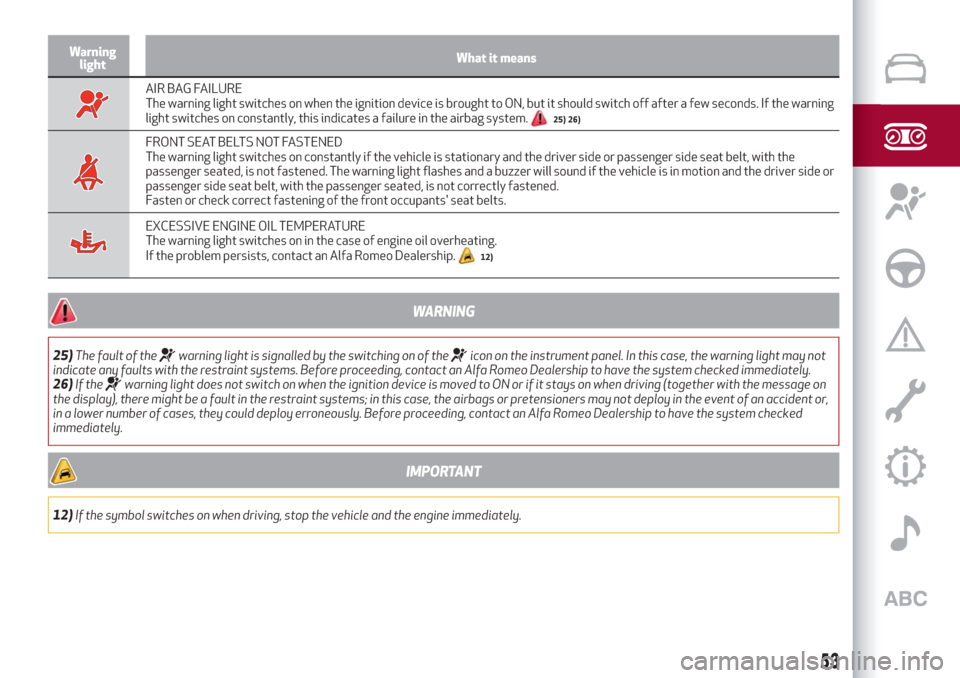
Warning
lightWhat it means
AIR BAG FAILURE
The warning light switches on when the ignition device is brought to ON, but it should switch off after a few seconds. If the warning
light switches on constantly, this indicates a failure in the airbag system.
25) 26)
FRONT SEAT BELTS NOT FASTENED
The warning light switches on constantly if the vehicle is stationary and the driver side or passenger side seat belt, with the
passenger seated, is not fastened. The warning light flashes and a buzzer will sound if the vehicle is in motion and the driver side or
passenger side seat belt, with the passenger seated, is not correctly fastened.
Fasten or check correct fastening of the front occupants' seat belts.
EXCESSIVE ENGINE OIL TEMPERATURE
The warning light switches on in the case of engine oil overheating.
If the problem persists, contact an Alfa Romeo Dealership.
12)
WARNING
25)The fault of thewarning light is signalled by the switching on of theicon on the instrument panel. In this case, the warning light may not
indicate any faults with the restraint systems. Before proceeding, contact an Alfa Romeo Dealership to have the system checked immediately.
26)If the
warning light does not switch on when the ignition device is moved to ON or if it stays on when driving (together with the message on
the display), there might be a fault in the restraint systems; in this case, the airbags or pretensioners may not deploy in the event of an accident or,
in a lower number of cases, they could deploy erroneously. Before proceeding, contact an Alfa Romeo Dealership to have the system checked
immediately.
IMPORTANT
12)If the symbol switches on when driving, stop the vehicle and the engine immediately.
53
Page 56 of 244
Amber warning lights
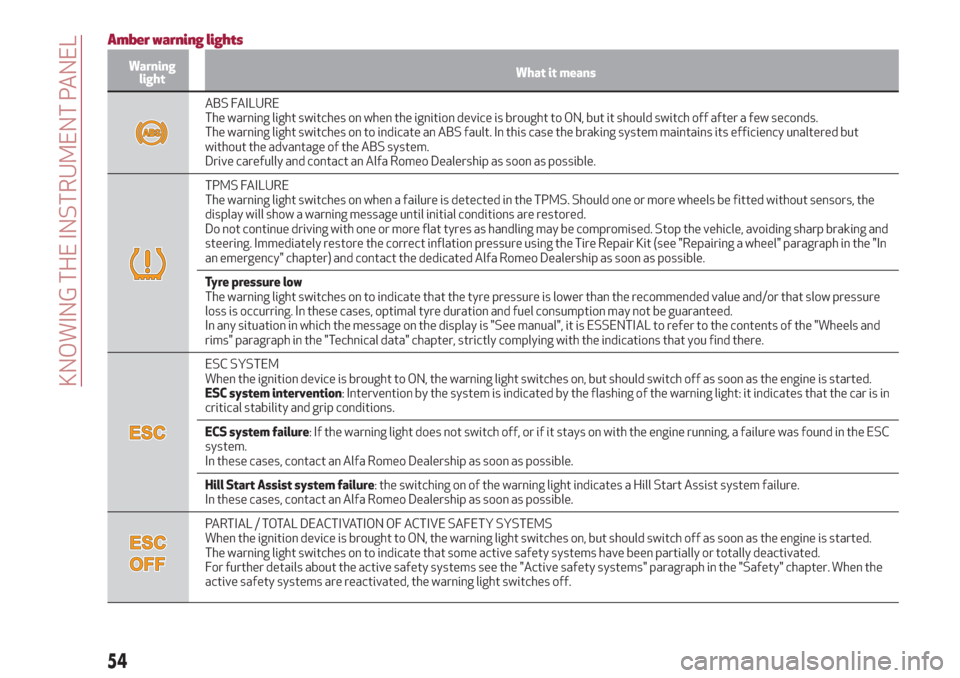
Warning
lightWhat it means
ABS FAILURE
The warning light switches on when the ignition device is brought to ON, but it should switch off after a few seconds.
The warning light switches on to indicate an ABS fault. In this case the braking system maintains its efficiency unaltered but
without the advantage of the ABS system.
Drive carefully and contact an Alfa Romeo Dealership as soon as possible.
TPMS FAILURE
The warning light switches on when a failure is detected in the TPMS. Should one or more wheels be fitted without sensors, the
display will show a warning message until initial conditions are restored.
Do not continue driving with one or more flat tyres as handling may be compromised. Stop the vehicle, avoiding sharp braking and
steering. Immediately restore the correct inflation pressure using the Tire Repair Kit (see "Repairing a wheel" paragraph in the "In
an emergency" chapter) and contact the dedicated Alfa Romeo Dealership as soon as possible.
Tyre pressure low
The warning light switches on to indicate that the tyre pressure is lower than the recommended value and/or that slow pressure
loss is occurring. In these cases, optimal tyre duration and fuel consumption may not be guaranteed.
In any situation in which the message on the display is "See manual", it is ESSENTIAL to refer to the contents of the "Wheels and
rims" paragraph in the "Technical data" chapter, strictly complying with the indications that you find there.
ESC SYSTEM
When the ignition device is brought to ON, the warning light switches on, but should switch off as soon as the engine is started.
ESC system intervention: Intervention by the system is indicated by the flashing of the warning light: it indicates that the car is in
critical stability and grip conditions.
ECS system failure: If the warning light does not switch off, or if it stays on with the engine running, a failure was found in the ESC
system.
In these cases, contact an Alfa Romeo Dealership as soon as possible.
Hill Start Assist system failure: the switching on of the warning light indicates a Hill Start Assist system failure.
In these cases, contact an Alfa Romeo Dealership as soon as possible.
PARTIAL / TOTAL DEACTIVATION OF ACTIVE SAFETY SYSTEMS
When the ignition device is brought to ON, the warning light switches on, but should switch off as soon as the engine is started.
The warning light switches on to indicate that some active safety systems have been partially or totally deactivated.
For further details about the active safety systems see the "Active safety systems" paragraph in the "Safety" chapter. When the
active safety systems are reactivated, the warning light switches off.
54
KNOWING THE INSTRUMENT PANEL
Page 60 of 244
SYMBOLS ON THE DISPLAY
Red symbols
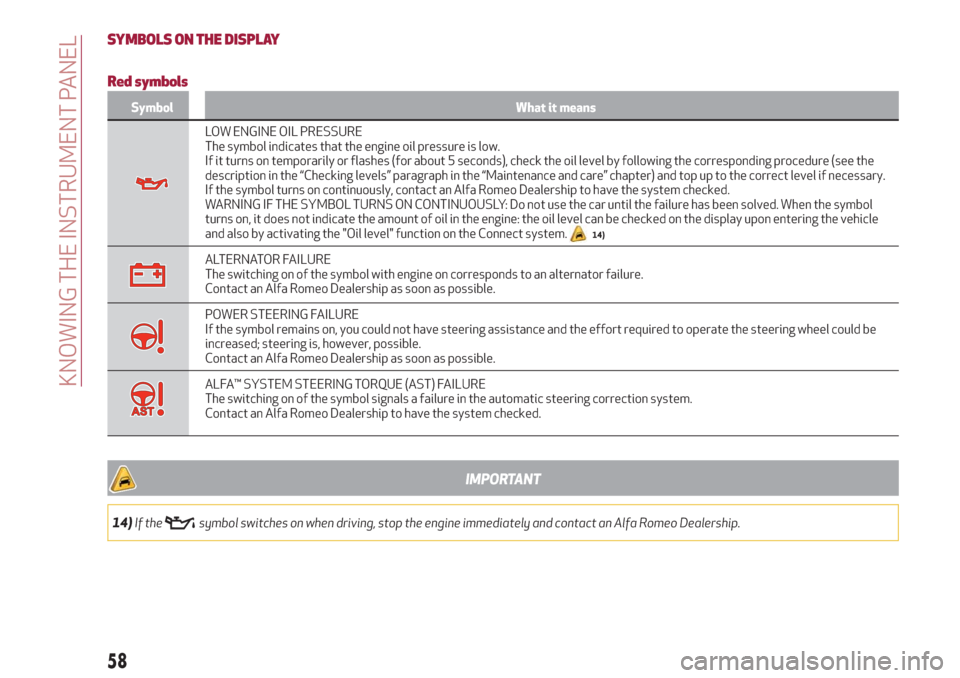
Symbol What it means
LOW ENGINE OIL PRESSURE
The symbol indicates that the engine oil pressure is low.
If it turns on temporarily or flashes (for about 5 seconds), check the oil level by following the corresponding procedure (see the
description in the “Checking levels” paragraph in the “Maintenance and care” chapter) and top up to the correct level if necessary.
If the symbol turns on continuously, contact an Alfa Romeo Dealership to have the system checked.
WARNING IF THE SYMBOL TURNS ON CONTINUOUSLY: Do not use the car until the failure has been solved. When the symbol
turns on, it does not indicate the amount of oil in the engine: the oil level can be checked on the display upon entering the vehicle
and also by activating the "Oil level" function on the Connect system.
14)
ALTERNATOR FAILURE
The switching on of the symbol with engine on corresponds to an alternator failure.
Contact an Alfa Romeo Dealership as soon as possible.
POWER STEERING FAILURE
If the symbol remains on, you could not have steering assistance and the effort required to operate the steering wheel could be
increased; steering is, however, possible.
Contact an Alfa Romeo Dealership as soon as possible.
ALFA™ SYSTEM STEERING TORQUE (AST) FAILURE
The switching on of the symbol signals a failure in the automatic steering correction system.
Contact an Alfa Romeo Dealership to have the system checked.
IMPORTANT
14)If thesymbol switches on when driving, stop the engine immediately and contact an Alfa Romeo Dealership.
58
KNOWING THE INSTRUMENT PANEL
Page 65 of 244
Symbol What it means
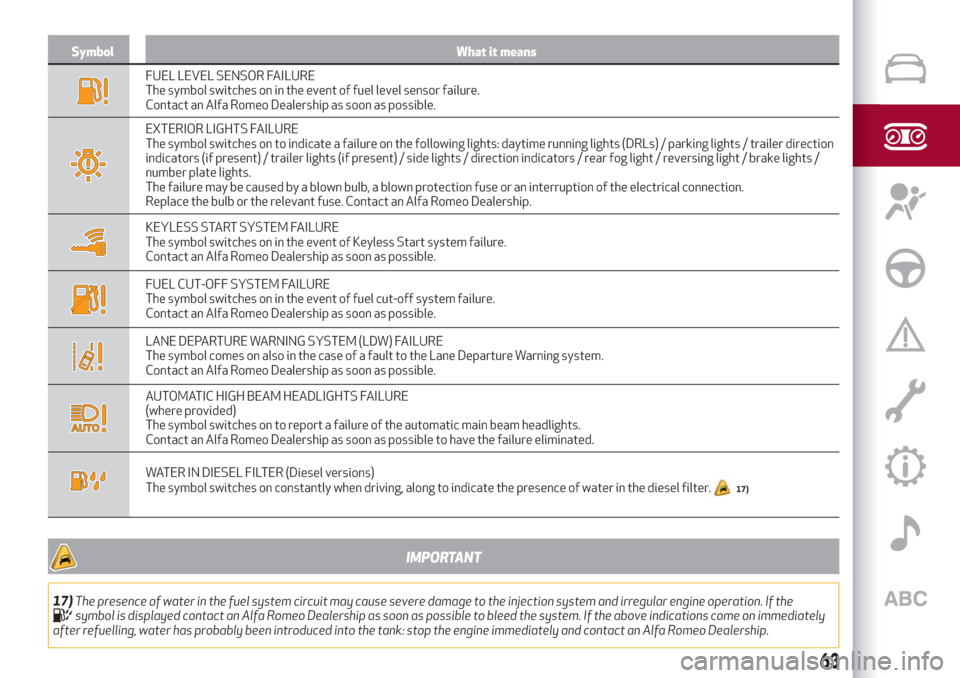
FUEL LEVEL SENSOR FAILURE
The symbol switches on in the event of fuel level sensor failure.
Contact an Alfa Romeo Dealership as soon as possible.
EXTERIOR LIGHTS FAILURE
The symbol switches on to indicate a failure on the following lights: daytime running lights (DRLs) / parking lights / trailer direction
indicators (if present) / trailer lights (if present) / side lights / direction indicators / rear fog light / reversing light / brake lights /
number plate lights.
The failure may be caused by a blown bulb, a blown protection fuse or an interruption of the electrical connection.
Replace the bulb or the relevant fuse. Contact an Alfa Romeo Dealership.
KEYLESS START SYSTEM FAILURE
The symbol switches on in the event of Keyless Start system failure.
Contact an Alfa Romeo Dealership as soon as possible.
FUEL CUT-OFF SYSTEM FAILURE
The symbol switches on in the event of fuel cut-off system failure.
Contact an Alfa Romeo Dealership as soon as possible.
LANE DEPARTURE WARNING SYSTEM (LDW) FAILURE
The symbol comes on also in the case of a fault to the Lane Departure Warning system.
Contact an Alfa Romeo Dealership as soon as possible.
AUTOMATIC HIGH BEAM HEADLIGHTS FAILURE
(where provided)
The symbol switches on to report a failure of the automatic main beam headlights.
Contact an Alfa Romeo Dealership as soon as possible to have the failure eliminated.
WATER IN DIESEL FILTER (Diesel versions)
The symbol switches on constantly when driving, along to indicate the presence of water in the diesel filter.17)
IMPORTANT
17)The presence of water in the fuel system circuit may cause severe damage to the injection system and irregular engine operation. If thesymbol is displayed contact an Alfa Romeo Dealership as soon as possible to bleed the system. If the above indications come on immediately
after refuelling, water has probably been introduced into the tank: stop the engine immediately and contact an Alfa Romeo Dealership.
63
Page 110 of 244
90)Do not affix rigid objects to the garment
hooks or support handles.
91)Do not rest your head, arms or elbows on
the door, windows or the area in which the
Window bag is located to avoid possible
injury during airbag inflation.
92)Never lean your head, arms or elbows
out of the window.
93)If, when the ignition device is turned to
ON, the
warning light does not switch on
or stays on whilst driving, a fault may have
occurred in the restraint systems. In this
case the airbags or pretensioners may not
be deployed in an impact or, in a lower
number of cases, they may be deployed
accidentally. Before continuing, contact an
Alfa Romeo Dealership immediately to have
the system checked.
94)In case of a LED
OFFfailure (located
on the front courtesy light), thewarning
light appears on the instrument panel.
95)On cars with side bags, do not cover the
front seat backrests with extra covers.
96)Do not travel carrying objects in your
lap, in front of your chest or between your
lips (pipe, pencils, etc.): they could cause
severe injury if the airbag is deployed.
97)If the car has been subject to theft,
attempted theft, vandalism, or flooding,
have the airbag system inspected at an Alfa
Romeo Dealership.
98)Malfunction of the airbag failure
warning light is indicated by the activation
of an airbag failure icon and a dedicated
message on the instrument panel display.
The pyrotechnic charges are not disabled.
Before continuing, contact an Alfa Romeo
Dealership immediately to have the system
checked.99)The airbag deployment threshold is
higher than that of the pretensioners. For
collisions in the range between the two
thresholds, it is normal for only the
pretensioners to be activated.
100)The airbag does not replace seat belts
but increases their efficiency. Because front
airbags are not deployed for low-speed
crashes, side collisions, rear-end shunts or
rollovers, occupants are protected, in
addition to any side bags, only by their seat
belts, which must therefore always be
fastened.
108
SAFETY
Page 117 of 244
IMPORTANT DO NOT accelerate while
shifting from position P (or N) to another
position.
IMPORTANT After selecting a gear, wait
a few seconds before accelerating. This
precaution is particularly important with
a cold engine.
AutoStick - Manual (sequential)
shifting mode
In the case of frequent gearshifting (e.g.
for sport driving, when the vehicle is
driven with a heavy load, on slopes, with
strong headwind or when towing heavy
trailers), it is recommended to use the
Autostick (sequential shifting) mode to
select and keep a lower fixed ratio.
In these conditions, the use of a lower
gear improves vehicle performance,
preventing overheating.
It is possible to shift from D mode (Drive)
to sequential mode regardless of vehicle
speed.
Activation
Starting from D (Drive) mode, to activate
the sequential drive mode, move the
lever to the left (– and + indication of the
trim). The gear engaged will be shown on
the display.
Gearshifting is made by moving the gear
lever forwards, towards symbol – or
backwards, towards symbol +.Steering wheel stalks
(where provided)
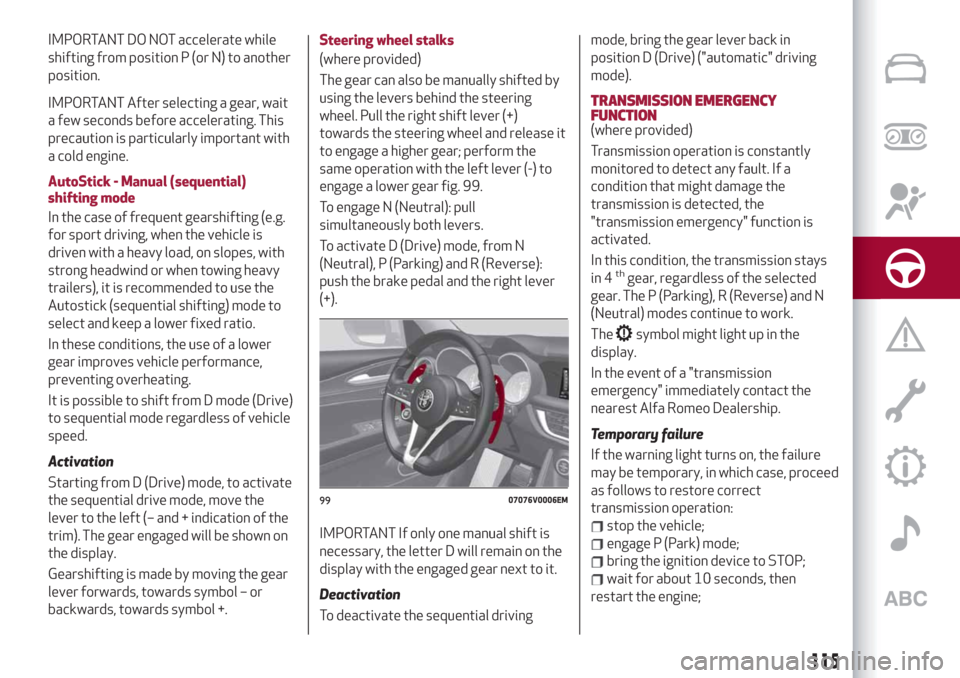
The gear can also be manually shifted by
using the levers behind the steering
wheel. Pull the right shift lever (+)
towards the steering wheel and release it
to engage a higher gear; perform the
same operation with the left lever (-) to
engage a lower gear fig. 99.
To engage N (Neutral): pull
simultaneously both levers.
To activate D (Drive) mode, from N
(Neutral), P (Parking) and R (Reverse):
push the brake pedal and the right lever
(+).
IMPORTANT If only one manual shift is
necessary, the letter D will remain on the
display with the engaged gear next to it.
Deactivation
To deactivate the sequential drivingmode, bring the gear lever back in
position D (Drive) ("automatic" driving
mode).
TRANSMISSION EMERGENCY
FUNCTION
(where provided)
Transmission operation is constantly
monitored to detect any fault. If a
condition that might damage the
transmission is detected, the
"transmission emergency" function is
activated.
In this condition, the transmission stays
in 4
thgear, regardless of the selected
gear. The P (Parking), R (Reverse) and N
(Neutral) modes continue to work.
The
symbol might light up in the
display.
In the event of a "transmission
emergency" immediately contact the
nearest Alfa Romeo Dealership.
Temporary failure
If the warning light turns on, the failure
may be temporary, in which case, proceed
as follows to restore correct
transmission operation:
stop the vehicle;
engage P (Park) mode;
bring the ignition device to STOP;
wait for about 10 seconds, then
restart the engine;
9907076V0006EM
115
Page 126 of 244
of the vehicle. Failure to comply with
these precautions may cause serious
accidents and fatal injuries.
SETTING THE DISTANCE BETWEEN
VEHICLES
The distance between your vehicle and
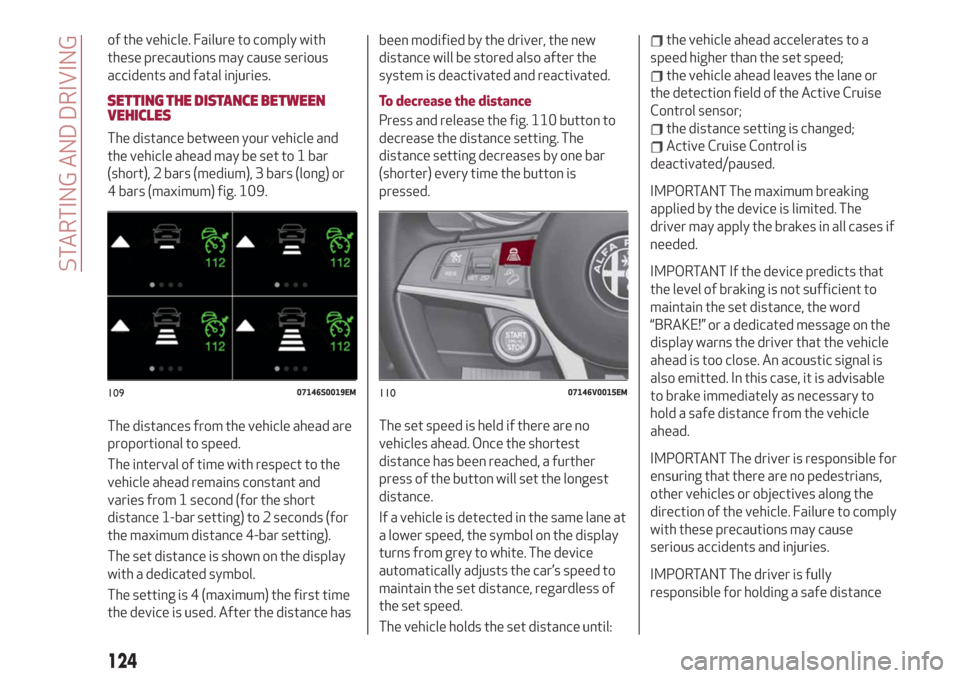
the vehicle ahead may be set to 1 bar
(short), 2 bars (medium), 3 bars (long) or
4 bars (maximum) fig. 109.
The distances from the vehicle ahead are
proportional to speed.
The interval of time with respect to the
vehicle ahead remains constant and
varies from 1 second (for the short
distance 1-bar setting) to 2 seconds (for
the maximum distance 4-bar setting).
The set distance is shown on the display
with a dedicated symbol.
The setting is 4 (maximum) the first time
the device is used. After the distance hasbeen modified by the driver, the new
distance will be stored also after the
system is deactivated and reactivated.
To decrease the distance
Press and release the fig. 110 button to
decrease the distance setting. The
distance setting decreases by one bar
(shorter) every time the button is
pressed.
The set speed is held if there are no
vehicles ahead. Once the shortest
distance has been reached, a further
press of the button will set the longest
distance.
If a vehicle is detected in the same lane at
a lower speed, the symbol on the display
turns from grey to white. The device
automatically adjusts the car’s speed to
maintain the set distance, regardless of
the set speed.
The vehicle holds the set distance until:
the vehicle ahead accelerates to a
speed higher than the set speed;
the vehicle ahead leaves the lane or
the detection field of the Active Cruise
Control sensor;
the distance setting is changed;
Active Cruise Control is
deactivated/paused.
IMPORTANT The maximum breaking
applied by the device is limited. The
driver may apply the brakes in all cases if
needed.
IMPORTANT If the device predicts that
the level of braking is not sufficient to
maintain the set distance, the word
“BRAKE!” or a dedicated message on the
display warns the driver that the vehicle
ahead is too close. An acoustic signal is
also emitted. In this case, it is advisable
to brake immediately as necessary to
hold a safe distance from the vehicle
ahead.
IMPORTANT The driver is responsible for
ensuring that there are no pedestrians,
other vehicles or objectives along the
direction of the vehicle. Failure to comply
with these precautions may cause
serious accidents and injuries.
IMPORTANT The driver is fully
responsible for holding a safe distance
10907146S0019EM11007146V0015EM
124
STARTING AND DRIVING
Page 135 of 244
IMPORTANT
DO NOT EXCEED THE MAXIMUM
LEVEL: this could cause damage to the
tank. AdBlue® freezes under 12.2°F
(–11°C). Although the system is
designed to operate below the freezing
point of AdBlue®, it is advisable not to
fill the tank beyond the maximum level
because if the AdBlue® freezes the
system can be damaged. Follow the
instructions in the “Topping up AdBlue®
diesel emissions additive” paragraph in
this chapter.
If AdBlue® is spilled on painted
surfaces or aluminium, immediately
clean the area with water and use
absorbent material to collect the fluid
that has been spilled on the ground.
Do not try to start the engine if
AdBlue® was accidentally added to the
Diesel fuel tank, this can result in
serious engine damage, contact an Alfa
Romeo Dealership.
Do not add additives or other fluids
to AdBlue®, doing so could damage the
system.
The use of non-conforming or
degraded AdBlue® may lead to
indications appearing on the
instrument panel display (see “Warning
lights and messages" paragraph in the
“Knowing the instrument panel”
chapter).
Never pour AdBlue® into another
container: it could be contaminated.
In case of damage to the sewage
system of exhaust gas resulting from
the use of additives / tap water, the
introduction of diesel fuel, or at least
by not fulfilling the requirements, the
warranty expires.
If the AdBlue® runs out, see “Warning
lights and messages" paragraph in the
“Knowing the instrument panel”
chapter to continue using the car
normally.
The AdBlue® level is not updated if
the car is parked on a sloping road.
Fuels - identification of vehicle
compatibility. Graphic symbol for
consumer information in accordance
with EN16942
The symbols, shown below, make it easier
to recognise the correct fuel type to use
with your car.
Before refuelling, check the symbols
(where provided) inside the fuel filler flap
and compare them with the symbols
shown on the fuel pump (where provided).PETROL ENGINES
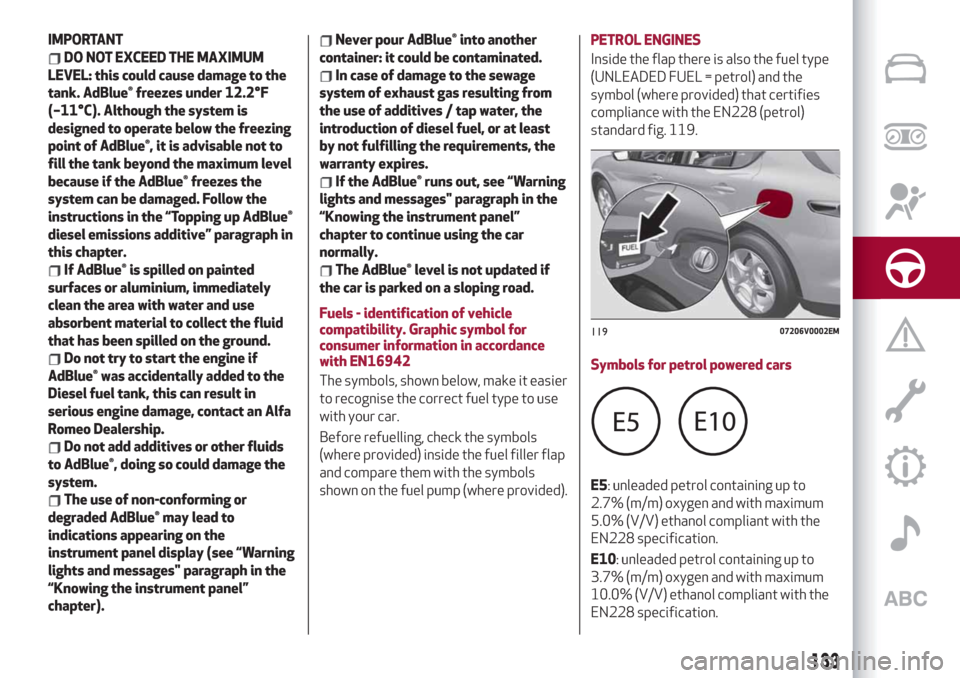
Inside the flap there is also the fuel type
(UNLEADED FUEL = petrol) and the
symbol (where provided) that certifies
compliance with the EN228 (petrol)
standard fig. 119.
Symbols for petrol powered cars
E5: unleaded petrol containing up to
2.7% (m/m) oxygen and with maximum
5.0% (V/V) ethanol compliant with the
EN228 specification.
E10: unleaded petrol containing up to
3.7% (m/m) oxygen and with maximum
10.0% (V/V) ethanol compliant with the
EN228 specification.
11907206V0002EM
133
Page 138 of 244
AdBlue® (UREA) ADDITIVE FOR
DIESEL EMISSIONS
(2.2 JTD versions only)
The car is equipped with an UREA
injection system and Selective Catalytic
Reduction to meet emission standards.
These two systems ensure compliance
with the diesel emissions requirements;
at the same time, they ensure
fuel-efficiency, handling, torque and
power. For messages and system
warnings, refer to the "Warning lights and
messages" paragraph in the "Knowing the
instrument panel" chapter.
AdBlue® (UREA) is considered a very
stable product with a long shelf life.
Stored at temperatures LOWER than
89.6° F (32 °C), it has a shelf life of at
least one year.
For more information on the AdBlue®
liquid type, see the “Fluids and lubricants”
paragraph in the “Technical
specifications” chapter.
The car is provided with an automatic
AdBlue® heating system when the engine
starts allowing the system to work
correctly at temperatures lower
than -11 °C.
IMPORTANT AdBlue® freezes at
temperatures lower than 12.2 °F (-11 °C).
SUGGESTIONS FOR DRIVING
SAVING FUEL
Below are some suggestions which may
help you save fuel and thus lower the
amount of harmful emissions released
into the atmosphere.
Vehicle maintenance
Checks and operations should be carried
out in accordance with the "Scheduled
Servicing Plan" (see chapter
"Maintenance and care").
Tyres
Check the tyre pressures at least once
every four weeks: if the pressure is too
low, consumption levels increase as
resistance to rolling is higher.
Unnecessary loads
Do not travel with an overloaded boot.
The weight of the vehicle and its
arrangement greatly affect fuel
consumption and stability.
Electric devices
Use electrical devices only for the
amount of time needed. The heated rear
window, additional headlights, screen
wipers and heater fan require a
considerable amount of energy;
increasing the current uptake increases
fuel consumption (by up to +25% in an
urban cycle).Climate control system
Using the climate control system will
increase consumption: use standard
ventilation when the temperature
outside permits.
Devices for aerodynamic control
The use of non-certified devices for
aerodynamic control may adversely
affect air drag and consumption levels.
DRIVING STYLE
Starting
Do not warm up the engine at low or high
revs when the vehicle is stationary; this
causes the engine to warm up more
slowly, thereby increasing fuel
consumption and emissions. It is
therefore advisable to move off
immediately, slowly, avoiding high
speeds: in this way the engine will warm
up more quickly.
Unnecessary actions
Avoid revving up when starting at traffic
lights or before stopping the engine. The
latter action, as well as double-
declutching, is unnecessary and causes
increased fuel consumption and
pollution.
Gear selection
Use a high gear when traffic and road
conditions allow it. Using a low gear for
faster acceleration will increase fuel
136
STARTING AND DRIVING
Page 167 of 244
161)Remove any metal objects (e.g. rings,
watches, bracelets), that might cause an
accidental electrical contact and cause
serious injury.
162)The batteries contain acid that can
burn skin or eyes. Batteries produce
hydrogen, which is easily flammable and
explosive. Thus keep away flames or devices
which may cause sparks.
IMPORTANT
61)Never use a fast battery-charger to
start the engine as this could damage the
electronic systems of your vehicle,
particularly the ignition and engine fuel
supply control units.
62)Do not connect the cable to the negative
terminal (–) of the flat battery. The following
spark could lead to battery explosion and
cause serious harm. Only use the specific
earth point; do not use any other exposed
metallic part.
FUEL CUT-OFFSYSTEM
DESCRIPTION
Depending on the type and violence of
the impact, the control unit of the ORC
occupant protection systems determines
whether to activate the airbags and the
front seat belt pretensioners and
whether to immediately interrupt the
current from the batteries to the supply
pumps and to the devices that operate
the engine. The power from the battery is
interrupted by "skipping" the pyrotechnic
fuse placed on the fusebox next to the
positive pole of the battery.
When the fuse is "skipped", only some
services, necessary for the safety of the
car (eg: door locks, anti-theft device, etc.),
remain powered.
IMPORTANT After the impact, carefully
check the car for fuel leaks, for instance
in the engine compartment, under the car
or near the tank area.
IMPORTANT Contact an Alfa Romeo
Dealership to have the system checked.
AUTOMATIC TRANSMISSION
GEAR LEVER UNLOCKING
To release the automatic transmission
lever, contact an Alfa Romeo Dealership.
165