fold seats AUDI A5 CABRIOLET 2010 Owners Manual
[x] Cancel search | Manufacturer: AUDI, Model Year: 2010, Model line: A5 CABRIOLET, Model: AUDI A5 CABRIOLET 2010Pages: 364, PDF Size: 86.51 MB
Page 82 of 364

Seats and storage Folding down the front seat backs
- Lift the latch=> page 79, fig. 8 2.
- Tilt the seat bac k forward.
Moving the front seats forward
- Press a nd ho ld the switch @ until th e seat has r eached t he
desir ed p osition .
Moving front seats back
-Press and ho ld t he switc h@ until th e seat has reached t he
des ired position. The seat stops a utomatically when it has
reached its starting position again .
To make it easier to enter and leave the rear seat , t h e seatbacks of the
front sea ts ca n be folded forward and the he ad restraints are a uto
matically lowered . At the same time, the front seats can be moved
forward and back.
W hen the front seats a re moved forward, their or ig inal position is
sto red . When it is moved back, the seat automat ically stops in this
posit io n. T o move the seat even further b ack, you have to release the
switch @ and reactivate it.
T he head rest raints from the front sea ts, depending on t he se at
height that has been set, a re a utomatically retracted when t he seat
backs are folded down. They return to their or iginal position again
when the sea tbacks for the fron t seats a re ra ised .
(I) Tips
With the driver 's o r passenger's door closed, the corresponding
switch to move the seat is inoperative. •
Seat memory
Applies to veh icles : w it h seat memo ry
Memory for driver's seat
The seat adjustment settings for t wo drivers can be
stored using the memory buttons in the driv er's door .
Fig. 83 Driver 's doo r:
Seat memory
In additio n to the setting for the driver's seat, the exterior rear v iew
m irror setting ca n be stored and reca lled throug h seat memory if the
veh icle is properly equipped.
Storing and recalling settings
With the he lp of the memory b uttons 1 a nd 2 ~ fig. 83 the settings
for two different drivers can be stored and recalled~
page 81.
The cur rent settings are also automatically stored on the remote
c o ntrol key being used when the vehicle is locke d. Whe n the vehicle is
unlocked, the settings stored on the remote contro l key being used
are autom atic ally re calle d.
Turning seat memory on and off
If the [ ON/OFF ] switc h is depressed , th e seat memo ry is inoperative.
The word
OFF in the [ ON/OFF] sw itch illuminates .
All the stored setti ngs are retained . We recommend using the
I O N/OFF ] switch and deact ivating the seat memory if the vehicle is .,
Page 84 of 364

Seats and storage
Head restraints
Applies to vehicles: with adjustable head restra ints
Adjusting the front head restraints
Head restraints that are adjusted according to body size,
along with the seat bealt, offer effective protection.
Fig. 84 Front seat:
Adjusting head
restraint electrically
-Push the switch up or down=> fig. 84 to adjust the height
of the head restraint.
- Adjust the headrests so the upper edge is as even as
possible with the top of your head=>
page 181, "Proper
adjustment of head restraints".
Refer to~ page 181, "Proper adjustment of head restraints" for
guidelines on how to adjust the height of the front head restraints to
suit the occupant's body size.
& WARNING
• Driving without head restraints or with head restraints that are
not properly adjusted increases the risk of serious or fatal neck
injury dramatically.
• Read and heed all WARNINGS~
page 181.
[I] Tips
Correctly adjusted head restraints and safety belts are an extremely
effective combination of safety features. •
Applies to vehicles: with front armrest
Front armrest
The center armrest can be adjusted to several levels.
Adjusting the center armrest
Fig. 85 Armrest
between the
driver· s/front
passenger 's seats.
- To adjust the angle, raise the armrest from the starting
position detent by detent => fig. 85.
- To bring the armrest back into the starting position, raise
it out of the top detent and fold it back down.
The armrest can slide forward and back. •
Page 86 of 364
Seats and storage
Increasing the size of the Luggage
compartment
The rear seat backrests can be folded forward either
separately or together.
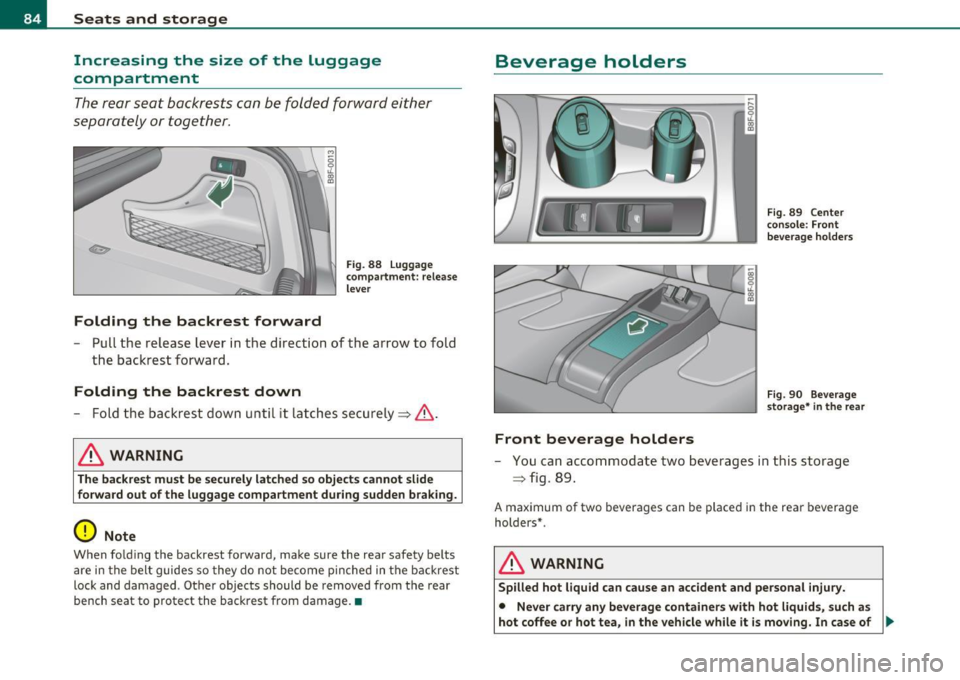
Folding the backrest forward
Fi g. 88 Lug gag e
compa rtment: releas e
l e ver
- Pull the release lever in the direction of the arrow to fold
the bac krest forward.
Folding the backrest down
- Fold the backrest down unti l it latches securely => & .
& WARNING
The backrest must be secure ly latched so obje ct s cannot slide
forward out o f the luggage compartment dur ing sudden braking.
0 Note
When fold ing t he backrest forward, make sure the rear safety be lts
are in the belt guides so they do not become pinched in the backrest
lock and damaged . Othe r objects should be removed from the rear
bench seat to protect the backrest from damage. •
Beverage holders
Front beverage holders
Fig. 8 9 Ce nter
c on sole: Front
b ev era g e ho lder s
Fi g. 90 Beve rag e
st or age* in the re ar
- You can accommodate two beverages in t his sto rage
=> fig. 89 .
A maximum of two beverages can be placed in the rear beverage
holders* .
& WARNING
Spilled hot liquid can c ause an accident and personal injury.
• Never carry any beverage container s with h ot liquid s, such a s
hot coffee or hot tea, in the vehicle while it i s moving. In case of .,_
Page 181 of 364

______________________________________________ D_ ri_v _ i_n _,,g ,c.._ S_a_ f_ e_ l..:: y __ _
& WARNING (continued)
to help reduce the risk of personal injury if the driver's airbag
inflates.
• Never hold the steering wheel at the 12 o'clock position or with
your hands at other positions inside the steering wheel rim or on
the steering wheel hub. Holding the steering wheel the wrong way can cause serious injuries to the hands, arms and head if the
driver's airbag deploys.
• Pointing the steering wheel toward your face decreases the
ability of the supplemental driver's airbag to protect you in a colli·
sion.
• Always sit in an upright position and never lean against or
place any part of your body too close to the area where the airbags
are located.
• Before driving, always adjust the front seats and head
restraints properly and make sure that all passengers are properly
restrained.
• Never adjust the seats while the vehicle is moving. Your seat
may move unexpectedly and you could lose control of the vehicle.
• Never drive with the backrest reclined or tilted far back! The
farther the backrests are tilted back, the greater the risk of injury due to incorrect positioning of the safety belt and improper
seating position.
• Children must always ride in child safety seats~
page 222.
Special precautions apply when installing a child safety seat on
the front passenger seat
~ page 200. •
Controls and equip
ment Safety first Vehicle operation
Proper seating position for the front
passenger
The
proper front passenger seating position is important
for safe, relaxed driving.
For your own safety and to reduce the risk of injury in the
event of an accident, we recommend that you adjust the seat
for the front passenger to the following position:
- Move the front passenger seat back as far as possible.
There must be a minimum of 10 inches (25 cm) between
the breastbone and the instrument panel=>& .
- Adjust the angle of the seatback so that it is in an upright
position and your back comes in full contact with it when
ever the vehicle is moving .
- Adjust the head restraint so that the upper edge is as even
with the top of your head as possible but not lower than
eye level and so that it is as close to the back of your head
as possible.
- Keep both feet flat on the floor in front of the front
passenger seat.
- Fasten and wear safety belts correctly =:>
page 194.
For detailed information on how to adjust the front passenger's seat,
see ~
page 77.
& WARNING
Front seat passengers who are unbelted, out of position or too
close to the airbag can be seriously injured or killed by the airbag
as it unfolds. To help reduce the risk of serious personal injury: .,
Vehicle care Do-it-yourself service Technical data
Page 182 of 364
• ....__D_ r_iv _i_ n_, g=-- S_ a _ f_e _,Ly _ ______________________________________________ _
& WARNING (continued)
• Passengers must always sit in an upright position and never
lean against or place any part of their body too close to the area
where the airbags are located.
• Passengers who are unbelted, out of position or too close to
the airbag can be seriously injured by an airbag as it unfolds with
great force in the blink of an eye.
• Always make sure that there are at least 10 inches (25 cm)
between the front passenger's breastbone and the instrument
panel.
• Each passenger must always sit on a seat of their own and
properly fasten and wear the safety belt belonging to that seat.
• Before driving, always adjust the front passenger seat and
head restraint properly. • Always keep your feet on the floor in front of the seat. Never
rest them on the seat, instrument panel, out of the window, etc.
The airbag system and safety belt will not be able to protect you properly and can even increase the risk of injury in a crash.
• Never drive with the backrest reclined or tilted far back! The
farther the backrests are tilted back, the greater the risk of injury due to incorrect positioning of the safety belt and improper
seating position.
• Children must always ride in child safety seats~
page 222.
Special precautions apply when installing a child safety seat on
the front passenger seat
~ page 200. •
Proper seating positions for passengers in
rear seats
Rear seat passengers must sit upright with both feet on
the floor consistent with their physical size and be prop
erly restrained whenever the vehicle is in use.
To reduce the risk of injury caused by an incorrect seating
position in the event of a sudden braking maneuver or an
accident, your passengers on the rear bench seat must
always observe the following:
- Make sure that the seatback is securely latched in the
upright position ~
page 84.
- Keep both feet flat in the footwell in front of the rear seat.
- Fasten and wear safety belts properly ~
page 194.
- Make sure that children are always properly restrained in a
child restraint that is appropriate for their size and age
~ page 222.
& WARNING
Passengers who are improperly seated on the rear seat can be seri
ously injured in a crash.
• Each passenger must always sit on a seat of their own and
properly fasten and wear the safety belt belonging to that seat.
• Safety belts only offer maximum protection when the seatback
is securely latched in the upright position and the safety belts are
properly positioned on the body. By not sitting upright, a rear seat
passenger increases the risk of personal injury from improperly
positioned safety belts! •
Page 211 of 364

situations. Be sure to read the important information about safety
and heed the WARNINGS in this chapter.
Deployment of the Advanced A irbag System and the activation of the
safety belt pretensioners depend on the deceleration measured by
the crash sensors and registered by the electron ic control unit. T he
amount of inflation of the front airbags can a lso be adapted to the
front seat position, depending on the distance between the respec
tive front seat and the steering wheel or instrument panel as regis
tered by sensors in the seats. Crash severity depends on speed and
deceleration as well as the mass and stiffness of the vehicle or object
involved in the crash .
On the passenger side, regardless of safety belt use, the air bag w ill
be turned off if the weight on the passenger seat is less than the
amount programm ed in the electronic control unit . The front airbag
on the passenger side will also be turned off if one of the chi ld safety
seats that has been certified under Federal Motor Vehicle Safety
Standard 208 has been recognized on the seat. The
PASSENGER AIR
BAG OFF
light comes on and stays on to tell you when the front
Advanced Airbag on the passenger side has been turned off
=> page 202, "Child rest raints on the front seat -some important
things to know".
& WARNING
To reduce the risk of injury when an airbag inflates, always wear
safety belts properly.
• If you are unrestrained, leaning forward, sitting sideways or
out of position in any way, your risk of injury is much higher .
• You will also receive serious injuries and could even be killed if
you are up against the airbag or too close to it when it inflates •
even with an Advanced Airbag
=> page 200. •
Safety first Vehicle OP-eration
Airbag system
More important things to know about front
airbags
Fig. 199 Inflated
front airbags
Safety belts are important to help keep front seat occupants in the
proper seated position so that airbags can unfold properly and
prov ide supplemental protection in a frontal collision.
Th e front airbags are designed to provide additiona l protection for
the chest and face of the driver and the front seat passenger when:
• safety belts are worn properly,
• the seats have been positioned so that the occupant is properly
seated as far as possible from the airbag ,
• and the head restraints have been properly adjusted .
Because airbags inflate in the blink of an eye with great force, things
you have on your lap o r have placed on the seat could become
dangerous projectiles, and be pushed into you if the airbag inflates.
When an airbag deploys, fine dust is released. This is normal and is
not caused by a fire in the vehicle. This dust is made up mostly of a
powder used to lubricate the airbags as they deploy .
It could irritate
skin.
It is important to remember that while the supplemental airbag
system is desig ned to reduce the likelihood of serious injur ies, other
injuries, for example swell ing, bruising and m inor abrasions, can also
happen when airbags inflate. Airbags do not protect the arms or the •
Vehicle care Do-it-yourselt service iTechnical data
Page 212 of 364
-L___:_A~ i r'....: b~ a ::::: gL:: s~y -=s ::..:t :.:e :..: m..:..:.. ______________________________________________ _
lower parts of the body. Front airbags only supplement the three
point s afety be lts i n some fro ntal c ollisions in which t he vehicle de ce l
eratio n is h igh enough to dep loy the a irbags.
Front airbags will not deploy:
• if the ignition is sw itched off when a cras h occu rs,
• in s ide collisions,
• in rea r-end collisions,
• in rollovers,
• when the cras h deceleration me asured by the ai rbag syste m is less
than t he m in imum threshold needed for airbag dep loyment as regis
t ere d by the e lectro nic cont rol unit.
The front passenger airbag will also not deploy:
• when the fron t pa sse nger sea t is not o ccupied,
• when the we ight on the front passenge r seat as sense d by the
Advanced Airbag Sys tem in dicates t hat the front airbag on the
passenger side has to be turned off by t he e lectron ic control un it (the
PASSENGER AIR BAG OFF light comes on and st ay s on).
& WARNING
Sitt ing in the wrong posit ion can increa se the risk of serious injury
in crashes .
• To reduce the risk of injury when the airbags inflate , the driver
and passengers must always sit in an upright position , must not
lean against or place any part of their body too close to the ar ea
where the airbags are located.
• Occupants who are unbelted, out of position or too close to the
airbag can be ser iously injured by an airbag as it unfolds with
great force in the blink of an eye=>
page 202.
& WARNING
A child in a rearward-facing ch ild safety seat installed on the front
pa ssenger seat will be seriou sly injured and can be killed if the
front airbag inflates -even with an Advanced Airbag System.
• The inflating airbag will hit the child safety seat or infant
carrier with great force and will smash the child safety seat and
child against the backrest, center armrest , door or roof.
• Always install rear-f acing child safety seats on the rear seat.
• If you must install a rearward facing child safety seat on the
front p assenger seat because of e xceptional circumstances and
the PASSENGER AIR BAG OFF light does not come on and stay on,
i mmediately install the rear-facing child safety seat in a rear
seating position and have the airbag system inspected by your
authorized Audi dealer.
& WARNING
Objects between you and the airb ag wilt increase the risk of injury
in a crash by interfering with the way the airbag unfolds or by
being pushed into you as the airbag inflates.
• N ever hold things in your hands or on your lap when the vehicle
is in use.
• Never tran sport items on or in the area of the front passenger
seat . Object s could move into the area of the front airbag s during
brak ing or other sudden maneuver and become dangerous projec
tiles that can cause serious personal injury if the airbags inflate.
• Never place or attach accessories or other objects (such as
cupholders , telephone bra ckets , large, heavy o r bulky objects) on
the doors, over or near the area marked "AIRBAG " on the steering
wheel, instrument panel , seat backrests or between those areas
and yourself . The se obj ect s could cause injury in a crash , especially
when the airbags inflate .
• Never recl ine the front passenger's seat to transport objects.
Items can also move into the area of the side airbag or the front ..,
Page 237 of 364

Child Safety ------------------------"'--l'ff'II
& WARNING (c on tinued )
• Always make sure the seat backrest to which the child re stra int
is installed is in an upright position and securely latched into place
and cannot fold forward . Otherwise , the seat back with the child
safety seat atta ched to it could fly forward in the e vent of an acci
dent or other emergency situation.
• Always read and heed all WARNINGS whenever u sing a child
restrained in a vehicle is being used~
page 222. Special precau
tions apply when installing a child safety seat on the front passenger seat~
page 202, "Child restra ints on the front seat -
s ome important things to know ".•
Deactivating the convertible locking
retractor
The convert ible locking retractor for child restraints will
be dea ctivat ed aut om at ic ally when the belt i s woun d all
th e way bac k in to t he retr actor .
- Press the re d but to n o n th e sa fety belt buckle. T he b elt
to ng ue wi ll pop out of th e buckle .
- Guide the safety belt all t he way back in to its stowed posi-
tion.
Always le t the safety bel t retract completely into i ts stowe d position .
Th e safety belt can now be used as an ord inary safe ty be lt withou t the
convertible locking ret ractor fo r ch ild rest raints .
If the convertib le locking retractor should be activated inadvertently,
t he s afety bel t m ust be unfastened and guide d com plete ly b ack i nto
its stowed position to deactivate this feature. If the convertible
lo ck ing r etr acto r is no t deact ivated, the sa fe ty belt w ill gradu ally
become t ighter and uncomfo rtable to wear .
Controls and equip
ment Safety first Vehicle operation
& WARNING
Improperly installed child safety seats increase the risk of serious
personal injury and death in a colli
sion.
• Never unfasten the safety belt to deactivate the convertible
locking retractor for child restraints while the vehicle i s moving.
You would not be restrained and could be seriously injured in an
accident.
• Always read and heed all WARNINGS whenever using a child
re strained in a vehicle i s being used~
page 222. Special precau
tions apply when installing a child safety seat on the front
pas senger seat~
page 202, "Child restraints on the front seat -
some important things to know ".•
LATCH Lower anchorages and
tethers for children
Child Restraint System anchors and how
are they related to child safety
To provide a simp le r and more practicable way to attac h the child
restra int on the ve hicle sea t, Fe d era l regu lations require spec ia l
lower anchorages in veh icles and devices on new child restra ints to
attach to t he vehicle anc ho rages.
Th e combin ation of the te ther anchorages and t he lower an chorages
is now generally called the
LATCH system for " Lower Anchorages and
T ether s fo r Chi ldren. "
Forward-fac ing ch ild restra ints manufactured after September 1,
1 999, are required by U .S . federa l reg ulations to comp ly with new
child head movement per formanc e requi reme nts . These new perfor
mance requirements ma ke a tether necessary on most new child
sea ts.
Vehicle care Do-it-yourself service Technical data
Page 272 of 364
-~_C_ le_ a_n_ i_ n_ g=- a_ n_d___. p_ ro_ t_e _c_ t_ i_o _n ___________________________________________ _
consider if children, animals or other factors might prove to be partic
ularly hard on the leather.
By contrast, leather types that are covered by a colored finish layer
are more durable. This has a positive effect on the leather's resistance
to wear and soiling in daily use . On the other hand, the typical charac
teristics of natural leather are barely or not apparent . However, this
does not mean that the leather itself is of inf erior quality.
Care and handling
Because of the exclusive nature of the types of leather that Audi uses
and the ir un iqu e properties (such as sensitivity to oils, grease, so iling,
etc.), you will need to be somewhat careful with these leathers, and
a certain type of care is required. For example, dark clothing mate
ria ls can disco lor leather seats (especially if such clothing is damp and
was not dyed correctly). Dust and dirt particles in pores, folds, and
seams can have an abrasive effect and can damage the leathe r
surface as well as weaken seams .
Th e leather should be cleaned regu larly as needed. After having been
used for a relatively long time, your leather seats will acquire a rich
aged finish. This is a characteristic of natural leather and a sign of
true quality.
In order to ma intain the value of this natural product over the life of
your vehicle, you should fo llow the recommendations below:
0 Note
• To keep your leather from bleaching out, do not allow it to be
exposed to bright sunlight for long periods of time . If you have to
leave the vehicle parked outside for long periods, cover the leather to
protect it from direct exposure to sunlight.
• Sharp objects on clothing, such as zippers, rivets or sharp pieces
on belts can leave pe rmanent scratches or scrape marks on the
surface of the leather.
W Tips
• After each time you clean the leathe r and at regular intervals, use
a leather preservative cream that contains UV-blockers and that
wor ks into the leather. This cream will nourish and moisturize the
leather, helping it to breathe and s tay supple . It also helps to build up
a protect ive coating on the surface.
• Clean the leather every 2 -3 months, and clean any areas that get
soiled.
• Remove fresh marks made by ballpoint pens, ink, lipstick , shoe
polish, etc. as soon as poss ible.
• Preserve the color of the leather as needed by using a special
colored leather care cream to touch up areas of uneven color .•
Ap plies to veh icles : with nat ural lea ther
Cleaning and caring for leather upholstery
and trim
Natural leather requires special care and attention.
Normal cleaning
-Clean soiled areas with a slightly moistened cotton or
woolen cloth.
More stubborn dirt
- More stubborn dirt can be removed using a cloth satu
rated with a mild soap solution (2 tablespoons mild liquid
soap).
- Never allow the soap solution to satu rate the leather, and
make certain that no water soaks into the seams .
- Wipe off the soap solution with a soft, dry cloth. .,_
Page 354 of 364

-Alphabetical inde x lffi'f ___,__ ______________ _
Emergency release
Selector lever ............ ... .. ..
154
Emergency starting .. ..... .......... 333
Emergency towing ..... ............. 336
Eme rgency unlocking
Ignition key .. .. .. .. ...... ........
39
Energy management ................ 247
Battery power ................ ... 249
Driver notification ............. ... 249
Engine
Compartment . ...... .... .... .. ..
281
Coolant ............ .... .. .... .. 286
Hood . ............. .... ...... .. 279
Starting ..................... ... 106
Starting with jumper cables ..... ... 333
Stopping . ...................... 107
Engine compartment
Safety instructions ............ ...
280
Working the engine compartment .. 280
Engine coolant system
Malfunction .......... ...... .. ....
29
Radiator fan ........ .... .. .. .. .. 289
Engine coolant temperature
Temperature gauge ............ .. .. 8
Engine cooling system ............ ...
286
Adding coolant ... ............... 288
Checking coo lant level . .. ....... .. 287
Checking the engine coolant level . .. 287
Engine data ...... .......... ...... .. 342
Engine hood
Closing .................. .... ...
280
How to release the hood .. ....... .. 279
Engine oil . ..... ....... ... .. .. .. ... 282
Add ing ....... ... .. .. .. .. ....... 285
Additives .. ..... ... .. .. ......... 285
Changing .. .... .. .... .. .. .. .. .. . 285
Check o il level ...... .... .. .. .. .. . 284
Consumption . .. .. .. .. .... .. ..... 284
Oil consumption .......... .. .. .. . 283
Oil grades .... ................ .. 282
Specification and viscosity ... ... .. . 282
Engine oil level ................... ... 35
Engine oil pressure
Malfunction ... ................. ..
30
Engine oil sensor defective ............ 35
Engine speed limitation ............... 35
Environment
Break-in period ............ ..... .
250
Catalytic converter ........ .. .. .. . 251
Disposing of your vehicle battery . .. .
294
Driving at high speeds ..... ...... . 253
Driving to minimize pollution and noise ..
252
Fuel ........................... 276
Fuel economy ................... 252
Leaks under your vehicle .......... . 280
Letting the vehicle stand and warm up ...
253
Proper disposal of d rained brake fluid 290
Proper disposal of drained engine coo lant
288
Proper disposal of d rained engine oil 285
Recycl ing used engine o il .. . .. .. .. . 285
Unleaded fuel ............ .. .... . 274
What should I do with an old battery?
294
Environmental note
Rear window defogger ........ .
92, 100
EPC
See Electronic power control . . . . . . . . 13
ESP
See Electronic stabilization program (ESP)
240
Event Data Recorder (EDR) 240
Exhaust ta il pipes
Cleaning ........... ...... .... ..
267
Expansion tank .. .. .. .. ............. 287
F
Fan .................. .. .... .... 91,98
Radiator . ........... ...... .... .. 289
Fastening
Booster seats ............ .... . ..
230
Convertible child safety seats ...... 228
Infant seats .. .. ................ . 227
Flat tire
Changing .......................
320
Floor mats ..... ...... .. . .. .. .. .. .. 183
Fog lights .................. ..... ... 63
Folding the rear seat backrests .. ...... . 84
Foot pedals . ........... ...... .... .. 182
For the sake of the environment
Gasoline fumes and the environment
276
Refueling ................ ... .. .. 276
Saving fuel by early upshifting ........ 9
Front airbags Description .. ...... .............
204
How they work ...... .. .... .. .. .. 209