ESP AUDI A8 2017 Owners Manual
[x] Cancel search | Manufacturer: AUDI, Model Year: 2017, Model line: A8, Model: AUDI A8 2017Pages: 354, PDF Size: 88.68 MB
Page 292 of 354
Wheel s
Occupant loading and distri
bution for vehicle normal load
for various designated seat ing
capacit ies
Refer to the tire inflation pres
sure label ¢
page 293, fig . 268
for the number of seating posi
tions . Refer to the table¢
table
on page 295
for the number of
people that correspond to the ve
hicle normal load .
New tires or wheels
Audi recommends having all work
on tires or wheels performed by
an authorized Audi dealer or au
thorized Audi Service Facility .
These facilities have the proper knowledge and are equipped with
the required tools and replace
ment parts.
.,. New tires do not yet have the
optimum gripping properties. Drive carefully and at moderate
speeds for the first 350 miles (500 km) with new tires .
.,. Use tires of the same construc
tion, size (rolling circumference)
and as close to the same tread pattern as poss ible on all four
wheels .
290
.,.Do not replace tires individually .
At least replace both tires on the
same axle at the same time.
.,. Audi recommends that you use
Audi Original Tires. If you would
like to use different tires, please
note that the tires may perform
differently even if they are the
same size ¢
,&..
.,. If you would like to equip your
vehicle with a tire/rim combina
tion that is different from what
was installed at the factory, con
sult with an authorized Audi
dealer or authorized Audi Service Facility before making a pur
chase ¢&, .
The spare tire* is different from
the regular tires installed on the
vehicle -for example, if winter
tires or wide tires are installed -
so only use the spare tire* tempo
rarily in case of emergency and
drive carefully while it is in use. It
should be replaced with a regular
tire as soon as possible.
All four wheels must be equipped
with tires that are the same brand and have the same construction
and tread pattern so that the
drive system is not damaged by
different tire speeds. For this rea -
son, in case of emergency, only .,.
Page 295 of 354
This can especially have a nega
tive effect on handling, on the
risk aquaplaning when driving
through water, when driving
through curves and when brak ing, which increases the risk of
an accident.
Tire pressure
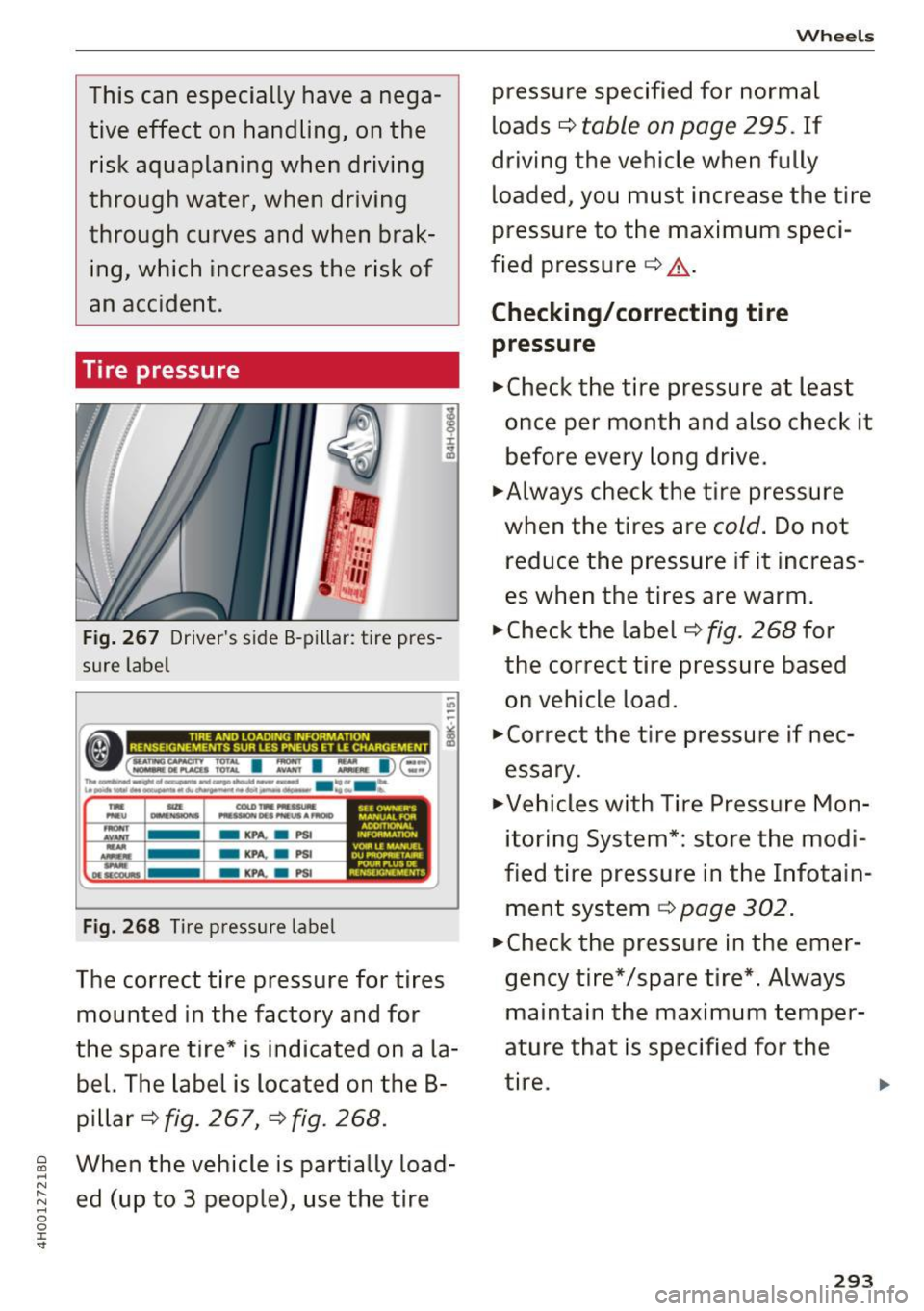
Fig. 267 Driver's side B -pillar : tire pres
sur e label
-"' -,--------------- -
• ============ i (
:=:=a : I =:: I :.. I) (':: ~) n,.......,.._,.,.. ......... _.__......, _ _.., .... _ ... l ................... . __.......... .......... ..._ .. .,,, ..
Fig. 268 Tire pressure label
The correct tire pressure for tires
mounted in the factory and for
the spare tire* is indicated on a la
bel. The label is located on the B
pillar ¢
fig. 267, ¢ fig. 268.
~ When the vehicle is partially load-
N
~ ed (up to 3 peop le), use the tire
0
0
I
pressure specified for normal
loads¢
table on page 295. If
driving the vehicle when fully loaded, you must increase the tire
pressure to the maximum speci
fied pressure ¢.&, .
Checking/correcting tire
pressure
.,..Check the tire pressure at least
once per month and also check it before every long drive .
.,..Always check the tire pressure
when the tires are
cold. Do not
reduce the pressure if it increas
es when the tires are warm .
.,..Check the label ¢
fig. 268 for
the correct tire pressure based on vehicle load.
.,..Correct the tire pressure if nec
essary.
.,..Vehicles with Tire Pressure Mon
itoring System*: store the modi
fied tire pressure in the Infotain
ment system ¢
page 302.
.,..Check the pressure in the emer
gency tire* /spare t ire* . Always
maintain the maximum temper
ature that is specified for the
tire. .,.
293
Page 302 of 354

Wheels
- Please a lso remember that, wh ile these tires
deliver responsive handling, they may ride less
comfortably and ma ke more noise than other
cho ices.
Reduc ed performance in winter /cold s eason
condit ions
All tires are designed for certain purposes. The
low aspect ratio, ultra high performance t ires
or iginally i nstalled on your vehicle are intended
for maximum dry and wet road performance and
handling . They are not s uitable for cold, snowy or
icy weathe r cond itions.
If you drive under those
circumstances, you s hou ld equ ip your ve hicle
with a ll-season or win ter tires, wh ic h offe r bette r
traction under those con dit ions . We suggest you
use the recommended snow or all -season tires
specified fo r your vehicle, or their equivalent.
Refer to¢
page 298 for more deta iled info rm a
tion regarding w in ter tires.
Uniform tire quality grading
- Tread wear
- Traction AA A B C
- Temperatu re ABC
Qua lity grades can be found where applicable on
the t ire side wall betwee n tread s hou lde r and
maximum sect io n w id th
¢pag e 283, fig. 265.
For e xample: Tread wear 2 00 , Traction AA , Tem
perature
A .
All passenger car tires must conform to Federa l
Safety Requirements in addition to these grades.
Tread wea r
The tread wear grade is a comparat ive ra ting
based on the wear rate of the tire when tested
under contro lled conditions on a specified gov
ernment test course.
F or examp le, a t ire graded
150 would wear one
and one ha lf
( 1 1/2) times as well on the govern
ment course as a tire g raded
100 .
The rela tive perfo rmance of tires depe nds upon
the actua l condi tions of their use, howeve r, and
may depart significant ly from the norm d ue to
300
variations in driving habits, service p ract ices an d
differences in road characteristics and climate.
Traction
The traction grades, from hig hest to lowest, a re
AA, A, B and
C. Those grades rep resent the tire's
ability to stop o n wet p avement as measure d un
der controlled conditions on specified govern
ment test s urfaces of asphalt an d concrete. A tire
marked C may have poor traction performance
¢ _& .
Temperature
The temperature grades are A ( the highest), B,
and C, representing the tire 's resistance to the
generatio n of heat and its ability to dissipate
heat when tested under contro lled conditions on
a specified indoor laboratory test wheel.
Sustained high temperature can cause the mate
rial of the tire to degenerate and reduce tire life,
and excessive temperature can lead to s udden
tire failure¢ &.
The grade C cor responds to a level of perform
ance which all passenger car tires must meet un
der the Federal Motor Vehicle Safety Standard
No.
109. Grades Band A represent hig her levels
of performance on the laboratory test wheel than
t h e m inim um requ ired by law .
A WARNING
-
The tract io n grade assigned to this t ire is
based on st raig ht-a head b raking tr action
tes ts, and do es not in clude acceler ation, cor
nerin g, hyd roplaning or pe ak traction ch arac
teristics.
A WARNING
T he temperat ure grade fo r thi s tire is esta b
lishe d for a tire that is properly inflated and
not ove rloaded. Excessive speed, underinfla -
tion, o r excessive load ing, either separately or
in comb inat ion, can cause heat bu ildup and
-
possible tire failure. ..,.
Page 304 of 354

Wheels
the recommended tire pressure for your vehicle
¢page 293, fig. 268.
Tire tread circumference and vibration character
istics can change and cause a tire pressure warn
ing if:
- the tire pressure in one or more tires is too low.
- the tire has structural damage .
- the tire was replaced or the tire pressure was
changed and it was not stored¢
page 302.
-the spare tire* is installed.
Indicator lights
IE Loss of pressure in at least one tire¢&. .
Check the tires and replace or repair if necessary.
Check/correct the pressures of all four tires and
store the pressure again in the Infotainment sys
tem ¢
page 302 .
mm (Tire Pressure Monitoring System) Tire
pressure: System malfunction!.
Ifmm appears
after switching the ignition on or while driving
and the
IE indicator light in the instrument clus
ter blinks for approximately one minute and then
stays on , there is system malfunction . Try to
store the correct tire pressures¢
page 302. If
the indicator light does turn off or turns on again
after a short period of time, drive to an author
ized Audi dealer or authorized Audi Service Facili
ty immediately to have the malfunction correct
ed .
A WARNING
- If the tire pressure indicator appears in the
display, reduce your speed immediately and
avoid any hard steer ing or braking maneu
vers . Stop as soon as possible and check the
t ir es and their pressure .
- The driver is responsible for maintaining the
correct tire pressure. You must check the
t ire pressure regularly.
- Under certain conditions (such as a sporty
dr iv ing style, winter cond itions or unpaved
roads), the tire pressure monitoring system
indicator may be delayed.
- Do not use run-flat tires on your vehicle. Us
ing them when not permitted can lead to
vehicle damage or accidents .
302
(D Tips
-The tire pressure monitoring system can al
so stop working when there is an ESC mal
function.
- Using snow chains may result in a system
malfunction.
- The tires with the identification "AO" or
"RO" ¢
page 290 have been matched with
your Audi tire pressure monitoring system.
We recommend that you use these tires.
Storing tire pressures
App lies to: AB, 58
If the tire pressure changes or a tire is replaced ,
it must be confirmed in the Infotainment sys
tem.
... Make sure before storing that the tire pressur es
of all four tires meet the specified values and
are adapted to the load ¢
page 291.
... Switch the ignition on.
... Select: the
ICARI funct ion button> Car Systems
control button > Servicing & checks > Tire
pressure monitoring
> Store tire pressure >
Yes, store now.
(D Tips
Do not store the tire pressures if snow chains
are installed. Othe rw ise the system could
malfunction.
Tire Pressure Monitoring System (S8 plus)
(l) General notes
App lies to : 58 plus
Each tire, including the spare (if provided),
sho uld be checked monthly when cold and inflat
ed to the inflation pressure recommended by the
vehicle manufacturer on the vehicle placard or
tire inflation pressure label. (If your vehicle has
tires of a different size than the size indicated on
the vehicle placard or tire inflation pressure la
bel, you should determ ine the proper t ire infla-
tion pressure for those tires). .,.
Page 305 of 354

0 co .... N ,..._
N .... 0 0 :c '
equipped with a tire pressure monitoring system (TPMS) that illuminates a low tire pressure tell
tale when one or more of your tires is significant ly under-inflated. Accordingly, when the low tire
pressure telltale illuminates, you should stop and
check your tires as soon as possible, and inflate
them to the proper pressure. Driving on a signifi
cantly under-inflated tire causes the tire to over
heat and can lead to tire failure. Under-inflation
also reduces fuel efficiency and tire tread life,
and may affect the vehicle's handling and stop
ping ability.
Please note that the TPMS is not a substitute for
proper tire maintenance, and it is the driver's re
sponsibility to maintain correct tire pressure,
even if under-inflation has not reached the level
to trigger illumination of the TPMS low tire pres
sure telltale.
Your vehicle has also been equipped with a TPMS
malfunction indicator to indicate when the sys
tem is not operating properly. The TPMS mal
function indicator is combined with the low tire
pressure telltale. When the system detects a
malfunction, the telltale will flash for approxi
mately one minute and then remain continuously
illuminated. This sequence will continue upon
subsequent vehicle start-ups as long as the mal
function exists .
When the malfunction indicator is illuminated,
the system may not be able to detect or signal
low tire pressure as intended. TPMS malfunctions
may occur for a variety of reasons, including the
installation of replacement or alternate tires or
wheels on the vehicle that prevent the TPMS
from functioning properly. Always check the
TPMS malfunction telltale after replacing one or
more tires or wheels on your vehicle to ensure
that the replacement or alternate tires and
wheels allow the TPMS to continue to function
properly.
Wheels
Description
App lies to : 58 plus
The tire pressure monitoring system monitors
the pressure in the four tires when driving .
The system uses sensors that measure the tem
perature and pressure in the tires. The data is
sent from these sensors to the control module by
radio frequency.
The Tire Pressure Monitoring System shows the current pressures and temperatures of the tires
in the Infotainment system
o page 304. It also
compares the current tire pressures with the
stored tire pressures and gives a warning in the
driver information system if the tire pressure is
different from what is stored
o page 304.
The system does not detect if the stored tire
pressures match the recommended tire pres
sures.
- Every time the tire pressures change, for exam-
ple when the load in the vehicle changes,
- after replacing a tire, or
- if wheels with new wheel sensors are used,
you must store the tire pressures again
opage 305.
A WARNING
--The tire pressure monitoring system assists
the driver in monitoring tire pressures. The
driver is responsible for having the tires in
flated to the correct pressure.
- Do not change the tire pressure when the
temperature of the tire is high. This could
result in serious damage to the tire and
even cause the tire to burst, increasing the
risk of an accident.
- A tire with low pressure flexes more. This
heats the tire up too much. This could cause
the tread to separate and even cause the
tire to burst, increasing the risk of an acci
dent.
- The Tire Pressure Monitoring System does
not warn you of damage or defects in the
tire construction that could cause the tire to
burst, for example. Inspect your tires regu
larly.
303
Page 308 of 354

Care and cleaning
Care and cleaning
General information
Regular, proper care helps to maintain your vehi
cle's value.
It can also be a requirement when
submitting warranty claims for corrosion damage
and paint defects on the body.
The necessary care products can be obtained
from an authorized Audi dealer or authorized
Audi Service Facility. Read and follow the instruc
tions for use on the packaging.
A WARNING
-Using cleaning and care products incorrectly
can be dangerous to your health .
- Always store cleaning and care products out
of reach of children to reduce the risk of poi
soning.
@ For the sake of the environment
- Preferably purchase environmentally-friend ly cleaning products.
- Do not dispose of leftover cleaning and care
products with household trash.
Car washes
The longer that deposits such as insects, bird
droppings, tree sap or road salt remain on the ve hicle, the more the surface can be damaged. High
temperatures such as those caused by sunlight
increase the damaging effect .
Before washing, rinse off heavy deposits with
plenty of water.
Stubborn deposits such as bird droppings or tree
sap are best removed with plenty of water and a microfiber cloth.
Also, wash the underside of your vehicle once road salt stops being used for the season .
Pressure washers
When washing your veh icle w ith a pressure wash
er, always follow the operating instructions pro
vided with the pressure washer. This is especially
important in regard to the pressure and spraying
distance. Do not aim the spray directly at the
306
seals on the side windows, doors, lids or the sun
roof* or at tires, rubber hoses, insulating materi
al, sensors* or camera lenses* . Keep a distance of
at least 16 in (40 cm).
Do not remove snow and ice with a pressure
washer.
Never use cone nozzles or high pressure nozzles.
The water temperature must not be above 140 °F
(60 °C).
Automatic car washes
Spray off the vehicle before washing.
Make sure that the windows and roof* are closed
and the windshield wipers are off . Follow instruc
tions from the car wash operator, especially if
there are accessories attached to your vehicle.
If possible, use car washes that do not have
brushes.
Only use car washes where the veh icle remains
stationary and the washing equipment moves
around the vehicle when washing and drying. Car
washes that move the vehicle through the car
wash using a chain are not recommended.
Washing by hand
Clean the vehicle starting from the top and work
ing down using a soft sponge or cleaning brush.
Use solvent-free cleaning products.
Washing vehicles with matte finish paint by
hand
To avoid damaging the paint when washing, first
remove dust and large particles from your vehi
cle. Insects, grease spots and fingerprints are
best removed with a special cleaner for matte
finish paint.
Apply the product using a microfiber cloth. To
avoid damaging the paint surface, do not use too
much pressure.
Rinse the vehicle thoroughly with water. Then
clean using a neutral shampoo and a soft micro
fiber cloth .
Rinse the vehicle thoroughly again and let it air
dry. Remove any water residue using a chamois. ..,..
Page 310 of 354
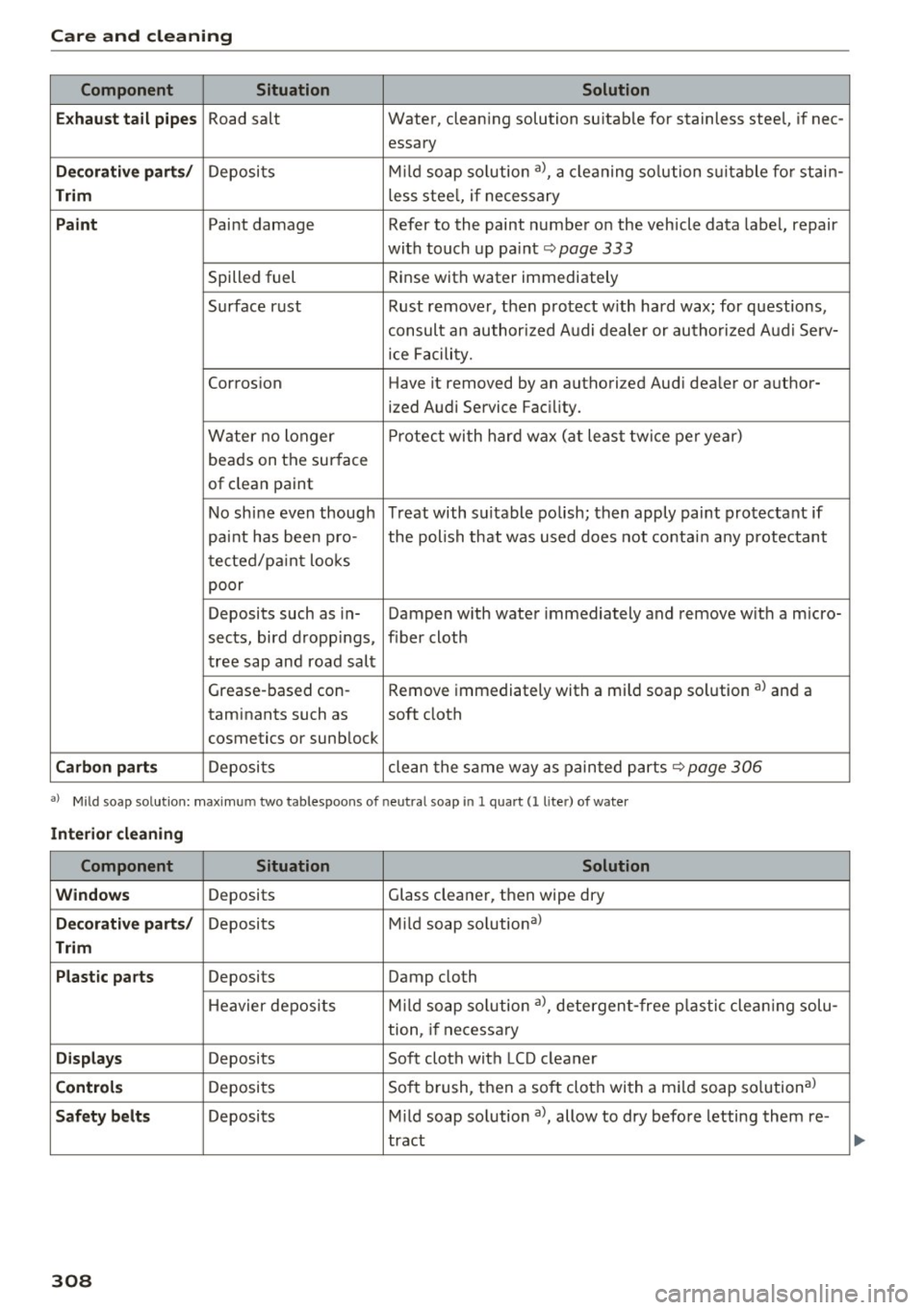
Care and cleaning Component Situation Solution
Exhaust tail pipes
Road salt Water, cleaning solution suitab le for stainless steel, if nee-
essary
Decorative parts/ Deposits Mild
soap solution a), a cleaning solution suitable for stain-
Trim less stee l, if necessary
Paint Paint damage Refer to th e paint number on the vehicle data label, repair
with touch up paint ~
page 333
Spilled fuel Rinse
with water immediately
Surface rust Rust remover, then protect with hard wax; for questions,
consult an author ized Audi dealer or authorized Aud i Serv-
ice Facility.
Corros ion Have it removed by an authori zed Aud i dea ler or author-
ized Audi Service Facility.
Water no longer Pr
otect wi th hard wax (at least twice per year)
beads on the surface
of clean paint
No shine even though Treat wit h suitable polish; then apply paint protectant if
paint has been pro- the polish that was used does not contain any protectant
tected/paint looks
poor
Deposits such as in- Dampen with water immediately and remove with a micro-
sects, bird dropp ings, f iber cloth
tree sap and road salt
Grease-based con- Remove immediately with a mild soap solution a ) and a
taminants such as soft cloth
cosmetics or sunblock
Carbon parts Deposi ts clean the same way as painted parts ~ page 306
a) Mild soap so lution: maxim um two tabl espoo ns of n eu tra l s oap in 1 quart Cl lite r) of w ater
Interior cleaning
Component Situation Solution
Windows
Deposits Glass cleaner, then wipe dry
Decorative parts/ Deposits Mild soap
solution al
Trim
Plastic parts
Deposits Damp clo1th
Heavier deposits Mild soap solution
al, detergent-free pla stic clean ing solu-
tion, if necessary
Displays Deposits Soft cloth with LCD cleaner
Controls Deposits Soft brush, then
a soft cloth with a mild soap so lution al
Safety belts Deposits Mild soap solution al, allow to dry before letting them re-
tract
308
...
Page 311 of 354
0 co .... N ,..... N .... 0 0 :c '
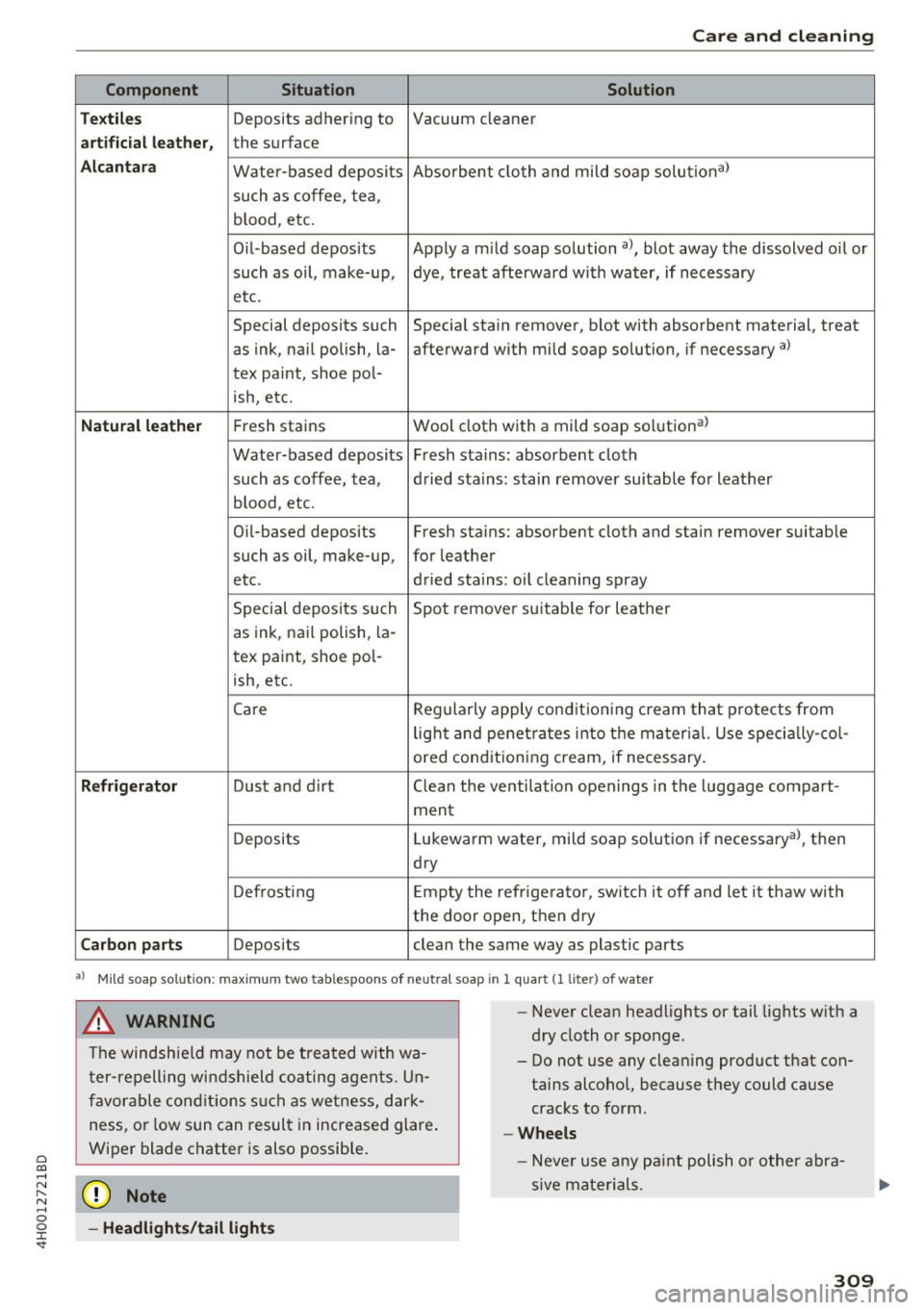
Component Situation Solution
T ex til es
Deposits adhering to Vacuum cleaner
art ifici al leat her, the surface
A lcan tara Water-based deposits Absorbent
cloth and mild soap solutiona>
such as coffee, tea,
b lood, etc.
Oil -based deposits Apply a m ild soap solution
a), blot away the dissolved o il or
such as oil, make-up, dye, treat afterward with water, if necessary
etc.
Special deposits such Special stain
remover, blot with absorbent material, treat
as ink, nail polish, la- afterward with mild soap solution, if necessary
a)
tex paint, shoe pol-
ish, etc.
Natu ral le ath er Fresh stains Wool cloth with a mild soap solution a)
Water-based deposits Fresh stains: absorbent cloth
such as coffee, tea, dried stains: stain
remover suitable for leather
b lood , etc.
Oi [-based deposits Fresh stains: absorbent cloth and stain
remover suitable
such as oil, make-up, for leather
etc. dried stains: oil cleaning spray
Special deposits such Spot remove r suitab le for leather
as ink, nail polish, la-
tex paint, shoe pol-
ish, etc.
Care Regularly apply condit ion ing c ream that protects from
lig ht and penet rates into the material. Use specia lly-co l-
ored conditioning cream, if necessary .
Refrig erator Dust and d irt Clean the ventilation openings in the luggage com part-
ment
Deposits Lukewarm water, mild
soap solution if necessarya>, then
dry
Defrosting Empty the refrigera to r, switch it off and let it thaw with
the door open, then dry
Carb on part s Deposits clean the same way as plast ic parts
a) Mi ld soap solution: maximum two tablespoons of neutral soap in 1 quar t (1 liter) of water
_&. WARNING
The windshie ld may not be treated with wa
ter-repelling windshield coating agents. Un
favorable cond itions such as wetness, dark
ness, or low sun can result in increased glare .
Wipe r blade chatter is also possible.
(D Note
- He adlight s/tail li ghts
-
- Never clean headlights or tail lights w ith a
dry cloth or sponge.
- Do not use any cleaning product that con
tains alcohol, because they could cause
cracks to form .
-W heels
- Neve r use any pa int polish o r other abra-
sive mate rials.
309
Page 314 of 354

Emergency assistance
Emergency assistance
General information
... Park the vehicle as far as possible from moving
traffic in the event of a breakdown. In the event
of a flat tir e, park the vehicle on a level surface .
It you are on a steep hill, be especially careful.
.,. Set the parking brake .
.,. Switch the emergency flashers on .
... Set up the warning triangle
r=;, page 312 .
... Have the passengers exit the vehicle . They
should move to a safe place, for example be
hind a guard rail.
A WARNING
Follow the steps given above. This is for your
protection and the for the safety of other driv
ers.
Equipment
Warning triangle
Applies to: vehicles with warning triangle
Fig. 271 L uggage compa rtm ent lid : w arnin g triangle
The warning triangle placed in the vehicle at the
factory is located in the luggage compartment.
... To remove the warning triangle, press the fas-
tener in the direction of the arrow and fold the
holder down.
The luggage compartment lid is only designed to
hold the warning triangle offered by th e Audi
Genuine Accessories program.
312
Vehicle tool kit
Applies to: vehicles with vehicle toot kit
Fig. 272 L u gg age compartmen t: cargo floor cove r fo lded
upward
Fig. 273 Luggage co m partment: exa mple of veh icle toot
kit and vehicle j ack
The vehicle tools and vehicle jack* are stored in
the luggage compartment under the floor cover .
... Lift the cargo floor by the plastic handle .
... Hook the handle into the luggage compartment
seal
r::> fig. 272 .
.,. Turn the handwheel counter-clockwise and re
move it .
.,. Remove the spare tire* to access the vehicle
tool kit
r::;, fig. 2 72 .
Depend ing on the equipment , the veh icle tool kit
may be located under the spare tire, under an
other cover or in the tool box.
T he position of the vehicle jack* may vary .
A WARNING
Improper use of the veh icle jack can cause se
rious personal injuries.
- Never use the screw driver hex head to
tighten wheel bolts, since the bolts cannot
attain the necessary tightening torque if you .,..
Page 328 of 354
Fuses a nd bul bs
Bulbs
Replacing light bulbs
For your safety, we recommend that you have
your authorized Audi dealer replace burned out
bulbs for you.
It is becoming increasingly more and more diffi
cult to replace vehicle light bulbs since in many
cases, other parts of the car must first be re
moved before you are able to get to the bu lb .
This applies espec ially to the light bulbs in the
front of your car wh ich you can only reach
through the engine compartment .
Sheet metal and bulb holders can have sharp
edges that can cause ser ious cuts, and parts
m ust be correctly taken apa rt and then p roperly
put back together to help prevent breakage of
parts and long term damage from water that can
enter housings that have not been properly re
sealed.
For your safety, we recommend that you have
your authorized Audi dealer replace any bu lbs for
you, since your dealer has the proper tools, the correct bulbs and the expertise.
G as di sc harg e l am ps (Xe non li ghts):
Due to the high electrical voltage, have the bulbs
replaced by a qua lified technic ian . Headlights
with Xenon light can be identified by the high
voltage sticker.
LED headlights* require no maintenance. Please
contact your authorized Aud i dealer if a bulb
needs to be replaced.
A WARNING
Contact w ith high-voltage components of the
electrical system and improper rep lacement
of gas discharge (Xenon) headlight bulbs can
cause serious personal injury and death.
- Xenon bulbs are pressurized and can ex
plode when being changed.
- Changing Xenon lamps requires the special training, instructions and equipment.
- Only an a uthorized Audi dea ler or other
qualified workshop should change the bulbs
in gas discharge lamps .
326
A WARNING
-
There are parts with sharp edges on the open-
ings and on the bulb holders that can cause
serious cuts.
- If you are uncertain about what to do, have
the work performed by an authorized Audi
dealer or other qualified workshop. Ser ious
pe rsonal injury may resu lt from improperly
pe rformed wor k.
@ Tips
- If you must replace the light bulbs yourself,
always remember that the eng ine compart
ment of any vehicle is a hazardous area to
work in. Always read and heed all WARN INGS
'* page 271.
-It is best to ask your authorized Audi dealer
whenever you need to change a bulb.