light AUDI Q5 2018 Repair Manual
[x] Cancel search | Manufacturer: AUDI, Model Year: 2018, Model line: Q5, Model: AUDI Q5 2018Pages: 392, PDF Size: 60.56 MB
Page 120 of 392
Assistance systems
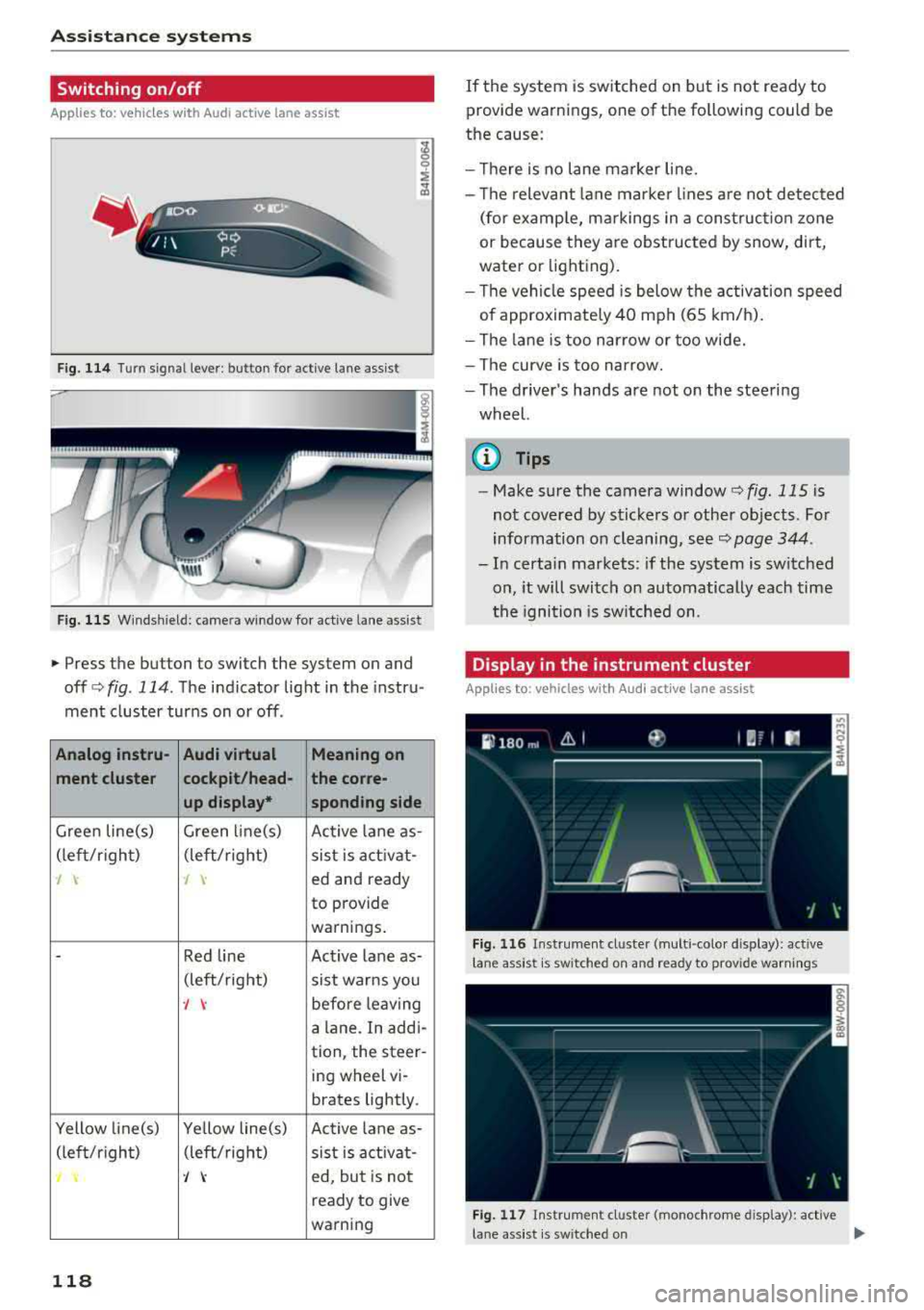
Switching on /off
Applies to: vehicles with Audi active lane assist
F ig. 114 Turn signal lever: butto n for act ive lane assist
F ig. 115 Windsh ield: camera window fo r ac tive lane assist
• Press the button to switch the system on and
off c:':>fig . 114. The indicator light in the instru
ment cluster turns on or off.
Analog instru- Audi virtual Meaning on
ment cluster cockpit/head- the corre-
up display• sponding side
Green line(s) Green li ne(s)
Active lane as-
(left/r ig ht) (left/right)
sist is activat-
-J 'I ed and ready
to provide
warnings .
-Red line Act ive lan e as-
(left/ right)
sist warns you
-J \: before leaving
a lane . In addi-
tion, the steer-
ing wheel vi-
brates lightly.
Yellow line(s) Yellow line(s)
Active lane as-
(left/r ig h t) (left/right)
sist is activat-
'/ \: ed, but is not
ready to give
warning
118
If the system is switched on but is not ready to
provide warnings, one of the following could be
the cause:
- Th ere is no lane marker line.
- Th e relevant lane marker lines are not detected
(for examp le, markings in a construction zone
or because they are obstructed by snow, dirt,
water or lighting).
- Th e vehicle speed is below the activation speed
of approximately 40 mph (65 km/h).
- The lane is too narrow or too wide.
- The curve is too narrow.
- The driver's hands are not on the steering
wheel.
{i) Tips
- Make sure the camera window<=> fig. 115 is
not covered by stickers or other objects. For
information on cleaning, see¢
page 344.
-In certa in markets: if the system is switched
on, it will switch on automatically each time
th e igni tion is switched on .
Display in the instrument cluster
Applies to: vehicles with Audi active lane assist
Fig. 116 Instr ument cluster (mult i- colo r dis play): active
l ane assist is sw itched on and ready to provide warn ings
Fig. 117 Instrument cluster (monochrome disp lay): active
lane assist is switched on
...
Page 121 of 392
u co ..... N ,..._
N ..... 0 <( 0 00
You can open up the Driver assistance disp lay for
the active lane assist using the m ultifunction
steer ing whee l buttons
¢ page 12 .
An addit ional ind ic a tor appears in the head- up
d isp lay* .
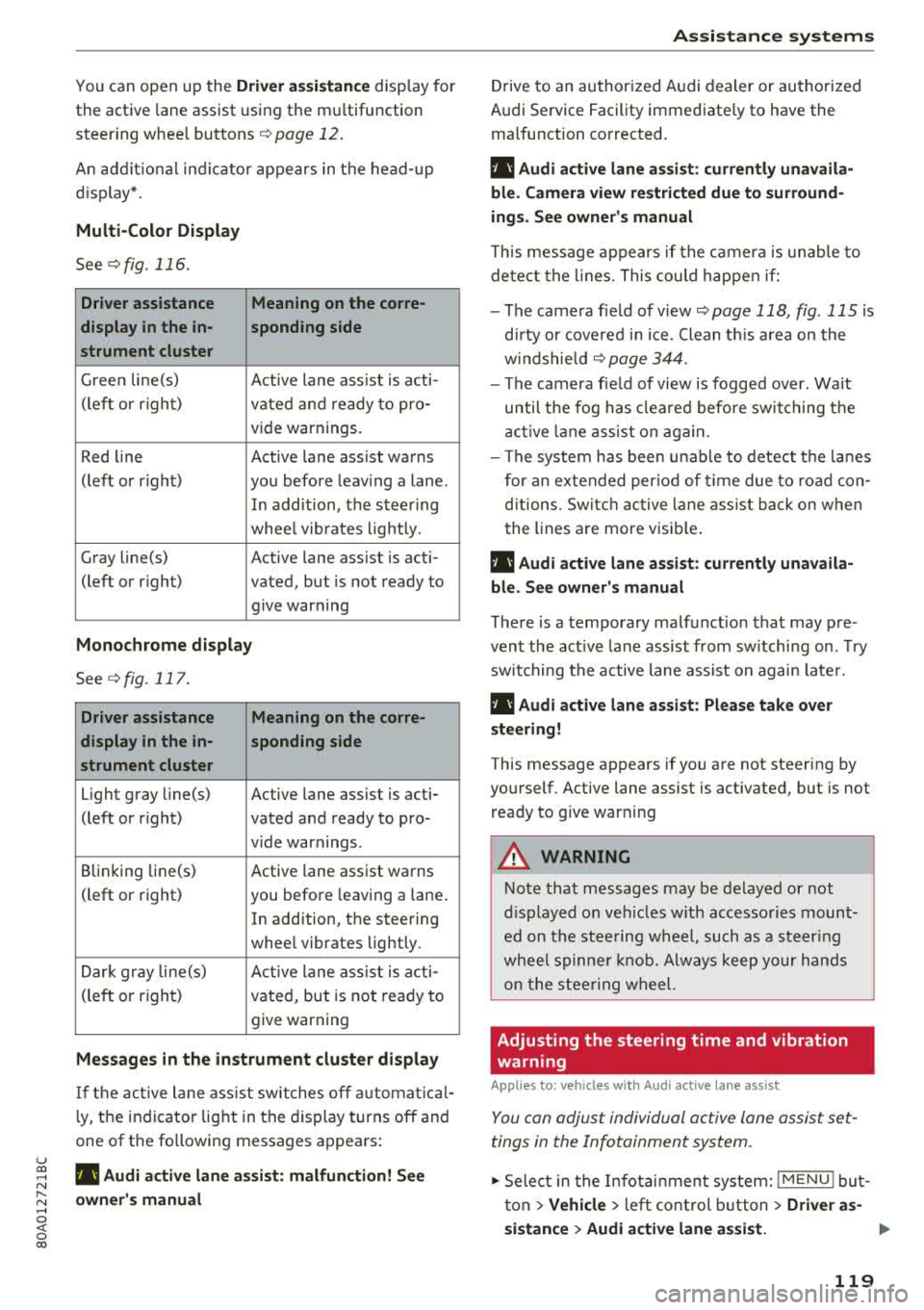
Multi-Color Display
See ¢fig . 116.
Driver assistance Meaning on the corre-
display in the in- sponding side
strument cluster
G ree n line(s)
Active lane assist is acti-
(left or r ight)
vated and ready to pro -
v ide warnings.
Red line Active lane assist warns
(left or r ight) you before leav ing a la ne .
In add ition, the steer ing
whee l vibrates lightly.
Gray line(s) Active lane assist is acti-
(left or right) vated, but is not ready to give warning
Monochrome display
See c>fig. 117.
Driver assistance Meaning on the corre-
display in the in- sponding side
strument cluster
Light gray line(s) Active lane assist is acti-
(left or r ight) vated and ready to pro-
vide warnings .
B linking Li ne(s)
Active lane assist warns
(left or right) you before leaving a lane .
In addition, the steering
whee l vibrates lightly.
Dar k gray line(s)
Active lane assist is acti -
(le ft or righ t)
vated, but is not ready to
give warning
Messages in the instrument cluster display
I f t he active lane ass ist swit ches off automat ic al
l y, t he indicator lig ht in the display turns off and
one of the following messages appea rs :
rl! Audi a ctiv e lan e assi st : malfunction! See
owner 's manu al
A ss istance systems
Drive to an authori zed A udi dealer or authori zed
Audi Service Facility immediate ly to have the
malfunction corrected.
rl! Audi active lane as sist: currently unavaila
ble . Camera view rest ricted due to surround
ings . See owne r's manual
T his message appears if the c amera is unab le to
de te ct the lines. This could happen if:
- The camera fie ld of view
c> page 118, fig . 115 is
d irty or covered i n ice . Clean t his area on the
w indshie ld
c> page 344.
- The camera fie ld of view is fogged over. Wait
until the fog has clea red befo re switching the
a cti ve lane ass ist o n again.
- The system has bee n unab le to detect the la nes
for an extended per io d of time due to roa d con
ditions . Switc h ac tive lane ass ist back on w hen
the lines are more visib le .
rl! Audi active lane assist: currently unavaila
bl e. See owner's manual
T here is a temporary malfunct ion that may pre
vent the act ive lane assis t from sw itchi ng on . Try
switching t he active lane assist on again late r.
rl! Audi active lane a ssist : Pl ease take over
steering!
This message appears if you are not steering by
yourself . Active lane assist is activated, but is not
ready to g ive war ning
A WARNING
-
No te that messages may be de layed or not
d isp layed o n ve hicl es w ith accesso ries moun t
ed on the stee ring w heel, such as a steer ing
whee l spinne r knob. Alw ays keep yo ur han ds
on the s tee ring wheel.
Adjusting the steering time and vibration
warning
Applies to: veh icles w it h Aud i act ive lane ass ist
You can adjus t individual active lane assist set
tings in the Infotainment system.
.,. Select in the Infotai nment system: I MENU ! but
t on >
Vehicle > le ft con trol b utton > Driver as-
sistance
> Audi active lane a ssis t. ..,.
119
Page 127 of 392
u co ..... N r--N ..... 0 <( 0 00
(D Tips
-You can cancel the automatic brake activa
tion w ith increasing braking fo rce if you ap
ply the brakes yourse lf or accelerate cons id
erab ly.
- In some situations, rea r cross-traffic assist
may warn you even if there is no cross traffic
i n a cr itical area , for examp le when back ing
i nto a parking space or maneuver ing .
- The rea r cross-traffic ass ist also switches off
when you switch off the ESC.
- The system is not available when towing a
trailer.
Messages
Applies to: vehicles with Audi side assist
A message appears in the inst rumen t cluste r dis
p lay if the s ide ass ist swi tches off automatically .
@t Audi side assist: malfunction! Please contact
Service
@j Audi side assist and exit warning: malfunc
tion! Please contact Service
The system cannot guarantee that it w ill detec t
ve hicles co rrectly a nd it has sw itched off. The
sensors have been mov ed o r are faulty. Have t he
system checked by an a uthori zed Audi dea ler or
author ized Audi Se rvice Facility soon.
@j Audi side assi st: cur rently unavailable. Sen
sor vision restricted due to surroundings . See
owner 's manual
e, Audi side as sis t and e xit warning: currently
unavailable. Sensor vision restricted due to sur
roundings
The rad ar senso r vis io n i s impa ire d. The area in
fron t of the senso rs must no t be covered by b ike
rac ks, st ic kers, leaves, snow or any othe r ob jects.
C lea n the area i n front of th e sensors, if necessa
ry¢ page 121, fig. 121.
e, Audi side as sis t: currentl y unavailable. See
owner 's manual
et Audi side a ssist and exit warning : currently
unavailable. See owner 's manual
A ss istance systems
S id e ass ist cannot be switched on at this time be
ca use there is a ma lfunction (for example, the
batte ry c harge leve l may be too low).
et Audi side assist : unavailable in towing mode
e, Audi side assist and exit warning: currently
unavailable . Towing mode
S ide ass ist switches off automatically when the
electrica l connec to r i n t he factory-installed t rail
er hitch is connec ted . There is no guarantee the
syste m will sw itch o ff when us ing a ret rofitted
t railer h itch . Do no t use side a ssist an d the ex it
war nin g when tow ing a tra ile r.
Ill Rear parking aid: obstacle detect ion restrict
ed
The rear cross-traffic ass ist is not available . E i
ther the ESC is sw itched off, or the rada r senso rs
may be cove red by a b ike rac k, st ic ke rs , leaves,
snow o r othe r objects . Swit ch the ESC on, o r
cl ea n the area in fron t of the senso rs if necess ary
¢page 12 1, fig . 12 1. If thi s message con tinues
to be displayed, dr ive imme dia tely to an author
ized Audi dea ler or author ized Audi Service Facili
ty to have the ma lf u nction repaired.
Audi drive select
Introduction
Applies to: vehicles with Audi drive select
Dr ive sele ct m akes i t possible to exper ien ce d if
f erent types of vehi cle se ttings in one veh icle.
Yo u can select the driv in g modes
Offroad* or
Lift / Offroad *, Allroad* , Comfort , Auto and Dy
namic
i n the Infota inme nt system, fo r example
to switch from a spo rty to a comfo rtable d riving
mode. In the
Individual mode, the settings can
be adjusted to you r persona l preferences. This
makes it possible to combine sett ings such as a
spo rty engine setting wi th light steer ing .
Description
Applies to: vehicles with Audi drive select
The following systems, among ot her th ings, a re
in fluenced by dr ive se lect:
.,.
125
Page 130 of 392
Ass is tance sy stem s
Systems comfort
Engine sound*
subtle
AC C* comfortable
al Subtle in th e se lector lever position "D" and sporty in " S".
@ Tips
Your sett ings a re automatical ly saved in Indi
vidual mode.
Raising/lowering the vehicle
Applies to: veh icles w ith a ir suspe nsion
.,.. Press the left or right arrow key ¢ page 127,
fig . 126
until the desired mode appears in the
instrument cluster/Infotainment system d is
play. Or
.,.. Select in the Infotainment system: I MENU I but
ton
> Ve hicle > Aud i d rive sele ct .
.,.. Select and conf irm the desired setting.
CD Note
The Lift / Offroad mode switches to All road
mode when dr iv ing above approximately
20 mph (30 km/h) and the vehicle automati
cally lowe rs again . These modes may only be
used on a tempo rary bas is and are not intend
ed for continuo us d riving.
(D Tips
- The filled -in boxes in the Infotainment sys
tem represent the current vehicle level. If
the segment is white or blinking, then the
vehicle is lifting or lowering. If only the bot
tom segment is filled in, then the veh icle is
at the lowest level ( lowest ground clear
ance). If all the segments are filled in, then
the vehicle is at the highest level (highest
ground clear a nee) .
- The target level is highlighted with a
red
frame while the vehicle is lifting or lower
i ng . The frame is then h idden when the ve
hicle reaches the target level.
- The vehicle lifts up to the highest level
when you select
Lift / Offroad . Select an
other mode to lower the vehicle again .
128
auto dynamic
subtle/sportyal sporty
ba lanced sporty
Rear lowering
Applies to: vehicles wit h air suspensio n
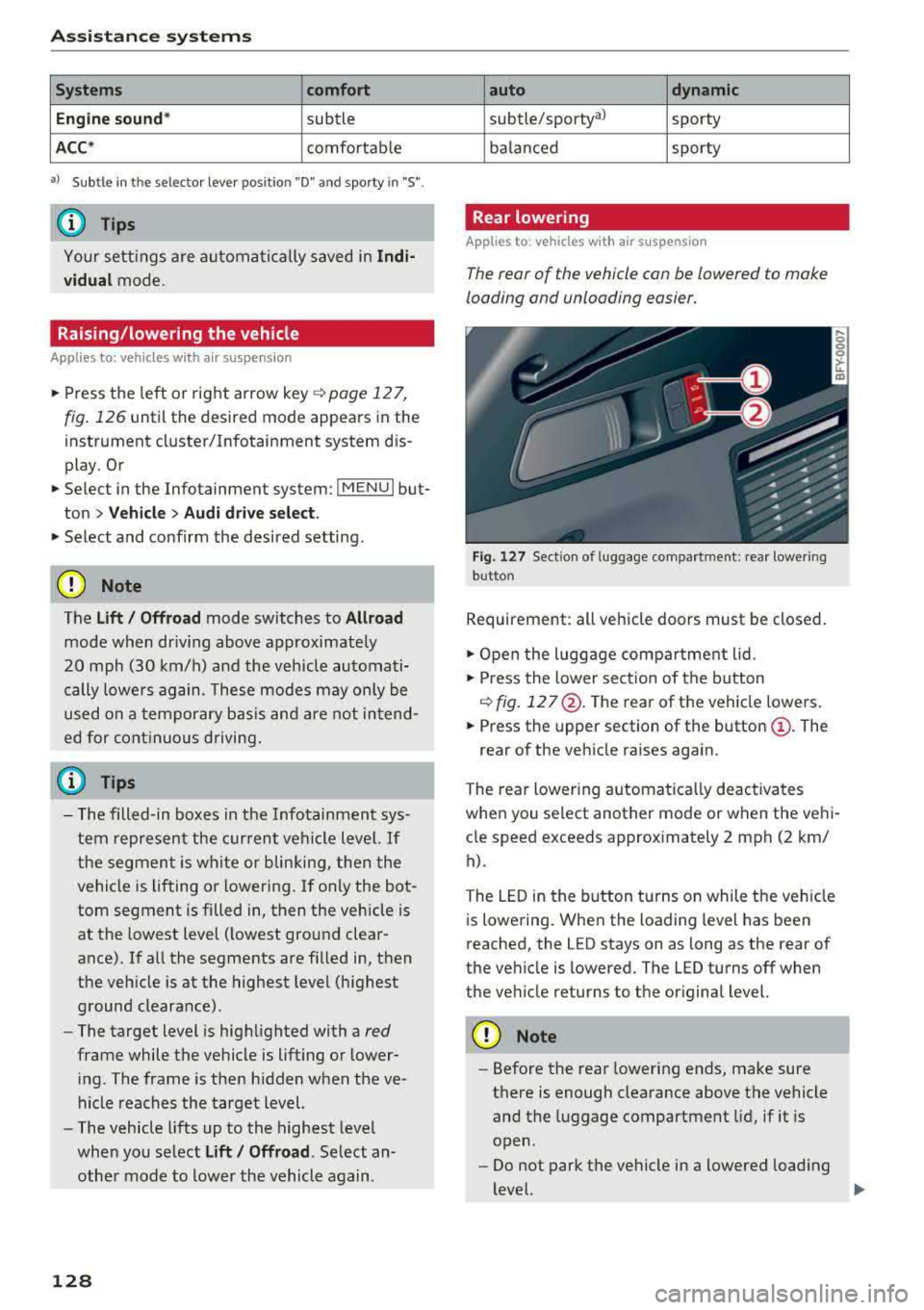
The rear of the vehicle con be lowered to make
loading and unloading easier.
Fig. 127 Section of luggage compa rtment: rear lower ing
but ton
Requirement: all vehicle doors must be closed.
.,.. O pen the luggage compar tment lid.
.,.. Press the lower sect io n of the button
C) fig. 12 7@ . The rear of the vehicle lowe rs .
.,.. Press the upper section of the button@. The
rear of the veh icle raises again.
The rear lowering a utomat ica lly deactiva tes
whe n you select another mode or when the ve hi
cle speed exceeds approx imately 2 mph (2 km/
h).
The LED in the button t urns on while the veh icle
is lowering. When the loading level has been
reached, the LED stays on as long as the rear of
the vehicle is lowered. The LED turns off when
the veh icle returns to the original level.
CD Note
-Before the rear lowering ends, make sure
there is enough clearance above the vehicle
and the luggage compartment lid, if it is
open .
- Do not park the vehicle in a lowered load ing
level.
..,..
Page 132 of 392
Parking aid
Parking aid
General information
A pplies to: ve hicles w ith a rea r parking sys te m /parking sys
tem p lus/rearv iew camera/peripheral cameras
Depending on your vehicle's equipment , various
parking aids will help you when parking and ma
neuvering.
The
rear parking system is an audible parking aid
that warns you of obstacles
behind the vehicle
¢ page 131.
The parking system plus assists you when park
ing by audibly and visually indicating objects de
tected
in front of and behind the vehicle
¢ page 131.
The rearview camera shows the area behind the
vehicle in the Infotainment system display. The lines in the rearview camera image help you to
park or maneuver
¢ page 133.
The peripheral cameras give various views to
help you when parking or maneuvering
¢ page 135 . The parking system plus functions
are also available ¢
page 131.
_& WARNING
-Always look for traffic and check the area
around your vehicle by looking at it directly
as well. The parking system cannot replace
the driver's attention. The driver is always
responsible when entering or leaving a park
ing space and during similar maneuvers.
- Please note that some surfaces, such as
clothing, are not detected by the system.
-
- Sensors and cameras have blind spots in
which people and objects cannot be detect
ed . Be especially cautious of small children
and animals.
- Always keep your eyes on the vehicle's sur roundings, using the rearview mirror as
well.
- The sensors can be displaced by impacts or
damage to the radiator grille, bumper,
wheel housing and the underbody . The park
ing system may be impaired as a result.
Have an authorized Audi dealer or author-
130
ized Audi Service Facility check their func
tion .
@ Note
-Some objects are not detected or displayed
by the system under certain circumstances:
- objects such as barrier chains, trailer draw
bars, vertical poles or fences
- objects above the sensors such as wall ex
tensions
- objects with certain surfaces or structures
such as chain link fences or powder snow
- If you continue driving closer to a low ob
ject, it may disappear from the sensor range . Note that you will no longer be
warned about this obstacle.
- Keep enough distance from the curb to re
duce the risk of damage to the rims .
(D Tips
-The system may provide a warning even
though there are no obstacles in the cover
age area in some situations, such as:
- certain road surfaces or when there is tall
grass
- external ultrasonic sources such as from
cleaning vehicles
- in heavy rain, snow, or thick vehicle ex
haust
- We recommend that you practice parking in
a traffic-free location or parking lot to be
come familiar with the system. When doing
this, there should be good light and weath
er conditions.
- You can change the volume of the signals
and the display ¢
page 138.
-Please refer to the instructions for towing a
trailer located in
¢page 139.
-What appears in the infotainment display is
somewhat time-delayed.
- The sensors must be kept clean and free of
snow and ice for the parking aid to operate.
- The rearview camera is cleaned when clean
ing the rear window
¢page 51.
Page 142 of 392
Intelligent Technology
Intelligent Technology Electronic Stabilization
Control (ESC)
Description
Electronic Stabilization Control (ESC) supports
driver safety. It reduces the risk of slipping and improves driving stability. ESC detects critica l sit
uations such as when the vehicle is oversteering
and understeering or the wheels are spinning.
The vehicle is stabilized by applying the brakes or
reducing eng ine torque. When the ESC engages,
the
D.1 ind icator light blinks in the instrument
cluste r.
The follow ing systems are integrated in the ESC:
Anti-lock braking system (ABS)
ABS prevents the wheels from locking when brak
ing. The vehicle can still be steered even during
hard braking. Apply steady pressure to the brake
pedal. Do not pump the pedal. A pulsing in the
brake pedal indicates that the system is acting to
stabilize the vehicle .
Brake assist system
The brake assist system can decrease braking dis
tance. It increases braking power when the driver
presses the brake pedal quickly in emergency sit
uations . You must press and hold the brake pedal
until the dangerous situat ion is over . In veh icles
with adapt ive c ruise control*, the brake assist
system is more sensitive if the distance detected
t o the vehicle dr iv ing ahead is too small.
Anti-Slip Regulation (ASR)
ASR reduces engine power when the drive wheels
beg in sp inning and adapts the force to the road
conditions . This makes it easie r to start, acceler
ate and dr ive up hill s.
Electronic Differential Lock (EDL)
EDL applies the brakes to a wheel that starts
spinning and transfers the drive power to the
other driving wheels. This funct ion is not availa
b le at higher speeds.
140
In extreme cases, EDL automatica lly switches off
to keep the brake on the braked whee l from over
heating. The vehicle is still working correctly. ED L
will switch on again automatically when condi
tions have returned to normal.
Power steering
The ESC can also support vehicle stability
through steering .
Selective wheel torque control
Selective wheel torque control is used when driv
in g on curves. Brak ing is targeted toward the
whee ls on the inside of the curve as needed. This
a llows more precise driving in curves.
Automatic post-collision braking system
The "automatic post-collis io n braking system"
can help to reduce the risk of sl iding and of addi
tional collisions after an accident. If the airbag
contro l modu le detects a collision, the vehicle is
braked by the ESC.
The vehicle does not brake automatically if:
-the driver presses the accelerator pedal, or
-the ESC, the brake system or the veh icle electri-
cal system are not functioning.
A WARNING
-The ESC and its integrated systems cannot
overcome the lim its imposed by natura l
p hys ical laws. Th is is espec ially impo rtant
on slippery or wet roads. If the systems be
gin acting to stabilize your vehicle, you
should immediately alter your speed to
match the road and traffic conditions. Do
not let the increased safety provided tempt
you into taking risks. This could increase
your r isk of a coll is ion.
-Please note the risk of a collision increases
when dr iv ing fast, especially through curves
and on slippery or wet roads, and when dr iv
ing too close to objects ahead . The ESC and
its integrated systems cannot always pre
ve nt co llisions
-there is still a risk of acci
dents!
Page 143 of 392
u co ..... N r--N ..... 0 <( 0 00
-Press t he acce lerato r pedal ca refully whe n
acce le ratin g on smooth , sli ppery sur faces
s u ch as ice and snow. The dr ive whee ls can
spin even w hen th ese con trol systems are
ins tall ed a nd th is can a ffect drivi ng s tabili ty
a nd incr ease the r is k of a coll is io n.
(D Tips
- The ABS and ASR only function co rrectly
whe n all fo ur whee ls have a s imilar wear
Switching on and off
Intelligent Technology
c ondi tion . Diff erent tir e si zes can lea d to a
re duction in eng ine power.
- You may hear n oises when t he systems de
sc ribe d are wor king.
- Applies to: vehicles with roof racks supplied
by the factory: when in st alli ng the roof rac k
s upplie d by t he factory on t he roof rail, se n
so r tec hno logy is use d to adjust the ESC to
any poss ible c hange in t he ve hicle's cente r
of grav ity resu lting from the load.
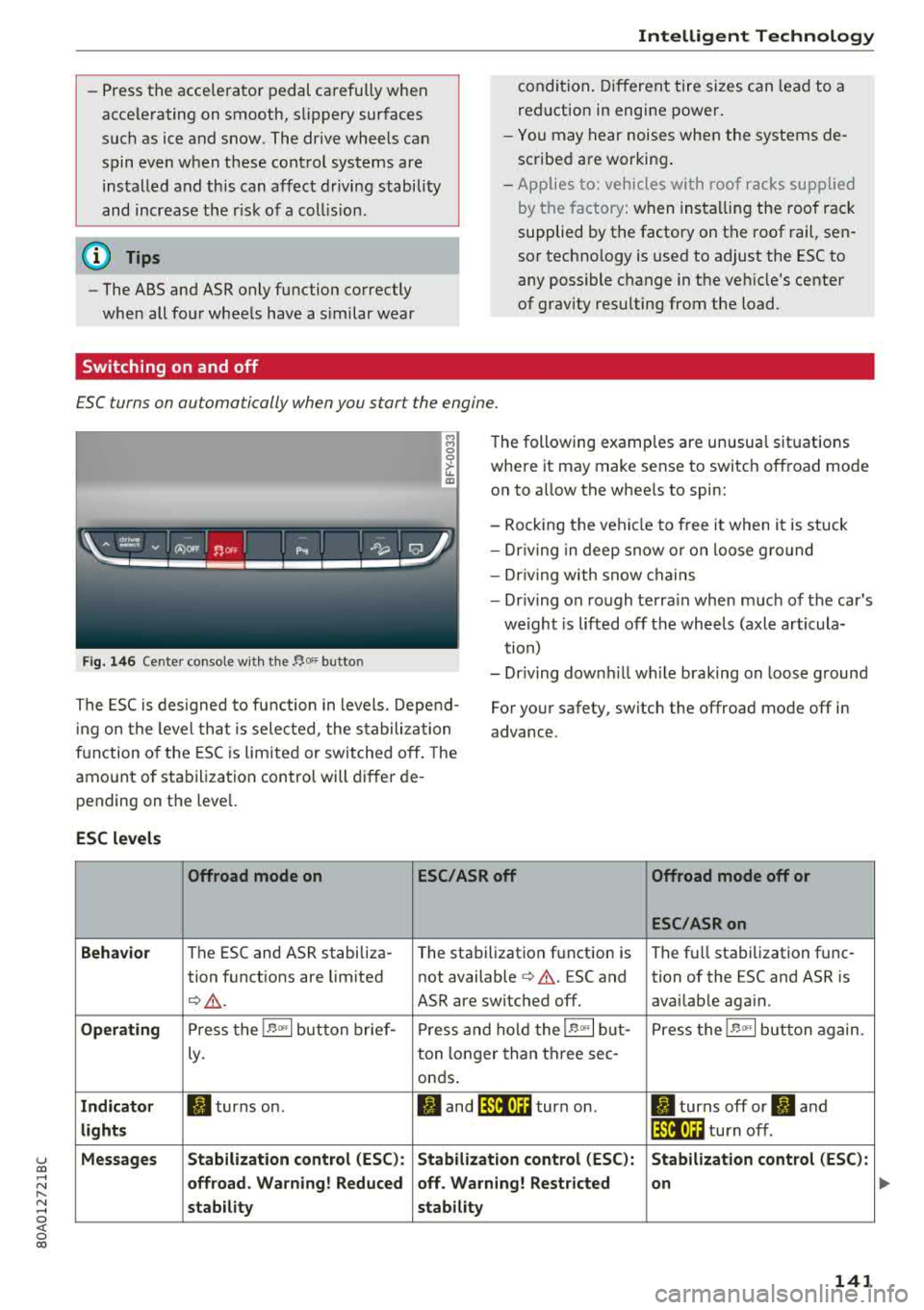
ESC turns on automatically when you start the engine.
F ig. 146 Ce nte r co nso le w it h th e 1',oFF butto n
The following examp les are unusua l situations
whe re it may make se nse to switch off road mode
o n to a llow the whee ls to spin:
- Rock ing t he veh icle to free i t when it is stuck
- Dr iv ing in deep snow o r on loose g ro und
- Dr iv ing with snow c hains
- Dr iv ing on ro ugh te rra in when much of the car 's
we ight is lifted off the wheels (axl e art icula
t ion)
- Dr iv ing down hill while b raking on loose g round
T he ES C is des igned to fu nction in levels . Depe nd
in g on the leve l that i s sele cted , the s ta b ili zat io n
f u nction o f the ES C i s lim ite d or sw it c hed off . The
amo unt o f sta biliza tio n control will differ de
pending on t he leve l. For yo
ur safety, switch the offroad mode off in
advance.
ESC levels
Offroad mode on ESC/ASRoff Offroad mode off or
ESC/ASRon
Behavior
T he ESC and ASR stabiliza -
The sta bilization f unction is T
h e f ull stabilizatio n fu nc -
tion f unct ions are limited not available
c> & . ESC and tion of the ESC and ASR is
Q _& . ASR are switc hed off . availab le aga in.
Operating P ress the 1.$ <>, I button brief - Pr ess and hold t he 1.$ <>, I but- P ress the 1.$ <>, I button again .
Ly. ton
lo n ge r than th ree sec -
on ds.
Indicator II turns on . JI and lf'lii•)H turn on. II turns off or II and
lights lf'lii•)~~ tu rn off.
Messages Stabilization control (ESC
): Stabil .ization control (ESC): Stabilization control (ESC ):
offroad . Warning! Reduced off . Warning! Restricted on
stability stability
141
..
Page 144 of 392
Intelligent Technology
A WARNING
You should only switch offroad mode on or
switch ESC/ ASR
off if your driving abilities
and the traff ic conditions perm it. There is a
r isk of slid ing.
- The stabilization function is limited when
offroad mode is switched on. The driving
wheels cou ld spin and the vehicle could
swerve, espec ially on slick or slippery road
surfaces.
- There is no vehicle stab ilizat ion when ESC/
ASR are switched
off .
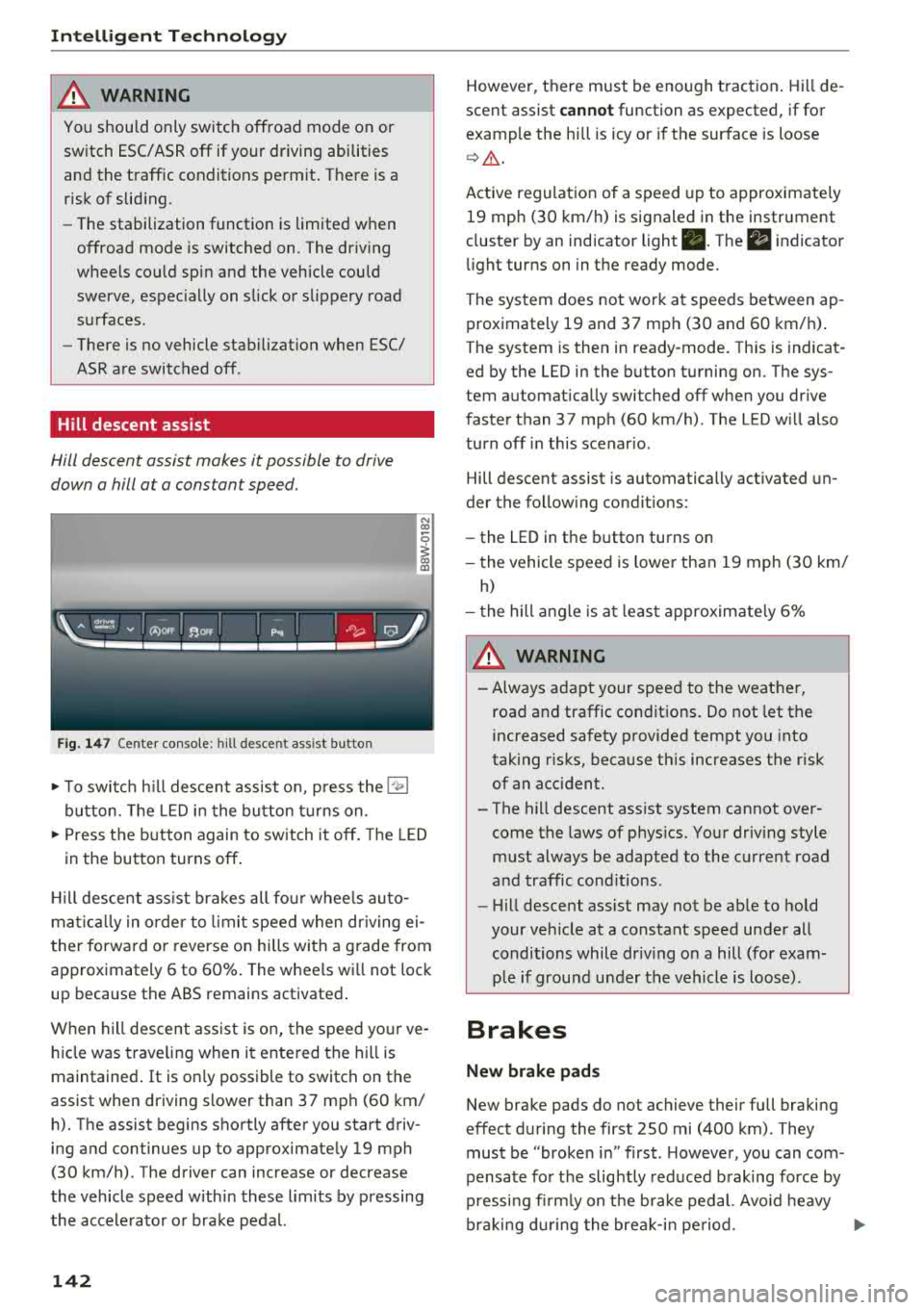
Hill descent assist
Hill descent assist makes it possible to drive
down a hill at a constant speed.
F ig . 147 Center console: hill desce nt ass ist button
.,. T o switc h hill descent assist on, press the l"l;,1
button. The LED in the button turns on.
-
N co
0
~ ID
.,. Press the button again to switch it off. The LED
in the button turns
off .
Hill descent ass ist brakes all fo ur whee ls auto
mat ically in o rder to limit speed when dr iving ei
ther forward or reverse on hills with a g rade from
approximately 6 to 60%. The wheels wi ll not lock
up because the ABS remains activated .
When hill descent ass ist is on, the speed yo ur ve
hicle was traveling when it ente red the hill is
maintained .
It is only possible to switch on the
assist when driving slower than 37 mph (60 km/
h). The assist begins shortly after you start driv
ing and continues up to approximate ly 19 mph
(30 km/h) . The driver can increase or decrease
the vehicle speed with in these limits by pressing
the accelerator or brake pedal.
142
However, there must be enough traction . Hi ll de
scent assist
cannot function as expected , if for
example the hill is icy or if the surface is loose
c> ,& .
Active regulation of a speed up to approximate ly
19 mph (30 km/h) is signaled in the instrument
cluster by an indicator light
• . The ii indicator
li ght turns on in the ready mode.
The system does not work at speeds between ap
proximately 19 and 37 mph (30 and 60 km/h).
The system is then in ready-mode. Th is is indicat
ed by the LED in the button turning on. The sys
tem automat ically switched off when you dr ive
faster than 37 mph (60 km/h) . The LED w ill also
turn off in this scenar io .
Hill descent assist is automatically activated un
der the follow ing condit ions:
- the LED in the button turns on
- the vehicle speed is lower than 19 mph (30 km/
h)
-the hill angle is at leas t approximate ly 6%
A WARNING
- Always adapt your speed to the weathe r,
road and traffic conditions . Do not let the
increased safety provided tempt you into
taking risks, because this increases the risk
of an accident .
- The hill descent assist system cannot over
come the laws of phys ics. Your driving style
must always be adapted to the current road
and traffic cond itions .
- Hill descent ass ist may not be ab le to hold
your veh icle at a constant speed under all
conditions while dr iv ing on a hill (fo r exam
p le if ground under the vehicle is loose).
Brakes
New brake pads
-
New brake pads do not achieve their full braking
effect during the first 250 mi (400 km). They
must be "broken in" first . H owever, you can com
pensate for the slightly reduced braking force by
pressi ng fi rml y on t he brake pedal. Avo id heavy
braking during the break-in period .
..,.
Page 145 of 392
u co ..... N r--N ..... 0 <( 0 00
Wear
Brake pad wear depends largely on the way the
vehicle is driven and on operating conditions.
This is especially true if you are driving frequently in the city and on curves or with a sporty driving
style.
Operating noise
Noises may occur when braking depending on the
speed, braking force and outside conditions such
as temperature and humidity.
Wet conditions or road salt
In certain situations, for example after driving
through water, in heavy rain or after washing
your car, the braking effect may be reduced due
to moisture or ice on the brake rotors and brake
pads. The brakes must be "dried" first with a few
careful brake applications.
At higher speeds and with the windshield wipers
turned on, the brake pads press against the brake
rotors for a short amount of time. This action,
which is not felt by the driver, happens at regular
intervals and ensures a better reaction time for
the brakes in wet weather.
The braking effect can also be reduced if you are
driving on salted roads and you do not apply the brakes for long periods of time. The layer of salt
on the brake rotors and pads must be worn off
first when the brakes are applied.
Corrosion
Leaving the vehicle parked for long periods of
time, low mileage and avoiding heavy braking
can contribute to corrosion on the brake rotors
and to dirty brake pads.
If you usually avoid heavy braking or if there is
corrosion present, occasional heavy braking at high speeds is recommended to clean the brake
rotors and
pads¢ ,&..
Brake system malfunction
If you notice that the brake pedal travel has sud
denly increased, then a brake circuit in the dual
circuit brake system may have malfunctioned. Drive to an authorized Audi dealer or authorized
Audi Service Facility immediately to have the
Intelligent Technology
problem corrected. On the way there, drive with
reduced speed and keep in mind that you will
need a longer distance to stop and you will need
to press the brake pedal harder.
Low brake fluid level
When the brake fluid level is low, malfunctions in
the brake system may occur. The brake fluid level
is electronically monitored.
Brake booster
The brake booster amplifies the pressure you ap
ply to the brake pedal.
& WARNING
= -
- Only apply the brakes for the purpose of
cleaning the brake system when road and
traffic conditions permit. You must not en
danger other road users. This increases the
risk of an accident.
- Never let the vehicle roll while the engine is
stopped because this increases the risk of an
accident.
- Never place objects in the driver's footwell.
An object could end up in the area around
the pedals and prevent you from using
them. You would not be able to use the ped
als if sudden driving or braking maneuvers
were needed, which increases the risk of an
accident.
- Only use floor mats that do not obstruct the
area around the pedals and that can be se
curely fastened in the footwells.
- To reduce the risk of injury, do not place
your foot under the brake pedal.
@ Note
- Never let the brakes "rub" by pressing the
pedal lightly when braking is not actually
necessary. This causes the brakes to over
heat and increases braking distance and
causes wear.
- Before driving downhill a long distance on a
steep hill, decrease your speed and select a
lower gear. This makes use of the engine
braking effect and relieves the brakes. If
you need to brake additionally, brake in in- tervals and not continuously.
.,,.
143
Page 146 of 392
Intelligent Technology
(D Tips
-If the brake booster is not working, you
must press the brake pedal with much more
force than normal.
- If you retrofit your vehicle with a front spoil
er, whee l covers or similar items, make sure
that the a ir flow to the front wheels is not
in terrupted. Otherw ise the brake system
can become too hot .
Electromechanical
steering, Dynamic
steering
The electromechanical steering supports the
driver's steering movements.
Power steering adapts electronically based on
the vehicle speed.
Indicator lights and messages
• Steering: malfunction! Please stop vehicle
If th is ind icator light turns on and stays on and
this message appears, the power steering may
have fa iled.
Stop the vehicle in a safe location as soon as pos
sible . Do
not continue driving . See an author ized
Aud i deale r or authorized Aud i Serv ice Facility fo r
assistance .
,~n Steering: malfunction! You can continue
driving
If the indicator light turns on and the message
appears, the steering wheel may be more diffi
cult to move or more sensit ive than usual. The
steer ing wheel may also be at an angle when
driving st raight.
Drive slowly to an au thorized Audi dealer or au
thor ized Audi Service Fac il ity to have the mal
function corrected .
I@ Dynamic steering: correcting steering wheel
position
If the indicator light turns on and this message
appears, the dynamic steering* is reinitializing.
The steering wheel will be easy to move after
starting the engine. Re initialization might be
144
necessary if the steering wheel was moved while
the engine was switched
off. T he disp lay turns
off if the initialization was successfu l.
(D Tips
-If the . or Erfl indicator light only stays on
for a short time, you may continue driving.
- T he dynamic steering stability systems
¢page 140 are not avai lab le in the event of
a system malfunction .
- For additional information on dynamic
steering, see
¢ page 125.
All-wheel drive (quattro)
General information
In all wheel drive, the driv in g power is distribut
ed between all four whee ls when needed. This
happens automatically depending on your driving
behavior as well as the current road conditions.
Also see
c> page 140 , Electronic Stabilization
Con trol (ESC).
The all-whee l drive system distributes the driving
power variably to the front and rear axle. It works
together with selective wheel torque control,
which activates when driving through curves
c> page 140. With the sport differential*, power
distribution to the rear wheels is variable and can
be adjusted using the drive select
c>poge 125 .
The all wheel drive concept is designed for high
engine power . Your vehicle is excep tionally pow
erful and has excellent driving characteristics
both under normal driving conditions and on
snow and ice. Always read and follow safety pre
cautions ¢.&. .
Winter tires
By using all wheel dr ive, your veh icle has good
forward motion w ith standard tires in winter con
ditions. However, using winter or all season t ires
o n oil four wheels in the winter is recommended,
because this w ill imp rove the braking effect.
Snow chains
If there are snow chain laws, snow chains must
also be used on veh icles with all wheel drive
c> page 340, Snow chains . .,.