ignition AUDI Q7 2009 Owner´s Manual
[x] Cancel search | Manufacturer: AUDI, Model Year: 2009, Model line: Q7, Model: AUDI Q7 2009Pages: 426, PDF Size: 97.13 MB
Page 340 of 426
___ C_h_ e_ c_k _in --== g'-- a_n _d_ f_il _li _n ..:::g:::..- ___________________________________________ _
models; 60% for Canadian models). This mixture both assures the
necessary frost protection and protects metal components in the
engine's cooling system from corrosion and scaling. It also raises
the boiling point of the coolant.
Do not reduce the concentration of the coolant in the summer by
adding plain water.
Th e pro port io n of coo la nt additi ve mu st be at
lea st 50 % but n ot mor e th an 60 %
to maintai n ant ifreeze protection
and cooling efficiency. If the coolant frost protection is too low , the
coolant could free ze and damage the veh icle heating and engine
cooling system .
For year-round driving , antifreeze is added at the factory for temper
atures down to:
• -31 °F ( -35 °c1 usA
• - 40 °F ( - 40 °C) Canada.
You can mix the
Gl 2+ + coolant additive with other additives (G12+
or G12). Always check w ith your authorized Audi dealer.
& WARNING
B efo re you che ck anyt hing in th e eng ine compartmen t, alway s
re ad a nd he ed all WARN ING S~
& in " Working in the engine
c ompar tm ent " on
page 33 1.
0 Not e
• Before winter sets in, have the coolant checked to see if the
coo lant additive in your vehicle is sufficient to meet the climate
conditions. This is especia lly important if you live in a region where
the winter is extremely cold . If necessary, increase the proportion of
coolant additive to 60%.
• When adding coolan t additive to your coo ling system,
remember:
-We recommend using only coolant additive
G12+ + (check the
label) for your vehicle. This coolant additive is avai lable at autho
riz ed Audi dealers. Other types of antifreeze can significantly reduce corrosion protection. The resulting corrosion can cause a
loss of coolant and serious engine damage.
• Do not add any type of radiator leak sealant to your vehicle's
engine coolan t. Adding radiator repair fluid may adversely affect the
function and performance of your cooling system and could result
in damage not covered by your New Vehicle Limited Warranty. •
Checking the engine coolant level
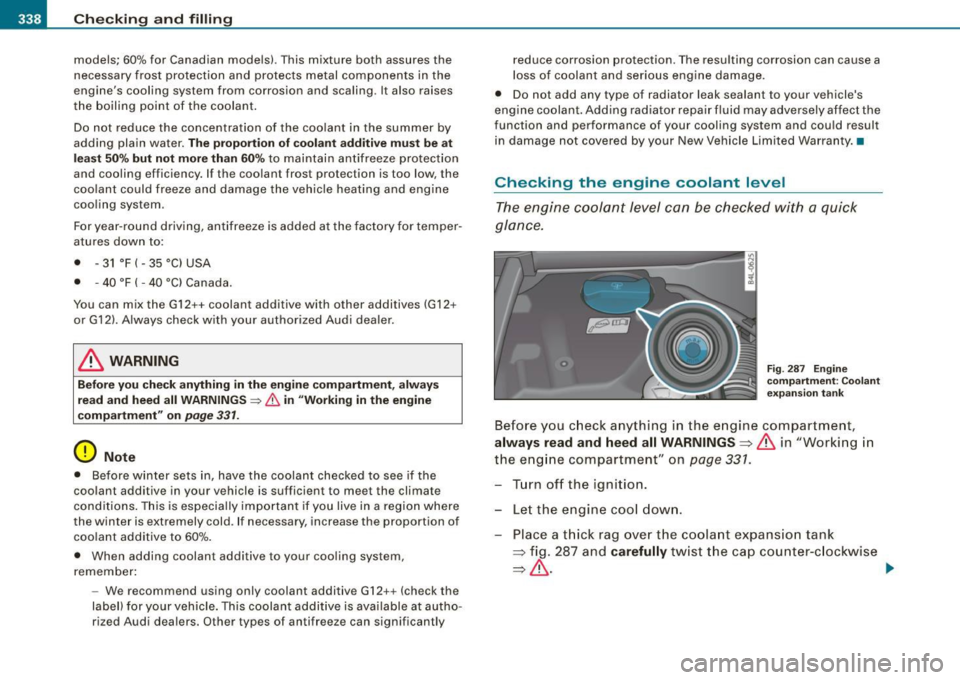
The engine coolant level can be checked with a quick
glance.
F ig . 287 E ngine
com partm ent : Cool ant
ex pans io n tank
Before you check anything in the engine compartment,
alw ays read and h eed all WARNINGS ~
& in "Working in
the eng ine compartment" on page 331.
- Turn off the ignition.
- Let the engine coo l dow n.
Place a thick rag over the coola nt expansio n tank
~ fig . 287 and carefully twist the cap counter-c lockwise
~ & - .,
Page 342 of 426
-~_C_ h_e _c _ k_ i_n ...:::g::;...._ a_n_ d_ f_ i_ll _in -'g:::;.._ ___________________________________________ _
G12+ +, G12 + or G12 is not available, do not use a different addit ive .
Use p lain water ins tead until you ca n get the c orrec t additive and
can restore the correct ratio . This should be done as soon as
poss ible.
If you have los t a considerable amount o f coo lant, then you s hould
add co ld antifreeze and cold water only when the engine is cold .
A lways us e
new en gi ne c oolant when refi llin g .
Do not fi ll coo lant above the "MAX" mark. Excess coolant wil l be
forced out through the pressure relief valve in the cap when the
engine beco mes hot.
& WARNING
• The cooling sy stem is under pressure and can get very hot .
Reduce the risk of s calding from hot coolant by following these
steps .
- Turn off the engine and allow it to cool down.
- Protect your face, hands and arms from escaping fluid and
steam by covering the cap with a large, thick rag .
- Turn the cap slowly and very carefully in a counter -clockwise
dire ction while applying light , downward pressure on the top
of the cap .
- To avoid being burned , do not spill antifreeze or coolant on
the exhaust system or hot engine parts . Under certain condi
tions , the ethylene glycol in engine coolant can catch fire.
• Antifreeze is po isonous . Always store antifreeze in its original
container and well out of the reach of children.
• If you drain the coolant , it must be caught and safely stored in
a proper container clearly marked "poison ".
0 Note
• Coo lant po llutes t he e nviro nment and cou ld cause a n en gin e
fire. Excess coolant wi ll be forced out through the pressure re lief
va lve in the cap when the eng ine becomes hot.
• I f, in an emergency, on ly wate r can be added, the correct ratio
between wate r and ant ifree ze::::>
page 337 must be restored as soon
as possib le .
W For the sake of the environment
Drained coolant should not be reused. Always dispose of used
coo la nt whi le observ ing all env iro nmen tal reg ulat io n s. •
Radiator fan
The radiato r fan switches on au toma tic ally by i tself.
The radiator fa n is dr iven by the eng ine via th e V -belt. The visco us
clutch regulates the speed of the fan according to the temperature
o f t he coo la nt.
An auxiliary electric radiator fan * sw itches on and off depending on
coo la nt t empe rat ure a nd othe r vehic le operating c ondi tio ns.
A ft er you sw itch the e ngine o ff, the au xiliary fa n ca n conti nue
running for up to 10 m inutes- even with the ignition off. It can even
switch o n again lat er by itsel f::::> & , if
• the temperature of the eng ine coo lant rises due to the heat
bu ild -up from the eng ine in the eng ine compartment, or
• the engine compartment heats up because the vehic le is parked
in i ntense sun ligh t.
& WARNING
• To reduce the ri sk of personal injury never touch the radiator
fan .
~
Page 344 of 426
-~_C_ h_e _c _ k_ i_n ...:::g::;...._ a_n_ d_ f_ i_ll _in -'g:::;.._ ___________________________________________ _
& WARN ING (c o ntinued )
• Brake failure can re sult from old or inappr opriate brake fluid .
Ob serve the se precautio ns:
- Use only brake fluid that meets SAE specific ation J 1703 and
c onform s to Fed era l Moto r Vehi cle St anda rd 116. Al ways c heck
with your authori zed Audi dealer to make sure you are u sin g
the corre ct brake fluid. The correct typ e of brake fluid i s also
indicated o n the brake fluid reser vo ir .
- The br ake flu id mu st be ne w. Heavy u se of the brake s can
c au se a vapor lock if the brake fluid i s left in the s ystem too
long. Thi s can seriou sly affect the effi cien cy of the brake s as
w ell a s your safet y. Thi s could re sult in an acci dent .
0 Note
Brake fluid will damage the paint of your vehicle .
For the sake of the environment
Because of the problem of proper disposal of brake fluid as well as
the special too ls required and the necessa ry expertise, we recom
mend that you have the brake fluid changed by your authorized Audi
dea ler .•
Battery
General information
Under normal operating condi tions, the battery in your Audi does
not need any maintenance. With
high outside temperatures or long
daily drives we recommend that you have the e lectrolyte level
checked by an au thorized Audi dealer or qualified workshop . The
e lectrolyte level should also be ch ecked each time the battery is
charged ~
page 344.
Have the battery checked when you take your vehicle in for service .
Yo u are well advised to replace a battery that is o lder than 5 years .
With certain types of airbag dep loyment, the battery is discon
nected from the vehicle electrical system for safety reasons~
& in
"Repair, care and disposal of the airbags" on
page 255.
Disconnecti ng th e batt ery termin als
Some vehicle functions (power window regulators , for example) are
lost if the battery termina ls are disconnected. These functions have
to be relearned after the battery terminals are connected again . To
prevent this, the battery should only be disconnected from the
vehic le electrical sys tem when abso lutely necessary for repairs .
Vehicles not driven for long per iods
If you do not drive your vehicle ove r a period of several days or
weeks, electrical components are gradually cut back or switched off .
T his reduces energy consumption and maintains starting capab ility
over a longer period
~ page 295 .
Take i nto consideration that whe n you u nlock your vehicle, some
convenience functions, such as the master key remote function or
powe r seat adjustme nt, may not be ava ilable. The convenience
functions will be available again when you turn on the ignition and
start the engine .
Wint er op erati on
Duri ng the winter mont hs, batte ry capacity tends to decrease as
temperatures drop . This is because more power is also consumed
whi le star tin g, and the headlights, rear window defogger, etc ., are
used more often.
Avoid unnecessary power consumption, particular ly in city traffic or
when trave li n g o nly short dis tances . Let your authorized Audi dea ler
check the capacity of the vehicle battery before winter sets in
~ page 344. A we ll cha rged battery w ill not only preven t starting
problems when the weather is cold, but will also last longer . ..,_
Page 346 of 426
•---=C:.:h..:. e=-= c..:.k :..:.in :..:.:= g:.....= a..:.n :.:d::....:. f.:.:il .:.:li ..:.n :..::g~ --------------------------------------------
& WARNING (continued )
battery to heat up very quickly, wh ich could lead to damage or
explosion and personal injury .
• When a battery is charged , it produces h ydrogen gas which i s
explosive and could cau se personal injury .
• Always keep the battery well out of the reach of children.
• Before work is done on the electrical system , disconnect the
negative ground cable .
• Before performing any work on the ele ctri cal system , switch off
the engine and ignition as well as any electrical equipment. The negative cable on the battery m ust be disconnected . If you are ju st
going to replace a light bulb , then it is enough to switch off the
lights .
• Before disconnecting the battery , switch off the anti -theft
alarm system! Otherwise you will set off the alarm .
• When disconne cting the battery , first disconnect the negative
c able and then the positive cable .
• Before reconnecting the battery , make sure all electrical
c onsumers are swit ched off . Reconnect the positive cable first and
then the negative cable. Never interchange the cables - this could start a fire !
• Never charge a frozen or a thawed -out battery. It could
explode! If a battery has frozen , then it must be replaced . A
discharged battery can freeze over at 32 °F (0 °Cl.
• Make sure the vent hose is always attached to the opening on
the side of the battery.
• Never use batteries whi ch are damaged . There is the danger of
an explosion! Always replace a damaged battery.
& WARNING
Californ ia Proposition 65 W arning :
& WARNING (continued )
• Battery posts, terminals and related accessories contain lead
and lead compounds, chemicals known to the State of California
to cause can cer and reproductive problems . Wash hands after
handling .
0 Note
• Do not disconnect t he veh icle battery w he n th e ign itio n is
switched on or when the engine is running , otherwise, you will
damage e le ctronic co mponents in the elec trical sys tem.
• I f your vehicle i s going to stand for a long period of time without
b ei ng dr iven, prot ec t the batte ry from "fr ee zing", otherwise it will
be damaged and will then have to be rep laced. •
Battery charging
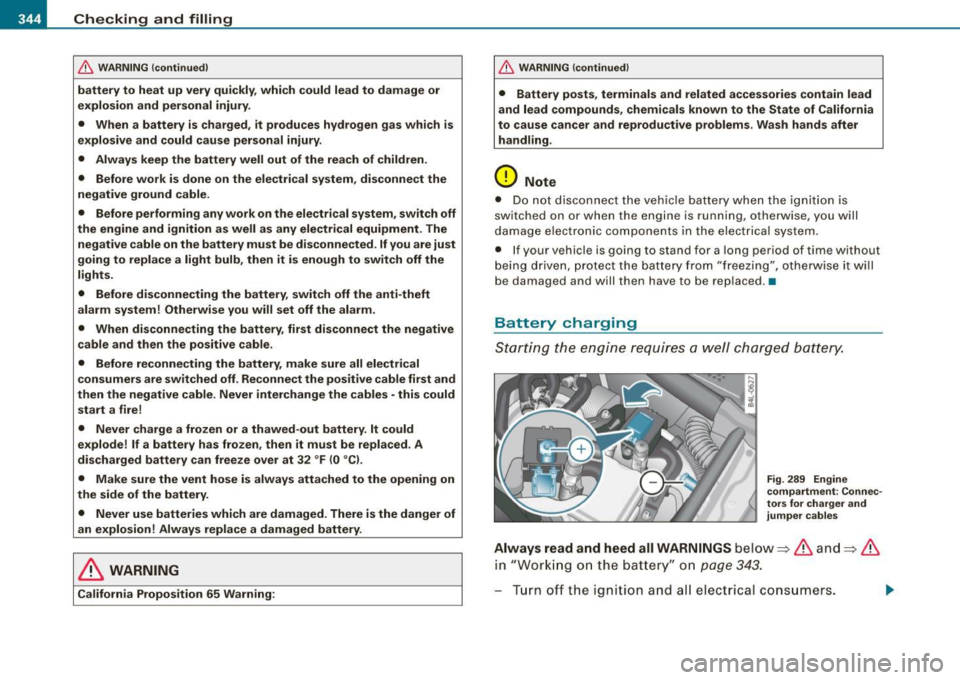
Sta rti ng th e e ngin e req uires a well c harged ba tte ry.
F ig . 289 Engine
compartment : Conne c
tors fo r charge r and
jumper cable s
Always read and heed all WARNINGS be low ~ & and::::} &
in "W orkin g on the b atte ry" on pa ge 34 3.
- Tur n off the ig ni tio n a nd a ll elec tric al co nsum ers.
Page 348 of 426
llftl __ C _h_ e_ c_k _in --== g'-- a_n _d_ f_il _li _n ..:::g:::..- ___________________________________________ _
Battery replacement
The new battery must have the same specffications and
dimensi ons as the original equipment battery.
Intel ligen t energy management in your vehicle is responsible for
distributing the e lectrica l ene rgy throughout your vehicle
::} page 295. The intelligent energy management system will keep
the engine battery charged bette r then vehicles wi thou t this system .
To make sure the additional electrical energy is available once again
after you have changed the batte ry, we recommend that you install
batteries of the same type and manufacture only (the same as those
installed at the time your vehicle was delivered). Specifications are
listed on the battery housing . Your authorized Audi dealer will then
code the battery management cont rol unit .
If i t is no t possib le to use a ba ttery o f this type, the new battery m ust
have the same capacity, vo ltage (12 volts), amperage, construction
and plug seal ing.
When installing the battery, make sure the ignition and all electrica l
consumers are turned off .
0 Note
Make sure the ventilation hose on the side of the bat tery is
connected, otherwise fumes or battery acid can leak out .
W For the sake of the environment
Because of the problem of proper d isposal of a battery , we recom
mend your authorized Aud i dea ler change the battery for you .
Ba tteries contain sulfuric acid a nd lead and must always be
disposed of properly in compliance with all environmental regula
tions. D isposi ng o f vehicle ba tteries i mproper ly is very dangerous to
the environment .•
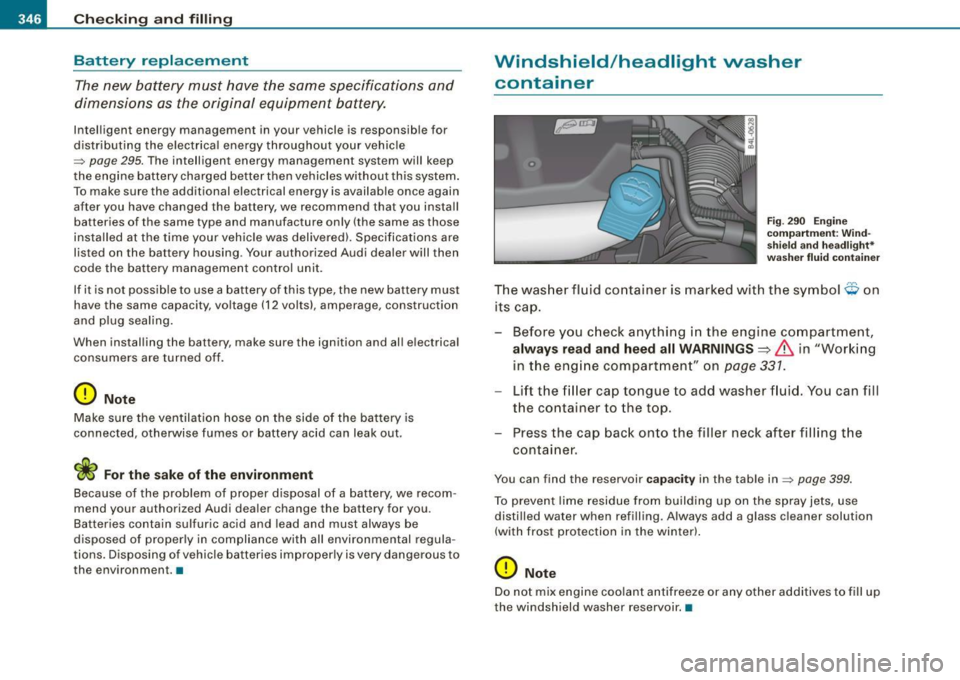
Windshield/headlight washer
container
Fi g. 290 Engine
co mpartment : Wind
s hield and h eadli ght *
washer fluid container
T he w as her fluid co ntainer is m arke d with the sy mbol ¢' on
its cap .
- Before you c heck anything in the engine compartment,
always read and heed all WARNINGS~
& in "Wor kin g
in t he en gine comp artmen t" on
page 33 7.
- Lift the fi ller cap tongue to add washer fluid. You can fill
the containe r to the top.
- Press the cap bac k on to the filler neck after fi lling t he
contai ner .
You can find the reservoir capa city in the tab le in ::} page 399.
To prevent lim e residue from building up on the sp ray je ts, use
distilled water when refilling . Always add a glass cleaner solution
(with fr ost protection in the winter).
0 Note
Do no t mix engine coo lant antifreeze or any o ther additives to fill up
the windshield washer reservoir. •
Page 383 of 426

_________________________________________________ F_ u_ s_ e_s _ a_n _d_ b_ u _ lb_ s _ __._
Fuses and bulbs
Fuses
Replacing a fuse
A problem in the electrical system may be caused by a
blown fuse.
Fig . 307 Ins trument
pa nel left: Face c over
F ig . 308 I nst rume nt
pa nel left: Co ntent
F ac e cover
- Locate the fuse which belongs to the component which
failed.
- Switch off the ignition and the e lectr ica l component
affected. - Carefully p
ry t he face cover off the instr umen t pane l
using the ignition key or a screwdriver~ fig. 307.
- Rem ove the plastic clip @ from i ts retainer in the face
cove r~ fig. 308, p lace i t over the questionable fuse and
remove the fuse.
- Replace a blown fuse (recognizable by the melted metal
str ip inside) wi th a f use of the
same amperage.
The individual circuits are protected by fuses. T he fuse panels with
the fuses are located on the left and right front faces of the instru
ment pane l behind a cover and in the right storage area in the
luggage compartment.
There is a plastic clip @ in the cover on the lef t side of the instru
ment pane l, which can be used to remove the fuses . The crank © is
used for emergency operation of the Panoramic sliding sun roof *.
You w ill also find a label on both covers in the instrument panel with
the fuse layout © for the corresponding fuse panel.
& WARNING
Nev er replac e a fuse with one that ha s a high er amperag e rati ng.
• A fu se w ith a to o high ampe rage could damage the ele ctr ical
pa rt a nd cause a fire .
0 Note
• On no account should fuses be repaired (e .g. patched up wi th tin
foil or wire) as this may cause serious damage elsewhere in the e lec
trica l circuit o r cause fire.
• If a fuse blows repeatedly, do not keep replacing it. Instead , have
the cause of the repea ted short circuit or overload located and fixed.
ti>
Vehicle care Do-it-yourself service Technical data
Page 384 of 426
lllftl.,___F_ u_ s_ e_s _ a_n _ d_ b_ u_lb _ s _______________________________________________ _
[ i J Tips
You are well advised to keep a supply of spare fuses in your vehicle .
Fuses with the proper ampere ratings are available at your autho
rized Audi dealer. •
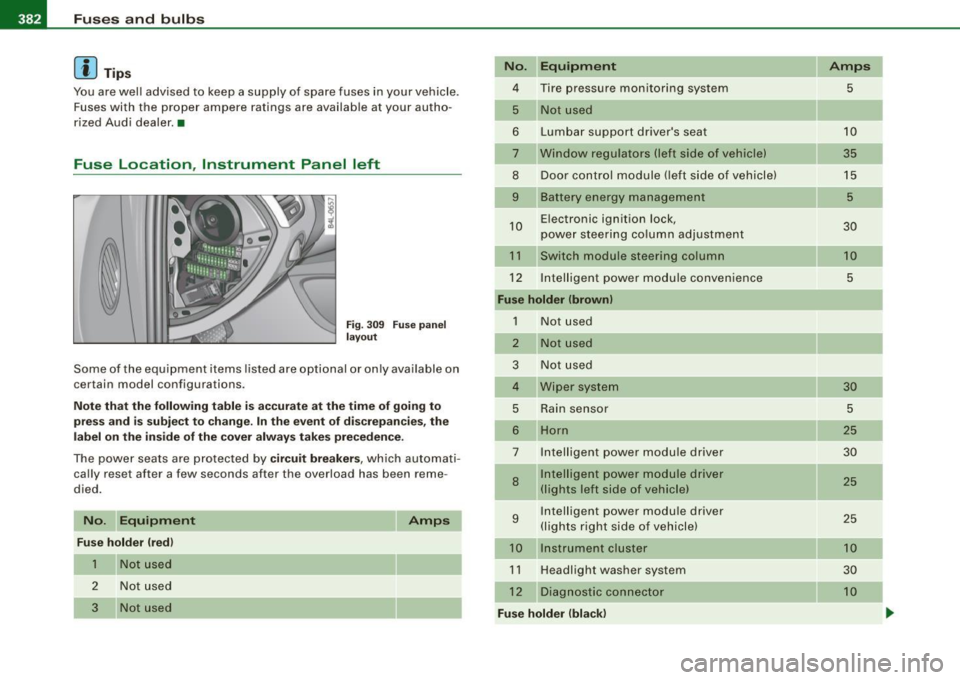
Fuse Location, Instrument Panel left
Fig . 309 Fuse panel
layout
Some of the equipment items listed are optional or only available on
certain model configurations .
Note that the following table is accurate at the time of going to
press and is subject to change. In the event of discrepancies, the
label on the inside of the cover always takes precedence.
The power seats are protected by circuit breakers, which automati
cally reset after a few seconds after the overload has been reme
died.
No.
Equipment
Fuse holder (red)
1
2
3
Not used
Not used
Not used
Amps
No. Equipment
4 Tire pressure monitoring system
5 Not used
6 Lumbar support driver's seat
7 Window regulators (left side of vehicle)
8 Door control module (left side of vehicle)
9 Battery energy management
10 Electronic ignition lock,
power steering column adjustment
11 Switch module steering column
12 Intelligent
power module convenience
Fuse holder (brown)
1
2
Not used
Not used
3 Not used
4 Wiper system
5 Rain sensor
6 Horn
7
8
9
Intelligent power module driver
Intelligent power module driver
(lights left side of vehicle)
Intelligent power module driver
(lights right side of vehicle)
10 Instrument cluster
11 Headlight washer system
12 Diagnostic connector
Fuse holder (black) Amps
5
10
35 15
5
30
10 5
30
5
25
30
25 25
10
30
10
-
Page 399 of 426
_________________________________________________ G_ e_ n_ e_r _a _l_ i_n _f_o _ r_ m_ a_ t _i _o _ n __ ll'II
v e hic le identificatio n number of your vehic le (p erforation) as well as
th e G ro ss V ehic le We ight Rat ing (GVWR) an d the Gro ss A xle We ig ht
R ating (GAWRl .
The high voltage warning label is located on the lock carrier.
The spark ignition system complies with the Canadian standard ICES-002 . •
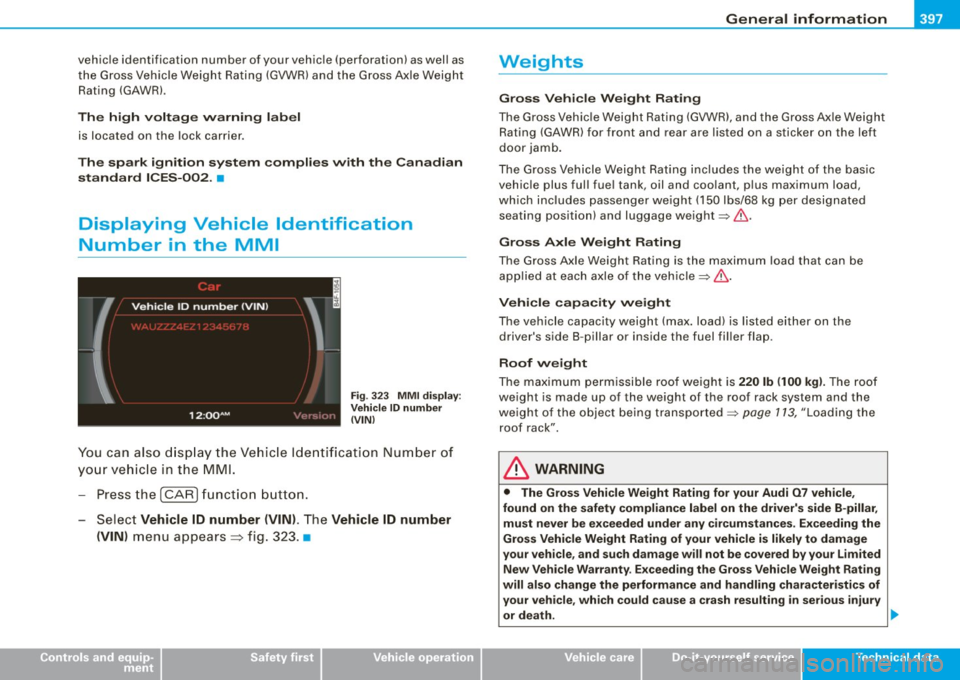
Displaying Vehicle Identification
Number in the MMI
Fig . 323 MMI di splay :
Vehicle ID number
(VIN)
Y ou can also display t he Vehi cle Id ent ifi catio n Num ber of
y o ur vehi cle in the MM I.
- Pre ss th e
(CA RI fun ctio n bu tton.
- Selec t
Vehicle ID number (VIN) . The Vehicle ID number
(VIN)
m enu appea rs=> fig. 3 23 . •
Controls and equip
ment Safety first Vehicle operation
Weights
Gross Vehicle Weight Rating
The G ross Ve hicle We ight Rating (GVWR), a nd the Gross A xle Weight
R ating (GAW R) for front and rear are l isted on a stic ker on the left
doo r jamb .
T he G ross Ve hicle We igh t R ating includes t he weight o f the bas ic
vehic le plus full fue l tank , oil and coo lant, p lus maximum load,
w hi ch includes passe nger we ight (1 50 lbs/68 kg per des ignat ed
seat ing position) and luggage weight:::::,&.
Gross Axle Weight Rating
The Gross Axle Weight Rating is the maximum load that can be
ap plied at each axl e of the vehicle:::::, .&,.
Vehicle capacity weight
The vehic le capacity weig ht (max. load) is list ed e ither on the
driver's side B -pillar or ins ide the fuel fi ller flap.
Roof weight
The maxi mum pe rm is s ible roof we ig ht i s 220 lb (100 kg ). The ro of
we ight is made up of th e wei ght of t he roof rack system an d the
we igh t of t he o bjec t being tra nspo rted :::::, page 1 13, "Lo adi ng the
roo f rack".
& WARNING
• The Gross Vehi cle Weight Rating for your Audi 07 vehi cle ,
found on the safety compliance label on the driver's side B -pillar ,
must never be exceeded under any circumstances . Exceeding the
Gross Vehicle Weight Rating of your vehicle is likely to damage
your vehicle , and such damage will not be covered by your Limited
New Vehicle Warranty . Exceeding the Gross Vehicle Weight Rating
will also change the performance and handling characteristics of
your veh icle , which could cause a crash resulting in serious injury
or death. .,_
Vehicle care Do-it-yourself service Tec hn ica l da ta
Page 405 of 426
__________________________________________________ C_o_ n _ s_u_ m_ e ___ r_l_ n _f_ o_ r _m...:....:.. a:.;..:. ti .... o:.. n ........ _llll
& WA RNIN G (continu ed )
• The engine compartment of any motor vehi cle i s a potentially
h az ardou s area. N ev er re ach into the are a arou nd or to uch the
r a di ator fan . It is temperature co ntrolled and can swi tc h o n
s uddenly -even wh en the engine i s off and the ignition key h as
been removed . The r adiator f an switches on autom atic all y w hen
the coolant reache s a certain temperature and will continue to run
until the coo lant t emper ature drop s.
• Alway s remov e th e ignition key befo re anyone get s under the
v ehi cle .
• Alway s s upport your vehi cle with safety sta nd s if it i s ne ces
sa ry to wor k unde rne ath the veh icle . The ja ck suppl ied with the
v ehic le i s not adequ ate for thi s purpo se and could coll ap se
c au sin g s eriou s per son al in jury .
• If you m ust w ork under neath the vehi cle with the wheel s on
the ground , alwa ys m ake sure the veh icle i s on l eve l ground , that
the wheels ar e always securely blocked and that the engine
ca nn ot be sta rted .
• Alway s mak e sure the tran sm iss ion selecto r leve r (automatic
tr ansmi ssion ) is in "P " (P a rk po sition ) and the park brake is firml y
applied .
c£> For the sake of the environment
• Changing the engine settings w ill adverse ly affect emission
levels . This is detrimenta l to the environment and increases fuel
consumption.
• Always observe environmenta l regu lations when disposing of
old engine oil, used brake fluid, dirty engine coolant, spent batteries
or worn out tires.
• Undeployed airbag modules and pretens ioners might be classi
fied as Perchlorate Material -specia l handling may apply, see
www .dtsc .ca .gov/hazardouswaste/perchlorate. When the vehicle or
parts of the restraint system including airbag modules safety belts
with pretens ioners are scrapped, all applicable laws and regu la-
Controls and equip
ment Safety first Vehicle operation
tions must be observed. Your authorized Audi dealer is familiar with
these requirements and we rec
ommend that you have your dea ler
perform this service for you .•
Additional accessories ,
modifications and parts replacement
Addition al a ccessori es and parts
replacement
Always c onsul t an authorized Audi dealer before
purchasing accessories.
Your vehicle incorporates the latest safety design features ensuring a high standard of act ive and passive safe ty .
This safety could be compromised by non -approved changes to the
vehic le . F or this reason, if par ts have to be replaced, please observe
the following points when insta lling additiona l accessories:
Approved Audi accessories and genuine Audi parts are avai lable
from authorized Audi dealers.
These dealers also have the necessary facilities, tools and trained specialis ts to install the parts and accessories prope rly.
& WARNING
Using the wrong spare part s or u sing non-approved acce ssorie s
can c ause seri ous persona l injur y.
• Use onl y acc essorie s ex pres sly approved by Audi and g enuine
Audi spare p art s
• The se p art s and acce ssorie s have been spe cia lly de signed to
be used on you r vehi cle .
• Nev er in stall acc ess orie s s uch a s telep hone cra d le s or
be ver age holder s on airb ag cover s or within th e airbag deploy-
Vehicle care Do-it-yourself service Tec hn ica l da ta
Page 411 of 426

______________________________________________ A_ l_,_ p _h_ a_ b_e _t_ic _ a _ l _in _ d_e _ x __ lll
Important things to know . ... .. .... 241
Indi cator light ...... .. .... ... ..... 252
Monitoring ... .... .... ..... .. .... 252
PASSENGER AIR BAG OFF light ... .. 253
Repairs .. .... .... .... ... .... .... 255
Safety instructions ... .... ..... .. . 254
Side airbags ... .. .... .... ...... .. 257
Side curtain airbags ... .. .... .... . 260
Weight -sensing mat .... ........ .. 264
When must the system be inspected? ..
252
All Wheel Drive .. .... ....... ...... .. 294
Alloy wheels ... .. .... .... ..... .. .... 318
All-whee l drive
Winter tires .... .. .... ...... ... .. . 363
Alternator Malfunction . .... .... ........ ..... 32
Anti-freeze
See Engine coo lant system .. ...... . 337
Anti-glare inside day-night mirror .... 86, 87
Anti -lock brake system
How the ABS system works . .... ... 292
Warning/indicator lights .. .... .... .. 22
Anti-Slip Regulation System (ASR)
How the system works ........ .... 290
Anti-theft systems
Anti-theft alarm system ... ......... 63
Elec tronic immobilizer .. ... .... .... 51
Approach/departure angle ............ 302
Ashtray Front .. .... ... .. .... .... ...... .. 116
R ear .... ... .. .... .... ........... 116
Controls and equip
ment Safety first
ASR
How the Anti-Slip Regulation System
works ...... ............. ...... 290
Asterisk What does it mean when something is
marked with an asterisk? .. ....... .. 6
Audi braking guard ....... .... ... .... 168
Error messages ....... .... ... .... 170
Settings ........... ... .... .... ... 169
Status messages .......... .... ... 170
Switching on and off .. .... .... .... 169
Audi Service Repair Manuals and Literature
401
AUTO mode AC climate contro ls ..... ...... .... 126
Auto Safety Hotline ..... ... ... .. .... . 229
Auto -Check Control ...... ..... ... .... . 30
Automatic belt retractor ... .. .... .... . 235
Automatic car wash
See Washing ............... .... .. 313
Au tomatic mode
Four -zone automatic comfort air
conditioning .... ...... ...... ... 132
Automatic Shif t Lock (ASU ...... ... ... 186
Automatic transmission
6 -speed automatic transmission .... 184
Automatic Shift Lock (ASU ...... .. . 186
Driving ...... ....... ...... .... ... 1 84
Dynamic shift program .... ........ 187
Emergency release for selector lever 189
F ail-safe mode ...... ... .. .... ... . 189
Ignition key safety lock ..... .. .... . 143 Manua
l sh ift program .. .. ....... .. 188
Selector lever .................... 185
Shift buttons ...... .... .... ...... . 189
Steering wheel with tiptronic® ..... 189
Average speed ....................... 40
Avo id damaging the vehicle ... .... .... 299
B
Background lighting
Lighting profiles . ......... ......... 79
Bass box ........... ... .. .... ...... . 371
Battery ...... .... ... .... .... .... ... 342
Battery location .......... .... .... 343
Charging ........................ 344
Important warnings when working on the
battery ...... ....... .... ...... . 343
Jump starting ................ .... 387
Low ...... ........... ....... .. .. 295
Replacing the battery ............ . 346
State of charge ................... 295
Voltage ........... ...... .... .... . 36
Winter operation ............ ... .. 342
Working on the battery ... ....... .. 343
Before driving ... .... .... ...... .... . 221
Blended gasoline .................... 325
Body cavity sealing .. .... .... .... ... . 318
Booster seats ...... ... .. .... .... .... 271
How do I properly insta ll a booster seat in
my vehic le? . .... .... .... ... .... 271
Safety instructions .... .......... .. 271
Brake assistant .......... .... .... ... 293
K ick -down .... .... ...... ...... ... 187 Brake booster ....................... 292
Vehicle operation Vehicle care Do-it-yourself service Technical data