ignition AUDI Q7 2009 Owner´s Manual
[x] Cancel search | Manufacturer: AUDI, Model Year: 2009, Model line: Q7, Model: AUDI Q7 2009Pages: 426, PDF Size: 97.13 MB
Page 276 of 426
___ C_h_ i_ ld _ S_ a_ f_ e_ t_y ____________________________________________ _
& WARNING (continued)
• If the backrest is not securely latched, the child and the child
restraint will be thrown forward together with the backrest and
will strike parts of the vehicle interior . The child can be seriously
injured or killed.
• Never install rear-facing child safety seats or infant carriers on
the front passenger seat. A child will be seriously injured and can be killed when the passenger airbag inflates .
• The inflating airbag will hit the child safety seat or infant
carrier with great force and will smash the child safety seat and
child against the backrest, center arm rest, door or roof.
• Always install rear-facing child safety seats or infant carriers on
the rear seat.
• Forward-facing child safety seats or infant carriers installed on
the front passenger's seat may interfere with the deployment of
the airbag and cause serious injury to the child.
• It is safer to install a forward-facing child safety seat on the rear
seat. • Always read and heed all WARNINGS whenever using a child
restrained in a vehicle is being used
~ page 263. Special precau
tions apply when installing a child safety seat on the front
passenger seat
~ page 243, "Child restraints on the front seat -
some important things to know ".
L1}. WARNING
Always take special precautions if you must install a forward or
rearward -facing child restraint on the front passenger's seat in
exceptional situations:
• Whenever a forward or rearward -facing child restraint is
installed on the front passenger seat, the PASSENGER AIR BAG
OFF light must come on and stay on whenever the ignition is
switched on .
& WARNING (continued)
• If the PASSENGER AIR BAG OFF light does not come on and stay
on, perform the checks described
~ page 252, "Monitoring the
Advanced Airbag System" .
• Take the child restraint off the front passenger seat and install
it properly at one of the rear seat positions if the PASSENGER AIR
BAG OFF light does not stay on whenever the ignition is switched
on .
• Improper installation of child restraints can reduce their effec
tiveness or even prevent them from providing any protection.
• An improperly installed child restraint can interfere with the
airbag as it deploys and seriously injure or even kill the child.
• Always carefully follow the manufacturer's instructions
provided with the child safety seat or carrier.
• Never place additional items on the seat that can increase the
total weight registered by the weight-sensing mat and can cause injury in a crash.
L1}. WARNING
Forward-facing child restraints:
• Always make sure the forward -facing seat has been designed
and certified by its manufacturer for use on a front seat with a
passenger front and side airbag.
• Never put the forward-facing child restraint up , against or very
near the instrument panel .
• Always move the passenger seat into its rearmost position in
the seat's fore and aft adjustment range, as far away from the airbag as possible before installing the forward-facing child
restraint . The backrest must be adjusted to an upright position.
• Make sure that the PASSENGER AIR BAG OFF light comes on
and stays on all the time whenever the ignition is switched on . _.
Page 277 of 426

Child Safety -
--------------------''---
& WARNING
Rearward-facing child restraints:
• A child in a rearward-facing child safety seat installed on the
front passenger seat will be seriously injured and can be killed if
the front airbag inflates -even with an Advanced Airbag System.
• The inflating airbag will hit the child safety seat or infant
carrier with great force and will smash the child safety seat and
child against the backrest, center arm rest, door or roof.
• Always be especially careful if you must install a rearward
facing child safety seat on the front passenger seat in exceptional
circumstances.
• A tight tether strap on a rearward-facing child restraint
attached to the front passenger seat can put too much pressure
on the weight-mat in the seat and register a heavier weight in the
Advanced Airbag System. The heavier weight registered can make
the system work as though an adult were on the seat and deploy
the Advanced Airbag when it must be suppressed causing serious
or even fatal injury to the child.
• Make sure that the PASSENGER AIR BAG OFF light comes on
and stays on all the time whenever the ignition is switched on.
• If the PASSENGER AIR BAG OFF light does not come on and stay
on, immediately install the rear-facing child safety seat in a rear
seating position and have the airbag system inspected by your
authorized Audi dealer. •
Activating the convertible locking retractor
Use the convertible locking retractor to secure a child
restraint.
Always heed the child safety seat manufacturer's instruc
tions when installing a child restraint in your vehicle. To
activate the convertible locking retractor:
Controls and equip ment Safety first
Vehicle operation
-Place the child restraint on a seat, preferably on the rear
seat.
- Slowly pull the belt
all the way out.
- Route it around or through the child restraint belt path
~& -
- Push the child safety seat down with your full weight to
get the safety belt really tight .
- Insert the belt tongue into the buckle for that seating
position.
- Guide the safety belt back into the retractor until the belt
lies flat and snug on the child safety seat.
- You should hear a "clicking" noise as the belt winds back
into the inertia reel. Test the convertible locking retractor
by pulling on the belt. You should no longer be able to
pull the belt out of the retractor. The convertible locking
retractor is now activated.
- Make sure that the red release button is facing away from
the child restraint so that it can be unbuckled quickly.
- Pull on the belt to make sure the safety belt is proper ly
tight and fastened so that the seat cannot move forward
or sideways more than one inch (2.5 cm).
& WARNING
Using the wrong child restraint or an improperly installed child
restraint can cause serious personal injury or death in a crash.
• Always make sure that the safety belt retractor is locked when
installing a child safety seat. An unlocked safety belt retractor
cannot hold the child safety seat in place during normal driving or
in a crash. ..
Vehicle care Do-it-yourself service Technical data
Page 297 of 426

& WARNING (continued)
• On wet road surfaces, be careful not to drive too fast because
the front wheels could begin to slide on top of the water (aqua
planing) . If this should occur , you will have no warning from a
sudden increase in engine speed as with a front -wheel drive
vehicle. Always drive at speeds which are suited to the road condi
tions -risk of crash. •
Energy management
Starting ability is optimized
Energy management controls the distribution of electrical
energy and thus optimizes the availability of electrical
energy for starting the engine.
If a vehicle with a conventional energy system is not driven for a
long period of time, the battery is discharged by idling current
consumers (e.g. immobilizer). In certain circumstances it can result
in there being insufficient energy available to start the engine.
Intelligent energy management in your vehicle handles the distribu
tion of electrical energy. Starting ability is markedly improved and
the life of the battery is extended.
Basically , energy management consists of
battery diagnosis, idling
current management
and dynamic energy management .
Battery diagnosis
Battery diagnosis continuously determines the state of the battery.
Sensors determine battery voltage, battery current and battery
temperature. This determines the current state of charge and the
power of the battery.
Controls and equip ment Safety first Vehicle operation
Intelligent technology
Idling current management
Idling
current management reduces energy consumption while the
vehicle is standing. With the ignition switched off, it controls the
energy supply to the various electrical components. Data from
battery diagnosis is considered.
Depending on the battery's state of charge, individual consumers
are gradually turned off to prevent excessive discharge of the
battery and thus maintain starting capability.
Dynamic energy management
While the vehicle is being driven, dynamic energy management
distributes the energy generated according to the needs of the indi
vidual components. It regulates consumption, so that more elec
trical energy is not being used than is being generated and ensures
an optimal state of charge for the battery.
[ i] Tips
• But even energy management cannot negate the limits of
physics. Consider that the power and life of a battery are limited.
• I f starting ability is threatened, you are informed by a warning
~ page 296, "Driver notification in the instrument cluster
display". •
What you should know
-----------------
The highest priority is given to maintaining starting capa-
bility.
Th e battery is severely taxed in short -distance driving, in city traffic
and during the cold time of year. Abundant electrical energy is
required, but only a litt le is generated. It is also critical if the engine
is not running and electrical components are turned on. In this
instance energy is being consumed but none is being generated.
It is in precisely these situations that you will notice energy manage
ment actively regulating the distribution of energy.
•
Vehicle care Do-it-yourself service Technical data
Page 298 of 426
llffl __ ln_ t _e_ ll-'"ig ...,_ e_ n_t _t_ e_ c_ h _ n_o _ l_o _,.g= y,_ __________________________________________ _
Vehicle stands for an extended period
If you do not drive your vehicle over a period of several days or
weeks, electrical components are gradually cut back or switched off.
This reduces energy consumption and maintains starting capability
over a longer period.
Take into consideration that when you unlock your vehicle, some
convenience functions, such as the remote key or power seat
adjustment, may not be available. The convenience functions will be
available again when you turn on the ignition and start the engine.
With the engine turned off
If you listen to the radio, for example, with the engine turned off or
use other MMI functions, the battery is being discharged.
If starting capability is jeopardized due to energy consumption, the
following warning appears in the MMI display:
Please start engine, otherwise system will switch off in
3 minutes.
The warning indicates that the system will be turned off automati
cally after 3 minutes. If you wish to continue using the functions,
you have to start the engine.
With the engine running
Although electrical energy is generated when the vehicle is being
driven, the battery can become discharged. This happens mostly
when little energy is being generated and a great deal consumed and the battery's state of charge is not optimal.
To bring the energy balance back into equilibrium, consumers
which require especially large amounts of energy are temporarily
cut back or switched off. Heating systems in particular require a
great deal of energy. If you notice, for example, that the heated
seats* or the heated rear window are not heating, they have been
temporarily cut back or switched off. These systems will be available
again as soon as the energy balance has been restored.
You will also notice that engine idle speed has been increased
slightly. This is normal and not a cause for concern. By increasing engine idle speed the additional energy required is generated and
the battery is charged. •
Driver notification in the instrument cluster
display
If battery power drops into the range where it can limit the ability of
the engine to start, this is shown in the instrument cluster display
with the following driver message:
C Low battery charge: battery will be charged while driving
This notification reminds you that the starting capability of the
engine may be limited. As soon as you start driving again, the
battery will be recharged and the notification will go out.
Driver notification appears and goes out again
If this driver notification appears after the ignition is turned on or
while driving and it goes out again after a while, the battery has
been adequately recharged.
Driver notification appears and does not go out again
If this driver notification appears after the ignition is turned on or
while driving and does not go out again, the battery's state of
charge is not in the optimal range. Starting ability is restricted. Have
the battery checked as soon as possible by an authorized Audi dealer or qualified workshop. •
Page 300 of 426
___ D_ r_iv _ in_... g"'- a_ n_ d_ e_ n_ v_i_r _o _n_ m_ e_n_ t _______________________________________________ _
New brake pads
--
Remember that new brake pads do not have a full braking
effect during the first 250 miles (400 kilometers) after they
are installed .
New brake pads have to be "burnished in" before they have optimal
grab =>& .
During the break -in period, you should avoid putting severe loads
on the brakes . Severe loads include, for examp le, sudden hard
braking, in particular at very high speeds or, for example, on moun
tain passes.
& WARNING
New brake pads don't have the best stopping power and must be
"broken-in" during the initial 100 to 150 miles (150 to 200 kilome
ters) of normal city driving. You can compensate for this by
pressing the brake pedal more firmly . This also applies later when
new pads are installed.
:J
Catalytic converter
It is very important that your emission control system
(catalytic converter) is functioning properly to ensure that
your vehicle is running in an environmentally sound
manner.
- Always use lead-free gasoline:=> page 325, "Fuel supply".
- Never run the tank down all the way to empty.
- Never put too much motor oil in your engine ==>
page 336,
"Adding engine oil 't=:;r\11
•
Never try to push- or tow-start your vehicle.
The catalytic converter is an efficient "clean-up" device built into the
exhaust system of the vehicle. The catalytic converter burns many
of the po llutants in the exhaust gas before they are released into the
atmosphere.
The exclusive use of unleaded fuel is critically important for the life
of the catalytic converter and proper functioning of the engine.
& WARNING
• Do not park or operate the vehicle in areas where the hot
exhaust system may come in contact with dry grass, brush, fuel
spill or other material which can cause a fire .
• Do not apply additional undercoating or rustproofing on or
near the exhaust manifold, exhaust pipes, catalytic converter or
heat shields. During driving, the substance used for undercoating
could overheat and cause a fire .
0 Note
• Be aware that just one tank filling with leaded fuel will alr eady
seriously degrade the performance of the catalytic converter.
• Do not exceed the correct engine oil level=>
page 336.
• Do not drive until the fuel tank becomes completely empty. The
engine could misfire. Unburned fuel could also get into the exhaust
system and this could cause the catalytic converter to overheat.
• Do not turn off the ignition while the vehicle is moving.
• Do not continue to operate your vehicle under these conditions,
as otherwise fuel can reach the catalytic converter. This could result
in overheating of the converter, requiring its replacement .
• To assure efficient operation of the Emission Control System:
- Have your vehicle maintained properly and in accordance with
the service recommendations in your Warranty
& Maintenance
booklet. •
Page 302 of 426
___ D_ r_i v_ in_... g"'- a_ n_ d_ e_ n_ v_i_r _ o _n_ m __ e_n _ t _______________________________________________ _
one half. Never drive faster than the posted speed limit and weather
conditions permit. •
Reducing unnecessary =citing
Even when your car is just idling it burns up fuel.
- Shut the eng ine off when you are not driving the vehicle .
- Do not warm up the vehicle by letting the engine run at
idle.
It makes sense to shut off the engine in traffic jams, when waiting
for trains to pass at rai lroad crossings , or at traffic lights that have
long waits on red. Turning the engine off for just 30 -40 seconds
saves more fuel than is burned starting the engine again .
It takes a long time for the engine to warm up fu lly when it is
running at idle. However, wear and noxious emissions are especially
high when the engine is warming up. So you should drive away as
soon as you start the engine and avoid running at high rpms while
the engine is still warming up.
0 Note
Do not leave engine idling unattended after starting . If warning
lights should come on to indicate improper operation, they would
go unheeded. Extended idling also produces heat, which could result in overheating or other damage to the vehicle or other
property .•
Regu1ar ma1--.tenance
A badly tuned engine unnecessarily wastes a lot of fuel.
- Have your vehic le serviced at regular intervals . By having your vehicle regularly serviced by an authori
zed Audi
dea ler helps to ensure that it runs properly and economica lly. The
condition of your vehicle not only affects its safety and ability to
hold its value, it a lso affects
fu el con sumpti on.
C he ck your oil each time you fill your t ank .
The amount of oil used is related to engine load and speed.
It is norma l for the oil consumption of a new engine to reach its
lowest va lue after a certain mileage has been driven.
You must drive your vehicle about 3,000 miles (5,000 kilometers) before you can properly assess oil consumption .
T his also applies to fuel consumption and engine output .
0 Note
• Have your vehicle maintained properly and in accordance with
the service recommendations in your Warranty
& Maintenance
booklet. Lack of proper ma intenance as well as improper use of the
vehic le wi ll impair the function of the emission control system and
cou ld lead to damage.
• Do not alter or remove any component of the Emiss ion Control
System unless approved by the manufacturer.
• Do not alter or remove any device, such as heat shields,
switches, ignition wires, valves, which are designed to protect your
vehicle 's Em ission Control System and other important vehicle
components .•
Fewer short tr ips
Fuel consumption will always be relatively high on short
trips.
- Try to avoid driving short dista nces wi th a cold engine. _,
Page 326 of 426
lll'ft __ C_ le_ a _ n_i_n ~g _ a_ n_ d __ p_r _o _t _e _c_ t_ i_o _n ___________________________________________ _
Engine compartment
Be especially careful when cle aning the engine compart
ment.
Alw ays sw itch off the ignition before cle aning the en gine ~ &.
Ple num p anel
Remove leaves from the p lenum pane l in front of the windshield
under the engine hood. This prevents the water drain ho les from
becoming blocked, and it prevents debris from entering the vehicle
inter ior through the hea ting and ventilation ducts .
Corrosion protection
The engine compartment and transmission have been corrosion
protected at the factory .
Good anti-corros ion treatment is very important, particularly in the
winter. If the vehicle is frequently driven on salt treated roads, the
en tire engine compartment and plenum pa nel sh ould be tho r
oughly c leaned at the end of winter and retreated to prevent salt
damage. A t the same time, the underside o f the vehicle shou ld be
washed as well.
If the engine compartment is cleaned at any t ime with grease
removin g solutions
3
l, or if you have the eng ine washed, the anti
corrosion treatment is almost a lways removed as well. It is therefore
essential to have a long -lasting corrosion protection reapplied to all
surfaces, seams, joints and components in the engine compart
ment .
& WARNING
Be awa re: The engi ne compa rtment of any moto r vehicle i s a
potenti ally ha zardou s area .
• Before workin g in the eng ine compartment , be sure to read the
inform ation
~ page 324 .
31 Use on ly the correct cleaning solutions. Never use gasoline or diesel fuel.
& WARN ING (continued )
• Before reaching into the front plenum panel , always remove the
ignition key . Otherw ise, the windshield wiper system could unin
tentionally be swit ched on , po ssibl y causing personal injury from
the moving wiper link age .
• Never re ach into the are a a round or touch the radiator fan . The
au xilia ry fan i s temper ature cont rolled and can swit ch on suddenly
- even when the ignition is off .
• Do not w ash, w ax or dry the engine with the engine run ning.
Moving or hot parts could injure you .
• Do not clean the underside of the cha ssis , fenders , wheel
cover s, or other hard to rea ch parts without protecting your hands
and arm s. You ma y cut your self on sh a rp -edged metal part s.
• Always read and heed all WARNINGS and other inform ation
~ poge312. •
Page 327 of 426
Fue l supply and fillin g you r fu el tank -___________ ...:._:......:,_______;::;...a,__ __
•
Fuel supply and filling your fuel tank
Gasoline
Fuel supply
Using the right fuel helps keep the environment clean and
prevents engine damage.
Fuel r ecomm end ati on
The fuel recommended for your vehic le is unl eade d prem ium grade
gaso line . See also ~
page 399, "Data". Audi recommends using TOP
T IER Detergent Gasoline with a minimum octane rating of 91 AKI (95
RON). For more information on TOP TIER Detergent Gaso line, please
go to the official website (www.toptiergas .com).
The recommended gasoline octane rating for your engine can also be found on a label located on the inside of the fuel fille r flap. This
rating may be specified as AK I or RON .
Your vehic le may also be operated us ing unleaded regular gasoline
with a minimum octane rating of 87 AKl/91 RON . However, using 87
AKl/9 1 RON octane fuel will slightly reduce engine performance.
Use unle ad ed ga so line only . Unleaded gaso line is avai lable
throughout the USA, Canada, and in most European countries. We
recommend that you do not take your vehicle to areas or countr ies
where un leaded gasoline may not be available .
For more information on refueling your vehicle, see~
page 326.
Octane ra tin g
Octane rating indicates a gaso line's ability to resist engine
damaging "knock" caused by premature ignition and detonation.
Therefore, buying the correct grade of gaso line is very important to
help prevent possible engine damage and a loss of engine perfor
mance. Gasoline most common
ly used in the United States and Canada has
the following octane ratings that can usua lly be found on the filler
pump:
• Premium Grade : 91 -96 AKI
• Regular Grade: 87 -90 AKI
Explanation of the abbreviations:
AKI = Anti Knock Index= (R +M)/2 = (RON +MON)/2
RON = Research Octane Number
MON
= M otor Octane Number .
0 Note
• Do not use any fue l with octane ratings lower than 87 AKI or 91
RON otherwise expensive engine damage will occur .
• Do
not use leaded gasoline. The use of leaded gasoline w ill
severe ly damage your vehicle's catalytic converter and its abi lity to
control exhaust emissions. •
Blended gasoline
Use of g aso line containing alco hol or M TB E ( meth yl
t er tiary butyl e ther )
You may use unleaded gasoline blended with alcohol or MTBE
(commonly referred to as oxygenates) if the blended mixture meets
the follow ing criteria:
Bl end of g asoline m eth anol (wood al coho l or methyl alc oh ol)
• Anti-knock index must be 87 AKI or higher .
• Blend must contain no more than 3% methanol.
• Blend must contain more than 2% co-solvents.
Vehicle care I t •
Page 331 of 426
<£> For the sake of the environment
As soon as the correctly operated nozzle switches off automatically
for the first time, the tank is full. Do not try to add more fuel because
fuel may spill out. In addition, the expansion space in the fuel tank
will be filled -causing the fuel to overflow when it becomes warm
and pollute the environment.
[ i] Tips
• Running your engine while refuelling may cause vapors to
escape or even cause fuel to spill out of the tank. This would then
shut off the fuel nozzle before the tank is full.
• Do not refuel your vehicle with the ignition turned on . The fuel
gauge may otherwise not indicate the correct fuel level after
refuelling. •
Unlocking the fuel filler flap by hand
You can open the fuel filler flap by hand if the power
locking system should fail .
•
Fig. 279 Luggage
compartment : Prying
cover open
Fuel supply and filling your fuel tank
Fig. 280 Luggage
compartment : Emer
gency opening of fuel
filler flap
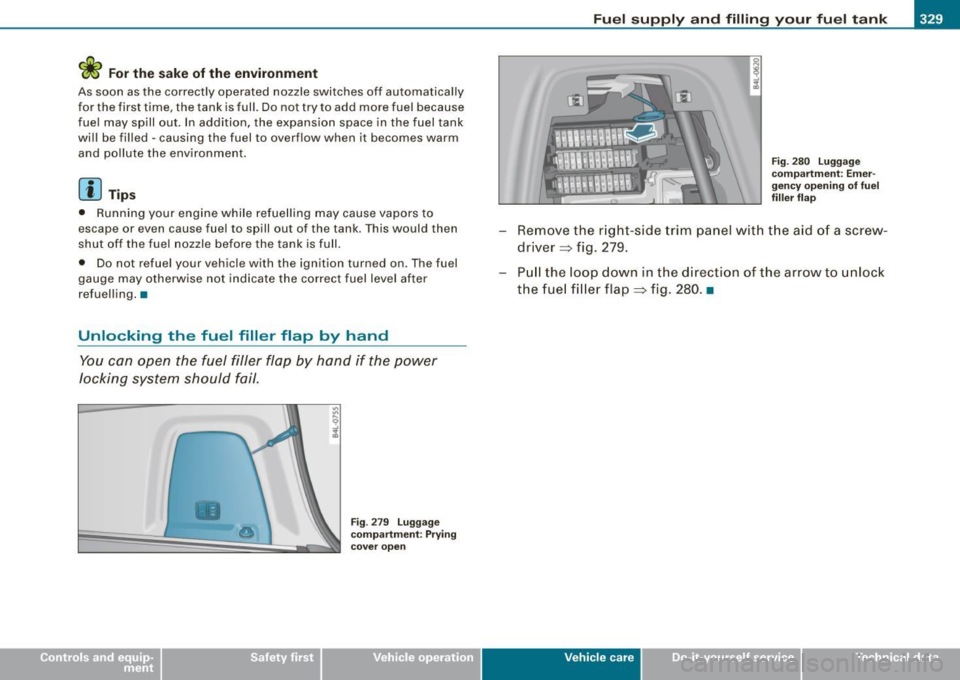
- Remove the right-side trim panel with the aid of a screw
driver => fig. 279.
- Pull the loop down in the direction of the arrow to unlock
the fuel filler flap=> fig. 280. •
Vehic le care I I irechnical data
Page 333 of 426
_____________________________________________ C_ h_ e .=....= c..:..k :..:.in :....:..:= g:.....= a..:..n .:....:d::......:. f.:..:il .:..:li ..:..n ::.:g:!....- __
•
Closing the engine hood
- Pull the hood down until the pressure from the struts is
reduced .
- Let the hood
drop down and latch in place. Do not try to
push it shut;
it may fail to engage => &.
& WARNING
A hood that is not completely latched could fly up and block your
view while driving.
• When you close the engine hood, check it to make sure the
safety catch has properly engaged. The hood should be flush with
the surrounding vehicle body parts.
• If you notice while driving that the hood is not secured prop
erly, stop at once and close it. •
Working in the engine compartment
Be especially careful whenever you work in the engine
compartment.
Whenever you must perform any work in the engine compartment,
for example checking and filling different fluids, there is a risk of injury, burns and accidents. To prevent personal injury always
observe the following WARNINGS. The engine compartment of any
vehicle is a hazardous area
~ & .
& WARNING
To help avoid injury, before you check anything under the hood :
• Turn off the engine.
• Remove the ignition key.
• Apply the parking brake .
& WARNING (continued)
• Move selector lever to "P" (Park).
• Always let the engine cool down. Hot components will burn
skin on contact.
• To reduce the risk of being burned, never open the hood if you
see or hear steam or coolant escaping from the engine compart
ment. Wait until no steam or coolant can be seen or heard before
carefully opening the hood.
• Keep children away from the engine compartment .
• Never spill fluids on hot engine components. They can cause a
fire.
• Never touch the radiator fan. The auxiliary electric fan is
temperature controlled and can switch on suddenly.
• Never open the coolant reservoir cap when the engine is still
warm . The coolant system is pressurized and hot coolant could
spray out.
• Protect your face, hands and arm from steam or hot engine
coolant by placing a thick rag over the cap when you open the
coolant reservoir.
• If work on the fuel system or the electrical system is necessary :
- Always disconnect the battery.
- Never smoke or work near heaters or open flames . Fluids in
the engine compartment could start a fire.
- Keep an approved fire extinguisher immediately available.
• To avoid electrical shock and personal injury while the engine
is running or being started, never touch:
- Ignition cables
- Other components of the high voltage electronic ignition system.
• If you must perform a check or repair with the engine running: -First, fully apply the parking brake, move selector lever to "P"
(Park). .,
Vehicle care
I t •