lock AUDI Q7 2011 Owner´s Manual
[x] Cancel search | Manufacturer: AUDI, Model Year: 2011, Model line: Q7, Model: AUDI Q7 2011Pages: 392, PDF Size: 93.29 MB
Page 288 of 392

-~_C_ le_ a_n_ i_ n_ g=- a_ n_d__. p_ ro_ t_e _c_ t_ i_o _n ___________________________________________ _
through use. Steam cleaners should not be used , because the steam
t ends t o push the dirt d eeper into the fa bric and lock it th ere.
Normal cleaning
Genera lly, we re commen d using a soft sponge or a lin t-free
m icrofiber cloth to the clean fabric. Brushes should on ly be used fo r
c arpets and floor m ats, s ince other fabric sur faces could be harmed
by brushes .
N orma l s ur face sta ins can be cleaned using a comme rcially avai lab le
foam cleaner . Spread t he foa m on the surface of the fabr ic w it h a soft
sponge and work it in gently . Do not saturate the fabr ic. T hen pat the
fo am dr y usin g abso rbent, dr y cl oths (e.g. microfibe r cl ot h) a nd
vacuum it afte r it has dr ied comp lete ly.
Cleaning stains
Sta ins caused by beverages (e.g. coffee, fruit ju ice, etc.) can be
treated with a mild detergen t so lutio n. Apply th e det ergent solut io n
w ith a sponge. In the case of stubborn stains, a dete rgent paste can
be applied dire ctly to t he s tain and wor ked in to the fabric . A fter
wa rds , use copious amo unts of clean water to remove the rema ining
deter gent . App ly th e wa ter w ith a damp cloth o r spo nge and pa t the
fabric d ry with an absorbent, dry cloth .
Sta ins from choco late or makeup sho uld have dete rgent paste (e.g .
ox-gall soap) ru bbed into them. Afterwards, remove the soap w ith
water (damp spo nge).
Alcoho l can be used to treat st ains fro m gre ase, oil, lips tick or a ba ll
point pen . Melted g rease o r dye must be patted off us ing absorbe nt
m ate rial. It may be ne cess ary to re tre at th e ar eas wi th deterge nt
paste a nd water .
In the case of genera l soiling of the upholste ry and cover mater ia l, we
reco mmen d hir ing a spec ialist th at has the equ ipment to clean the
seat covers and other fa bric surfaces by shampooing and s pray
ex tra ct io n.
& WARNING
Always read and heed all WARNINGS and the informat ion
:=> page 278 .
W Tips
Ope n Velc ro fasteners on yo ur clothin g can damage the seat cover .
Please make sure that Velc ro fasteners are closed. •
Plastic parts and instrument panel
Always use a clean cloth moistened in clear water to clea n these
areas . For persistent dirt use an A udi approve d
solvent-free plastic
cleaner/protectant .
& WARNING
Solvents can change the properties of some plastics and make it
harder for the airbag to deploy.
• Never clean the instrument panel or the su rface of airbag
module s with cleaning produ ct s that contain solvents.
• Products containing solvents will make the surface of this part
porous.
• Seriou s injuries can result if plast ic parts come loose when the
airbag is deployed .
• Always read and heed all WARNINGS and other information
=> page 278 .
0 Note
Cleaning agents conta ining solvents will a ttack the material and can
change the way it behaves .•
Page 292 of 392
-~_C_ le_ a_n_ i_ n_ g=- a_ n_d___. p_ ro_ t_e _c_ t_ i_o _n ___________________________________________ _
Engine compartment
Be especially careful when cleaning the engine compa rt
men t.
Always switch off the ignition before cleaning the engine=:>& .
Plenum panel
Remove leaves from the plenum panel in front of the win dshi eld
unde r th e eng ine hood . T hi s prevents the water d rain holes from
becoming b locked, and it prevents debris from entering the vehicle
inter io r th rough the heat ing and vent ilation ducts .
Corrosion protection
The eng ine compartment and transmission have been cor rosion
protected at the factory.
Good ant i-cor rosion treatment is very impo rtant , pa rtic ular ly in the
w inter . If the vehicle is frequently driven on sa lt treated roads, the
en tire eng ine compar tment and plenum p anel sho uld be thoroug hly
cleaned at the end of winter and retreated to prevent salt damage. At
t he same t ime, the underside of the vehi cle should be washed as well.
If the e ng ine compartment is clea ned at any t ime with grease
removing so lutions
2l , or i f you have the engine washed , the anti
co rros io n treatment is a lmost a lways removed as w ell.
It is t herefore
essential to have a long-last ing corrosion p rotect ion reapplied to all
surfa ces, seams, jo ints and compo nents in the engi ne co mpa rt ment .
& WARNING
Be aware: The engine compartment of any motor vehicle is a
potentially hazardous area .
• Before working in the engine compartment, be sur e to read the
information =:>
page 290.
2
l Use on ly th e co rr ect clean ing so lut ions. Never use gaso line or diese l fuel.
& WARNING (c on tinued )
• Before reaching into the front plenum panel , alway s remove
the ignition key. Otherwise, the windshield wiper system could unintentionally be switched on , possibly causing personal injury
from the moving wiper linkage.
• Never reach into the area around or touch the radiator fan. The
auxiliary fan is temperature controlled and can switch on suddenly
· ev en when the ignition is off.
• Do not wash, wax or dry the engine with th e engine running.
Moving or hot pa rts could injure you.
• Do not clean the underside of the chass is, fenders, wheel
covers, or other hard to reach part s without protecting your hands
and arm s. You may cut yourself on sharp-edged metal parts.
• Always read and heed all WARNINGS and other information
=:> page 2 78. •
Page 295 of 392
labeled ask the station operator what fuel is being dispensed befo re
fi lling up yo ur vehicle.
Service stations offering Diesel f uel are generally loca ted on truck
routes or major hig hways. Directo ries of Diese l fue l stations are
usually availab le at Diese l fuel stations.
Some states in t he USA require permits to purchase Diesel fuel. Check
w ith your State Mo tor Vehicle De partment.
Diesel fuel may not be available outs ide the USA and Canada. Be sure
to check before trave ling to othe r countries .
Winter operation
At t empe ratures below 20° F (- 7° C), Die sel fue l No . 2 l oses its flu idity
due to wax separation, wh ich may clog the fuel filter or tank fi lter and
keep the engine from running .
T o help t he filte r from be ing clogged by wax, the fue l fi lter in your
vehicle is automatically preheated. Preheat ing the fuel f ilter makes
operat io n of yo ur vehicle possib le with Die sel fuel No. 2 dow n to -
10° F (-24° C).
If you expect temperat ures below 5° F (-1S° C) ask yo ur fuel dealer
whether their Diesel fuel No . 2 is suffic iently w interized for the
prevailing and expected temperat ures.
If not winterized or insuff ic ie ntly w inte riz ed Diese l fuel has already
thickened to the extent that the engine w ill not start, warm the
vehicle up by leaving i t in a heated garage.
It is normal that the eng ine noise level (dieseling) is louder during the
warm-up period in winte r. It is also normal when whitish -blue smoke
comes out of t he tailpipe afte r start ing and du ring warm-up. The
amount of smoke depends on the outside temperature .
Do not let your Diesel engine idle unnecessa rily af ter a co ld start.
Dr iv ing off slow ly w ill shorten the warm-up per iod.
Safety first
Fuel supply and filling your fuel tank
& WARNING
• Never use "starting as sist flu ids ." Th ey may be potentially
explo sive or cause a "run-away " engine condition . Thi s could
re sult in s eriou s engine damage and per sonal injury .
• Never u se fuel line anti -freeze off ered fo r ga soline engine s.
0 Note
• Your D iesel eng ine has been spec ifically desig ned to ope rate on ly
on Ultra Low Sulfur Diesel fue l. Therefore, never use home heating o il
or reg ular gasoline . The properties of these fuels may cause serious
damage to the fuel injection system and to t he engine . Using these
fue ls can cause expens ive eng ine repairs and will also adversely affect
your New Vehicle Lim ited Wa rranty.
• If Diese l fuel shou ld get on any rubber hose, it must be wiped off
immediately. Then wash the contaminated hose port ion w ith soap
and warm water . Do not allow Diesel fue l to remain on connecting
hoses. They may deve lop leaks and cause se rious damage. •
Fuel tank
Fuel filler neck
The f ue l fi ller neck is located o n the rig ht rea r side panel behind t he
fue l filler flap.
If the power locking system shou ld fai l, you can st ill open the flap
ma nually -for deta iled instructions see:::::>
page 296.
You can find the fue l tank capacity of your veh icle in
Technical Data
:::::, page 365.
The label on the inside of t he fuel filler flap tells you the correct fuel
for your veh icle. For more informat ion about fuel specifications, see
:::::>
page 291 . _,,
Vehicle care Technical data
Page 296 of 392
Fuel supply and filling your fuel tank
Your vehicle fuel tank has an on-board refuelling vapor recovery
system . This feature helps to prevent fuel vapors from escaping from
the tank and polluting the environment while you refuel your vehicle.
In order to fill the tank properly while protecting the environment,
please follow this refueling procedure carefully.
& WARNING
Under normal operating conditions, never carry additional fuel
containers in your car. Gas canisters and other containers used to
transport fuel can be dangerous. Such containers, full or empty, may leak and could cause a fire in a collision. If you must transport
fuel to use for your lawn mower, snow blower, etc., be very careful and always observe local and state laws regarding the use, trans
portation and storage of such fuel containers. Make certain the
container meets industry standards (ANSI/ASTM F852 -86).
0 Note
Never drive your vehicle until the fuel tank is completely empty. The
ir regular supply of fuel can cause misfiring. Gasoline could enter the
exhaust system and damage the catalytic converter. •
Refuelling
Fig. 224 Right rear
vehicle side: Opening
the fuel filler flap Fig
. 225 Fuel cap
hooked on the opened
fuel filler flap
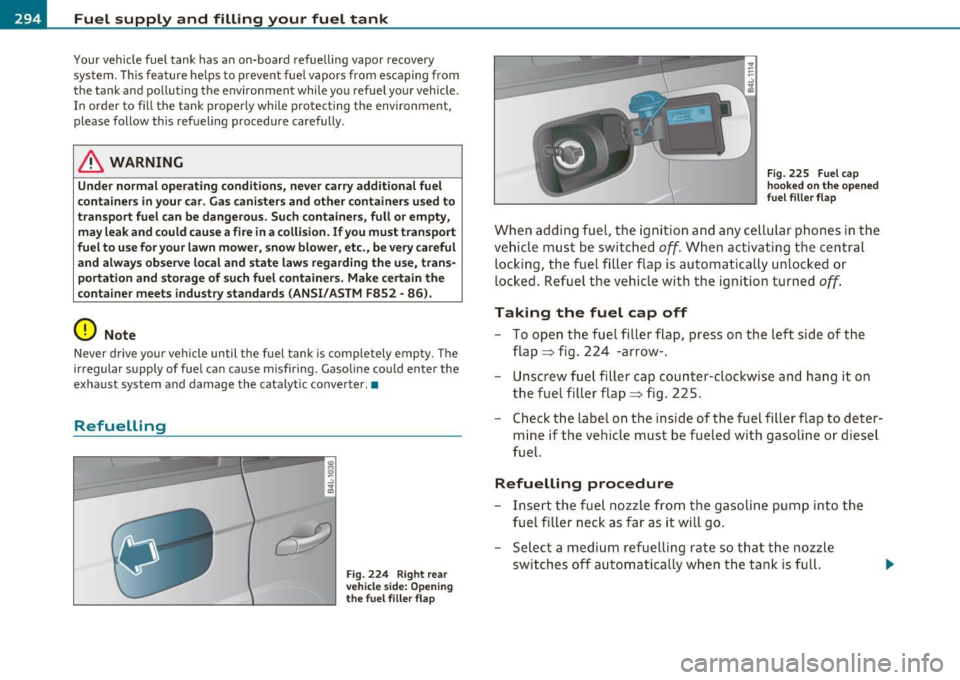
When adding fuel, the ignition and any cellular phones in the
vehicle must be switched
off. When activating the central
locking, the fuel filler flap is automatically unlocked or
locked. Refuel the vehicle with the ignition turned
off.
Taking the fuel cap off
- To open the fuel filler flap, press on the left side of the
flap ~ fig. 224 -arrow-.
- Unscrew fuel filler cap counter-clockwise and hang it on
the fuel filler flap~ fig. 225.
- Check the label on the inside of the fuel filler flap to deter
mine if the vehicle must be fueled with gasoline or diesel
fuel.
Refuelling procedure
- Insert the fuel nozzle from the gasoline pump into the
fuel filler neck as far as it will go.
- Select a medium refuelling rate so that the nozzle
switches off automatically when the tank is full.
Page 297 of 392
Putting the fuel cap back on
- After filling your tank, twist the fuel fi ller cap c lockwise as
f ar as it w ill go.
- Close t he fue l fi ller flap.
To avoid fuel spi lling or evapo rating from the f uel tank a lways close
fue l filler cap properly and comp lete ly . An impro perly closed fuel
filler cap may also ca use the MIL lamp~
page 30 to come on (only
vehicle s wi th gaso lin e e ngine).
& WARNING
Improper refueling or handling of fuel can cause fire, explosion
and severe burns .
• Fuel i s highly flammable and can cause severe burns and other
injuries.
• Failure to shut the engine off while refueling and /or to insert
the pump nozzle fully into the fuel filler neck could cause fuel to spray out of filler n eck or to overflow. Fuel spray and ov erflowing
fuel can cause a fire.
• Never use a cellular telephone while refueling. The electromag
netic radiation can cau se sparks that can ignite fuel vapors and
cause a fire.
• Never get back into your vehicle while refueling. If in excep
tional cir cumstan ces you must get ba ck in your v ehicle while refu
eling, make certain that you close the door and touch metal to
discharge static electricity before touching the filler nozzle again .
Static electricity can cause sparks that can ignite fuel vapo rs
released during refueling.
• Never smoke or have an open flame anywhere in o r near your
vehicle when refueling or filling a portable fue l container.
• For your safety , we strongly recommend that you do not travel
with a portable fuel container in your vehicle . The container , full
or empty may leak and could cau se a fire , especially in a crash.
Safety first
Fuel supply and filling your fuel tank
& WARNING (co ntinued )
• If, under exceptional circumstances , you must tran sport a
portable fuel container, please observe the following:
-Never fill a portable fuel container while it is anywhere in or
on the vehicle (for example, in the luggage compartment, or
on the trunk ). Static electricity can build up while filling and
can ignite fuel vapors causing a fire .
- Always place a portable fuel container on the ground before
filling .
- Always keep the filler nozzle completel y inside the portable
container before and during filling.
- If filling a portable container made of metal, the filler nozzle must always be in contact with the container. This will help
prevent static ele ctricity from discharging and cause a fire .
- Ne ver spill fuel inside the vehicle or luggage compartment .
Fuel vapor s are highly flammable.
- Always observe local and state /provincial laws regarding the
use, storage and tran sportation of fuel containers .
-Make certain the fuel container meets industry standards
( ANSI / ASTM F852-86 ).
0 Note
If any f uel has spilled o nto the ca r, it should be remove d immed iate ly
to prevent damage to the paint.
f or t he firs t time, the t ank i s full. Do no t try to ad d mo re fuel bec ause
fue l may spill out. In addition, the expansion space in the fuel tank
w ill be fi lled -caus ing the fue l to overf low when it becomes wa rm and
poll ute the enviro nment . .,_
Vehicle care Technical data
Page 298 of 392

Fuel supply and filling your fuel tank
(I) Tips
• Runn ing your eng ine while refuelling may cause vapors to escape
or even cause fuel to spill out of the tank. This would then shut off the
fuel nozzle before the tank is full.
• Do not refuel your vehicle with the ignition turned on. The fuel
gauge may otherwise not ind icate the correct fuel level after refuel
ling.
• Diesel vehicles* are equipped w ith a mechanism to prevent incor
rect fueling. They can only be fueled with diesel pump nozzles. A
worn, damaged, or improperly specified nozz le may not allow this
mechanism to open, thereby preventing refueling. If you cannot
insert the pump nozzle, rotate it in the tank opening. This should
open the mechanism and allow refueling. •
Unlocking the fuel filler flap by hand
You can open the fuel filler flap by hand if the power
locking system should fail.
•
Fig. 226 Luggage
compartment: Prying
cover open Fig. 227
Luggage
compartment: Emer
gency opening of fuel
fille r flap
- Remove the right -s id e trim panel with the aid of a screw
driver => fig. 226.
- Pull the loop down in the direc tion of the arro w to unlock
the fuel filler flap=> fig . 227. •
TDI clean diesel
App lies to veh icles: w ith diese l eng ine
General information
On TOI clean diesel vehicles, an urea solution (AdBlue®) is injected
into the exhaust system before a specia l catalytic converter to reduce
nitrogen emissions.
The Ad Blue is stored in a separate tank in the vehicle and f illed during
maintenance intervals. Under norma l driving conditions, there will be
enough Ad Blue to last from one maintenance interval to the next.
Because of this, the scheduled maintenance intervals should always
be followed.
The Ad Blue usage accounts for approximately 0.5% to 1 % of the
diesel fuel that is us ed. The Ad Blue tank capacity is approximately 6
gallons (23 liters). ..,_
Page 300 of 392

Fuel supply and filling your fuel tank
This message appears when the AdBlue tank is empty. You will also
he ar three warning signals in a row. Please add AdBl ue. Otherwise yo u
w ill not be able to start the engine again once you stop it.
When the minimum Ad Blue level has been reached, you must add at least 1 gallon (3.8 liters) . This is equal to two bott les from the refill
container available from authorized dealers~
page 298. This is the
m ini mum amo unt required to ensure the system detects the refill ing
and to start the engine.
Filling incorr ectly
If the Ad Blue tank was filled w ith a different fluid than Ad Blue and
the sys tem detects that it is incor rect, you will be not ified as follows:
ff 1
, 'W"l , AdBlue! No re start in 600 miles
( 1000 km )! See owner 's manual
Th is message appears when it is only possible to drive the distance
indicated in the
driver information system. You will also hear a
wa rning signa l. Drive to the nearest qualified wo rkshop to have the
ma lfunction repaired. Otherw ise the engine w ill not start again if you
stop it once the distan ce indicated has bee n driven .
Ad Blue ~ 0 mi (0 km ) Ad Blu e: syste m fault . No res tart! See
owner 's manual
Th is message appears if the system detects it was filled inco rrectly.
You will also hear three warning signals in a row.
Drive immediately
to the nearest qua lified workshop to have the malfunction repaired .
O therwise you w ill not be able to star t the engine again once you stop
it .•
A ppli es to veh icles : wi th diesel e ngine
Filling AdBlue
A special refill bottle must be used to fill the Ad Blue.
Fi g. 2 29 Rig ht r ea r
veh icle side : re moving
t h e A dBlu e ca p
Fig . 230 A d Blue filler
t ub e: in sert ing t he
re fill bottl e
The filler flap automatically unlocks or locks w hen the central
locking system is operated. The Ad Blue filler tube is located
at the right near the diesel filler tube.
Opening the filler tube and adding AdBlue
- Press the left side of the fuel filler flap to open it
=> page 294, fig. 224 -arrow- .
- Turn the cap counte rclockwise with the lug wrench from
the vehic le tool ki t to remove it~ fig. 229.
~
Page 301 of 392

- Remove the cap from the refill bott le.
- Position t he refill bott le on the filler tube a nd turn the
bottle clockwise u ntil it stops turning~
page 298,
fig. 230 © -
- Press lightly against the bottom of the bottle@to em pty
it. Contin ue pressing the bottom o f the bott le until it is
empty or until fluid stops flowing into the tank.
- Turn the bottle to the left without pressing on the
bottom .
Closing the filler tube
- Turn t he cap clockw ise on t he fi ller t ube with t he lug
wrench un til you hear it t ighte n comp letely.
- Then press on the le ft side of the filler fla p un til yo u hear
i t lock.
& WARNING
• Ad B lu e can irritat e the skin, eye s and respiratory sy stem. If
the re is contact with the fluid , flush immed iately with plenty of
water. Con sult a phy sician if ne ce ss ary .
• Do not allow Ad Blue to come into contact with clothing. If
there is contact with the fluid , flush immediate ly with plenty of
water.
0 Note
• Only use Ad Blue that conforms to the standard ISO 22241-1. Do
no t m ix any addit ives wi th the Ad Blue and do not dil ute it with water.
• Ad Blue is not a diesel add it ive. Do not add it to the diese l tank. If
Ad Blue is mixed w it h diesel f ue l, it can lead to damage to the engine
and the Ad Blue tank system. The L imited New Vehicle Warranty does
no t cover su ch damage.
Safety first
Fuel supply and filling your fuel tank
• Ad Blue attacks surfaces such as pai nted vehicle components,
plast ic and carpet. Remove the fluid as q uickly as poss ible wi th a
damp cloth and plenty of cold wate r. If the Ad Blue has already crys
tallized, use wa rm water and a sponge. Ad Bl ue residue that is not
removed will crystallize and can damage the affected s urface.
• Do not store the refi ll bott le in the veh icle. If it leaks, the esc aping
Ad Blue could damage the vehicle interior .
(I) Tips
• The fuel fil ler flap of your vehicle is not locked whe n you lock the
vehicle from the inside.
• The refill bottle ho lds approximate ly 0.5 gallon (1.9 liters) .
Always add two bottles of Ad Blue (1 gallon/3.8 liters) as soon as a
message appears in the instrument cluster display~
page 297. The
ignition must be switched off when filling the Ad B lue.
• The vehicle must be driven after the Ad Blue has been fi lled. The
system may take up to two minutes to detect when Ad B lue is added .
Whe n there is no more Ad Blue in the ta nk and
O mi (0 km) appears in
the instrument cluster display, switch the ignition on for approxi
mately 15 seco nds and then sta rt the eng ine.
• You can obtain refill bottles from any a uthorized Audi dealer or
other qualified workshop.
• F ollow t he Ad Blue manufacturer 's inst ru ct io ns for usage and
storage .•
Vehicle care Technical data
Page 303 of 392

____________________________________________ ....:C _h_ e..:......::. c....:k :..:..in :....:..::: g!....::. a:..:..n.:... d:.:......: f....: i.:..ll :.:.i.:...n ::.:gi!-- __
Closing the engine hood
- Pull the hood down until the pressure from the struts is
reduced.
- Let the hood
drop down and latch in place. Do not try to
push it shut;
it may fail to engage=:> &.
& WARNING
A hood that is not completely latched could fly up and block your
view while driving.
• When you close the engine hood, check it to make sure the
safety catch has properly engaged. The hood should be flush with
the surrounding vehicle body parts.
• If you notice while driving that the hood is not secured prop
erly, stop at once and close it. •
Working in the engine compartment
Be especially careful whenever you work in the engine
compartment.
Whenever you must perform any work in the engine compartment,
for example checking and filling different fluids, there is a risk of injury, burns and accidents. To prevent personal injury always
observe the following WARNINGS. The engine compartment of any
vehicle is a hazardous area=>& .
& WARNING
To help avoid injury, before you check anything under the hood:
• Turn off the engine.
• Remove the ignition key.
• Apply the parking brake.
Safety first
& WARNING (continued)
• Move selector lever to "P" (Park).
• Always let the engine cool down. Hot components will burn
skin on contact.
• To reduce the risk of being burned, never open the hood if you
see or hear steam or coolant escaping from the engine compart
ment. Wait until no steam or coolant can be seen or heard before
carefully opening the hood.
• Keep children away from the engine compartment.
• Never spill fluids on hot engine components. They can cause a
fire. • Never touch the radiator fan. The auxiliary electric fan is
temperature controlled and can switch on suddenly.
• Never open the coolant reservoir cap when the engine is still
warm. The coolant system is pressurized and hot coolant could
spray out.
• Protect your face, hands and arm from steam or hot engine
coolant by placing a thick rag over the cap when you open the
coolant reservoir.
• If work on the fuel system or the electrical system is necessary:
- Always disconnect the battery.
- Never smoke or work near heaters or open flames. Fluids in
the engine compartment could start a fire.
- Keep an approved fire extinguisher immediately available.
• To avoid electrical shock and personal injury while the engine is
running or being started, never touch:
-Ignition cables
- Other components of the high voltage electronic ignition
system.
• If you must perform a check or repair with the engine running:
- First, fully apply the parking brake, move selector lever to
"P" (Park). .,
Vehicle care Technical data
Page 311 of 392

___________________________________________ C_ h _ e_c _k _ i_n -=g ~ a_n _ d_ f_i _ll _i _ n -=g =--- ......J•
-We recommend using only coolant additive Gl2 ++ (check the
l a bel) for yo ur vehicle. This coolant ad dit ive is available at au tho·
r ized Audi dealers . Other types of antifreeze can s ignificantly
reduce corrosion protection. The resulting corrosion can cause a
loss of coolant and serious engine damage .
• Do not add any type of radiator leak sealant to your vehicle's
eng ine coo lant . Adding radiator repa ir fluid may adversely affect the
function and performance of your cooling system and could result in
damage not covered by your New Vehicle Limited Warranty .•
Checking the engine coolant Level
The engine coolant level can be checked with a quick
glance .
Fig. 2 37 En gin e
c o mpar tmen t: C oolant
ex pansion tank
Before you c heck anything in the eng ine compartment,
always read and heed all WARNINGS~ & in "Working in
the e ngine compartment" on
page 301.
- Turn off the ignit ion .
- Let t he eng ine cool down .
- Place a thick rag over the coolant expans ion tank
~ fig . 237 and carefully twist the cap counter ·clockwise
~ & -
Vehicle OP-eration
-Read the engine coolant level in th e open coo lant expan ·
sion tank ~ fig . 2 3 7 . With a cold engine, th e coolant level
should be between the "min" and "max" ma rkings . Whe n
the engine is warm , the level may be slight ly above the
"max" marking .
The location o f the coo lant expans ion tank can be seen in the engine
compartment illustration=>
page 302 .
To obt ain an accurate reading , the engine must be sw itched off.
Th e expans ion t an k in your vehicle is equippe d with an electric coolant
level sensor.
When the coolant lev el is too low, the warning light in the Auto·Check
System=>
page 35 will blink until you add coolant and t he level has
been resto red to normal. Even though there is an electric coolant
level sensor, we st ill recommend you check the coolant leve l from
time to time.
Coolant loss
Coolant loss may indicate a leak in the coo ling system . In the event of
coo lant loss , the cooling system sho uld be inspected immed iate ly by
your authorized Aud i dea ler . It is not enough mere ly to add coolant.
In a
s ealed system, losses can oc cu r only if the boiling point of the
coolant is exceeded as a result of ove rheating .
& WARNING
The cooling system is under pressure and can get ve ry hot. Reduce
the ri sk of scalding from hot coolant by following the se steps.
• Turn off the engine and allow it to cool down .
• Protect your face, hand s and arms from e scaping fluid and
s team b y co ve ring the cap with a large, thi ck r ag.
• Turn the cap slowly and ver y carefully in a counter-clockwise
direction whil e applying light , downward pre ssure on the top of
thecap .
~
Vehicle care Do-it-yourselt service iTechnical data