door AUDI Q7 2013 Owner´s Manual
[x] Cancel search | Manufacturer: AUDI, Model Year: 2013, Model line: Q7, Model: AUDI Q7 2013Pages: 348, PDF Size: 87.72 MB
Page 180 of 348
178 Safety belts
forces on the body more "tolerable" and less likely to cause injury.
Although these examples are based on a fron
tal collision , safety belts can also substantial
ly reduce the risk of injury in other kinds of
crashes . So, whether you're on a long trip or
just going to the corner store, always buckle
up and make sure others do, too. Accident sta
tistics show that vehicle occupants properly
wearing safety belts have a lower risk of being injured and a much better chance of surviving
an accident . Properly using safety belts also
greatly increases the ability of the supplemen
tal airbags to do their job in a collision. For
this reason, wearing a safety belt is legally re
quired in most countries including much of
the United States and Canada.
Although your Audi is equipped with airbags ,
you still have to wear the safety belts provid
ed. Front airbags, for example, are activated
only in some frontal collisions . The front air
bags are not activated in all frontal collisions,
in side and rear collisions, in roll overs or in
cases where there is not enough deceleration
through impact to the front of the vehicle .
The same goes for the other airbag systems in
your Audi. So, always wear your safety belt
and make sure everybody in your vehicle is
properly restrained!
Important safety instructions about
safety belts
Safety belts must always be correctly posi tioned across the strongest bones of your
body.
.. Always wear safety belts as illustrated and
described in this chapter.
.. Make sure that your safety belts are always
ready for use and are not damaged.
A WARNING
Not wearing safety belts or wearing them
improperly increases the risk of serious
personal injury and death. Safety belts can
work only when used correctly . -
Always fasten your safety belts correctly
before driving off and make sure all pas
sengers are correctly restrained.
- For maximum protection, safety belts
must always be positioned properly on
the body.
- Never strap more than one person, in
cluding small children, into any belt .
- Never place a safety belt over a child sit
ting on your lap.
- Always keep feet in the footwell in front
of the seat while the vehicle is being driv
en.
- Never let any person ride with their feet
on the instrument panel or sticking out
the window or on the seat.
- Never remove a safety belt while the ve
hicle is moving. Doing so will increase
your risk of being injured or killed .
- Never wear belts twisted.
- Never wear belts over rigid or breakable
objects in or on your clothing, such as
eye glasses, pens, keys, etc., as these
may cause injury .
-Never allow safety belts to become dam
aged by being caught in door or seat
hardware.
- Do not wear the shoulder part of the belt
under your arm or otherwise out of posi
tion .
- Several layers of heavy clothing may in
terfere with correct positioning of belts
and reduce the overall effectiveness of
the system.
- Always keep belt buckles free of anything that may prevent the buckle from latch
ing securely .
- Never use comfort clips or devices that create slack in the shoulder belt . Howev
er, special clips may be required for the
proper use of some child restraint sys
tems .
- Torn or frayed safety belts can tear, and
damaged belt hardware can break in an
accident. Inspect belts regularly. If web-
bing , bindings, buckles, or retractors are .,,.
Page 189 of 348
as defined in the electronic control unit
¢ page 195, PASSENGER AIR BAG OFF light .
Always remember, a chi ld safety seat or infant
carrier installed on the front seat may be
struck and knocked out of position by the rap
id ly inflating passenger's airbag in a frontal
coll is ion . The airbag cou ld greatly reduce the
effectiveness of the child restraint and even
seriously injure the child during inflat ion.
F or this reason, and because the back seat is
the safest p lace for children -when properly
restra ined accord ing to their age and si ze - we
strongly recommend that children always sit in the back seat¢
page 205, Child Safety.
A WARNING
A child in a rearward-facing child safety
seat insta lled on the front passenger seat
w ill be seriously injured and can be k illed if
t he fron t airbag inf lates - even with an Ad
vanced Airbag System .
- The inflating a irbag w ill hit the child
sa fety seat or infant carrier w it h great
f orce and w ill smash the ch ild safety seat
and child against the backrest, center
armrest, door or roof.
- Always install rear -facing child sa fety
seats on the rear seat.
- If you mus t install a rearward facing
child safety seat on the front passenger
seat because of exceptional circ umstan
ces and the
PASSENGER AIR BAG O FF
light does not come on and stay on, im
med iately install the rear-facing child
safety seat in a rear seating posit ion and
have the a irbag system inspected by you r
authori zed Aud i dealer.
- Forward-fac ing ch ild safety seats instal
led on the front passenger's seat may in
terfere with the deployment of the air
b ag and cause serious person al injury to
the ch ild .
WARNING
If, in exceptional c ir c umstances, you mus t
install a forwa rd -facing child restra int on
the front passenger's seat:
A irbag system 187
-Always ma ke sure the forward-facing
seat has been designed and certified by its manufacturer for use on a front seat
with a passenger front and s ide a irbag.
- Never put the forward-facing child re
straint up against or very near the instru ment panel.
- Always move the passenger seat into its
rearmost position in t he seat's fore and
aft adj ustment range, as fa r away from
the airbag as possible before installing
the forward-fa cing ch ild restra int. The
backrest mu st be a dju ste d to an upright
posi tion.
- Ma ke sure that the
PASSENGER AIR BAG
OFF
li ght comes on and stays on all the
time wheneve r the ignit ion is swi tched
on.
A WARNING
To reduce the risk of serious injury, make
sure that the
PASSENGER AIR BAG OFF
light wi ll be displayed whenever a child re
straint is installed on the front passenger
seat and the ignition is sw itched on.
- If the
PASSENGER AIR BAG OFF light
does not stay on, perform the checks de
scribed ¢
page 195, Monitoring the Ad
vanced Airbag System .
-Take t he chi ld restraint off the front pas
senger seat and install it properly at one
of the rear seat positions if the
PASSEN
GER AIR BAG OFF
li g ht does not stay on.
- Have the airbag system inspected by
your author ized Audi dealer immed iate
ly.
- Always carefully follow instr uctions from
child r estraint manufa cture rs when in
s tall ing c hild restra ints.
A WARNING
If, in exce ptiona l circumstan ces, you must
ins tall a forward or rearw ard-facing c hild
restra int on the front passenger's seat:
- Imp roper ins tal lation o f ch ild restraints
can reduce their effec tiveness or even
•
•
Page 196 of 348
194 Airbag sys te m
- when the weight on the front passenger
seat as sensed by the Advanced Airbag Sys
tem indicates that the front airbag on the
passenger side has to be turned off by the
electron ic control unit (the
PA SSEN GER AIR
BAG OFF
light comes on and stays on)
A WARNING
Sitting in the wrong position can increase
the risk of serious injury in crashes.
- To reduce the r isk of injury when the air
bags inflate, the driver and passengers
must always sit in an upright position,
must not lean against o r place any pa rt
of the ir body too close to the area where
the airbags are located .
- Occ upants who are unbelted, out of posi
t ion or too close to the airbag can be se
riously injured by an airbag as it unfolds
with great force in the blink of an eye
¢page 186.
A WARNING -
A child in a rearward-facing child safety
seat installed on the front passenger seat
w ill be seriously injured and can be k illed if
the front a irbag inflates -even with an Ad
vanced Airbag System.
- The inflating a irbag will hit the child
safety seat or infant carrier with great
force and w ill smash the ch ild safety seat
and child against the backrest, center
armres t, door or roof.
- Always install rear-facing child safety
seats on the rear seat.
- If you must install a rearward-fac ing
child safety seat on the front passenger
seat because of excep tional circ umstan
ces and the
PASSENGER AIR BAG OFF
light does not come on and stay on, im
mediately install the rear-facing child
safety seat in a rear seating position and
have the airbag system inspected by your
authorized Audi dealer.
A WARNING
Objects between you and the airbag will
i nc rease the r isk of injury in a crash by in
terfering with the way the airbag unfolds
or by be ing pushed into you as the airbag
i n flates.
- Never hold things in yo ur hands or on
your lap when the veh icle is in use.
- Never transpo rt items on or in the area
of the front passenger seat. Objects
could move into the a rea of the front air
b ags du ring bra king or other sudden ma
neuvers and become dangero us projec
tiles that can cause serious personal in
jury if the ai rbags inflate.
- Never p lace or attach accessories or oth
er objects (such as cupholde rs, tele
phone brackets, large, heavy or bulky ob
jects) on the doors, ove r or near the area
marked "AIRBAG" on the steer ing whee l,
instrument panel , seat backrests or be
tween those areas and yourself . These
objects could ca use in jury in a c rash, es
pecially when the airbags infla te.
- Never recline the front passenger 's seat
to transpo rt objects . Items can a lso
move into the a rea of the s ide airbag or
the front airb ag d uring bra king or in a
sudden maneuve r. Objects nea r the air
bags can become projectiles and cause
in ju ry, partic ularly when the seat is re
clined.
- Never tilt the front passenger seat back
rest forward when the vehicle is moving .
An inflating a irbag w ill force the back
rest backward and can injure rear seat oc
cupants.
A WARNING
The fine dust created when airbags deploy
can cause breathing prob lems for people
with a history of asthma or other breath i ng cond itions.
-
- To reduce the risk of breath ing problems,
those with asthma o r othe r respiratory
....__ c_ o_ n_ d_ it_ i_o _ ns_ s_ ho _u_ l_ d ....:g:_ e_ t_ f_re _s_ h _ a_ i_r _ri ..::g :....h _t __
_J .,.
Page 197 of 348
away by getting out of the vehicle or
opening windows or doors.
-If you are in a collision in which airbags
deploy, wash your hands and face with
mild soap and water before eating.
- Be careful not to get the dust into you r
eyes, or into any cuts or scratches.
- If the residue should get into your eyes,
flush them with water.
Monitoring the
Advanced Airbag
System
Airbag monitoring indicator light
Two separate indicators monitor the function
of the Advanced Airbag System: the airbag
monitoring indicator light and the
PA SSEN ·
GER AIR BAG OFF
light.
The Advanced Airbag System (including the
e lectronic control unit, sensor circuits and sys
tem wiring) is monitored cont inuously to
make sure that it is functioning properly
whenever the ignit ion is on . Each t ime you
turn on the ignition, the airbag monitoring in
d icator light
I will come on for a few seconds
(sel f diagnos tics) .
The system must be inspected when the
indicato r light
I:
- does not come on when the ignit ion is
switched on
- does not go out a few seconds after you
have swi tched o n the ignition, o r
- comes on w hile driving
If an airbag system malfunct ion is detected,
the indicator light will first start flashing to
catch the driver's attention and then stay on
continuously to serve as a constant reminde r
to have the system inspected immediately.
If a malfunction occurs that tur ns the front
a irbag on the passenger side off, the
PAS SEN
GER AIR BAG OFF
light w ill come on and stay
on w henever the ignition is on.
A irbag system 195
A WARNING
An airbag system that is not functioning
p roperly cannot provide supplemental pro
tection in a frontal crash.
- If the airbag ind icator light comes on, it
means that there may be something
wrong with the Advanced Airbag System .
I t is poss ible that the ai rbag w ill inflate
when it is not supposed to, or will not in
fla te when it sho uld.
- Have the airbag system inspe cted imme
diate ly by yo ur aut ho rized Aud i dea ler.
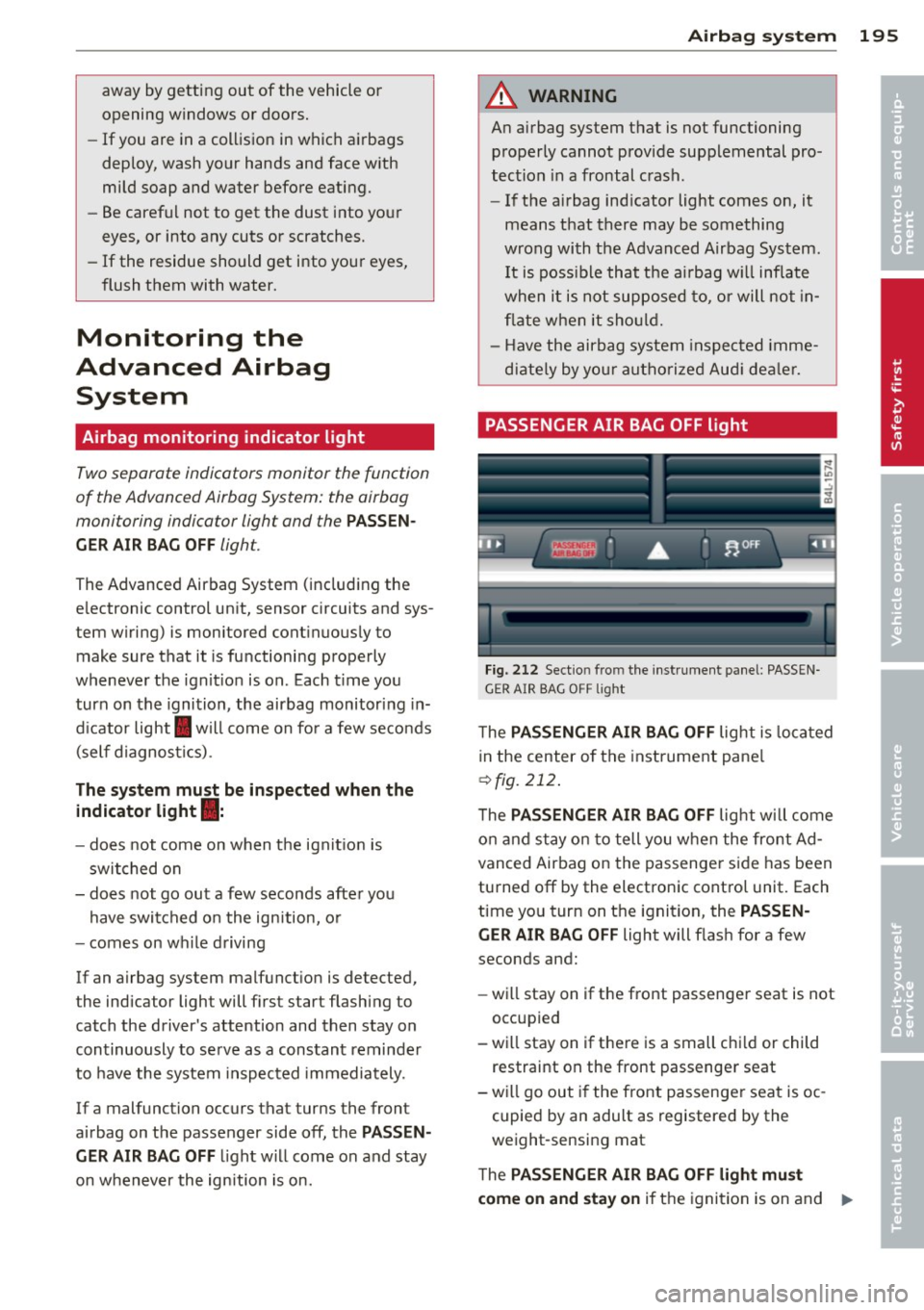
PASSENGER AIR BAG OFF light
Fi g. 212 Sec tion fro m th e in str um ent pa nel: PASSEN
GER AIR BAG O FF light
-
T he PASSENGER AIR BAG OFF light is loca ted
i n the center of the instrument pa ne l
¢ fig. 212 .
The PAS SENGER AIR BAG OFF lig ht will come
o n and stay on to tell you when the front Ad
vanced Airbag on the passenger side has been
turned off by the electronic control unit. Each
t ime yo u turn on the ignition, the
PASSEN·
GER AIR BAG OFF
light will flash for a few
seconds and:
- w ill stay on if the front passenger seat is not
occupied
- w ill stay on if there is a small chi ld or child
restraint on the front passenger seat
- w ill go out if the front passenger seat is oc
cupied by an adult as registered by the
weight-sensing mat
T he
PASSENGER AIR BAG OFF light must
come on and sta y on
if the ignition is on and ..,.
•
•
Page 198 of 348
196 Airbag sys te m
- a car bed has been insta lled on the front
seat, or
- a rearward-facing chi ld restraint has been
installed on the front passenger seat, or
- a fo rward -facing child restraint has been in
sta lled on the front passenger seat, or
- the weight registered on the front passen
ger seat is equa l to or less than the com
bined weight of a typical 1 year -old restrain
ed in one of the rear-facing or forward-fac
ing infant restraints listed in Federal Motor
Vehicle Safety Standard 208 with which the
Advanced Airbag System in your veh icle was
certified.
If the front passenger seat is not occupied,
the front airbag will not deploy, and the
PAS
SENGER AIR BAG OFF
li ght will stay on. Nev
er install a rearward-fac ing c hild restra int on
the front passenger seat, the safest place fo r
a child in any kind of child restraint is at one
of the seat ing positions on the rea r seat
~ page 186, Child restraints on the front seat
- some important things to know
and
~ page 205, Child Safety.
If the PASSENGER AIR BAG OFF light c om es
on
when one of the conditions listed above is
met, be sure to check the light regularly to
make certain that the
PASSENGER AIR BAG
OF F
light stays on cont inuo usly whenever the
ignit ion is on. If the
PA SSENGER AIR BAG
OFF
light does not appear on and does not
stay on all the time, stop as soon as it is safe
to do so and
- react ivate the system by turning the ignition
off and then turning it on again;
- remove and re insta ll the chi ld restraint .
Make sure that the child restraint is properly
installed and that the safety be lt for the
front passenger seat has been correct ly
routed through the child restra int as descri
bed in the chi ld restrai nt manufacturer's in
stru ct ions;
- make sure that the convert ible locking fea
tu re on the safety belt fo r the front passen
ger seat has been a ctivated and that the
sa fe ty belt has been pulled tight. The belt
must not be loose or have loops of slack so that the sensor be
low the sa fe ty belt latch
on the seat can do its job~
page 215.
-ma ke sure that things tha t may increase the
weight of the ch ild and chi ld safety seat a re
not being t ransported on the front passen
ger seat;
- make sure that the safety belt tension sen
sor is not blocked. S hake the safety belt
latch on the front passenger seatback and
forth;
- If a strap or tether is be ing used to tie the
child safety seat to the front passenger
seat, make sure that it is not so tight that it
causes the weight-sensing mat to measure more weight than is act ually on the seat .
If the PAS SENGER AIR BAG OFF light still
does not come on
and does not stay on con
t in uous ly (when the ignition is switched on),
- take the child restraint off the front passen-
ger seat and install it properly at one of the
rear seat positions. Have the airbag system
inspected by your authorized Aud i dealer
immed iately.
- move the child to a rear seat position and
make sure that the ch ild is properly restra in
ed in a ch ild restra int that is app rop riate for
its s ize and age.
The
PASSENGER A IR BAG OFF light should
NOT come on when the ignit ion is on and an
adult is s itting in a proper seating position on
t h e front passenge r seat. If the
PASSENGER
AIR BAG OFF
light comes on and s tays on o r
f lashes fo r about 5 seconds w hile d riving, un
der these ci rcumstances, make sure tha t:
- the adult on the front passenge r seat is
prope rly seated on the cente r of the sea t
cushion wi th his or her back up aga inst the
backrest and the backrest is not recl ined
~ page 166 , Proper occupant seating posi
tions,
- the adult is not taking weight off the seat by
holding on to the passenger assist handle
above the front passenger door or support-
ing their weight on the armrest, .,.
Page 202 of 348
200 Airbag system
The side airbags are located in the sides of the
front seat backrests ¢
fig. 213 and the rear
backrest* facing the doors. They are ident ified
by the word "AIRBAG".
The side airbag system basically consists of:
-the e lectronic control module and external
side impact sensors
- the two side airbags located in the sides of
the front backrests
- two rear side airbags (as an ordered
option)
-the a irbag warn ing light in the instrument
cluster .
The airbag system is monitored electron ically
to make certain that it is functioning properly
at all times. Each time you turn on the igni
tion, the airbag system indicator light will
come on for a few seconds (self diagnostics) .
The s ide airbag system supplements the safe
ty belts and can help to reduce the risk of in
jury to the driver's, front and rear* passeng
er's upper torso on the side of the veh icle that
i s struck in a side collision . Th e airbag deploys
on ly in side impacts and only when the veh icle
acceleration registered by the control unit is
high enough . If this rate is below the refer
ence value programmed into the control unit,
the side airbags will not be triggered, even
though the car may be badly damaged as a re
sult of the collision. It is not possible to de
f in e an a irbag tr igger ing range that will cover
every possible angle of impact, since the cir
cumstances will vary considerably between
one collision and another. Important factors
include, for examp le, the nature (hard or soft)
of the impacting object, the angle of impact ,
vehicle speed, etc . ¢
page 201, Important
safety instructions on the side airbag system .
Aside from their normal safety function , safe
ty belts work to help keep the driver or front
passenger in position in the event of a side
coll ision so that th e side airbags can provide
protection.
The airbag system is
not a substitute for your
safety be lt. Rather, it is part of the overall oc
cupant restraint system in your vehicle . Al
ways remember that the side airbag system can
only help to protect you if you are wearing
your safety belt and wearing it properly. This
is another reason why you should a lways wear
your safety belts, not just because the law re
quires you to do so¢
page 175, General
notes .
It is important to remember that wh ile the
s u pplementa l side airbag system is designed
to reduce the likelihood of serious injuries,
other injur ies, for example, swelling, bru is in g,
and minor abrasions can also be assoc iated
with deployed side airbags . Remember too,
s ide airbags will dep loy only once and only in
certain kinds of accidents - your safety belts
are always there to offer protection.
Vehicle damage , repair costs or even the lack
of vehicl e damage are not necessarily an indi
cation of over-sensitive or failed airbag activa
t ion. In some coll is ions, both front and side
airbags may inflate . Remember too, that air
bags will deploy only once and only in certain
k inds of co llisions -yo ur safety belts are al
ways there to offer protection in those acc i
den ts in which airbags are no t supposed to
deploy or when they have already deployed .
The side airbag system will not deploy:
-when the ignition is t urned off
- in side collisions when the acceleration
measured by the sensor is too low
- in front -end collisions
- in rea r-end collisions
- in rollovers .
In some types of accidents the front airbags ,
s ide curtain airbags and s ide a irbags may be
triggered together .
A WARNING
-
-Safety belts and the airbag system will
only provide protection when occupants
ar e in the proper seating position
¢page 201.
- If the airbag indicator light comes on
when the vehicle is being used, have the
system inspected immediately by your
authorized Audi dealer. The airbag may
Page 203 of 348
not work properly when the vehicle
acceleration in a side collision is high
enough to activate the airbag.
How supplemental side airbags work
Side airbags deploy instantly and can help re duce the risk of upper torso injuries for occu
pants who are properly restrained.
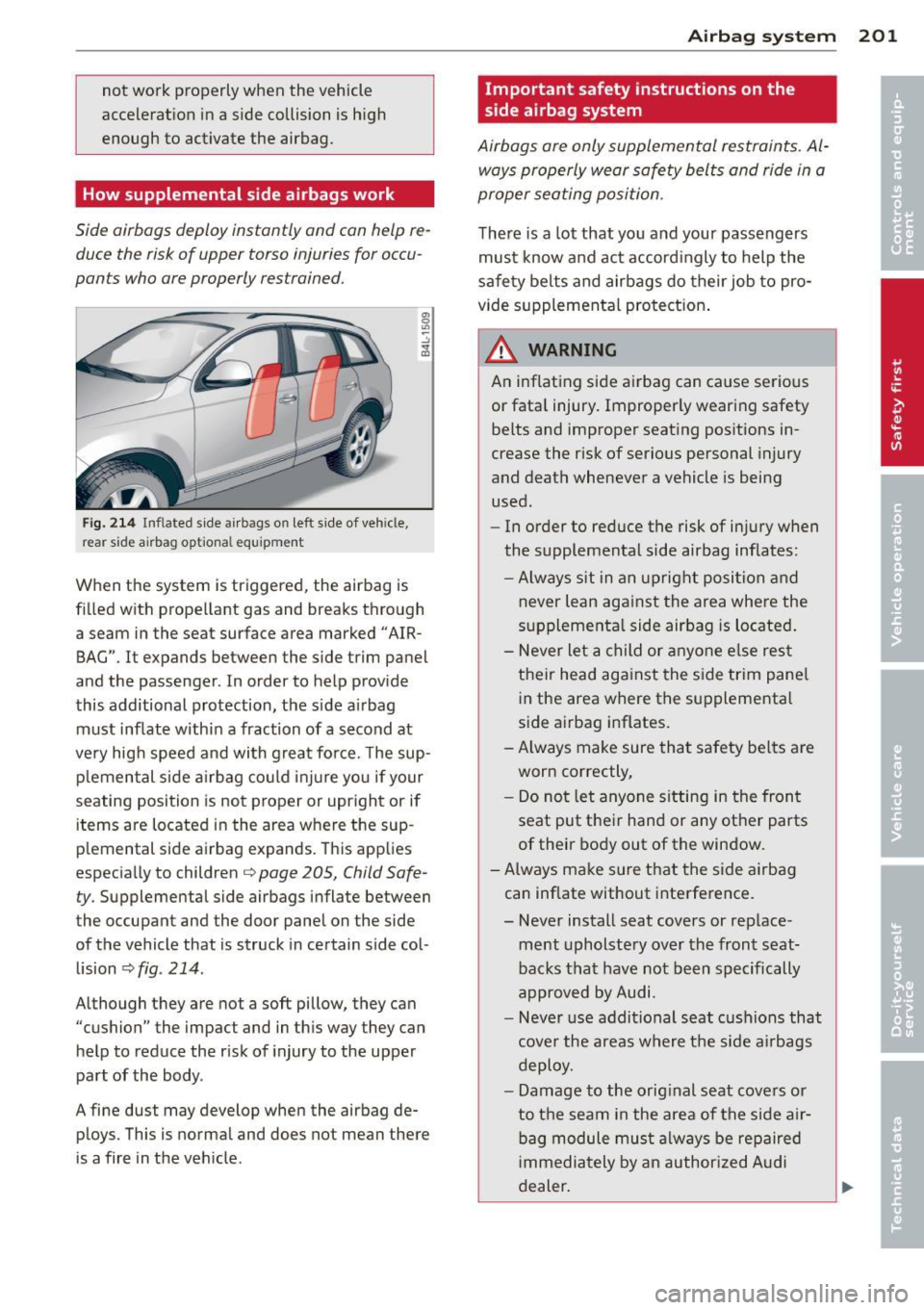
Fig. 214 Inflated side airbags on left side of veh icle,
rear side airbag optional equipment
When the system is triggered, the airbag is
filled with propellant gas and breaks through a seam in the seat surface area marked "AIR
BAG". It expands between the side trim panel
and the passenger . In order to help provide
this additional protection, the side airbag must inflate within a fraction of a second at
very high speed and with great force. The sup
plemental side airbag could injure you if your
seating position is not proper or upright or if
items are located in the area where the sup
plemental side airbag expands. This applies
especially to children
¢ page 205, Child Safe
ty.
Supplemental side airbags inflate between
the occupant and the door panel on the side
of the vehicle that is struck in certain side col
lision
~ fig . 214.
Although they are not a soft pillow, they can
"cushion" the impact and in this way they can
help to reduce the risk of injury to the upper
part of the body .
A fine dust may develop when the airbag de ploys. This is normal and does not mean there
is a fire in the vehicle.
Airbag system 201
Important safety instructions on the
side airbag system
Airbags are only supplemental restraints. Al
ways properly wear safety belts and ride in a
proper seating position.
There is a lot that you and your passengers
must know and act accordingly to help the
safety belts and airbags do their job to pro
vide supplemental protection.
A WARNING
An inflating side airbag can cause serious
or fatal injury. Improperly wearing safety
belts and improper seating positions in
crease the risk of serious personal injury
and death whenever a vehicle is being
used.
- In order to reduce the risk of injury when
the supplemental side airbag inflates:
- Always sit in an upright position and
never lean against the area where the
supplemental side airbag is located.
- Never let a child or anyone else rest
their head against the side trim panel
in the area where the supplemental
side airbag inflates.
- Always make sure that safety belts are
worn correctly,
- Do not let anyone sitting in the front
seat put their hand or any other parts
of their body out of the window.
-Always make sure that the side airbag can inflate without interference.
- Never install seat covers or replace
ment upholstery over the front seat
backs that have not been specifically
approved by Audi.
- Never use additional seat cushions that
cover the areas where the side airbags deploy.
- Damage to the original seat covers or
to the seam in the area of the side air
bag module must always be repaired
immediately by an authorized Audi
dealer.
Page 204 of 348
202 Airbag system
-Objects between you a nd the airbag can
increase the risk of injury in an acc ident
by interfering wit h the way the airbag
unfolds or by be ing pushed into you as
the a irbag inflates .
- Never p lace or a ttach accessories or
other objects (such as cupholders, tele
phone brackets, or even large, bulky
objects) on the doors, over or near the
area marked "AIRBAG" on the seat
backrests.
- Such objects and accessories can be
come dangerous projectiles and cause
injury when the supplemental s ide air
bag deploys.
- Never carry any objects or pets in t he
deployment space between them and
the airbags or allow children or other
passengers to travel in this posit ion.
- Always use the built-in coat hooks only
for lightwe ight clothing . Never leave any
heavy o r sharp-edged objects in the
poc ke ts that may in terfere with side air
bag dep loyment and can cause personal
injury in an accident .
- Always prevent the side a irbags from be
ing damaged by heavy objects knoc king
against o r hitti ng the sides of the seat
backs.
- The airbag system can only be triggered
once . If the a irbag has been triggered ,
the system must be replaced by an au
thorized Audi dealership.
- Damage (cracks, deep scratches etc .) to
the origina l seat covers or to the seam in
the area of the side airbag module must always be repaired immediately by an au
thorized Aud i dealer.
- If children a re seated improperly, their
risk of injury increases in the case of an
acc ident
q page 205, Child Safety.
- Never attempt to modify any compo
nents of the airbag system in a ny way.
- In a side co llision, s ide airbags will not
f unction properly if senso rs cannot cor
rect ly measure increasing air p ressu re in
s ide the doors when air escapes t hro ugh larger, unclosed openings in the door
panel.
- Never dr ive with inte rior door t rim pan
els removed.
- Never dr ive when parts have bee n re
moved from the inside door pane l and
the ope nings they leave have not been
properly closed.
- Never dr ive when loudspe akers in the
doo rs have been removed unless the
speake r holes have been properly
closed.
- Always make certain tha t openings are
cove red or f ille d if ad dit iona l speakers
o r other equipment is insta lled in the
inside door panels .
- Always have work on the doors done by
an a uthorized Audi dea ler or q ualified
wor kshop.
Side curtain airbags
Description of side curtain airbags
The side curtain airbags can provide supple
mental protection to properly restrained oc
cupants .
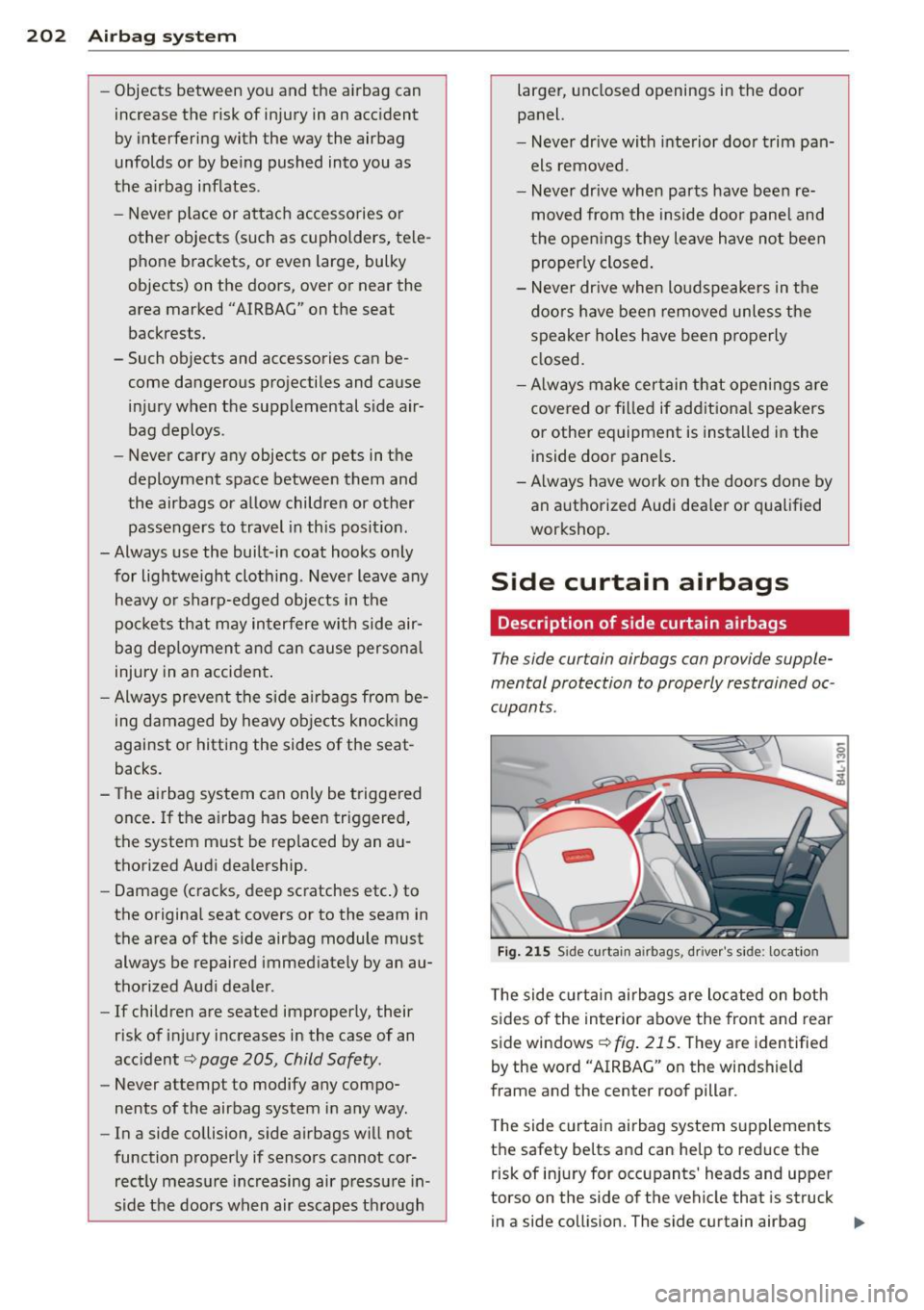
Fig. 21S Side curtain a irbags, driver 's side : locat ion
T he side c urtai n airbags are located on bot h
s ides of the interior above the front and rear
s ide windows
c!;J fig . 215. They are identified
by the word "AIRBAG" on the windshield
frame and the center roof pillar .
T he side c urtain airbag system s upplements
t h e safety be lts and can he lp to red uce the
risk of in jury for occupants' heads and upper
torso on the side of the vehicle that is struck
in a side collision. The side curtain airbag ..,.
Page 207 of 348
Child Safety
Important things to know
Introduction
The rear seat is generally the safest place in a
collision .
The physical principles of what happens when
your veh icle is in a crash app ly also to chi ldren
~ page 177, What happens to occupants not
wearing safety belts? .
But unlike adults and
teenagers, their muscles and bones are not
fu lly developed. In many respects children are
at greater risk of serious injury in crashes than
adu lts.
Because children's bod ies are not fully deve l
oped, they require restraint systems especial ly designed for their size, weight, and body
structure. Many countries and all states of the
United States and provinces of Canada have
laws requiring the use of approved child re
straint systems for infants and small children .
In a fronta l crash at a speed of 20 -35 mph
(30-56 km/h) the forces acting on a 13-pound
(6 kg) infant w ill be more than 20 t imes the
weight of the child . This means the weight of
the child would suddenly be more than
260 pounds (120 kg). Under these conditions,
on ly an appropriate chi ld restraint properly
used can reduce the risk of ser ious injury .
Child restraints, like adult safety belts, must
be used properly to be effective. Used improp
erly, they can increase the risk of serious in
jury in an accident.
Consult the child safety seat manufacturer's
instructions in order to be sure the seat is
right for your chi ld's size ~
page 208 , Impor
tant safety instructions for using child safety
seats.
Please be sure to read and heed all of
the important information and WARNINGS
about ch ild safety, Advanced A irbags, and the
installation of child restraints in this chapter.
There is a lot you need to know about the Ad
vanced Airbags in your vehicle and how they work when infants and children in child re-
Child Sa fet y 205
straints are on the front passenger seat . Be
cause of the large amount of important infor
mation, we cannot repeat it a ll here . We urge
you to read the detailed information in this owner's manual about airbags and the Ad
vanced Airbag System in your vehicle and the
very important information about transport
ing children on the front passenger seat .
Please be sure to heed the WARNINGS -they
are extremely important for your safety and
the safety of your passengers, especially in
fants and small chi ldren .
.A, WARNING
-Accident statistics have shown that chil
dren are generally safer in the rear seat
area than in the front seating position.
Always restrain any child age 12 and un der in the rear.
- All vehicle occupants and especially chil
dren must be restrained properly when
ever riding in a vehicle . An unrestrained
or improperly restrained chi ld could be
injured by str ikin g the interior or by be
ing ejected from the vehicle during a
sudden maneuver or impact. An un re
strained or improper ly restrained chi ld is
also at greater risk of injury or death
through contact with an inflating airbag.
- A suitable chi ld restraint properly instal
led and used at one of the rear seating
positions provides the highest degree of
protection for infants and small children
in most accident situations.
A WARNING
Children on the front seat of any car even
with Advanced Airbags can be ser iously in
jured or even killed when an a irbag in
flates. A child in a rearward-fac ing ch ild
safety seat installed on the front passen
ger seat will be ser iously injured and can
be killed if the front airbag inflates .
- The inflating airbag will h it the child
safety seat or infant carrier with great
force and will smash the child safety seat
and child against the backrest, center
armrest, or door.
•
•
Page 211 of 348
A WARNING
1
Not using a child safety seat, using the
wrong child safety seat or improperly in
stalling a child restraint increases the risk
of serious personal injury and death .
-All vehicle occupants and especially chil dren must always be restrained properly
whenever riding in a vehicle.
- An unrestrained or improperly restrain
ed child can be injured or killed by be
ing thrown against the inside of the ve
hicle or by being ejected from it during
a sudden maneuver or impact.
- An unrestrained or improperly restrain
ed child is at much greater risk of injury
or death by being struck by an inflating
airbag.
- Commercially available child safety seats
are required to comply with U.S. Federal
Motor Vehicle Safety Standard (FMVSS)
213 (in Canada CMVSS 213).
- When buying a child restraint, select
one that fits your child and the vehicle.
- Only use child restraint systems that
fully contact the flat portion of the
seat cushion. The child restraint must
not tip or lean to either side. Audi does
not recommend using child safety
seats that rest on legs or tube-like
frames . They do not provide adequate
contact with the seat.
-Always heed all legal requirements per
taining to the installation and use of
child safety seats and carefully follow
the instructions provided by the manu
facturer of the seat you are using.
- Never allow children under 57 inches
(1.45 meters) to wear a normal safety
belt. They must always be restrained by a
proper child restraint system. Otherwise,
they could sustain injuries to the abdo
men and neck areas during sudden brak
ing maneuvers or accidents.
- Never let more than one child occupy a
child safety seat .
Child Safety 209
-Never let babies or older children ride in
a vehicle while sitting on the lap of an
other passenger.
- Holding a child in your arms is never a
substitute for a child restraint system .
- The strongest person could not hold
the child with the forces that exist in
an accident. The child will strike the in
terior of the vehicle and can also be
struck by the passenger.
- The child and the passenger can also
injure each another in an accident.
- Never install rear-facing child safety
seats or infant carriers on the front pas
senger seat . A child will be seriously in
jured and can be killed when the passen
ger airbag inflates -even with an Ad
vanced Airbag System .
- The inflating airbag will hit the child
safety seat or infant carrier with great
force and will smash the child safety seat
and child against the backrest, center
armrest, door or roof .
-Always install rear-facing child safety
seats or infant carriers on the rear seat .
- Forward-facing child safety seats instal
led on the front passenger's seat can in
terfere with the airbag when it inflates
and cause serious injury to the child.
Al
ways install forward-facing child safety
seats on the rear seat .
- If exceptional circumstances require the
use of a forward-facing child restraint on
the front passenger's seat, the child 's
safety and well-being require that the
following special precautions be taken:
- Make sure the forward-facing seat has
been designed and certified by its man
ufacturer for use on a front seat with a
passenger front and side airbag.
- Always carefully follow the manufac
turer's instructions provided with the
child safety seat or carrier.
- Always move the front passenger seat
into the rearmost position of the pas
senger seat's fore and aft adjustment range, and as far away from the airbag •
•
•
•