ESP AUDI RS5 COUPE 2015 Workshop Manual
[x] Cancel search | Manufacturer: AUDI, Model Year: 2015, Model line: RS5 COUPE, Model: AUDI RS5 COUPE 2015Pages: 254, PDF Size: 64.12 MB
Page 152 of 254

Child safety
Child safety
Important information
Introduction
The rear seat is generally the safest place in a
collision .
The physical principles of what happens when
your vehicle is in a crash apply also to children
¢ page 121, What happens to occupants not
wearing safety belts? .
But unlike adults their
muscles and bones are not fully developed . In
many respects children are at greater risk of seri
ous injury in crashes than adults .
Because children's bod ies are not fully developed,
they requ ire restraint systems especially de
signed fo r their size, weight, and body structure.
Many countries and all states of the United
States and prov inces of Canada have laws requi r
ing the use of approved child restraint systems
for infants and small children.
I n a frontal crash at a speed o f 20-35 mph
(30-56 km/h) the forces acting on a 13 -po und
(6 kg) infant will be more than 20 times the
weight of the child. This means the weight of the
child would sudden ly be more than 260 pounds
(120 kg). Under these conditions, only an appro
priate ch ild restraint properly used can reduce
the risk of serious injury. Child restraints must be
used properly to be effective . Used improperly,
they can increase the risk of serious injury in an
accident.
Consult the ch ild safety seat manufacturer's in
structions to be sure the seat is right for your
child's size¢
page 153, Important safety in
structions for using child safety seats.
Please be
sure to read and heed all of the important infor
mation and WARN INGS about child sa fety, Ad
vanced Airbags, and the installation of child re
straints in this chapter.
There is a lot you need to know about the Ad
vanced Airbags in your vehicle and how they work
when infants and children in child restraints are
on the front passenger seat. Because of the large
amount of important information, we cannot re
peat it all here. We urge you to read the detailed
150
information in this owner 's manual about airbags
and the Advanced Airbag System in your vehicle
and the very important information about trans
porting children on the front passenger seat.
Please be sure to heed the WARNINGS -they are
extremely important for your safety and the safe
ty of your passengers, especially infants and
small chi ldren .
&_ WARNING
-Accident statistics have shown that children
are generally safer in the rear seat area than
in the front seating position. Always restrain
any child age 12 and under in the rear.
- All vehicle occupants and especially children
m ust be restrained properly whenever riding
in a vehicle. An unrestrained or improperly
restrained chi ld could be injured by striking
the interior or by be ing ejected from the ve
hicle dur ing a sudden maneuver or impact.
An unrestra ined or improperly restrained
child is also at greater risk of injury or death
through contact with an inflating airbag.
-A suitable ch ild restraint properly installed
and used at one of the rear seating posit ions
provides the highest degree of protect ion
for infants and small children in most acci
dent situations.
&_ WARNING
Children on the front seat of any car even with
Advanced Airbags can be seriously injured or
even killed when an airbag inflates. A child in
a rearward-facing child safety seat installed
on the front passenger seat will be serious ly
injured and can be killed if the front airbag in
f lates .
- The inflating airbag will h it the ch ild safety
seat or infant carr ier with great force and
w ill smash the child safety seat and child
aga inst the backrest, center armrest or
door .
-Always install rearward-facing child safety seats on the rear seat .
- If you must install a rearward fac ing ch ild
safety seat on the front passenger seat in
Page 153 of 254

M N
0:: loo ,...., \!) er,
N er, ,....,
exceptional circumstances and the PASSEN
GER AIR BAG OFF
light does not come on
and stay on, immediately install the rear
ward-facing child safety seat in a rear seat
ing position and have the airbag system in
spected immediately by your authorized
Audi dealer.
A WARNING
If, in exceptional circumstances, you must in
stall a forward-facing child restraint on the
front passenger's seat:
- Always make sure the forward-facing seat
has been designed and certified by its man
ufacturer for use on a front seat with a pas
senger front and side airbag.
- Always follow the manufacturer's instruc
tions provided with the child safety seat or carrier.
- Always
move the passenger seat into its
rearmost position in the seat's fore and aft
adjustment range, as far away from the air
bag as possible before installing the child
restraint. The backrest must be adjusted to
an upright position.
- Always make sure that the
PASSENGER AIR
BAG OFF
light comes on and stays on all the
time whenever the ignition is switched on.
Always replace child restraints that were in
stalled in a vehicle during a crash. Damage to
a child restraint that is not visible could cause
it to fail in another collision situation.
Advanced front airbag system and children
Your vehicle is equipped with a front "Advanced
Airbag System" in compliance with United States
Federal Motor Vehicle Safety Standard (FMVSS)
208 as applicable at the time your vehicle was
manufactured.
The Advanced Airbag system in your vehicle has
been certified to meet the "low-risk" require
ments for 3- and 6-year old children on the pas
senger side and small adults on the driver side.
The low risk deployment criteria are intended to
Child safety
reduce the risk of injury through interaction with
the airbag that can occur, for example, by being
too close to the steering wheel and instrument
panel when the ai rbag inflates. In addition, the
system has been certified to comply with the "suppression" requirements of the Safety Stand
ard, to turn off the front airbag for infants up to
12 months who are restrained on the front pas
senger seat in child restraints that are listed in
the Standard.
Even though your vehicle is equipped with an Ad
vanced Airbag system, all children, especially
those 12 years and younger, should always ride in
the back seat properly restrained for their age
and size. The airbag on the passenger side makes
the front seat a potentially dangerous place for a
child to ride. The front seat is not the safest place
for a child in a forward-facing child safety seat. It
can be a
very dangerous place for an infant or a
larger child in a rearward-facing seat.
Advanced Airbags and the weight-sensing
mat in the front seat
The Advanced Airbag System in your vehicle de
tects the presence of an infant or child in a child
restraint on the front passenger seat using the
weight-sensing mat in the seat cushion and the sensor below the safety belt latch on the front
passenger seat that measures the tension on the
safety belt .
The weight-sensing mat measures total weight of
the child and the child safety seat and a child blanket on the front passenger seat. The weight
on the front passenger seat is related to the de
sign of the child restraint and its "footprint", the
size and shape of the bottom of the child re
straint as it sits on the seat. The weight of a child
restraint and its "footprint" vary for different
kinds of child restraints and for the different
models of the same kind of child restraint offered
by child restraint manufacturers.
The weight ranges for the individual types, makes
and models of child restraints that the NHTSA
has specified in the Safety Standard together
with the weight ranges of typical infants and typ-
ical 1 year-old child have been stored in the ...,
151
Page 155 of 254

M N
0:: loo ,...., \!) 1.1'1
N 1.1'1 ,....,
Model Manufactured on or
a fter
Cosco Summit Deluxe September 25, 2007
High Back Booster
22-262
Cosco High Back Boos -September 25, 2007
ter 22-209
Evenflo Tribute V September 25, 2007
379xxxx
Evenflo Medallion 254 December 1, 1999
Evenflo Generations September 25, 2007
3S2xxxx
Graco ComfortSport September 25, 2007
Graco Toddler Safety September 25, 2007
Seat Step 2
Graco Platinum Cargo September 25, 2007
.&, WARNING
To reduce the risk of serious injury, make sure
that the
PASS ENGER AIR BAG OFF light
comes on and stays on whenever a child re
straint is installed on the front passenger seat
and the ignition is switched on.
- Take the child restraint off the front passen ger seat and install it properly at one of the
rear seat positions if the
PASSENGER AIR
BA G OFF
light does not stay on.
- Have the airbag system inspected by your
authorized Audi dealer immediately.
(D Tips
The ch ild seats listed in categories A to C have
been statically tested by Audi on ly for the Ad
vanced Airbag function.
Important safety instructions for using
child safety seats
Correct use of child safety seats substantially re
duces the risk of injury in an accident!
As the driver, you are responsible for the safety of
everybody in the vehicle, especially children:
.,. Always use the right child safe ty seat for each
child and a lways use it properly
¢ page 155 . Child
sa fety
.,. Always carefully follow the child safety seat
manufacturer's instructio ns on how to route
the safety belt properly through the child safe
ty seat.
.,. When using the vehicle safety belt to install a
child safety seat, you must first activate the
convert ible lock ing retractor on the safety belt
to prevent the child safety seat from mov ing
r::) page 159 .
.,. Push the ch ild safety sea t down with yo ur full
weight to get the safety belt rea lly tight so that
the seat cannot move forward or sideways more
than one inch (2.5 cm).
.,. If a strap or tether is being used to tie the child
safety seat to the front passenger seat, make
sure that it is not so tight that it causes the
weight -sensing mat to measure more we ight
than is actually on the seat .
.,. Secure unused safety belts on the rear seat
r::)page 155 .
Always remember : Even though your vehicle is
equipped with an Advanced Airbag system, all
c hi ld ren, especially those 12 years and younge r,
shou ld a lways r ide in the back seat prope rly re
stra ined for their age and size.
A WARNING
=
Not using a child sa fety seat, us ing the wrong
chi ld safety seat or improperly installing a
chi ld restraint increases the risk of serious
personal injury and death.
- All vehicle occ upants and especially children
must always be restrained properly whenev
er riding in a vehicle.
- An unrest rained or improperly restrained
ch ild can be injured or killed by being
thrown against the ins ide of the vehicle o r
b y being ejected from it du ring a s udden
maneuver or impact.
- An unrestrained or improperly res trained
child is at much greater risk of injury or
death by being struck by an inflating air
bag.
- Commercia lly available child safety seats
are req uired to comply with U.S. Federa l Mo
tor Vehicle Safety Standard (FMVSS) 213 (in
Canada CMVSS 213). .,_
153
Page 157 of 254
"' N
0:: loo
rl I.O
"' N
"' rl
-Take the child restraint off the front passen
ger seat and install it properly at one of the
rear seat positions if the
PASSENGER AIR
BAG OFF
light does not stay on .
- Have the airbag system inspected by your
authorized Audi dealer immediately.
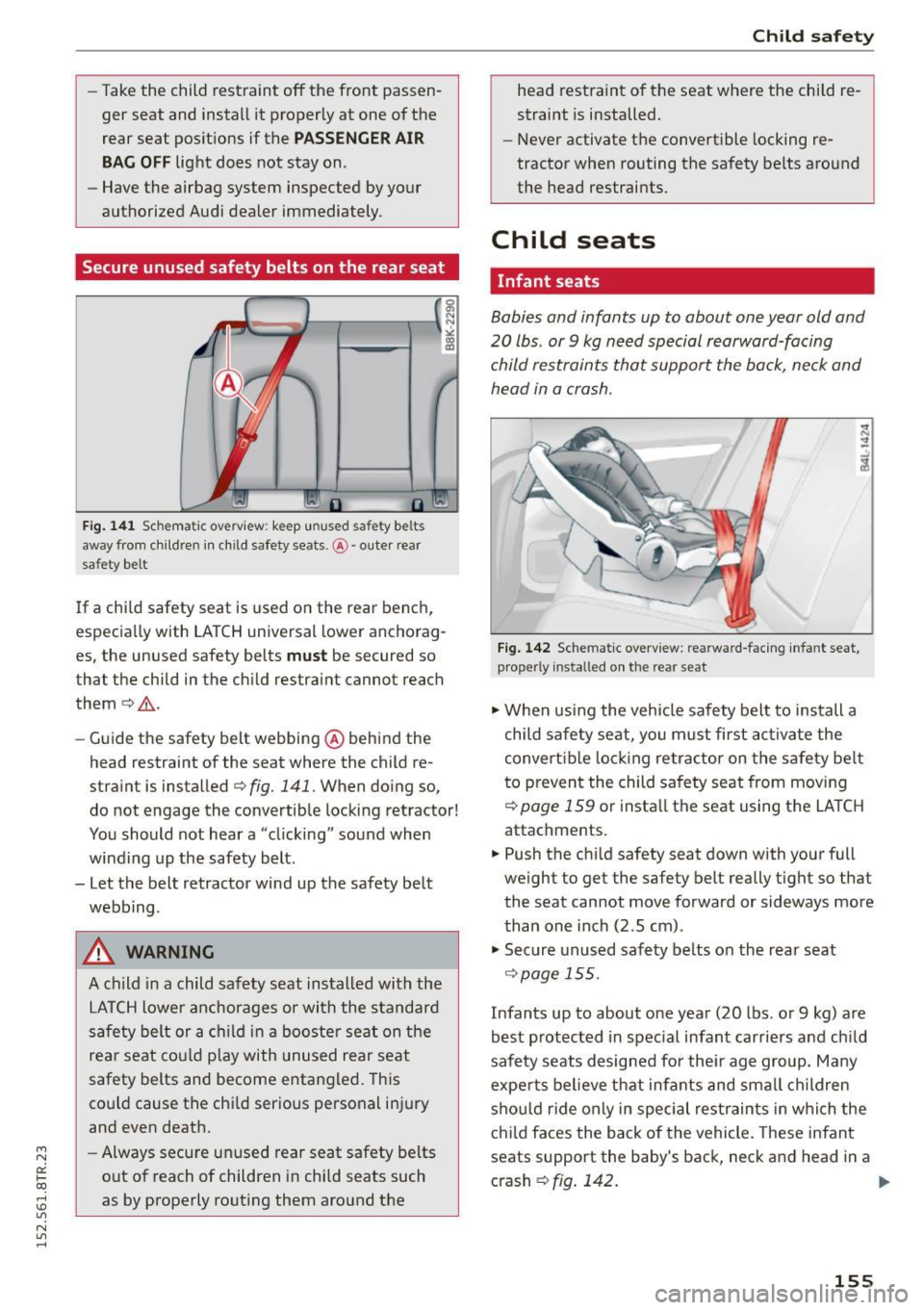
Secure unused safety belts on the rear seat
F ig . 141 Schemat ic overview : keep un used sa fety be lts
away from child ren in child safety seats. @-oute r rear
sa fety belt
If a chi ld safety seat is used on the rear bench,
especia lly with LATCH universal lower anchorag
es, the unused safety belts
must be secured so
that the child in the child restraint cannot reach
them
c::> ,& .
-Gui de the safety belt webbing @ behind the
head restraint of the seat where the child re
straint is installed
c:> fig. 141. When do ing so,
do not engage the convertible locking retractor!
You should not hear a "clicking " sound when
winding up the safety belt .
- Let the belt retractor wind up the safety belt webbing .
A WARNING
A child in a child safety seat installed with the
LA TCH lower anchorages or with the standard
safety belt or a child in a booster seat on the
rea r seat could play with unused rear seat
safety belts and become entangled. This
co uld cause the chi ld serious personal inj ury
and even death.
- Always secure un used rear seat safety belts
o ut of reach of children in child seats such
as by properly routing them around the
Child safety
head restraint of the seat where the child re
straint is installed.
- Never activate the convertible locking re
tractor when routing the safety be lts around
the head restraints.
Child seats
Infant seats
Babies and infants up to about one year old and
20 lbs. or
9 kg need special rearward-facing
child restraints that support the back, neck and
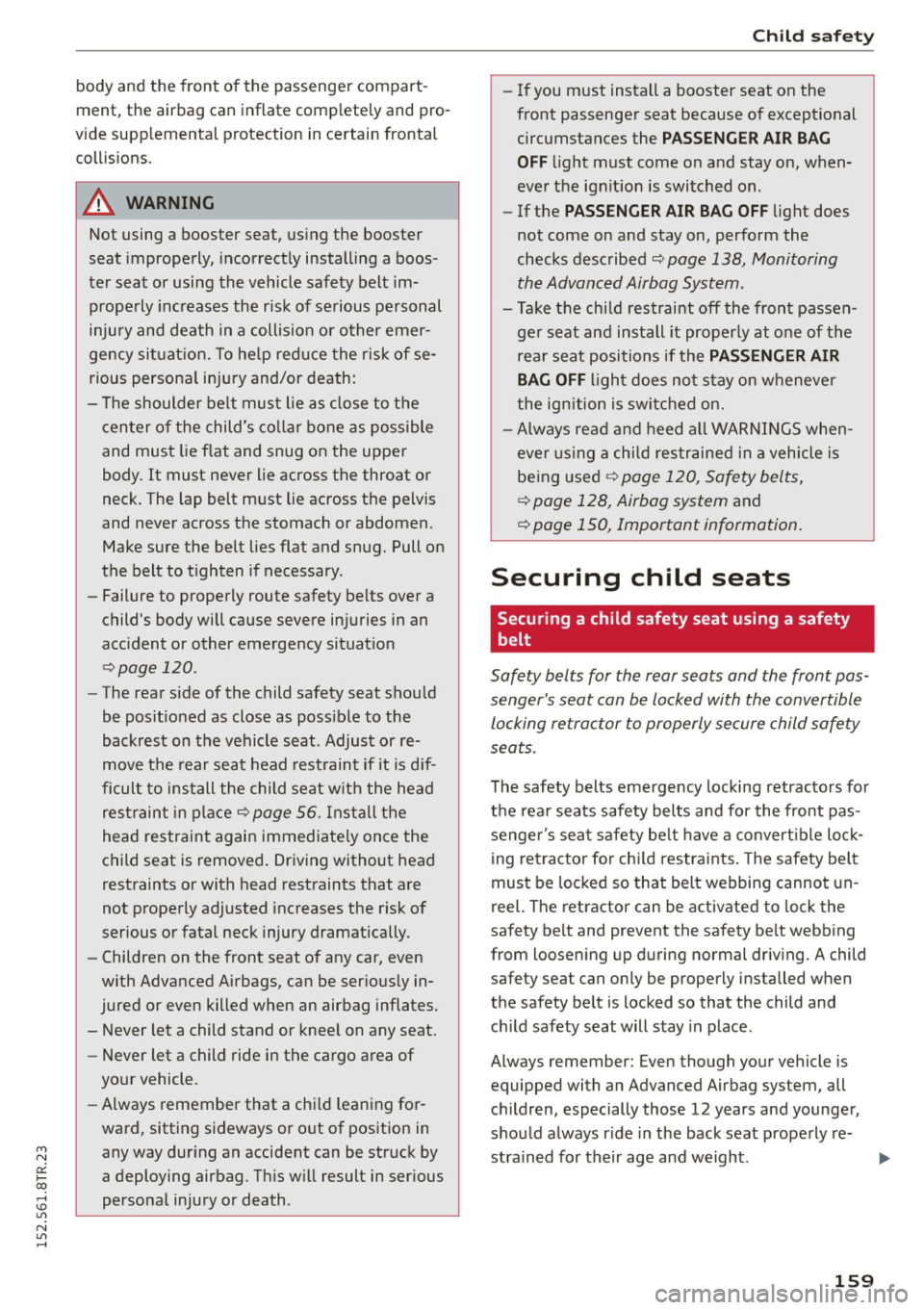
head in a crash.
Fig. 142 Schematic overv iew: re arward -fac ing infant seat ,
proper ly in stalled on the rear seat
... When using the vehicle safety belt to install a
child safety seat, you must first activate the
convert ible locki ng retractor on the safety belt
to prevent the child safety seat from mov ing
c:> page 159 or install the seat using the LATCH
attachments.
... Push the ch ild safety seat down with your full
weight to get the safety belt really tight so that
the seat cannot move forward or sideways more
than one inch (2.5 cm) .
... Secure unused safety belts on the rear seat
c::>page 155.
Infants up to about one year (20 lbs. or 9 kg) are
best p rotected in spec ial infant carriers and ch ild
safety seats designed for the ir age group. Many
experts believe that infants and small children
should ride only in special restraints in which the
child faces the back of the vehicle. These infant
seats support the baby's back, neck and head in a
crash
c:> fig . 142. ll>
155
Page 160 of 254

Child safety
BAG OFF light does not stay on whenever
the ignition is switched on.
Booster seats and safety belts
Properly used booster seats can help protect
children weighing between about 40 lbs. and 80
lbs. (18 kg and 36 kg) who ore less than 4 ft .
9
in. (57 inches/1.45 meters) tall.
Fig . 14 5 Rear seat: ch ild p roperly restra ined in a booster
seat
The vehicle's safety belts alone will not fit most
children until they are at least 4
ft. 9 in . (57 in
ches/1.45 meters) tall and weigh about 80 lbs.
(36 kg) . Booster seats raise these c hildren up so
that the safety belt will pass properly over the
stronge r pa rts of their bod ies and the safety belt
can help protect them in a crash.
• Do not use the convertible locking retractor
when using the vehicle's safety belt to restrain
a chi ld on a booster seat .
• The shoulder be lt must lie as clo se to the cen
t er of the child's collar bone as poss ible and
must lie flat and sn ug on the upper body . It
must never lie across the throat or neck . The
lap belt must lie across the pelvis and never
across the stomach or abdomen . Make sure the
belt lies flat and snug. Pull on the belt to tight
en if necessary.
• Secu re unused safety belts on the rear seat
~ page 155.
Children up to about 40 lbs. (18 kg) are best pro
tected in child safety seats designed for their age
and weight . Experts say that the skeletal struc
ture, part icularly the pelvis, of these ch ildren is
not f ully deve loped, and they must not use the
158
vehicle safety be lts without a suitable child re
straint.
It i s usually best to put t hese chi ldren in appro
pr iate booste r seats . Be sure the boos ter seat
meets a ll applicab le safety standards.
Booster seats ra ise the sea ting pos ition of t he
ch ild an d repos ition bo th the lap and shoulder
parts o f the safety bel t so th at they pass across
the chi ld's body in the right places . The rout ing of
the be lt over the chi ld's body is very important
for t he chi ld's protection, whether or not a boos
ter seat is used. C hildren age 12 and under must
always ride in the rear seat.
Children who are at least 4
ft . 9 in . (57 inc hes/
1.45 meters) tall ca n generally use the vehicle's
three po int lap and shoulder be lts. Never use the
lap belt portion of the vehicle's safety belt alone
to rest rain any child, regardless of how b ig the
c hi ld is . A lways remember that ch ild ren do not
have the p ronounced pe lvic st ructure required for
the p roper func tion of lap belt port ion of the ve
h icle 's th ree po int lap and shoulder be lts. The
ch ild' s sa fety abso lutely requires tha t a lap belt
portion of the safety belt be fastened snug ly and
as low as possible around the pelvis . Never let
the lap be lt portion of the safety belt pass over
the child's stomach or abdomen.
In a crash, a irbags must inflate within a blink of
an eye and with considerable force . In order to do
i ts job, the airbag needs room to inflate so that it
will be there to protect the occ upant as the occu
pant moves forward into the airbag .
A ve hicle occupant who is out of pos ition and too
close to the a irbag gets in the way of an inflating
airbag. When an occupant is too close, he or she
will be struck vio lent ly and will receive serious or
possibly even fatal injury .
In order for the airbag to
offer protection, it is
important that all vehicle occupants, especially
any ch ildren, who must be in the front seat be
cause of exceptional circumstances, be prope rly
restrained and as far away from the airbag as
poss ible. By keep ing room betw een the ch ild 's ..,
Page 161 of 254
M N
0:: loo ,...., \!) ..,.,
N ..,., ,....,
body and the front of the passenger compart
ment, the airbag can inflate completely and pro
vide supplemental protection in certain frontal
collisions .
& WARNING
Not using a booster seat, using the booster
seat improperly, incorrectly installing a boos
ter seat or using the vehicle safety belt im properly increases the risk of serious personal
injury and death in a collision or other emer
gency situation. To help reduce the risk of se
rious personal injury and/or death:
- The shoulder belt must lie as close to the
center of the child's collar bone as possible
and must lie flat and snug on the upper
body.
It must never lie across the throat or
neck. The lap belt must lie across the pelvis
and never across the stomach or abdomen.
Make sure the belt lies flat and snug. Pull on
the belt to tighten if necessary.
- Failure to properly route safety belts over a
child's body will cause severe injuries in an
accident or other emergency situation
~ page 120.
-The rear side of the child safety seat should
be positioned as close as possible to the
backrest on the vehicle seat . Adjust or re
move the rear seat head restraint if it is dif
ficult to install the child seat with the head
restraint in place
~page 56. Install the
head restraint again immediately once the
child seat is removed. Driving without head
restraints or with head restraints that are
not properly adjusted increases the risk of
serious or fatal neck injury dramatically.
- Children on the front seat of any car, even
with Advanced Airbags, can be seriously in
jured or even killed when an airbag inflates.
- Never let a child stand or kneel on any seat.
- Never let a child ride in the cargo area of
your vehicle.
- Always remember that a child leaning for
ward, sitting sideways or out of position in any way during an accident can be struck by
a deploying airbag. This will result in serious
personal injury or death .
Child safety
-If you must install a booster seat on the
front passenger seat because of exceptional
circumstances the
PASSENGER AIR BAG
OFF
light must come on and stay on, when
ever the ignition is switched on .
- If the
PASSENGER AIR BAG OFF light does
not come on and stay on, perform the
checks described~
page 138, Monitoring
the Advanced Airbag System.
- Take the child restraint off the front passen
ger seat and install it properly at one of the
rear seat positions if the
PASSENGER AIR
BAG OFF
light does not stay on whenever
the ignition is switched on.
- Always read and heed all WARNINGS when
ever using a child restrained in a vehicle is
being used¢
page 120, Safety belts,
¢ page 128, Airbag system and
¢ page 150, Important information.
Securing child seats
Securing a child safety seat using a safety
belt
Safety belts for the rear seats and the front pas
senger's seat can be locked with the convertible
locking retractor to properly secure child safety
seats.
The safety belts emergency locking retractors for
the rear seats safety belts and for the front pas
senger 's seat safety belt have a convertible lock
ing retractor for child restraints. The safety belt
must be locked so that belt webbing cannot un
reel. The retractor can be activated to lock the
safety belt and prevent the safety belt webbing
from loosening up during normal driving. A child
safety seat can only be properly installed when
the safety belt is locked so that the child and child safety seat will stay in place .
Always remember: Even though your vehicle is
equipped with an Advanced Airbag system, all
children, especially those 12 years and younger,
should always ride in the back seat properly re-
strained for their age and weight . ..,_
159
Page 163 of 254
M N
0:: loo ,...., \!) ..,.,
N ..,., ,....,
adjustment range, as far away from the air
bag as possible before installing the for
ward-facing child restraint. The backrest must be adjusted to an upright position .
- Make sure that the
PASSENGER AIR BAG
OFF
light comes on and stays on all the time
whenever the ignition is switched on .
A WARNING
Rearward-facing child restraints:
- A child in a rearward-facing child safety seat
installed on the front passenger seat will be
seriously injured and can be killed if the
front airbag inflates -even with an Ad
vanced Airbag System.
- The inflating airbag will hit the child safety
seat or infant carrier with great force and
will smash the child safety seat and child
against the backrest, center armrest, door
or roof.
- Always be especially careful if you must in
stall a rearward facing child safety seat on
the front passenger seat in exceptional cir
cumstances.
- A tight tether strap on a rearward-facing
child restraint attached to the front passen
ger seat can put too much pressure on the
weight-mat in the seat and register a heavi er weight in the Advanced Airbag System .
The heavier weight registered can make the
system work as though an adult were on the
seat and deploy the Advanced Airbag when
it must be suppressed causing serious or
even fatal injury to the child.
- Make sure that the
PASSENGER AIR BAG
OFF
light comes on and stays on all the time
whenever the ignition is switched on.
- If the PASSENGER AIR BAG OFF light does
not come on and stay on, immediately in
stall the rearward-facing child safety seat in
a rear seating position and have the airbag
system inspected by your authorized Audi
dealer.
Child safety
Activating the convertible locking retractor
Use the convertible locking retractor to secure a
child restraint .
Always heed the child safety seat manufacturer's
instruc tions when installing a child restrain t in
your vehicle . To activate the convertible locking
retractor:
.. Place the child restraint on a sea t, preferably on
the rear seat.
.. Slowly pull the belt
all the way out .
.. Route it around or through the child restraint
belt path
~ . & .
.. Push the child safety seat down with your full
weight to get the safety belt really tight.
.. Insert the belt tongue into the buckle for that
seating posit ion.
.. Guide the saf ety belt back into the retractor un
til the belt lies flat and snug on the child safety
seat .
.. You should hear a "clicking" noise as the belt
winds back into the inertia reel. Test the con
vertible locking retractor by pulling on the belt .
You should no longer be able to pull the belt
out of the retractor. The convertible locking re
tractor is now activated .
.. Make sure that the red release button is facing
away from the child restraint so that it can be
unbuckled quickly.
.. Pull on the belt to make sure the safety belt is
properly tight and fastened so that the seat
cannot move forward or sideways more than
one inch (2 .5 cm) .
A WARNING
Using the wrong child restraint or an improp
erly installed child restraint can cause serious
personal injury or death in a crash .
- Always make sure that the safety belt re
tractor is locked when installing a child safe
ty seat. An unlocked safety belt retractor
cannot hold the child safety seat in place
during normal driving or in a crash.
- Always buckle the child safety seat firmly in place even if a child is not sitting in it. A
loose child safety seat can fly around during
a sudden stop or in a crash. ..,.
161
Page 168 of 254
Child safety
-Never attach a tether strap to a tie-down
hook in the luggage compartment.
- Never use child restraint tether anchorages
to secure safety belts or other kinds of occu
pant restraints.
- Never secure or attach any luggage or other
items to the LATCH lower anchorages or to
the tether anchors.
- If a tether or other strap is used to attach a
child restraint to the front passenger seat,
make sure that it is not so tight, that it
causes the weight-sensing mat to measure
more weight than is actually on the seat .
- The heavier weight registered can make the
Advanced Airbag System work as though an
adult were on the seat and deploy the Ad
vanced Airbag when it must be suppressed
causing serious or even fatal injury to the
child.
- If you must install a rearward facing child
safety seat on the front passenger seat be cause of exceptional circumstances and the
PASSENGER AIR BAG OFF light does not
come on and stay on, immediately install
the rear-facing child safety seat in a rear
seating position and have the airbag system inspected by your authorized Audi dealer.
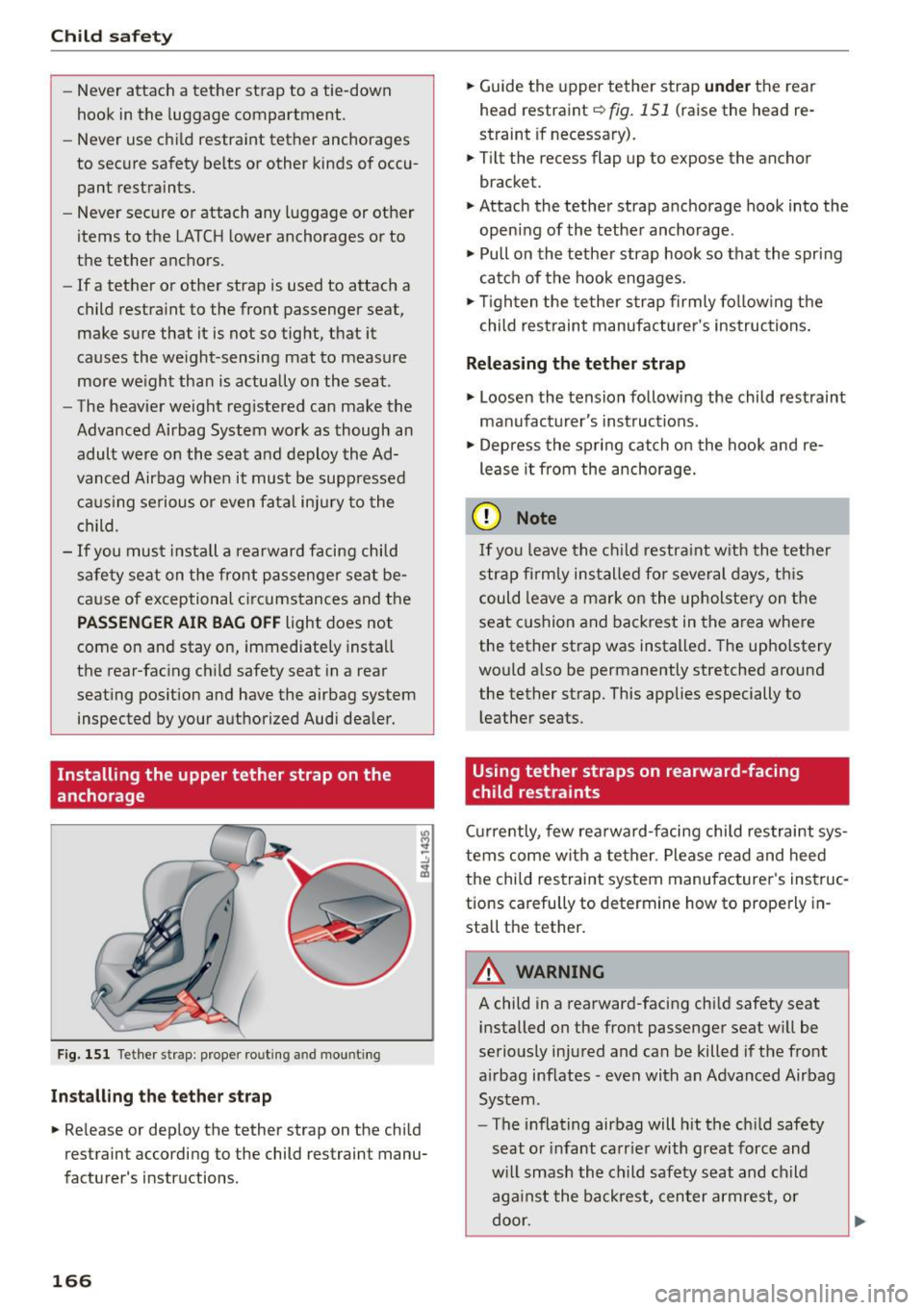
Installing the upper tether strap on the
anchorage
Fig. 151 Tether strap: proper routing and mountin g
Installing the tether strap
.,. Release or deploy the tether strap on the child
restraint according to the child restraint manu
facturer's instructions .
166
.,. Guide the upper tether strap under the rear
head restraint r=:>fig.
151 (raise the head re
straint if necessary).
.,. Tilt the recess flap up to expose the anchor
bracket.
.,. Attach the tether strap anchorage hook into the
opening of the tether anchorage .
.,. Pull on the tether strap hook so that the spring
catch of the hook engages.
.,. Tighten the tether strap firmly following the
child restraint manufacturer's instructions.
Releasing the tether strap
.,. Loosen the tension following the child restraint
manufacturer's instructions.
.,. Depress the spring catch on the hook and re
lease it from the anchorage.
(D Note
If you leave the child restraint with the tether
strap firmly installed for several days, this
could leave a mark on the upholstery on the
seat cushion and backrest in the area where
the tether strap was installed. The upholstery
would also be permanently stretched around
the tether strap. This applies especially to
leather seats.
Using tether straps on rearward-facing
child restraints
Currently, few rearward-facing child restraint sys
tems come with a tether. Please read and heed
the child restraint system manufacturer's instruc
tions carefully to determine how to properly in
stall the tether.
A WARNING
A child in a rearward-facing child safety seat
installed on the front passenger seat will be
seriously injured and can be killed if the front
airbag inflates -even with an Advanced Airbag
System.
- The inflating airbag will hit the child safety
seat or infant carrier with great force and
will smash the child safety seat and child against the backrest, center armrest, or
door.
Page 172 of 254
Smart Technology
In extreme cases, EDL automatically switches off
to help keep the brake on the braked wheel from
overheating. EDL will switch on again automati
cally when conditions have returned to normal.
Steering recommendation
The ESC helps to stabilize the vehicle by changing
the steering torque.
I n vehicles with dynamic steering*, ESC also
he lps to stabilize the steering in critical situa
tions .
Selective wheel torque control
Select ive wheel torque control is used when driv
ing on c urves . The front wheel on the inside of
the curve or both whee ls on the inside of the
curve are braked selectively as needed. This al
lows more precise driving in curves . Th e applica
b le system may not activate when driving in wet
or snowy conditions .
A WARNING
- The ESC and its integrated systems cannot
overcome the laws of physics. This is espe
c ially important on slippery or wet roads. If
the systems beg in acting to stabilize your
vehicle, you should immediately change
your speed to match the road and traffic
Switching on/off
conditions . Do not let the increased safety
provided by these systems tempt you to
take risks. Doing so will increase the risk of a
loss of vehicle control, collision and serious
personal injuries.
- Always adapt your speed to road, traffic and
weather conditions. The risk of losing con
trol of the vehicle increases when dr iving
too fast, especially through curves and on
slippery or wet roads, and when driv ing too
close to vehicles up ahead. The ESC and its
integ rated systems cannot always prevent
collisio ns -there is sti ll a risk of accidents!
- Always accelerate with special care on even,
smooth surfaces such as those that are wet
or covered with ice and snow. The drive
wheels can spin even with these assistance
systems that cannot always help to reduce
the risk of loss of vehicle control.
@ Tips
-ABS and ASR only work correctly when all
four wheels are equ ipped w ith identical
t ires. Different tire s izes can lead to a reduc
t ion in engine power.
- You may hear noises when the systems de scribed are working.
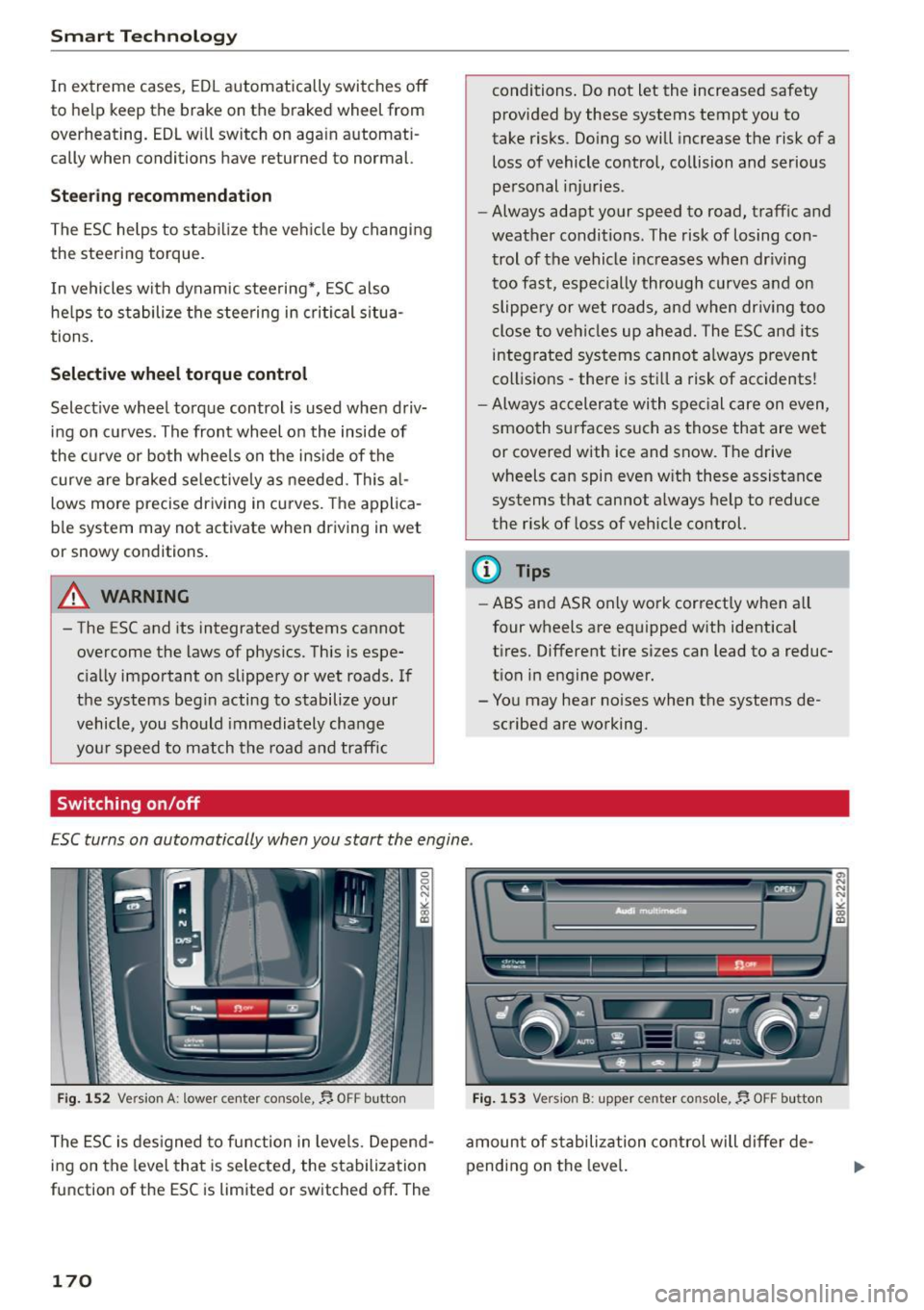
ESC turns on automatically when you start the engine .
Fig. 152 Version A : lower center console,~ OFF button
The ESC is designed to function in levels. Depend
ing on the level that is selected, the stabilization
function of the ESC is limited or switched off. The
170
Fig. 153 Version B: upper center console,~ OFF butto n
amount of sta bilization control will differ de
pending on the level.
Page 173 of 254

"' N
0:: loo
rl I.O
"' N
"' rl
The following situations are exceptions where it may be useful to switch on sport mode to allow
the wheels to spin:
Smart Technology
- Rocking the vehicle to free it when it is stuck
- Dr iving in deep snow or on loose ground
- Dr iving with snow chains
Sport mode on ESC/ASRoff Sport mode off or
ESC/ASR on
Behavior
The ESC and ASR stabiliza- The stabilization funct ion is The full stabilization func-
t ion funct ions are limited not available
¢ &.. ESC and tion of the ESC and ASR is
¢&_ . ASR are switched off. available again.
Operation Press the I!> OF FI button Press and hold the I.!> OFFI Press the I.$ OF F! button
briefly. button longer than
3 sec- again .
onds .
Indicator II turns on. • and lf'll•U~ turn on . II turns off or. and
lights lf'll•l~~ turn off .
Driver mes- Stabilization control (ESC ): Stabilization control (ESC): Stabilization control
sages Sport. Warning! Restricted off. Warning! Restricted (
ESC) : On
stability stability
A WARNING -
You should only switch sport mode on or
sw itch ESC/ASR off if your driving ab ilities and
road conditions permit.
- The stabilization function is limited when
sport mode is switched on. The dr iving
wheels could spin and the vehicle could
swerve, especially on slick or slippery road
surfaces.
- There is no vehicle stabilization when ESC/
ASR are sw itched off.
(D Tips
- ESC/ASR cannot be switched off or sport
mode cannot be sw itched on when cr uise
control or adaptive cruise control* is switch
ed on.
- Malfunctions in the rear spoiler may make it
i mpossible to switch the ESC/ASR off or to
switch sport mode on.
Rear spoiler
Applies to vehicles: with retractable rear spoiler
The rear spoiler improves vehicle handling and
enhances driver control.
Fig. 154 Center console: button fo r the rear spo ile r
The rear spo iler deploys and retracts. Spoiler op
eration can be set for automat ic or manual oper
ation.
Automatic mode (normal operation)
-Extends automatically: when the vehicle speed
exceeds approx imately 75 mph (120 km/h).
- Retracts automatically: when the vehicle speed
drops below approx imately 50 mph (80 km/h).
Manual mode
- Manual deployment: Tapping briefly on the
switch ~ fig. 154 deploys the rear spoiler.
171