ESP AUDI RS5 COUPE 2015 Repair Manual
[x] Cancel search | Manufacturer: AUDI, Model Year: 2015, Model line: RS5 COUPE, Model: AUDI RS5 COUPE 2015Pages: 254, PDF Size: 64.12 MB
Page 174 of 254
Smart Technolog y
-Manua l retraction: At speeds up to about
10 mph (20 km/h) , retract the rear spoiler by
pressing and holding the switch. At speeds be
tween 10 mph (20 km/h) and 75 mph (120 km/h), retract the rear spoiler by tapping
on the switch
Ind icat or light
- Rear sp oile r: sy st em m alfu ncti on
The rear spoiler may not have extended due to a
malfunct ion . This cou ld change the vehicle's driv
ing characteristics at high speeds . Do not drive at
speeds above 85 mph (140 km/h) . Drive to the
nearest authorized Audi dealer or qualified repair
facility to have the malfunction corrected.
A WARNING
Dr iv ing at higher speeds w ithout the rear
spoiler deployed can impa ir handling charac
teristics, mak ing the veh icle harder to co ntrol.
- Always make sure that the spoiler is de-
ployed when driving at speeds over 85 mph
(140 km/h) . If the rear spoiler warn ing/ indi
c ator light in t he instrument cluster comes
on, the rear spoi ler may not have deployed .
- Never dr ive at speeds highe r than 85 mph
(140 km/ h) if the spoiler is not deployed.
Have the spo iler inspected as soon as possi
ble by an author ized Audi dealer or qualif ied
workshop.
- Always obey speed limi ts and o ther traffic
laws .
A WARNING ,.__.__
Improper ope ration of the rear spoiler can
cause crushing injuries .
- Always make sure that nobody, espec ia lly
children, is in the way when the rear spo iler
is deployed or retracted .
(D Note
Never push the vehicle or apply fo rce to the
rea r spo ile r - i t cou ld be damaged.
(D Tips
Clean the spo ile r compartment every 2 to 3
months. The spoiler compartment m ust al-
172
-
ways be free of ice, snow, leaves or other de bris .
Braking
What affects braking efficiency?
New brake pads
During the first 250 miles (400 km), new brake
pads do not possess their full braking e ffect, they
have to be "broken in" first¢.&. . The break -in pe
riod can be considerably longe r for vehicles with
ceramic brake rotors*. You can compensate for
th is slightly reduced braking power by pushing
harder on the brake pedal. Avoid heavy braking
loads during the b reak-in period.
Op era ting condition s and dri ving h abit s
The brakes on today's automobiles are still sub
j ect to wear, depending largely on operating con
dit ions and driving habits ¢.&, . On vehicles that
are either dr iven most ly in stop-and-go city traf
fic or are driven hard, the brake pads should be
checked by yo ur autho rized Aud i dealer more of
ten than specified in the
Warranty & Mainte·
nan ce bookl et.
Fail ure to have you r brake pads
i nspected c an resu lt in red uced b rake pe rform
ance.
On steep slopes, you shou ld use the braking ef
fect of the engine. This way, you prevent unnec
essary wear on the bra ke system. If yo u must use
you r brakes, do not hold the brakes down contin
u ously. Pump the brakes at intervals .
Operating noise
Noises may occur when brakin g depending on the
speed, braking force and ou ts ide cond itions su ch
as tempera ture and hum idity.
Due to the nature of the materials used in ceram
i c bra ke roto rs*, noises may become mo re appa
r ent at low speeds.
Effect of water and road salt
In certa in situations, for examp le after driv ing
through water, in heavy rain, after overnight con
densation or after washing your car , the braking
effect can be redu ced by moistu re or ice on the
1111>
Page 175 of 254

brake rotors and brake pads. The brakes must be
dried first with a few carefu l brake applications .
At h igher speeds and with the w indshield w ipers
turned on, the brake pads press against the brake rotors for a sho rt amount of time. This occurs at
regular intervals without the driver noticing and
prov ides for better brake response time under
wet conditions.
The effectiveness of the brakes can be reduced
when the vehicle is driven on a salt-covered road
and the brakes are not used. Likew ise, you clean
off accumulated salt coating from brake discs
and pads with a few cautious applications of the
brake ¢,&. .
Due to their surface characteristics, ceram ic
brake rotors* absorb moisture in such conditions.
This can cause a temporary reduction in braking
force compared to dry brakes . You can compen
sate for this by press ing the brake pedal harder .
Corrosion
There may be a tendency for dirt to bui ld up on
the brake pads and corrosion to form on the discs
if the car is not driven regularly or only for short
trips with little use of the brakes .
If the brakes are not used frequently, or if corro
sion has formed on the discs, it is advisable to
clean off the pads and discs by brak ing firmly a
few t imes from a moderately high speed¢& .
Fa ul ts i n the brake sys te m
If you should notice a sudden increase in brake
pedal travel, then one of the two brake circuits
may have failed¢&.
Low brak e flu id l eve l
Malfunctions can occur in the brake system if the
brake fluid level is too low. The brake fluid leve l is
monitored e lectronically.
Brake boo ste r
The brake booster increases the pressure that you
genera te with the brake pedal.
It works only M
"" when the engine is running.¢ & 0:: l-oo ,...., \!) 1.1'1
N 1.1'1 ,....,
Smart T echno log y
Brake lining wear statu s
Brake lining wear may be checked by visual in
spection of the condition of the brake pads
thro ugh the openings in the wheel. If necessary,
the wheel may be removed for this inspection
¢ page 218, Replacing wheels .
A WARNING ...__
-New brake pads don't have the best stop
ping power and must be "broken-in" during
the initial 250 miles (400 kilometers) . The
break-in per iod can be cons iderably longer
for vehi cles w ith ceramic b rake rotors*. You
can compensate for this by p ress ing the
b rake peda l more fi rmly. This a lso applies
later when new pads are installed.
- You shou ld perform braking maneuvers for
the purpose of cleaning the brake system
only if road conditions permit. Other road
users must not be put at risk -you may
cause an accident!
-
- Before descend ing a steep grade, reduce
speed and sh ift transmission into a lower
gear or lower dr iving range. Do not ride the
brakes or hold the pedal down too long or
too often . This could cause the brakes to get
hot and dimin ish braking effic iency .
- Do not "ride the brakes" by rest ing your foot
on the pedal when you do not intend to
brake. This may cause the brakes to over
heat, premature wear and increased stop
p ing distance.
- Under certain cl imatic and operat ing condi
tions such as passing t hrough water, dr iv ing
in heavy rain or after washing the veh icle,
the effect iveness of the brakes can be re
duced . In winter, ice can accumulate on the
brake pads, linings, discs and drums . Care
fu lly apply brakes for a test. Brakes will dry
and ice coatings will be cleaned off after a
few careful brake applications.
- Driving for an extended period of time on salt-covered roads without using your
brakes can a lso affect braking efficiency.
Clean off accumulated salt coating from brake discs and pads with a few careful
brake applications.
173
Page 178 of 254

Smart Technolog y
(D Tips
-But even energy management cannot neg
ate the limits of physics. Consider that the power and life of a battery are limited.
- If starting ability is threatened, the indica
tor light (•)appears
Qpage 16.
What you should know
The highest priority is given to maintaining start
ing capability.
The battery is severely taxed in short-distance
driving, in city traffic and during the co ld time of
year . Ab undant electrical energy is required, but
only a little is generated. It is also critical if the
engine is not runn ing and electrical components
are turned on. In this instance energy is being
consumed but none is being generated.
It is in precisely these situat ions that you wi ll no
tice energy management actively regulating the
d istr ibut io n of energy.
Vehicle s tand s for an exte nded p eriod
If you do not drive your vehicle over a period of
several days or weeks, e lectrica l components are
gradually cut back or switched off. This reduces
energy consumption and maintains starting ca
pability over a longer period. Some of the con
ven ience funct ions may not operate, such as the
interior lights or the powe r seat adjustment. The
conven ience functions will be ava ilable again
when you sw itch on the ign it io n and start the en
g ine.
With th e engine turned off
If you listen to the radio, for example, with the
engine turned off or use other MMI funct ions,
the battery is being discha rged .
If starting capability is jeopardized due to energy
consumption, a message appears in the MMI dis p lay . The message ind icates that the system will
be sw itched off automat ica lly in a moment. If
you wish to cont inue using the functions , you
have to start the engine .
176 With the en
gine running
Although elec trical energy is generated when the
vehicle is being d riven, the battery can become
discharged . This happens mostly when litt le en
ergy is being generated and a great deal con
sumed and the battery's state of charge is not
optimal.
T o bring the energy ba lance back into equilibri
u m, consumers whic h req uire especially large
amounts of energy are temporari ly cut back or
switched off. Heating systems in part icular re
quire a great deal of energy. If you notice, for ex
ample, that the heated seats* o r the heated rear
window are not heating, they have been tempo
r ari ly cut back o r switched off . Th ese systems w ill
be ava ilable again as soon as the ene rgy ba lance
has been res tored.
You w ill also notice that engine id le speed has
been increased slightly . Thi s is normal and not a
ca use for concer n. By increasing eng ine idle
speed the addi tional energy required is gene rated
and the battery is charged.
Page 179 of 254

M N
0:: loo ,...., \!) 1.1"1
N 1.1"1 ,....,
Driving and the
environment
Breaking in
New engine
The engine needs to be run-in during the first
1,000 miles (1,500 km).
For the first 600 miles (1,000 kilometers ):
"' Do not use full throttle .
"' Do not drive at engine speeds that are more
than
2/3 of the max imum permitted RPM .
From 600 to 1,000 miles (1,000 to 1,500
kilometers):
"' Speeds can gradually be increased to the maxi
mum perm issible road or engine speed.
During and after break-in period
"'Do not rev the engine up to high speeds when it
is cold. This applies whether the transmission is
in N (Neutral) or in gear .
After the break-in period
"'Do not exceed maximum engine speed under
any circumstances.
"'U pshift into the next higher gear
before reach
ing the red area at the end of the tachometer
scale
c=> page 10.
During the first few hours of driving, the engine's
internal friction is higher than later when all the
moving parts have been broken in. How well this
break-in process is done depends to a considera
ble extent on the way the vehicle is driven during
the first 1,000 miles (1,500 kilometers).
(D Note
Extremely high engine speeds are automati
cally reduced. However, these rpm limits are
p rog rammed for an engine wel l run- in, not a
new engine.
@) For the sake of the environment
Do not dr ive with unnecessarily high eng ine
speeds -upshifting early saves fuel, reduces
noise and protects the environment.
Driving and the environment
New tires
If your vehicle is running on new tires, drive very
carefully for the fi rst 350 m iles (500 kilometers)
after fitting .
New tires tend to be slippery and must also
be "broken-in". Be sure to remember this dur
ing the first
350 miles (500 kilometers).
Brake gently. Avoid following closely behind
other vehicles or other situations that might
require sudden, hard brak ing .
Avoid damaging the
vehicle
When you are d riving on poor roads, or over
curbs, steep ramps, etc., ma ke certain that low
lying parts such as spoilers and exhaust system
parts do not bottom out and get damaged.
T his is espec ially true for veh icles with low-s lung
chassis (sports chassis)* and fully loaded
vehicles.
Driving through water on
roads
Note the following to avoid vehicle damage when
driving through water, for example on f looded
roads:
- The water must not be any higher than the bot
tom of the vehicle body.
- Do not drive faster than walking speed.
A WARNING
= -
After driving through water, mud, slush, etc.,
the brakes may be s low to take effect because
of wet brake rotors and pads. Dry the brakes
first by braking carefully to restore the full braking effect.
(D Note
Vehicle components such as the engine,
transmission, suspension or electrical system
can be severely damaged by driving through
water . ""
177
Page 181 of 254

M N
0:: loo ,...., \!) ..,.,
N ..,., ,....,
-Have your veh icle maintained properly and
in accordance with the service recommen
dations in your Warranty
& Maintenance
book let.
- Lack of proper maintenance as well as im
proper use of the vehicle will impair the
function of the emission control system and could lead to damage.
@ For the sake of the environment
Even when the Emission Control System is op
erating properly, the exhaust gas can have a
sulfur-like exhaust gas smell under some op
erating states. This depends on the sulfur
content of the fuel being used . Using a differ
ent brand of fuel may help, or filling the tank
w ith lead-free super grade gasoline.
Shutting down vehicle
If you wou ld like your vehicle to remain inopera
tive for a longer period of time, contact an Audi
or other specialized dealer. T hey can advise you
on necessary precautions e.g. corrosion preven
tion, maintenance and storage. Pay attention to
additional information concerning the battery. Refer to
c:;, page 196.
Economical and environ
mentally-friendly driving
General
Your personal style of driving will determine the
economy of your vehicle, as well as exhaust and
noise levels.
Fu el economy, environmental impact , and wear
on your engine, brakes and tires largely depend
on three factors:
- your personal driving style
- operating conditions
- technical limitations
If you anticipate what you need to do next and
drive economically, you can easily cut your fue l
consumption by 10-15 percent. This sect ion will
give you some tips on how you can help the envi
ronment and your pocketbook .
Driving and the environment
(D Tips
The consumption estimates as published by
ENVIRONMENTAL PROTECTION AGENCY (EPA)
and Transport Canada may not correspond to
your actual consumption on the road, which
will vary depending upon vehicle load and
speed, road and weather conditions, tr ip
l ength, etc.
Drive smoothly and keep a lookout ahead
Vehicles use the most fuel when they are acceler
ating .
.. Avoid unnecessary accelerating and braking .
Vehicles use the most fuel when they are acceler
ating. If you anticipate what is going to happen next, you will need to brake less and , thus, accel
erate less. Let the veh icle coast whenever possi
ble -for example when you see that the next traf
fic light is red.
Avoid full throttle
Driving at moderate speeds saves fuel and im
proves your mileage .
.. Try and keep well below your car's maximum
speed.
Acce lerating gently reduces fue l consumption,
engine wear, and does not disturb the environ
ment .
Fuel consumpt ion, exhaust emiss ions and engine
noise increase disproportionately at high speeds.
If you drive at approximate ly three quarters of
top speed, fue l consump tion will be reduced by
one half. Never drive faster than the posted
speed l imit and weather cond itions permit .
Reducing unnecessary idling
Even when your car is just idling it burns up fuel.
.. Shut the eng ine off when you are not driving
the vehicle.
.. Do not warm up the vehicle by letting the en-
gine run at idle .
ll>
179
Page 182 of 254
Driving and th e environment
It makes sense to shut off the engine in traffic
jams, when waiting for trains to pass at rai lroad
crossings, or at traff ic lights that have long waits
on red. Turning the eng ine off for just 30-40 sec
onds saves more fuel than is burned starting the
engine again .
It takes a long time for the engine to warm up
fully when it is running at idle. However, wear
and nox ious em issions are especially h igh when
the engine is warm ing up. So you should dr ive
away as soon as you start the engine and avoid running at high rpms while the engine is still
warming up.
{[) Note
Do not leave engine idling unattended after
starting. If warning lights should come on to
indicate improper operation, they would go
unheeded. Extended id ling a lso produces
heat, wh ich co uld resu lt in overheating or ot h
er damage to the vehicle or other property .
Regular maintenance
A badly tuned engine unnecessarily wastes a lot
of fuel.
~ Have you r vehicle se rv iced at regular i nte rva ls.
By having your vehicle regularly serviced by an
author ized Audi dealer helps to ensure that it
r u ns p roperly and economically. The condition of
your veh icle not only affe cts its safety and ability
to hold its va lue, i t also affects
fue l con sump
tion.
Ch eck your oil each tim e you fill your tank .
The amount of oil used is related to engine load
and speed .
It is normal for the oil consumption of a new en
g ine to reach its lowest value after a certain mile
age has been driven.
You must drive yo ur vehicle about 3,000 miles
(5,000 ki lometers) before you can properly as
sess o il consumption .
This a lso applies to fuel consumption and engine
output .
180
(D Note
-Have your veh icle ma intained properly and
in accordance with the service recommenda
tions in your Warranty
& Maintenance book
let. Lack of proper maintenance as well as
improper use of the vehicle will impair the
function of the emission control system and cou ld lead to damage .
- Do not alter or remove any component of the Emission Control System unless ap
proved by the manufacturer.
- Do not alter or remove any device, such as
heat shields, sw itches, ignit ion wires,
valves, which a re des igned to p rotect your
vehicle's Emission Control System and other
impo rtant vehicle components.
Fewer short trips
Fuel consumption will always be relatively high
on short trips.
~ Tr y to avoid dr iv ing sho rt distances w ith a co ld
eng ine .
The eng ine and cata lytic converter have to reach
their opt imal
op erat ing temperature to reduce
fuel consumpt io n and noxious em issions effec
tive ly.
Just after starting, a co ld eng ine in a mid -s ize car
o nly achieves a fuel economy of 6-8 m iles per
gallon (30-40 l/100 km). After about a half a
mile, fuel economy climbs to 12 mpg ( 20 l/100
k m). After about
2.5 mi les ( 4 km) , the eng ine is
at i ts p roper operating tempera ture and fuel
economy has reached a normal level. So you can
see that yo u should avo id short trips whenever
poss ib le.
The
outside temperature is also cr itical in th is re
gard. Your car cons umes more fuel in the winter
than in the summer.
Page 183 of 254
Care and cleaning
General information
Regular, proper care helps to maintain your vehi
cle's value. It can a lso be a req uirement when
submitting warranty claims for corrosion damage
and paint defects on the body.
The necessary care products can be obtained
from your a uthorized Audi dea ler . Read and fol
l ow the instructions for use on the packaging .
A WARNING
- Using cleaning and care products incorrectly
can be dangerous to your health.
- Always store cleaning and care products out of reach of children to reduce the r isk of po i
soning .
@) For the sake of the environment
-Preferably use environmentally-friendly
products when b uying cleaning agents.
- Do not dispose of leftover cleaning and care
products with h ousehold tras h.
Car washes
The longer that deposits remain on the vehicle ,
the more the s urface may be damaged . H igh
temperatures s uch as those caused by s unlight
increase the damaging effect.
Before washing, rinse off heavy deposits with
p lenty of water.
S tu bbor n depos its s uch a s bird dropp ings o r tree
sap are best removed w ith plenty of wa ter and a
microfiber cloth .
A lso, was h the unde rs ide of your vehi cle once
ro ad salt s tops be ing use d fo r t he season .
Pressure washers
When washing your ve hicles w ith a pressure
washer, always follow the operating instructions p rov ided with t he p ress ure washer. This is espe-
"' "' cially importan t in reg ard to the p ress ure and 0::
~ sp ray ing dist ance. Do not aim the spray direc tly
~ at seals on side windows, doors, the hood, the 1.1"1
~ rear lid or the sunroof * or at tires, rubber hoses, ,....,
Care and cleaning
insulat ing mater ia l, sensors * or camera lenses *.
Keep a distance of at least 16 inches (40 cm) .
D o no t remove snow and ice with a pressu re
washe r.
Never use rotary nozzles or high pressure noz
zles.
The water temperature must not be above 140 °F
(60 °C) .
Automat ic car washes
Sp ray off the ve hicle before washing .
Make sure tha t the w indows and roo f* are close d
and the windshield wipers are off . Follow inst ruc
tions from the car wash operator, especially if
there are accessor ies attached to your vehicle.
If possible, use car washes th at do not h ave
brushes.
Only use car washes whe re the vehicle rem ains
stationa ry and the w ashing eq uipmen t moves
aro und the veh icle when w ash ing and dry ing . Car
washes that move the vehicle thro ugh the car
wash using a c hain are n ot recommende d.
Washing by hand
Clean the ve hicl e s tarting fro m the top and work
i ng down using a soft sponge or cleaning b rush .
U se solven t-free cleani ng p ro du cts .
Washing vehicles with matte finish paint by
hand
To avoid d amaging the paint whe n was hing, first
r emove dus t and la rge particles from yo ur vehi
cle . Insects, g rease s pots and finge rprints are
best removed with a spec ial cleaner for matte
finish paint.
Apply t he p rod uct us ing a micro fiber cloth . To
avoi d damaging the paint surface, do not use too
much pressure.
Rinse the ve hicl e thoro ughly with water. Then
clean usi ng a neutra l shampoo and a soft mic ro
fi ber cloth .
Rinse the ve hicle thoro ughly again and le t it air
dry. Remove any wate r residue using a s ham my. .,.
181
Page 186 of 254

Fuel and Refu elin g
CJ) Note
-Methanol fuels which do not meet these re
quirements may cause corros ion and dam
age to plastic and rubber components in the
fuel system.
- Do not use fuels that fail to meet the speci fied criteria in this chapter .
- If you are unable to determine whether or
not a particular fuel blend meets the speci
fications, ask your service station or its fuel supplier.
- Do not use fuel for which the contents can
not be identified.
- Fuel system damage and performance prob lems resulting from the use of fuels differ
ent from those specified are not the respon
s ibility of Audi and are not covered under
the New Vehicle or the Emission Contro l
System Warranties.
- If you experience a loss of fuel economy or
driveability and performance problems due
to the use of one of these fuel b lends, we
recommend that you sw itch to unb lended
fuel.
Gasoline additives
A major concern among many auto manufactur
ers is carbon deposit build-up caused by the type
of gasoline you use .
A lthough gasoline grades differ from one manu
facturer to another, they have certain things in
common. All gasoline grades contain substances
that can cause deposits to collect on vita l engine
parts, such as fuel injectors and intake valves. Al
though most gasoline brands include additives to
keep eng ine and fuel systems clean, they are not
equally effect ive .
Audi recommends using TOP TIER Detergent Gas
oline . For more information on TOP TIER Deter
gent Gasoline, please go to the official webs ite
(www .toptiergas .com).
After an extended period of using inadequate
fuels, built-up carbon deposits can rob your en
g ine of peak performance .
184
(D Note
Damage or malfunction due to poor fuel qual
ity is not covered by the Audi New Vehicle
Limited Warranty.
Refueling
Fuel filler neck
The fuel filler neck is located on the right rear
side panel behind the fuel filler flap .
If the power lock ing system should fail, you can
still open the flap manually - for detailed instruc
tions see
9 page 186.
You can find the fuel tank capacity of your vehicle
in 9 page234.
The label on the inside of the fuel filler flap tells
you the correct fuel for your vehicle . For more in
format ion about fuel specifications, see
9 page 183.
Your vehicle fuel tank has an on-board refuelling
vapor recovery system. This feature helps to pre
vent fuel vapors from escap ing from the tank and
po lluting the environment while you refuel your
vehicle. In order to fi ll the tank properly while
protecting the environment , p lease follow this
r efueling procedure carefully .
_& WARNING
Under normal operating conditions, never car
ry additional fuel containers in your car . Gas
can isters and other containers used to trans
port fuel can be dangerous . Such containers,
full or empty, may leak and could cause a fire in a co llision .
If you must transport fuel to
use for your lawn mower, snow blower, etc .,
be ve ry careful and always observe local and
state laws regarding the use, transportation
and storage of such fue l conta iners . Make cer
tain the container meets industry standa rds
(ANSI/ASTM F8S2 - 86).
@ Note
Neve r drive your veh icle until the fuel tank is
complete ly empty. The ir regular supply of
f u el can cause misfiring. Gasoline could enter ..,.
Page 187 of 254

"' N
0:: loo
rl I.O
"' N
"' rl
the exhaust system and damage the catalytic
converter.
Refuelling
Fig . 155 Rig ht re ar v ehicl e sid e: Op enin g the fuel fille r flap
Fig. 156 Fuel f ill er fla p with atta ched fuel cap
When activating the central locking, the fuel fi ll
er flap is automatically un locked or locked . Re
fuel the veh icle with the ignition turned
off.
Taking the fuel cap off
~T urnoff the ignition.
~ Press the left side of the fue l filler flap to open
it
q fig. 155 -arrow -.
~ Unscrew fuel cap count er-clockw ise and hang it
on the fuel filler flap~
fig. 156.
Refuelling procedure
~ Insert the fuel nozzle from the gasol ine pump
into the fuel filler neck as far as it will go.
~ Select a medium refuelling rate so that the
nozzle switches off automat ica lly when the
tank is full.
Putting the fuel cap back on
~ After filling your tank, tw ist the f uel cap clock
wise as far as it wi ll go.
~ Close the fuel filler flap.
Fuel and Refueling
To avoid fuel spilling or evaporating from the fuel
tank always close fue l cap proper ly and com
pletely .
A WARNING
--
Improper refueling or handling of fuel can
cause fire, explosion and severe burns.
- Fuel is highly flammable and can cause se
vere burns and other injuries.
- Failure to shut the engine off while refuel
ing and/or to insert the pump noz zle fully
into the fue l filler neck could cause fuel to
spray out of filler neck or to overflow . Fuel
spray and overflowing fuel can cause a fire.
- Never use a cellular telephone while refuel
ing. The electromagnetic radiation can
cause sparks that can ignite fuel vapors and
cause a fire .
- Never get back into your vehicle while refu
eling. If in exceptional circumstances you
must get back in your vehicle whi le refuel
ing, make certain that you close the door
and touch metal to discharge static electric
ity before touching the filler nozzle again.
Static electricity can cause sparks that can ignite fue l vapors re leased during refueling.
- Never smoke or have an open f lame any
where in or near your vehicle when refueling
or filling a portable fue l conta iner .
- For your safety, we strongly recommend
that you do not travel with a portable f uel
container in your vehicle. The container, full
or empty may leak and cou ld cause a fire,
especially in a crash.
- If, under exceptional circumstances, you
must transport a portable fuel container,
ple ase observe the following:
- Never fill a portable fuel container while it
is anywhere in or on the veh icle (for exam
ple, in the luggage compartment, or on
the trunk). Static e lectricity can build up
while filling and can ignite fuel vapors
causing a f ire.
- Always place a portab le fue l container on
the ground before filling .
185
Page 189 of 254
"' N
0:: loo
rl I.O
"' N
"' rl
Checking and Filling Hood
Releasing and opening the engine hood
The engine hood is released from inside the vehi
cle.
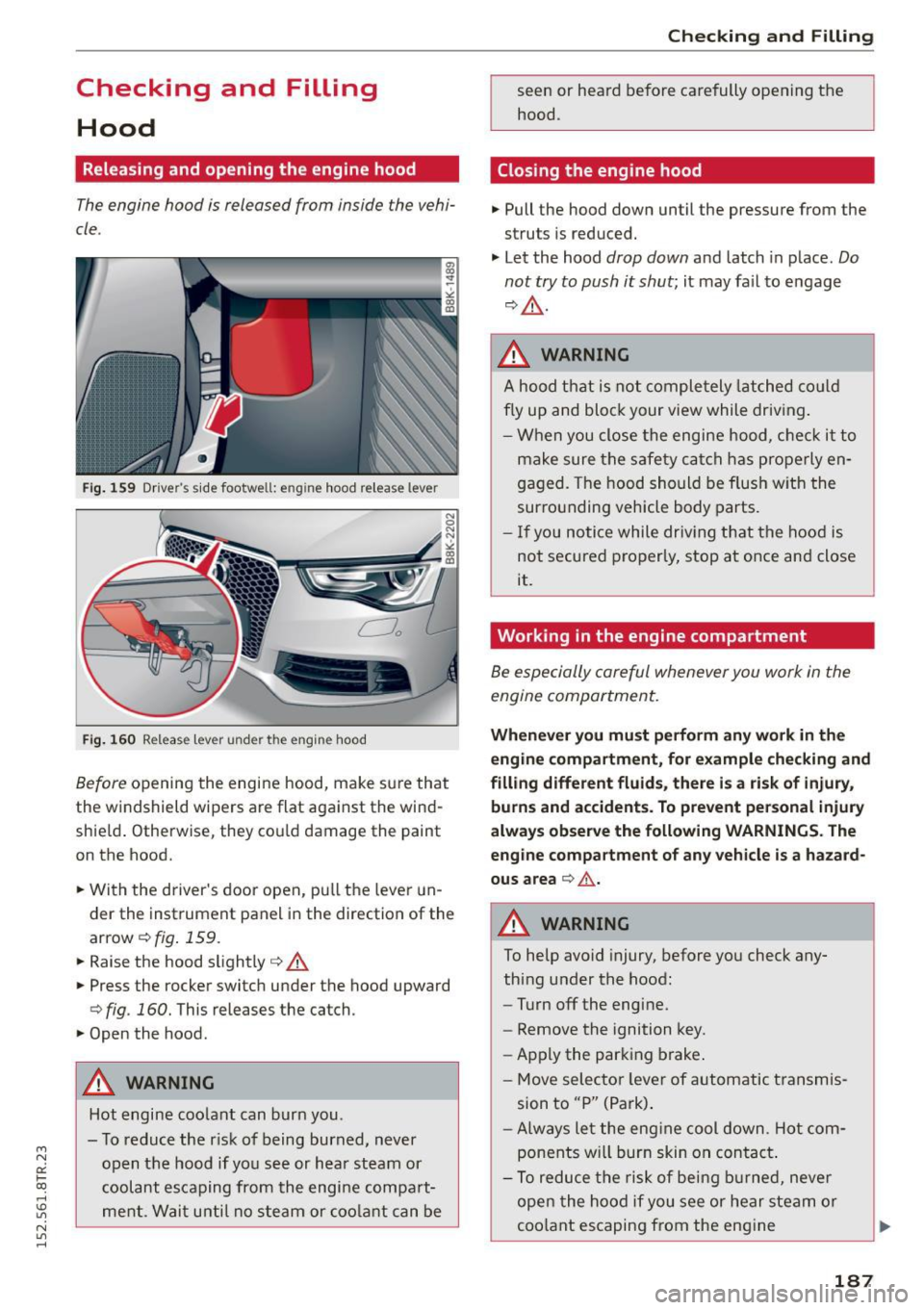
Fig. 159 Driver's side footwell: e ng in e hood release lever
Fig. 160 Releas e lev er un der t he e ngin e hood
Before opening the engine hood, make sure that
the windshield wipers are flat against the wind
shield . Otherwise, they could damage the paint
on the hood.
.. With the driver's door open, pu ll the lever un
der the instrument panel in the direction of the
arrow
c::> fig . 159.
.. Ra ise the hood slightly c::> &.
.. Press the rocker switch under the hood upward
c::> fig . 160. This releases the catch .
.. Open the hood.
A WARNING
Hot engine coolant can burn you.
- To reduce the r isk of being burned, never
open the hood if you see or hear steam or
coolant escaping from the engine compa rt
ment. Wait until no steam or coolant can be
Checking and Filling
seen or heard before carefully opening the
hood .
Closing the engine hood
.. Pull the hood down until the pressure from the
struts is reduced.
"' Let the hood
drop down and latch in place. Do
not try to push it shut;
it may fa il to engage
c::> &. -
A WARNING
A hood that is not comp letely latched could
fly up and block your view while driving.
- When you close the engine hood, check it to
make sure the safety catch has properly en
gaged . The hood should be flush with the
surrounding vehicle body parts.
- If you notice while driv ing that the hood is
not secured properly, stop at once and close
it.
Working in the engine compartment
Be especially careful whenever you work in the
engine compartment.
-
Whenever you must perform any work in the
engine compartment, for example checking and
filling different fluids , there i s a risk of injury ,
burns and accidents. To prevent personal injury
always observe the following WARNINGS . The
engine compartment of any vehicle is a hazard
ous area
c:> .&. .
A WARNING
-
To help avoid injury, before you check any-
thing under the hood:
- Turn off the engine.
- Remove the ignition key .
- Apply the parking brake.
- Move selector lever of automatic transmis-
sion to "P" (Park) .
-Always let the engine cool down. Hot com
ponents wi ll burn skin on contact .
- To reduce the risk of being burned, never
open the hood if you see or hear steam o r
coo lant escaping from the engine
187