brake AUDI RS7 SPORTBACK 2015 Workshop Manual
[x] Cancel search | Manufacturer: AUDI, Model Year: 2015, Model line: RS7 SPORTBACK, Model: AUDI RS7 SPORTBACK 2015Pages: 302, PDF Size: 74.76 MB
Page 238 of 302
236 Tires and wheels
Because technical changes may
be made to vehicle equipment
during the model year, always
compare the tire size designa
tion on the tire pressure label
on your vehicle with the tires on
your vehicle . Make sure that the
tire size information on the ve hicle label is the same as the
size of the tires on the vehicle .
This is especially important if
the vehicle belongs to someone else or you bought the vehicle
with different rims/tires or you bought the vehicle as a previ
ously owned vehicle.
Remember, your safety and
that of your passengers also de pends on making sure that load
limits are not exceeded . Vehicle
load includes everybody and ev
erything in and on the vehicle .
These load limits are technical ly referred to as the vehicle's
Gross Vehicle Weight Rating
("GVWR"). The Gross Axle
Weight Rating ("GAWR") is the
maximum load that can be ap
plied at each of the vehicle's
two axles . The Gross Vehicle
Weight Rating and the Gross
Axle Weight Rating are listed on the safety compliance stick- er label located on the driver's
side B-pillar. The tire pressure
label on your Audi lists the
maximum combined weight of
all of the occupants and lug
gage or other cargo that the ve
hicle can carry. For the location
of the tire pressure label
¢ fig. 195.
&_ WARNING
-
Overloading a vehicle can
cause loss of vehicle control,
a crash or other accident, se
rious personal injury, and
even death .
- Carrying more weight than
your vehicle was designed to carry will prevent the ve
hicle from handling properly
and increase the risk of a
loss of vehicle control.
-The brakes on a vehicle that has been overloaded may
not be able to stop the vehi
cle within a safe distance.
- Tires on a vehicle that has
been overloaded can fail
suddenly causing loss of
control and a crash.
-Always make sure that the total load being transported
does not make the vehicle .,.
Page 244 of 302
242 Tires and wheels
and increase the risk of the
loss of vehicle control.
-The brakes on a vehicle that
has been overloaded may
not be able to stop the vehi
cle within a safe distance.
-Tires on a vehicle that has
been overloaded can fail
suddenly, including a blow
out and sudden deflation,
causing loss of control and a
crash.
-Always make sure that the total load being transported
does not make the vehicle
heavier than the vehicle's
Gross Vehicle Weight Rat
ing.
Determining correct load
limit
Use the example below to cal
culate the total weight of the
passengers and luggage or oth
er things that you plan to trans
port so that you can make sure
that your vehicle will not be overloaded.
Steps for Determining
Correct Load Limit
1. Locate the statement "THE
COMBINED WEIGHT OF OC- CUPANTS AND CARGO
SHOULD NEVER EXCEED XXX
KG OR XXX LBS" on your ve
hicle's placard (tire inflation
pressure label)
~ page 233,
fig. 195.
2. Determine the combined
weight of the driver and pas
sengers that will be riding in
your vehicle.
3. Subtract the combined
weight of the driver and pas
sengers from
"XXX" kilo
grams or
"XXX" pounds
shown on the sticker
¢ page 233, fig. 195.
4. The resulting figure equals
the available amount of car go and luggage load capaci
ty. For example, if the
"XXX"
amount equals 1400 lbs.
and there will be five 150
lbs. passengers in your vehi
cle, the amount of available
cargo and luggage load ca
pacity is 650 lbs. (1400-750
(5
X 150) = 650 lbs.)
5. Determine the combined weight of luggage and cargo being loaded on the vehicle.
That weight may not safely
exceed the available cargo .,.
Page 247 of 302
"' N
a:: I.J "". rl I.O
"' rl
"' rl
_&. WARNING
Sudden tire failure can lead
to loss of control, a crash and serious personal injury!
-Never drive a vehicle when the tread on any tire is worn down to the wear indica
tors.
-
-Worn tires are a safety haz ard, they do not grip well on
wet roads and increase your risk of "hydroplaning" and
loss of control.
-Always keep chemicals that can cause tire damage, such
as grease, oil, gasoline and brake fluid away from tires.
-Tires age even if they are not being used and can fail
suddenly, especially at high
speeds. Tires that are more
than 6 years old can only be used in an emergency and
then with special care and at lower speeds.
-Never mount used tires on your vehicle if you are not sure of their "previous history." Old used tires may have
been damaged even though
the damage cannot be seen
that can lead to sudden tire
Tires and wheels 245
failure and loss of vehicle control.
New tires and replacing
tires and wheels
New tires and wheels hove to
be broken in.
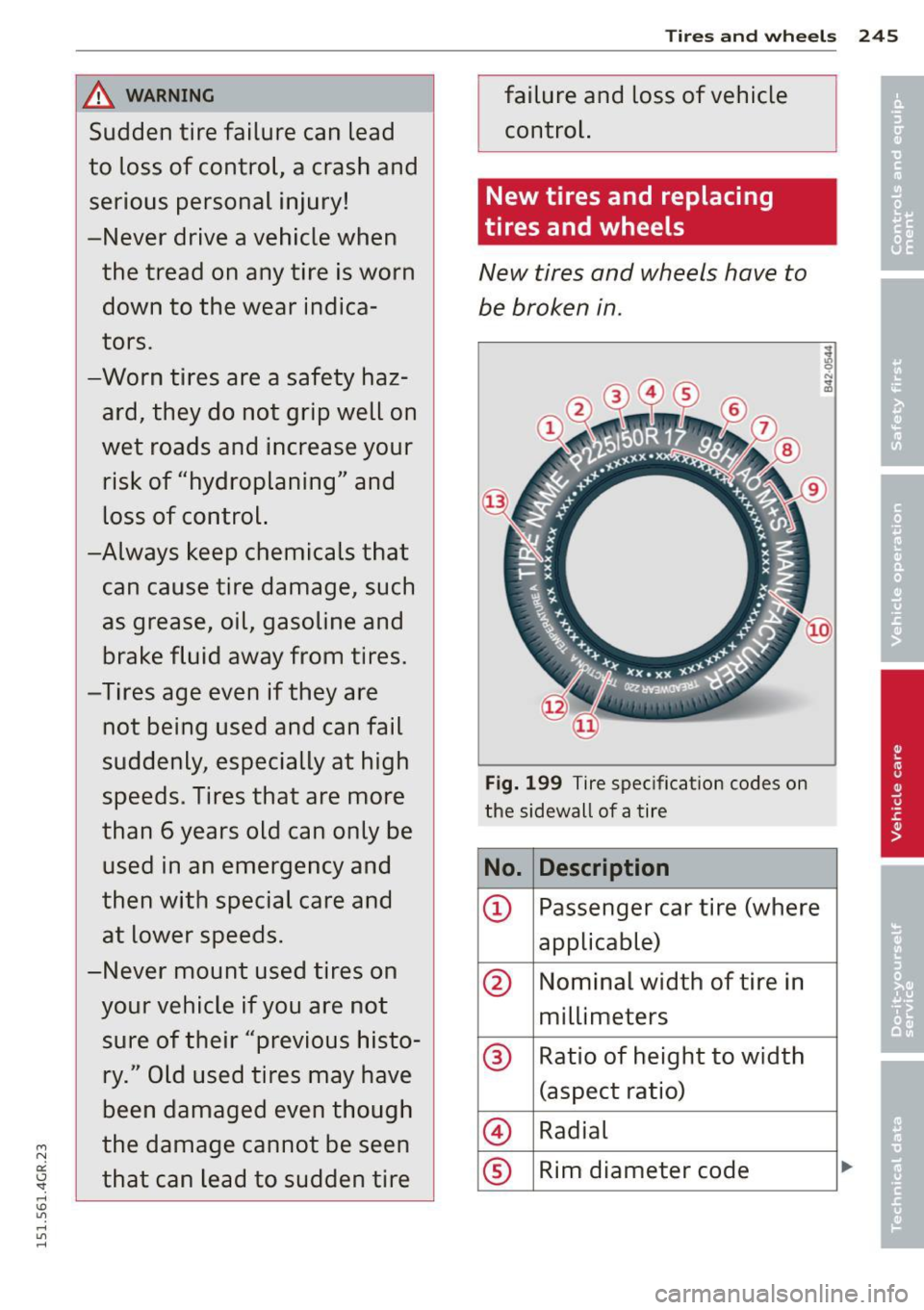
Fig. 199 Tire specification codes on
the sidewall of a tire
No. Description
CD Passenger car tire (where
applicable)
0 Nominal width of tire in
millimeters
® Ratio of height to width
(aspect ratio)
© Radial
® Rim diameter code
Page 252 of 302
250 Tires and wheels
that can lead to sudden tire
failure and loss of vehicle
control.
-All four wheels must be fit ted with radial tires of the
same type, size (rolling cir
cumference) and the same
tread pattern. Driving with
different tires reduces vehi
cle handling and can lead to
a loss of control.
-If the replacement tire is
not the same as the tires
that are mounted on the ve hicle -for example with win
ter tires -only use the re
placement tire for a short
period of time and drive
with extra care. Refit the
normal road wheel as soon
as safely possible.
-Never drive faster than the
maximum speed for which
the tires on your vehicle are rated because tires that are
driven faster than their rat
ed speed can fail suddenly.
-Overloading tires cause heat build-up, sudden tire fail
ure, including a blowout
and sudden deflation and
loss of control. -Temperature
grades apply
to tires that are properly in
flated and not over or un derinflated .
-For technical reasons it is not always possible to use
wheels from other vehicles -
in some cases not even
wheels from the same vehi
cle model.
-If you install wheel trim
discs on the vehicle wheels,
make sure that the air flow
to the brakes is not blocked .
Reduced airflow to the
brakes can them to over
heat, increasing stopping
distances and causing a col
lision.
-Run flat tires may only be used on vehicles that were
equipped with them at the
factory. The vehicle must
have a chassis designed for
run flat tires . Incorrect use
of run flat tires can lead to
vehicle damage or acci
dents. Check with an au
thorized Audi dealer or tire
specialist to see if your vehi
cle can be equipped with
run flat tires. If run flat tires .,.
Page 256 of 302
254 Tire s and wheel s
Wheel bolts
Wheel bolts must always be tightened to the
correct torque .
The design of wheel bolts is matched to the
factory installed rims. If different rims are fit
ted, the correct wheel bolts with the r ight
length and correctly shaped bolt heads must
be used. This ensures that wheels are fitted
secure ly and that the brake system funct ions
correctly .
In ce rtain circumstances, you may not use
wheel bolts from a different vehicle -even if it
i s the same mode l
~page 284.
_& WARNING
Improperly tig htened o r maintained whee l
bolts can become loose ca using loss of
contro l, a co llision and serious persona l in
jury.
- Always keep the wheel bolts and the
threads in the wheel hubs clean so the
wheel bolts can turn easily and be prop
erly t ightened.
- Never grease or oil the wheel bo lts and
the threads in the wheel hubs. They can
become loose while driving if greased or
oiled, even if tightened to the specif ied
torque.
- Only use wheel bolts that belong to the
rim being installed.
- Never use different wheels bolts on your
vehicle.
-Always maintain the correct tighten ing
torque for the wheel bo lts to reduce the
risk of a wheel loss. If the tightening tor
que of the wheel bolts is too low, they
can loosen and come out when the veh i
cle is moving. If the tightening torque is
too high, the whee l bolts and threads
can be damaged and the wheel can be
come loose.
@ Note
The spec ified torque fo r the wheel bo lts is
90 ft lb (120 Nm) w ith a tolerance of± 7,4
ft lb(± 10 Nm). Torque wheel bo lts diago- nally
. After changing a whee l, the torque
must be checked as soon as possible with a
torque wrench -preferably by an author
i zed Audi dealer or qualified workshop.
Low aspect ratio tires
Your Audi is factory-equ ipped w ith low aspect
ratio tires . These tires have been thoroughly
tested and been selected specifically fo r your
model for their superb perfo rmance, road fee l
and hand ling under a variety of d riving cond i
tions . As k your au thor ized A udi dealer for
more details .
T he low aspect ratio of these tires is ind icated
by a numera l of
55 or less in the tire's s ize
designation. The numera l represen ts the ratio
of the tire's sidewall height in relation to its
tread width expressed in percentage . Conven
tiona l tires have a height/width ratio of 60 or
more.
The perf orm ance of low- aspect-r atio tire s is
p ar ticu larly s ensitive to improper infl ati on
press ure . It is t here fore im portant that low
as pect rat io tires are infl ated to the spe cified
pre ssure and that the infl ation pressu re is
r e gularl y che ck e d and mainta in ed. Tire pre s
su res should b e check ed at least onc e a
month and alwa ys bef ore a long trip
~page 237, Checking tire pressure.
What you can do to a void tire and rim
damage
Low aspect ratio tires can be damaged more
easily by impact w it h potholes, curbs, gull ies
o r r idges on the road, pa rticularly if the tire is
u nderinfla ted .
In order to minimize the occurrence of impact
damage to the tires of you r vehicle, we recom
mend that you observe the follow ing p recau
tions:
- Always ma inta in recommended inflation
pressures. Check your tire pressure eve ry
2,000 miles (3,000 km) and add air if neces
sary .
- Dr ive carefully on roads with potholes, deep
gullies o r ridges. The impact from dr iv ing ..,.
Page 265 of 302
M N
0:: <.J 'SI: ,...., \!) ..,.,
,...., ..,., ,....,
@ Tips
After a tire repair, have the sealant bottle replaced at a dealership. This restores full
functionality to the Tire Mobility System.
Changing a wheel
Before changing a wheel
Observe the following precautions for your
own and your passenger's safety when chang
ing a wheel .
.. After you experience a tire failure, pull the
car well away from moving traffic and try to
reach
level ground before you stop c:> &, .
.. All passengers should leave the car and
move to a safe location (for instance, behind
the guardrail)
c:> &, .
.. Engage th e parking brake to prevent your
vehicle from rolling unintentionally
c:> &, .
.. Move selector lever to position Pc:> &, .
.. Take the jack out of the luggage compart
ment
c> page 259.
A WARNING
You or your passengers could be injured
while changing a wheel if you do not fol
low these safety precautions:
- If you have a flat tire, move a safe dis
tance off the road. Turn off the engine,
turn the emergency flashers on and use
other warning devices to alert other mo
torists.
- Make sure that passengers wait in a safe
place away from the vehicle and well
away from the road and traffic.
- To help prevent the vehicle from moving
suddenly and possibly slipping off the
jack, always fully set the parking brake
and block the wheel diagonally opposite
the wheel being changed . When one
front wheel is lifted off the ground, plac ing the Automatic Transmission in P
(Park) will
not prevent the vehicle from
moving.
What do I do now? 263
- Before you change a wheel, be sure the
ground is level and firm. If necessary,
use a sturdy board under the jack.
- Always store the vehicle tool kit, the jack
and the replaced tire in the luggage com
partment
c:>page 126.
([) Note
If you are changing the wheel on a steep
incline, use a rock or similar object to
block the opposite wheel to prevent the
vehicle from moving .
(l) Tips
- Before changing the wheel, you must ac
tivate the jacking mode, so that the au
tomatic controls for the Adaptive Air
Suspension* do not make it more diffi
cult to lift the vehicle with the jack
c:>page265 .
-Obey all laws .
Changing a wheel
When you change a wheel , follow these
quence described below step -by -step and in
exactly that order.
l. Activate the vehicle jack mode"
c:>page 265.
2. Remove the wheel bolt caps* . For more
details see also
c:> page 264, Wheels with
wheel bolt caps.
3. Loosen the wheel bolts c:>page 264.
4. Locate the proper mounting point for the
jack and align the jack below that point
c:> page 2 65.
5. Raise the car with the jack r::> page 265.
6. Remove the wheel with the flat tire and
t hen in stall the other wheelr::>
page 267 .
7. Tighten all wheel bolts lightly .
8.
Lower the vehicle with the jack .
9 . Use the wheel bolt wrench and
firmly
tighten all wheel bolts c:> page 264.
10. Replace the wheel bolt caps*.
•
•
Page 267 of 302
"' N
a:: I.J "". rl I.O
"' rl
"' rl
Loosening
• Slide the wh eel wr ench onto the wheel bolt
as far as it will go.
• Take tight hold of the
end of the wrench
handle and turn the whee l bolts
counter
cl oc kwis e
about one single turn in the direc
tion of arrow c:>
fig. 209.
Tightening
• Slide the wheel wrench onto the whee l bolt
as far as it will go.
• Take tight hold of the
end of the wrench
handle and turn each wheel bolt
clockwi se
until it is seated.
A WARNING
- Do not use force or hurry when chang ing
a wheel -you can cause the vehicle to slip
off the jack and cause serious persona l
injuries.
- Do not loosen the wheel bolts more than
one turn
before you raise the veh icle w ith
the jack. -You risk an injury .
@ Tips
-Never use the hexagonal socket in the
handle of the screwdrive r to loosen or
tighten the wheel bo lts.
- If a whee l bolt is very tight, yo u may find
i t easier to loosen by ca refully push ing
down on the end of the wheel bolt
wre nch w ith
one foot only. As yo u do so,
ho ld on to the car to keep your ba lance
and take care not to slip .
What do I d o now ? 265
Raising the vehicle
The vehicle must be lifted with the jack first
before the wheel can be removed .
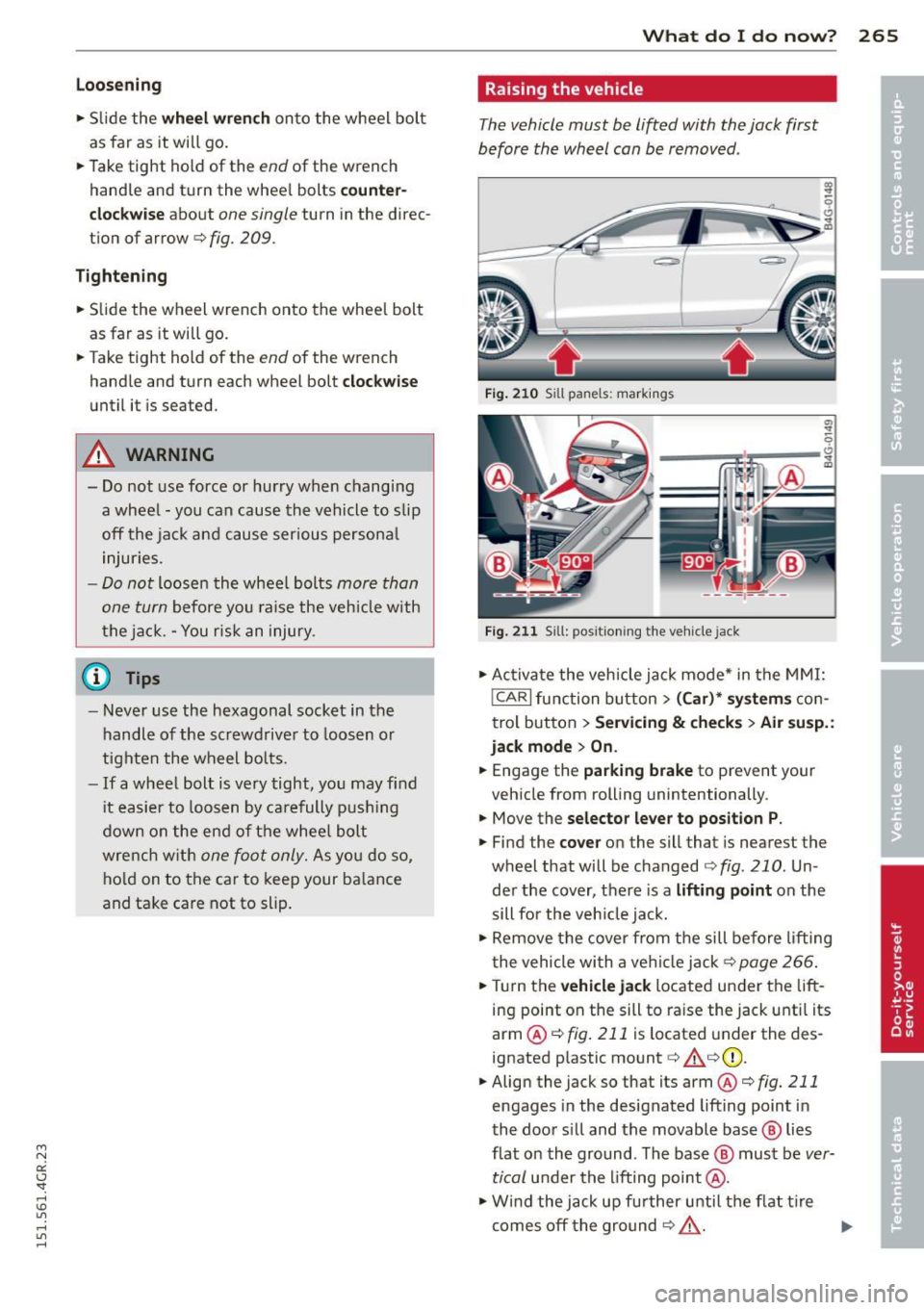
Fig . 210 Sill panels: markings
Fig. 211 Sill: pos ition ing the veh icle jack
• Ac tiva te the vehicle jack mode* in the MM I:
!CAR I fu nction button > (Car) * system s con
trol button>
Se rvicing & ch eck s> Air susp. :
jack mode > On .
• Engage the parking brake to prevent your
veh icle from rolling unintentionally .
• Move the
selector le ver to position P .
• Find the co ver on the sill that is nearest the
wheel that will be changed c:>
fig. 210. Un
de r the cover, t here is a
lifting po int on the
sill for the veh icle jack.
• Remove the cover from the sill before l ifting
the vehicle with a ve hicle jack c:>
page 266.
•Turn the vehicle jack located under the lift
ing point on the sill to raise the jack unti l its
arm @ c:>
fig. 211 is located under the des
ignated plastic mount c:> &_ c:>(D.
• Align the jack so that its arm @c:>
fig. 211
engages in the designated lifting point in
the door s ill and the movable base @ lies
flat on the ground. The base@ must be
ver
tical
under the lifting point @.
• W ind the jack up fu rther until the flat t ire
comes off the ground c:> &_ .
~
Page 269 of 302
Taking the wheel off/installing a wheel
Follow these instructions step-by-step for
changing the wheel.
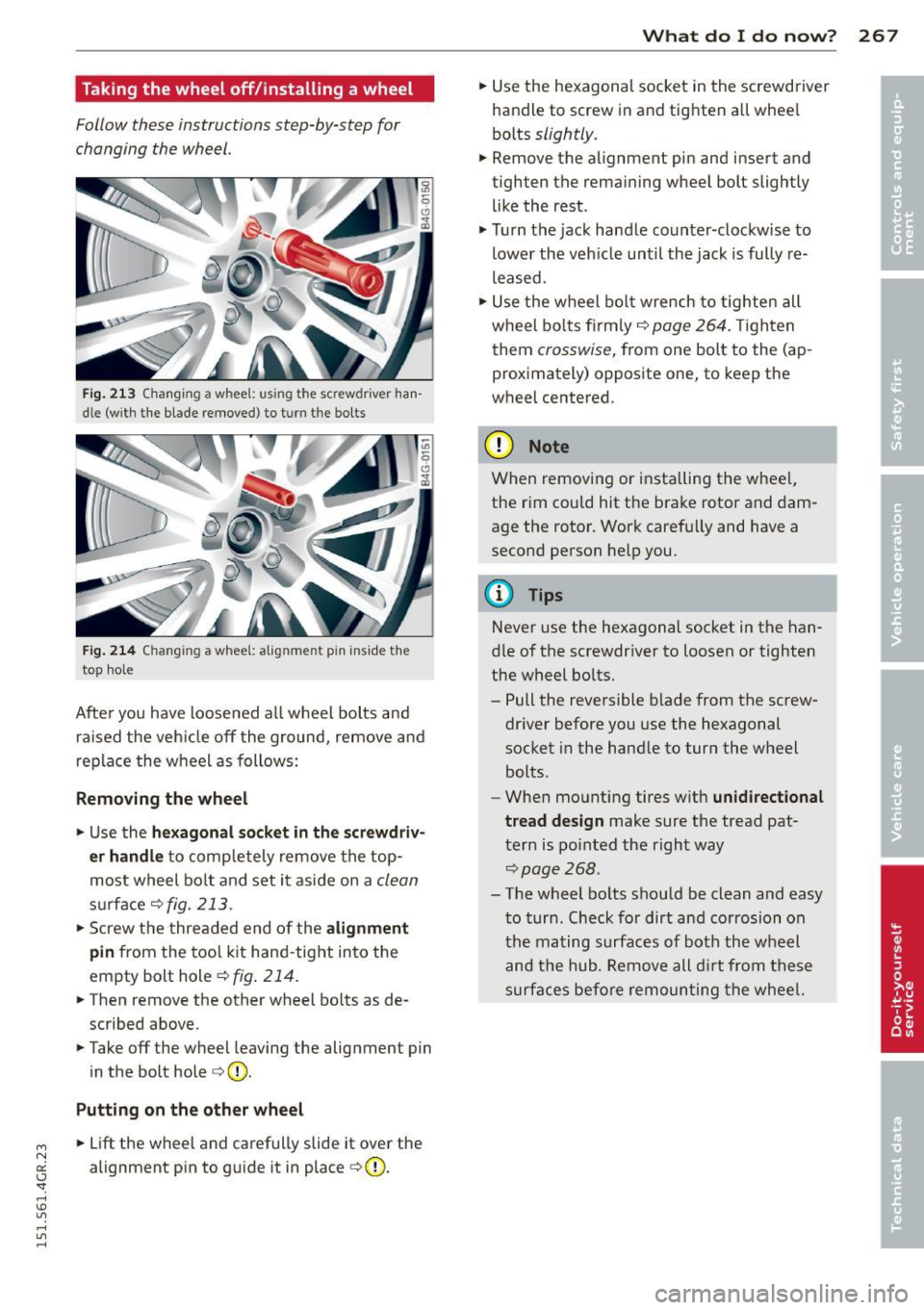
Fig. 213 Changing a wheel: using the screwdriver han
dle (with the blade removed) to turn the bo lts
F ig . 214 Changing a wheel: alignment pin ins ide the
top hole
After you have loosened a ll wheel bolts and
ra ised the veh icle off the ground, remove and
replace the wheel as follows:
R emoving the wheel
.. Use the hex agon al so ck et in th e screw driv
e r handle
to comp letely remove the top
most wheel bo lt and set it aside on a
clean
s u rface ¢fig. 213.
.. Screw the threaded end of the alignm ent
pin from the tool k it hand -tight into the
empty bolt hole¢
fig. 214.
.. Then remove the other wheel bo lts as de
scribed above .
.. Take off the wheel leaving the alignment pin
in the bolt hole ¢(D .
Putting on the oth er w heel
"' .. Lift the wheel and carefully slide it over the N
a:: alignment pin to guide it in place ¢(D. I.J -
"' rl
What do I d o now ? 267
.. Use the hexagonal socket in the screwdriver
handle to screw in and tighten all wheel
bolts
slightly.
.. Remove the alignment pin and insert and
tighten the remaining wheel bolt slightly like the rest.
.. Turn the jack handle counter-clockwise to
lower the veh icle until the jack is fully re
leased .
.. Use the wheel bo lt wrench to tighten all
wheel bo lts firm ly¢
page 264. Ti ghten
them
crosswise, from one bolt to the (ap
proximately) opposite one, to keep the
wheel centered.
(D Note
When removing or installing the whee l,
the rim could hit the brake rotor and dam
age the rotor. Work carefully and have a
second person help you.
@ Tips
Never use the hexagonal socket in the han
dle of the screwdriver to loosen or tighten
the w heel bolts.
- Pull the reversible blade from the screw
dr iver before you use the hexagonal
socket in the handle to turn the wheel
bolts.
- When mounting tires w ith
unidi rectional
tread design
make sure the tread pat
tern is po inted the right way
~page 268.
-The wheel bo lts shou ld be clean and easy
to turn. Check for dirt and corrosion on
the mating surfaces of both the wheel
and the hub. Remove all d irt from these
surfaces before remounting the whee l.
Page 271 of 302
"' N
a:: I.J "". rl I.O
Fuses and bulbs
Fuses
Replacing fuses
Fuses that have blown will have metal strips
that have burned through.
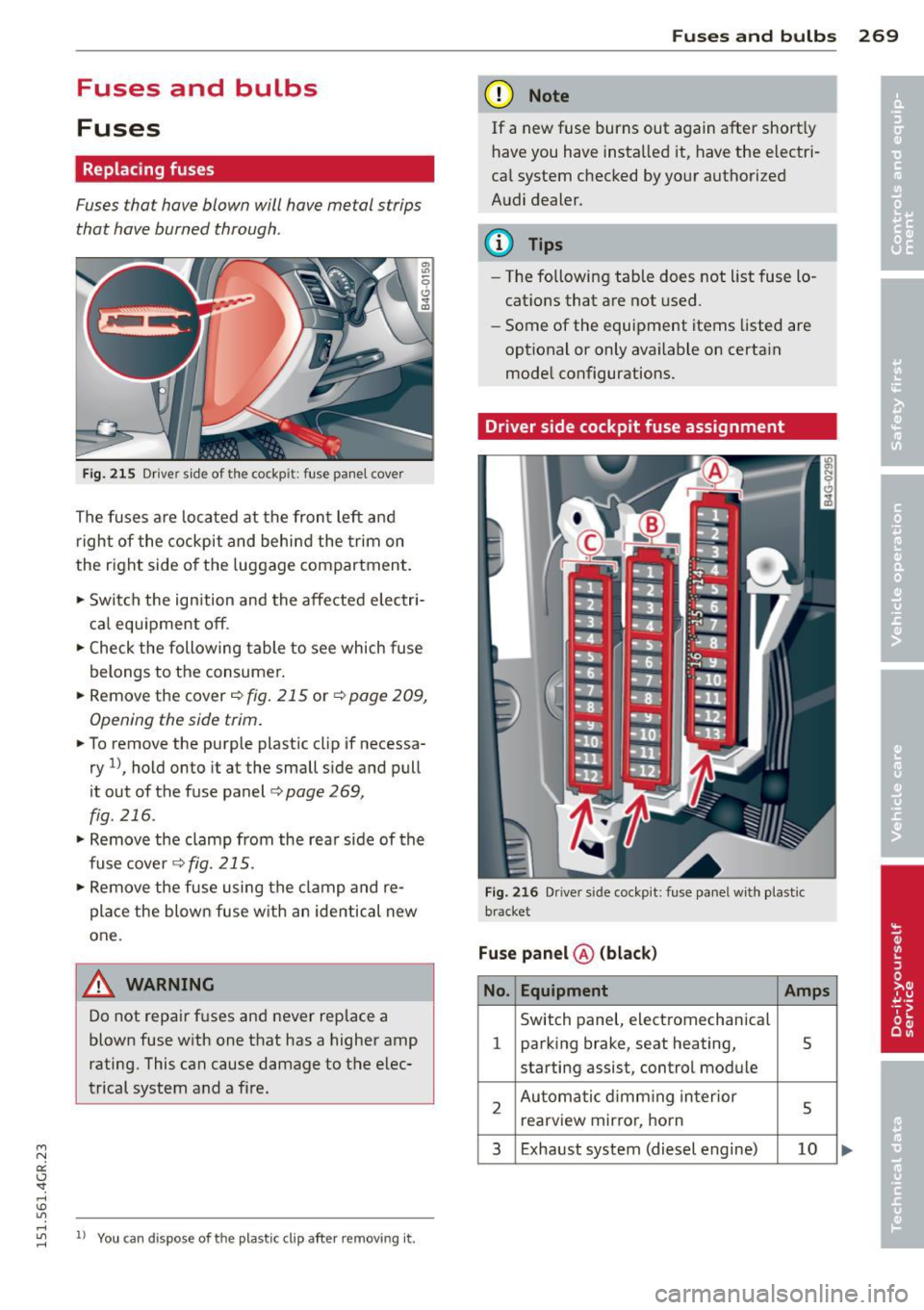
Fig. 215 Dr iver side of the cockp it: fuse panel cover
The fuses are located at the front left and
r igh t of the cockpit and behi nd the trim on
the right side of the luggage compartment .
.. Switch the ign ition and the affected electr i
ca l equipment off .
.. Check the following table to see which fuse
belongs to the consume r .
.. Remove the cover
r:!;> fig. 215 or r:!;> page 209,
Opening the side trim .
.. To remove the purple plastic clip if necessa
ry
ll, hold onto it at the small side and pull
it out of the fuse panel
r:!;> page 269,
fig. 216 .
.. Remove the clamp from the rea r side of the
fuse cover ¢
fig. 215 .
.. Remove the fuse using the clamp and re
pla ce the blown fuse w ith an identical new
one.
& WARNING , -
Do not repair fuses and never replace a
blown fuse w ith one that has a higher amp
rating. This can cause damage to the elec
trical system and a fire.
"' rl
~ 11 You can dis pose of the plastic clip after remov ing it.
Fu se s and bulb s 269
(D Note
If a new fuse burns out again after short ly
have you have insta lled it, have the electri
ca l system checked by your authorized
A udi dealer .
{!) Tips
-The following table does not list fuse lo
cat ions that are not used .
- Some of the equipment items listed are
opt ional or only available on certa in
mode l configurations.
Driver side cockpit fuse assignment
Fi g. 216 Dr iver side cockpit : fuse pa nel w ith plastic
bracket
Fuse panel @ (blac k)
No . Equipment Amps
Switch panel, electromechanica l
1 parking brake, seat heating, 5
starting assist, control module
2 Au tomatic d imm ing in terior
5 rearview mir ror, horn
3 Exhaust system (diesel engine) 10
Page 272 of 302
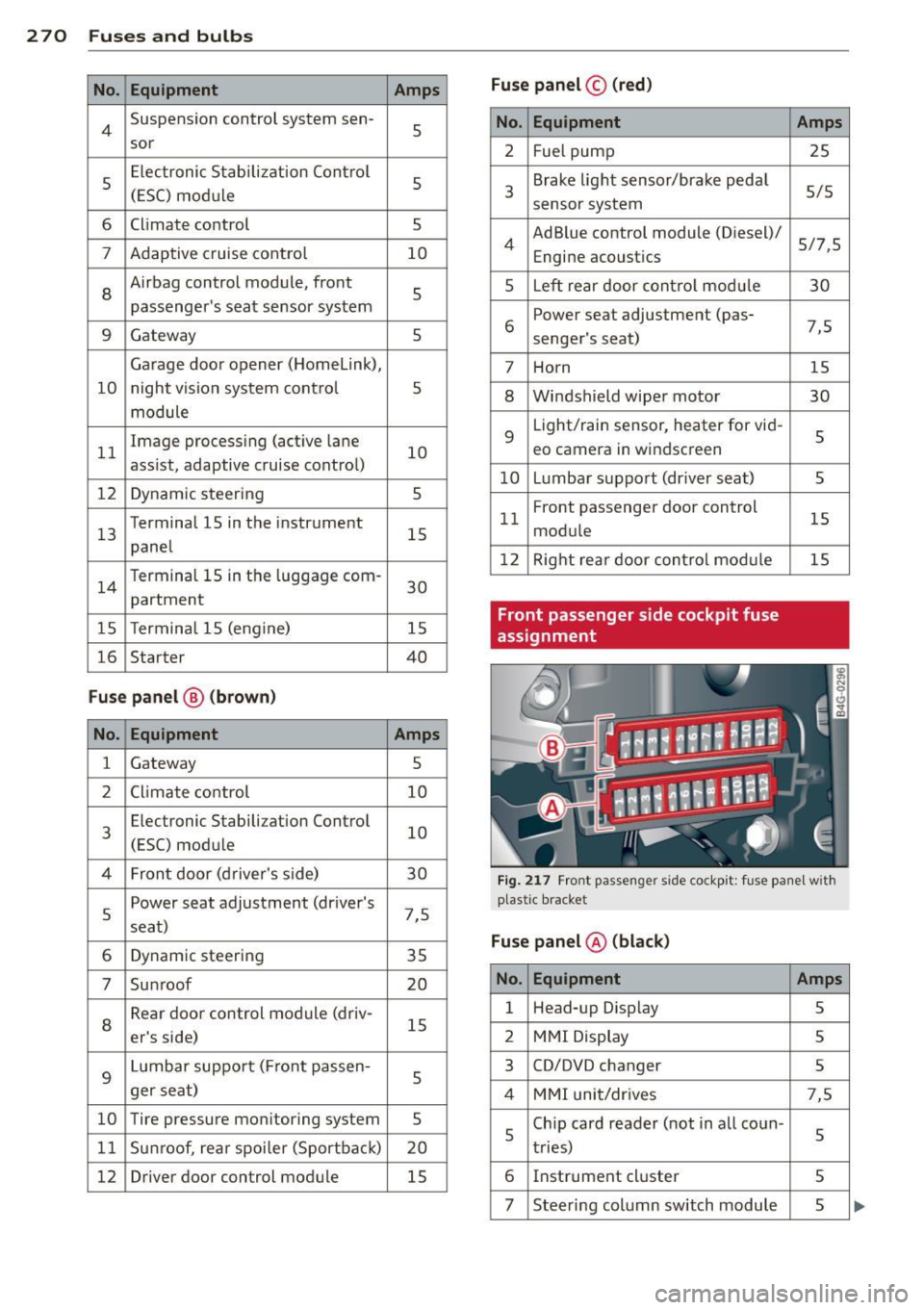
2 70 Fu ses and bulb s
No. Equ ipment Amps
4 Suspension control system sen-
5
sor
5 E
lectronic Stabilization Control
5
(ESC) mod ule
6 Climate control
5
7 Adaptive cruise control 10
8
Airbag control module, front
5
passenger's seat sensor system
9 Gateway 5
Garage door opener (Homelink),
10 night vision system contro l 5
module
11 Image
processing (active lane
10
ass ist, adaptive cruise control)
12 Dynamic steering 5
13 Terminal 15 in the
instrument
15
panel
14 Termina
l 15 in the luggage com-
partment 30
15 T
erminal 15 (engine)
15
16 Starter 40
Fuse p anel @ (b rown )
No . Equipment Amps
1 Gateway
5
2 Cl imate control 10
Electronic Stabilization Contro l
10
3
(ESC) module
4 Front door
(driver's side)
30
5 Power seat adjustment (driver's
7,5
seat)
6 Dynamic steering
35
7 Sunroof 20
Rear door control module (driv-
15
8
er's side)
9 Lumbar support
(Front passen-
5
ger seat)
10 Tire pressure monitoring system
5
11 Su
nroof, rear spoiler (Sportback)
20
12 Driver
door control module
15
Fuse panel © (r e d )
No . Equipment
2 Fuel pump
3 Brake light
sensor/brake pedal
sensor system
4 AdBlue
control module (Diesel)/
Engine acoustics
5 Left rear door contro l modu le
6 Power seat adjustment (pas-
senger's seat)
7 Horn
8 Windshield
wiper motor
9
Light/rain sensor, heater for vid-
eo camera in windscreen
10 Lumbar support (dr iver seat)
11 Front
passenger door control
module
12 Right rear door control mod ule
Front passenger side cockpit fuse
assignment Amp
s
25
5/5
5/7,5 30
7,5 15
30
5
5
15
15
Fig . 2 1 7 Front passenger side cockp it: fuse pane l w ith
plastic bracket
Fu se panel @ (bla ck)
No . Equipment Amps
1 Head-up Display
5
2 MMI Display 5
3 CD/DVD changer
5
4 MMI unit/drives 7,5
5 Chip card reader (not
in all coun-
5
tries)
6 Instrument cluster
5
7 Steering column switch
module 5