wheel AUDI RS7 SPORTBACK 2015 Workshop Manual
[x] Cancel search | Manufacturer: AUDI, Model Year: 2015, Model line: RS7 SPORTBACK, Model: AUDI RS7 SPORTBACK 2015Pages: 302, PDF Size: 74.76 MB
Page 194 of 302
192 Intelligent technology
overheat, premature wear and increased
stopp ing distance.
- Under certain climatic and operating
condit ions such as passing through wa
ter, driving in heavy ra in or after wash ing
the vehicle, the effect iveness of the
brakes can be reduced. In winter, ice ca n
accumulate on the brake pads, linings ,
discs and d rums . Carefully apply brakes
for a test . B rakes wi ll dry a nd ice coat
ings will be cleaned off after a few c are
f ul brake app lications .
- Dr iv ing fo r an ex tende d pe riod of time on
salt-covere d roads w ithout us ing yo ur
brakes can also affect braking efficiency.
Clean off accumulated salt coating from
bra ke discs and pads w ith a few caref ul
brake applicat ions.
- If you damage the front spoiler, or if you
install a different spoiler, be sure the air
flow to the front brakes is not obstruct ed. Otherwise the brake system could
over heat reducing the effectiveness of
the ent ire brake system .
- Failure of one brake c ircuit will impair
the braking capability res ulting in an in
creased stopp ing distance. Avoid driv ing
the vehicle and have it towed to t he near
est Aud i dea le r o r q ualified w ork sho p.
- Never let the vehicle ro ll to a stop w ith
the e ngine shu t off.
- If the brake booster is not working, the
brake pedal must be p ressed conside ra
bly harder to make up for the la ck of
booster assistance.
Electromechanical
power assist, dynamic
steering
The electromechanical power assist helps the
driver when steering .
Power stee ring adapts electronically based on
the vehicle speed .
Indicator lights and messages
• Steer ing defective! Stop the vehicle
If this indicato r light turns on and stays on
and this message appears, the power steering
may have failed.
Do
not con tinue dr iv ing . See your author ized
Audi dealer or other qualified repair facility
for assistance .
l;r-ij Steering: System fault You can continue
driving
If the indicato r light turns on and the mes
sage appea rs, the stee ring may be more diffi
cul t to move o r more sensi tive th an usua l. The
steering wheel may a lso be at an ang le when
driving straight .
Drive slowly to you r authorized Aud i dea le r o r
qualified wo rks hop to have the ma lf u nct ion
corre cted.
l;r,ij Dynamic steering: Initializing
If this driver message appears and t he indica
tor light is f lashing on the instrument panel,
dynam ic steer ing* is being rei nitia lized. Afte r
sta rting the engine, the stee ring wheel will
move s ligh tly. Re- ini tiali zation mig ht be ne c
e ssa ry if the stee ring wheel was moved h ard
to the left an d right wh ile the vehicle was not
moving . The display goes out as soon as initi
alization is complete.
D rive slowly to you r aut horized Audi de aler or
qualified wo rkshop to have the ma lf u nct ion
corrected.
A WARNING
Have t he dynamic stee ring * system mal
f u nction repa ired as soon as possib le by an
a uthorized Audi dealer or qua lified wor k
shop - risk of accident !
(D Tips
If the . or@ indicator light on ly stays
on for a short time, yo u may continue driv
i ng.
- The dynamic steering * sta bility systems
are not avai lab le in the event of a system
ma lf u nction.
- For add itiona l information on dynamic
steering *, refer t o
c> page 96.
Page 195 of 302
M N
0:: <.J 'SI:
Driving with your
quattro
With all-wheel drive, all four wheels are driv
en .
General information
With all-wheel drive, power is distributed to
all four wheels . This happens automatically
depending on your driving style and the road
conditions at the time . See also ¢
page 187.
A center differential distributes the driving
power variably to the front and rear axle. It
works together with selective wheel torque
control, which activates when driving through
curves ¢
page 188 . With the sport d ifferen
tial*, power distribution to the rear wheels is
va riable and can be adjusted with drive select
¢page 96.
The all-wheel drive concept is designed for
hi gh engine power. Your vehicle is exception
ally powerful and has exce llent dr iving charac
teristics both under normal driving conditions
and on snow and
ice. Always read and follow
safety precautions ¢.& .
Winter tires
When driving in the w inter , your ve hicle with
all-wheel drive has an advantage, even with
regular tires. In winter road conditions it may
be advisable to mount winter tires (or all-sea
son t ires) for improved driveability and brak
ing: these tires must be mounted on
all four
wheels. See also ¢ page 252, Winter tires.
Tire chains
Where tire chains are mandatory on certain
roads, this normally a lso applies to vehicles
with a ll-wheel drive¢
page 253, Snow
chains.
Replacing wheels/tires
Vehicles w ith all-wheel drive must always
have tires of the same size. Also avoid tires
with different tread depths. For details see
page ¢
page 245, New tires and replacing
~ tires and wheels . 1.1'1 ,...., 1.1'1 ,....,
Intelligent technology 193
Off•Road driving?
Your Audi does not have enough g round clear
ance to be used as an off-road vehicle.
It is
therefore best to avoid rough tracks and un
even terrain as much as possible. Also refer to
¢page 197.
A WARNING
Always adjust your dr iv ing to road and traf
fic conditions. Do not let the extra safety
afforded by all-wheel drive tempt you into
taking extra risks.
- Although the all-wheel drive is very ef fective, always remember that braking
capacity is lim ited by tire traction. You
should therefore not drive at excessive
speeds on icy or slippery road surfaces.
- On wet road surfaces, be careful not to
drive too fast because the front wheels
could begin to slide on top of the water
(aquaplaning) . If this should occur, you
will have no warning from a sudden in
crease in engine speed as with a front
wheel drive veh icle. Always drive at
speeds which are su ited to the road con
ditions - risk of crash.
Energy management
Starting ability is optimized
Energy management controls the distribution
of electrical energy and thus optimizes the
availability of electrical energy for starting
the engine .
If a vehicle with a conventiona l energy system
is not driven for a long period of tim e, the bat
tery is discharged by idling current consumers
(e.g . immobilizer). In certain circumstances it
can resu lt in there being insufficient energy
available to start the eng ine.
Intelligent energy management in your vehi
cle handles the distribution of e lectrica l ene r
gy. Starting ability is markedly improved and
the life of the battery is extended .
ll>
•
•
Page 204 of 302
202 Vehicle care and cleaning
Rinse the vehicle tho roughly again and let it
air dry . Remove any water residue using a
shammy .
S tu bborn depos its s uch as bird dropp ings or
tree sap are best removed with plenty of wa
ter and a microfiber cloth.
A WARNING
- Only wash the vehicle when the ignition
is off and follow the instructions from
the car wash operator to reduce the risk
of accidents .
- To reduce the r isk of cuts, protect your
self from sharp meta l compone nts whe n
was hing t he underbody or the ins ide of
t h e whee l hous ings.
- After washing the vehicle, the braking ef
fect may be delayed due to mo isture on
the brake roto rs o r ice in th e winter . The
brakes mus t be dried first with a few
c a refu l br ake appli cat io ns.
(D Note
- If you wash t he veh icle in a n au tomatic
ca r wash, yo u m ust retrac t the r ear spoi l
er if necessary, and fo ld the exter io r mir
r o rs in t o reduce the r is k of dam age. P
ower fo lding ex terior mirrors * mus t on
ly be folde d in an d out using the powe r
folding function.
- To prevent paint damage, do not wash
the vehicle i n direct sunlight.
- T o reduce the ris k of damage to the sur
face, do not use insect removi ng spong
es, kitchen sponges or similar items.
- Matte finish painted vehicle compo
nents :
- To reduce the risk of damage to the
surface, do not use polishi ng agen ts or
ha rd wa x.
- N eve r use car wash cycles that apply
p rotectiv e wax .
It can des troy the
ma tte fi nish effect .
- D o not place any st ickers o r magnet ic
signs on v ehicle parts painted w ith
ma tte fi nish paint. The paint cou ld be
d am aged when the stickers o r m agne ts
a re removed.
~ For the sake of the environment
Only wa sh the ve hicl e in facili tie s sp eci ally
d esigne d for th at pu rpose. Thi s will re duce
the r is k of dirty wate r contam inated with
oi l from entering the sewer system.
Cleaning and care information
When clea ning and cari ng fo r individua l vehi
cle components, refer to the fo llow ing tab le.
The informa tion con tained there is s imply rec
ommendations. Fo r q uest ions or for compo -nents that are not listed
, refer to a n author
i z ed Audi dea ler or a qu alified workshop. Also
f o llow the inform ation fo und in ~ .&. .
Cleaning exterior Component Situation Solution
Wiper blades Dirty
~ page 49, Cleaning windshield wiper blades
Headlights / Dirty Soft sponge with a m ild soap solution a>
tail lights
Sensors/ Dirty Sensors: soft cloth w ith a so lvent-free cleaning product
camera lenses Camera lenses: soft cloth with an alcohol-free cleaning
so lution
Snow/ice Hand b rush/so lvent-free de -icing spray
Wheels Road salt Water
Brake d ust Acid-free special cleaning so lution
Page 206 of 302
204 Vehicle care and cleaning
Component Situation Solution
T ex tile s,
Stains adhering to Vacuum cleaner
Vin yl, the surface
A lcan ta ra Water -based stains Absorbent cloth and mild soap solutiona>
such as coffee, tea,
blood, etc.
O il-based stains Apply a mild soap solutiona>, blot away the d issolved oil
such as oil, make- or dye, treat afterward w ith water, if necessary
up, etc.
Special stains such Special stain remover, blot with absorbent material,
as ballpoint pen, treat afterward with mild soap solutiona>, if necessary
na il polish, latex
pa int, shoe po lish,
etc.
N atu ral leather Fresh stains Cotton cloth with a mild soap solutiona>
Water-based stains Fresh stains: absorbent cloth
such as coffee, tea, Dr ied stains: sta in remover suitable for leather
blood, etc.
Oi l-based stains Fresh stains: absorbent cloth and sta in remover suitable
such as oil, make- for leather
up, etc. dried stains: Oil cleaning spray
Special stains such Stain remover suitable for leather
as ballpo int pen,
na il polish, latex
pa int, shoe polish,
etc.
Care Regular
ly apply condit ioning c ream that protec ts from
light a nd penetrates into the materia l. Use specially-col-
ored conditioning cream, if necessary.
Carbon part s Dirty Clean tlhe same way as plastic parts
a) Mi ld soap so lut ion : maximum two tablespoons neut ra l soap in 1 quart (I lite r) of water
& WARNING
The windshie ld may not be treated with
water -repe lling windshield coating agents .
Unfavorab le conditions such as wetness,
darkness, or low sun can result in in
creased glare. W iper blade chatter is a lso
possible .
(V Note
-Headlights /tail lights
- Never clean headlights or tail lights
w it h a dry cloth or sponge. -
Do not use any cleaning product that
contains alcohol, because they could
cause cracks to form.
-Wheels
- Never use any paint polish or other
abrasive mater ials.
- Damage to the protective layer on the
rims such as stone chips or scratc hes
must be repa ired immediately.
- Sensor s/camera len ses
- Never use warm or hot water to re-
move snow or ice from the camera
le ns. This could cause th e lens to crack . ""
Page 228 of 302
226 Tires a nd whee ls
Tires and wheels
Tires
General notes
Tires may be the least appreci
ated and most abused parts of
a motor vehicle.
Ti res may be the least appreci
ated and most abused parts of
a motor vehicle. Tires are, how
ever, one of the most important
parts of a vehicle, partic ularly
considering the comparatively
small patch of r ubber on each
tire that assures that all-impor
tant contact between you, your
vehicle and the road.
Maintaining the co rrect tire
p ressure, making sure that your
vehicle and its tires do not have
to carry more we ight than they
can safe ly handle, avoiding
damage from road hazards and
regular ly inspecting tires for
damage including cuts, s lashes
irregular wear and overall con
d ition are the most important
things that you can do to help avoid sudden tire fai lure inc lud
ing tread separation and blow
outs.
Avoiding damage
If you have to drive over a curb
or similar obstacle, drive very
slowly and as close as possible
at a right angle to the curb.
Always keep chemicals includ
ing grease, o il, gasoline and
brake fluid off the tires.
Inspect the tires regularly for
damage (cuts, c racks or blis
ters, etc.). Remove any foreign
bodies embedded in the treads.
Storing tires
Mark tires when you remove
them to indicate the direction
of rotation . This ensures you to
be able to mount them correct
ly when you reinstall them .
When removed , the wheels or
tires should be stored in a cool,
dry and preferably dark p lace.
Store tires in a vertical position if they are not mounte d on
r ims, in a horizontal position if
they are mounted on rims.
New tires
New tires have to be broken in
¢ &.
The tread depth of new tires
may vary , according to the type .,.
Page 229 of 302
Tires and wheels 22 7
and make of tire and the tread -New tires tend to be slip-•
pattern. pery and must be broken in. • '
Hidden damage To reduce the risk of losing
Damage to tires and rims is of- control, a collision and seri-
ous personal injuries, drive
ten not readily visible. If you with special care for the
notice unusual vibration or the first 350 miles (560 km).
vehicle pulls to one side, this
-Driving with worn or dam-
may indicate that one of the
aged tires can lead to loss of
tires has been damaged. The
control, sudden tire failure,
tires must be checked immedi-
ately by an authorized Audi including a blowout and
sudden deflation, crashes
dealer or qualified workshop.
and serious personal inju-
Unidirectional tires ries. Have worn or damaged
A unidirectional tire can be tires replaced immediately.
identified by arrows on the -Tires age even if they are
sidewall, that point in the di rec- not being used and can fail
tion the tire is designed to ro- suddenly, especially at high
tate. You must follow the speci- speeds. Tires that are more
fied direction of rotation. This is than 6 years old can only be
necessary so that these tires used in an emergency and
can develop their optimum then with special care and
characteristics regarding grip, at low speed.
road noise, wear and hydro- -Never mount used tires on
planing resistance. For more in- your vehicle if you are not
formation
¢ page 268. sure of their "previous histo-
ry." Old used tires may have
A WARNING
been damaged even though -
New tires or tires that are the damage cannot be seen
old, worn or damaged cannot that can lead to sudden tire
provide maximum control failure and loss of vehicle
M N and braking ability. 0:: control. <.J 'SI: ,...., \!) 1.1'1 ,...., 1.1'1 ,....,
Page 230 of 302
228 Tires and wheels
-If you notice unusual vibra
tion or if the vehicle pulls to
one side when driving, al
ways stop as soon as it is
safe to do so and check the
wheels and tires for dam
age.
0 Note
-Please note that summer and winter tires are de
signed for the conditions
that are typical in those sea
sons. Audi recommends us
ing winter tires during the
winter months. Low tem peratures significantly de
crease the elasticity of
summer tires, which affects
traction and braking ability. If summer tires are used
in
very cold temperatures, cracks can form on the tread
bars, resulting in perma
nent tire damage that can
cause loud driving noise and
unbalanced tires. Audi is not
responsible for this type of
damage.
-Burnished, polished or chromed rims must not be used in winter road condi
tions. The surface of the
rims does not have suffi
cient corrosion protection
for this and could be perma
nently damaged by road salt
or similar substances.
Glossary of tire and loading terminology
Accessory weight
means the combined weight (in
excess of those standard items
which may be replaced) of auto matic transmission, power
steering, power brakes, power
windows, power seats , radio,
and heater, to the extent that
these items are available as fac
tory-installed equipment (whether installed or not).
Aspect ratio
means the ratio of the height to
the width of the tire in percent.
Numbers of 55 or lower indi
cate a low sidewall for im
proved steering response and
better overall handling on dry
pavement.
...
Page 231 of 302
Bead
means the part of the tire that
is made of steel wires, wrapped
or reinforced by ply cords and
that is shaped to fit the rim .
Bead separation
means a breakdown of the bond
between components in the
bead.
Cord
means the strands forming the
plies in the tire.
Cold tire inflation pressure
means the tire pressure recom
mended by the vehicle manu
facturer for a tire of a designat
ed size that has not been driven
for more than a couple of miles (kilometers) at low speeds in
the three hour period before
the tire pressure is measured or
adjusted.
Curb weight
means the weight of a motor
vehicle with standard equip
ment including the maximum
capacity of fuel, oil, and cool
ant, air conditioning and addi
tional weight of optional equip
ment.
Tires and wheels 229
Extra load tire
means a tire design to operate
at higher loads and at higher inflation pressures than the
corresponding standard tire. Extra load tires may be identi
fied as "XL", "xl", "EXTRA
LOAD", or "RF" on the sidewall.
Gross Axle Weight Rating ("GAWR")
means the load-carrying capaci
ty of a single axle system,
measured at the tire-ground in
terfaces.
Gross Vehicle Weight Rating ("GVWR")
means the maximum total
loaded weight of the vehicle.
Groove
means the space between two
adjacent tread ribs.
Load rating (code)
means the maximum load that
a tire is rated to carry for a giv
en inflation pressure. You may
not find this information on all
tires because it is not required by law.
•
•
'
Page 233 of 302
Recommended inflation
pressure
see¢ page 229J Cold tire infla
tion pressure.
Reinforced tire
means a tire design to operate
at higher loads and at higher
inflation pressures than the
corresponding standard tire. Reinforced tires may be identi
fied as "XL", "xl", "EXTRA
LOAD", or "RF" on the sidewall.
Rim
means a metal support for a
tire or a tire and tube assembly
upon which the tire beads are
seated.
Rim diameter
means nominal diameter of the
bead seat. If you change your
wheel size, you will have to pur chase new tires to match the
new rim diameter.
Rim size designation
means rim diameter and width.
Rim width
means nominal distance be
~ tween rim flanges.
0:: <.J 'SI: ,...., \!) 1.1'1 ,...., 1.1'1 ,....,
Tires and wheels 231
Sidewall
means that portion of a tire be
tween the tread and bead.
Speed rating (letter code)
means the speed at which a tire
is designed to be driven for ex
tended periods of time. The rat ings range from 93 mph (150
km/h) to 186 mph (298 km/h)
¢
page 248. You may not find
this information on all tires be cause it is not required by law.
The speed rating letter code,
where applicable, is molded on
the tire sidewall and indicates
the maximum permissible road speeds ¢
A in Winter tires on
page 252.
Tire pressure monitoring system
means a system that detects
when one or more of a vehicle's tires are underinflated and illu
minates a low tire pressure
warning telltale.
Tread
means that portion of a tire
that comes into contact with
the road.
•
•
'
Page 235 of 302
"' N
a:: I.J "". rl I.O
"' rl
"' rl
Vehicle maximum load on the tire
means that load on an individu
al tire that is determined by
distributing to each axle its
share of the maximum loaded
vehicle weight and dividing by two.
Vehicle normal load on the tire
means that load on an individu
al tire that is determined by
Tires and wheels 233
distributing to each axle its
share of the curb weight, acces
sory weight, and normal occu
pant weight (distributed in ac
cordance with table below
¢ page 233) and dividing by
two.
Occupant loading and distribution for vehicle normal load for
various designated seating capacities
Designated seating Vehicle normal load, Occupant distribu-
capacity, number of number of occupants tion in a normally
occupants loaded vehicle
4 2 2 in front
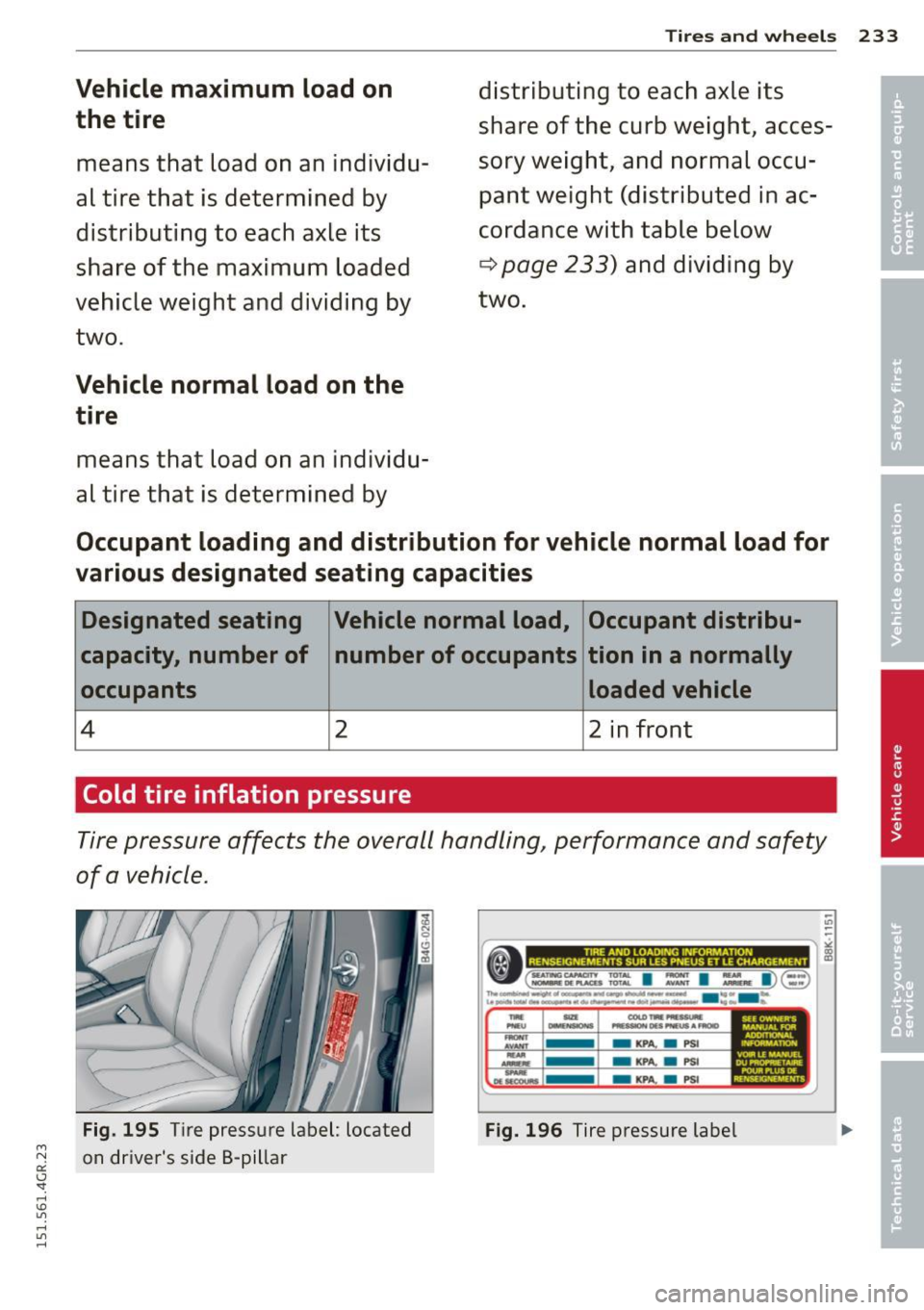
Cold tire inflation pressure
Tire pressure affects the overall
handlingJ performance and safety
of a vehicle.
Fig. 195 Tire pressure label: located
on driver's side B -pillar
-"' ---------------.... ,;,
& =-=====c=-=============== ::l
Ve=~= • = • =-1)§ -n,,......,..__.................................... • .... _ .. .................................... ___...,._ .. . -
- KPA, . PSI
- KPA. . PSI
- KPA. . PSI
Fig. 196 Tire pressure label