tow AUDI S3 2015 Owner's Guide
[x] Cancel search | Manufacturer: AUDI, Model Year: 2015, Model line: S3, Model: AUDI S3 2015Pages: 310, PDF Size: 76.15 MB
Page 195 of 310
M N
0 > co ,...., \!) 1.1'1
M 1.1'1 ,....,
the brakes. If you need to brake addit ion
ally, bra ke in intervals and not continu
ously.
(D Tips
- If the brake boos ter is not wor king, you
must p ress the brake pedal with much
more force t hen no rma l.
- If yo u retrof it your vehicle with a front
s po ile r, wheel covers or similar items,
make sure that the air f low to the front
whee ls is not interrupted. Otherwise the
brake system can become too hot.
Electromechanical
steering
The elec tromechanical steering suppor ts the
driver's s teering movements .
Powe r stee ring adapts electronically based o n
the veh icle speed.
The vehicle still has full stee ring fu nctionality
if the powe r steering fails o r whe n the eng ine
i s stopped (towi ng). To s teer, yo u must app ly
m uc h mo re fo rce than usual.
Indicator lights and messages
• Do not drive vehicle: steering defective
If th is in dicator lig ht tu rns on and stays on
and this message appears, the power steering may have fa iled.
Do
not co ntin u e dr iving . See an autho rize d
Aud i dea ler o r autho rized Aud i Service Fac ility
for assistance.
• Do not drive vehicle: steering defective
There is a malf unct io n in the electro nic steer
in g lo ck. You canno t turn the ign ition on.
Do
not tow your vehicle beca use it ca nnot be
steered. See an autho rized Aud i dea le r or au
thor ized Audi Se rv ice Facility for ass istance.
Ei:-Y Steering malfunction : you can continue
driving
I f the indicator light turns on, the steering
wheel may be more difficult to move or more
Smart Technolog y 193
sensit ive tha n usua l. The stee ring wheel may
also be at a n angle when dr iv ing stra ight .
D rive slowly to you r auth ori zed Audi de aler o r
qualifie d wo rkshop to have the ma lf u ncti on
correc ted.
II Steering lock : sy stem fault! Pl ease con
tact Service
T he re is a malfunction in the elec tronic steer
ing lock .
D rive to an author ized Audi dealer or author
ized Audi Serv ice Facility immediately to have
the malfunc tion corrected.
A WARNING
Have the sys tem ma lf u nction co rrec ted as
soon as po ssible by an aut horiz ed Aud i
d e aler or au thoriz e d Au di Service Fa cili ty,
a s this incr eases the r is k of an acciden t.
(D Tips
If th e . or l~ij indi cator ligh t only s tays
o n for a short t ime , you may con tinue dr iv
i ng.
ALL wheel drive
(quattro)
App lies to vehicles: wi th all wheel drive
In all wheel drive, all four wheels are pow
ered.
General information
In all whee l dr ive, the dr iv ing power is divi ded
between all fo ur whee ls. Thi s happens auto
matically depending on yo ur driv ing behavior
as well as the current road conditions. Refer
to
¢ page 189, Electronic stabilization con
trol (ESC) .
The all wheel drive concept is designed for
high eng ine power. Your veh icle is except ion
a lly powerfu l and has excellent driving charac
te ristics both under normal driv ing cond itions
and on snow a nd ice. Always read and follow
safety precaut ions¢ .&.. ..,.
•
•
•
Page 200 of 310
198 Driving and the environment
Driving through water
on roads
Note the following to avoid vehicle damage
when driving through water, for example on
flooded roads:
- The water must not be any higher than the
bottom of the vehicle body.
- Do not drive faster than wa lking speed.
A WARNING
After driving through water or mud, the
braking effect can be reduced due to mois
ture on the brake discs and brake pads. A
few careful brake applications should dry off the brakes.
@) Note
Vehicle components such as the engine, transmiss ion, suspension or electrical sys
tem can be severely damaged by driving
through water.
- Determ ine the depth before driving
through water.
- Do not stop the vehicle, drive in reverse
or switch the engine off when driving
through water .
- Keep in mind that oncoming vehicles may create waves that raise the water
level and make it too deep for your vehi
cle to drive through safely.
- Avoid dr iving through salt water (corro
s ion).
Catalytic converter
App lies to vehicles: with gasoline engine
It is very important that your emission con
trol system (catalytic converter) is function
ing properly to ensure that your vehicle is run
ning in an environmentally sound manner.
> Always use lead-free gaso line r=;, page 210,
Fuel supply .
> Never run the tank down all the way to emp-
ty.
> Never put too much motor o il in your engine
r=;, page 223, Adding engine oil
The catalytic converter is an efficient "clean
up" device built into the exhaust system of
the vehicle . The cata lytic converter burns
many of the pollutants in the exhaust gas be
fore they are released into the atmosphere.
The exclusive use of unleaded fuel is critica lly
important for the life of the catalytic convert
er and proper functioning of the engine.
A WARNING
-
The temperature of the exhaust system is high, both when driv ing and after stopping
the eng ine .
- Never touch the exhaust tail pipes once
they have become hot . This could result
in burns.
- Do not park or operate the vehicle in
areas where the hot exhaust system may
come in contact with dry grass, brush,
fue l spill or other material wh ich can
cause a fire.
- Do not app ly additional undercoating or
rustproofing on or near the exhaust manifold, exhaust pipes, catalytic con
verter or heat shields . Dur ing driving, the
substance used for undercoating could
overheat and cause a fire.
(D Note
- Be aware that just one tank filling with
leaded fuel will already seriously de
grade the performance of the catalytic
converter.
- Do not exceed the correct engine oil level
r=;, page 223.
-Do not drive until the fuel tank becomes
completely empty. The engine could mis
fire . Unburned fuel could also get into
the exhaust system and this cou ld cause
the catalytic converter to overheat.
- Do not switch off the ignition while the
vehicle is moving.
- Do not continue to operate your vehicle
under these conditions, as otherwise fuel
IIJ,,
Page 204 of 310
202 Trailer towing
Trailer towing Driving with a trailer
General information
Your Audi was designed primarily for passen
ger transportation .
If you plan to tow a tra iler, p lease remember
that the addit ional load will affect durab ility,
economy and performance .
T railer towing not on ly places more stress on
the vehicle, it also calls for more concentra
tion from the driver.
F or this reason, always fo llow the operating
and drivi ng i nstr uctions provided and use
common sense.
Technical requirements
Traile r hitch
Use a weight-carrying hitch conforming to the
gross trailer we ight. The hitch must be suita
b le for your veh icle and trailer and mu st be
mounted secure ly on the ve hicle's chassis at a
technically sound location . Use only a trailer
h itch with a removab le ball mount. A lways
check with the tr ailer hitch manu fac tur er to
make sure tha t you are using t he cor rect
hitch.
Do not us e a bumper hitch .
The hitch must be installed in such a way t hat
it does not interfe re with t he impact-absorb
ing bumper syst em . No mod ifications should
be made to the vehi cle exhaust and brake sys
tems . From time to time, check th at a ll hit ch
mo unt ing bo lts remain secure ly fastened.
When you are not towing a trail er, remove the
tra iler hitch ba ll mount. This prevents the
hi tch from causing d amage sho uld your ve hi
cle be str uck from be hind
¢ A .
Trailer brakes
If you r tra ile r is eq uipped w ith a braking sys
tem, check to be su re that it conforms to a ll
r egulat ions . T
he trailer hyd raulic brake system mus t not be
direct ly connected to the vehicle's hydraulic
brake system .
Safety chains
Always use s afety chains be tween your ve hicle
and t he tra ile r.
Trailer lights
Tra ile r li ghts must meet all regulations. Be
su re to c hec k w ith your Audi dea le r fo r cor rect
wiring, swi tches and relays.
Mirrors
If you are unable to see the traffic behind you
u sing the regular o utside m irrors, then you
must insta ll ext ended mirro rs . It is important
t h at you
always have clea r vis io n to the rea r.
,8. WARNING
-
Afte r removing t he trailer hit ch, d o no t
s tore it in yo ur vehicle . In case of sudden
br aking, t he h itch cou ld fly forward an d in
j ur e you or yo ur passengers .
Operating instructions
Maximum traile r weight
A trai le r fo r you r vehicle is limited to a typi cal
class 1 or class 2 trai le r.
Trailer load distribution
B e sure the load in the t ra ile r is held secure ly
i n p lace to p reven t it from shift ing forw ard,
backw ard or sideways.
Never allow a passenger to ride in a trailer
¢ A in Driving instru ctions on page 203.
Engine cooling system
Towing a trailer makes the engine work hard
er . It is impo rtant that the cooling system 's
performance is up to the additional load .
Make su re that the coo ling system has enough
fl uid .
Tire pressure
When towing a trailer, inflate the tires of your
vehicle to t he cold tire pressure listed under
ll>
Page 205 of 310
M N
0 > co ,...., \!) 1.1'1
M 1.1'1 ,....,
"Full load" on the label located on the driver's
side B-pillar (visible when the door is open).
Inflate trailer t ires to tra iler and t ire manufac
turers' specifications.
Lights
Check to make sure both vehicle and trailer
lights are working properly.
Safety chains
Be sure tra iler safety cha ins are properly con
nected from the trailer to the hitch on the ve
hicle. Leave enough slack in the chains to per
mit turning corners. When you install safety
chains, make su re they wi ll not drag on the
road when you are driving.
The chains should cross under the tra ile r
tongue to prevent it from dropping in case of
separation from the hitch.
Driving instructions
Driving with a trailer always requires extra
care and consideration.
To obtain the best poss ible handling of vehicle
and traile r, p lease note the following:
~ Do not tow a loaded tra iler when your car it
self is not loaded.
~ Be especia lly careful when passing other
vehicles.
~ Observe speed limits .
~ Do not drive at the maximum permissible
speed.
~ Always apply brakes early.
~ Monitor the temperature gauge.
Weight distribution
Towing a loaded trai ler with an empty car re
sults in a highly unstable distribution of
weight. If this cannot be avoided, drive at very
low speeds only to avoid the risk of losing
steering control.
A "balanced" rig is easier to operate and con
trol. This means that the tow vehicle should be loaded to the extent poss ible and permiss i
ble, wh ile keeping the trailer as light as poss i
ble under the circumstances . Whenever possi-
Trailer towing 203
ble, transfer some cargo to the luggage com
partment of the tow vehicle while observing
tongue load requirements and vehicle load ing
considerations.
Speed
T he higher the speed, the mo re difficult it be
comes for the driver to control the rig. Do not
drive at the maximum permissib le speed. Re
duce your speed even more if load, weather or
wind conditions are unfavorable -particularly
when going downhill.
Reduce veh icle speed
immediately if the trail
er shows the slightest sign of swaying .
Do not
try to stop the swaying by accelerating.
Observe speed limits . In some areas, speeds
for vehicles towing trai lers are lower than for
regular vehicles .
Always apply brakes early. When driving
downhi ll, shift into a lower gear to use the en
gine braking effect to s low the vehicle. Use of
the brakes alone can cause them to overheat
and fail.
Coolant temperature
The coolant temperatu re gauge <=> page 12
must be observed carefu lly. The coolant tem
perature can increase if you drive on long in
clines in a low gear at high engine speeds. Re
duce your speed immediately if the LEDs in
the top part of the display turn on.
For more information about indicator lights,
refer to .<=>
page 20.
A WARNING
Anyone not properly restrained in a mov
ing vehicle is at a much greater risk in an
accident. Never let anyone ride in your car
who is not properly wearing the restraints
provided by Audi.
Trailer towing tips
Important to know
Your vehicle handles d ifferently when towing
a trailer because of the additional weight and ..,.
•
•
•
Page 206 of 310
204 Trailer towing
different weight distribution. Safety, perform
ance and economy wi ll greatly depend on how
carefu lly you load your trailer and operate
your rig.
Before you actually tow your trailer, practice
turning, stopping and backing up in a n area
away from traffic. Keep practicing until you
have become comp letely fam iliar with the way
your veh icle-trailer comb ination behaves and
responds.
Backing up is d iff icult and requires practice.
Backing up with a tra iler genera lly requires
steering action opposite to that when back ing
up your veh icle without a trailer.
Maintain a greater distance between your ve
h icle and the one in front of you. You will need
more room to stop. To compensate for the
trailer, you will need a larger than normal
turning radius.
When passing, remember that yo u cannot ac
celerate as fast as you normally would be
cause of the added load. Make sure you have
enough room to pass. After passing, allow
p lenty of room for your tra iler before chang
ing lanes aga in.
Avoid jerky starts, sharp turns or rapid lane
changes.
(D Tips
- Do not tow a tra iler dur ing the break-in
period of you r vehicle.
- If you tow a trailer, your Audi may re
quire more frequent maintenance due to
the ext ra load
¢ page 289.
Parking on a slope
Do not park on a slope with a trailer. If it can
not be avoided, do so only after doing the fol
lowing:
Wh en park ing:
.. Apply the foot brake .
.. Have someone place chocks under both the
vehicle and the trailer wheels. ..
With chocks in place, slowly release the
brakes unti l the whee l chocks absorb the
load.
.. Turn the whee ls towards the curb.
.. App ly the parking brake.
.. Select the P selector lever posit ion.
When re starting afte r park ing :
.. App ly the foot brake.
.. Start the engine.
.. Select the D/S se lector lever position.
.. Release the parking brake and s lowly pull
out and away from the wheel chocks .
.. Stop and have someone retr ieve the wheel
chocks .
@ Tips
If you move the selector leve r of the auto
matic transmission to P befo re applying
the pa rking brake and before bloc king the
whee ls, you may h ave to use more force
la ter to move the lever out of the P posi
tion .
Page 251 of 310
M N
0 > co ,...., \!) 1.1'1
M 1.1'1 ,....,
Tires and vehicle load limits
There are limits to the amount of load or weight that any vehi
cle and any tire can carry. Ave
hicle that is overloaded will not
handle well and is more diffi
cult to stop. Overloading can
not only lead to loss of vehicle
control, but can also damage
important parts of the vehicle
and can lead to sudden tire fail
ure, including a blowout and
sudden deflation that can cause
the vehicle to crash.
Your safety and that of your
passengers also depends on
making sure that load limits are
not exceeded. Vehicle load in
cludes everybody and every
thing in and on the vehicle.
These load limits are technical
ly referred to as the vehicle's
Gross Vehicle Weight Rating
("GVWR").
The "GVWR" includes the
weight of the basic vehicle, all
factory installed accessories, a
full tank of fuel, oil, coolant and other fluids plus maximum
load. The maximum load in
cludes the number of passen
gers that the vehicle is intend-
Tires and wheels 249
ed to carry ("seating capacity")
with an assumed weight of 1
SO lbs (68 kg) for each pas
senger at a designated seating
position and the total weight of
any luggage in the vehicle. If
you tow a trailer, the weight of
the trailer hitch and the tongue
weight of the loaded trailer must be included as part of the
vehicle load.
The
Gross Axle Weight Rating
("GAWR") is the maximum load
that can be applied at each of
the vehicle's two axles.
The Gross Vehicle Weight Rat
ing and the Gross Axle Weight
Rating are listed on the safety
compliance sticker label locat
ed on the driver's side 8-pillar.
Your Audi has 5 seating posi
tions, 2 in the front and 3 in the rear for total seating capacity
of 5. Each seating position has
a safety belt¢
page 135, Safe
ty belts.
The fact that there is an upper
limit to your vehicle's Gross Ve
hicle Weight Rating means that
the total weight of whatever is
being carried in the vehicle (in
cluding the weight of a trailer ""
' •
•
' •
Page 253 of 310
M N
0 > co ,...., \!) 1.1'1
M 1.1'1 ,....,
KG OR XXX LBS" on your ve
hicle's placard (tire inflation
pressure label)
c:> page 240,
fig. 168.
2. Determine the combined
weight of the driver and pas sengers that will be riding in
your vehicle.
3 . Subtract the combined
weight of the driver and pas sengers from
"XXX" kilo
grams or
"XXX" pounds
shown on the sticker
c:> page 240 , fig. 168.
4. The resulting figure equals
the available amount of car
go and luggage load capaci
ty. For example, if the "XXX"
amount equals 1400 lbs.
and there will be five 150 lbs. passengers in your vehi
cle, the amount of available
cargo and luggage load ca
pacity is 650 lbs. (1400-750 (5
X 150) = 650 lbs.)
5. Determine the combined weight of luggage and cargo being loaded on the vehicle.
That weight may not safely
exceed the available cargo
and luggage load capacity
calculated in Step 4.
Tires and wheels 251
6. If your vehicle will be towing a trailer, load from your trail
er will be transferred to your
vehicle. Consult this manual
to determine how this re
duces the available cargo
and luggage load capacity of
your vehicle.
~check the tire sidewall
(¢ page 254, fig . 172) to de
termine the designated load rating for a specific tire.
' •
•
' •
Page 271 of 310
....,
N
0 > co
rl I.O
"' ....,
"' rl
-Do not drive faster than 50 mph (80 km/
h). You r isk having an accident.
- Avoid full-throttle acceleratio n, heavy
braking, and fast cornering . You risk hav
ing an acc ident.
- Never drive us ing more than one spare
wheel and tire. You risk having an acci
dent.
- Normal summer or winter tires must not
be mounted on the compact spare whee l
rim.
- For technical reasons, the use of tire
chains on the spare tire is not permitted.
If it is necessary to dr ive with tire chains,
the spare wheel must be mounted on the
front axle in the event of a flat in a rear
t ir e. The newly ava ilable front wheel
must then be i nstalled in pla ce of the
re ar wheel with the f lat tir e. Ins tall ing
the tire chai n befo re mo unting the wheel
and tire is recommended .
- Loose items in the passenger compart
ment can cause serio us personal inj ury
dur ing hard braking or in an accident.
Never store the inf latable spare tire or
jack and tools in the passenger compart ment.
- Norma l summer or winter tires m ust not
be mounted on the compact spare wheel
rim .
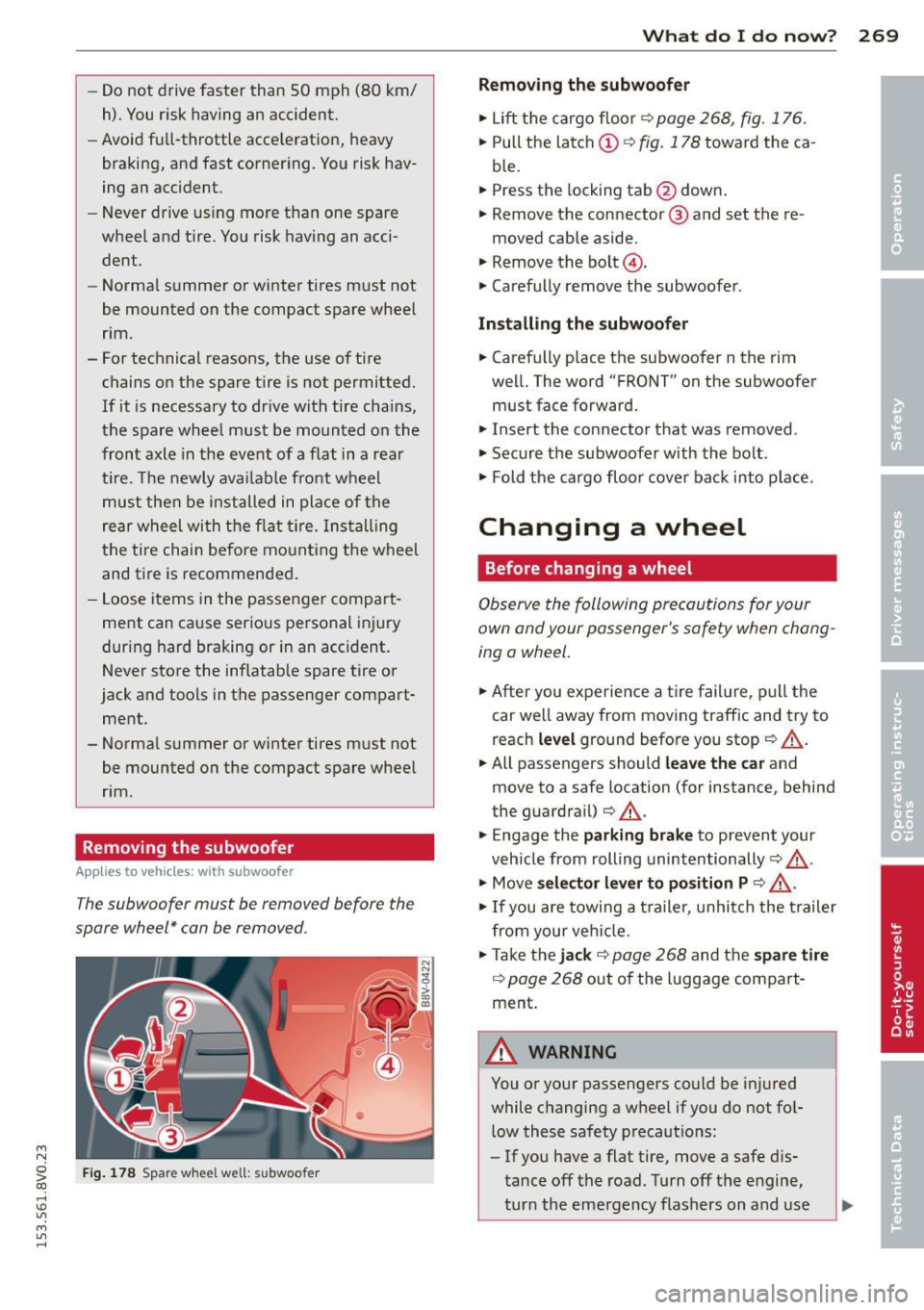
Removing the subwoofer
App lies to vehicles : with subwoofer
The subwoofer must be removed before the
spare wheel* can be removed .
Fig. 178 Spa re whee l w ell : subwoo fer
What do I do now ? 269
Removing the subwoofer
.,. Lift the cargo floor¢ page 268, fig . 176.
.,. Pull the latch (D ¢ fig. 178 toward the ca -
ble.
.,. Press the locking tab @down .
.,. Remove the connector ® and set the re-
moved cable as ide .
.,. Remove the bolt @ .
.,. Carefully remove the subwoofer .
Installing the subwoofer
.,. Carefully place the subwoof er n the rim
wel l. The word "FRONT" on the subwoofer
must face forward.
.,. Insert the connector that was removed.
.,. Secure the subwoofer with the bolt .
.,. Fold the cargo floo r cover back into place.
Changing a wheel
Before changing a wheel
Observe the following precautions for your
own and your passenger 's safety when chang
ing a wheel .
.,. Aft er you experience a tire failure, pull the
car we ll away from mov ing traffic and try to
reac h
level ground before you stop ¢ &_ .
.,. All passenge rs should
leave the car and
move to a safe location (for instance, behind
the guardrail)¢ &_ .
.,. Engage the
parking brake to prevent your
veh icle from rolling unintentionally¢&_ .
.,. Move
sel ector lever to po sition P ¢ ,&. .
.,. If you are towing a t ra iler, unhi tch the trailer
from your ve hicle .
.,. Take t he
jack ¢ page 268 and the sp a re tire
¢ page 268 out of the luggage com part
ment .
A WARNING
You or your passengers could be inj ured
while changing a w heel if you do not fo l
l ow these safety p recaut io ns:
- If you have a flat tire, move a safe d is
tance off the road. Turn off the engine,
turn the emergency flashers on and use
Page 282 of 310
280 Emergency situations
Emergency situations
General
This chapter is intended for trained emer
gency crews and working personnel who
have the necessary tools and equipment to
perform these ope rations.
Starting by pushing or
towing
Q;) Note
Vehicles w ith an automatic transmission
cannot be started by pus hing o r tow ing.
Starting with jumper
cables
If necessary, the engine can be started by
connecting it to the battery of another vehi
cle.
If the engine should fail to start because of a
discharged or weak battery, the battery can be
connected to the battery of
another vehicle,
using a
pair of jumpe r cables to start the en
g ine .
Jumper cables
Use only jumper cables of sufficiently large
cross section to carry the starter current safe
ly. Refer to the manufacturer's specif ications.
Use only jumper cables with
insulated termi
na l clamps which are distinctly marked:
plus(+) cable in most cases colored red
minu s(-) cable
in most cases colored black .
A WARNING
Batteries contain electricity, acid, and gas.
Any of these can cause very serious or fatal
inju ry. Follow the instructions below for
safe handling of your veh icle's battery.
- Always shield you r eyes and avoid lean
ing over the battery whenever possible.
- A discharged battery can freeze at tem
peratures just be low 32 °F (0 °C). Before connecting a
jumper cable, you must
thaw the frozen battery complete ly, oth
erwise it could explode.
- Do not allow battery acid to contact eyes
or skin . Flush any contacted area with
water immediately .
- Improper use of a booster battery to start a vehicle may cause an explosion.
- Vehicle batteries generate explosive gas
es. Keep sparks, flame and lighted ciga
rettes away from batteries.
- Do not try to jump start any vehicle with a low acid level in the battery.
- The vo ltage of the booster battery must
also have a 12-volt rating. The capacity
(Ah) of the booster battery should not be
lower than that of the discharged bat
tery . Use of batteries of d ifferent voltage
or substantially different "Ah" rating
may cause an exp losion and personal in
jury.
- Never charge a frozen batte ry. Gas trap
ped in the ice may cause an explosion.
- Never charge or use a battery that has
been frozen. The battery case may have
be weakened.
- Use of batter ies of different voltage or
substantially different capacity (Ah) rat
ing may cause an exp losion and injury.
The capacity (Ah) of the booster battery
should not be lower than that of the dis
charged battery.
- Before you check anything in the engine
compartment, always read and heed a ll
WARNINGS
¢page 217.
(D Note
-App lying a higher voltage booster bat
tery will cause expensive damage to sen
sitive electronic components, such as
contro l units, relays, radio, etc .
- Th ere must be no electrical contact be
tween the vehicles as otherwise current cou ld already start to f low as soon as the
positive(+) terminals are connected. .,.
Page 284 of 310
28 2 Em ergency sit uat ions
installed. Make sure the cables do not get
caught in moving engine components .
11. Sw itch the heater fan and rear window de-
froster
off.
12. Close the battery cover.
The battery is vented to the outside so that
not gases enter the passenger compartment.
Make sure that the connected positive termi
nal clamps on the jump start cable have suffi
cient contact with metal.
A WARNING
Follow the warn ings and instructions from
the jump start cable manufacturer to re
duce the risk of ser ious injuries and vehicle
damage.
If you are uns ure about anyth ing,
call roadside assistance.
- T he jump start cables must be long
enough so that the vehicles do not
touch.
- Route the jump sta rt cab les so they can
not get caught in the moving parts in the
engine compartment .
- Always read and follow the warn ings be
fore checking anything in the engine compartment ¢
page 217.
([) Note
Correctly jump start cables incorrect ly can
destroy the a lternator .
- Always connect the positive terminal(+)
to the positive terminal( +) and the neg
at ive termina l(- ) to the negative termi
nal(-) on the body ground point, b ut not
the negative termina l on the battery.
- Make sure the screw plugs on the battery ce lls are insta lled securely.
If not, tig ht
en the plugs before connecting the
clamps to the negat ive terminal on the
battery.
- Please note that the connecting process
described be low for the jump start ca
bles is intended for when your vehicle is
being jump started . If you are jump
starting another vehicle, do not connect
the negat ive cab le to the negative termi
nal (-) on the drained battery, but rathe r connect it to a
large metal component
that is bolted securely to the engine block, or to the engine block itsel f. If the
battery in the vehicle being jump started
is not vented to the outside, there is a
risk of explosion due to hydrogen gas .
- Make sure that the connected positive
terminal clamps have sufficient contact
w ith metal.
- Do not use the battery negative terminal
for jump start ing or a malfunct ion could
occur in the vehicle electrical system.
Emergency towing
with commercial tow
truck
General hints
Your Audi requires special handling for tow
ing .
The following information is to be used by
commerc ial tow truck operators who know
how to operate the ir equipm ent safely .
-Never tow your Aud i. Towing will cause
damage to the engine and transmission.
- Never wr ap the s afet y chains or winch ca
bles around the b rake lines.
- To p re v ent unnece ssary damage , your Aud i
must be transpo rted with a flat bed truck.
- To load the vehicle on to the fl at bed, u se
the towing loop found in the vehicle tools
and attach to the front or rea r ancho rage
c;,page 283 and c;,page 283.
A WARNING
A vehicle being towed is not safe for pas
sengers . Never allow anyone to ride in a
vehicle be ing towed, fo r any reason.
-