brake AUDI S8 2009 Workshop Manual
[x] Cancel search | Manufacturer: AUDI, Model Year: 2009, Model line: S8, Model: AUDI S8 2009Pages: 408, PDF Size: 91.63 MB
Page 283 of 408
- Lack of proper maintenance as wel l as improper use of the
vehic le wi ll impair the func tion of the emission con tro l system
and could lead to damage.
<£> For the sake of th e envir onm ent
Even when the Emission Control System is operating properly, the
exhaust gas can have a su lfur -like exhaust gas smell under some
operating states . This depends on the sulfur content of the fuel
being used. Using a different brand of fue l may help, or filling the
tank with lead-free super grade gasoline. •
Avoid damaging the vehicle
When you are driving on poor roads, or over curbs, steep ramps,
etc., make certain that low- lying parts such as spoi lers and exhaust
system parts do not bottom out and get damaged.
This is especially true for vehicles with low-slung chassis (sports
chassis) * and fully loaded vehicles .
a
Operate your vehicle economically
and minimize pollution
General
Your personal style of driving will determine the economy
of your vehicle, as well as exhaust and noise levels.
Fuel economy, environmental impact, and wear on your engine,
brakes and tires largely depend on three factors:
• your personal driving style
• operating cond itions
• technica l limitations
Controls and equip
ment Safety first Vehicle operation
Dri
ving and environm ent
If you anticipate what you need to do next and drive economica lly,
you can easily cut your fuel consumption by 10 -15 percent . This
section wil l give you some tips on how you can help the environ
ment and your pocketbook.
[ i ] Tips
The consumption estimates as published by ENV IRONMENTAL
PRO TEC TION AGENCY (EPA) and Transport Canada may not corre
spond to your actua l consumption on the road, which wi ll vary
depending upon vehic le load and speed, road and weather condi
tions, trip length, etc. •
Drive smoothly and keep a lookout ahead
Vehicles use the most fuel when they ore accelerating.
-Avoid unnecessary accelerat ing and braking.
Vehicles use the most fuel when they are accelerating . If you antici
pate what is going to happen next, you wi ll need to brake less and,
thus, acce lerate less. Let the vehicle coast whenever possib le - for
examp le when you see that the next traffic light is red. •
Avoid full throttle
Driving at moderate speeds saves fuel and improves your
mileage.
-Try and keep well below your car 's max imum speed.
Acce lerating gently reduces fue l consumption , engine wear, and
does not disturb the environment.
Fue l consumption, exhaust emissions and engine noise increase
disproportionately at high speeds . If you drive at approximate ly
three quarters of top speed, fuel consumption wil l be reduced by
Vehicle care Do-it-yourself service Technical data
Page 286 of 408

___ T_ r _a_ il_e _r_ t_ o_ vv_ in__... g,_ __________________________________________________ _
Trailer towing
Driving with a trailer
General information
Your Audi was designed primarily for passenger transpor
tation.
If you plan to tow a trailer, please remember that the additional load
wi ll affect durability, economy and performance.
Trai ler towing not on ly p laces more stress on the vehicle, it a lso ca lls
for more concentration from the driver.
For this reason, always fol low the operating and driving instructions
provided and use common sense.
0 Note
If you are going to tow a trai ler, you must activate the trailer opera
tion mode =>
page 192, "Towing a Trailer".
Technical requirements
Tra iler hitch
Use a weight-carrying hitch conforming to the gross trailer weight .
The hitch must be suitable for your vehicle and trailer and must be
mounted secure ly on the ve hicle's chass is at a
technically sound
location. Use only a trailer hitch with a removable ball mount.
Always check with the trai ler hitch manufacturer to make sure that
you are using the correct hitch .
Do not use a bump er hit ch.
The hitch must be installed in such a way tha t it does not interfere
with the impact-absorbing bumper system. No modifications should be made to the vehic le exhaust and brake systems. From time to time, check that all hitch mounting bolts remain securely
fastened.
When you are no
t towing a trailer, remove the traile r hitch ball
mount. This prevents the hitch from causing damage shou ld your
vehic le be struck from behind=>& .
Traile r br akes
If your trailer is equipped with a braking system, check to be sure
that it conforms to al l regu lations .
The trai ler hydraulic brake system must no t be direct ly connected to
the vehicle's hydraulic brake system.
S afet y c hains
Always use safety chains between your vehicle and the trailer.
Trailer light s
Trailer lights must meet all regulations. Be sure to check with your
Audi dealer for correc t wiring, swi tches and relays .
Mirrors
If you are unable to see the traf fic behind you using the regu lar
outside mirrors, then you
must install extended mirrors. It is impor
tant that you
always have c lear vision to the rear.
& WARNING
After rem oving the tr aile r hitch , do not store it in your vehi cle. In
ca se of sudde n braking , the hit ch co uld fl y for ward and injure you
or your p asseng ers. a
Page 287 of 408
Operating instructions
Max im um tra iler weight
A trailer for your vehicle is limited to a typical class 1 or class 2
trailer.
T ra ile r l oa d di stributio n
Be sure the load in the trailer is he ld securely in place to prevent it
from shifting forward, backward or sideways .
Never allo w a passe nger to r ide in a tr aile r~ & in "Driving instruc
tions" .
Engin e c oolin g sys te m
Towing a trailer makes the eng ine work harder. It is important that
the cooling system's performance is up to the additiona l load. Make
sure that the coo ling system has enough fluid .
Tire pr ess ure
When towing a trailer, inflate the tires of your vehicle to the co ld tire
pressure listed under "Full load" on the labe l located either on the
driver's side B -pil lar (visible when the door is open) or inside the fuel
filler flap . Inflate trai ler tires to trai ler and tire manufacturers' spec
ifications.
L ig ht s
The head light settings should be checked wit h the trai ler attached
before driving off. Check to make sure both vehicle and trai ler lights
are working properly .
Safe ty c ha in s
Be sure traile r safety chains are properly connected from the trailer
to the hitch on the vehicle. Leave enough slack in the chains to
perm it turning corners . When you i nsta ll safety chains, make sure
they will not drag on the road when you are driving.
T he chains should cross under the trailer tongue to prevent it from
dropping in case of separat ion from the hitch.
Controls and equip
ment Safety first Vehicle operation
Tr
aile r t owing
0 Note
If you are going to tow a trai ler, you must activate the trailer opera
tion mode ~
page 192, "Towing a Trailer". •
Driving instructions
Driving with a trailer always requires extra care and
consideration.
To obtain the best possible handling of veh icle and trailer,
please note t he following :
- Do not tow a loaded trailer when your car itself is not
loaded.
Be espec ia lly careful whe n passing other vehicles.
- Observe s peed limits .
Do not drive at the maximum permiss ible speed .
Always apply brakes ear ly.
Moni tor t he temperature ga uge.
Weight distr ibution
Towing a loaded trailer with an empty car results in a highly
unstable distr ibution of weight. If this cannot be avoided, drive at
very low speeds only to avoid the risk of losing steering control.
A "balanced" rig is easier to operate and control. This means that
the tow vehicle should be loaded to the extent possible and perm is
s ib le, while keeping the trailer as light as possib le under the circum
stances . Whenever possible, transfe r so me cargo to t he luggage
compartment of the tow vehicle whi le observing tongue load
requirements and vehicle loading considera tions . .,
Vehicle care Do-it-yourself service Technical data
Page 288 of 408
___ T_ r _a_ il_e _r_ t_ o_ vv_ in__... g,_ __________________________________________________ _
Speed
The higher the speed, the more difficult it becomes for the driver to
control the rig. Do not drive at the maximum permissible speed. Reduce your speed even more if load, weather or wind conditions
are unfavorable -particularly when going downhi ll.
Reduce vehicle speed
im med ia tel y if the trailer shows the slightest
sign of swaying.
Do not try to s top the swayi ng by accelerating.
Observe speed limits. In some areas, speeds for vehicles towing
trai lers are lower than for regular vehicles .
Always apply brakes ear ly. When driving downhill, shift into a lower
gear to use the engine braking effect to slow the vehicle. Use of the
brakes a lone can cause them to overheat and fail.
C ool ant t emp era tur e
The coolant temperature gauge=> page 12 must be observed care
fully. If the needle moves close to the upper end of the scale, reduce
speed immed iately and/or turn off the air conditioner.
If the coolant temperature warning light in the instrument cluster
starts flashing
- F- , pull off the road, stop and let the engine idle for
about two minutes to prevent heat build-up.
& WARNING
A nyo ne n ot properly re str aine d in a moving vehi cle i s at a mu ch
g re ater ri sk in an accident . Never let any on e r ide in y our car who
is n ot pr operl y wea ring th e re stra ints pr ovided b y Audi . •
Trailer towing tips
Important to know
Your vehicle handles differently when towing a trailer because of
the additional weight and different weight distribution. Safety, performance and economy will greatly depend on how carefully you
l
oad your trailer and operate your r ig.
Before you actually tow your trailer, practice turning, stopping and
backing up in an area away from traffic . Keep practicing unti l you
have become comp letely familiar with the way your vehicle-trai ler
combination behaves and responds.
Back ing up is difficult and requires practice. Backing up with a
trailer generally requires steering action opposite to that when backing up your vehic le without a tra iler.
Ma intain a greater distance between your veh ic le and the one in
front of you . You will need more room to stop. To compensate for
the trai ler, you w ill need a larger than norma l turning radius.
When passing, remember that you cannot accelerate as fast as you nor mally wou ld because of the added load . Make su re you have
enough room to pass. After passing, allow plenty of room for your
trai ler befo re changing lanes again .
Avoid jerky starts, sharp turns or rapid lane changes.
[ i ] T ips
• Do not tow a trailer during the break -in period of your vehicle.
• I f you tow a trailer, your Audi may require more frequent main te
nance due to the extra load=>
page 382. •
Parking on a slope
Do n ot park on a slope with a trailer. If it cann ot be
avoi ded, do so only after d oing the followi ng:
When p arking :
-Apply the foot brake.
- Have someone p lace chocks under both the vehicle and
the trailer wheels. ._
Page 289 of 408
-Wit h chocks i n place, slowly release the brakes until the
wheel chocks absorb the load .
- Turn the wheels towards the curb.
- Apply the parking brake.
- Move the selector lever to
P.
Wh en r est arting aft er parking :
-Apply the foot brake.
- Start the engine.
- Move the selector lever to
D .
- Release the parking brake and slowly pull out and away
f rom the whee l chocks.
- Stop and have someone retrieve the wheel chocks .
[ i ) Tip s
If you move the selector lever of the automatic transmission to P
befor e applying th e parking brake and before blocking th e wheels ,
you may have to use more force later to move the lever out of the
P
position .
Controls and equip ment Safety first Vehicle operation
Tr
aile r t owing
Vehicle care Do-it-yourself service Technical data
Page 292 of 408
___ C_ le_ a _ n_i_n ~g _ a_ n_ d __ p_r _o _t _e _c_ t_ i_o _n ___________________________________________ _
Cleaning and protection
General information
Regular care preserves vehicle value.
Any automobile is exposed to industrial fumes, corrosive road salt,
muddy dog feet, etc . A well cared for Audi can look like new many
years a fter purchase. Regu lar a nd correct ca re will co ntribu te to
maintaining the beauty and value of your Audi.
Furthermore, good care may be a condition for substantiating a
war ranty claim should co rros ion damage or paint defect s occur .
Your authorized Audi dealer has a variety of dedicated vehicle- care
product s
and can adv ise whic h ones to use for clea ning the e xter ior
and interior of your vehicle.
Whethe r you use p roducts recommended by Audi or other c ommer
cia lly availab le cleaning agents , please make sure you apply them
correctly.
& WARNING
• Cleaning agents may be poisonous. Keep them out of the reach
of ch ildren .
• Heed all caution label s.
• Always read directions on the contai ner before using any
product. Follow the di rection s carefully .
• Most chemical cleaners are concentrated and have to be
d iluted.
• Use spot removing fluids only in well ventilated area s.
• Do not use gasoline , kerosene , die sel fuel , nail polish remover
or other volatile fluids . They may be toxic , flammable or hazardous
in other way s. Do not wash , wa x or dry the vehicle w ith the igni
tion on or the engine running.
& WARNING (continued )
• Do not clean the under side s of chassis , fenders , wheel cove rs,
etc . without protecting your hands and arms. You may cut yourself
on sharp -edg ed metal parts .
• Moisture and ice on brakes may impair braking effi ciency
=> page 272 , "General info rmation ". Test the brake s carefully each
time you wa sh the vehicle.
~ For the sake of the environment
Se lect only enviro nmenta lly friend ly c leaning products . Leftover
clean ing products should not disposed of in the household waste. •
Care of exterior
Washing
Frequen t washing pro tects the vehi cle.
Th e bes t protection against envi ronmental influences is frequent
washing and waxing . How often this is required depends on:
• Ho w much the vehic le is used
• Where the vehic le is parked (garage, in the open under trees,
etc.)
• T he seasonal and weather conditions
• Environmenta l influences
T he longer bird droppings, insects, tree resin, road and industrial
gri me, tar, soot, road salt and ot her materials rema in on the ve hicle
body, the more lasting their destruc tive effects will be . High temper
atu res caused by exp osu re to in tense s un ligh t inte nsify the c orro -
sive effect, particularly when humidity is high as well.
~
Page 298 of 408
___ C_ le_ a _ n_i_n ~g _ a_ n_ d __ p_r _o _t _e _c_ t_ i_o _n ___________________________________________ _
brake dust is also corrosive. If left on for too long, brake dust can
cause pitting.
Use on ly specia l
acid-free cleaners formulated for a lloy r ims . Safe
products are available at your Audi dealer. Never leave the cleaner
on the ri ms longer than specified on the label. If not rinsed of f
promptly, the acid contained in some c leaners can attack the
threads o n the wheel bo lts .
Never use abrasive or metal po lishing c leaning agents. If the protec
tive coating has been chipped, e.g . by kicked up road dirt, touch i t
up as soon as poss ible .
& WARNING
• Moisture and i ce on b rake s may affe ct b raking effi cien cy
~ page 272 , "General information ". Te st the brake s carefully ea ch
t ime you wa sh the vehi cle .
• Always read and heed all WARNINGS and other information
~ pag e 290. •
Body cavity sealing
The body cavity sealing does not nee d to be checked .
All body cavities which could be affected by corrosion have been
t horoughly pr otected a t the factory .
This sealing does not require any inspection or additional treat
ment . If any wax should seep out of the cavity when the ambient
temperature is high, it can be removed with a plastic scraper and a suitable solvent .
& WARNING
Solvents can be dangerous.
• Ben zine is fla mmab le and to xic . If you use be nzine fo r removing
the wax , keep sparks, f lame and lighted cigarettes away . Never
& W ARN ING (continued )
dump benz ine on the ground , into open streams or down sewage
dra in s.
• Be sure to observe all safety and env ironmental regulat ions .
Follow all in struction s on the cont ainer .
• Alway s read and heed all WARNINGS and other inform ation
~ page290 .•
Chassis
Have the u nderc oating c hecked for dama ge from tim e to
time.
T he lower body shell of your Audi is also thoroughly protected
aga inst corrosion .
Any damage to the undercoat ing caused by road hazards shou ld be
repaired promptly.
& WARNING
Too much undercoating in the wrong place s can cau se a fire .
• Do not app ly addition al undercoating or rustproofing on or
near the exhaust manifold, exhau st pipe s, catalytic converter or
he at shield s. While dr iving , the sub stance used for underco ating
could overhe at and cau se a fire .
• Alwa ys read and heed all WARNINGS and other info rm ation
=> page290 .•
Page 311 of 408
_____________________________________________ C_ h_ e .=....= c..:..k :..:.in :....:..:= g:.....= a..:..n .:....:d::......:. f.:..:il .:..:li ..:..n ::.:g:!....-_11111
•
Closing the engine hood
- Pull the hood down until the pressure from the struts is
reduced .
- Let the hood
drop down and latch in place. Do not try to
push it shut;
it may fail to engage => &.
& WARNING
A hood that is not completely latched could fly up and block your
view while driving.
• When you close the engine hood, check it to make sure the
safety catch has properly engaged. The hood should be flush with
the surrounding vehicle body parts.
• If you notice while driving that the hood is not secured prop
erly, stop at once and close it. •
Working in the engine compartment
Be especially careful whenever you work in the engine
compartment.
Whenever you must perform any work in the engine compartment,
for example checking and filling different fluids, there is a risk of injury, burns and accidents. To prevent personal injury always
observe the following WARNINGS. The engine compartment of any
vehicle is a hazardous area
~ & .
& WARNING
To help avoid injury, before you check anything under the hood :
• Turn off the engine.
• Remove the ignition key.
• Apply the parking brake .
& WARNING (continued)
• Move selector lever to "P" (Park).
• Always let the engine cool down. Hot components will burn
skin on contact.
• To reduce the risk of being burned, never open the hood if you
see or hear steam or coolant escaping from the engine compart
ment. Wait until no steam or coolant can be seen or heard before
carefully opening the hood.
• Keep children away from the engine compartment .
• Never spill fluids on hot engine components. They can cause a
fire.
• Never touch the radiator fan. The auxiliary electric fan is
temperature controlled and can switch on suddenly.
• Never open the coolant reservoir cap when the engine is still
warm . The coolant system is pressurized and hot coolant could
spray out.
• Protect your face, hands and arm from steam or hot engine
coolant by placing a thick rag over the cap when you open the
coolant reservoir.
• If work on the fuel system or the electrical system is necessary :
- Always disconnect the battery.
- Never smoke or work near heaters or open flames . Fluids in
the engine compartment could start a fire.
- Keep an approved fire extinguisher immediately available.
• To avoid electrical shock and personal injury while the engine
is running or being started, never touch:
- Ignition cables
- Other components of the high voltage electronic ignition system.
• If you must perform a check or repair with the engine running: -First, fully apply the parking brake, move selector lever to "P"
(Park). .,
Vehicle care
I t •
Page 312 of 408
___ C_h_ e_ c_k _in --== g'-- a_n _d_ f_il _li _n ..:::g:::..- ___________________________________________ _
& WARNING (continued )
-Always u se extreme caution to prevent cloth ing , jewelry, or
long hair from getting caught in the radiator fan , V-belt s or
other moving parts , or from contacting hot parts . Tie back hair
before starting , and do not wear clothing that will hang or
droop into the engine .
• Minimize exposure to emis sion and chemical hazards
::::> & .
& WARNING
California Proposition 65 W arn ing :
• Engine exhaust , some of its constituents , and certain vehicle
c omponents cont ain or emit chemicals known to the State of Cali
fornia to cause cancer and birth defects and reproductive harm. In addition , certain fluids contained in vehi cles and certa in products
of component wear contain or emit chemicals known to the State
of California to cause cancer and birth defect s or other reprodu c
tive harm.
• Battery posts , terminals and related ac cessories conta in lead
and lead compounds , chemicals known to the State of California
to cause cancer and reproductive harms. Wash hands after
handling.
0 Note
When adding f luids, always make sure that they are poured into the
proper container or filler ope ning, otherwise serious damage to
vehic le systems wi ll occur .
ci> For the sake of the environment
To detect leaks in time, inspect the vehicle floor pan from under
n eath regularly. If you see spots fro m oil o r o th e r v eh icle flu ids, hav e
your vehicle inspected by an author iz ed Audi dea le r. •
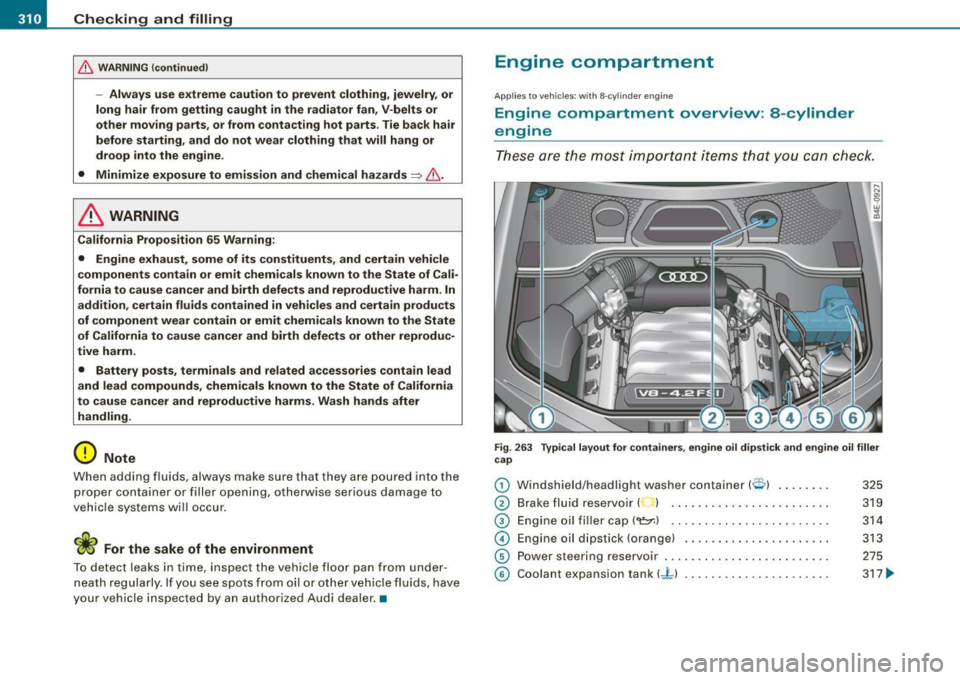
Engine compartment
Ap plies to vehi cle s: w ith 8 -c yli nd er e ng in e
Engine compartment overview : 8-cylinder
engine
T hese are the mos t impor tant items th at you c an ch eck .
Fig. 26 3 Typical l ayout for containe rs, engine o il d ip stic k and engine oil fille r
c a p
G) Winds hield/headlight washer containe r(<;;;> ) .. ..... .
0 Brake fluid reservoir ( l) .. .. .. .. ...... .... ... .. .
© En gine oil filler cap ('I::?:) .. .. .... ...... .... ... . _ .
© Engine oil d ipstick (orange) .... ..... ........ .... .
© Power st eering r eservoir ...... ........ ... ......• .
© Coolant expansion tank (- L l ... ...... .... ... .... . .
325
319
314
31 3
275
317 ..
Page 313 of 408

Checking and filling -
------------- ----=-----= =-----...J
& WARNING
Before y ou che ck an ything in the eng ine comp artment , alw ays
read and heed all WARNING S
~ & in "W orkin g in the engin e
c ompartment " on
page 309. •
App lies to ve hic les : with 1 2-cy lin d er engine
Engine compartment overview : 1 2-cylinder
engine
These are the most important items tha t you can check.
Fig . 264 Typical layo ut fo r c ontain ers, engi ne oil dip st ick a nd e ngine o il filler
ca p
G) Windshield/head light washer container ( Q ) . . . . . . . . 325
@ Brake fluid reservoir ( l . . . . . . . . . . . . . . . . . . . . . . . . 319
© Engine oi l dipstick (orange) . . . . . . . . . . . . . . . . . . . . . . 313
© Engine oil fi ller cap ('t=:11) .. .. ... ... .... .. .. ... .. . .
© Coolan t expansion tank(_}_ ) ... ........ .... ... ... .
& WARNING
Before you check anything in th e engine co mpartment , alw ays
r e a d and heed all WARNIN GS
~ & in " Worki ng i n t he engin e
c ompartm ent " on
page 309.
[ i ] Tip s
The coo lant expansion tank is located under a cover .•
Engine oil
Engine oil specifications
314
317
The engine oil us ed in your Audi needs the right kind of
oil.
Th e engin e in your Audi is a soph isticat ed pow erplant that was built
to exacting specifications . This engine needs the right kind of
e ngine o il that meets specifications regarding quality and v iscosity
so that it can run smoothly and re liably. Choosing the righ t oil and
changing o il wi thin the time and mileage interva ls printed in your
vehicle's Warranty
& Ma intenance book let matte rs a lot more today
than it did years ago . Audi has developed a special quality standard
for engine oil that wil l help assure that your vehicle's engine wi ll get
the lub rication it needs for proper operation .
Modern engin e lubrication has taken a quantum leap in the last few
years . Many syn thetic oils ava ilable today provide better engine
lubrica tion that can outlas t traditional petroleum-based oils,
making them a smart choice for use throughout the life of your Audi.
Whether you use synthetic or petroleum -based engine oil , the oil
that you use must conform to Audi's oi l quality standard VW 502 00
ti,,,
Vehic le care I I Technical data