instrument panel CADILLAC DEVILLE 1998 7.G Owner's Manual
[x] Cancel search | Manufacturer: CADILLAC, Model Year: 1998, Model line: DEVILLE, Model: CADILLAC DEVILLE 1998 7.GPages: 386, PDF Size: 22.36 MB
Page 170 of 386
Downloaded from www.Manualslib.com manuals search engine Driver’s Side Temperature Button
The red and blue temperature buttons adjust the air
temperature coming through the system. Press the
blue button for a cooler setting or the red button for a
warmer setting.
Passenger’s Side Temperature Knob
With this feature, the right front passenger can control
the temperature of air for hisher own zone. The
passenger can select a four degree warmer or cooler
temperature from the driver’s setting.
To turn the system on, press the knob on the passenger’s
side armrest. Rotate the knob to the right to increase
the temperature and turn to the left to decrease the
temperature. Press the knob again to turn the system
off.
Outside Temperature Display
The outside temperature is always displayed when your
vehicle is running. You can change it from Fahrenheit to
Celsius by pressing the ENG/MET (EnglisWmetric)
button on the Driver Information Center (DIC).
The outside temperature sensor is located near the
front grille. The sensor can be affected by road or
engine heat during idling, slow driving or when the engine
is first started after a
short trip. In order to ensure
proper automatic climate control operation, the outside
air temperature display may not update as quickly as
expected. This is to allow the air surrounding the outside
temperature sensor to be as close to the actual outside
conditions as possible. This is determined by how much
time has elapsed since the vehicle has been turned
off
and by vehicle speed.
Mode Controls
The AUTOECON button automatically controls the
direction
of air delivery for air conditioning and non-air
conditioning modes.
Automatic Operation
When the system is set for automatic operation, sensors
will control the air delivery mode. Air will come from
the floor, middle or windshield outlets. The fan speed
will
vary as the system maintains the selected
temperature setting.
Be careful not to put anything over the solar sensor
located in the middle of the instrument panel near the
windshield. This sensor is used by the automatic system
to regulate temperature.
Page 171 of 386
Downloaded from www.Manualslib.com manuals search engine To find your comfort zone, start with the 75 "F (24°C)
setting and allow about 30 minutes for the system to
regulate. Press the red or blue temperature buttons
to adjust the temperature if necessary. If you choose
60°F (16"C), the system will remain at that maximum
cooling setting and
will not regulate fan speed. If you
choose the temperature of
90°F (32" C), the system will
remain at that maximum heating setting and will not regulate fan speed. Choosing either maximum setting
will not cause the system to heat or cool any faster.
With the automatic setting, the air conditioning
compressor automatically cycles when needed to cool
the air. In cold weather, when the system senses the need for heat, the airflow will be directed out the floor
outlets.
As the interior temperature approaches a desired
setting, the blower speed will decrease.
To maintain
interior comfort, the airflow may move to the instrument
panel air outlets and floor outlets (bi-level mode). On
bright sunny days in cold weather, the airflow may come
out of the air conditioning outlets
(AC mode) to
maintain comfort and prevent stuffiness. If your vehicle is sitting
out on a hot day and you have
it set on
AUTO, the air will first flow out the floor air
outlets for a few seconds. That is normal.
This is to
expel hot air from the air outlets.
As the air is cooled,
the airflow will move through the air conditioning
outlets. If you start your vehicle with the
fan setting on
HI, it will
skip the air conditioning purge.
To avoid blowing cold
air in cold weather, the system will
delay turning on the fan until warm air is available. The
length of delay depends on the outside air temperature,
engine coolant temperature or the time since the engine
was last started.
As the coolant warrns up, the blower fan
speed
will gradually increase and air will flow from the
heater outlets, with some airflow to the windshield to
prevent fogging under most normal conditions.
If you leave your vehicle, the system will remember the
control setting the next time you start your engine,
except for recirculation and defrost. Each ignition cycle
cancels recirculation, whereas, DEFROST will change
to automatic operation when the ignition is shut off and
then turned back on.
Page 174 of 386
Downloaded from www.Manualslib.com manuals search engine Mode Button
Press this button to deliver air through the floor, middle
or windshield outlets. The system will stay in the
selected mode until the
MODE button is pushed again.
Press the up or down arrow to cycle through the
available modes.
Automatic Operation
When the system is set for automatic operation, sensors
will control the air delivery mode. Air will come from
the floor, middle or windshield outlets. The fan speed
will vary as the system maintains the selected
temperature setting.
Be careful not to put anything over the solar sensor
located in the middle of the instrument panel near the
windshield. This sensor is used by the automatic system
to regulate temperature.
To find your comfort zone, start with the 75°F (24°C)
setting and allow about
30 minutes for the system to
regulate. Turn the TEMP/AUTO knob to adjust the
temperature
if necessary. If you choose 60 "F (1 6 " C),
the system will remain at that maximum cooling
setting and will not regulate fan speed. If you choose the
temperature
of 90°F (32"C), the system will remain at
that maximum heating setting and will not regulate fan speed. Choosing either maximum setting will not cause
the system to heat or cool any faster. With the automatic setting, the air conditioning
compressor automatically cycles when needed to cool
the air. In cold weather, when the system senses the
need for heat, the airflow will be directed out the floor
outlets.
As the interior temperature approaches a desired
setting, the blower speed will decrease.
To maintain
interior comfort, the airflow may move to the instrument
panel
air outlets and floor outlets (bi-level mode). On
bright sunny days in cold weather, the airflow may come
out of the air conditioning outlets (AC mode) to
maintain comfort and prevent stuffiness.
If your vehicle is sitting out on a hot day and you have
it set on AUTO,
the air will first flow out the floor air
outlets for a few seconds. That is normal. This is to
expel hot air from the air outlets.
As the air is cooled,
the airflow will move through the air conditioning
outlets.
If you start your vehicle with the fan setting
on HI, it will skip the air conditioning purge.
To avoid blowing cold air in cold weather, the
system will delay turning on the fan until warm air is
available. The length of delay depends on the outside
air temperature, engine coolant temperature or the time
since the engine was last started. As the coolant warms
up, the blower fan speed will gradually increase and air will flow from the heater outlets, with some
airflow to the windshield to prevent fogging under
most normal conditions.
3-7
Page 175 of 386
Downloaded from www.Manualslib.com manuals search engine If you leave your vehicle, the system will remember
the control setting the next time you start your engine,
except for recirculation and defrost. Each ignition cycle
cancels recirculation, whereas, DEFROST will change
to automatic operation when the ignition is shut
off and
then turned back on.
Manual Operation
You may manually adjust the air delivery mode or
fan speed.
H AC: This setting directs airflow through the middle
instrument panel outlets.
A.
A@
BI-LEVEL: This setting directs air into your
vehicle in two ways. Cool air
is directed to the upper
portion of your body through the four instrument panel
outlets while warmed air
is directed to the floor.
7. HEATEIUDEFROSE This setting directs air to
the floor outlets and toward the windshield.
l# HEATER: This setting directs warmed air
through the floor outlets. Some warm air is diverted to
the windshield to minimize fogging.
.
DEFROST: Press this button to quickly remove
fog or frost from the windshield. This setting sends most
of the airflow to the windshield with only a small
amount to the floor outlets.
FAN SPEEDS: Press the button with the fan
symbol on it until AUTO is displayed on the screen.
At this setting, the fan speed
is automatically controlled.
If it is cold outside, the blower may not run in the
maximum high
fan speed right away. The system
checks the temperature of the engine coolant to assure
it is warm enough to provide heat. When the engine
coolant is warm, the controller allows the fan to
gradually increase to a higher speed. This prevents
cold air from blowing into the passenger compartment.
If you want the blower fan at
a high speed, press the
up arrow button until you see
HI on the display. If you
want the fan speed to be automatic, but you like the fan
speed to be higher than the AUTO setting, press the fan
symbol button until HI AUTO
is shown on the display.
If you want the blower fan at a low speed, press the
down arrow button until
LO is shown on the display.
If you want the
fan speed to.run lower than the AUTO
setting, press the button until
LO AUTO is shown on
the display.
3-8
Page 176 of 386
Downloaded from www.Manualslib.com manuals search engine OFF: Press this button to turn the system off. Fresh
air will continue to flow through the vehicle, and the
system will try
to maintain the previously set
temperature. The outside temperature will show on
the display when the system is
OFF.
AC: Press this button to turn the air conditioning on and
off. The system will cool and dehumidify the air inside
the vehicle. In the
AUTO mode, the display will show
that
AC is active, but the air conditioning compressor
only operates when the system determines it is needed.
0 RECIRCULATION: Press this button to limit the
amount of fresh air entering your vehicle. This is helpful
when you are trying to cool the air quickly or limit odors
entering your vehicle. In the
AUTO mode, the system
will use recirculation as necessary to cool the air.
Pressing the recirculation button will change the
operation to a manual mode and the air will recirculate
non-stop. Press this button again to turn off the
recirculation feature.
If you notice the windows fogging, press the recirculation button to exit the recirculation mode.
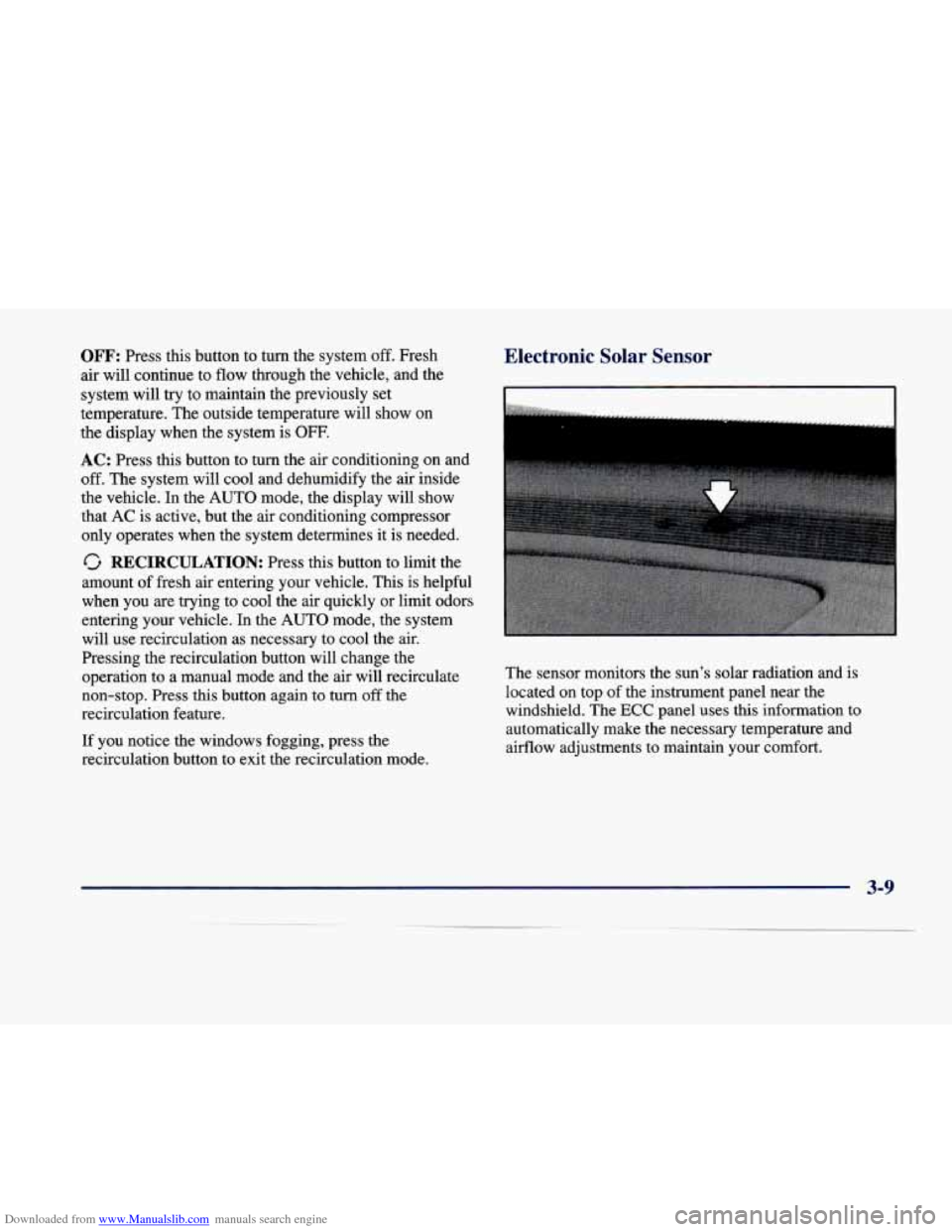
Electronic Solar Sensor
The sensor monitors the sun's solar radiation and is
located on top of the instrument panel near the
windshield. The
ECC panel uses this information to
automatically make the necessary temperature and
airflow adjustments to maintain your comfort.
3-9
Page 178 of 386
Downloaded from www.Manualslib.com manuals search engine Ventilation System
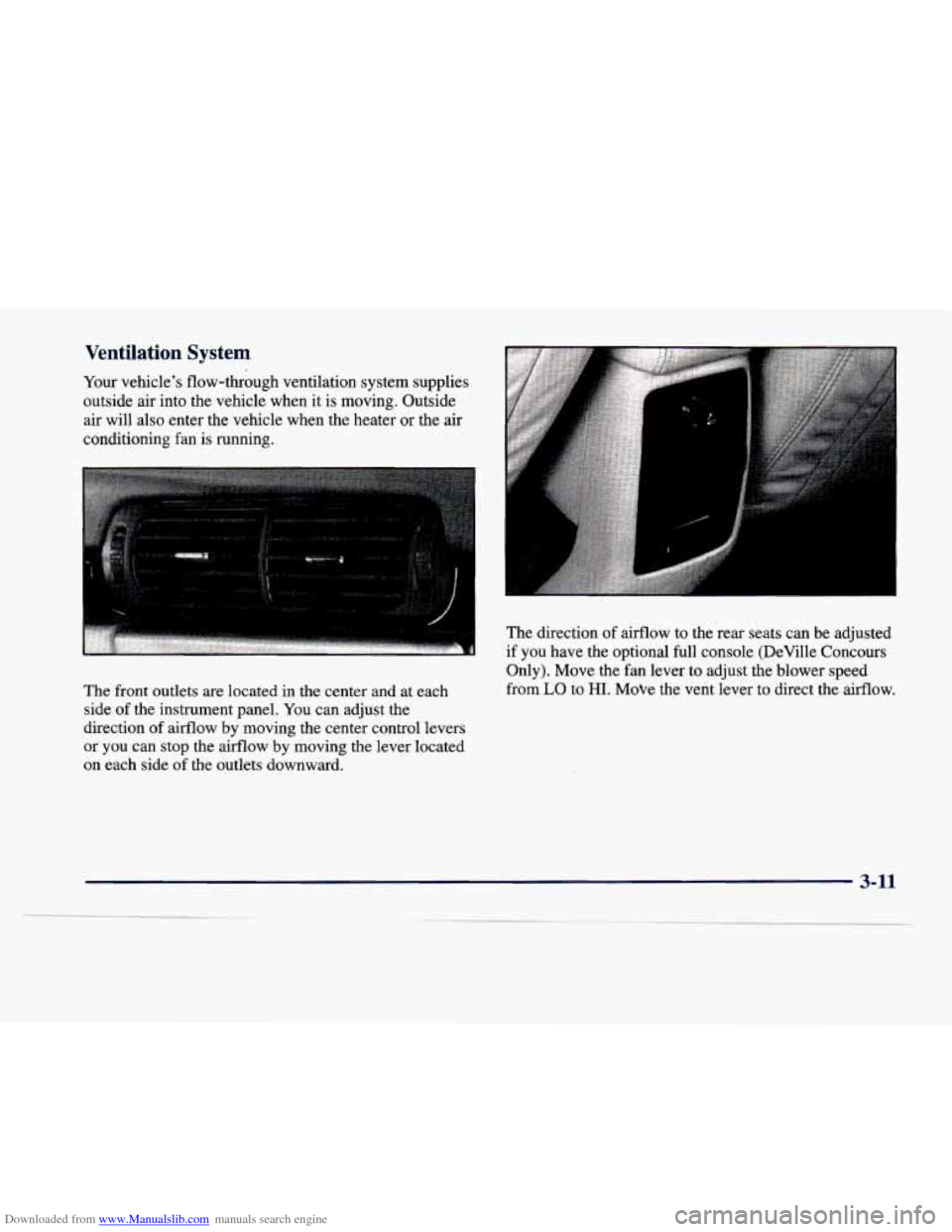
Your vehicle's flow-through ventilation system supplies
outside air into the vehicle when it is moving. Outside
air will also enter the vehicle when the heater or the air
conditioning fan is running.
The direction
of airflow to the rear seats can be adjusted
if you have the optional full console (DeVille Concours
Only). Move the fan lever to adjust the blower speed
from LO to
HI. Motre the vent lever to direct the airflow.
The front outlets are located in the center and at each
side
of the instrument panel. You can adjust the
direction of airflow by moving the center control levers
or you can stop the aifflow by moving the lever located
on each side
of the outlets downward.
3-11
Page 248 of 386
Downloaded from www.Manualslib.com manuals search engine Backing Up Tbrn Signals When Towing a Trailer
Hold the bottom of the steering wheel with one hand.
Then, to move the trailer to the left, just move that hand
to the left. To move the trailer to the right, move your
hand to the right. Always back
up slowly and, if
possible, have someone guide you.
Making arris
When you tow a trailer, your vehicle may need a different turn signal flasher and/or extra wiring. Check
with your Cadillac dealer. The green arrows on your
instrument panel will flash whenever you signal a turn
or lane change. Properly hooked
up, the trailer lamps
will also flash, telling other drivers you’re about to turn,
change lanes or stop.
When towing a trailer, the green arrows on your instrument panel will flash for turns even
if the bulbs on
the trailer are burned out. Thus, you may think drivers NOTICE:
Making very sharp turns while trailering could
cause the trailer to come in contact with the
vehicle. Your vehicle could
be damaged. Avoid
behind you are seeing your signal when they are not. It’s
important to check occasionally to be sure the trailer
bulbs are still working.
making very sharp turns while trailering. Driving On Grades
Reduce speed and shift to a lower gear before you start
When you’re turning with
a trailer, make wider turns down a long or steep downgrade. If you don’t shift
than normal. Do this
so your trailer won’t strike soft down, you might have to use your brakes so much that
shoulders, curbs, road signs, trees
or other objects. they would get hot and no longer work well.
Avoid jerky or sudden maneuvers. Signal well
in advance. On
a long uphill grade, shift down and reduce your
speed to around
45 mph (70 km/h) or less to reduce the
possibility
of engine and transaxle overheating.
4-37
Page 251 of 386

Downloaded from www.Manualslib.com manuals search engine Hazard Warning Flashers
Your hazard warning flashers let you warn others. They
also let police
know you have a problem. Your front and
rear turn signal lamps will flash on and off. Press the button in to make
lamps flash on and off,
A
the front and rear turn signal
This light on the instrument
panel will flash, indicating
that the hazard warning
flashers
are on.
The hazard warning flashers will
work once the button
is pressed
in regardless of the key position.
5-2
Page 264 of 386
Downloaded from www.Manualslib.com manuals search engine Engine Overheating
You will find an ENGINE COOLANT HOT, IDLE
ENGINE message or an ENGINE
OVERHEATED
STOP, ENGINE message on the Driver Information
Center (DIC). You will
also hear a chime. There is also
an engine temperature warning light andor gage on the
instrument panel. See “Engine Coolant Temperature
Warning Light” or “Engine Coolant Temperature Gage”
in the Index.
Overheated Engine Protection
Operating Mode
NOTICE:
After driving in the overheated engine protection
operating mode, to avoid engine damage, allow
the engine to cool before attempting any repair.
The engine oil will be severely degraded. Repair
the cause of coolant loss, change the oil and reset
the oil life indicator. See “Engine Oil, When to
Change” in the Index.
Should an overheated engine condition exist and the
message ENGINE OVERHEATED STOP ENGINE is
displayed, an overheat protection mode which alternates
firing groups
of four cylinders helps prevent engine
damage.
In this mode, you will notice a loss in power
and engine performance. This operating mode allows
your vehicle to be driven to a safe place in
an
emergency; you may drive up to 50 miles (80 lun).
Towing a trailer in the overheat protection mode should
be avoided.
5-15
Page 291 of 386
Downloaded from www.Manualslib.com manuals search engine octane fuel to get rid of pinging. It's the heavy, constant
knock that means you have a problem.
If your vehicle is certified to meet California Emission
Standards (indicated on the underhood emission control
label), it is designed to operate on fuels that meet
California specifications.
If such fuels are not available
in states adopting California emissions standards, your
vehicle will operate satisfactorily on fuels meeting
federal specifications, but emission control system
performance may be affected. The malfunction indicator lamp on your instrument panel may turn
on andor your
vehicle may
fail a smog-check test. If this occurs, return
to your authorized Cadillac dealer for diagnosis to
determine the cause of failure. In the event it is determined that the cause of the condition is the type of
fuels used, repairs may not be covered by your warranty.
Some gasolines that are not reformulated for low
emissions contain an octane-enhancing additive called
methylcyclopentadienyl manganese tricarbonyl (MMT); ask your service station operator whether or not his fuel
contains MMT. General Motors does not recommend the
use .of such gasolines. If fuels containing
MMT are used,
spark plug life may be reduced and your emission
control system performance may be affected. The malfunction indicator lamp on your instrument panel
may turn
on. If this occurs, return to your authorized
Cadillac dealer for service.
To provide cleaner air, all gasolines in the United States are now required to contain additives that will help
prevent deposits from forming in your engine and fuel system, allowing your emission control system to
function properly. Therefore,
you should not have to add
anything to the fuel. In addition, gasolines containing
oxygenates, such as ethers and ethanol, and
reformulated gasolines may be available in your area to
help clean the air. General Motors recommends that you
use these gasolines if they comply with the
specifications described earlier.
NOTICE:
Your vehicle was not designed for fuel that
contains methanol. Don't use it. It can corrode
metal parts in your fuel system and also damage plastic and rubber parts. That damage wouldn't
be covered under your warranty.
6-4