lock CHERY TIGGO 2009 Service Repair Manual
[x] Cancel search | Manufacturer: CHERY, Model Year: 2009, Model line: TIGGO, Model: CHERY TIGGO 2009Pages: 1903, PDF Size: 33.38 MB
Page 1257 of 1903
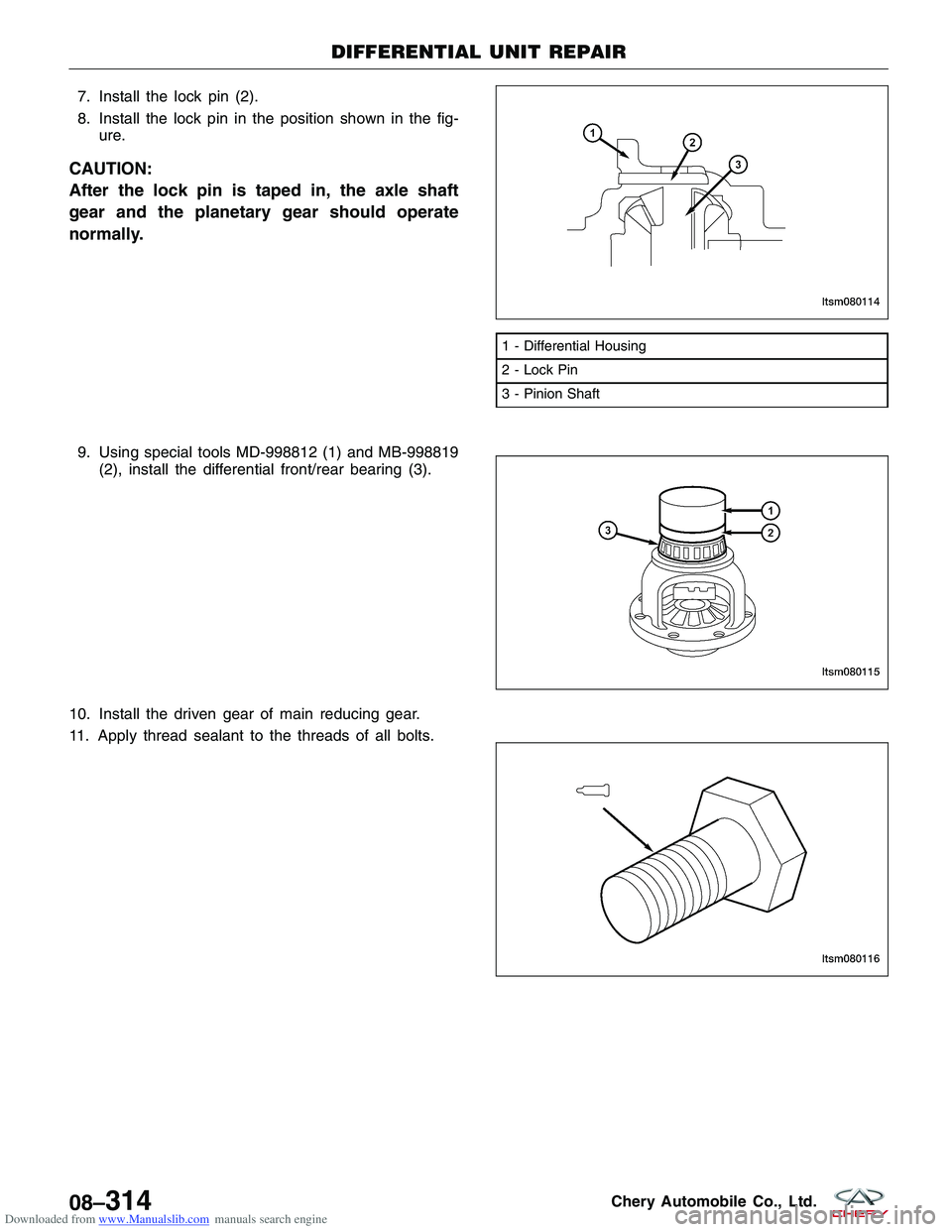
Downloaded from www.Manualslib.com manuals search engine 7. Install the lock pin (2).
8. Install the lock pin in the position shown in the fig-ure.
CAUTION:
After the lock pin is taped in, the axle shaft
gear and the planetary gear should operate
normally.
9. Using special tools MD-998812 (1) and MB-998819(2), install the differential front/rear bearing (3).
10. Install the driven gear of main reducing gear.
11. Apply thread sealant to the threads of all bolts.
1 - Differential Housing
2 - Lock Pin
3 - Pinion Shaft
DIFFERENTIAL UNIT REPAIR
LTSM080114
LTSM080115
LTSM080116
08–314Chery Automobile Co., Ltd.
Page 1273 of 1903
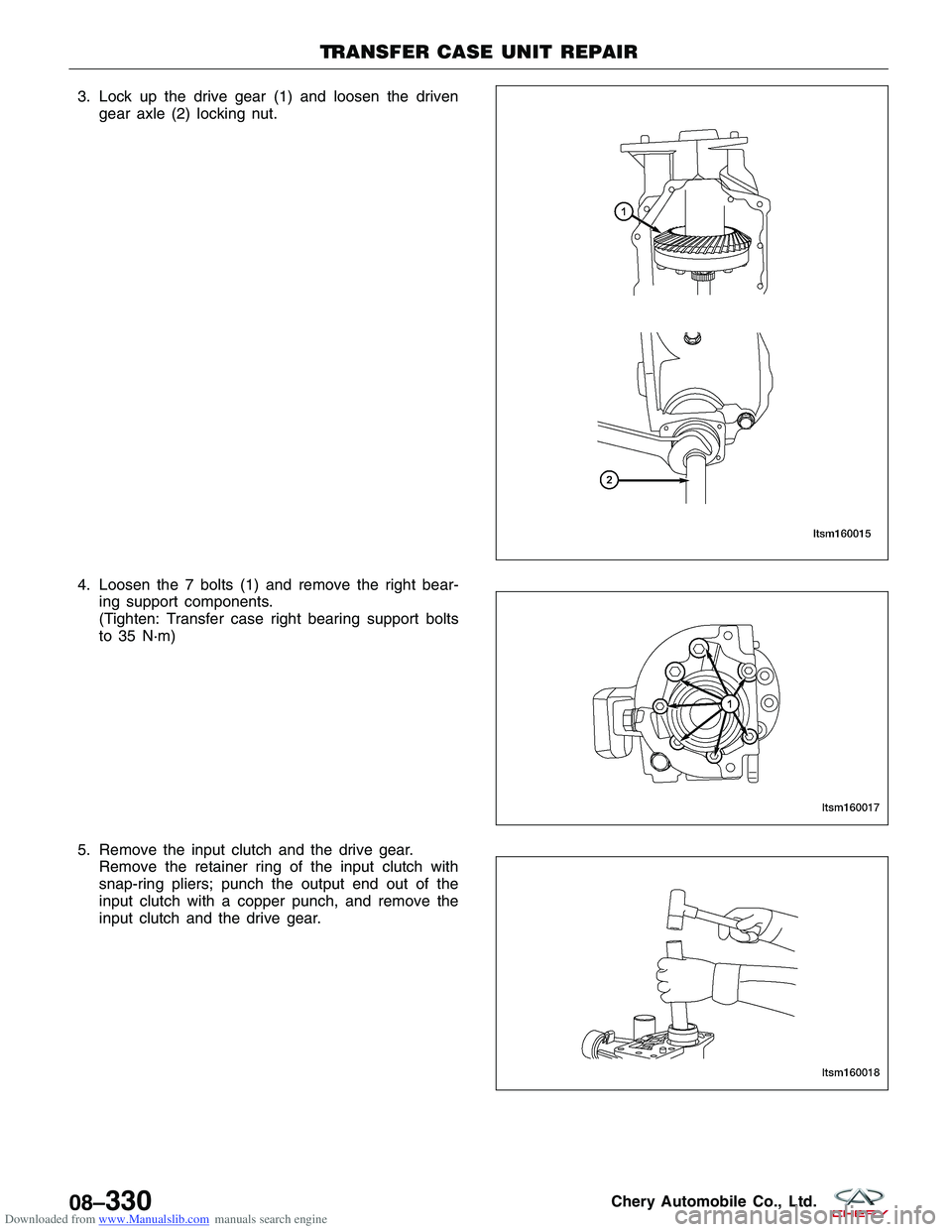
Downloaded from www.Manualslib.com manuals search engine 3. Lock up the drive gear (1) and loosen the drivengear axle (2) locking nut.
4. Loosen the 7 bolts (1) and remove the right bear- ing support components.
(Tighten: Transfer case right bearing support bolts
to 35 N·m)
5. Remove the input clutch and the drive gear. Remove the retainer ring of the input clutch with
snap-ring pliers; punch the output end out of the
input clutch with a copper punch, and remove the
input clutch and the drive gear.
TRANSFER CASE UNIT REPAIR
LTSM160015
LTSM160017
LTSM160018
08–330Chery Automobile Co., Ltd.
Page 1274 of 1903
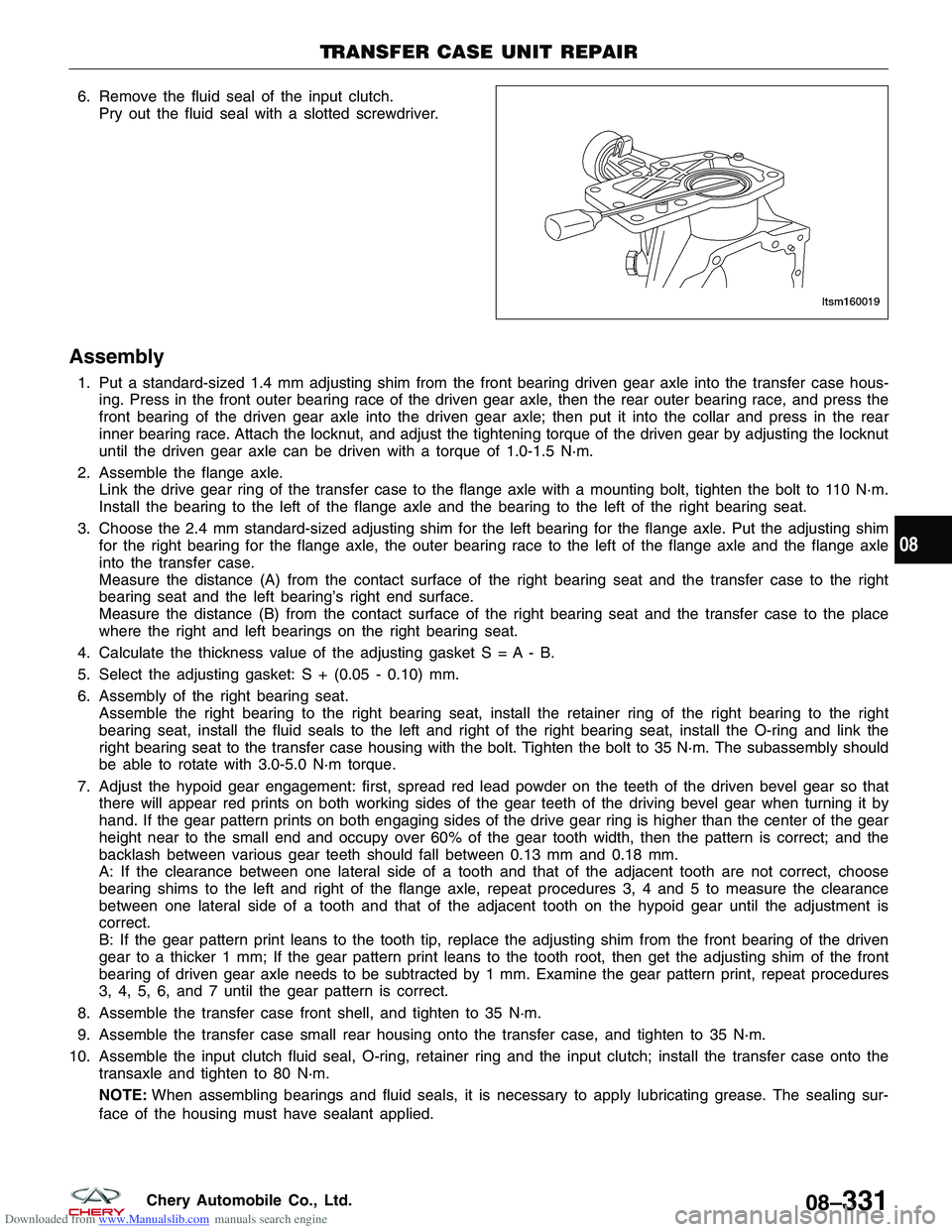
Downloaded from www.Manualslib.com manuals search engine 6. Remove the fluid seal of the input clutch.Pry out the fluid seal with a slotted screwdriver.
Assembly
1. Put a standard-sized 1.4 mm adjusting shim from the front bearing driven gear axle into the transfer case hous-ing. Press in the front outer bearing race of the driven gear axle, then the rear outer bearing race, and press the
front bearing of the driven gear axle into the driven gear axle; then put it into the collar and press in the rear
inner bearing race. Attach the locknut, and adjust the tightening torque of the driven gear by adjusting the locknut
until the driven gear axle can be driven with a torque of 1.0-1.5 N·m.
2. Assemble the flange axle. Link the drive gear ring of the transfer case to the flange axle with a mounting bolt, tighten the bolt to 110 N·m.
Install the bearing to the left of the flange axle and the bearing to the left of the right bearing seat.
3. Choose the 2.4 mm standard-sized adjusting shim for the left bearing for the flange axle. Put the adjusting shim for the right bearing for the flange axle, the outer bearing race to the left of the flange axle and the flange axle
into the transfer case.
Measure the distance (A) from the contact surface of the right bearing seat and the transfer case to the right
bearing seat and the left bearing’s right end surface.
Measure the distance (B) from the contact surface of the right bearing seat and the transfer case to the place
where the right and left bearings on the right bearing seat.
4. Calculate the thickness value of the adjusting gasket S = A - B.
5. Select the adjusting gasket: S + (0.05 - 0.10) mm.
6. Assembly of the right bearing seat. Assemble the right bearing to the right bearing seat, install the retainer ring of the right bearing to the right
bearing seat, install the fluid seals to the left and right of the right bearing seat, install the O-ring and link the
right bearing seat to the transfer case housing with the bolt. Tighten the bolt to 35 N·m. The subassembly should
be able to rotate with 3.0-5.0 N·m torque.
7. Adjust the hypoid gear engagement: first, spread red lead powder on the teeth of the driven bevel gear so that there will appear red prints on both working sides of the gear teeth of the driving bevel gear when turning it by
hand. If the gear pattern prints on both engaging sides of the drive gear ring is higher than the center of the gear
height near to the small end and occupy over 60% of the gear tooth width, then the pattern is correct; and the
backlash between various gear teeth should fall between 0.13 mm and 0.18 mm.
A: If the clearance between one lateral side of a tooth and that of the adjacent tooth are not correct, choose
bearing shims to the left and right of the flange axle, repeat procedures 3, 4 and 5 to measure the clearance
between one lateral side of a tooth and that of the adjacent tooth on the hypoid gear until the adjustment is
correct.
B: If the gear pattern print leans to the tooth tip, replace the adjusting shim from the front bearing of the driven
gear to a thicker 1 mm; If the gear pattern print leans to the tooth root, then get the adjusting shim of the front
bearing of driven gear axle needs to be subtracted by 1 mm. Examine the gear pattern print, repeat procedures
3, 4, 5, 6, and 7 until the gear pattern is correct.
8. Assemble the transfer case front shell, and tighten to 35 N·m.
9. Assemble the transfer case small rear housing onto the transfer case, and tighten to 35 N·m.
10. Assemble the input clutch fluid seal, O-ring, retainer ring and the input clutch; install the transfer case onto the transaxle and tighten to 80 N·m.
NOTE: When assembling bearings and fluid seals, it is necessary to apply lubricating grease. The sealing sur-
face of the housing must have sealant applied.
TRANSFER CASE UNIT REPAIR
LTSM160019
08
08–331Chery Automobile Co., Ltd.
Page 1276 of 1903
Downloaded from www.Manualslib.com manuals search engine GENERAL INFORMATION
Description
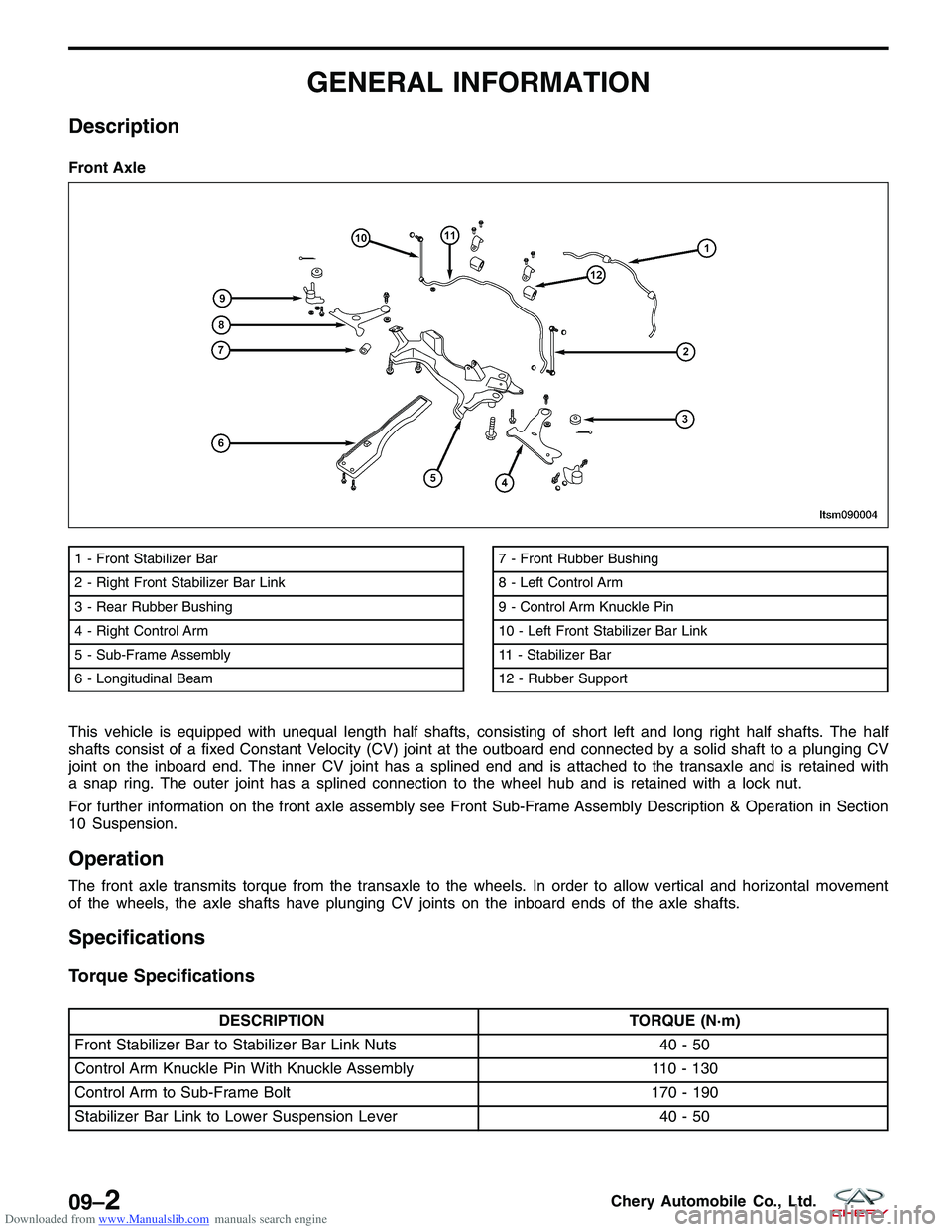
This vehicle is equipped with unequal length half shafts, consisting of short left and long right half shafts. The half
shafts consist of a fixed Constant Velocity (CV) joint at the outboard end connected by a solid shaft to a plunging CV
joint on the inboard end. The inner CV joint has a splined end and is attached to the transaxle and is retained with
a snap ring. The outer joint has a splined connection to the wheel hub and is retained with a lock nut.
For further information on the front axle assembly see Front Sub-Frame Assembly Description & Operation in Section
10 Suspension.
Operation
The front axle transmits torque from the transaxle to the wheels. In order to allow vertical and horizontal movement
of the wheels, the axle shafts have plunging CV joints on the inboard ends of the axle shafts.
Specifications
Torque Specifications
DESCRIPTIONTORQUE (N·m)
Front Stabilizer Bar to Stabilizer Bar Link Nuts 40 - 50
Control Arm Knuckle Pin With Knuckle Assembly 110 - 130
Control Arm to Sub-Frame Bolt 170 - 190
Stabilizer Bar Link to Lower Suspension Lever 40 - 50
Front Axle
1 - Front Stabilizer Bar
2 - Right Front Stabilizer Bar Link
3 - Rear Rubber Bushing
4 - Right Control Arm
5 - Sub-Frame Assembly
6 - Longitudinal Beam7 - Front Rubber Bushing
8 - Left Control Arm
9 - Control Arm Knuckle Pin
10 - Left Front Stabilizer Bar Link
11 - Stabilizer Bar
12 - Rubber Support
LTSM090004
09–2Chery Automobile Co., Ltd.
Page 1287 of 1903
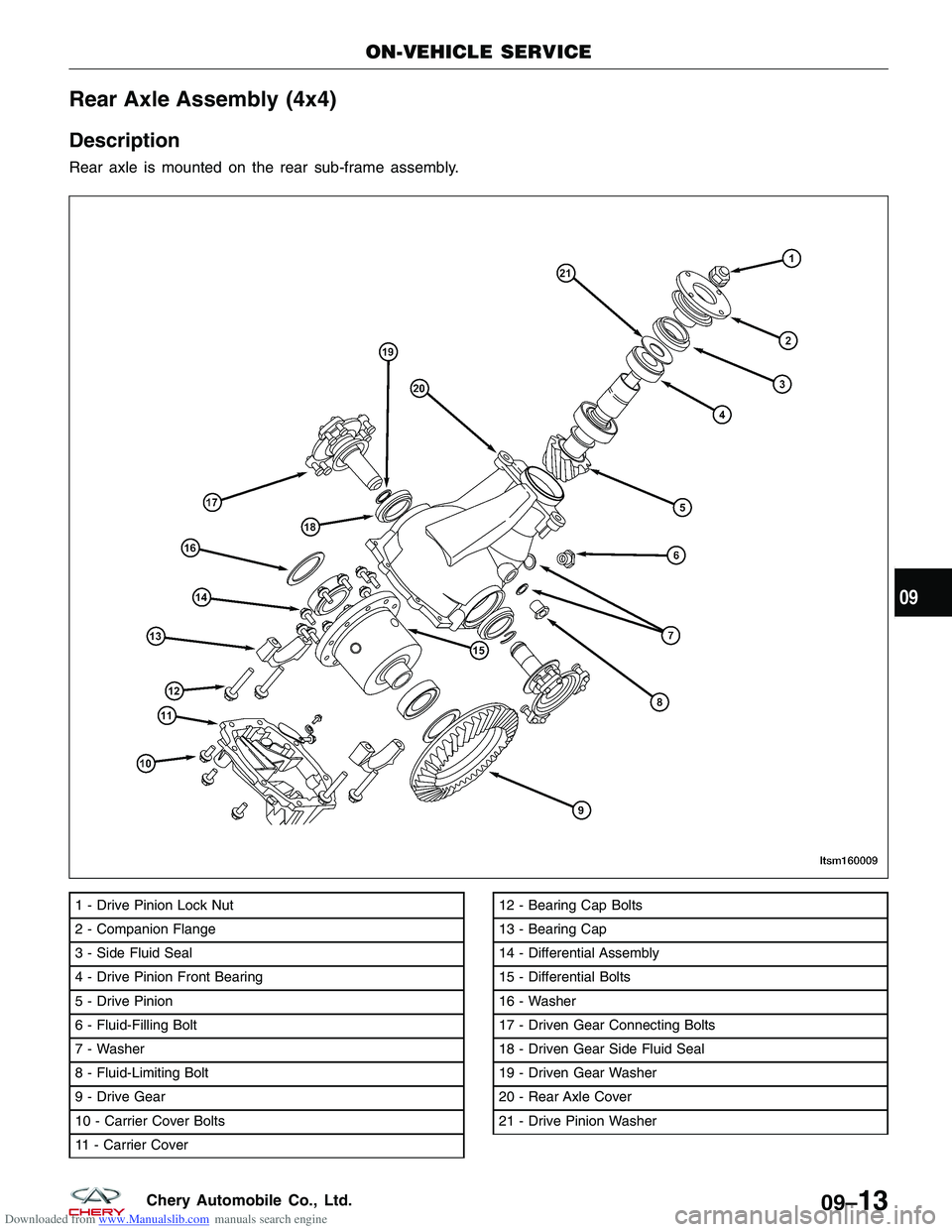
Downloaded from www.Manualslib.com manuals search engine Rear Axle Assembly (4x4)
Description
Rear axle is mounted on the rear sub-frame assembly.
1 - Drive Pinion Lock Nut
2 - Companion Flange
3 - Side Fluid Seal
4 - Drive Pinion Front Bearing
5 - Drive Pinion
6 - Fluid-Filling Bolt
7 - Washer
8 - Fluid-Limiting Bolt
9 - Drive Gear
10 - Carrier Cover Bolts
11 - Carrier Cover12 - Bearing Cap Bolts
13 - Bearing Cap
14 - Differential Assembly
15 - Differential Bolts
16 - Washer
17 - Driven Gear Connecting Bolts
18 - Driven Gear Side Fluid Seal
19 - Driven Gear Washer
20 - Rear Axle Cover
21 - Drive Pinion Washer
ON-VEHICLE SERVICE
LTSM160009
09
09–13Chery Automobile Co., Ltd.
Page 1292 of 1903
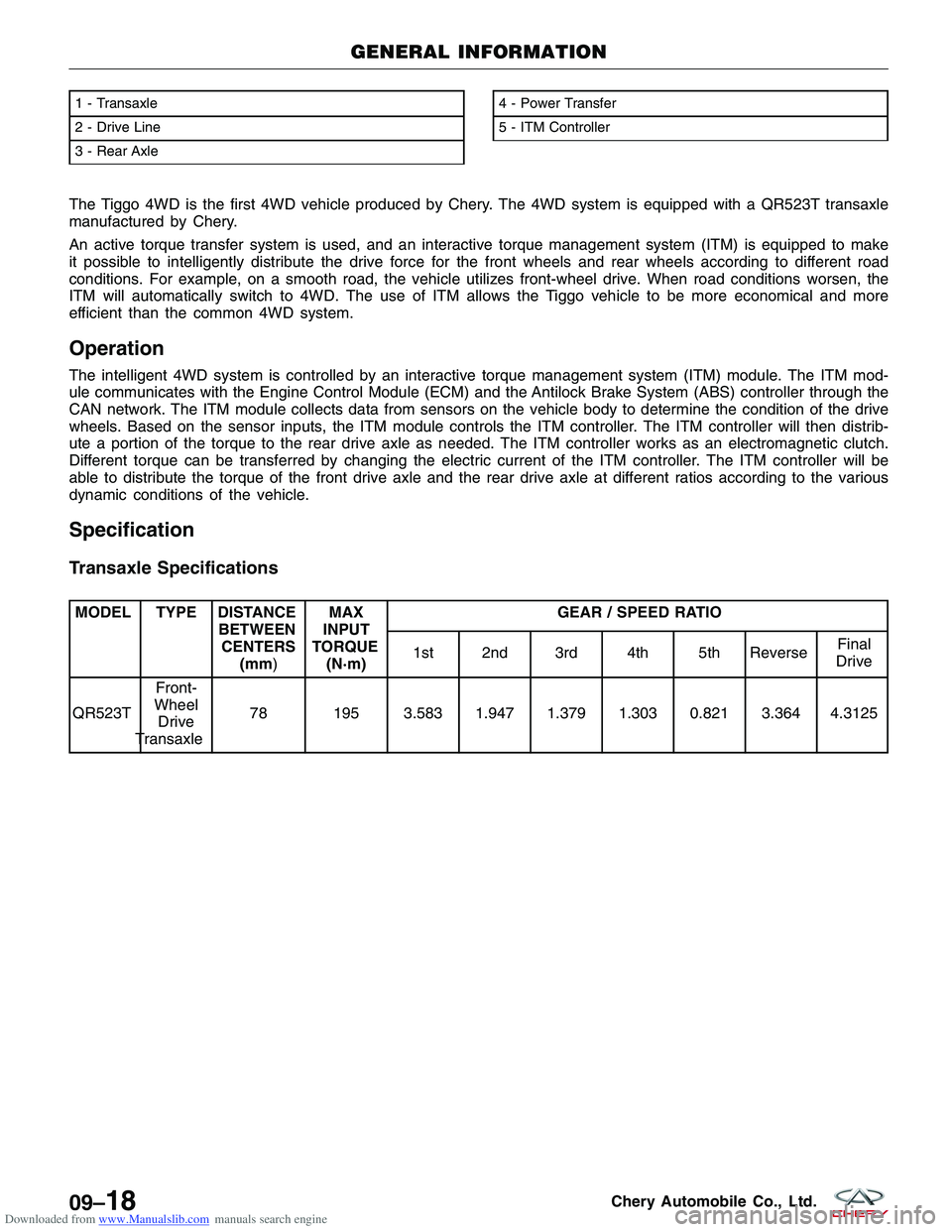
Downloaded from www.Manualslib.com manuals search engine The Tiggo 4WD is the first 4WD vehicle produced by Chery. The 4WD system is equipped with a QR523T transaxle
manufactured by Chery.
An active torque transfer system is used, and an interactive torque management system (ITM) is equipped to make
it possible to intelligently distribute the drive force for the front wheels and rear wheels according to different road
conditions. For example, on a smooth road, the vehicle utilizes front-wheel drive. When road conditions worsen, the
ITM will automatically switch to 4WD. The use of ITM allows the Tiggo vehicle to be more economical and more
efficient than the common 4WD system.
Operation
The intelligent 4WD system is controlled by an interactive torque management system (ITM) module. The ITM mod-
ule communicates with the Engine Control Module (ECM) and the Antilock Brake System (ABS) controller through the
CAN network. The ITM module collects data from sensors on the vehicle body to determine the condition of the drive
wheels. Based on the sensor inputs, the ITM module controls the ITM controller. The ITM controller will then distrib-
ute a portion of the torque to the rear drive axle as needed. The ITM controller works as an electromagnetic clutch.
Different torque can be transferred by changing the electric current of the ITM controller. The ITM controller will be
able to distribute the torque of the front drive axle and the rear drive axle at different ratios according to the various
dynamic conditions of the vehicle.
Specification
Transaxle Specifications
MODEL TYPE DISTANCEBETWEENCENTERS (mm) MAX
INPUT
TORQUE (N·m) GEAR / SPEED RATIO
1st 2nd 3rd 4th 5th Reverse Final
Drive
QR523T Front-
Wheel Drive
Transaxle 78 195 3.583 1.947 1.379 1.303 0.821 3.364 4.3125
1 - Transaxle
2 - Drive Line
3 - Rear Axle4 - Power Transfer
5 - ITM Controller
GENERAL INFORMATION
LTSM160027
09–18Chery Automobile Co., Ltd.
Page 1297 of 1903
Downloaded from www.Manualslib.com manuals search engine Interactive Torque Management (ITM) Control Module
Description
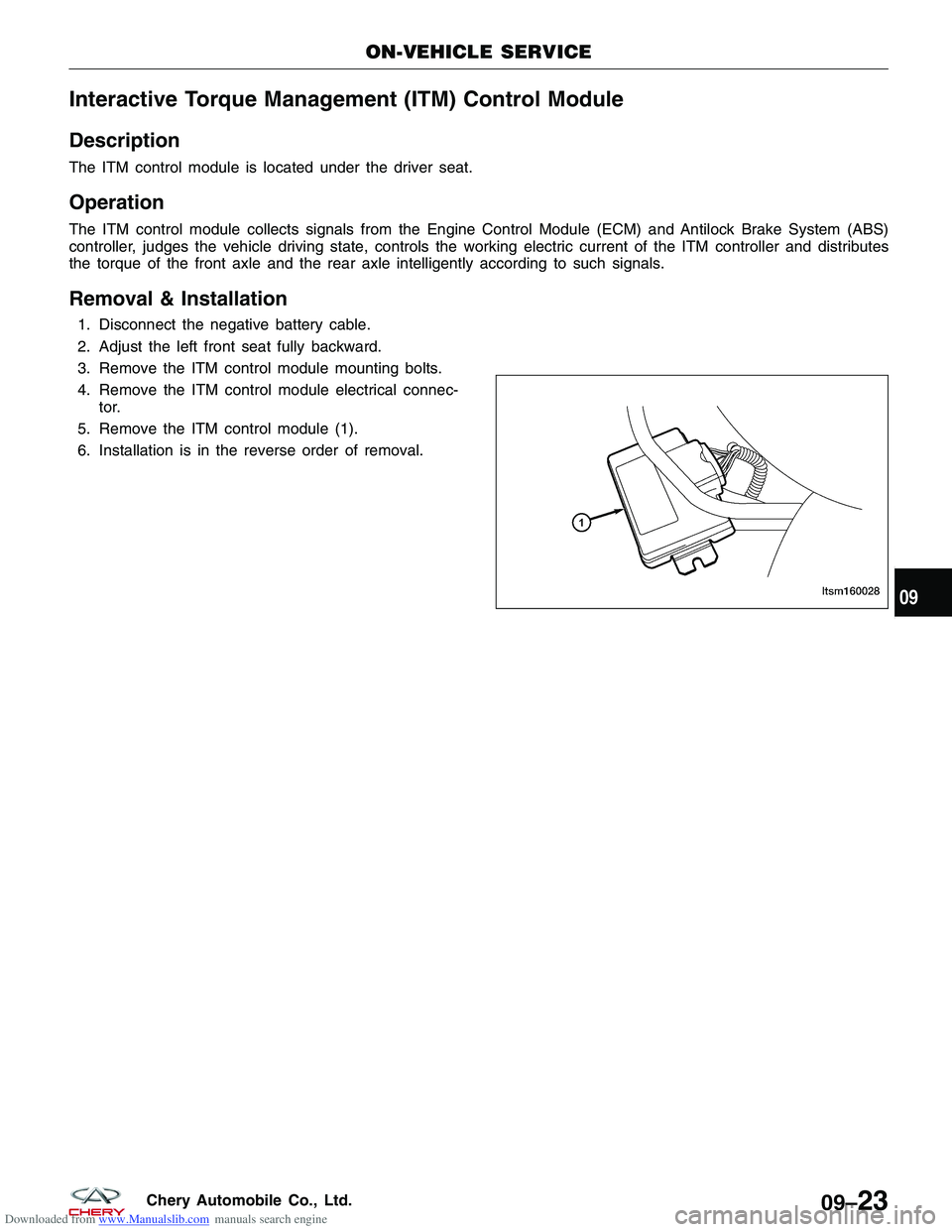
The ITM control module is located under the driver seat.
Operation
The ITM control module collects signals from the Engine Control Module (ECM) and Antilock Brake System (ABS)
controller, judges the vehicle driving state, controls the working electric current of the ITM controller and distributes
the torque of the front axle and the rear axle intelligently according to such signals.
Removal & Installation
1. Disconnect the negative battery cable.
2. Adjust the left front seat fully backward.
3. Remove the ITM control module mounting bolts.
4. Remove the ITM control module electrical connec-tor.
5. Remove the ITM control module (1).
6. Installation is in the reverse order of removal.
ON-VEHICLE SERVICE
LTSM16002809
09–23Chery Automobile Co., Ltd.
Page 1314 of 1903
Downloaded from www.Manualslib.com manuals search engine Front Strut Assembly
Description
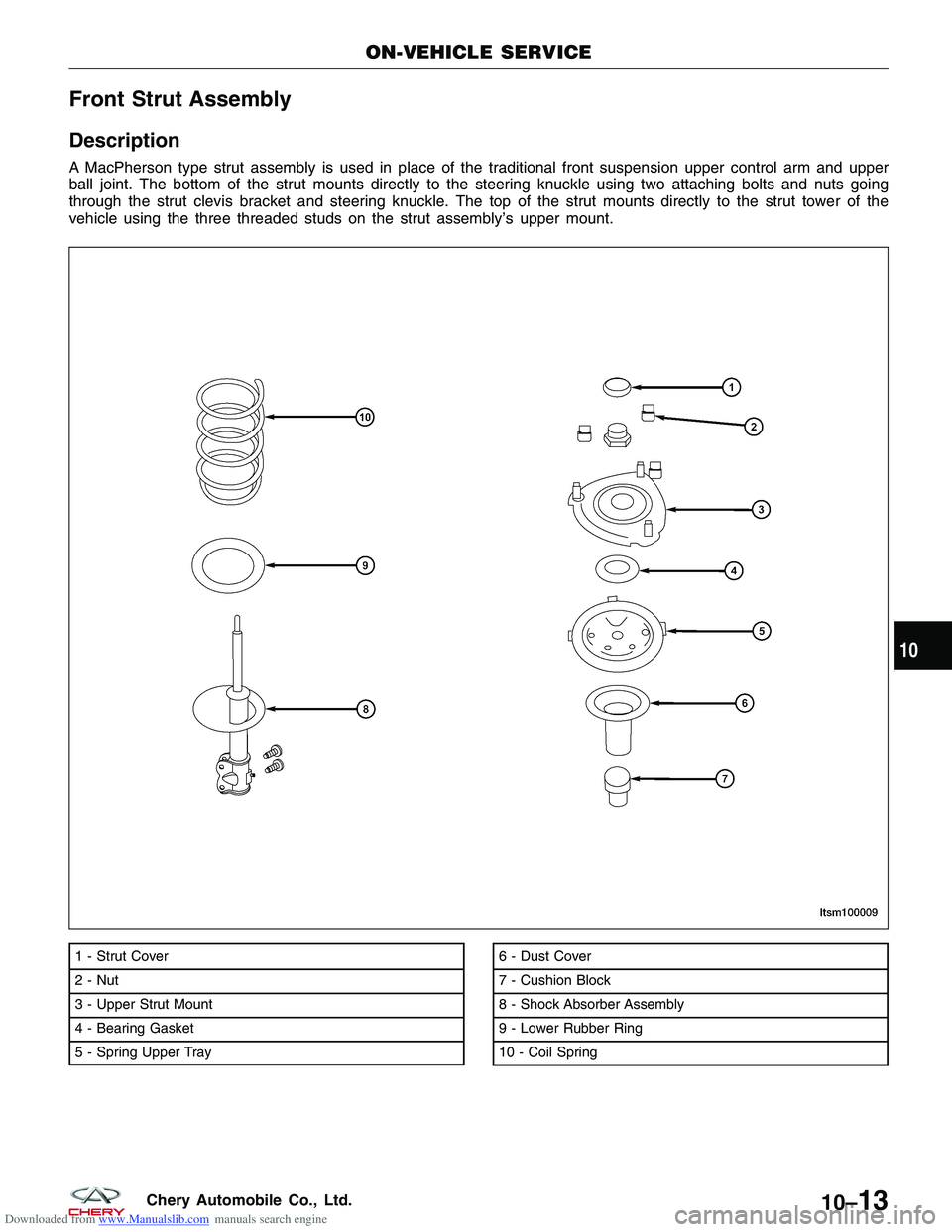
A MacPherson type strut assembly is used in place of the traditional front suspension upper control arm and upper
ball joint. The bottom of the strut mounts directly to the steering knuckle using two attaching bolts and nuts going
through the strut clevis bracket and steering knuckle. The top of the strut mounts directly to the strut tower of the
vehicle using the three threaded studs on the strut assembly’s upper mount.
1 - Strut Cover
2 - Nut
3 - Upper Strut Mount
4 - Bearing Gasket
5 - Spring Upper Tray6 - Dust Cover
7 - Cushion Block
8 - Shock Absorber Assembly
9 - Lower Rubber Ring
10 - Coil Spring
ON-VEHICLE SERVICE
LTSM100009
10
10–13Chery Automobile Co., Ltd.
Page 1318 of 1903
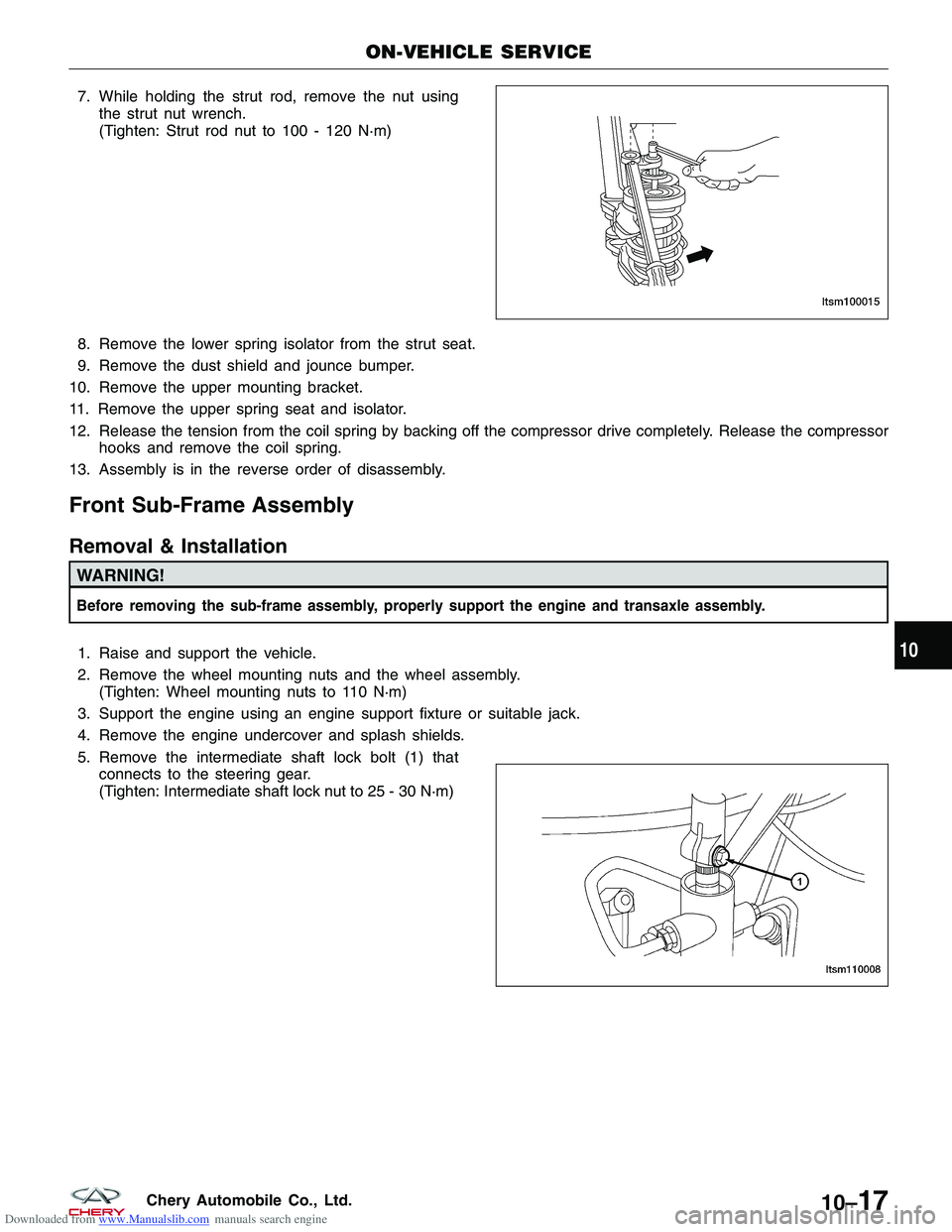
Downloaded from www.Manualslib.com manuals search engine 7. While holding the strut rod, remove the nut usingthe strut nut wrench.
(Tighten: Strut rod nut to 100 - 120 N·m)
8. Remove the lower spring isolator from the strut seat.
9. Remove the dust shield and jounce bumper.
10. Remove the upper mounting bracket.
11. Remove the upper spring seat and isolator.
12. Release the tension from the coil spring by backing off the compressor drive completely. Release the compressor hooks and remove the coil spring.
13. Assembly is in the reverse order of disassembly.
Front Sub-Frame Assembly
Removal & Installation
WARNING!
Before removing the sub-frame assembly, properly support the engine and transaxle assembly.
1. Raise and support the vehicle.
2. Remove the wheel mounting nuts and the wheel assembly. (Tighten: Wheel mounting nuts to 110 N·m)
3. Support the engine using an engine support fixture or suitable jack.
4. Remove the engine undercover and splash shields.
5. Remove the intermediate shaft lock bolt (1) that connects to the steering gear.
(Tighten: Intermediate shaft lock nut to 25 - 30 N·m)
ON-VEHICLE SERVICE
LTSM100015
LTSM110008
10
10–17Chery Automobile Co., Ltd.
Page 1324 of 1903
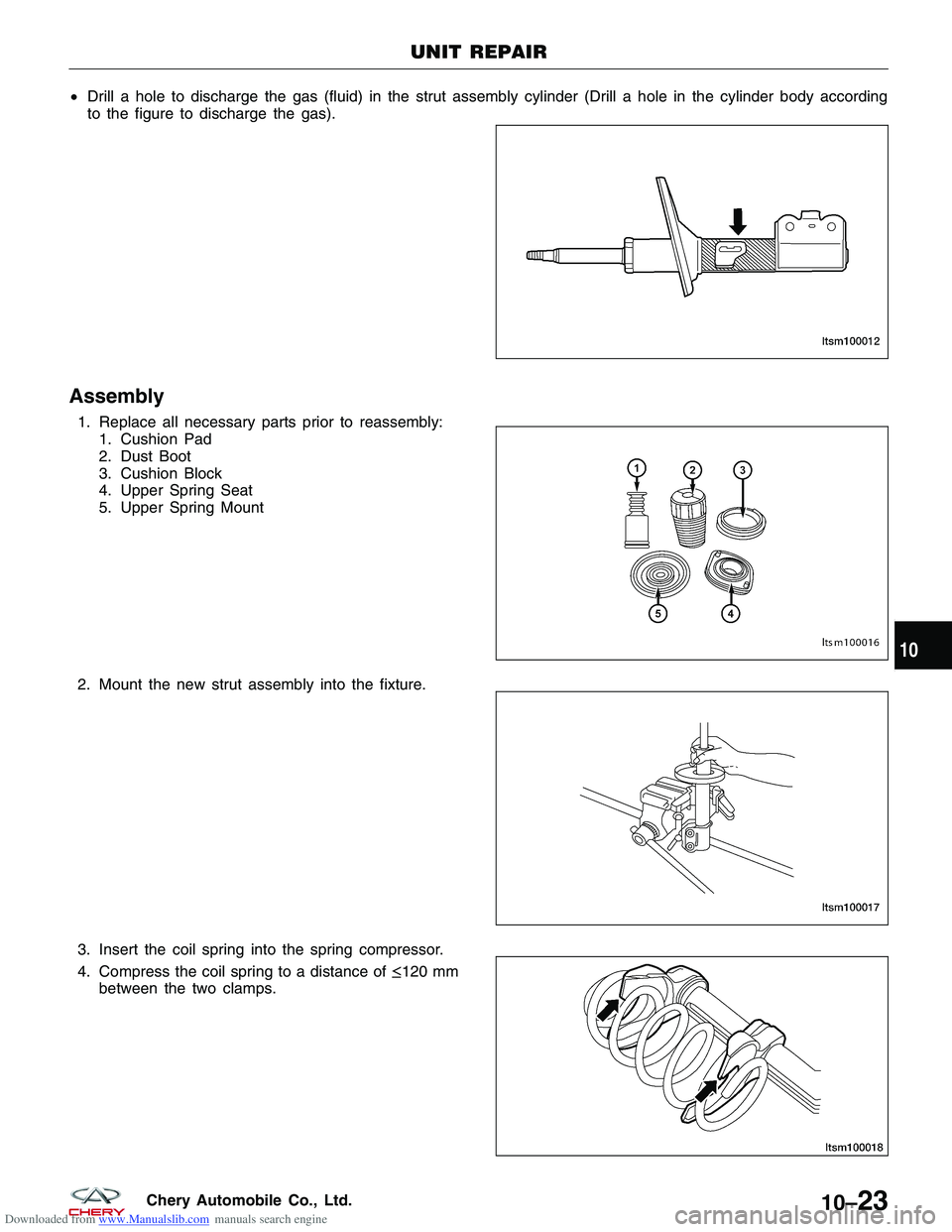
Downloaded from www.Manualslib.com manuals search engine •Drill a hole to discharge the gas (fluid) in the strut assembly cylinder (Drill a hole in the cylinder body according
to the figure to discharge the gas).
Assembly
1. Replace all necessary parts prior to reassembly:
1. Cushion Pad
2. Dust Boot
3. Cushion Block
4. Upper Spring Seat
5.
Upper Spring Mount
2. Mount the new strut assembly into the fixture.
3. Insert the coil spring
into the spring compressor.
4. Compress the coil spring to a distance of ≤120 mm
between the two clamps.
UNIT REPAIR
LTSM100012
LTSM100016
LTSM100017
LTSM100018
10
10–23Chery Automobile Co., Ltd.