lock CHERY TIGGO 2009 Service Repair Manual
[x] Cancel search | Manufacturer: CHERY, Model Year: 2009, Model line: TIGGO, Model: CHERY TIGGO 2009Pages: 1903, PDF Size: 33.38 MB
Page 1396 of 1903

Downloaded from www.Manualslib.com manuals search engine BRAKES
12
CONTENTSpage
Base Brakes ........................................................................\
. 12-1
Antilock Brakes ..................................................................... 12-34
Parking Brake ...................................................................... 12-79
BASE BRAKES
GENERAL INFORMATION12-2
Description 12-2
Operation 12-3
Specifications 12-4
Special Tools 12-5
Electrical Schematics 12-6
DIAGNOSIS & TESTING12-7
Diagnostic Help 12-7
Brake Noise 12-7
Braking Concerns 12-8
ON-VEHICLE SERVICE12-9
Brake Bleeding 12-9
Brake Bleeding Information 12-9
Brake Bleeding Procedure 12-9
Manual Brake Bleeding 12-9
Pressure Brake Bleeding 12-10
Master Cylinder - LHD 12-11
Description 12-11
Operation 12-11
Removal & Installation 12-11
Master Cylinder - RHD 12-12
Description 12-12
Operation 12-13
Removal & Installation 12-13
Power Brake Booster - LHD 12-14
Description 12-14
Operation 12-14
Removal & Installation 12-14
Power Brake Booster - RHD 12-16
Description 12-16
Operation 12-16
Removal & Installation 12-16Front Brake Caliper
12-18
Description 12-18
Operation 12-18
Removal & Installation 12-19
Rear Brake Caliper 12-19
Description 12-19
Operation 12-20
Removal & Installation 12-20
Front Brake Rotor 12-21
Removal & Installation 12-21
Inspection 12-21
Rear Brake Rotor 12-22
Removal & Installation 12-22
Inspection 12-22
Rear Brake Backing Plate 12-23
Removal & Installation 12-23
Front Brake Pads 12-24
Removal & Installation 12-24
Inspection 12-25
Rear Brake Pads 12-25
Removal & Installation 12-25
Inspection 12-26
UNIT REPAIR12-27
Front Brake Caliper 12-27
Disassemble 12-27
Inspection 12-28
Assemble 12-28
Rear Brake Caliper 12-30
Disassemble 12-30
Inspection 12-31
Assemble 12-32
12
12–1Chery Automobile Co., Ltd.
Page 1398 of 1903
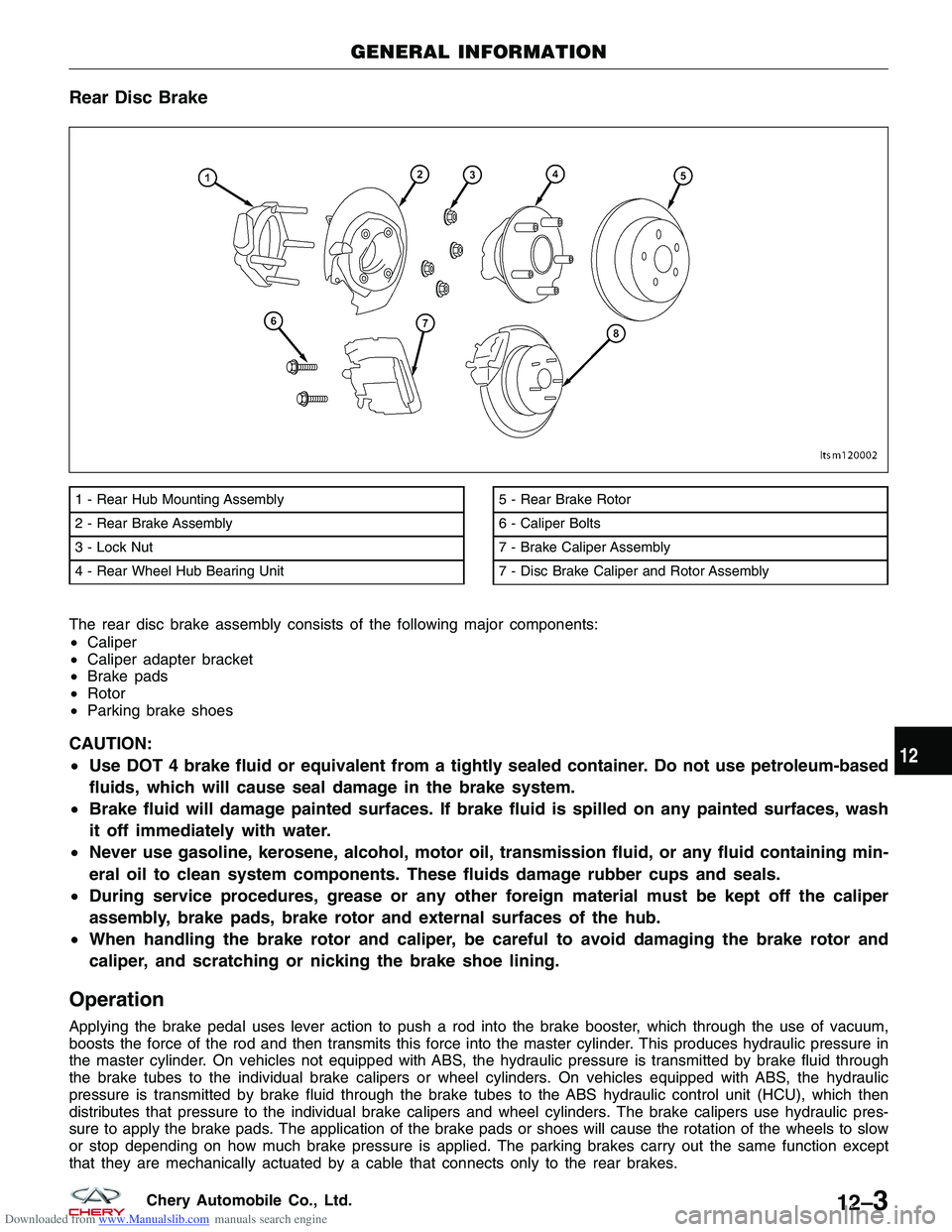
Downloaded from www.Manualslib.com manuals search engine Rear Disc Brake
The rear disc brake assembly consists of the following major components:
•Caliper
• Caliper adapter bracket
• Brake pads
• Rotor
• Parking brake shoes
CAUTION:
•Use DOT 4 brake fluid or equivalent from a tightly sealed container. Do not use petroleum-based
fluids, which will cause seal damage in the brake system.
• Brake fluid will damage painted surfaces. If brake fluid is spilled on any painted surfaces, wash
it off immediately with water.
• Never use gasoline, kerosene, alcohol, motor oil, transmission fluid, or any fluid containing min-
eral oil to clean system components. These fluids damage rubber cups and seals.
• During service procedures, grease or any other foreign material must be kept off the caliper
assembly, brake pads, brake rotor and external surfaces of the hub.
• When handling the brake rotor and caliper, be careful to avoid damaging the brake rotor and
caliper, and scratching or nicking the brake shoe lining.
Operation
Applying the brake pedal uses lever action to push a rod into the brake booster, which through the use of vacuum,
boosts the force of the rod and then transmits this force into the master cylinder. This produces hydraulic pressure in
the master cylinder. On vehicles not equipped with ABS, the hydraulic pressure is transmitted by brake fluid through
the brake tubes to the individual brake calipers or wheel cylinders. On vehicles equipped with ABS, the hydraulic
pressure is transmitted by brake fluid through the brake tubes to the ABS hydraulic control unit (HCU), which then
distributes that pressure to the individual brake calipers and wheel cylinders. The brake calipers use hydraulic pres-
sure to apply the brake pads. The application of the brake pads or shoes will cause the rotation of the wheels to slow
or stop depending on how much brake pressure is applied. The parking brakes carry out the same function except
that they are mechanically actuated by a cable that connects only to the rear brakes.
1 - Rear Hub Mounting Assembly
2 - Rear Brake Assembly
3 - Lock Nut
4 - Rear Wheel Hub Bearing Unit5 - Rear Brake Rotor
6 - Caliper Bolts
7 - Brake Caliper Assembly
7 - Disc Brake Caliper and Rotor Assembly
GENERAL INFORMATION
LTSM120002
12
12–3Chery Automobile Co., Ltd.
Page 1402 of 1903
Downloaded from www.Manualslib.com manuals search engine DIAGNOSIS & TESTING
Diagnostic Help
Brake diagnosis involves determining if the concern is related to a mechanical, hydraulic, electrical or vacuum oper-
ated component.
NOTE :
The brake reservoir fluid level will decrease in proportion to normal lining wear.
NOTE :
Brake fluid tends to darken over time. This is normal and should not be mistaken for contamination.
Preliminary Brake Check:
•Check the condition of the tires and wheels. Damaged wheels and worn, damaged or under inflated tires can
cause a pull, shudder, vibration and a condition similar to brake grab.
• If a complaint was based on noise while braking, check the suspension components. Jounce the front and the
rear of vehicle and listen for anything that might be caused by a loose, worn or damaged suspension or steer-
ing component.
• Inspect the brake fluid level and condition.
1. If the fluid level is abnormally low, look for any evidence of leaks at the calipers, brake lines, master cyl-
inder and at the Antilock Brake System (ABS) Hydraulic Control Unit (HCU).
2. If the fluid appears to be contaminated, drain a sample to examine.
• The system will have to be flushed if the fluid is separated into layers, or contains a substance other than
brake fluid. The system seals, cups, hoses, master cylinder and HCU will also have to be replaced after flush-
ing. Use clean brake fluid to flush the system.
• Check the parking brake operation. Verify free movement and full release of the cables and the lever. Also note
if the vehicle was being operated with the parking brake partially applied.
• Check the brake pedal operation. Verify that the pedal does not bind and has adequate free play. If the pedal
lacks free play, check the pedal and the power booster for looseness or for a binding condition. DO NOT road
test the vehicle until the condition is located and corrected.
• Check the vacuum booster check valve and vacuum supply hose.
• If the preliminary checks appear to be OK, road test the vehicle.
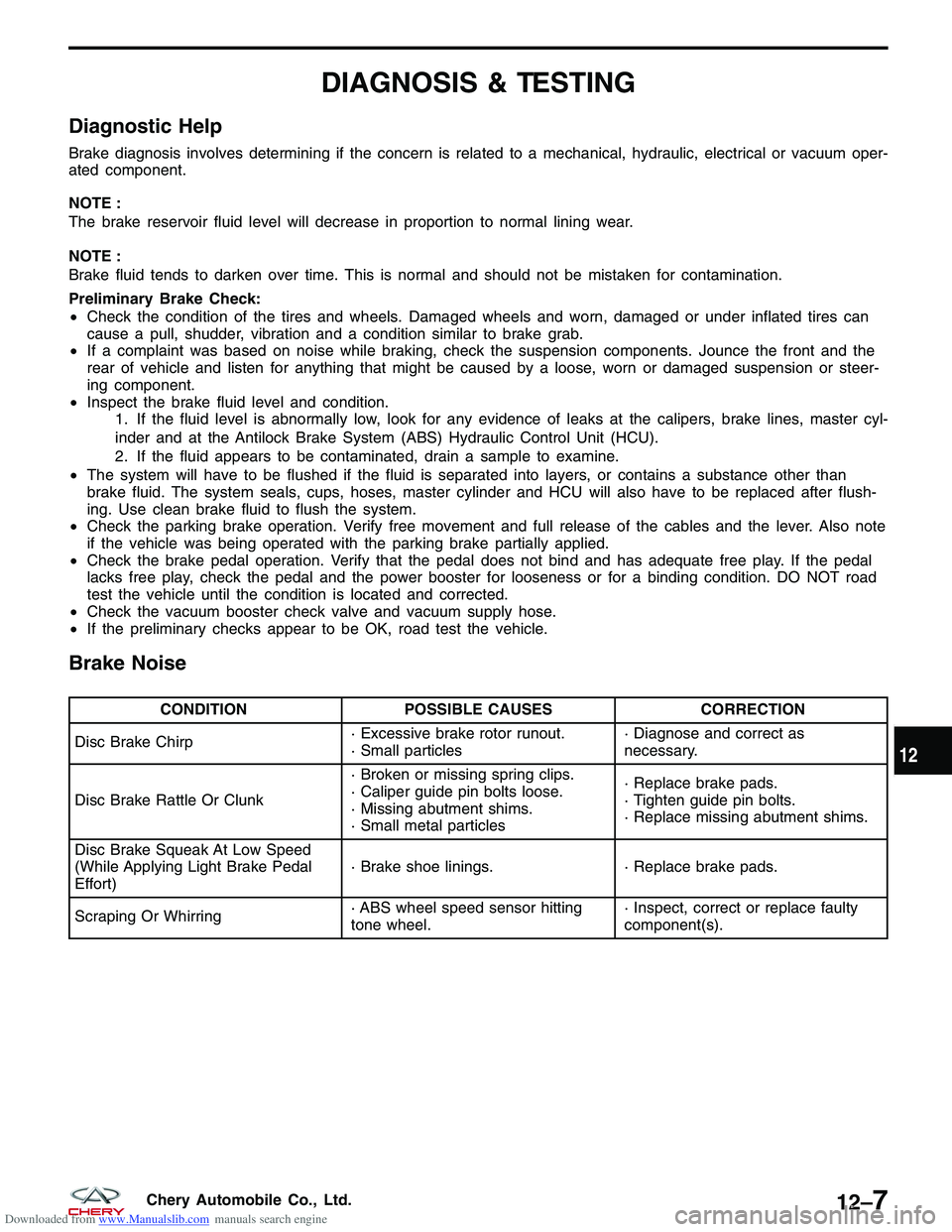
Brake Noise
CONDITION POSSIBLE CAUSES CORRECTION
Disc Brake Chirp · Excessive brake rotor runout.
· Small particles· Diagnose and correct as
necessary.
Disc Brake Rattle Or Clunk · Broken or missing spring clips.
· Caliper guide pin bolts loose.
· Missing abutment shims.
· Small metal particles· Replace brake pads.
· Tighten guide pin bolts.
· Replace missing abutment shims.
Disc Brake Squeak At Low Speed
(While Applying Light Brake Pedal
Effort) · Brake shoe linings.
· Replace brake pads.
Scraping Or Whirring · ABS wheel speed sensor hitting
tone wheel.· Inspect, correct or replace faulty
component(s).
12
12–7Chery Automobile Co., Ltd.
Page 1403 of 1903
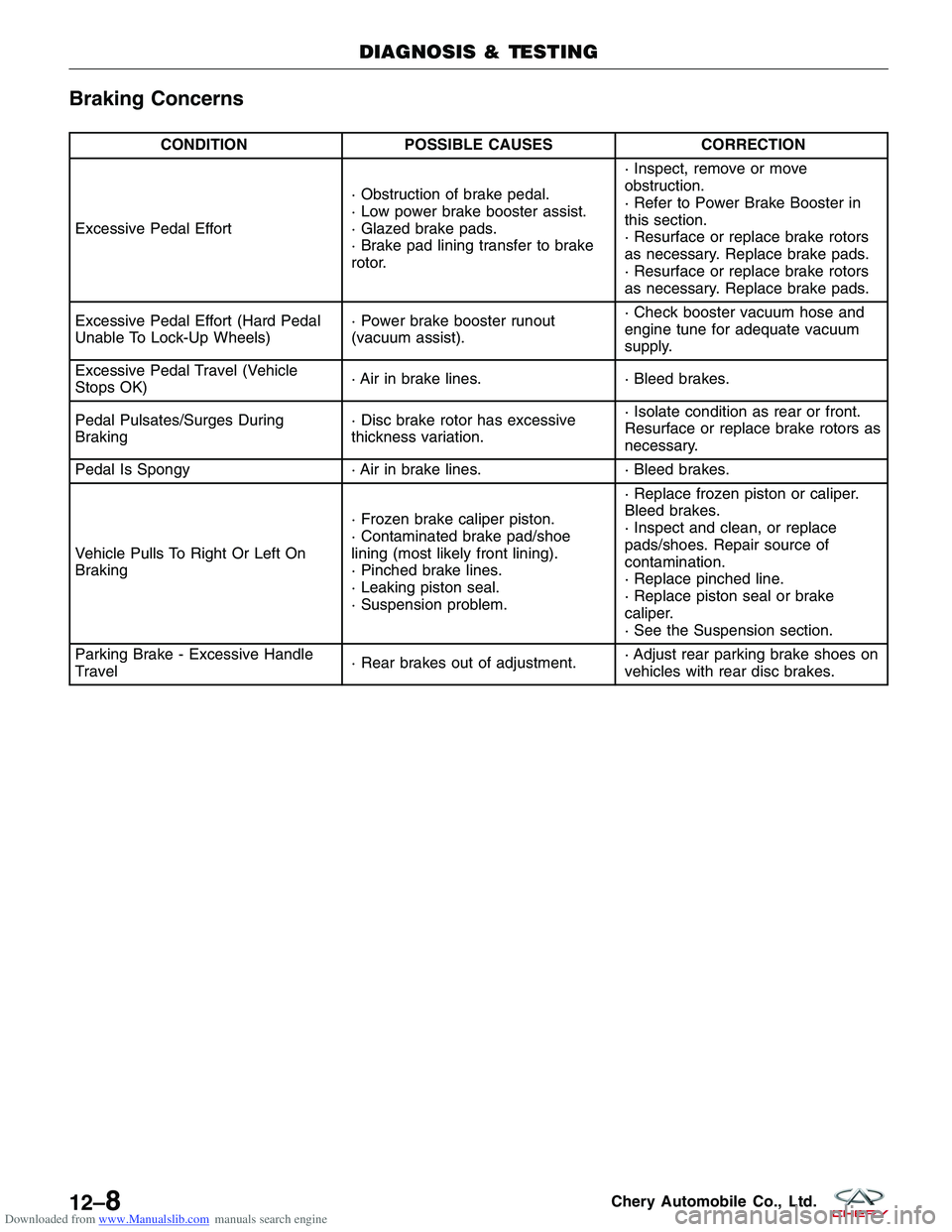
Downloaded from www.Manualslib.com manuals search engine Braking Concerns
CONDITIONPOSSIBLE CAUSES CORRECTION
Excessive Pedal Effort · Obstruction of brake pedal.
· Low power brake booster assist.
· Glazed brake pads.
· Brake pad lining transfer to brake
rotor.· Inspect, remove or move
obstruction.
· Refer to Power Brake Booster in
this section.
· Resurface or replace brake rotors
as necessary. Replace brake pads.
· Resurface or replace brake rotors
as necessary. Replace brake pads.
Excessive Pedal Effort (Hard Pedal
Unable To Lock-Up Wheels) · Power brake booster runout
(vacuum assist).· Check booster vacuum hose and
engine tune for adequate vacuum
supply.
Excessive Pedal Travel (Vehicle
Stops OK) · Air in brake lines.
· Bleed brakes.
Pedal Pulsates/Surges During
Braking · Disc brake rotor has excessive
thickness variation.· Isolate condition as rear or front.
Resurface or replace brake rotors as
necessary.
Pedal Is Spongy · Air in brake lines.· Bleed brakes.
Vehicle Pulls To Right Or Left On
Braking · Frozen brake caliper piston.
· Contaminated brake pad/shoe
lining (most likely front lining).
· Pinched brake lines.
· Leaking piston seal.
· Suspension problem.· Replace frozen piston or caliper.
Bleed brakes.
· Inspect and clean, or replace
pads/shoes. Repair source of
contamination.
· Replace pinched line.
· Replace piston seal or brake
caliper.
· See the Suspension section.
Parking Brake - Excessive Handle
Travel · Rear brakes out of adjustment.· Adjust rear parking brake shoes on
vehicles with rear disc brakes.
DIAGNOSIS & TESTING
12–8Chery Automobile Co., Ltd.
Page 1422 of 1903
Downloaded from www.Manualslib.com manuals search engine UNIT REPAIR
Front Brake Caliper
Disassemble
Before disassembling the brake caliper, clean and inspect it.
WARNING!
•Under no condition should high pressure air ever be used to remove a piston from a caliper bore. Personal
injury could result from such a practice.
• Do not place face or hands near caliper and piston if using compressed air pressure to remove piston. Do not
use high pressure.
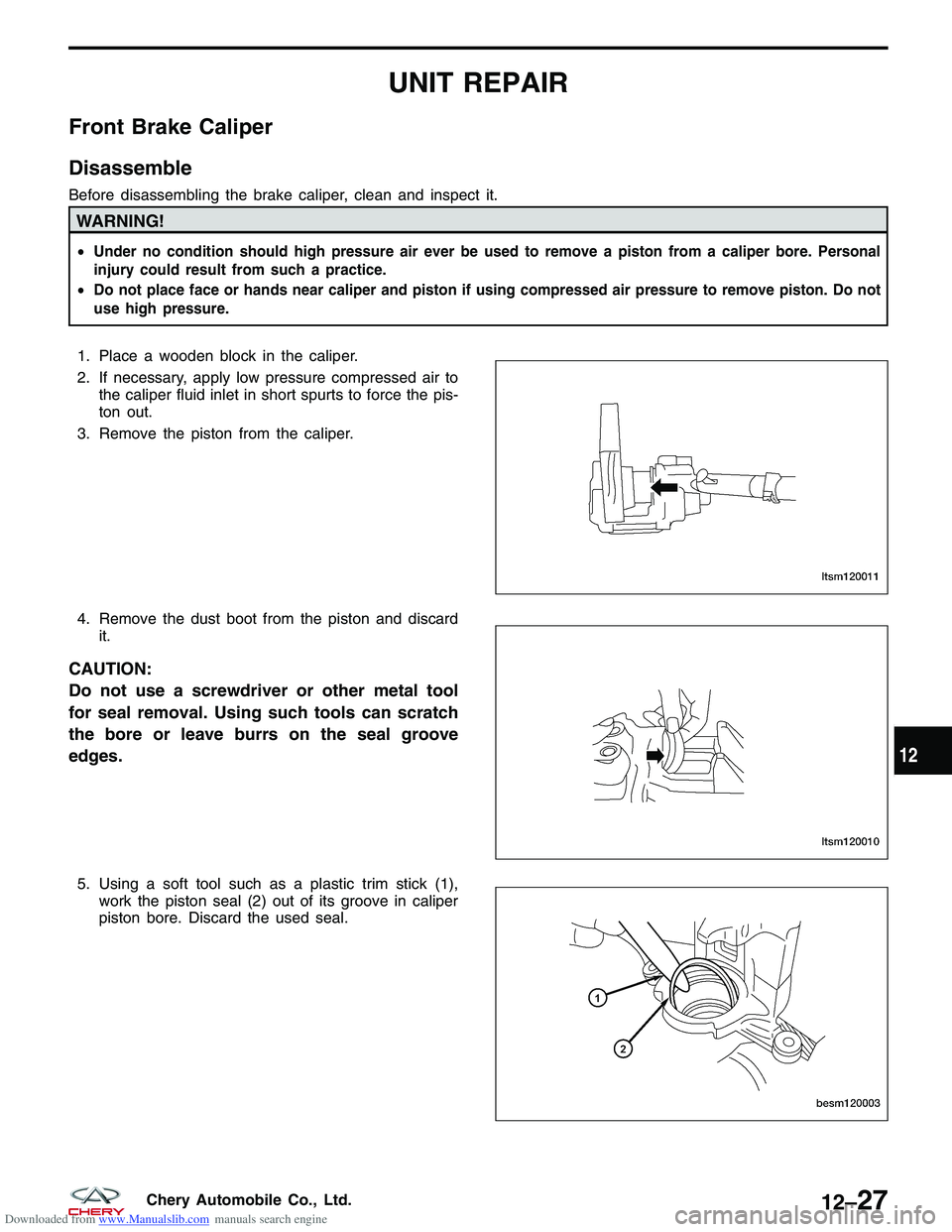
1. Place a wooden block in the caliper.
2. If necessary, apply low pressure compressed air to
the caliper fluid inlet in short spurts to force the pis-
ton out.
3. Remove the piston from the caliper.
4. Remove the dust boot from the piston and discard it.
CAUTION:
Do not use a screwdriver or other metal tool
for seal removal. Using such tools can scratch
the bore or leave burrs on the seal groove
edges.
5. Using a soft tool such as a plastic trim stick (1),work the piston seal (2) out of its groove in caliper
piston bore. Discard the used seal.
LTSM120011
LTSM120010
BESM120003
12
12–27Chery Automobile Co., Ltd.
Page 1425 of 1903
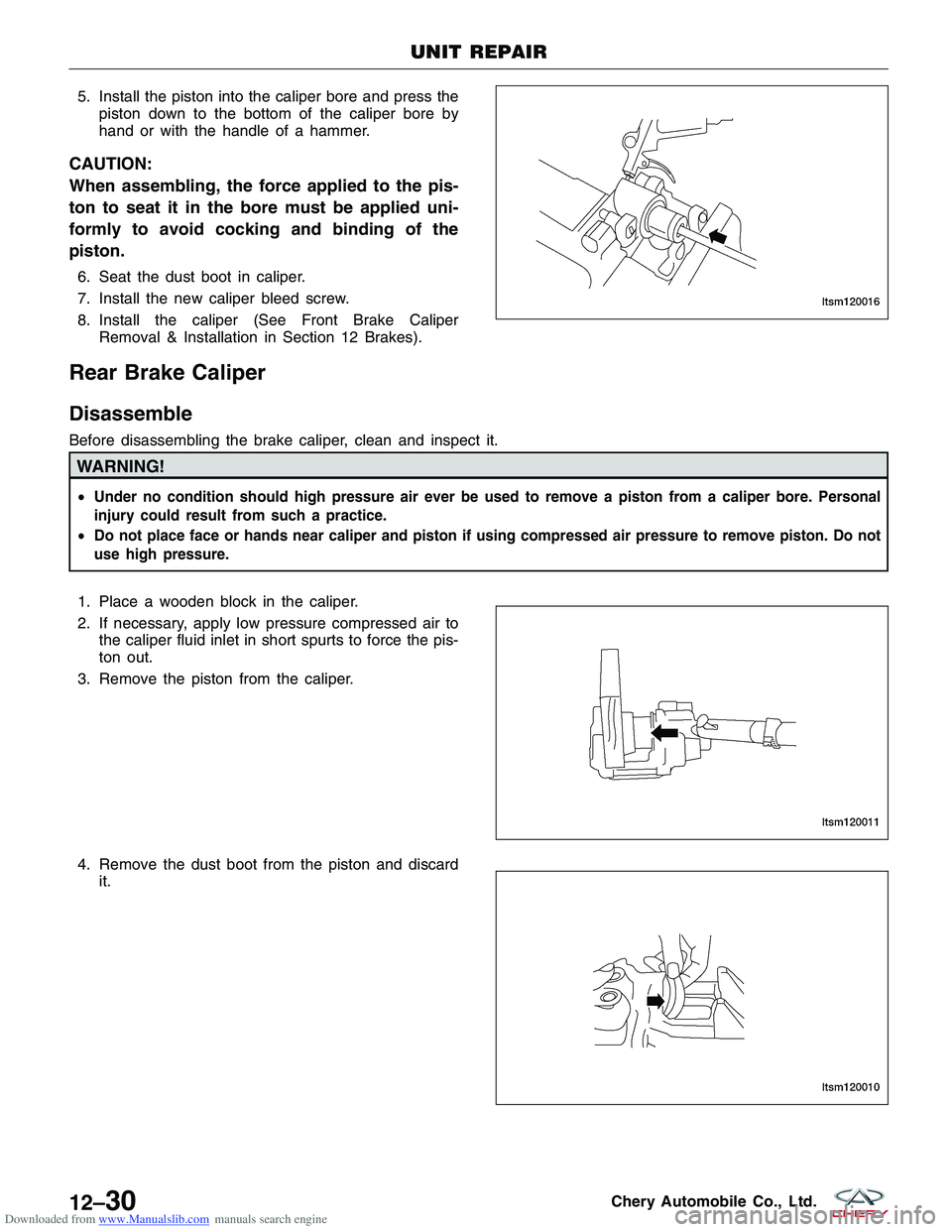
Downloaded from www.Manualslib.com manuals search engine 5. Install the piston into the caliper bore and press thepiston down to the bottom of the caliper bore by
hand or with the handle of a hammer.
CAUTION:
When assembling, the force applied to the pis-
ton to seat it in the bore must be applied uni-
formly to avoid cocking and binding of the
piston.
6. Seat the dust boot in caliper.
7. Install the new caliper bleed screw.
8. Install the caliper (See Front Brake CaliperRemoval & Installation in Section 12 Brakes).
Rear Brake Caliper
Disassemble
Before disassembling the brake caliper, clean and inspect it.
WARNING!
•Under no condition should high pressure air ever be used to remove a piston from a caliper bore. Personal
injury could result from such a practice.
• Do not place face or hands near caliper and piston if using compressed air pressure to remove piston. Do not
use high pressure.
1. Place a wooden block in the caliper.
2. If necessary, apply low pressure compressed air to
the caliper fluid inlet in short spurts to force the pis-
ton out.
3. Remove the piston from the caliper.
4. Remove the dust boot from the piston and discard it.
UNIT REPAIR
LTSM120016
LTSM120011
LTSM120010
12–30Chery Automobile Co., Ltd.
Page 1429 of 1903
Downloaded from www.Manualslib.com manuals search engine ANTILOCK BRAKES
GENERAL INFORMATION12-35
Description 12-35
Operation 12-36
Specifications 12-36
Special Tools 12-37
Electrical Schematics 12-38
Antilock Brake System (ABS) Module
Connector Pin-Out Table 12-44
DIAGNOSIS & TESTING12-45
Diagnostic Help 12-45
Diagnostic Help 12-45
Ground Inspection 12-45
Diagnostic Tools 12-46
Diagnostic Trouble Code (DTC) List 12-46
Antilock Brake System DTC List 12-46
Diagnostic Trouble Code (DTC) Tests 12-47
C1101 - Battery Voltage High, C1102 -
Battery Voltage Low 12-47
C1200 - Left Front Wheel Speed
Sensor Circuit Open or Shorted 12-54
C1203 - Right Front Wheel Speed
Sensor Circuit Open or Shorted 12-59 C1206 - Left Rear Wheel Speed Sensor
Circuit Open or Shorted 12-64
C1209 - Right Rear Wheel Speed
Sensor Circuit Open or Shorted 12-69
C1604 - ECU Defect, Internal Errors or
Solenoid Fault 12-74
ON-VEHICLE SERVICE12-76
Antilock Brake System (ABS) Bleeding
Procedure 12-76
ABS Bleeding Information 12-76
ABS Bleeding Instructions 12-76
Antilock Brake System (ABS) Hydraulic
Control Module 12-77
Removal & Installation 12-77
Front Wheel Speed Sensor 12-77
Removal & Installation 12-77
Rear Wheel Speed Sensor 12-78
Removal & Installation 12-78
12–34Chery Automobile Co., Ltd.
Page 1430 of 1903
Downloaded from www.Manualslib.com manuals search engine GENERAL INFORMATION
Description
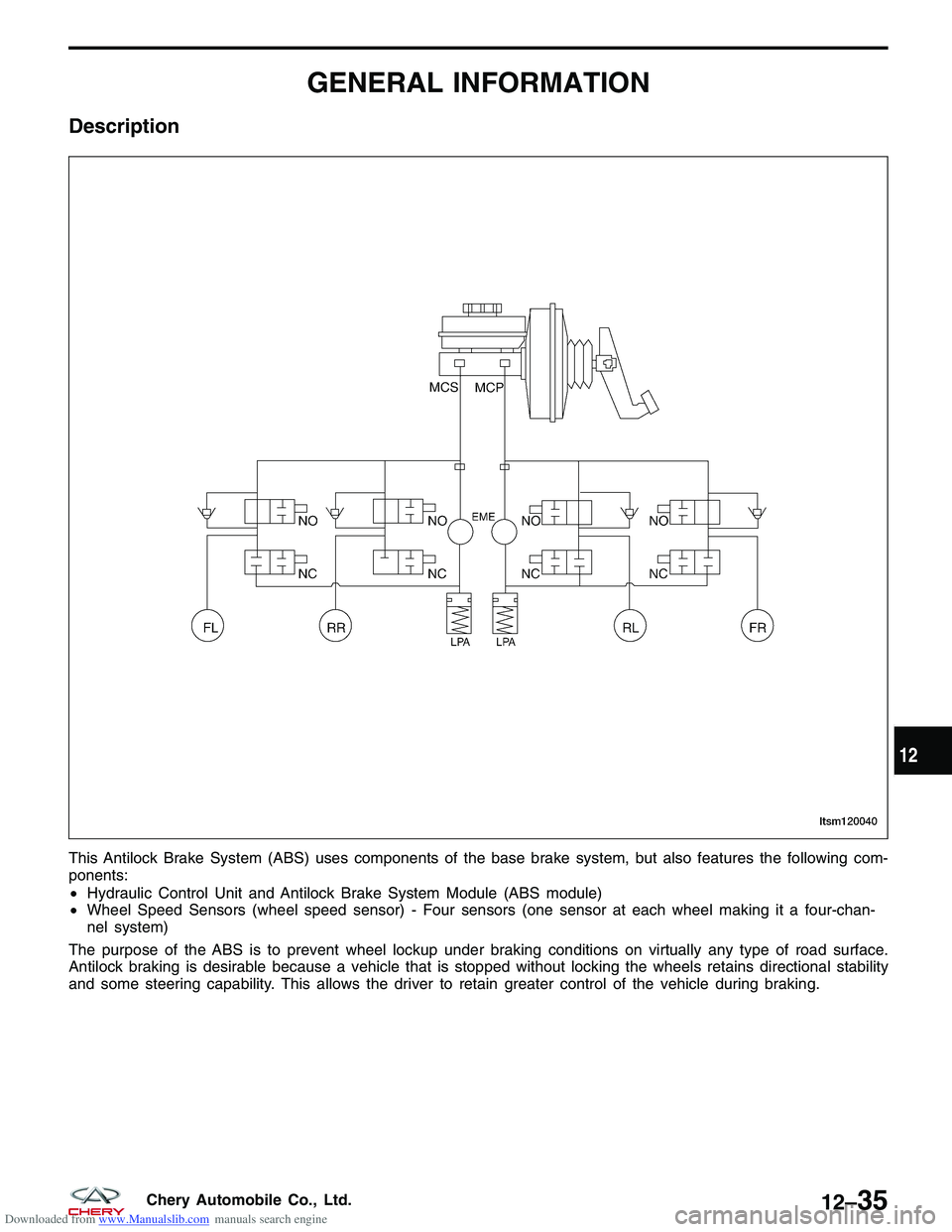
This Antilock Brake System (ABS) uses components of the base brake system, but also features the following com-
ponents:
•Hydraulic Control Unit and Antilock Brake System Module (ABS module)
• Wheel Speed Sensors (wheel speed sensor) - Four sensors (one sensor at each wheel making it a four-chan-
nel system)
The purpose of the ABS is to prevent wheel lockup under braking conditions on virtually any type of road surface.
Antilock braking is desirable because a vehicle that is stopped without locking the wheels retains directional stability
and some steering capability. This allows the driver to retain greater control of the vehicle during braking.LTSM120040
12
12–35Chery Automobile Co., Ltd.
Page 1431 of 1903
Downloaded from www.Manualslib.com manuals search engine Operation
ABS Braking
•ABS operation is available at all vehicle speeds above 20 km/h. If a wheel locking tendency is detected during
a brake application, the brake system enters the ABS mode. During ABS braking, hydraulic pressure in the four
wheel circuits is modulated to prevent any wheel from locking. Each wheel circuit is designed with a set of
electric solenoids to allow modulation. The system can build and release pressure at each wheel, depending on
signals generated by the wheel speed sensors at each wheel and received at the ABS Module.
• There are a few performance characteristics of the ABS that may at first seem abnormal, but in fact are nor-
mal. These characteristics are described below.
If the electrical system malfunctions, the Fail-Safe function is activated, the ABS becomes inoperative and
the ABS warning lamp turns on.
During ABS operation, the brake pedal may vibrate lightly and a mechanical noise may be heard. This is normal.
Stopping distance may be longer than that of vehicles without ABS when vehicle drives on rough, gravel, or snow-covered (fresh, deep snow) roads.
Specifications
Torque Specifications
DESCRIPTION TORQUE (N·m)
ABS Mounting Bolt (To Bracket) 10
ABS Mounting Bracket Screws (To Frame) 20
ABS Mounting Bracket Screw And Nut (To Frame) 20
ABS Wheel Speed Sensor Head Mounting Screw - Rear 10
Brake Tube Nuts 10
Wheel Mounting Nuts 110
GENERAL INFORMATION
12–36Chery Automobile Co., Ltd.
Page 1433 of 1903
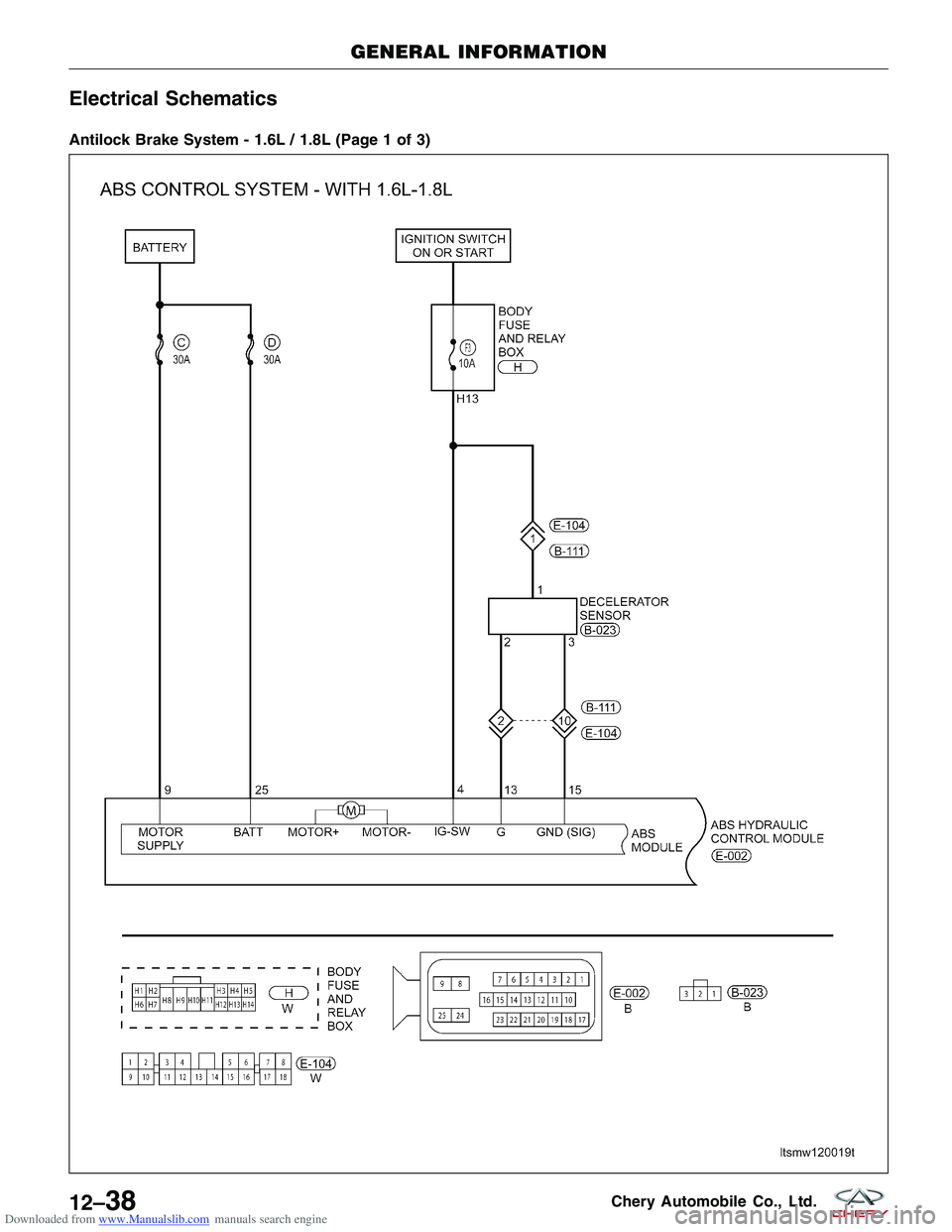
Downloaded from www.Manualslib.com manuals search engine Electrical Schematics
Antilock Brake System - 1.6L / 1.8L (Page 1 of 3)
GENERAL INFORMATION
LTSMW120019T
12–38Chery Automobile Co., Ltd.