ABS CHEVROLET CAMARO 1967 1.G Chassis Repair Manual
[x] Cancel search | Manufacturer: CHEVROLET, Model Year: 1967, Model line: CAMARO, Model: CHEVROLET CAMARO 1967 1.GPages: 659, PDF Size: 114.24 MB
Page 335 of 659
ENGINE-ELECTRICAL 6Y-10
circuit. Make absolutely certain all connections in
the circuit are secure.
5.
Do not short across or ground any of the terminals
on the generator or regulator.
6. Do not attempt to polarize the generator.
7.
Do not disconnect lead at generator without first dis-
connecting battery ground cable.
Trouble in the A.C. charging system will usually be
indicated by one or more of the following conditions:
1.
Faulty indicator lamp or ammeter operation.
2.
An undercharged battery (usually evidenced by slow
cranking speeds).
3.
An overcharged battery (usually evidenced by exces-
sive battery water usage).
4.
Excessive generator noise or vibration.
Described below are a series of on-the-vehicle quick
checks which are designed to assist the service tech-
nician in locating troubles within the various components
of the engine electrical system. Additional checks, ad-
justments and overhaul procedures of these components
are also described in the "Charging Systems—Service
Operations Section" and should be referred to as
necessary.
STATIC CHECKS
Before making any electrical checks, perform the fol-
lowing static checks:
1.
Check for loose fan belt.
2.
Check for defective battery. (Refer to Battery).
3.
Inspect all connections, including the slip-on con-
nectors at the regulator and Delcotron.
NOTE: Do not short field to ground to check if
generator is charging since this will seriously
damage the charging system.
SYSTEM CONDITION TEST
This test is used .to indicate the overall condition of the
charging system (both good and defective) and to isolate
the malfunctioning unit if the system is defective.
NOTE: On Corvette models difficulty may be
encountered -when attempting to make the re-
quired test connections at the voltage regulator.
It is advisable to remove the regulator from its
mounting location to perform the necessary con-
nections at the regulator for the following tests
but make sure unit is grounded.
1.
With ignition off, perform the prescribed Static
Checks outlined in this section. Then set hand brake
and shift transmission
into
neutral.
2.
Connect a voltmeter from junction block relay to
ground at regulator base.
CAUTION: Be sure meter clip does not touch a
resistor or terminal extension under regulator,
3.
Connect a tachometer on engine.
4.
Models equipped with Indicator Lamp: Turn ignition
switch on "ON" position and check indicator lamp.
If lamp fails to glow, perform appropriate tests and
corrections (Indicator Lamp Circuit Tests) before
continuing.
Models equipped with Ammeter: Turn ignition
switch to "ACC" with an accessory on and check
ammeter. If ammeter fails to read discharge, check
ammeter circuit before continuing.
5.
Models equipped with Indicator Lamp: If lamp glows,
start the engine and run' it at 1500 rpm or above.
Check indicator lamp. If lamp fails to go out, per-
form appropriate test and corrections (Indicator
Lamp Circuit Test) before continuing.
Models equipped with Ammeter: If ammeter reads
discharge, start the engine and observe ammeter. If
meter fails to move toward charge (from original
position), perform appropriate test and corrections
(Field Circuit Tests) before continuing.
NOTE: At this point a field circuit has been
established and any other problem will lie in
generator or regulator.
6. Turn on high-beam headlights and heater blower
motor to high speed, run engine at or above 1500
rpm (for a few minutes, if necessary) and read the
voltage on meter.
AIR GAP
ADJUSTING NUT
ONLY
ADJUSTING SCREW
(Turn To Adjust
Voltage Setting)
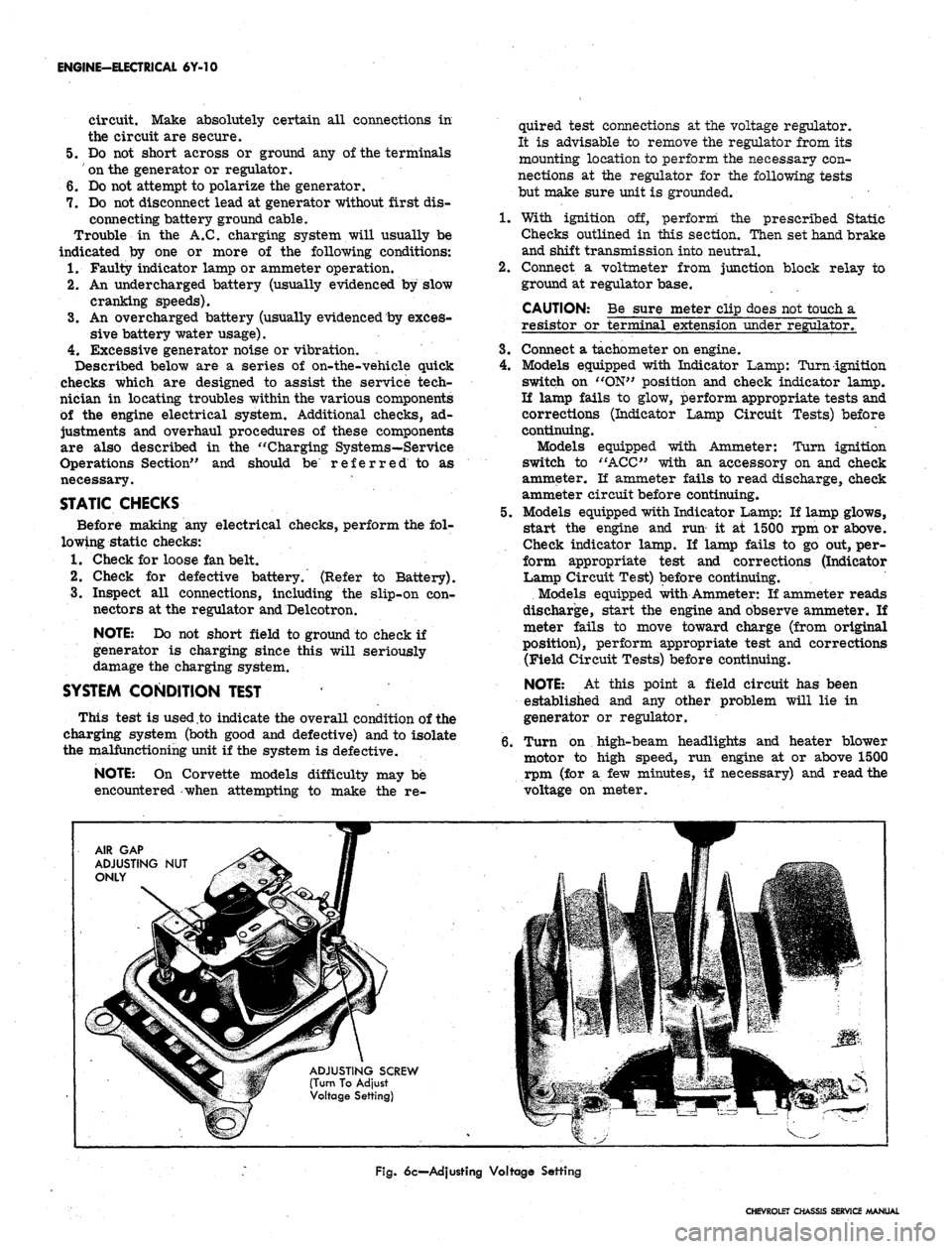
Fig.
6c—Adjusting Voltage Setting
CHEVROLET CHASSIS SERVICE MANUAL
Page 350 of 659
ENGINE-ELECTRICAL 6Y-25
1.
Remove the rotor.
2.
Remove both weight springs and advance weights.
3.
Remove roll pin retaining driven gear to distributor
shaft, slide the gear and spacers from the shaft.
Remove tachometer drive gear on Corvette models.
4.
Before sliding the distributor shaft from the hous-
ing, check for and remove any burrs on the shaft.
This will prevent damage to the seals and bushing
still positioned in the housing.
5. Slide the distributor mainshaft and cam-weight base
assembly from the housing.
6. Remove vacuum advance mechanism retaining
screws, remove the vacuum advance assembly.
7. Remove the spring retainer, remove the breaker
plate assembly from the distributor housing. Re-
move the contact point and condenser from the
breaker plate. Remove the felt washer and plastic
seal located beneath the breaker plate.
CLEANING AND INSPECTION
1.
Wash all parts in cleaning solvent except cap, rotor,
condenser, breaker plate assembly and vacuum con-
trol unit. Degreasing compounds may damage insula-
tion of these parts or saturate the lubricating felt in
the case of the breaker plate assembly.
2.
Inspect the breaker plate assembly for damage or
wear and replace if necessary.
3.
Inspect the shaft for wear and check its fit in the
bushings in the distributor body. If the shaft or bush-
ings are worn, the parts should be replaced.
4.
Mount the shaft in "V" blocks and check the shaft
alignment with a dial guage. The run-out should not
exceed .002".
5. Inspect the advance weights for wear or burrs and
free fit on their pivot pins.
6. Inspect the cam for wear or roughness. Then check
its fit on the end of the shaft. It should be absolutely
free without any roughness.
7. Inspect
the •
condition of the distributor points. Dirty
points should be cleaned and badly pitted points
should be replaced. (See Distributor Contact Points.)
8. Test the condenser for series resistance, micro-
farad capacity (.18 to .23) and leakage or breakdown,
following the instructions given by the manufacturer
of the test equipment used.
9. Inspect the distributor cap and sparkplug wires for
damage and replace if necessary.
ASSEMBLY
Four and Six Cylinder Engine
Refer to Figure 12i for Exploded View of Distributor.
1.
Replace cam assembly to mainshaft.
NOTE:
Lubricate top end of shaft with Delco
cam and ball bearing grease or equivalent prior
to replacing.
2.
Install governor weights on their pivot pins, replace
weight springs. Install weight cover and stop plate.
3.
Lubricate mainshaft and install it in distributor
housing.
4.
Install distributor driven gear to mainshaft and in-
sert attaching roll pin. Check to see that shaft turns
freely.
5. Install breaker plate assembly in the distributor body
and attach retaining screws.
6. Attach condenser and contact point set in proper lo-
cation with appropriate attaching screws.
NOTE:
Contact point set pilot must engage
matching hole in breaker plate. Connect primary
and condenser leads to contact set quick-
disconnect terminal.
7. Attach vacuum control assembly to distributor
housing.
8. Check and adjust contact point opening and align-
ment (See setting and alignment of points.)
9. Check breaker lever spring tension which should
be.
19-23 ounces. (See contact point replacement.)
V-8 Assembly-(Fig. 13i)
1.
Fill housing lubricating cavity with proper compound,
press in new plastic seal and install felt washer.
2.
Replace the vacuum advance unit, install the breaker
plate in housing and install the spring retainer on
the upper bushing.
3.
Lubricate and slide weight cam over mainshaft and
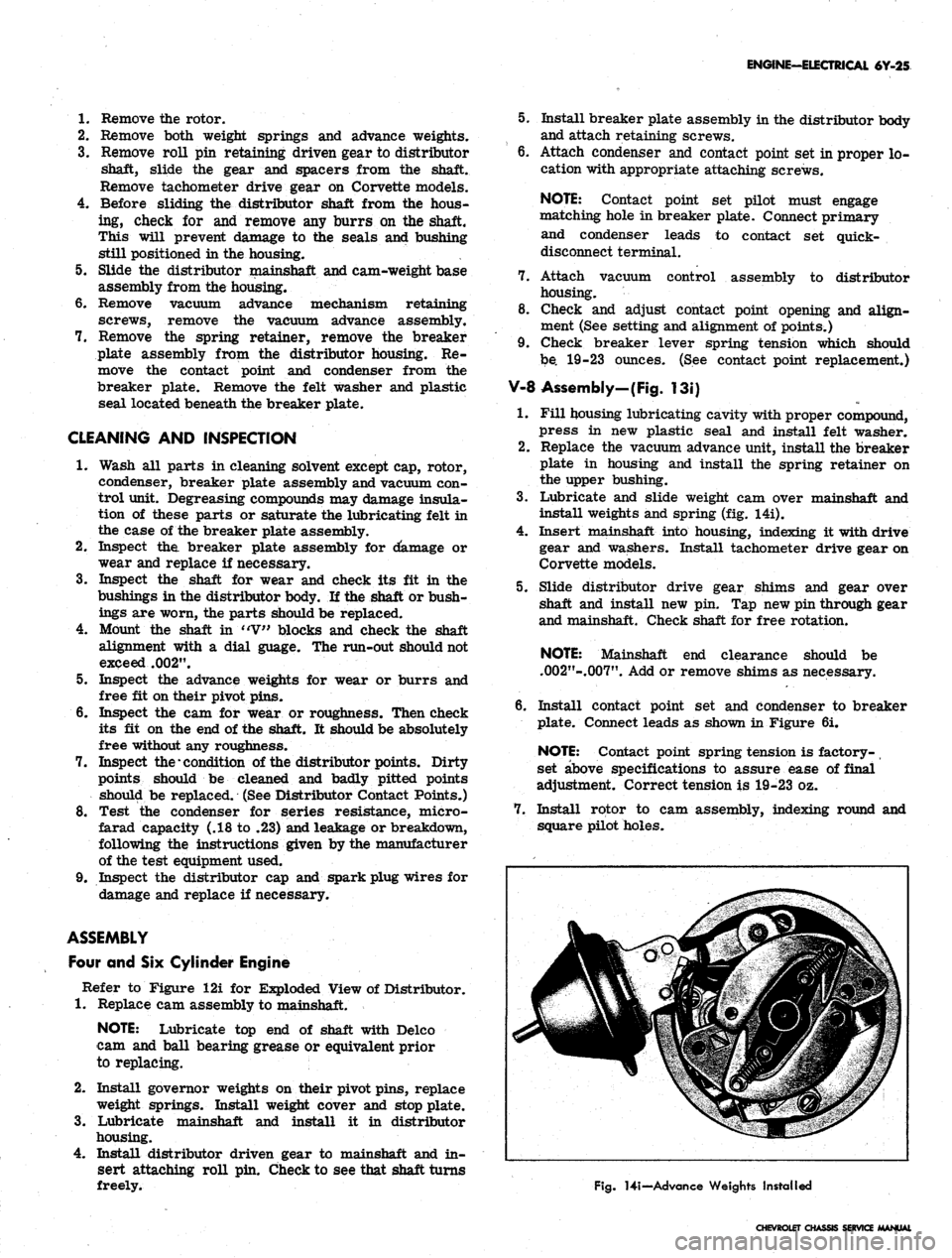
install weights and spring (fig. 14i).
4.
Insert mainshaft into housing, indexing it with drive
gear and washers. Install tachometer drive gear on
Corvette models.
5. Slide distributor drive gear shims and gear over
shaft and install new pin. Tap new pin through gear
and mainshaft. Check shaft for free rotation.
NOTE:
Mainshaft end clearance should be
.002"-.007". Add or remove shims as necessary.
6. Install contact point set and condenser to breaker
plate. Connect leads as shown in Figure 6i.
NOTE:
Contact point spring tension is factory-
set above specifications to assure ease of final
adjustment. Correct tension is 19-23 oz.
7. Install rotor to cam assembly, indexing round and
square pilot holes.
Flg.
Hi-Advance Weights Installed
CHEVROLET CHASSIS SERVICE
Page 391 of 659
CLUTCH AND TRANSMISSIONS 7-32
21.
Remove transmission output shaft slip yoke and in-
sert a plastic shipping plug in end of extension to
prevent spillage of transmission fluid.
NOTE:
The yoke is removed to avoid tearing
the heat reflecting pad on the underbbdy, when
the transmission is being removed.
22.
Remove bright metal ignition shielding from dis-
tributor area.
23.
Remove the transmission dip stick and tube
assembly.
24.
Disconnect transmission vacuum modulator line at
distributor advance line tee.
25.
Position transmission hoist under transmission and
attach safety chain to transmission.
26.
Remove transmission converter housing-to-engine
attaching foolts and slide transmission rearward.
NOTE:
Observe converter when moving trans-
mission rearward. If converter does not move
with the transmission, pry it free of flywheel
before proceeding.
27.
Install converter retaining strap.
28.
Lower and remove transmission from vehicle by
tilting the front down and to the right while inter-
mittently lowering the transmission to facilitate its
• removal.
29.
Reinstall transmission assembly by performing the
above steps in reverse order.
Bolt Torques
Transmission Case to Flywheel
Housing Bolts 35 ft. lbs.
Converter to Flywheel Bolts. . , . . 35 ft. lbs.
OTHER SERVICE OPERATIONS
Although certain operations, such as oil pan or gasket
replacement, valve body, governor, filler pipe "O" ring,
speedometer drive gear, case extension "0" ring and
rear oil seal, vacuum modulator, and servo cover or
gasket service may be performed from underneath the
vehicle without removing the Powerglide; their service
procedure is covered in the Passenger Overhaul Manual
and is not repeated here. Refer to the- Powerglide Sec-
tion of the Passenger Overhaul Manual for all other
service operations not covered here.
DIAGNOSIS
Proper operation of the Powerglide transmission may
be affected by a number of factors, all of which must be
considered when trouble in the unit is diagnosed.
Proper trouble diagnosis can only be accomplished
when performed in a thorough step by step procedure.
The following procedure has been devised and tested and
is recommended for all trouble diagnosis complaints and
if the service man will follow this checking procedure,
accurate and dependable diagnosis may be accomplished.
This will result in a savings of time, not only to the
service man, but to the customer as well.
WARMING UP TRANSMISSION
Before attempting to check and/or correct any com-
plaints on the Powerglide transmission it is absolutely
essential that the oil level be checked and corrected if
necessary. An oil level which is either too high or too
low can be the cause of a number of abnormal conditions
from excessive noise to slippage in all ranges.
It must be remembered that cold oil will slow up the
action of the hydraulic controls in the transmission. For
this reason a trouble or oil leak diagnosis should not be
attempted until the transmission has been warmed up by
either of the following procedures:
Shop Warm Up
1.
Connect tachometer to engine.
2.
Set parking brake tight and start engine.
3.
Place selector light in
"D"
(drive) range.
4.
Adjust carburetor idle speed adjusting screw to run
engine at approximately 750 rpm and operate in this
manner for two minutes. At the end of two minutes
of operation, the transmission will be sufficiently
warmed up for diagnosis purposes.
NOTE:
At this point, readjust the engine idle
speed to 450-475 rpm in
"D"
range.
Road Warm Up
Drive the car approximately 5 miles with frequent
starts and stops.
NOTE:
At this point, make sure the engine idle
speed is set to 450-475 rpm in
"D"
range.
CHECKING FLUID LEVEL AND CONDITION
After transmission has been warmed up, check the
fluid level with the engine idling, parking brake set and
control lever in "N" (neutral). If the fluid level is low,
add fluid to bring level up to the full mark on gauge rod,
CAUTION: If fluid level is too high, fluid may
be aerated by the planet carrier. Aerated fluid
will cause turbulence in the converter which will
result in lost power, lower stall speed and lower
pressures in control circuits. Lower fluid level
to full mark, then shut off engine to allow air
bubbles to work out of fluid.
When checking oil level, aburned smell and discolora-
tion indicate burned clutches or bands and the transmis-
sion will have to be removed.
MANUAL LINKAGE
Manual linkage adjustment and the associated neutral
safety switch are important from a safety standpoint.
The neutral safety switch should be adjusted so that the
engine will start in the Park and Neutral positions only.
With the selector lever in the Park position, the park-
ing pawl should freely engage and prevent the vehicle
CHEVROLET CHASSIS SERVICE MANUAL
Page 408 of 659
FUEL TANK AND EXHAUST SYSTEMS 8-2
COMPONENT PART REPLACEMENT
FUEL TANK
Draining Tank
The absence of a drain plug in the gas tanks makes it
necessary to siphon fuel from the tank when draining is
needed. The following procedure is recommended.
1.
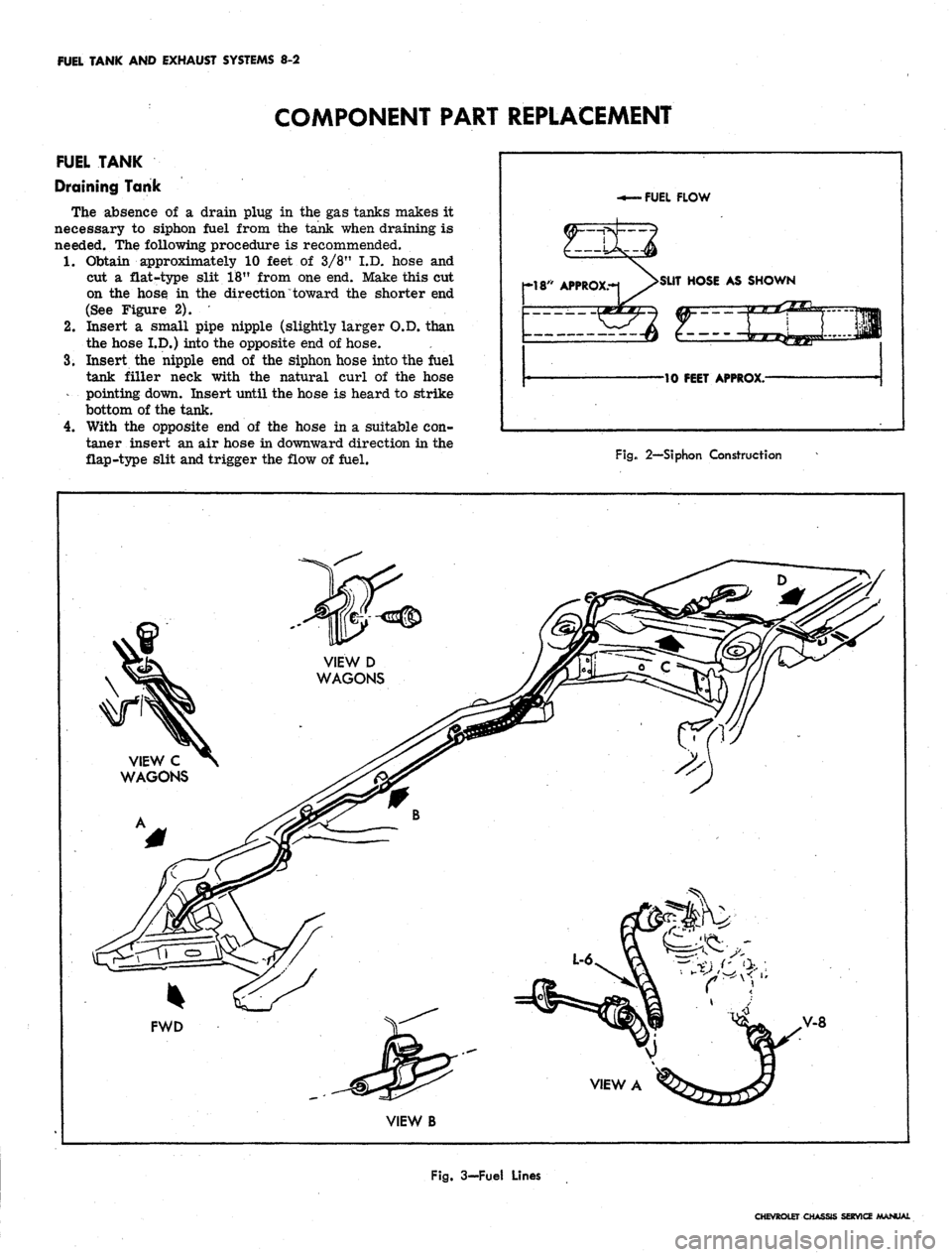
Obtain approximately 10 feet of 3/8" I.D. hose and
cut a flat-type slit 18" from one end. Make this cut
on the hose in the direction "toward the shorter end
(See Figure 2).
2.
Insert a small pipe nipple (slightly larger O.D. than
the hose I.D.) into the opposite end of hose.
3.
Insert the nipple end of the siphon hose into the fuel
tank filler neck with the natural curl of the hose
pointing down. Insert until the hose is heard to strike
bottom of the tank.
4.
With the opposite end of the hose in a suitable con-
taner insert an air hose in downward direction in the
flap-type slit and trigger the flow of fuel.
FUEL FLOW
-If*
APPROX.-1 >SUT «<>«
AS SHOWN
10 FEET APPROX.-
Fig. 2—Siphon Construction
FWD
V-8
VIEW B
Fig. 3-Fuel Lines
CHEVROLET CHASSIS SERVICE MANUAL
Page 414 of 659
FUEL TANK AND EXHAUST SYSTEMS
8-8
CHEVELLE
FUEL TANKS
INDEX
Page
General Description.
g.g
Component Part Replacement
8-8
Fuel Tanks
. 8-8
Fuel Lines
8-8
Metering Units (Gauge, Sending Unit)
Fuel Tank Filler Neck Caps.
. .
Fuel Tank Vent Lines
Page
8-8
8-8
8-9
GENERAL DESCRIPTION
All models
use a 20
gallon capacity (approx.) fuel tank
mounted between
the
frame rails behind
the
rear axle.
The fuel tanks
are
basically
the
same
for
sedan, 2-seat
station wagon
and
pickup models except
for
filler neck
location
and
venting
(fig. 8).
All fuel tanks
are
vented
to the
atmosphere. Sedan
model tanks have
an
external vent hose and pipe assem-
bly
(fig. 11) and use a
non-vented fuel cap. Station wagon
and pickup model tanks
are
vented through
a
hose
and
vent pipe assembly
to the
filler neck
(fig. 8)
and
use a
vented, anti-surge type
gas cap. The
fuel caps
are two
different designs conforming
to SAE
standards
and are
not interchangeable.
The filler neck assembly
on
sedan models
is a
rear
fill design located behind
the
center
bar of the
bumper.
Station wagon
and
sedan pickup model filler neck assem-
blies
are
located
in
the left rear quarter panel.
The fuel pickup pipe
is
built integrally with
the
tank
gauge, located
at the
top-front center
of
the tank.
A
fine
mesh screen
is
located
at
the bottom-end
of the
fuel pick-
up pipe
to
prevent
the
entrance
of
foreign material into
the fuel system.
The sedan fuel tanks
are
held
in
place
by
two metal
straps attached individually
to the
underbody
at
each
end.
The straps hinge
at the
forward end and secure
the
tank
at
the
rear with
an
adjustable bolt
and nut
assembly.
The station wagon
and
pickup models have
a
frame
mounted fuel tank secured with straps
to
front and rear
supports.
COMPONENT PART REPLACEMENT
FUEL TANK
Draining Tank
The absence
of a
drain plug
in the gas
tanks makes
it
necessary
to
siphon fuel from
the
tank when draining
is
needed. Refer
to the
recommended draining procedures
previously outlined under Chevrolet Models
in
this
section.
Removal
and
Installation (Sedan Models)
1.
Raise vehicle.
2.
Drain fuel tank.
3.
Disconnect fuel pickup line
and
gauge wires from
tank unit.
4.
Disconnect vent hose from tank.
5. Remove tank support straps and lower tank carefully.
6.
To
install, reverse
the
removal procedure.
Removal
and
Installation
(Station Wagon
and
Pickup)
1.
Follow Steps
1
thru
3
outlined under sedan models.
2.
Remove tank support straps.
3.
Remove frame screw attachments from
the
front
support
(fig. 8).
4.
Guide tank forward
and
remove.
5.
To
install, reverse removal procedure.
FUEL LINES
The fuel lines, extending from fuel tank toiiuelpump,
are routed
on the
underside
of the
underbody along
the
right side
of the
vehicle opposite
the
single exhaust
sys-
tem.
The
fuel lines should occasionally
be
inspected
for
leaks,
kinks,
or
dents.
If
evidence
of
dirt
is
found
in the
carburetor
or
fuel pump
on
disassembly,
the
lines should
be disconnected
and
blown
out.
Check
the
fuel tank
strainer
for
damage
or
omission. Fuel lines
are of 5/16"
diameter tubing with beaded type ends
for
connections
of
hoses.
FUEL PIPE RETAINER
CUP
Removal
and
Installation
If fuel pipes
and
retainer clips
are
removed, Tool
J-7777 should
be
used
to
install
new
retainer clips
(fig.
10).
After removal
of the old
clip from
the
frame, position
the
new
clip
in the
location
of the old
clip. Index
the
"blind rivet"
and
press hard (hand pressure should
do)
to expand rivet.
GAUGE UNIT
AND
FUEL STRAINER
Removal
and
Installation
(Fig. 11)
1.
Drain tank
to a
level below
the
unit.
2.
Disconnect fuel pickup line
and
gauge unit wire.
3.
Use
special Tool J-8950
to
remove
cam
lock.
Re-
move unit
and
rubber gasket.
CAUTION: Carefully remove unit
so as not to
damage screen
on the end of
the pipe.
4.
Clean screen
by
blowing
out
with compressed
air.
5. Reverse procedure
to
install.
FUEL TANK FILLER NECK CAPS
The fuel tank filler neck caps
are
non-vented with
an
anti-surge feature. Station wagons have vented caps.
(Refer
to
"Fuel Tank Vent Lines").
CHEVROLET CHASSIS SERVICE MANUAL
Page 419 of 659
FUEL TANK
AND
EXHAUST SYSTEMS
8-13
CHEVY II
FUEL TANKS
INDEX
Page
Page
General Description.
8-13
Component Part Replacement
8-13
Fuel Tanks
8-13
Fuel Lines
8-14
Metering Units (Gauge Sending Unit)
8-13
Fuel Tank Filler- Neck Caps.
. . 8-14
Fuel Tank Vent Lines .......
8-14
GENERAL DESCRIPTION
ANTI-SQUEAK
MA'
ANTI-SQUEAK
MATERIAL
SEDANS
STATION WAGON
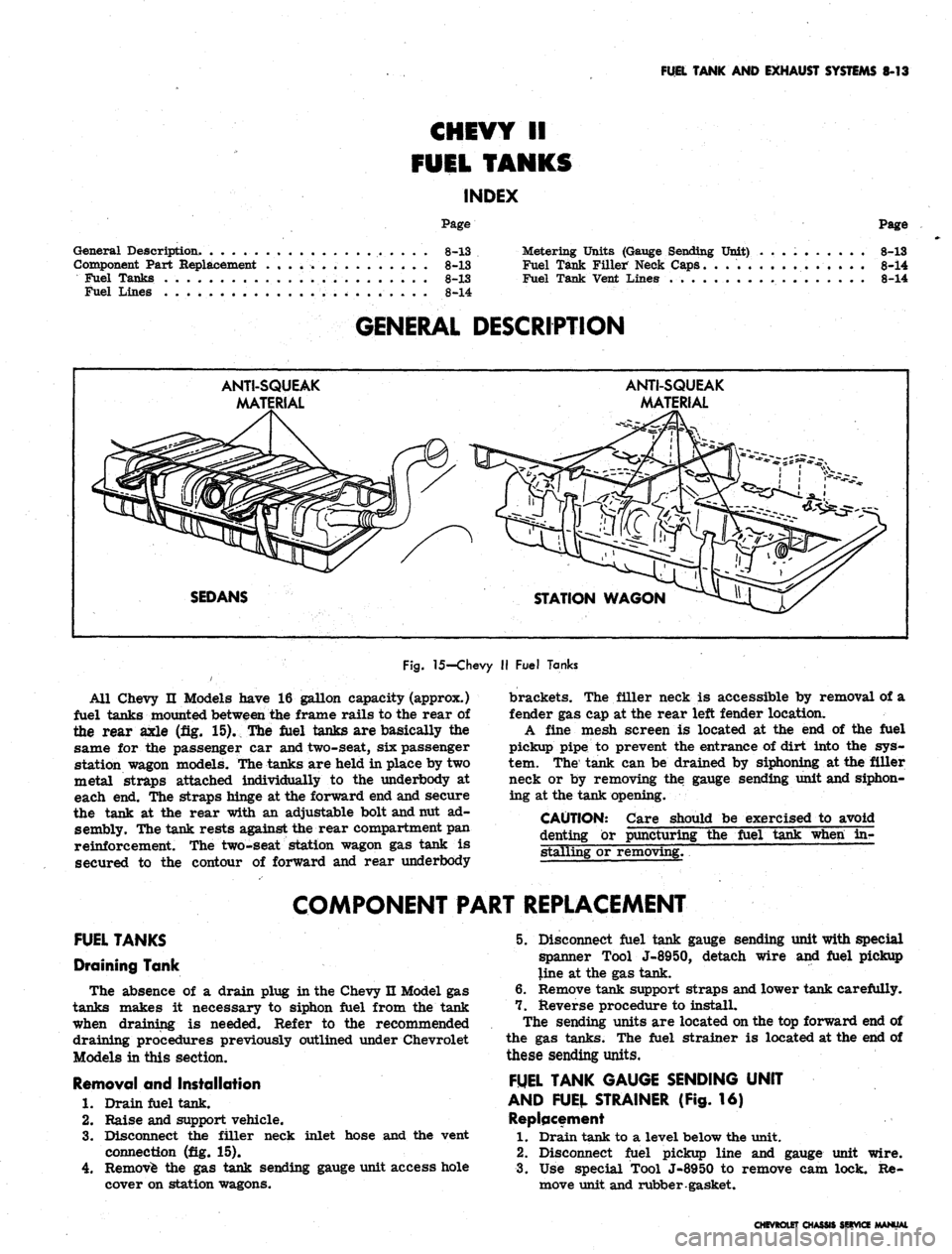
Fig.
15-Chevy
II
Fuel Tanks
All Chevy
II
Models have
16
gallon capacity (approx.)
fuel tanks mounted between
the
frame rails
to the
rear
of
the rear axle
(fig. 15). The
fuel tanks
are
basically
the
same
for the
passenger
car
and two-seat,
six
passenger
station wagon models. The tanks
are
held
in
place
by two
metal straps attached individually
to the
underbody
at
each
end. The
straps hinge
at the
forward
end
and secure
the tank
at the
rear with
an
adjustable bolt and nut
ad-
sembly. The tank rests against the rear compartment
pan
reinforcement.
The
two-seat station wagon
gas
tank
is
secured
to the
contour
of
forward
and
rear underbody
brackets.
The
filler neck
is
accessible
by
removal
of a
fender
gas cap at the
rear left fender location.
A fine mesh screen
is
located
at the end of the
fuel
pickup pipe
to
prevent
the
entrance
of
dirt into
the sys-
tem.
The
tank
can be
drained
by
siphoning
at the
filler
neck
or by
removing
the
gauge sending unit and siphon-
ing
at the
tank opening.
CAUTION: Care should
be
exercised
to
avoid
denting
or
puncturing
the
fuel tank when
in-
stalling
or
removing.
~
COMPONENT PART REPLACEMENT
FUEL TANKS
Draining Tank
The absence
of a
drain plug
in
the Chevy
n
Model
gas
tanks makes
it
necessary
to
siphon fuel from
the
tank
when draining
is
needed. Refer
to the
recommended
draining procedures previously outlined under Chevrolet
Models
in
this section.
Removal
and
Installation
1.
Drain fuel tank.
2.
Raise
and
support vehicle.
3.
Disconnect
the
filler neck inlet hose
and the
vent
connection
(fig. 15).
4.
Remove
the gas
tank sending gauge unit access hole
cover
on
station wagons.
5. Disconnect fuel tank gauge sending unit with special
spanner Tool J-8950, detach wire
and
fuel pickup
line
at the gas
tank.
6. Remove tank support straps and lower tank carefully.
7. Reverse procedure
to
install.
The sending units
are
located on
the top
forward
end of
the
gas
tanks.
The
fuel strainer
is
located
at the end of
these sending units.
FUEL TANK GAUGE SENDING UNIT
AND FUEL STRAINER
(Fig. 16)
Replacement
1.
Drain tank
to a
level below
the
unit.
2.
Disconnect fuel pickup line
and
gauge unit wire.
3.
Use
special Tool J-8950
to
remove
cam
lock.
Re-
move unit and rubber gasket.
CHEVROLET CHASSIS SERVICE MANUAL
Page 441 of 659
SECTION
9
STEERING
CONTENTS
OF
THIS SECTION
Standard Steering
9-1
Power Steering
9-33
Special Tools
9-40
STANDARD STEERING
INDEX
Page
General Description 9.x
Maintenance and Adjustments 9.1
Adjustments
........................
9-2
Steering Gear 9-2
Steering Wheel Alignment and Higji
Point Centering. . . . 9-4
Toe-in Adjustment 9-4
Corvette Steering Ratio . . . . 9-4
Component Replacement and Repairs . . . . 9-4
Steering Wheel . . . 9-4
Regular Production 9-4
Simulated Wood . . . . 9-5
Corvette Telescoping 9-5
Steering Coupling . 9-6
Steering Gear . 9-9
Sector Shaft Seal Replacement 9-10
Steering Column 9-10
Removal 9-10
Disassembly—Syncromesh Column 9-12
Page
Assembly—Syncromesh Column . . 9-14
Disassembly—Column Mounted Powerglide
Lever or Floor Shift Column 9-16
Assembly-^Column Mounted Powerglide
Lever or Floor Shift Column g_x7
Disassembly—Tilt Column 9-19
Assembly—Tilt Column 9-21
Disassembly—Standard Corvette Column 9-23
Assembly—Standard Corvette Column 9-25
Disassembly—Corvette Telescoping Column .... 9.26
Assembly—Corvette Telescoping Column 9-27
Installation 9.27
Steering Linkage 9.29
Tie
Rods.
. 9-29
Relay Rod . . 9-31
Idler Arm . . . . 9-31
Pitman Arm. . 9-32
Steering Arms • • • • 9-32
Steering Damper 9-32
GENERAL DESCRIPTION
The regular production steering gear
is the
recirculat-
ing ball type. This gear provides
for
ease
of
handling
by
transmitting forces from worm
to
sector gear through
ball bearings.
The
steering linkage
is of
the relay type,
and extended interval lubrication design, with the pitman
arm connected
to one end of
the relay
rod. The
other
end
of
the
relay
rod is
connected
to an
idler
arm
which
is
connected
to the
frame side rail opposite
the
steering
gear.
Two
adjustable
tie
rods connect
the
relay
rod to
the steering arms.
All passenger
car
models
for 1967 are
equipped with
new energy absorbing steering columns.
The
mast jacket,
shift tube,
and
steering shaft
are
designed
to
collapse
under various front impact conditions.
All new
columns
are
of
this design, including
the
tilt option and telescope
option.
MAINTENANCE
AND
ADJUSTMENTS
The manual steering gear
is
filled
at the
factory with
a
water resistant grease. Seasonal change
of
this lubrica-
tion
is
unnecessary and
the
housing should
not be
drained.
The steering gear lubricant level should
be
checked every
36,000 miles. Whenever required, additions should
be
made using
a
water resistant
EP
chassis lubricant.
Check and fill steering gear
as
follows:
1.
Remove lower
and
outboard cover retaining screws
(fig.
1).
2.
Insert filling device
in
lower screw hole.
3.
Inject lubricant until
it
appears
in
outboard screw
hole; gear
is now
filled
to
correct level.
The steering linkage should
be
lubricated with water
resistant
EP
chassis lubricant every 6,000 miles
or six
months, whichever occurs first. Lubrication points
and
additional information
on the
chassis lubricant
to be
used
can
be
found
in
Section
0 --
General Information
and
Lubrication.
CHEVROLET CHASSIS SERVICE MANUAL
Page 442 of 659

STEERING 9-2
Fig.
1—Cover
Attaching Bolts—Chevy li Shown
ADJUSTMENTS
STEERING
GEAR
Before any adjustments are made to the steering gear
in an attempt to correct such conditions as shimmy,
loose or hard steering etc., a careful check should be
made of front end alignment, shock absorbers, wheel
balance and tire pressure for possible cause.
Correct adjustment of the steering gear is very im-
portant. Perform adjustments following the sequence
listed below,
1.
Remove pitman arm nut and mark relation of pitman
arm position to sector shaft. Remove pitman arm
with Tool J- 6632 as shown in Figure 2.
2.
Loosen the pitman shaft lash adjuster screw locknut
and turn the adjuster screw a few turns in a counter-
clockwise direction (fig. 3). This removes the load
Fig. 2—Removing Pitman Arm
imposed on the worm bearings by the close meshing
of rack and sector teeth. Turn steering wheel gently
in one direction until stopped by gear, then back away
about one turn.
CAUTION: Do not turn steering wheel hard
against stops when steering relay rod is discon-
nected as damage to ball guides may result.
3.
All except Corvette and telescopic columns:
a. Disconnect steering column harness at chassis
wiring connector plug.
b.
Remove horn cap or ornament and using an inch
pound torque wrench and socket on steering wheel
nut, measure torque required to keep the wheel
in motion.
LASH ADJUSTER
SCREW
LOCK NUT
WORM BEARING
ADJUSTER
\
WORM
ADJUSTER
Fig.
3—Steering Gear Adjustment Points
CHEVROLET CHASSIS SERVICE MANUAL
Page 450 of 659

STEERING 9-10
SECTOR SHAFT SEAL REPLACEMENT
A faulty seal may be replaced without removal of
steering gear from car by removing pitman arm as out-
lined under Maintenance and Adjustments--Steering Gear
Adjustments and proceed as follows:
1.
Loose lash adjuster lock nut and turn lash adjuster
screw several turns counterclockwise.
2.
Remove three cap screws holding side cover to gear
bushing.
3.
Pull side cover and sector shaft from gear housing
as a unit. Do not separate side cover from sector
shaft.
4.
Pull sector shaft seal from gear housing using
hooked tool or pliers.
5. Coat new seal with chassis grease and position in
sector shaft bore.
6. Place a socket or piece of pipe of suitable diameter
on top of seal and drive seal into bore by tapping
pipe or socket with soft hammer.
7. Install sector shaft side cover assembly, being care-
ful not to damage new seal with splines on end of
shaft; splines may be wrapped with a few turns of
tape to prevent this.
8. Install new side cover gasket and align side cover on
gear housing and install cap screw.
9. Perform steering gear adjustment and install pitman
arm as outlined under Maintenance and Adjustments.
STEERING COLUMN
All models are equipped with new energy absorbing
steering columns. The columns are of five basic designs
as follows:
1.
Syncromesh. The syncromesh column is used on
models with standard, column mounted, conventional
shift levers. The shift tube, within the outer mast
jacket, includes two lower shift levers for connection
to the transmission control linkage.
2.
Automatic and floor shift. This column is used on
models equipped with column mounted powerglide
shift levers, or models with floor shift. If the ve-
hicle has the column mounted powerglide shift con-
trol, the inner shift tube has a single lower shift
lever for connection to the transmission control
linkage. On floor shift models, no lower shift levers
are present on the shift tube.
3.
Tilt wheel option. The upper end and steering shaft
of this column is specially designed to accommodate
the optional tilt steering wheel.
4.
Standard Corvette Column. The standard Corvette
column is similar in design to the Automatic and
Floor Shift column used on other models, except
no shift tube is used. Other differences are pointed
out in the disassembly and assembly procedures for
Standard Corvette column.
5. Telescopic wheel option. The upper end and steering
shaft of this column is specially designed to ac-
commodate the optional telescoping steering wheel.
To perform service procedures on steering column
upper end components, it is not necessary to remove the
column from the vehicle. The steering wheel, horn com-
ponents, turn signal switch, upper housing with bearing,
shift control lever, hazard warning knob, and upper shift
bowl may all be removed with the column remaining in
the vehicle. When servicing the above components, omit
the removal procedure and proceed with the applicable
disassembly procedures. Because of the numerous dif-
ferences in steering column types, be sure to refer to the
set of instructions below which apply to the exact column
to be serviced:
CAUTION: The outer mast jacket, shift tube, _
steering shaft, and instrument panel column
mounting b
racket
are designed as energy ab-
sorbing units. Because of the design of these
components, it is absolutely necessary to handle
the column with care when performing any serv-
ice operation required. Avoid hammering, jar-
ring, dropping, or leaning on any portion of the
column.
Removal
1.
Disconnect steering column harness at connector.
Disconnect neutral safety switch and back-up lamp
switch connectors if so equipped.
Remove steering wheel as outlined in this section.
Remove nuts and washers securing flanged end of
column to steering gear. On Chevy H models, re-
move nut and clamp bolt securing lower end of steer-
ing column to steering gear.
Disconnect transmission control linkage, if so
equipped, from lower column shift tube, levers.
Chevrolet and Chevy II only: Remove screws at-
taching upper and lower mast jacket covers together.
On Chevrolet, remove screws attaching lower cover
to instrument panel (figs. 15 and 18). Remove lower
cover.
Chevelle only: Remove screws securing mast jacket
trim cover to instrument panel and remove cover
(fig. 15).
Corvette, only: Remove screws securing escutcheon
to instrument panel. Remove screws securing upper
and lower covers together and remove covers.
On Chevrolet and Chevelle columns with Powerglide
shift levers, loosen set screw at six o'clock position
at bottom of column and remove the transmission
shift indicator pointer (fig. 15).
9. Chevrolet only (fig. 19):
a. Remove screws securing cover trim to dash
panel and remove cover trim.
2.
3.
4.
5.
6.
7.
8.
Fig.
18—Mast Jacket Cover Attachments—Chevy II
CHEVROLET CHASSIS SERVICE MANUAL
Page 469 of 659

STEERING 9-29
column mounting bracket, and place bracket in cor-
rect position on underside of instrument panel.
Loosely install bracket using bracket to column
mounting screws and bracket to instrument panel
washers and bolts.
NOTE: Steering shaft to gear clamp must be
tightened before column attaching bolts are
torqued. Refer to "Steering Gear-Chevy n",
installation procedure, for correct Chevy II
steering column alignment procedure.
5.
Camaro only (fig. 60):
Lay wedge shim in position on instrument panel
column mounting bracket and place bracket in cor-
rect position on underside of instrument panel.
Loosely install bracket using bracket to column
mounting screws, nuts, and washer and bolt as shown
in Figure 60.
6. Corvette only (fig. 61):
Loosely secure column mounting bracket to sup-
port plate and instrument panel with washers and
bolts.
7.
Secure flanged end of column to steering coupling
with lockwashers and nuts. On Chevy n, connect col-
umn to steering gear with clamp, clamp bolt, and
nut. On Corvette, slide steering shaft flange into
lower coupling
half,
and install upper clamp bolt
loosely; also secure support, seal and clamp loosely
at dash on engine side.
8. Tighten instrument panel mounting bracket bolts and
nuts.
Refer to torque specifications at rear of manual
for correct torque values.
9. Chevrolet only (fig. 15):
Place upper and lower mast jacket covers in po-
sition and secure covers together and to instrument
panel using nuts and screws as shown in Figure 15.
10.
Chevy H only (fig. 18):
Place lower mast jacket cover in position under
mast jacket and secure to upper cover with screws.
11.
CheveUe only (fig. 15):
Place mast jacket trim cover in position over col-
Fig.
61—Instrument Panel Mounting Bracket and
Support Plqte—Corvette
umn on underside of instrument panel and secure
with screws.
12.
Corvette only (fig. 14):
Slide escutcheon into position at instrument panel
and secure with screws. Place upper end lower
covers in position and secure with screws.
13.
On Chevrolet and CheveUe models with column
mounted powerglide controls, secure transmission
shift indicator pointer into position with set screw
(fig. 15). ,
14.
Chevrolet only (fig. 19):
a. Secure seal and cover to dash panel with screws.
b.
Place clamp assembly in position and install
clamp screw.
c. Install dash panel trim cover with mounting
screws.
15.
Chevelle only (fig. 20):
a. Secure seal and inner and outer covers to dash
panel with screws.
b.
Secure inner and outer covers together with
screws.
c. Install trim cover to dash panel with two
retainers.
16.
Chevy H only (fig. 21):
a. Secure seal, retainer, and clamp to dash panel
with screws.
b.
Install clamp screw.
c. Slide collar into position. Pinch and staple upper
tabs together.
17.
Camaro only (fig. 22):
a. Secure seal, upper cover, and lower cover to
dash panel with screws.
b.
Secure upper and lower cover together with
screws.
c. Fold rubber boot over securely against dash panel
to conceal covers.
18.
Corvette only (fig. 23):
a. Secure seal and support assembly to dash panel
on engine compartment side.
b.
Tighten clamp, washer, and clamp bolt on engine
compartment side.
19.
Connect transmission linkage to lower shift tube
levers in engine compartment, if column is so
equipped. Adjust levers as outlined in Section 7.
20.
Install steering wheel as outlined in this section.
21.
Connect directional signal, horn, back-up lamp, and
neutral start switch at wiring harness plugs. Adjust
back-up lamp, neutral start switch as outlined in
Section 12.
22.
Adjust steering gear and align and center steering
wheel as outlined in this section.
STEERING LINKAGE (Fig. 62)
TIE RODS
There are two tie rod assemblies used on all models.
Each assembly is of three piece construction, consisting
of a sleeve and two tie rod ends. The ends are threaded
into the sleeve and locked with clamps. Right and left
hand threads are provided to facilitate toe-in adjustment
and steering gear centering.
The tie rod ends are self-adjusting for wear and re-
quire no attention in service other than periodic lubrica-
tion and occasional inspection to see that ball studs are
tight. Replacement of tie rod ends should be made when
CHEVROLET CHASSIS SERVICE MANUAL