ABS CHEVROLET CAMARO 1967 1.G Chassis User Guide
[x] Cancel search | Manufacturer: CHEVROLET, Model Year: 1967, Model line: CAMARO, Model: CHEVROLET CAMARO 1967 1.GPages: 659, PDF Size: 114.24 MB
Page 177 of 659
FRONT SUSPENSION ,3-13
6. Carefully lower the inner end of the control arm.
Tension on the spring will be removed before the
spring can be removed from the vehicle.
7.
Remove the spring.
Installation
1.
With the suspension set up as in Step 2 of the disas-
sembly procedure, insert a block of wood between the
upper control arm and the spring tower to keep the
arm up out of the way.
2.
Set the spring in place on the crossmember after
checking on proper positioning necessary.
3.
Install the steel bar and wood block as shown in Fig-
ure 20 and lift the control arm up until the inner
pivot cam bolt can be installed. ,
4.
Install the outer cam and loosely install the lock
washer and nut
5.
Set the cam bolt on the mark scribed during the re-
moval procedure and hold in this position while tight-
ening the nut (See specifications at the end of this
book).
6. Replace the strut rod to lower control arm nuts,
bolts and lock washers, the stabilizer bar link, the
shock absorber, the tie rod end, and the wheel and
tire.
7.
Lower vehicle to floor and install the shock absorber
upper stem retaining nut retainer and grommet.
8. Check the camber adjustment.
Chevelle and Camaro
Removal
1.
With an open end wrench hold the shock absorber up-
per stem from turning, and then, remove the upper
stem retaining nut, retainer and rubber grommet.
2.
With the car supported by the frame so that the con-
trol arms hang free, remove the wheel and tire as-
sembly (replace one wheel nut to retain the brake
drum),
shock absorber, and stabilizer bar to lower
control arm link.
4.
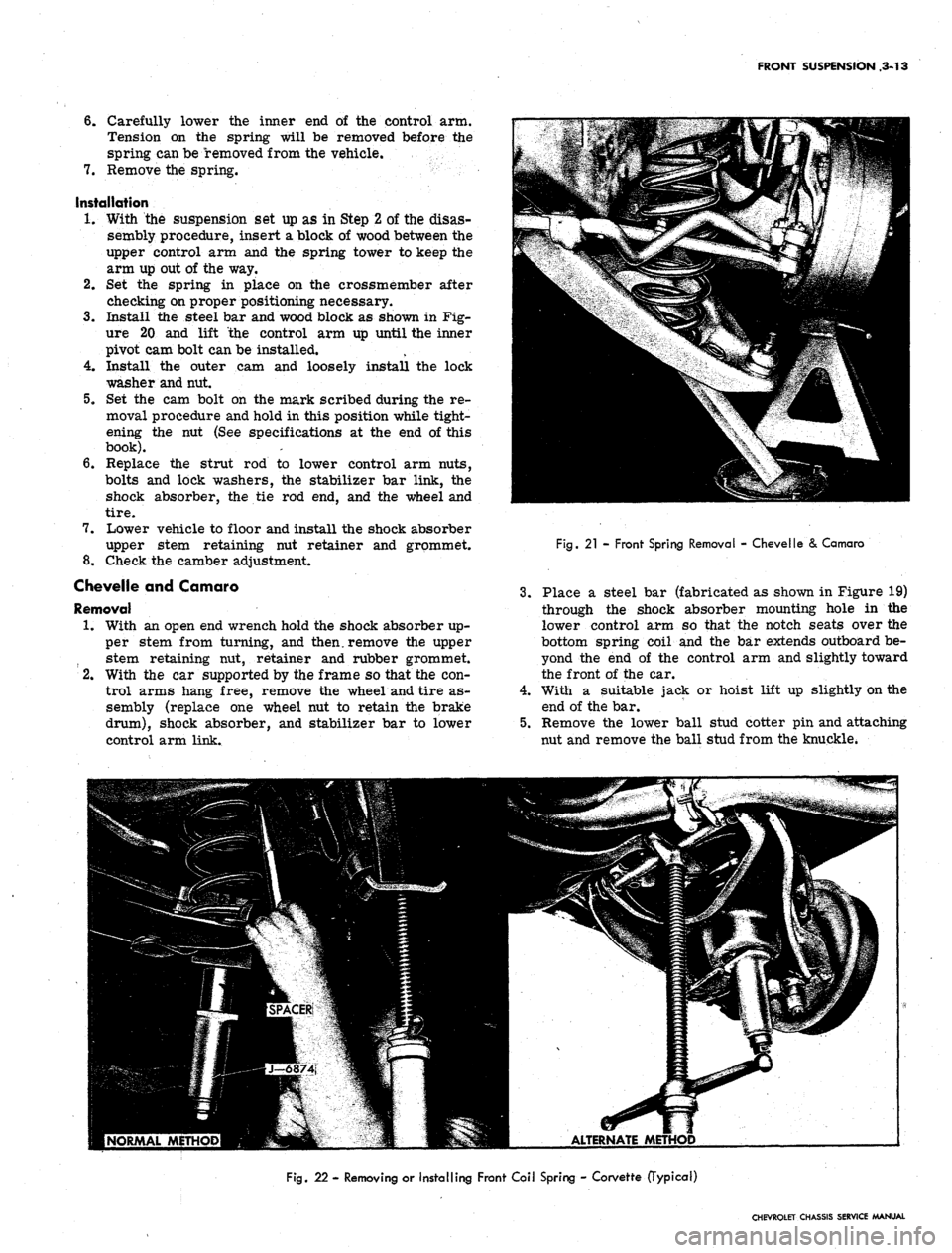
5.
Fig.
21 - Front Spring Removal - Chevelle & Camaro
Place a steel bar (fabricated as shown in Figure 19)
through the shock absorber mounting hole in the
lower control arm so that the notch seats over the
bottom spring coil and the bar extends outboard be-
yond the end of the control arm and slightly toward
the front of the car.
With a suitable jack or hoist lift up slightly on the
end of the bar.
Remove the lower ball stud cotter pin and attaching
nut and remove the ball stud from the knuckle.
ALTERNATE METHOD
Fig.
22 - Removing or Installing Front Coil Spring - Corvette (Typical)
CHEVROLET CHASSIS SERVICE MANUAL
Page 178 of 659
FRONT SUSPENSION 3-14
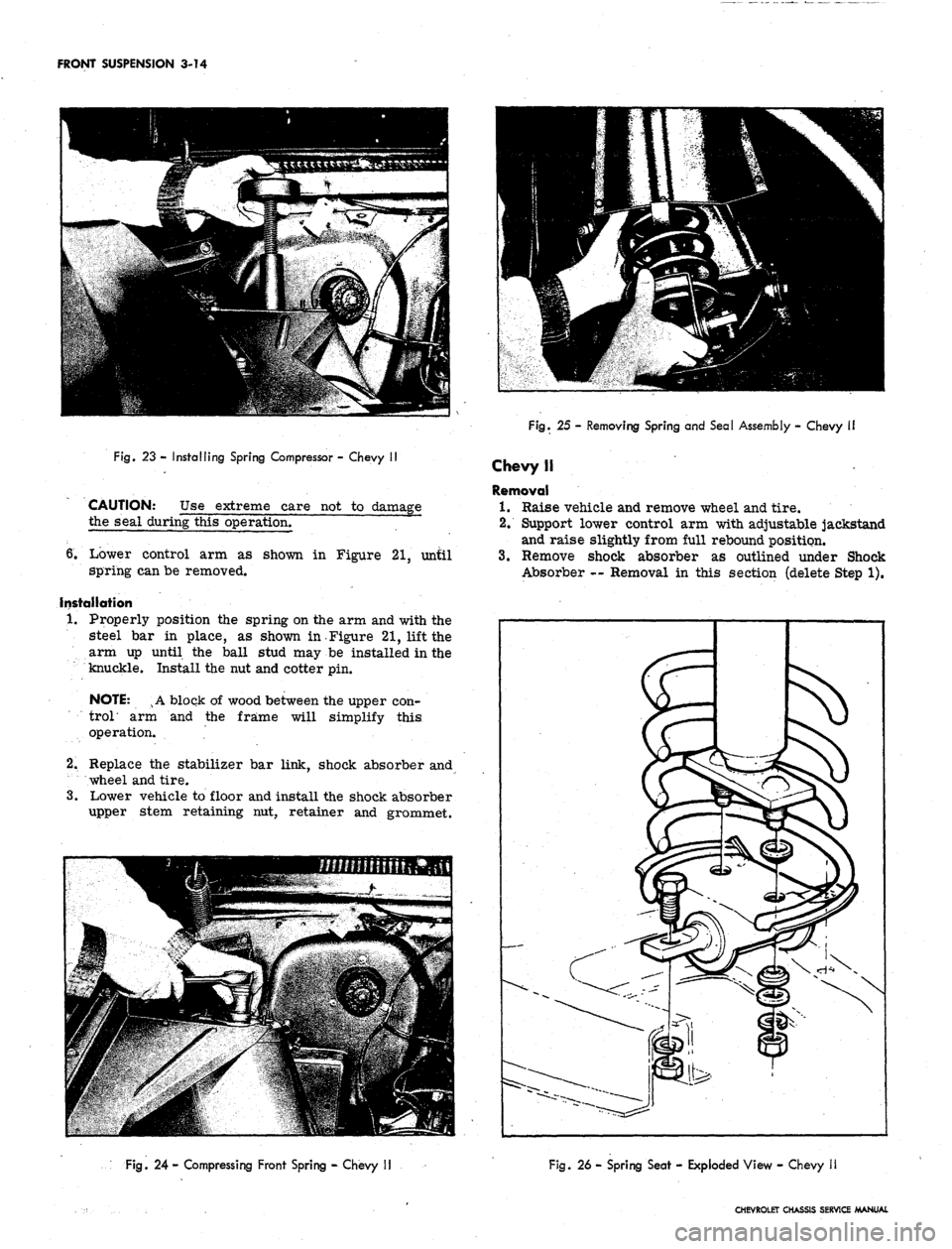
Fig.
23 - Installing Spring Compressor - Chevy II
CAUTION: Use extreme care not to damage
the seal during this operation.
6. Lower control arm as shown in Figure 21, until
spring can be removed.
Installation
1.
Properly position the spring on the arm and with the
steel bar in place, as shown in.Figure 21, lift the
arm up until the ball stud may be installed in the
knuckle. Install the nut and cotter pin.
NOTE:
^A block of wood between the upper con-
trol' arm and the frame will simplify this
operation.
2.
Replace the stabilizer bar link, shock absorber and
wheel and tire.
3.
Lower vehicle to floor and install the shock absorber
upper stem retaining nut, retainer and grommet.
Fig.
25 - Removing Spring and Seal Assembly - Chevy 11
ChevyiI
Removal
1.
Raise vehicle and remove wheel and tire.
2.
Support lower control arm with adjustable jackstand
and raise slightly from full rebound position.
3.
Remove shock absorber as outlined under Shock
Absorber -- Removal in this section (delete Step 1).
Fig.
24 - Compressing Front Spring - Chevy
Fig.
26 - Spring Seat - Exploded View - Chevy II
CHEVROLET CHASSIS SERVICE MANUAL
Page 179 of 659
FRONT SUSPENSION 3-15
4.
Insert Spring Compressor J-
6874-
4-
5 with Adapters
J-6874-8-9 into upp^r spring tower so that lower
MU"
bolt fits into shock absorber mounting holes in
spring seat (fig. 23). Secure the two lower studs to
the spring seat with nuts.
5.
Fit the tool upper pilot to top of spring and compress
spring by tightening upper nut (fig. 24). Compress
spring until screw is bottomed out.
6. Remove lower spring seat retaining nuts, lift spring
and seat assembly from control arm and guide it
down and out through fender skirt (fig. 25).
Spring Seat Replacement (Fig. 26)
1.
Release spring tension and disconnect spring com-
pressor from spring seat.
2.
Install new spring seat to spring compressor.
Installation
1.
If spring is to be replaced, install new spring into
tool and compress spring until screw is bottomed
out.
NOTE: Spring coil ends must be against spring
stops in upper and lower seats.
2.
Lift spring and tool assembly into place and position
so that the upper spring stop is inboard.
NOTE: Locating tab on upper spring seat may
be flattened before reinstalling spring.
3.
Install lower spring seat to control arm and torque
nuts as shown in the Specifications.
4.
Loosen spring compressor until spring is properly
seated in upper spring tower and remove.
5.
Install shock abosrber as outlined under Shock Ab-
sorber—Installation in this section.
Corvette
Removal
1.
With car on suitable hoist or jack, (support vehicle
by frame so control arms may swing free) remove
wheel and tire assembly, stabilizer bar and shock
absorber. Loosen the lower ball joint to steering
knuckle nut, and the' two lower control arm cross
shaft bushing bolts.
2.
Place Tool J-6874-1 across top of sixth coil (ap-
prox.),
then loosely secure Tool J-6874-2 to the up-
per shoe, with attaching capscrews and lock washers.
The upper shoe "V" notch and lower shoe raised land
should contact spring.
3.
Insert Tool J-6874 up through center of spring and
attach to upper and lower shoe assembly.
4.
Position spacers under shock absorber mounting hole
and against bottom of lower control arm. Install
special bearing washer and Tool J-6874-5. Locate
bearing against spacer and large washer against
bearing. Feed screw up through large washer bear-
ing and spacer and thread into Tool J-6874 and
tighten snugly (fig. 22).
5.
Center shoe assembly on spring and tighten screw
until a very slight compression is placed on spring
(fig. '22). Then firmly tighten down the two cap-
screws securing the upper and lower shoes to lock
these shoes to spring.
6. Turn head of screw until spring is compressed just
enough to clear the spring tower, then remove the
lower ball joint to steering knuckle nut (fig. 22).
NOTE: It may be necessary to assist the
spring out of the spring tower with a pry bar or
a similar tool.
7.
Disconnect the lower ball joint from the steering
knuckle and lower the control arm with the com-
pressed spring. Immediately release compression
on spring by backing off long screw. Release spring
and tool and withdraw spring.
CAUTION: The spring force under compres-
sion is very large. Exercise every safety pre-
caution when performing this operation to see
that individuals and materials subject to damage
are removed from the path of the spring when
the control arm is being lowered. Also, the
compressed spring
be relaxed immedi-
ately after lowering the control arm to reduce
the time of exposure to the large compressive
force.
Installation
1.
Position spring with closely coiled end up. Place
Tool J-6874-1 across the top of the sixth coil (ap-
prox.) then loosely secure Tool J-6874-2 to the
upper shoe with attaching capscrews and lock wash-
ers.
The upper shoe MV" notch and lower shoe
raised land should contact spring.
2.
Insert Tool J-6874 up through center of spring and
attach to upper and lower shoe assembly with bolt
and nut.
3.
Set spring in its seat on the lower control arm.
4.
Position spacers centrally under shock absorber
mounting hole and against bottom of lower control
arm. Install bearing, large washer and Tool
J-6874-5.
Locate bearing against spacer and large
washer against bearing. Feed the screw up through
large washer, bearing and spacer and thread into
yoke rod. Tighten snugly, but do not start to draw
down yet
5.
Center the shoe assembly on the spring and tighten
the lag screw until a very slight compression is
placed on spring, then firmly tighten down the two
capscrews securing the upper and lower shoes. This
will lock the shoes to the coil spring.
6. Turn head of screw until spring is compressed just
enough to clear the spring tower.
NOTE: It may be necessary to assist the
spring into the spring tower with a pry bar or
similar tool.
7.
Immediately install the lower ball joint into steering
knuckle and secure in place with attaching nut.
8. Release compression on spring and at the same time
use a drift to guide the coil spring into its proper
seat. End of coils must be 3/8" from coil stops in
spring seat.
9. Tighten the lower ball joint to steering knuckle nut
and lock with cotter key.
10.
Install shock absorber and stabilizer bar.
11.
Install wheel, tire and drum assembly.
12.
Remove car from hoist or jack stands.
13.
Tighten the two lower control cross shaft bushing
bolts to 45-55 lbs. ft. torque.
NOTE: If a suitable adjustable jack-stand is
CHEVROLET CHASSIS SERVICE MANUAL
Page 180 of 659
FRONT SUSPENSION 3-16
available the following procedure may also be
used (fig. 22-Alternate Method).
1.
Support car on suitable hoist or jack (so control
arms may swing free) and remove the wheel and
tire assembly, shock absorber, and stabilizer link
at control arm.
2.
Place suitable jack stand under the lower control
arm cross shaft.
3.
Follow Steps 2-5 as outlined on previous page.
4.
Turn head of tool screw to partially compress
spring.
5. Remove the three control arm cross shaft attaching
bolts,
washers and nuts.
6. Carefully lower jack stand and if necessary increase
compression on spring and when coil spring is out of
its upper seat, relax tension on spring (fig. 22).
7. By using a pry bar to assist, if necessary, remove
the coil spring from the lower control arm.
8. Installation is the reverse of the above procedure.
Carefully follow instructions for installing spring
tool.
LOWER CONTROL ARM SPHERICAL JOINT
Chevrolet, Chevelle, Comoro and Corvette
Inspection
The lower control arm spherical joint should be re-
placed whenever wear is indicated in the upper joint
inspection.
NOTE: The lower control arm spherical joint
is a loose fit in the assembly when not connected
to the steering knuckle.
Only if inspection of each upper joint indicates them
both to be within limits, inspect each lower joint for ex-
cessive wear as follows:
1.
After reconnecting upper joints to steering knuckles,
support vehicle weight on wheels or wheel hubs.
2.
With outside micrometer or caliper, measure dis-
tance from top of lubrication fitting to bottom of ball
stud, and record the dimensions for each side.
3.
Then support vehicle weight at outer end of each
lower control arm, so that wheels or wheel hubs are
free,
then repeat Step 2.
4.
If the difference in dimensions on either side is
greater than 1/16" (.0625"), the joint is excessively
worn and both lower joints should be replaced.
If inspection of lower spherical joints does not indicate
excessive wear, inspect further as follows:
5.
On Chevrolet Only--Examine lubrication hole in each
joint assembly after cleaning out hole. Look for evi-
dence of the liner partially or fully blocking lubrica-
tion opening. Such evidence indicates that liner is
disintegrating and that both lower spherical joints
should be replaced.
Another indication of lower spherical joint excessive
wear is indicated when difficulty is experienced when
lubricating the joint. If the liner has worn to the point
where the lubrication grooves in the liner have worn
away, then abnormal pressure is required to force lubri-
cant through the joint. This is another reason to recom-
mend replacement of both lower joints.
If the above inspections do not indicate any reason for
spherical joint replacements, test the torque tightness of
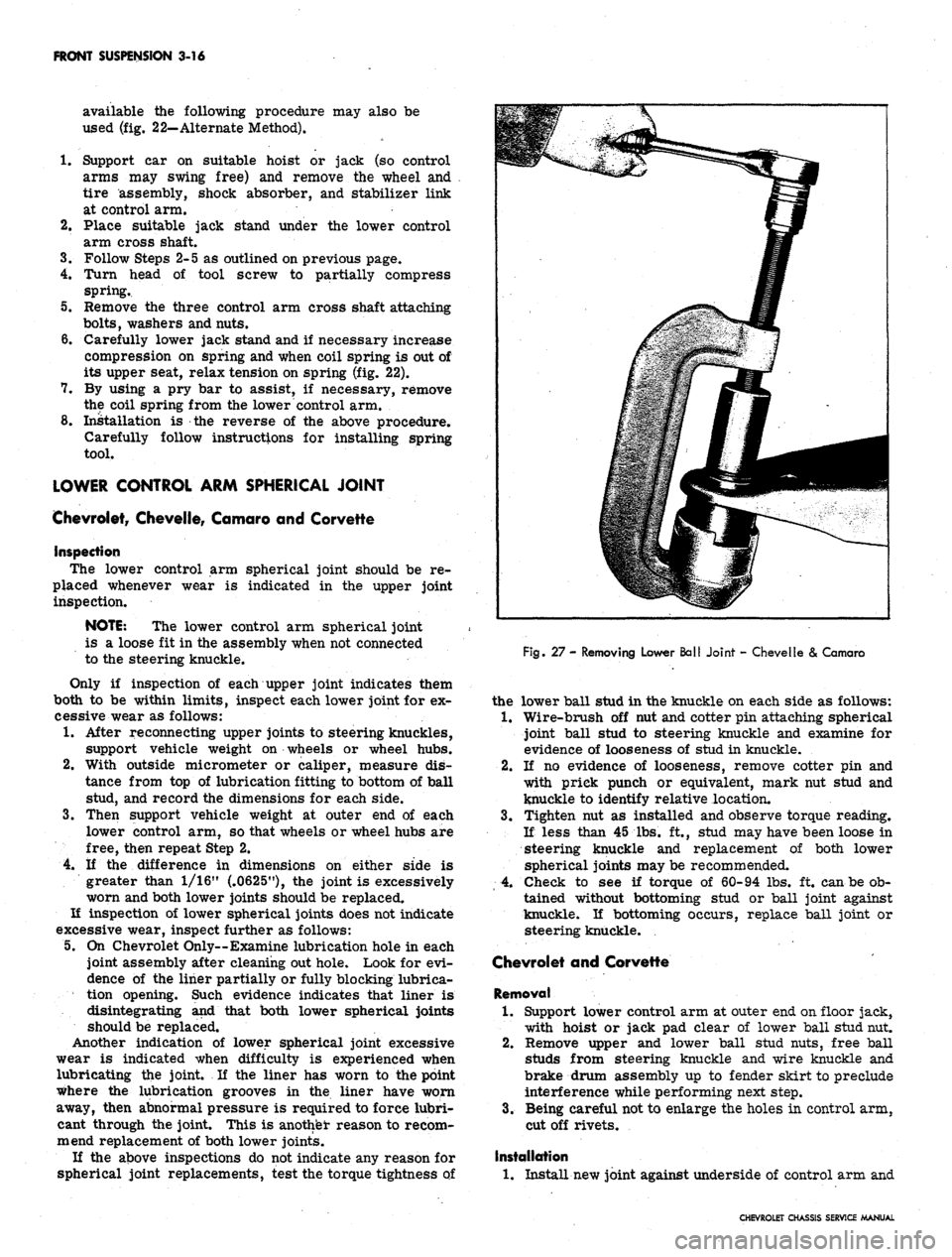
Fig. 27 - Removing Lower Ball Joint - Chevelle
&
Camaro
the lower ball stud in the knuckle on each side as follows:
1.
Wire-brush off nut and cotter pin attaching spherical
joint ball stud to steering knuckle and examine for
evidence of looseness of stud in knuckle.
2.
If no evidence of looseness, remove cotter pin and
with prick punch or equivalent, mark nut stud and
knuckle to identify relative location.
3.
Tighten nut as installed and observe torque reading.
If less than 45 lbs. ft., stud may have been loose in
steering knuckle and replacement of both lower
spherical joints may be recommended.
4.
Check to see if torque of 60-94 lbs. ft. can be ob-
tained without bottoming stud or ball joint against
knuckle. If bottoming occurs, replace ball joint or
steering knuckle.
Chevrolet and Corvette
Removal
1.
Support lower control arm at outer end on floor jack,
with hoist or jack pad clear of lower ball stud nut.
2.
Remove upper and lower ball stud nuts, free ball
studs from steering knuckle and wire knuckle and
brake drum assembly up to fender skirt to preclude
interference while performing next step.
3.
Being careful not to enlarge the holes in control arm,
cut off rivets.
Installation
1.
Install new joint against underside of control arm and
CHEVROLET CHASSIS SERVICE MANUAL
Page 186 of 659

FRONT SUSPENSION
3-22
CHEVROLET
s-L 1 \
TYPICAL
OF
-^-x ^K CORVETTE, CHEVELLE AND CAMARO
CHEVY n
Rg.
37 - Upper Control Arm Attachment
NOTE:
Additional support to upper control
arm may be necessary while chiseling.
7. Clean ball joint seat in arm and inspect for cracking
or other evidence of fatigue. If cracks are present at
the rivet holes or ball joint opening, replace arm as
outlined later in this section.
8. Attach replacement ball joint assembly to the control
arm, using special bolts furnished with replacement
kit.
NOTE:
Use only special hardened bolts fur-
nished with this replacement kit. Do not attempt
to use other non-hardened bolts and do not at-
tempt to rivet replacement ball joint to arm.
9. Raise lower control arm and steering knuckle as-
sembly into position, insert upper ball stud into up-
per steering knuckle and install stud nut. Torque
nut as shown in the specifications and insert new
cotter pin. Install stabilizer and strut rod.
10.
Lubricate ball joint, install wheel and tire and re-
move adjustable jackstand.
11.
Lower vehicle and remove upper control arm spacer.
12.
Check and readjust caster and camber angles where
necessary.
LUBE FITTINGS
Special self threading type lube fittings are used in the
spherical joint assemblies. If it is necessary to replace
a fitting a standard threaded type may be used. However,
replacement spherical joint assemblies are supplied less
the lube fitting. Therefore it will be necessary to install
a self threading type fitting into the untapped hole pro-
vided when replacing the entire assembly.
UPPER CONTROL ARM
Chevrolet, Chevelle, Camaro and Corvette
(Fig.
37)
Removal
1.
Support vehicle weight at outer end of lower control
arm.
2.
Remove wheel and tire assembly.
3.
Remove cotter pin and nut from upper control arm
ball stud. ,
4.
REMOVE The stud from knuckle.
5. Remove two nuts retaining upper control arm shaft to
front crossmember. (Chevelle, Camaro and Cor-
vette—Note number of shims at each bolt.)
6. Remove the bolts attaching the control arm to the
frame to allow proper clearance for control arm
removal if necessary.
7. Remove upper control arm from vehicle.
Installation
1.
Install upper control arm in vehicle.
2.
Install nuts, bolts and lock washers retaining upper
control arm shaft to frame. (Chevelle, Camaro and
Corvette—Install same number of shims as removed
at each bolt.)
3.
Torque nuts as shown in the Specifications at the end
of this book.
4.
Install ball stud through knuckle, install nut, tighten
and install cotter pin.
5. Install wheel and tire assembly.
6. Lower vehicle to floor.
7. Bounce front end of vehicle to centralize bushings
and tighten bushing collar bolts as shown in the
Specifications.
Chevy II (Fig. 37)
Removal
1.
Remove spring and shock absorber as outlined above.
2.
Position adjustable jackstand under lower control
arm.
3.
Remove cotter pin and nut from upper ball joint stud
and strike steering knuckle boss to loosen stud.
4.
Drop lower control arm and steering knuckle
assembly.
CHEVROLET CHASSIS SERVICE MANUAL
Page 187 of 659
FRONT SUSPENSION 3-23
CHEVROLET
J-7052-2
CAMARO
& CHEVELLE
J-21482
CHEVROLET
J-7052-2
CAMARO
& CHEVELLE
J-21482
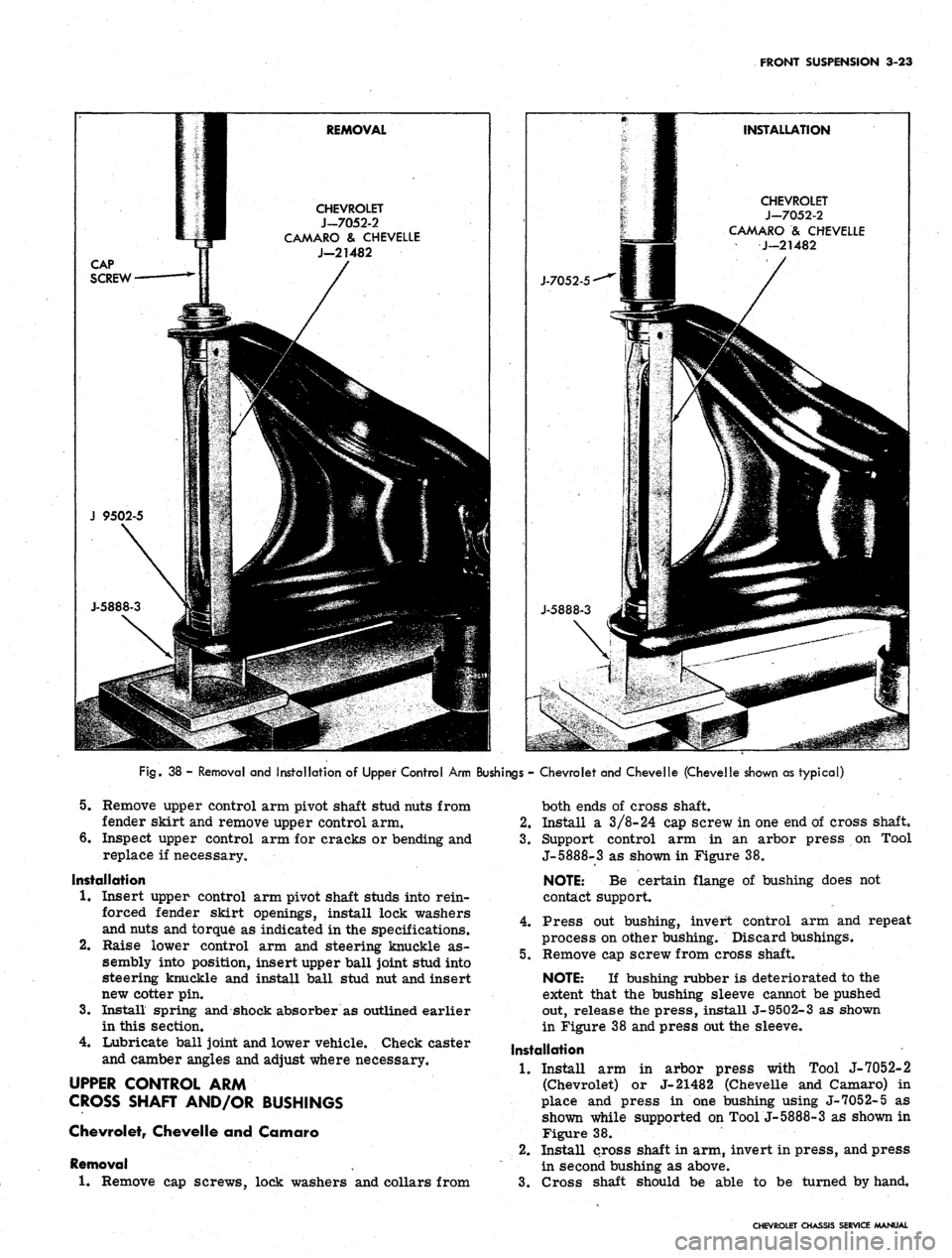
Fig.
38 - Removal and Installation of Upper Control Arm Bushings - Chevrolet and Chevelle (Chevelle shown as typical)
5.
Remove upper control arm pivot shaft stud nuts from
fender skirt and remove upper control arm.
6. Inspect upper control arm for cracks or bending and
replace if necessary.
Installation
1.
Insert upper control arm pivot shaft studs into rein-
forced fender skirt openings, install lock washers
and nuts and torque as indicated in the specifications.
Raise lower control arm and steering knuckle as-
sembly into position, insert upper ball joint stud into
steering knuckle and install ball stud nut and insert
new cotter pin.
Install spring and shock absorber as outlined earlier
in this section.
Lubricate ball joint and lower vehicle. Check caster
and camber angles and adjust where necessary.
UPPER CONTROL ARM
CROSS SHAFT AND/OR BUSHINGS
Chevrolet, Chevelle and Camaro
Removal
1.
Remove cap screws, lock washers and collars from
2.
3.
4.
both ends of cross shaft.
2.
Install a 3/8-24 cap screw in one end of cross shaft,
3.
Support control arm in an arbor press on Tool
J-5888-3 as shown in Figure 38.
NOTE: Be certain flange of bushing does not
contact support.
4.
Press out bushing, invert control arm and repeat
process on other bushing. Discard bushings.
5.
Remove cap screw from cross shaft.
NOTE: If bushing rubber is deteriorated to the
extent that the bushing sleeve cannot be pushed
out, release the press, install J-9502-3 as shown
in Figure 38 and press out the sleeve.
Installation
1.
Install arm in arbor press with Tool J-7052-2
(Chevrolet) or J-21482 (Chevelle and Camaro) in
place and press in one bushing using J-7052-5 as
shown while supported on Tool j-5888-3 as shown in
Figure 38.
2.
Install cross shaft in arm, invert in press, and press
in second bushing as above.
3.
Cross shaft should be able to be turned by hand.
CHEVROLET CHASSIS SERVICE MANUAL
Page 191 of 659
SECTION
4
REAR SUSPENSION
AND
DRIVE LINE
CONTENTS
OF
THIS SECTION
Page
Rear Suspension
4-1
Drive Line.
. 4-26
Rear Axle ......
4-26
Propeller Shaft
and
Universal Joints
Special Tools
4-37
4-43
REAR SUSPENSION
INDEX
General Description
4-1
Chevrolet
4-1
Chevelle
4-1
Chevy
n and
Camaro
. . . . . 4-2
Corvette
. . . . . . 4-3
Maintenance
and
Adjustments ...............
4-4
Riding Height Check (Chevrolet, Camaro,
Chevelle
and
Chevy
II) 4-5
Wheel Alignment (Corvette)
4-5
Wheel Bearing Adjustment (Corvette)
4-6
Component Parts Replacement (Chevrolet, Camaro,
Chevelle
and
Chevy
JJ) 4-7
Coil Spring
4-7
Chevrolet
4-7
Removal
4-7
Installation
4-7
Chevelle
4-8
Removal
4-8
4-8
Installation
.
Leaf Spring, Spring Seat Pads, Spring
Eye
Bushings
4-9
Chevy
H 4-9
Removal
4-9
Installation
4-9
Camaro
4-10
Removal
4-10
Installation
4-11
Shock Absorber
4-11
Chevrolet
and
Chevelle
. 4-11
Removal
4-11
Installation
. . 4-12
Chevy
II 4-12
Removal
4-12
Installation
4-rl2
Camaro
4-12
Removal
. 4-12
Installation
4-12
Control
Arm . . 4-12
Chevrolet Upper
4-12
Removal
. 4-12
Page
Bushing Replacement
. 4-13
Installation
4-14
Chevrolet Lower
4-14
Removal
4-14
Bushing Replacement
4-14
Installation
. 4-15
Chevelle Upper
and
Lower.
. 4-15
Removal
4-15
Bushing Replacement
4-15
Installation
4-17
Rear Suspension
Tie Rod
(Chevrolet)
. . .
......
. . . 4-17
Removal
4-17
Bushing Replacement
4-17
Installation
4-17
Component Parts Replacement (Corvette)
. . 4-17
Wheel Spindle
and
Support
4-17
Removal
4-17
Repairs
', . 4-17
Installation
4-18
Differential Carrier Support Bracket Replacement.
. 4-20
Shock Absorber
4-20
Removal
4-20
Installation
* .... 4-20
Strut
Rod and
Bracket
4-20
Removal
4-20
Repairs
4-21
Installation
4-21
Spring
4-21
Removal
4-21
Repairs
4-22
Installation
4-22
Torque Control
Arm 4-23
Removal
4-23
Repairs
. 4-23
Installation
4-24
Suspension Crossmember
4-24
Removal
4-24
Repairs—Isolation Mount
4-25
Installation
4-25
Stabilizer Shaft Replacement
4-25
GENERAL DESCRIPTION
CHEVROLET
The link type rear suspension (fig. 1) has two lower
control arms which maintain proper axle to frame re-
lationship and also take the acceleration, drive and
braking forces. A single upper control arm on light-
duty models (or two upper control arms on heavy-duty
models and all station wagons) limits axle rotation when
drive, acceleration or braking forces are applied. Lateral
movement of the axle is restricted by the axle-to-frame
tie rod. Two full coil springs and two direct, double
acting shock absorbers are provided for additional ride
control.
CHEVELLE
The rear suspension (fig. 2) is of the four-link design
utilizing axle mounted, full coil springs and direct,
double-acting shock absorbers.
Two rubber-bushed lower control arms, stretching
slightly outboard from axle-mounted brackets to frame
side member mounted brackets, maintain fore and aft
CHEVROLET CHASSIS SERVICE MANUAL
Page 192 of 659

TIE ROD
ATTACHMENT
SHOCK ABS")
REAR SUSPENSION AND DRIVE LINE 4-2
SHOCK ABSORBER
UPPER ATTACHMENT
COIL SPRING
\
R.H. UPPER
CONTROL ARM
LH.
UPPER
CONTROL ARM
(HEAVY DUTY AND
STATION WAGON)
TIE ROD
ATTACHMENT
SHOCK ABSORBER
LOWER ATTACHMENT
LOWER
CONTROL ARM
Fig.
1—Chevrolet Rear Suspension Components
relationship of the axle assembly to the vehicle proper.
These lower control arm axle brackets also mount the
axle rebound bumpers and provide for lower attachment
of the shock absorber. Upper attachment of the shock
absorber is a platform mount to the rear of the coil
spring frame bracket. The coil springs are pigtailed
at both ends; the upper end is isolated from the frame
seat by a rubber insulator, while the lower end seats
on the axle mounted spring bracket which has a vertical
flange to retain the spring.
Sideways movement of the axle assembly is controlled
by two angularly mounted, rubber-bushed upper control
arms.
Projecting ears, cast as part of the differential
carrier, provide for rear attachment and frame cross-
member mounted brackets retain them at the forward
end.
CHEVY 11 AND CAMARO
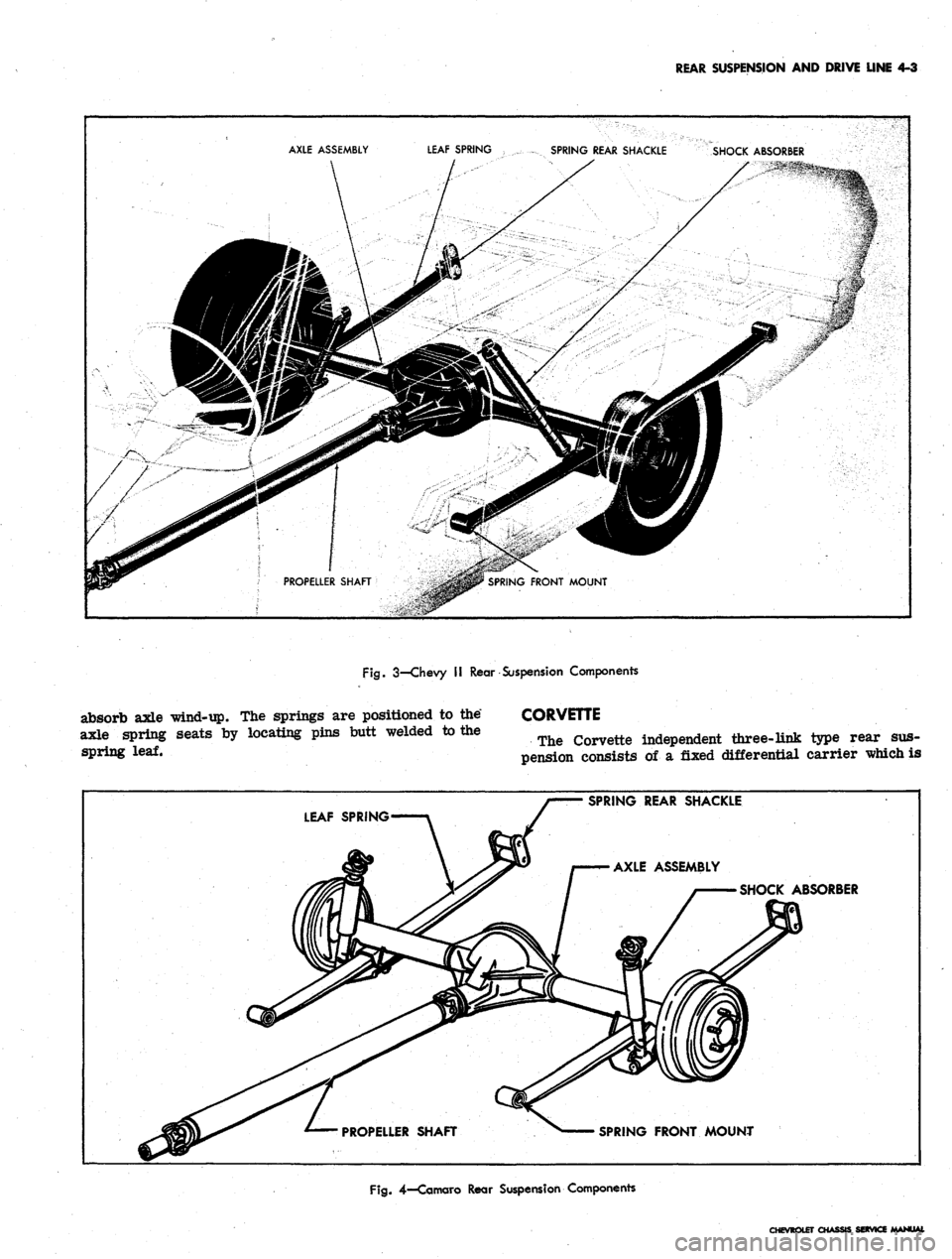
The.Chevy n and Camaro rear suspension (fig. 3 and
fig.
4) consists of two uniformly stressed rear springs
and two shock absorbers mounted to the spring lower
seats.
The
.
springs are rubber mounted at both axle
and frame attaching points, thus insuring uniform spring
loading, minimizing transmittal of road vibration to
passenger compartment, and providing a pivot point to
•MMMi
MMM—Hi—1—1——1——1MMMMiM_
[•?{aw-i
'
"'
i
\ SHOCK^^BBB^^B(^^CO1L
ABSORBER ^HH^ SPRING
g^8^"
_ LOWER
feSfcto^
CONTROL
ARM
Fig.
2—Chevelle Rear Suspension Components
CHEVROLET CHASSIS SERVICE MANUAL
Page 193 of 659
REAR SUSPENSION
AND
DRIVE LINE
4-3
AXLE ASSEMBLY
LEAF SPRING
SPRING REAR SHACKLE
SHOCK ABSORBER
Fig.
3—Chevy
II
Rear Suspension Components
absorb axle "wind-up.
The
springs
are
positioned
to
the*
axle spring seats
by
locating pins butt welded
to
the
spring
leaf.
CORVETTE
The Corvette independent three-link type rear
sus-
pension consists
of a
fixed differential carrier which
is
SPRING REAR SHACKLE
LEAF SPRING
SHOCK ABSORBER
SPRING FRONT MOUNT
Fig.
4—Comoro Rear Suspension Components
CHEVROLET CHASSIS SERVICE MANUAL
Page 194 of 659
REAR SUSPENSION AND DRIVE LINE
4-4
PROPELLER SHAFT
CARRIER FRONT SUPPORT
CAMBER CAM CONTROL ARM
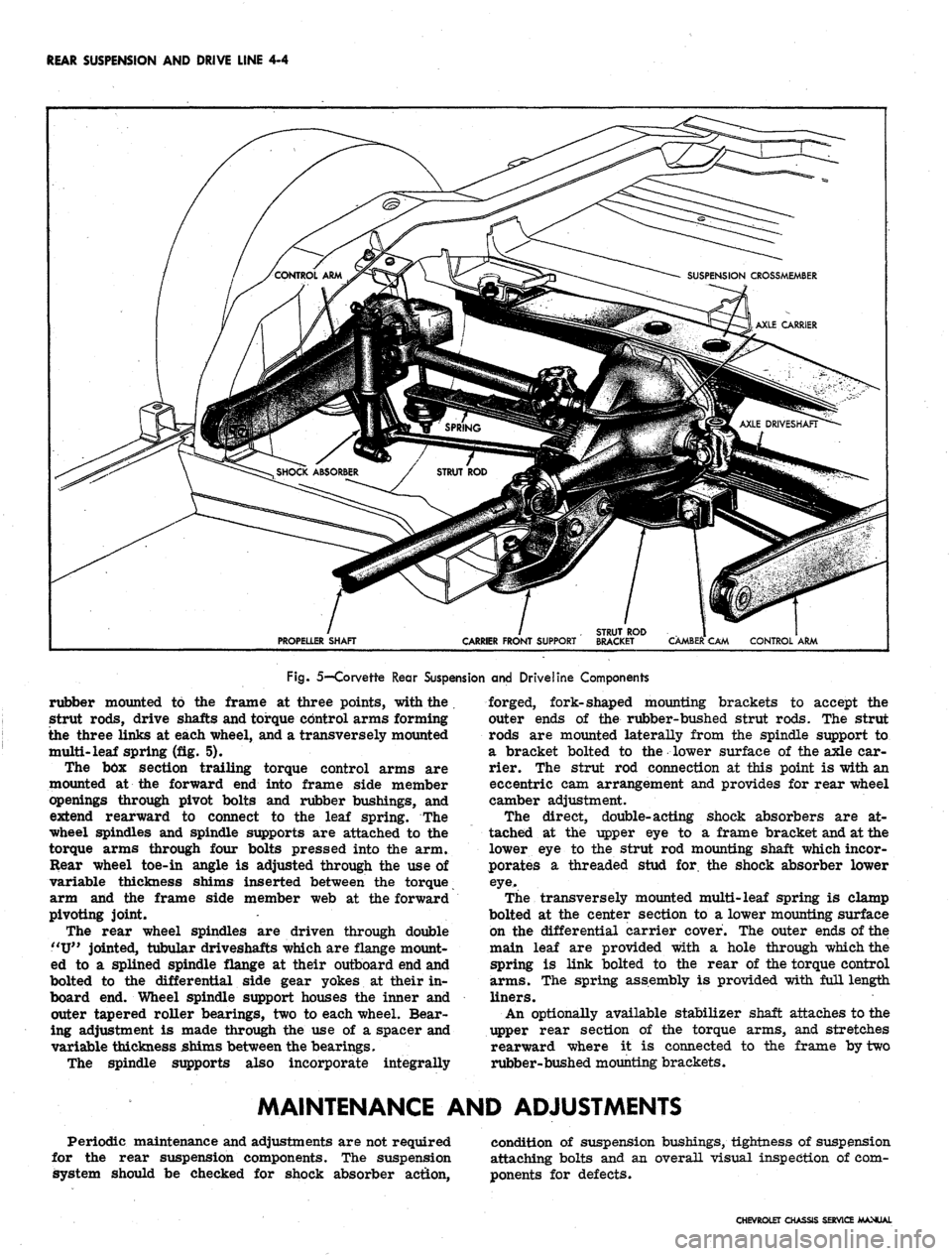
Fig. 5—Corvette Rear Suspension and Driveline Components
rubber mounted to the frame at three points, with the .
strut rods, drive shafts and torque control arms forming
the three links at each wheel, and a transversely mounted
multi-leaf spring (fig. 5).
The bbx section trailing torque control arms are
mounted at the forward end into frame side member
openings through pivot bolts and rubber bushings, and
extend rearward to connect to the leaf spring. The
wheel spindles and spindle supports are attached to the
torque arms through four bolts pressed into the arm.
Rear wheel toe-in angle is adjusted through the use of
variable thickness shims inserted between the torque
arm and the frame side member web at the forward
pivoting joint.
The rear wheel spindles are driven through double
"U"
jointed, tubular driveshafts which are flange mount-
ed to a splined spindle flange at their outboard end and
bolted to the differential side gear yokes at their in-
board end. Wheel spindle support houses the inner and
outer tapered roller bearings, two to each wheel. Bear-
ing adjustment is made through the use of a spacer and
variable thickness shims between the bearings.
The spindle supports also incorporate integrally
forged, fork-shaped mounting brackets to accept the
outer ends of the rubber-bushed strut rods. The strut
rods are mounted laterally from the spindle support to
a bracket bolted to the lower surface of the axle car-
rier. The strut rod connection at this point is with an
eccentric cam arrangement and provides for rear wheel
camber adjustment.
The direct, double-acting shock absorbers are at-
tached at the upper eye to a frame bracket and at the
lower eye to the strut rod mounting shaft which incor-
porates a threaded stud for. the shock absorber lower
eye.
The transversely mounted multi-leaf spring is clamp
bolted at the center section to a lower mounting surface
on the differential carrier cover. The outer ends of the
main leaf are provided with a hole through which the
spring is link bolted to the rear of the torque control
arms.
The spring assembly is provided with full length
liners.
An optionally available stabilizer shaft attaches to the
upper rear section of the torque arms, and stretches
rearward where it is connected to the frame by two
rubber-bushed mounting brackets.
MAINTENANCE AND ADJUSTMENTS
Periodic maintenance and adjustments are not required
for the rear suspension components. The suspension
system should be checked for shock absorber action,
condition of suspension bushings, tightness of suspension
attaching bolts and an overall visual inspection of com-
ponents for defects.
CHEVROLET CHASSIS SERVICE MANUAL