torque CHEVROLET DYNASTY 1993 Manual PDF
[x] Cancel search | Manufacturer: CHEVROLET, Model Year: 1993, Model line: DYNASTY, Model: CHEVROLET DYNASTY 1993Pages: 2438, PDF Size: 74.98 MB
Page 312 of 2438
BENDIX ANTILOCK 4 MODULATOR ASSEMBLY BLEEDING PROCEDURE
(1) Assemble and install all brake system compo-
nents on the vehicle, making sure all hydraulic fluid
lines are installed and properly torqued. (2) Bleed the base brake system, using ONLYthe
bleeding procedure outlined in the Service Adjust-
ments section of this service manual supplement. To perform the bleeding procedure on the ABS modu-
lator assembly, the battery, battery tray and acid shield
must be removed from vehicle. Then reconnect the
vehicle's battery to vehicle's battery cables, using
ONLY approved battery jumper cables. (3) Connect the DRB Diagnostics Tester to the vehi-
cle's diagnostics connector. The vehicle diagnostic con-
nector is located behind the fuse panel access cover on
the lower section of the dash panel left of the steering
column. The diagnostic connector is a blue 6 way
connector. (4) Using the DRB check to make sure the CAB does
not have any stored fault codes. If it does, remove them
using the DRB.
WARNING: WHEN BLEEDING THE MODULATOR AS-
SEMBLY WEAR SAFETY GLASSES. A CLEAR BLEED
TUBE MUST BE ATTACHED TO THE MODULATOR
BLEED SCREWS AND SUBMERGED IN A CLEAR
CONTAINER FILLED PART WAY WITH FRESH CLEAN
BRAKE FLUID. DIRECT THE FLOW OF BRAKE FLUID
AWAY FROM THE PAINTED SURFACES OF THE VE-
HICLE. BRAKE FLUID AT HIGH PRESSURE MAY
COME OUT OF THE BLEEDER SCREWS, WHEN
OPENED.
When bleeding Antilock modulator assembly, the
following bleeding sequence MUSTbe followed to
insure a complete bleeding of all air from the Antilock
brake, and base brake hydraulic systems. The modu-
lator assembly can ONLY be bled using a manual
bleeding procedure to pressurize the hydraulic
system.
MODULATOR ASSEMBLY CIRCUIT BLEEDING PROCEDURE AND SEQUENCE
1 MODULATOR PRIMARY CHECK VALVE CIRCUIT
Note: To bleed hydraulic circuits of the Bendix
Antilock 4 Brake System modulator assembly,
the aid of a second mechanic or helper will be
required to pump the brake pedal. (1) Install a clear bleed tube (such as Tygon) on
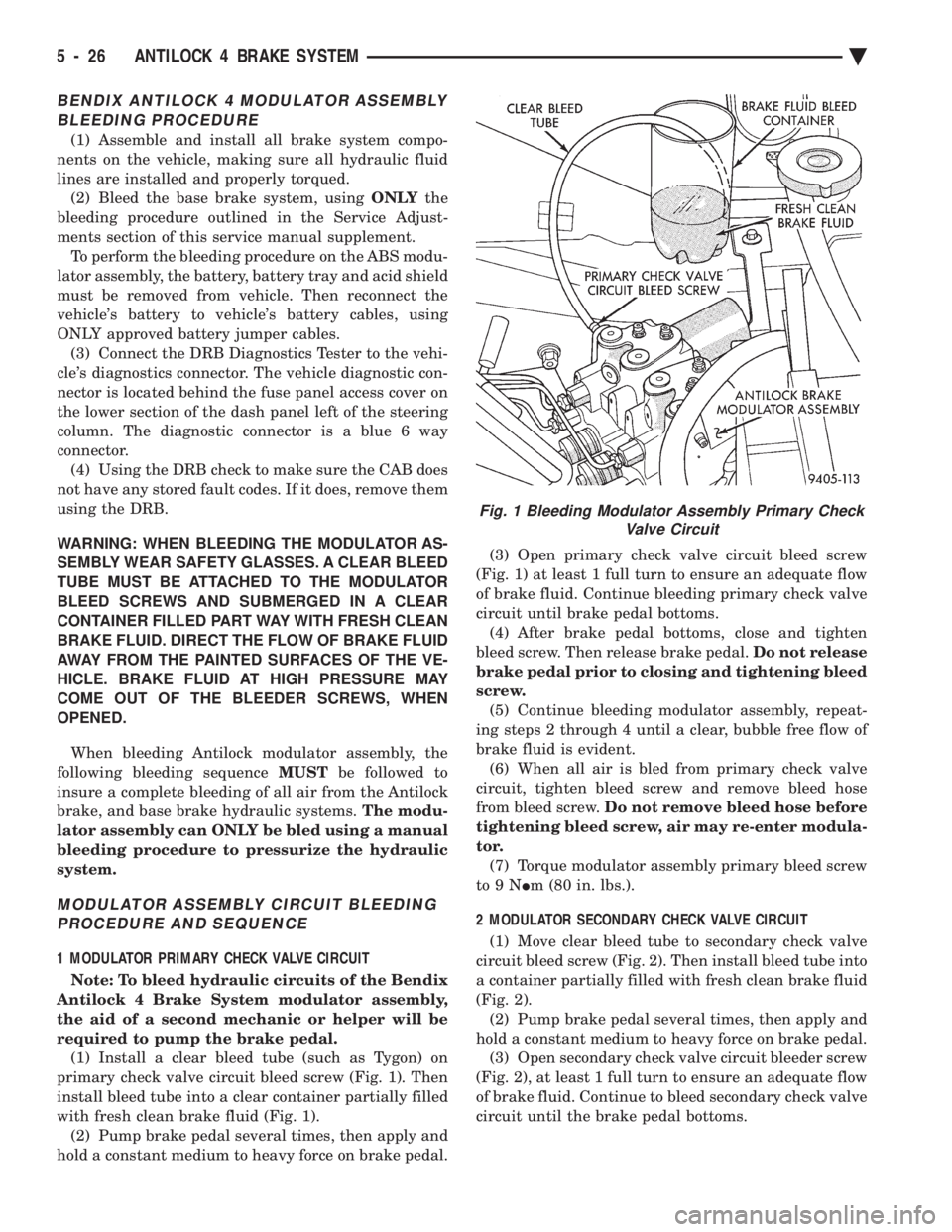
primary check valve circuit bleed screw (Fig. 1). Then
install bleed tube into a clear container partially filled
with fresh clean brake fluid (Fig. 1). (2) Pump brake pedal several times, then apply and
hold a constant medium to heavy force on brake pedal. (3) Open primary check valve circuit bleed screw
(Fig. 1) at least 1 full turn to ensure an adequate flow
of brake fluid. Continue bleeding primary check valve
circuit until brake pedal bottoms. (4) After brake pedal bottoms, close and tighten
bleed screw. Then release brake pedal. Do not release
brake pedal prior to closing and tightening bleed
screw. (5) Continue bleeding modulator assembly, repeat-
ing steps 2 through 4 until a clear, bubble free flow of
brake fluid is evident. (6) When all air is bled from primary check valve
circuit, tighten bleed screw and remove bleed hose
from bleed screw. Do not remove bleed hose before
tightening bleed screw, air may re-enter modula-
tor. (7) Torque modulator assembly primary bleed screw
to9N Im (80 in. lbs.).
2 MODULATOR SECONDARY CHECK VALVE CIRCUIT (1) Move clear bleed tube to secondary check valve
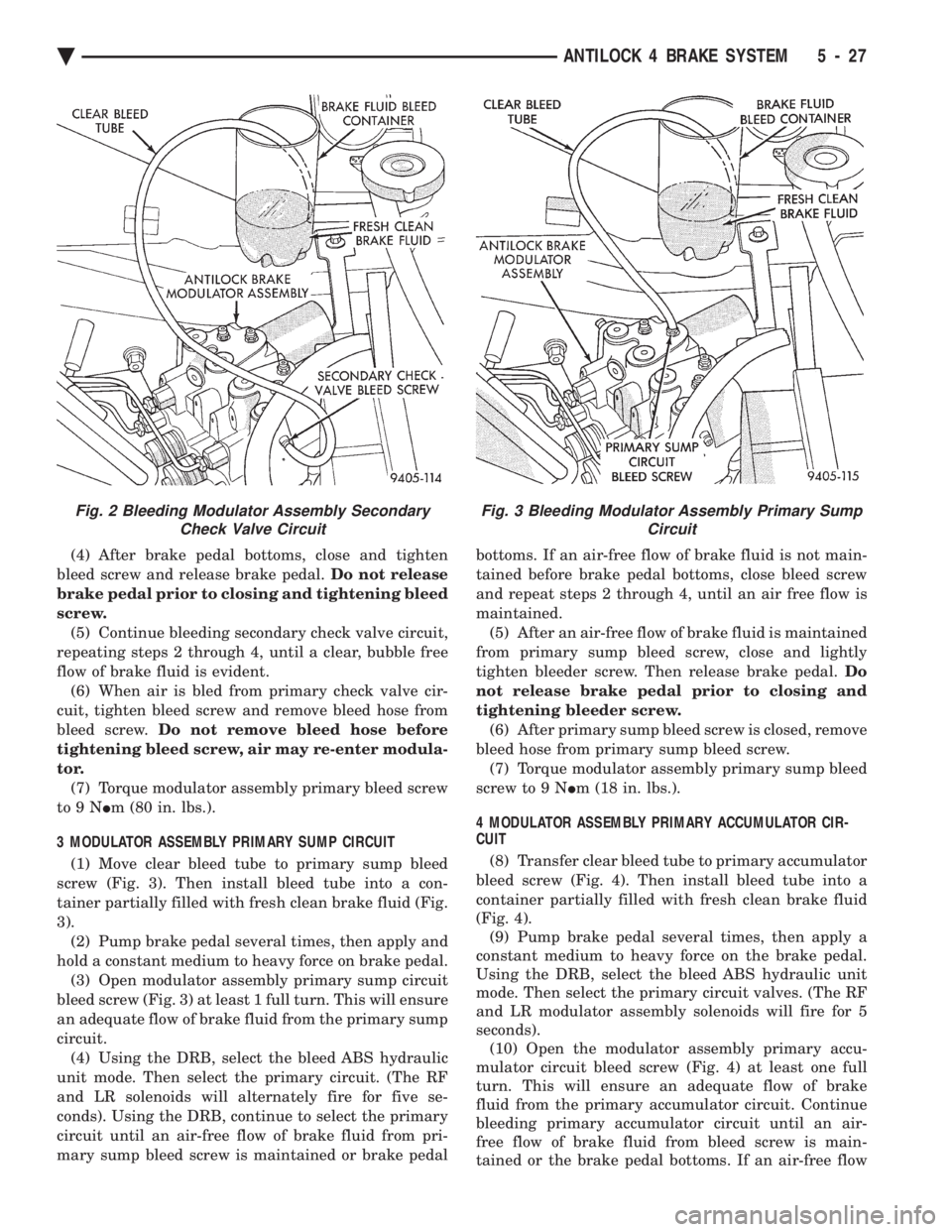
circuit bleed screw (Fig. 2). Then install bleed tube into
a container partially filled with fresh clean brake fluid
(Fig. 2). (2) Pump brake pedal several times, then apply and
hold a constant medium to heavy force on brake pedal. (3) Open secondary check valve circuit bleeder screw
(Fig. 2), at least 1 full turn to ensure an adequate flow
of brake fluid. Continue to bleed secondary check valve
circuit until the brake pedal bottoms.
Fig. 1 Bleeding Modulator Assembly Primary Check Valve Circuit
5 - 26 ANTILOCK 4 BRAKE SYSTEM Ä
Page 313 of 2438
(4) After brake pedal bottoms, close and tighten
bleed screw and release brake pedal. Do not release
brake pedal prior to closing and tightening bleed
screw. (5) Continue bleeding secondary check valve circuit,
repeating steps 2 through 4, until a clear, bubble free
flow of brake fluid is evident. (6) When air is bled from primary check valve cir-
cuit, tighten bleed screw and remove bleed hose from
bleed screw. Do not remove bleed hose before
tightening bleed screw, air may re-enter modula-
tor. (7) Torque modulator assembly primary bleed screw
to9N Im (80 in. lbs.).
3 MODULATOR ASSEMBLY PRIMARY SUMP CIRCUIT (1) Move clear bleed tube to primary sump bleed
screw (Fig. 3). Then install bleed tube into a con-
tainer partially filled with fresh clean brake fluid (Fig.
3). (2) Pump brake pedal several times, then apply and
hold a constant medium to heavy force on brake pedal. (3) Open modulator assembly primary sump circuit
bleed screw (Fig. 3) at least 1 full turn. This will ensure
an adequate flow of brake fluid from the primary sump
circuit. (4) Using the DRB, select the bleed ABS hydraulic
unit mode. Then select the primary circuit. (The RF
and LR solenoids will alternately fire for five se-
conds). Using the DRB, continue to select the primary
circuit until an air-free flow of brake fluid from pri-
mary sump bleed screw is maintained or brake pedal bottoms. If an air-free flow of brake fluid is not main-
tained before brake pedal bottoms, close bleed screw
and repeat steps 2 through 4, until an air free flow is
maintained.
(5) After an air-free flow of brake fluid is maintained
from primary sump bleed screw, close and lightly
tighten bleeder screw. Then release brake pedal. Do
not release brake pedal prior to closing and
tightening bleeder screw. (6) After primary sump bleed screw is closed, remove
bleed hose from primary sump bleed screw. (7) Torque modulator assembly primary sump bleed
screw to 9 N Im (18 in. lbs.).
4 MODULATOR ASSEMBLY PRIMARY ACCUMULATOR CIR-
CUIT
(8) Transfer clear bleed tube to primary accumulator
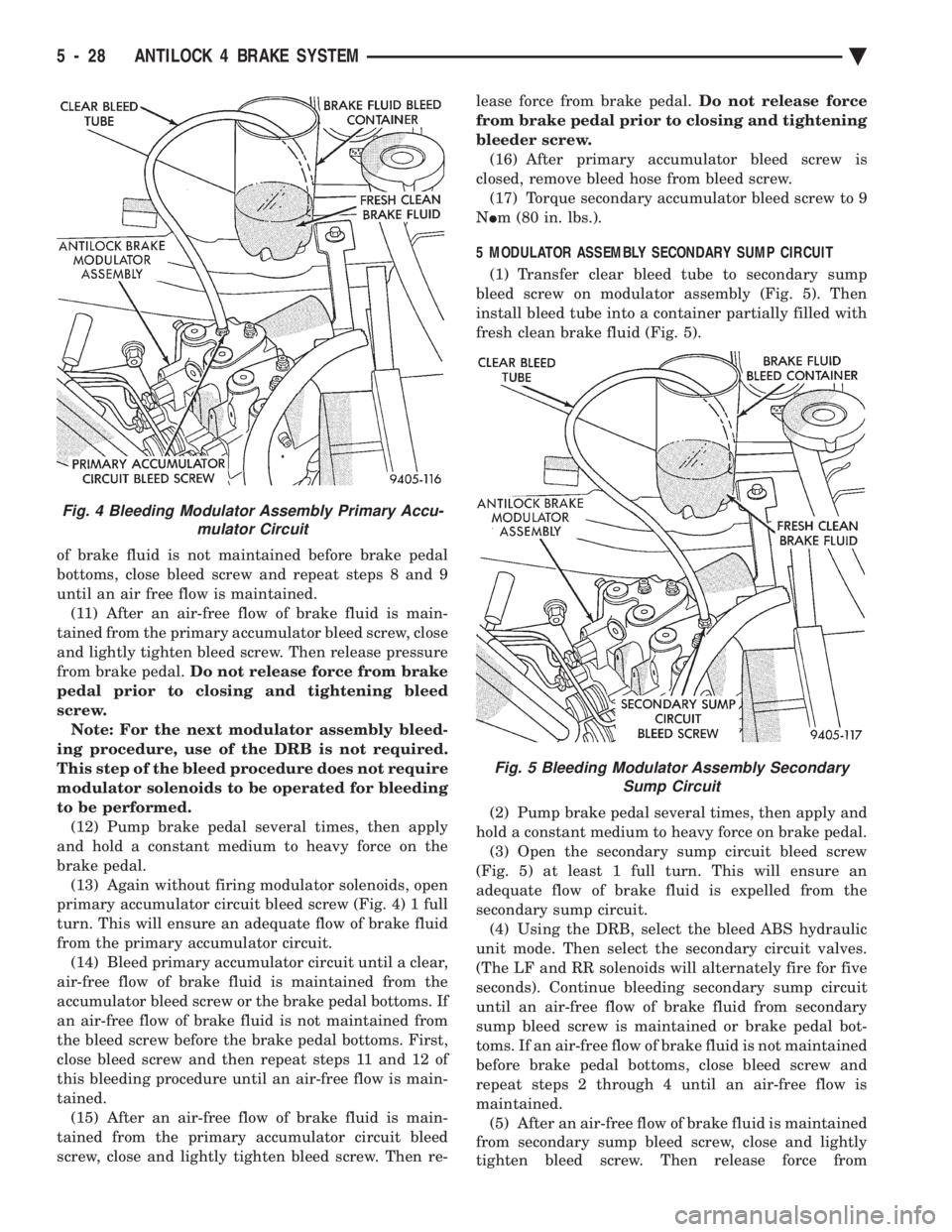
bleed screw (Fig. 4). Then install bleed tube into a
container partially filled with fresh clean brake fluid
(Fig. 4). (9) Pump brake pedal several times, then apply a
constant medium to heavy force on the brake pedal.
Using the DRB, select the bleed ABS hydraulic unit
mode. Then select the primary circuit valves. (The RF
and LR modulator assembly solenoids will fire for 5
seconds). (10) Open the modulator assembly primary accu-
mulator circuit bleed screw (Fig. 4) at least one full
turn. This will ensure an adequate flow of brake
fluid from the primary accumulator circuit. Continue
bleeding primary accumulator circuit until an air-
free flow of brake fluid from bleed screw is main-
tained or the brake pedal bottoms. If an air-free flow
Fig. 3 Bleeding Modulator Assembly Primary Sump CircuitFig. 2 Bleeding Modulator Assembly SecondaryCheck Valve Circuit
Ä ANTILOCK 4 BRAKE SYSTEM 5 - 27
Page 314 of 2438
of brake fluid is not maintained before brake pedal
bottoms, close bleed screw and repeat steps 8 and 9
until an air free flow is maintained.(11) After an air-free flow of brake fluid is main-
tained from the primary accumulator bleed screw, close
and lightly tighten bleed screw. Then release pressure
from brake pedal. Do not release force from brake
pedal prior to closing and tightening bleed
screw. Note: For the next modulator assembly bleed-
ing procedure, use of the DRB is not required.
This step of the bleed procedure does not require
modulator solenoids to be operated for bleeding
to be performed. (12) Pump brake pedal several times, then apply
and hold a constant medium to heavy force on the
brake pedal. (13) Again without firing modulator solenoids, open
primary accumulator circuit bleed screw (Fig. 4) 1 full
turn. This will ensure an adequate flow of brake fluid
from the primary accumulator circuit. (14) Bleed primary accumulator circuit until a clear,
air-free flow of brake fluid is maintained from the
accumulator bleed screw or the brake pedal bottoms. If
an air-free flow of brake fluid is not maintained from
the bleed screw before the brake pedal bottoms. First,
close bleed screw and then repeat steps 11 and 12 of
this bleeding procedure until an air-free flow is main-
tained. (15) After an air-free flow of brake fluid is main-
tained from the primary accumulator circuit bleed
screw, close and lightly tighten bleed screw. Then re- lease force from brake pedal.
Do not release force
from brake pedal prior to closing and tightening
bleeder screw. (16) After primary accumulator bleed screw is
closed, remove bleed hose from bleed screw. (17) Torque secondary accumulator bleed screw to 9
N Im (80 in. lbs.).
5 MODULATOR ASSEMBLY SECONDARY SUMP CIRCUIT (1) Transfer clear bleed tube to secondary sump
bleed screw on modulator assembly (Fig. 5). Then
install bleed tube into a container partially filled with
fresh clean brake fluid (Fig. 5).
(2) Pump brake pedal several times, then apply and
hold a constant medium to heavy force on brake pedal. (3) Open the secondary sump circuit bleed screw
(Fig. 5) at least 1 full turn. This will ensure an
adequate flow of brake fluid is expelled from the
secondary sump circuit. (4) Using the DRB, select the bleed ABS hydraulic
unit mode. Then select the secondary circuit valves.
(The LF and RR solenoids will alternately fire for five
seconds). Continue bleeding secondary sump circuit
until an air-free flow of brake fluid from secondary
sump bleed screw is maintained or brake pedal bot-
toms. If an air-free flow of brake fluid is not maintained
before brake pedal bottoms, close bleed screw and
repeat steps 2 through 4 until an air-free flow is
maintained. (5) After an air-free flow of brake fluid is maintained
from secondary sump bleed screw, close and lightly
tighten bleed screw. Then release force from
Fig. 4 Bleeding Modulator Assembly Primary Accu- mulator Circuit
Fig. 5 Bleeding Modulator Assembly SecondarySump Circuit
5 - 28 ANTILOCK 4 BRAKE SYSTEM Ä
Page 315 of 2438
brake pedal. Do not release brake pedal prior to
closing and tightening bleeder screw. (6) After secondary sump bleed screw is closed, re-
move bleed hose from bleed screw. (7) Torque secondary sump bleed screw to 9 N Im (80
in. lbs.).
6 MODULATOR ASSEMBLY SECONDARY ACCUMULATOR
CIRCUIT
(8) Transfer bleed tube to secondary accumulator
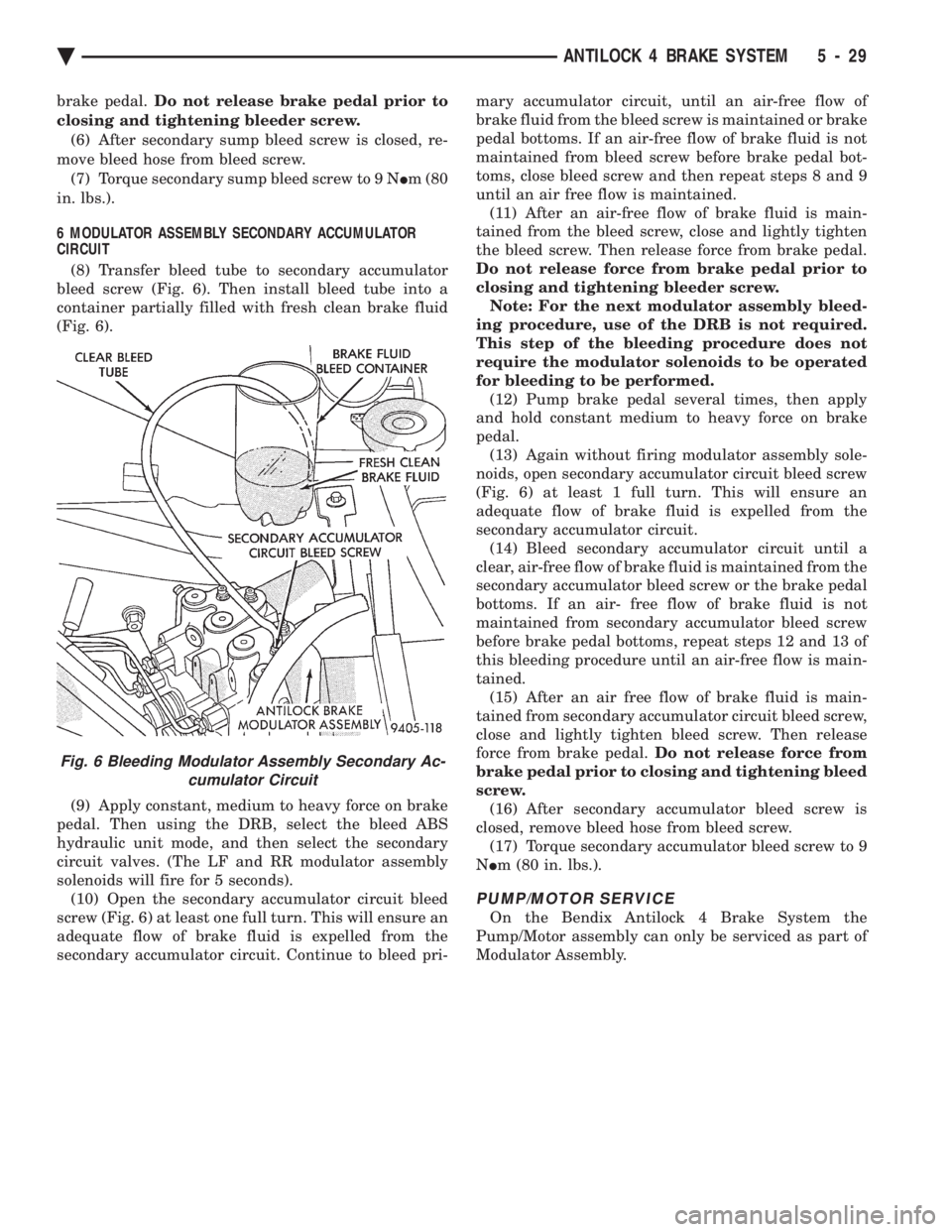
bleed screw (Fig. 6). Then install bleed tube into a
container partially filled with fresh clean brake fluid
(Fig. 6).
(9) Apply constant, medium to heavy force on brake
pedal. Then using the DRB, select the bleed ABS
hydraulic unit mode, and then select the secondary
circuit valves. (The LF and RR modulator assembly
solenoids will fire for 5 seconds). (10) Open the secondary accumulator circuit bleed
screw (Fig. 6) at least one full turn. This will ensure an
adequate flow of brake fluid is expelled from the
secondary accumulator circuit. Continue to bleed pri- mary accumulator circuit, until an air-free flow of
brake fluid from the bleed screw is maintained or brake
pedal bottoms. If an air-free flow of brake fluid is not
maintained from bleed screw before brake pedal bot-
toms, close bleed screw and then repeat steps 8 and 9
until an air free flow is maintained. (11) After an air-free flow of brake fluid is main-
tained from the bleed screw, close and lightly tighten
the bleed screw. Then release force from brake pedal.
Do not release force from brake pedal prior to
closing and tightening bleeder screw. Note: For the next modulator assembly bleed-
ing procedure, use of the DRB is not required.
This step of the bleeding procedure does not
require the modulator solenoids to be operated
for bleeding to be performed. (12) Pump brake pedal several times, then apply
and hold constant medium to heavy force on brake
pedal. (13) Again without firing modulator assembly sole-
noids, open secondary accumulator circuit bleed screw
(Fig. 6) at least 1 full turn. This will ensure an
adequate flow of brake fluid is expelled from the
secondary accumulator circuit. (14) Bleed secondary accumulator circuit until a
clear, air-free flow of brake fluid is maintained from the
secondary accumulator bleed screw or the brake pedal
bottoms. If an air- free flow of brake fluid is not
maintained from secondary accumulator bleed screw
before brake pedal bottoms, repeat steps 12 and 13 of
this bleeding procedure until an air-free flow is main-
tained. (15) After an air free flow of brake fluid is main-
tained from secondary accumulator circuit bleed screw,
close and lightly tighten bleed screw. Then release
force from brake pedal. Do not release force from
brake pedal prior to closing and tightening bleed
screw. (16) After secondary accumulator bleed screw is
closed, remove bleed hose from bleed screw. (17) Torque secondary accumulator bleed screw to 9
N Im (80 in. lbs.).
PUMP/MOTOR SERVICE
On the Bendix Antilock 4 Brake System the
Pump/Motor assembly can only be serviced as part of
Modulator Assembly.
Fig. 6 Bleeding Modulator Assembly Secondary Ac- cumulator Circuit
Ä ANTILOCK 4 BRAKE SYSTEM 5 - 29
Page 318 of 2438
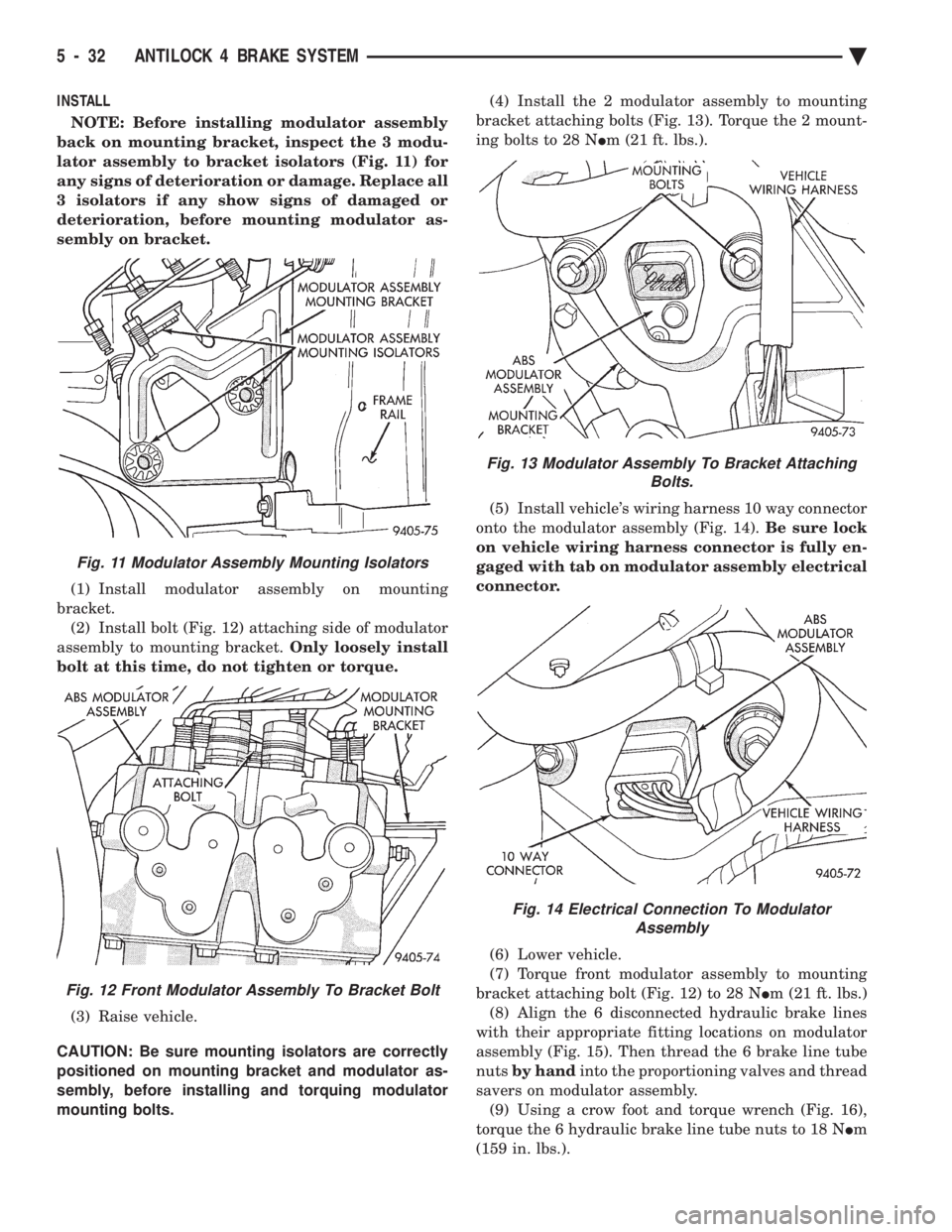
INSTALL NOTE: Before installing modulator assembly
back on mounting bracket, inspect the 3 modu-
lator assembly to bracket isolators (Fig. 11) for
any signs of deterioration or damage. Replace all
3 isolators if any show signs of damaged or
deterioration, before mounting modulator as-
sembly on bracket.
(1) Install modulator assembly on mounting
bracket. (2) Install bolt (Fig. 12) attaching side of modulator
assembly to mounting bracket. Only loosely install
bolt at this time, do not tighten or torque.
(3) Raise vehicle.
CAUTION: Be sure mounting isolators are correctly
positioned on mounting bracket and modulator as-
sembly, before installing and torquing modulator
mounting bolts. (4) Install the 2 modulator assembly to mounting
bracket attaching bolts (Fig. 13). Torque the 2 mount-
ing bolts to 28 N Im (21 ft. lbs.).
(5) Install vehicle's wiring harness 10 way connector
onto the modulator assembly (Fig. 14). Be sure lock
on vehicle wiring harness connector is fully en-
gaged with tab on modulator assembly electrical
connector.
(6) Lower vehicle.
(7) Torque front modulator assembly to mounting
bracket attaching bolt (Fig. 12) to 28 N Im (21 ft. lbs.)
(8) Align the 6 disconnected hydraulic brake lines
with their appropriate fitting locations on modulator
assembly (Fig. 15). Then thread the 6 brake line tube
nuts by hand into the proportioning valves and thread
savers on modulator assembly. (9) Using a crow foot and torque wrench (Fig. 16),
torque the 6 hydraulic brake line tube nuts to 18 N Im
(159 in. lbs.).
Fig. 11 Modulator Assembly Mounting Isolators
Fig. 12 Front Modulator Assembly To Bracket Bolt
Fig. 13 Modulator Assembly To Bracket Attaching Bolts.
Fig. 14 Electrical Connection To ModulatorAssembly
5 - 32 ANTILOCK 4 BRAKE SYSTEM Ä
Page 319 of 2438
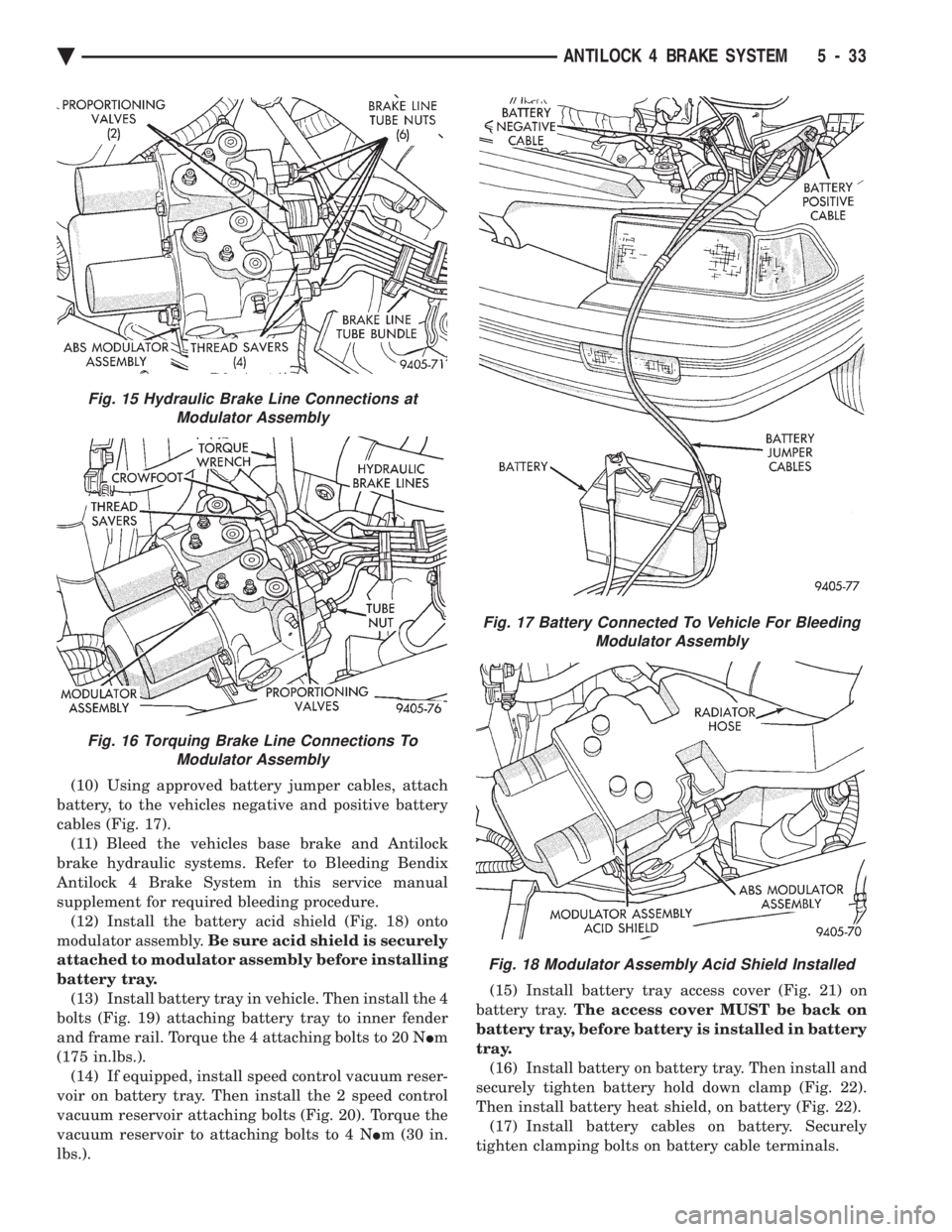
(10) Using approved battery jumper cables, attach
battery, to the vehicles negative and positive battery
cables (Fig. 17). (11) Bleed the vehicles base brake and Antilock
brake hydraulic systems. Refer to Bleeding Bendix
Antilock 4 Brake System in this service manual
supplement for required bleeding procedure. (12) Install the battery acid shield (Fig. 18) onto
modulator assembly. Be sure acid shield is securely
attached to modulator assembly before installing
battery tray. (13) Install battery tray in vehicle. Then install the 4
bolts (Fig. 19) attaching battery tray to inner fender
and frame rail. Torque the 4 attaching bolts to 20 N Im
(175 in.lbs.). (14) If equipped, install speed control vacuum reser-
voir on battery tray. Then install the 2 speed control
vacuum reservoir attaching bolts (Fig. 20). Torque the
vacuum reservoir to attaching bolts to 4 N Im (30 in.
lbs.). (15) Install battery tray access cover (Fig. 21) on
battery tray. The access cover MUST be back on
battery tray, before battery is installed in battery
tray. (16) Install battery on battery tray. Then install and
securely tighten battery hold down clamp (Fig. 22).
Then install battery heat shield, on battery (Fig. 22). (17) Install battery cables on battery. Securely
tighten clamping bolts on battery cable terminals.
Fig. 15 Hydraulic Brake Line Connections at Modulator Assembly
Fig. 16 Torquing Brake Line Connections To Modulator Assembly
Fig. 17 Battery Connected To Vehicle For Bleeding Modulator Assembly
Fig. 18 Modulator Assembly Acid Shield Installed
Ä ANTILOCK 4 BRAKE SYSTEM 5 - 33
Page 322 of 2438
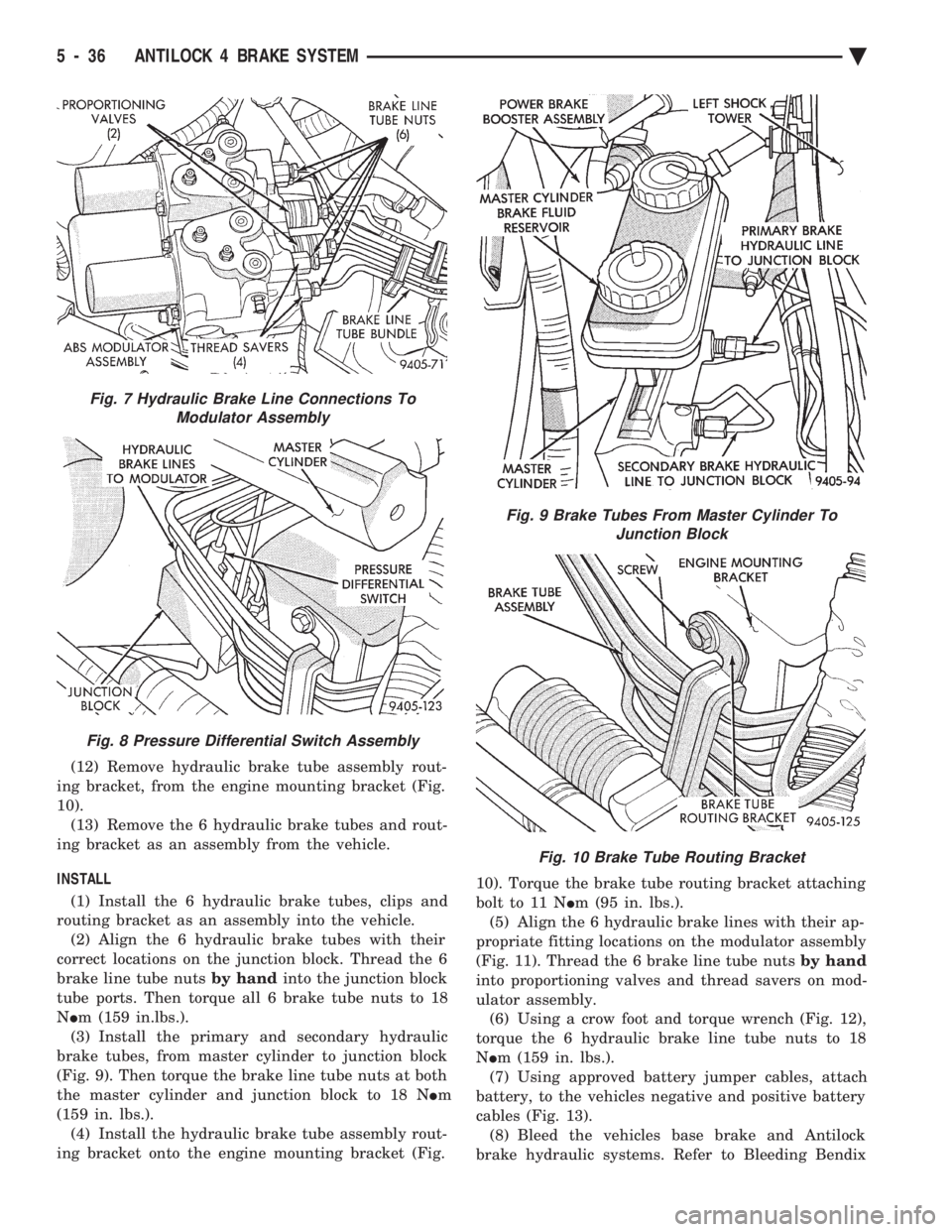
(12) Remove hydraulic brake tube assembly rout-
ing bracket, from the engine mounting bracket (Fig.
10). (13) Remove the 6 hydraulic brake tubes and rout-
ing bracket as an assembly from the vehicle.
INSTALL (1) Install the 6 hydraulic brake tubes, clips and
routing bracket as an assembly into the vehicle. (2) Align the 6 hydraulic brake tubes with their
correct locations on the junction block. Thread the 6
brake line tube nuts by handinto the junction block
tube ports. Then torque all 6 brake tube nuts to 18
N Im (159 in.lbs.).
(3) Install the primary and secondary hydraulic
brake tubes, from master cylinder to junction block
(Fig. 9). Then torque the brake line tube nuts at both
the master cylinder and junction block to 18 N Im
(159 in. lbs.). (4) Install the hydraulic brake tube assembly rout-
ing bracket onto the engine mounting bracket (Fig. 10). Torque the brake tube routing bracket attaching
bolt to 11 N
Im (95 in. lbs.).
(5) Align the 6 hydraulic brake lines with their ap-
propriate fitting locations on the modulator assembly
(Fig. 11). Thread the 6 brake line tube nuts by hand
into proportioning valves and thread savers on mod-
ulator assembly. (6) Using a crow foot and torque wrench (Fig. 12),
torque the 6 hydraulic brake line tube nuts to 18
N Im (159 in. lbs.).
(7) Using approved battery jumper cables, attach
battery, to the vehicles negative and positive battery
cables (Fig. 13). (8) Bleed the vehicles base brake and Antilock
brake hydraulic systems. Refer to Bleeding Bendix
Fig. 7 Hydraulic Brake Line Connections To Modulator Assembly
Fig. 8 Pressure Differential Switch Assembly
Fig. 9 Brake Tubes From Master Cylinder To Junction Block
Fig. 10 Brake Tube Routing Bracket
5 - 36 ANTILOCK 4 BRAKE SYSTEM Ä
Page 323 of 2438
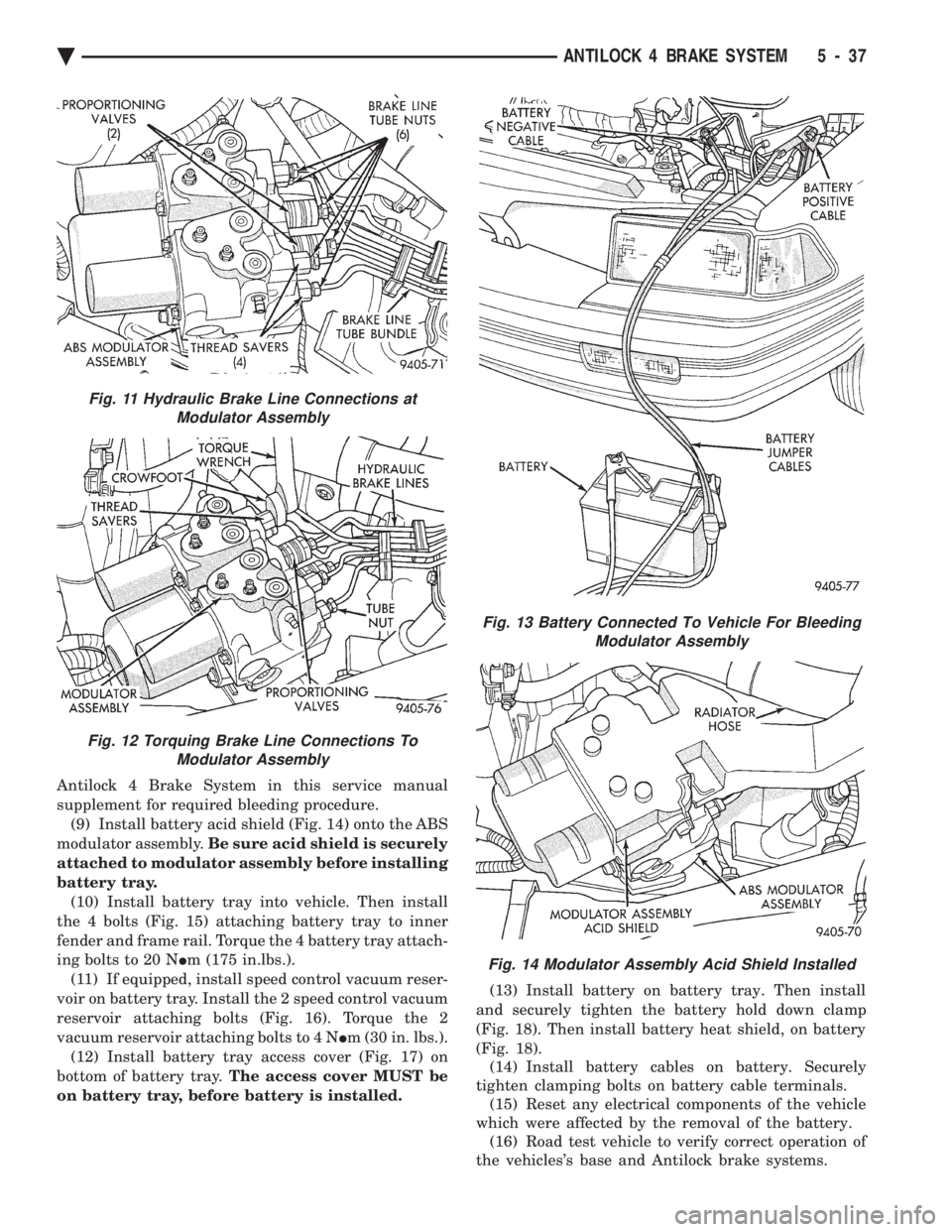
Antilock 4 Brake System in this service manual
supplement for required bleeding procedure.(9) Install battery acid shield (Fig. 14) onto the ABS
modulator assembly. Be sure acid shield is securely
attached to modulator assembly before installing
battery tray. (10) Install battery tray into vehicle. Then install
the 4 bolts (Fig. 15) attaching battery tray to inner
fender and frame rail. Torque the 4 battery tray attach-
ing bolts to 20 N Im (175 in.lbs.).
(11) If equipped, install speed control vacuum reser-
voir on battery tray. Install the 2 speed control vacuum
reservoir attaching bolts (Fig. 16). Torque the 2
vacuum reservoir attaching bolts to 4 N Im (30 in. lbs.).
(12) Install battery tray access cover (Fig. 17) on
bottom of battery tray. The access cover MUST be
on battery tray, before battery is installed. (13) Install battery on battery tray. Then install
and securely tighten the battery hold down clamp
(Fig. 18). Then install battery heat shield, on battery
(Fig. 18). (14) Install battery cables on battery. Securely
tighten clamping bolts on battery cable terminals. (15) Reset any electrical components of the vehicle
which were affected by the removal of the battery. (16) Road test vehicle to verify correct operation of
the vehicles's base and Antilock brake systems.
Fig. 13 Battery Connected To Vehicle For Bleeding Modulator Assembly
Fig. 14 Modulator Assembly Acid Shield Installed
Fig. 11 Hydraulic Brake Line Connections atModulator Assembly
Fig. 12 Torquing Brake Line Connections To Modulator Assembly
Ä ANTILOCK 4 BRAKE SYSTEM 5 - 37
Page 326 of 2438
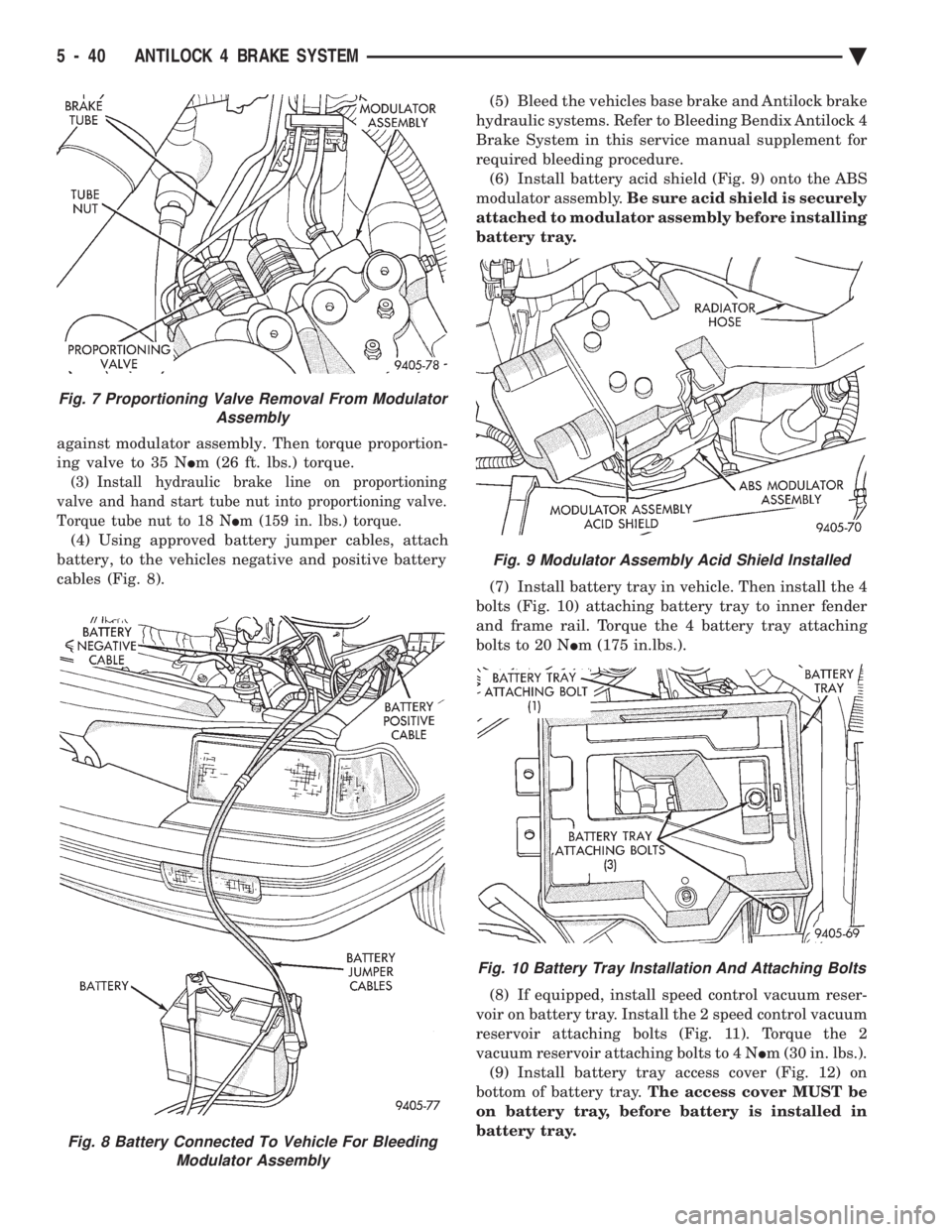
against modulator assembly. Then torque proportion-
ing valve to 35 N Im (26 ft. lbs.) torque.
(3) Install hydraulic brake line on proportioning
valve and hand start tube nut into proportioning valve.
Torque tube nut to 18 N Im (159 in. lbs.) torque.
(4) Using approved battery jumper cables, attach
battery, to the vehicles negative and positive battery
cables (Fig. 8). (5) Bleed the vehicles base brake and Antilock brake
hydraulic systems. Refer to Bleeding Bendix Antilock 4
Brake System in this service manual supplement for
required bleeding procedure. (6) Install battery acid shield (Fig. 9) onto the ABS
modulator assembly. Be sure acid shield is securely
attached to modulator assembly before installing
battery tray.
(7) Install battery tray in vehicle. Then install the 4
bolts (Fig. 10) attaching battery tray to inner fender
and frame rail. Torque the 4 battery tray attaching
bolts to 20 N Im (175 in.lbs.).
(8) If equipped, install speed control vacuum reser-
voir on battery tray. Install the 2 speed control vacuum
reservoir attaching bolts (Fig. 11). Torque the 2
vacuum reservoir attaching bolts to 4 N Im (30 in. lbs.).
(9) Install battery tray access cover (Fig. 12) on
bottom of battery tray. The access cover MUST be
on battery tray, before battery is installed in
battery tray.
Fig. 8 Battery Connected To Vehicle For Bleeding Modulator Assembly
Fig. 7 Proportioning Valve Removal From Modulator Assembly
Fig. 9 Modulator Assembly Acid Shield Installed
Fig. 10 Battery Tray Installation And Attaching Bolts
5 - 40 ANTILOCK 4 BRAKE SYSTEM Ä
Page 328 of 2438
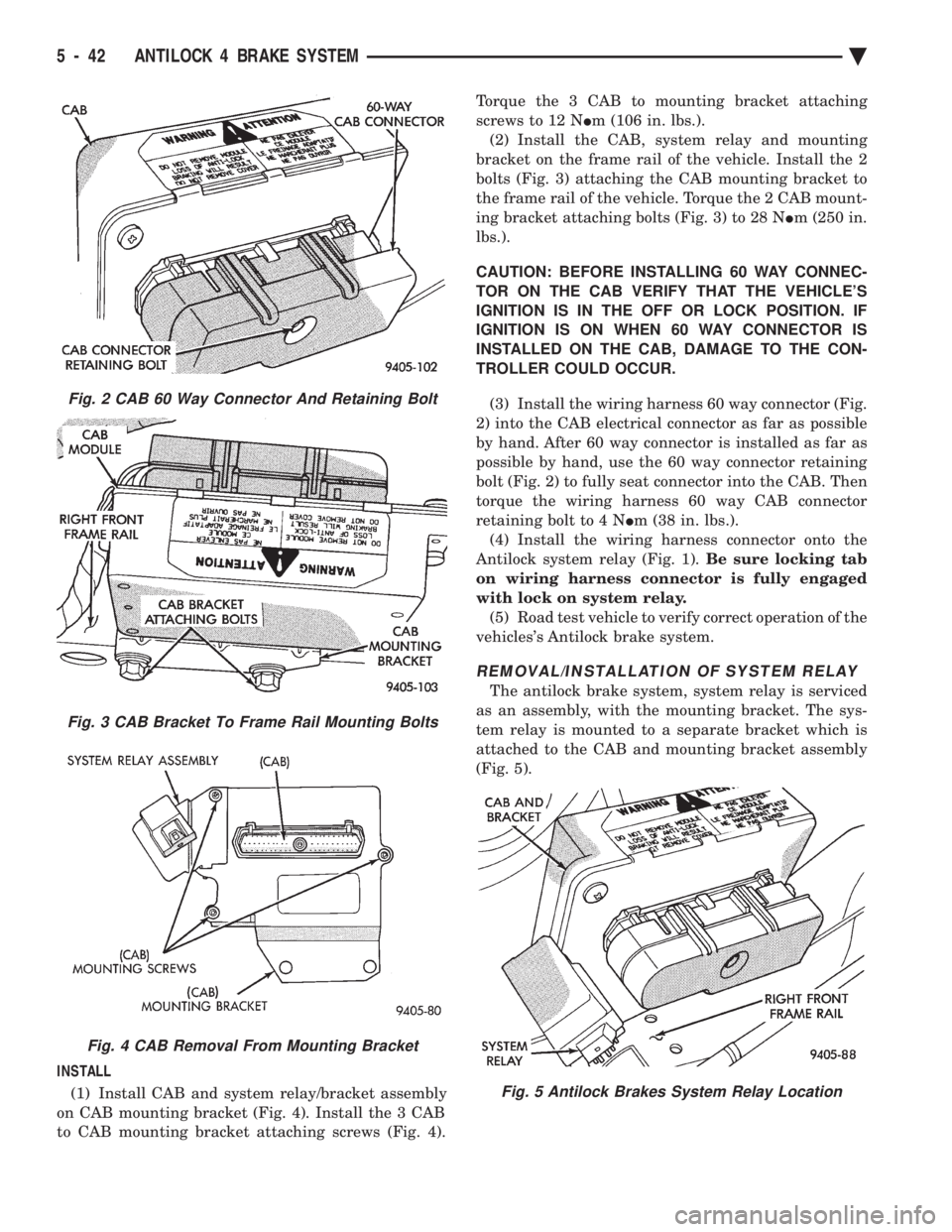
INSTALL (1) Install CAB and system relay/bracket assembly
on CAB mounting bracket (Fig. 4). Install the 3 CAB
to CAB mounting bracket attaching screws (Fig. 4). Torque the 3 CAB to mounting bracket attaching
screws to 12 N Im (106 in. lbs.).
(2) Install the CAB, system relay and mounting
bracket on the frame rail of the vehicle. Install the 2
bolts (Fig. 3) attaching the CAB mounting bracket to
the frame rail of the vehicle. Torque the 2 CAB mount-
ing bracket attaching bolts (Fig. 3) to 28 N Im (250 in.
lbs.).
CAUTION: BEFORE INSTALLING 60 WAY CONNEC-
TOR ON THE CAB VERIFY THAT THE VEHICLE'S
IGNITION IS IN THE OFF OR LOCK POSITION. IF
IGNITION IS ON WHEN 60 WAY CONNECTOR IS
INSTALLED ON THE CAB, DAMAGE TO THE CON-
TROLLER COULD OCCUR.
(3) Install the wiring harness 60 way connector (Fig.
2) into the CAB electrical connector as far as possible
by hand. After 60 way connector is installed as far as
possible by hand, use the 60 way connector retaining
bolt (Fig. 2) to fully seat connector into the CAB. Then
torque the wiring harness 60 way CAB connector
retaining bolt to 4 N Im (38 in. lbs.).
(4) Install the wiring harness connector onto the
Antilock system relay (Fig. 1). Be sure locking tab
on wiring harness connector is fully engaged
with lock on system relay. (5) Road test vehicle to verify correct operation of the
vehicles's Antilock brake system.
REMOVAL/INSTALLATION OF SYSTEM RELAY
The antilock brake system, system relay is serviced
as an assembly, with the mounting bracket. The sys-
tem relay is mounted to a separate bracket which is
attached to the CAB and mounting bracket assembly
(Fig. 5).
Fig. 2 CAB 60 Way Connector And Retaining Bolt
Fig. 3 CAB Bracket To Frame Rail Mounting Bolts
Fig. 4 CAB Removal From Mounting Bracket
Fig. 5 Antilock Brakes System Relay Location
5 - 42 ANTILOCK 4 BRAKE SYSTEM Ä