torque CHEVROLET DYNASTY 1993 Repair Manual
[x] Cancel search | Manufacturer: CHEVROLET, Model Year: 1993, Model line: DYNASTY, Model: CHEVROLET DYNASTY 1993Pages: 2438, PDF Size: 74.98 MB
Page 254 of 2438
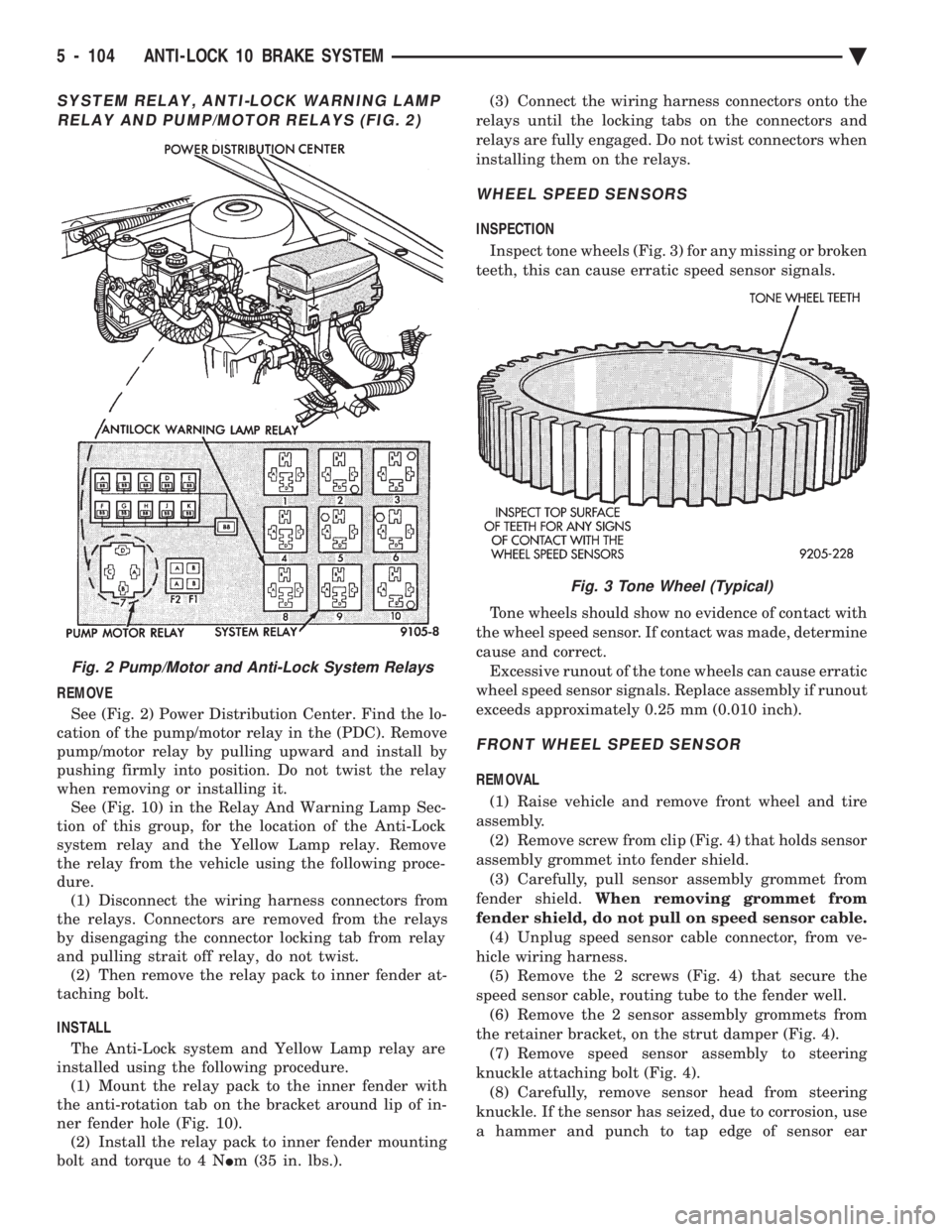
SYSTEM RELAY, ANTI-LOCK WARNING LAMP RELAY AND PUMP/MOTOR RELAYS (FIG. 2)
REMOVE
See (Fig. 2) Power Distribution Center. Find the lo-
cation of the pump/motor relay in the (PDC). Remove
pump/motor relay by pulling upward and install by
pushing firmly into position. Do not twist the relay
when removing or installing it. See (Fig. 10) in the Relay And Warning Lamp Sec-
tion of this group, for the location of the Anti-Lock
system relay and the Yellow Lamp relay. Remove
the relay from the vehicle using the following proce-
dure. (1) Disconnect the wiring harness connectors from
the relays. Connectors are removed from the relays
by disengaging the connector locking tab from relay
and pulling strait off relay, do not twist. (2) Then remove the relay pack to inner fender at-
taching bolt.
INSTALL The Anti-Lock system and Yellow Lamp relay are
installed using the following procedure. (1) Mount the relay pack to the inner fender with
the anti-rotation tab on the bracket around lip of in-
ner fender hole (Fig. 10). (2) Install the relay pack to inner fender mounting
bolt and torque to 4 N Im (35 in. lbs.). (3) Connect the wiring harness connectors onto the
relays until the locking tabs on the connectors and
relays are fully engaged. Do not twist connectors when
installing them on the relays.
WHEEL SPEED SENSORS
INSPECTION
Inspect tone wheels (Fig. 3) for any missing or broken
teeth, this can cause erratic speed sensor signals.
Tone wheels should show no evidence of contact with
the wheel speed sensor. If contact was made, determine
cause and correct. Excessive runout of the tone wheels can cause erratic
wheel speed sensor signals. Replace assembly if runout
exceeds approximately 0.25 mm (0.010 inch).
FRONT WHEEL SPEED SENSOR
REMOVAL
(1) Raise vehicle and remove front wheel and tire
assembly. (2) Remove screw from clip (Fig. 4) that holds sensor
assembly grommet into fender shield. (3) Carefully, pull sensor assembly grommet from
fender shield. When removing grommet from
fender shield, do not pull on speed sensor cable. (4) Unplug speed sensor cable connector, from ve-
hicle wiring harness. (5) Remove the 2 screws (Fig. 4) that secure the
speed sensor cable, routing tube to the fender well. (6) Remove the 2 sensor assembly grommets from
the retainer bracket, on the strut damper (Fig. 4). (7) Remove speed sensor assembly to steering
knuckle attaching bolt (Fig. 4). (8) Carefully, remove sensor head from steering
knuckle. If the sensor has seized, due to corrosion, use
a hammer and punch to tap edge of sensor ear
Fig. 2 Pump/Motor and Anti-Lock System Relays
Fig. 3 Tone Wheel (Typical)
5 - 104 ANTI-LOCK 10 BRAKE SYSTEM Ä
Page 255 of 2438
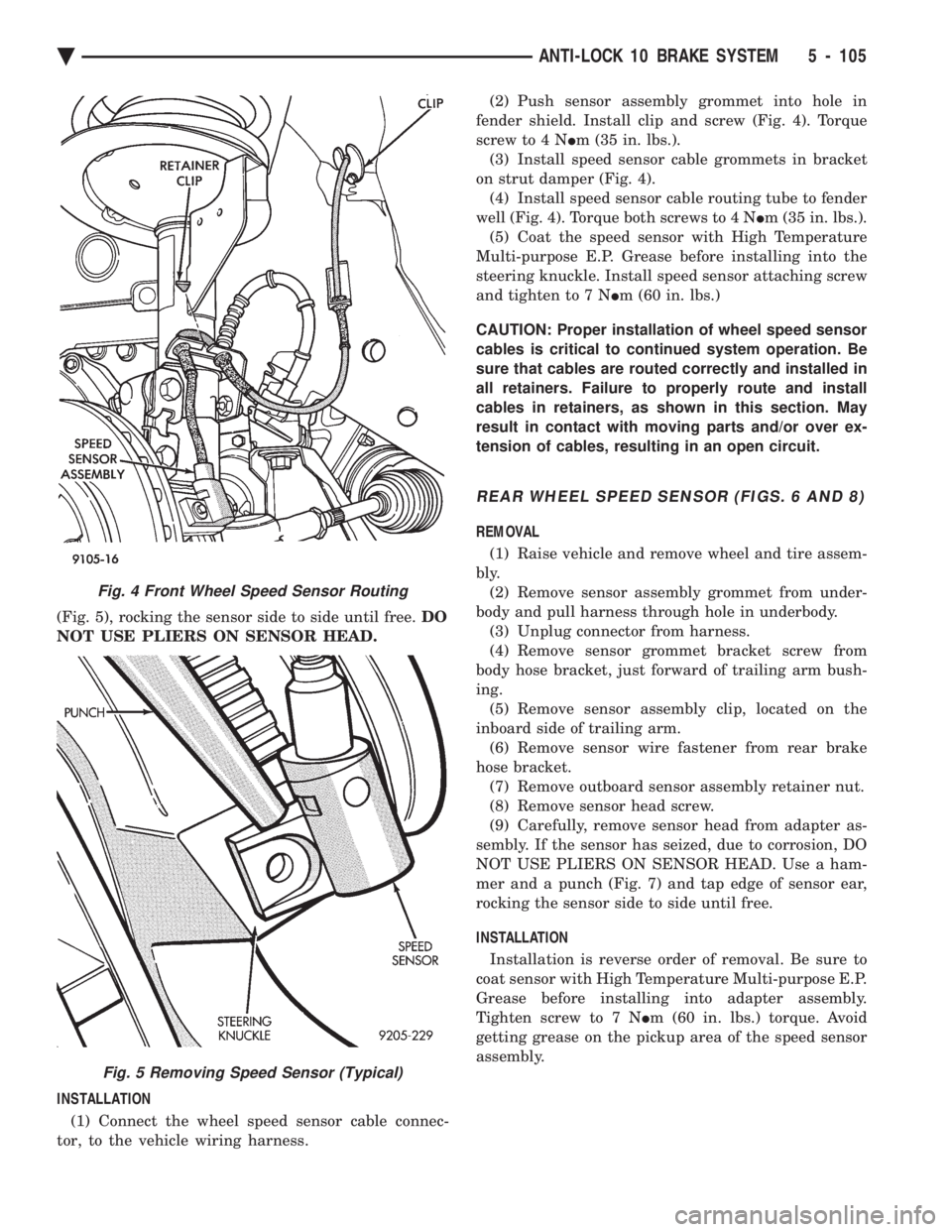
(Fig. 5), rocking the sensor side to side until free. DO
NOT USE PLIERS ON SENSOR HEAD.
INSTALLATION (1) Connect the wheel speed sensor cable connec-
tor, to the vehicle wiring harness. (2) Push sensor assembly grommet into hole in
fender shield. Install clip and screw (Fig. 4). Torque
screw to 4 N Im (35 in. lbs.).
(3) Install speed sensor cable grommets in bracket
on strut damper (Fig. 4). (4) Install speed sensor cable routing tube to fender
well (Fig. 4). Torque both screws to 4 N Im (35 in. lbs.).
(5) Coat the speed sensor with High Temperature
Multi-purpose E.P. Grease before installing into the
steering knuckle. Install speed sensor attaching screw
and tighten to 7 N Im (60 in. lbs.)
CAUTION: Proper installation of wheel speed sensor
cables is critical to continued system operation. Be
sure that cables are routed correctly and installed in
all retainers. Failure to properly route and install
cables in retainers, as shown in this section. May
result in contact with moving parts and/or over ex-
tension of cables, resulting in an open circuit.
REAR WHEEL SPEED SENSOR (FIGS. 6 AND 8)
REMOVAL
(1) Raise vehicle and remove wheel and tire assem-
bly. (2) Remove sensor assembly grommet from under-
body and pull harness through hole in underbody. (3) Unplug connector from harness.
(4) Remove sensor grommet bracket screw from
body hose bracket, just forward of trailing arm bush-
ing. (5) Remove sensor assembly clip, located on the
inboard side of trailing arm. (6) Remove sensor wire fastener from rear brake
hose bracket. (7) Remove outboard sensor assembly retainer nut.
(8) Remove sensor head screw.
(9) Carefully, remove sensor head from adapter as-
sembly. If the sensor has seized, due to corrosion, DO
NOT USE PLIERS ON SENSOR HEAD. Use a ham-
mer and a punch (Fig. 7) and tap edge of sensor ear,
rocking the sensor side to side until free.
INSTALLATION
Installation is reverse order of removal. Be sure to
coat sensor with High Temperature Multi-purpose E.P.
Grease before installing into adapter assembly.
Tighten screw to 7 N Im (60 in. lbs.) torque. Avoid
getting grease on the pickup area of the speed sensor
assembly.
Fig. 4 Front Wheel Speed Sensor Routing
Fig. 5 Removing Speed Sensor (Typical)
Ä ANTI-LOCK 10 BRAKE SYSTEM 5 - 105
Page 258 of 2438
CAUTION: Do not insert dual function pressure
switch into hydraulic assembly using the socket
and ratchet. Cross threading of the switch may oc-
cur. (1) Install the dual function pressure switch into
the hydraulic assembly by hand until the O-ring
seals are seated. (2) Using Socket, Special Tool 6607, (Fig. 10)
torque the dual function pressure switch into the hy-
draulic assembly to 12 N Im (9 ft. lbs.).
(3) Connect the wiring harness connectors (Fig. 9)
onto the dual function pressure switch and the boost
pressure transducer. Be sure the locking tabs on the
connectors are fully engaged on the switches. (4) Lower the vehicle.
(5) Turn the ignition switch to the on position and
let the system pressurize. Check for any leaks at the
dual function pressure switch. (6) Fully de-pressurize the hydraulic assembly a
second time. This will purge any air out that may
have entered hydraulic assembly when the switch
was removed. Turn the ignition switch to the on po-
sition and let the system pressurize again. (7) Road test vehicle to insure that the brake sys-
tem is performing correctly.
PRIMARY PRESSURE TRANSDUCER
REMOVE
WARNING: FAILURE TO FULLY DE-PRESSURIZE
THE HYDRAULIC BLADDER ACCUMULATOR PRIOR
TO REMOVING PRIMARY PRESSURE TRANS-
DUCER. WILL RESULT IN PERSONAL INJURY
AND/OR DAMAGE TO PAINTED SURFACES OF THE
VEHICLE.
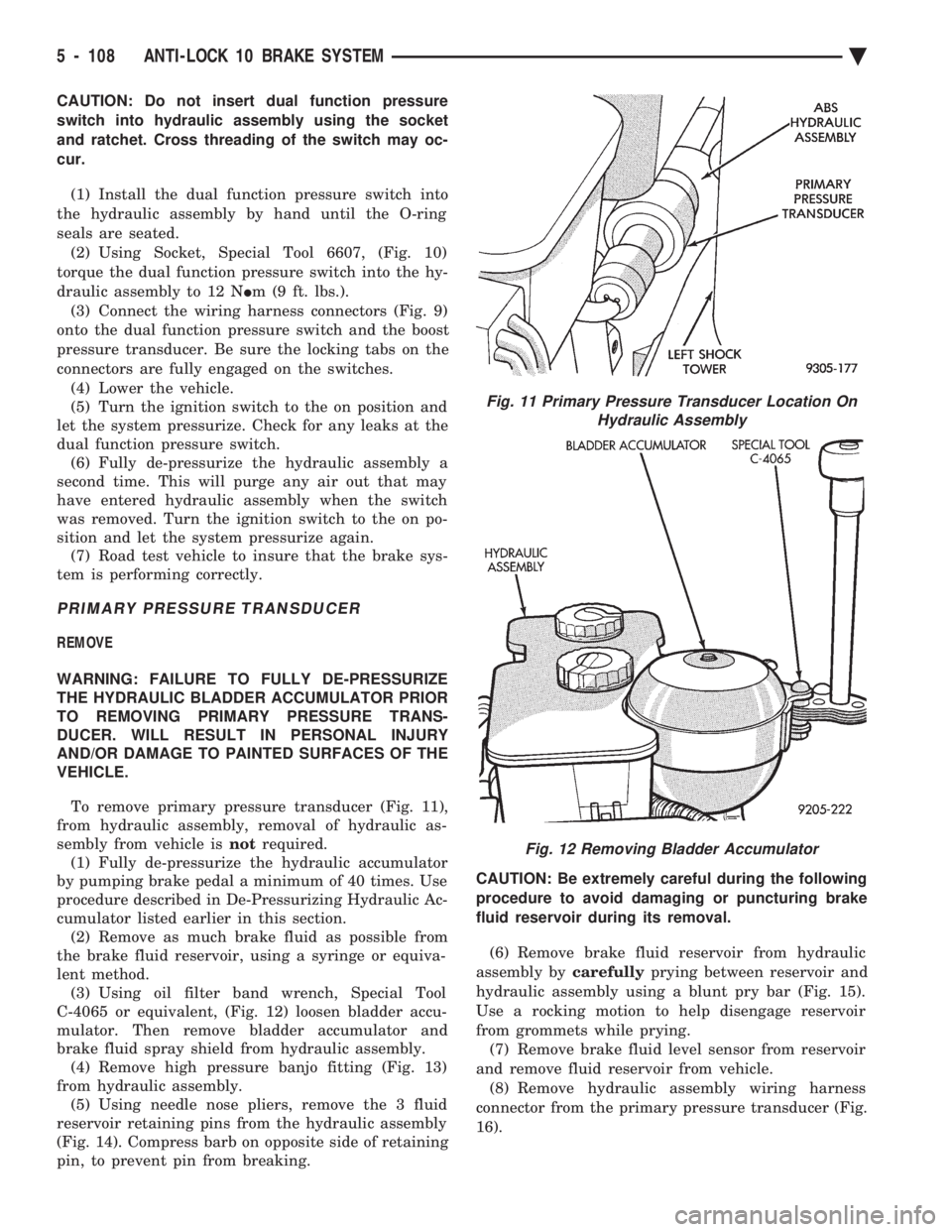
To remove primary pressure transducer (Fig. 11),
from hydraulic assembly, removal of hydraulic as-
sembly from vehicle is notrequired.
(1) Fully de-pressurize the hydraulic accumulator
by pumping brake pedal a minimum of 40 times. Use
procedure described in De-Pressurizing Hydraulic Ac-
cumulator listed earlier in this section. (2) Remove as much brake fluid as possible from
the brake fluid reservoir, using a syringe or equiva-
lent method. (3) Using oil filter band wrench, Special Tool
C-4065 or equivalent, (Fig. 12) loosen bladder accu-
mulator. Then remove bladder accumulator and
brake fluid spray shield from hydraulic assembly. (4) Remove high pressure banjo fitting (Fig. 13)
from hydraulic assembly. (5) Using needle nose pliers, remove the 3 fluid
reservoir retaining pins from the hydraulic assembly
(Fig. 14). Compress barb on opposite side of retaining
pin, to prevent pin from breaking. CAUTION: Be extremely careful during the following
procedure to avoid damaging or puncturing brake
fluid reservoir during its removal.
(6) Remove brake fluid reservoir from hydraulic
assembly by carefullyprying between reservoir and
hydraulic assembly using a blunt pry bar (Fig. 15).
Use a rocking motion to help disengage reservoir
from grommets while prying. (7) Remove brake fluid level sensor from reservoir
and remove fluid reservoir from vehicle. (8) Remove hydraulic assembly wiring harness
connector from the primary pressure transducer (Fig.
16).
Fig. 11 Primary Pressure Transducer Location On Hydraulic Assembly
Fig. 12 Removing Bladder Accumulator
5 - 108 ANTI-LOCK 10 BRAKE SYSTEM Ä
Page 259 of 2438
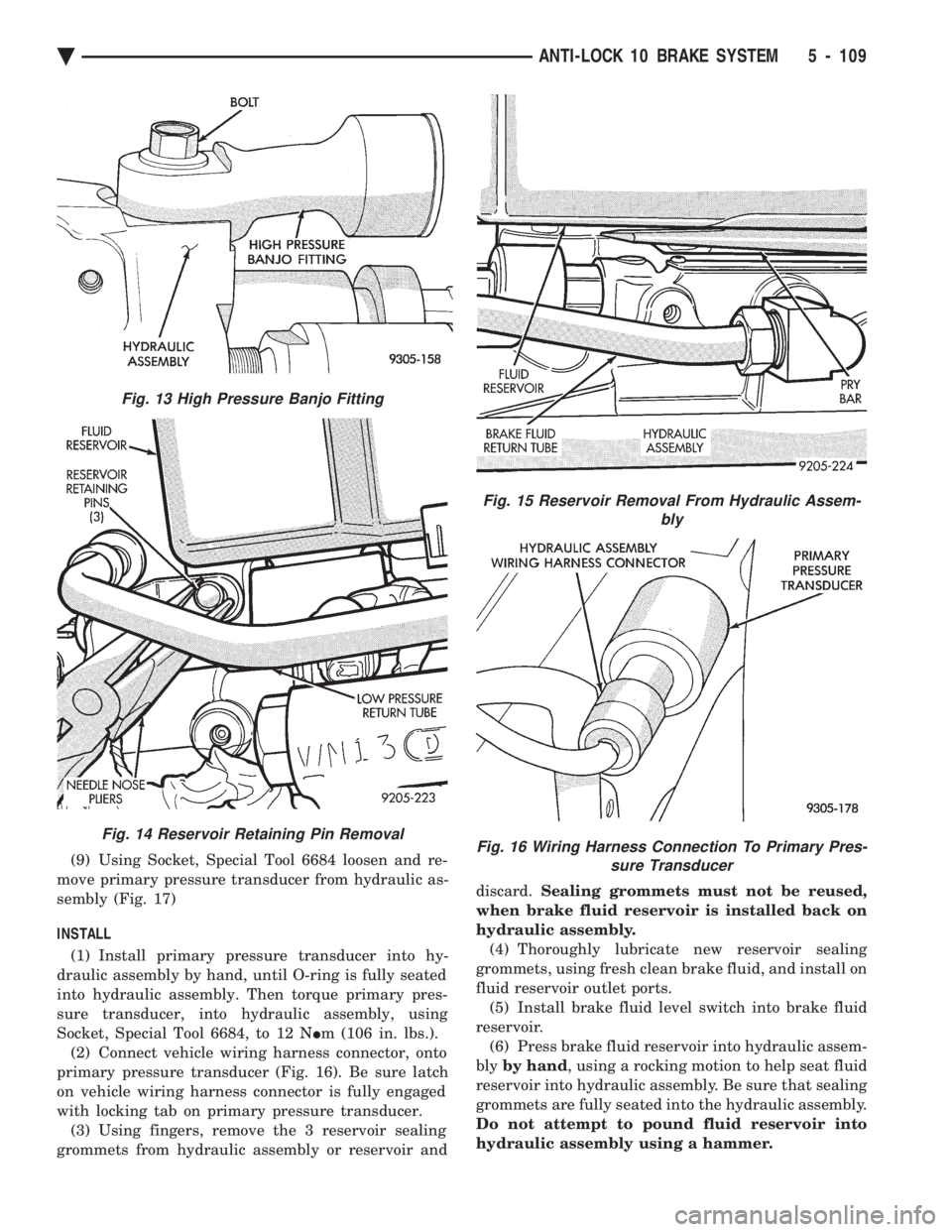
(9) Using Socket, Special Tool 6684 loosen and re-
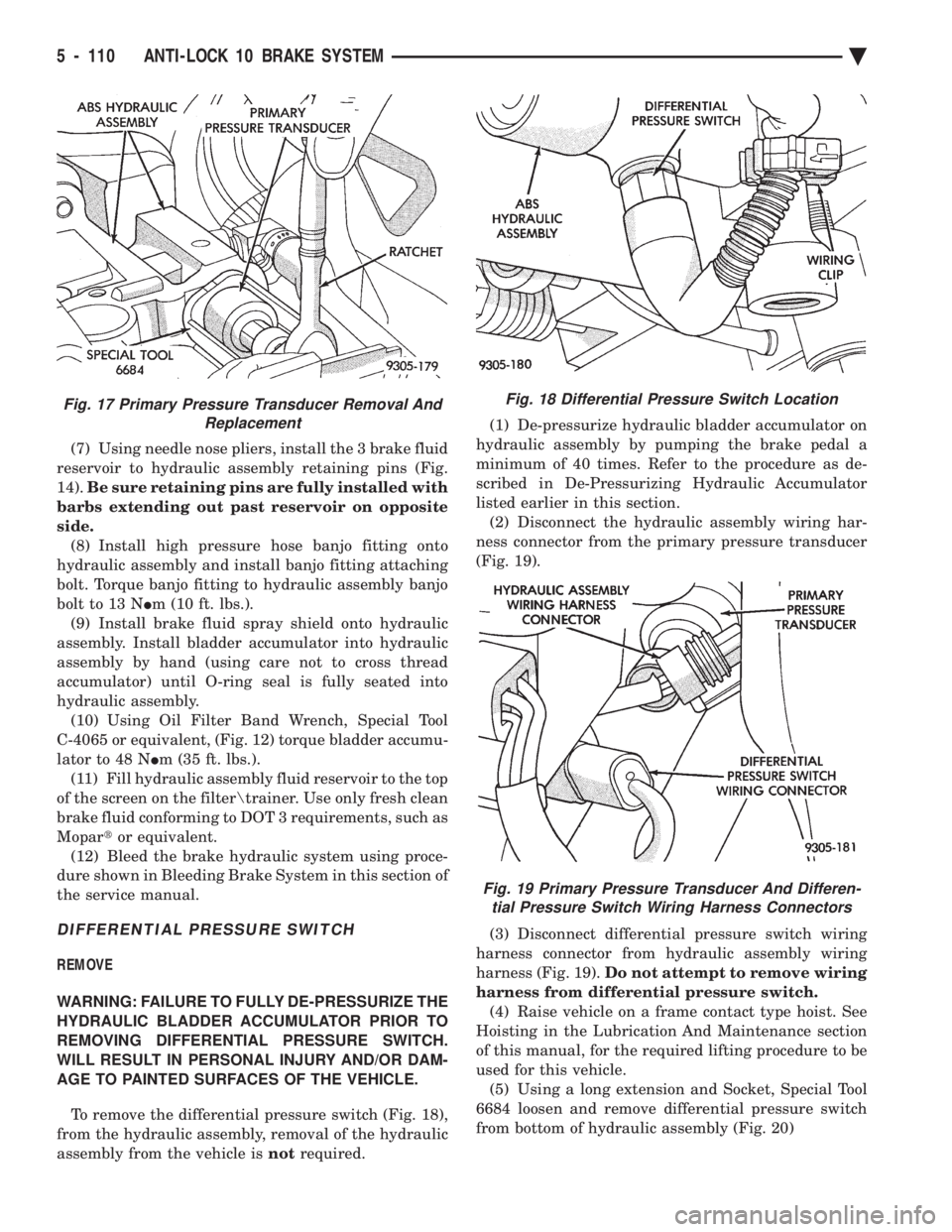
move primary pressure transducer from hydraulic as-
sembly (Fig. 17)
INSTALL
(1) Install primary pressure transducer into hy-
draulic assembly by hand, until O-ring is fully seated
into hydraulic assembly. Then torque primary pres-
sure transducer, into hydraulic assembly, using
Socket, Special Tool 6684, to 12 N Im (106 in. lbs.).
(2) Connect vehicle wiring harness connector, onto
primary pressure transducer (Fig. 16). Be sure latch
on vehicle wiring harness connector is fully engaged
with locking tab on primary pressure transducer. (3) Using fingers, remove the 3 reservoir sealing
grommets from hydraulic assembly or reservoir and discard.
Sealing grommets must not be reused,
when brake fluid reservoir is installed back on
hydraulic assembly. (4) Thoroughly lubricate new reservoir sealing
grommets, using fresh clean brake fluid, and install on
fluid reservoir outlet ports. (5) Install brake fluid level switch into brake fluid
reservoir. (6) Press brake fluid reservoir into hydraulic assem-
bly by hand , using a rocking motion to help seat fluid
reservoir into hydraulic assembly. Be sure that sealing
grommets are fully seated into the hydraulic assembly.
Do not attempt to pound fluid reservoir into
hydraulic assembly using a hammer.
Fig. 13 High Pressure Banjo Fitting
Fig. 14 Reservoir Retaining Pin Removal
Fig. 15 Reservoir Removal From Hydraulic Assem- bly
Fig. 16 Wiring Harness Connection To Primary Pres-sure Transducer
Ä ANTI-LOCK 10 BRAKE SYSTEM 5 - 109
Page 260 of 2438
(7) Using needle nose pliers, install the 3 brake fluid
reservoir to hydraulic assembly retaining pins (Fig.
14). Be sure retaining pins are fully installed with
barbs extending out past reservoir on opposite
side. (8) Install high pressure hose banjo fitting onto
hydraulic assembly and install banjo fitting attaching
bolt. Torque banjo fitting to hydraulic assembly banjo
bolt to 13 N Im (10 ft. lbs.).
(9) Install brake fluid spray shield onto hydraulic
assembly. Install bladder accumulator into hydraulic
assembly by hand (using care not to cross thread
accumulator) until O-ring seal is fully seated into
hydraulic assembly. (10) Using Oil Filter Band Wrench, Special Tool
C-4065 or equivalent, (Fig. 12) torque bladder accumu-
lator to 48 N Im (35 ft. lbs.).
(11) Fill hydraulic assembly fluid reservoir to the top
of the screen on the filter rainer. Use only fresh clean
brake fluid conforming to DOT 3 requirements, such as
Mopar tor equivalent.
(12) Bleed the brake hydraulic system using proce-
dure shown in Bleeding Brake System in this section of
the service manual.
DIFFERENTIAL PRESSURE SWITCH
REMOVE
WARNING: FAILURE TO FULLY DE-PRESSURIZE THE
HYDRAULIC BLADDER ACCUMULATOR PRIOR TO
REMOVING DIFFERENTIAL PRESSURE SWITCH.
WILL RESULT IN PERSONAL INJURY AND/OR DAM-
AGE TO PAINTED SURFACES OF THE VEHICLE.
To remove the differential pressure switch (Fig. 18),
from the hydraulic assembly, removal of the hydraulic
assembly from the vehicle is notrequired. (1) De-pressurize hydraulic bladder accumulator on
hydraulic assembly by pumping the brake pedal a
minimum of 40 times. Refer to the procedure as de-
scribed in De-Pressurizing Hydraulic Accumulator
listed earlier in this section. (2) Disconnect the hydraulic assembly wiring har-
ness connector from the primary pressure transducer
(Fig. 19).
(3) Disconnect differential pressure switch wiring
harness connector from hydraulic assembly wiring
harness (Fig. 19). Do not attempt to remove wiring
harness from differential pressure switch. (4) Raise vehicle on a frame contact type hoist. See
Hoisting in the Lubrication And Maintenance section
of this manual, for the required lifting procedure to be
used for this vehicle. (5) Using a long extension and Socket, Special Tool
6684 loosen and remove differential pressure switch
from bottom of hydraulic assembly (Fig. 20)
Fig. 18 Differential Pressure Switch Location
Fig. 19 Primary Pressure Transducer And Differen- tial Pressure Switch Wiring Harness Connectors
Fig. 17 Primary Pressure Transducer Removal And Replacement
5 - 110 ANTI-LOCK 10 BRAKE SYSTEM Ä
Page 261 of 2438
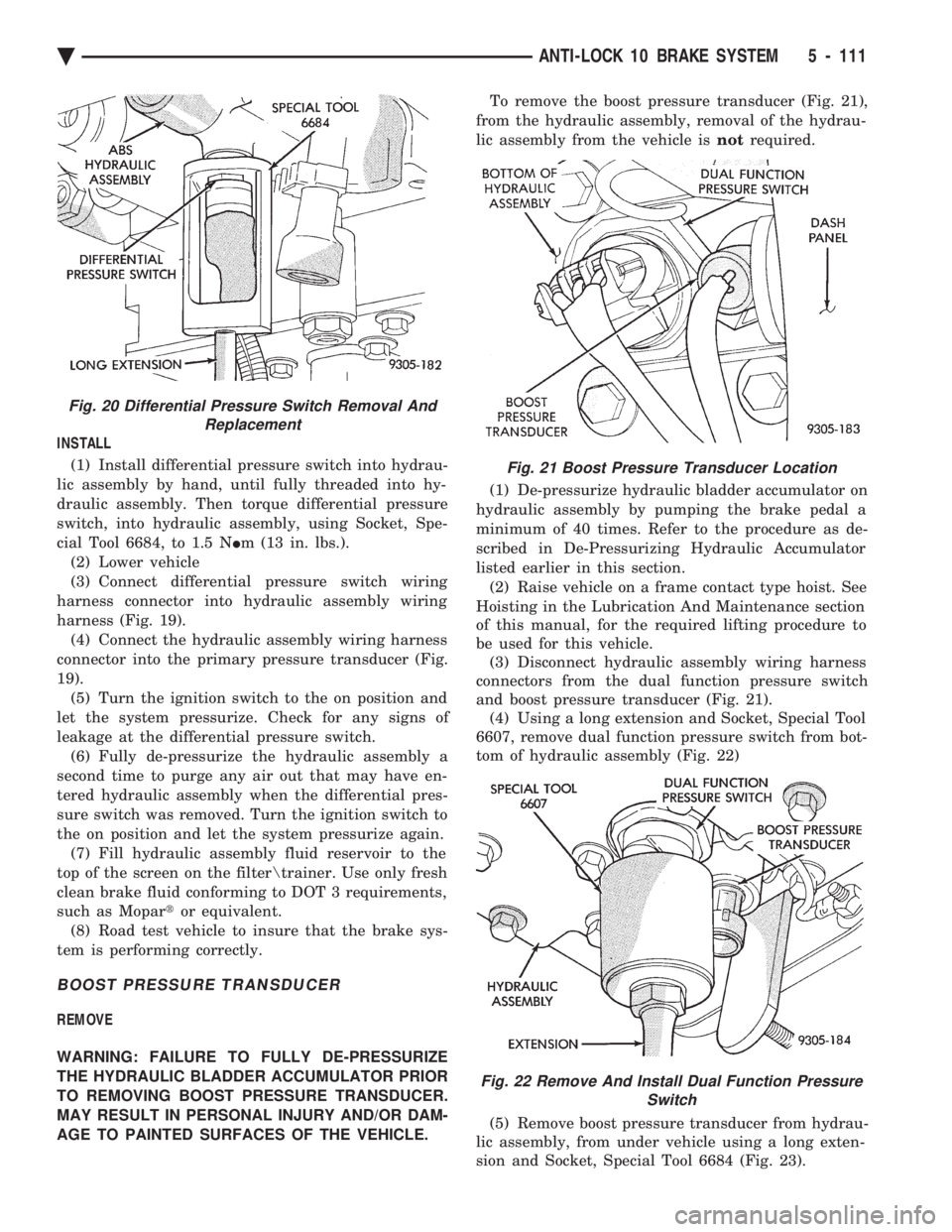
INSTALL (1) Install differential pressure switch into hydrau-
lic assembly by hand, until fully threaded into hy-
draulic assembly. Then torque differential pressure
switch, into hydraulic assembly, using Socket, Spe-
cial Tool 6684, to 1.5 N Im (13 in. lbs.).
(2) Lower vehicle
(3) Connect differential pressure switch wiring
harness connector into hydraulic assembly wiring
harness (Fig. 19). (4) Connect the hydraulic assembly wiring harness
connector into the primary pressure transducer (Fig.
19). (5) Turn the ignition switch to the on position and
let the system pressurize. Check for any signs of
leakage at the differential pressure switch. (6) Fully de-pressurize the hydraulic assembly a
second time to purge any air out that may have en-
tered hydraulic assembly when the differential pres-
sure switch was removed. Turn the ignition switch to
the on position and let the system pressurize again. (7) Fill hydraulic assembly fluid reservoir to the
top of the screen on the filter rainer. Use only fresh
clean brake fluid conforming to DOT 3 requirements,
such as Mopar tor equivalent.
(8) Road test vehicle to insure that the brake sys-
tem is performing correctly.
BOOST PRESSURE TRANSDUCER
REMOVE
WARNING: FAILURE TO FULLY DE-PRESSURIZE
THE HYDRAULIC BLADDER ACCUMULATOR PRIOR
TO REMOVING BOOST PRESSURE TRANSDUCER.
MAY RESULT IN PERSONAL INJURY AND/OR DAM-
AGE TO PAINTED SURFACES OF THE VEHICLE. To remove the boost pressure transducer (Fig. 21),
from the hydraulic assembly, removal of the hydrau-
lic assembly from the vehicle is notrequired.
(1) De-pressurize hydraulic bladder accumulator on
hydraulic assembly by pumping the brake pedal a
minimum of 40 times. Refer to the procedure as de-
scribed in De-Pressurizing Hydraulic Accumulator
listed earlier in this section. (2) Raise vehicle on a frame contact type hoist. See
Hoisting in the Lubrication And Maintenance section
of this manual, for the required lifting procedure to
be used for this vehicle. (3) Disconnect hydraulic assembly wiring harness
connectors from the dual function pressure switch
and boost pressure transducer (Fig. 21). (4) Using a long extension and Socket, Special Tool
6607, remove dual function pressure switch from bot-
tom of hydraulic assembly (Fig. 22)
(5) Remove boost pressure transducer from hydrau-
lic assembly, from under vehicle using a long exten-
sion and Socket, Special Tool 6684 (Fig. 23).
Fig. 20 Differential Pressure Switch Removal And Replacement
Fig. 21 Boost Pressure Transducer Location
Fig. 22 Remove And Install Dual Function Pressure Switch
Ä ANTI-LOCK 10 BRAKE SYSTEM 5 - 111
Page 262 of 2438
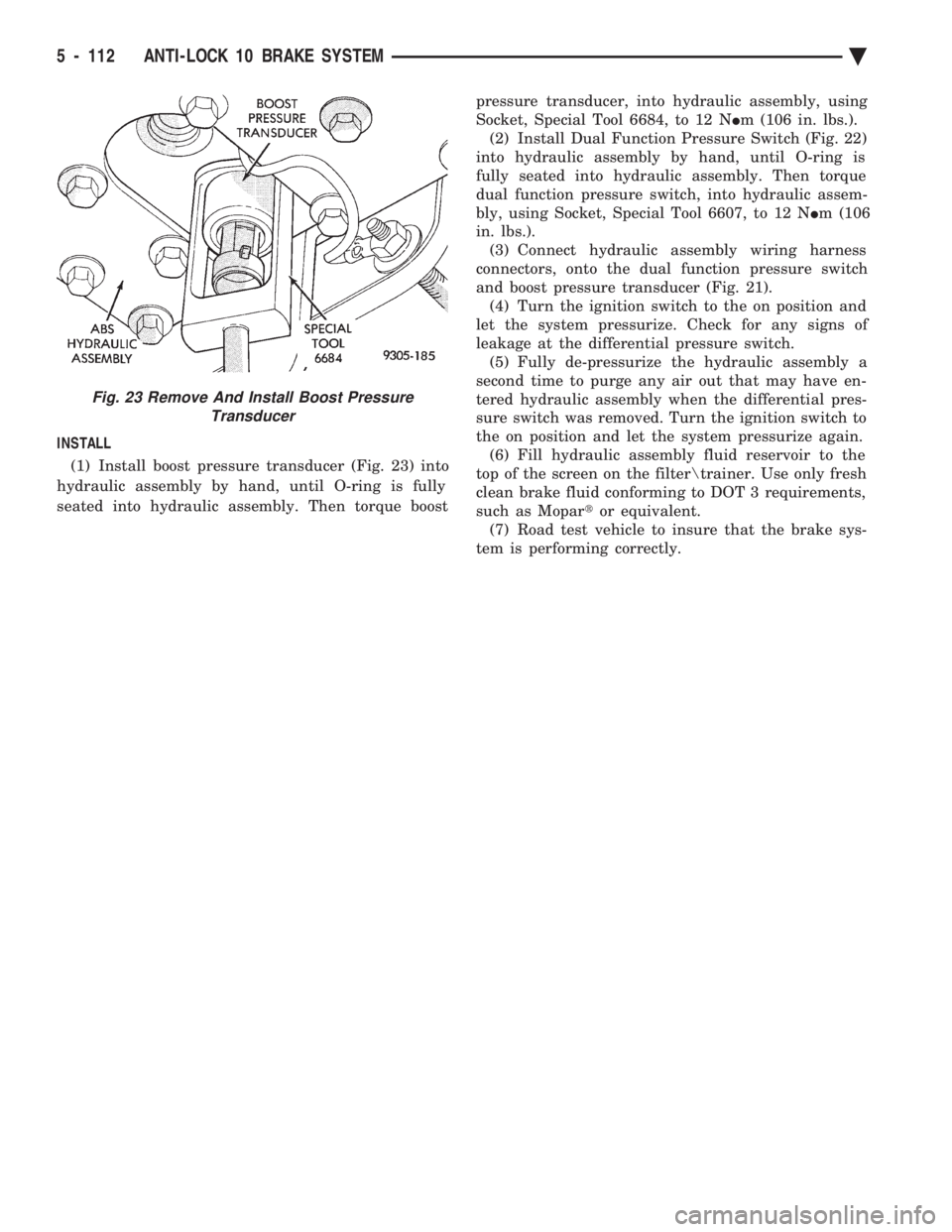
INSTALL (1) Install boost pressure transducer (Fig. 23) into
hydraulic assembly by hand, until O-ring is fully
seated into hydraulic assembly. Then torque boost pressure transducer, into hydraulic assembly, using
Socket, Special Tool 6684, to 12 N Im (106 in. lbs.).
(2) Install Dual Function Pressure Switch (Fig. 22)
into hydraulic assembly by hand, until O-ring is
fully seated into hydraulic assembly. Then torque
dual function pressure switch, into hydraulic assem-
bly, using Socket, Special Tool 6607, to 12 N Im (106
in. lbs.). (3) Connect hydraulic assembly wiring harness
connectors, onto the dual function pressure switch
and boost pressure transducer (Fig. 21). (4) Turn the ignition switch to the on position and
let the system pressurize. Check for any signs of
leakage at the differential pressure switch. (5) Fully de-pressurize the hydraulic assembly a
second time to purge any air out that may have en-
tered hydraulic assembly when the differential pres-
sure switch was removed. Turn the ignition switch to
the on position and let the system pressurize again. (6) Fill hydraulic assembly fluid reservoir to the
top of the screen on the filter rainer. Use only fresh
clean brake fluid conforming to DOT 3 requirements,
such as Mopar tor equivalent.
(7) Road test vehicle to insure that the brake sys-
tem is performing correctly.
Fig. 23 Remove And Install Boost Pressure Transducer
5 - 112 ANTI-LOCK 10 BRAKE SYSTEM Ä
Page 276 of 2438
As soon as the condition goes away, the Anti-Lock
Warning Light is turned off. Although a fault code
will be set in most cases.
BENDIX ABS SYSTEMS DIAGNOSTICS
Bendix Anti-Lock 6 Brake System Diagnostics, be-
yond basic mechanical diagnostics, covered earlier in
this section. Are accomplished by using the DRB II
scan tool. See testing procedures outlined in the Ben-
dix Anti-Lock 6 Diagnostics Manual for the 1992
M.Y. vehicles. Please refer to the above mentioned manual for
any further electronic diagnostics and service proce-
dures that are required on the Bendix Anti-Lock 6
Brake System.
ON-CAR ABS BRAKE SYSTEM SERVICE
GENERAL SERVICE PRECAUTIONS
The following are general cautions which should be
observed when servicing the Anti-Lock brake system
and/or other vehicle systems. Failure to observe
these precautions may result in Anti-Lock Brake
System component damage. If welding work is to be performed on the vehicle,
using an electric arc welder, the (CAB) connector
should be disconnected during the welding operation. The (CAB) connector should never be connected or
disconnected with the ignition switch in the ON po-
sition. Many components of the Anti-Lock Brake System
are not serviceable and must be replaced as an as-
sembly. Do not disassemble any component which is
not designed to be serviced.
CHECKING BRAKE FLUID LEVEL
CAUTION: Only use brake fluid conforming to DOT
3 specifications, such as Mopar or Equivalent. Do
not use any fluid which contains a petroleum base.
Do not use a container which has been used for pe-
troleum based fluids or a container which is wet
with water. Petroleum based fluids will cause swell-
ing and distortion of rubber parts in the hydraulic
brake system. Water will mix with brake fluid, low-
ering the fluid boiling point. Keep all brake fluid
containers capped to prevent contamination. Re-
move the front cap of the master cylinder reservoir
and fill to the bottom of the split ring.
For the specific procedure for the inspection of
brake fluid level and adding of brake to the reser-
voir. Refer to the Service Adjustments Section in this
group of the service manual.
BLEEDING BENDIX ANTI-LOCK 6 BRAKE SYSTEM
The Anti-Lock Brake System must be bled anytime
air is permitted to enter the hydraulic system, due to
disconnection of brake lines, hoses of components. If the Modulator Assembly is removed from the ve-
hicle, both the Base Brake System and the Anti-Lock
Brake System must be bled using the appropriate
procedures. It is important to note that excessive air
in the brake system will cause a soft or spongy feel-
ing brake pedal. During bleeding operations, be sure that the brake
fluid level remains close to the FULL level in the
reservoir. Check the fluid level periodically during
the bleeding procedure and add DOT 3 brake fluid as
required. The Bendix Anti-Lock 6 Brake System must be
bled as two independent braking systems. The non
ABS portion of the brake system is to be bled the
same as any non ABS system. Refer to the Service
Adjustments section in this manual for the proper
bleeding procedure to be used. This brake system can
be either pressure bled or manually bled. The Anti-Lock portion of brake system MUST be
bled separately. This bleeding procedure requires the
use of the DRB II Diagnostic tester and the bleeding
sequence procedure outlined below.
ABS BLEEDING PROCEDURE (FIG. 1)
(1) Assemble and install all brake system compo-
nents on vehicle making sure all hydraulic fluid
lines are installed and properly torqued. (2) Bleed the base brake system. Using the stan-
dard pressure or manual bleeding procedure as out-
lined in the Service Adjustments section of this
service manual. To perform the bleeding procedure on the ABS
unit. The battery and acid shield must be removed
from the vehicle. Reconnect the vehicles battery, to
the vehicles positive and negative battery cables us-
ing jumper cables. This is necessary to allow access
to the 4 bleeder screws located on the top of the Mod-
ulator assembly. (3) Connect the DRB II Diagnostics Tester to the
diagnostics connector. Located behind the Fuse Panel
access cover on the lower section of the dash panel to
the left of the steering column. (It is a blue 6 way
connector). (4) Using the DRB II check to make sure the
(CAB) does not have any fault codes stored. If it does
remove them using the DRB II.
5 - 126 ANTI-LOCK 6 BRAKE SYSTEM Ä
Page 280 of 2438
junction block. Torque both lower mounting bracket
bolts to 28 N Im (250 in. lbs.)
(4) Reinstall the 4 hydraulic brake tubes to the
Modulator Assembly and torque the fittings to 16
N Im (145 in. lbs.).
(5) Reconnect the 10 way Modulator assembly con-
nector, and the delta P switch connector. (6) Lower the vehicle and install the 2 master cyl-
inder supply tubes to the Modulator Assembly.
Torque the Modulator Assembly fittings and the
master cylinder fittings to 16 N Im (145 in.lbs.).
(7) Torque the Modulator to fender splash shield
attaching bolt to 28 N Im (250 in. lbs.)
(8) Bleed the brake system. Refer to the Bleeding
Bendix Anti 6 Brake System in this section of the
manual for proper bleeding procedure. (9) Reinstall the acid shield and battery tray. Re-
install battery and connect battery cables.
MASTER CYLINDER AND POWER BOOSTER
REMOVAL AND INSTALLATION
If the Master Cylinder or the Power Booster need
to be serviced or replaced. Refer to Master Cylinder
or Power Brake Service section in this group of the
service manual. After servicing the Master Cylinder. Refer back to
this section of the service manual. For the appropri-
ate procedure and sequence, used to bleed the base
and ABS portion of the brake system
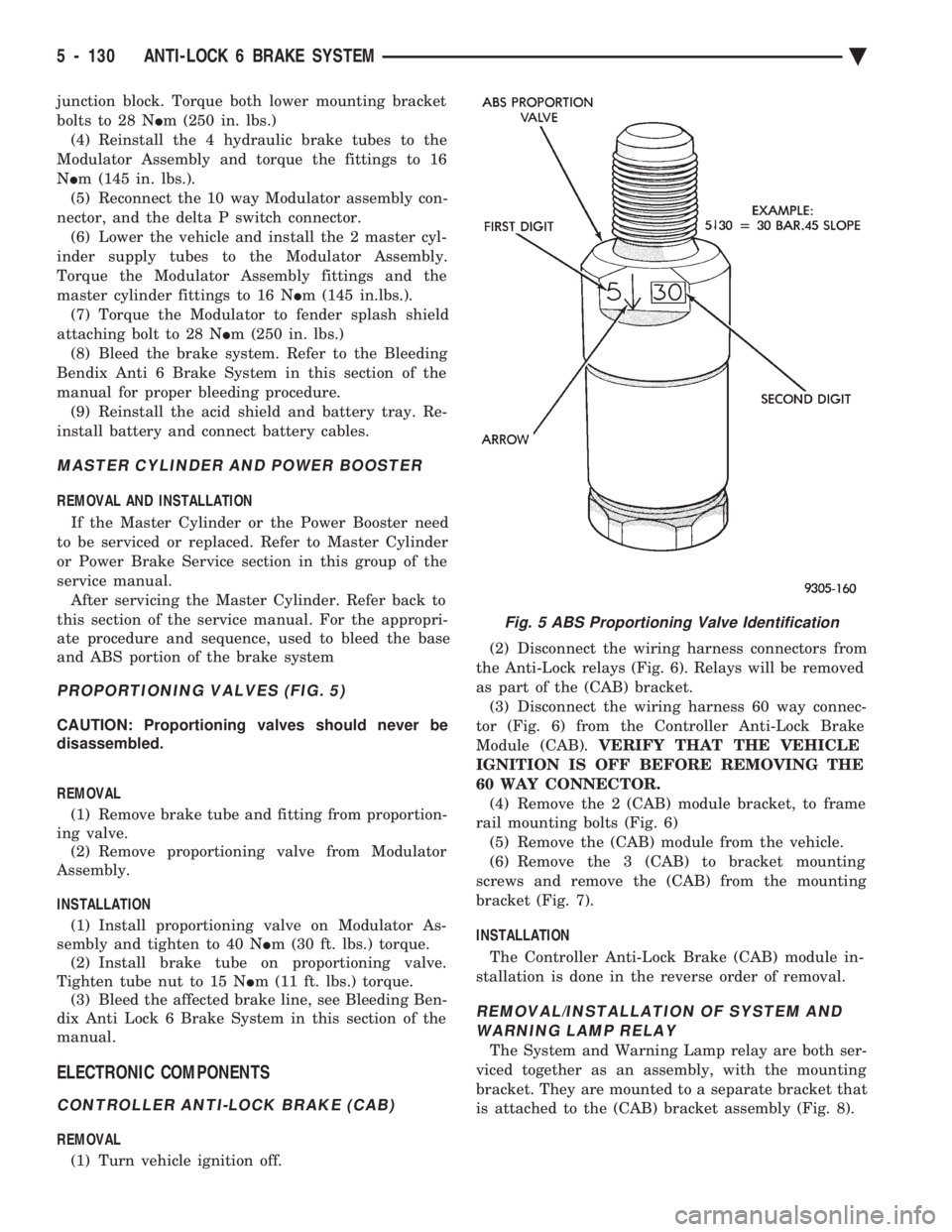
PROPORTIONING VALVES (FIG. 5)
CAUTION: Proportioning valves should never be
disassembled.
REMOVAL (1) Remove brake tube and fitting from proportion-
ing valve. (2) Remove proportioning valve from Modulator
Assembly.
INSTALLATION (1) Install proportioning valve on Modulator As-
sembly and tighten to 40 N Im (30 ft. lbs.) torque.
(2) Install brake tube on proportioning valve.
Tighten tube nut to 15 N Im (11 ft. lbs.) torque.
(3) Bleed the affected brake line, see Bleeding Ben-
dix Anti Lock 6 Brake System in this section of the
manual.
ELECTRONIC COMPONENTS
CONTROLLER ANTI-LOCK BRAKE (CAB)
REMOVAL
(1) Turn vehicle ignition off. (2) Disconnect the wiring harness connectors from
the Anti-Lock relays (Fig. 6). Relays will be removed
as part of the (CAB) bracket. (3) Disconnect the wiring harness 60 way connec-
tor (Fig. 6) from the Controller Anti-Lock Brake
Module (CAB). VERIFY THAT THE VEHICLE
IGNITION IS OFF BEFORE REMOVING THE
60 WAY CONNECTOR. (4) Remove the 2 (CAB) module bracket, to frame
rail mounting bolts (Fig. 6) (5) Remove the (CAB) module from the vehicle.
(6) Remove the 3 (CAB) to bracket mounting
screws and remove the (CAB) from the mounting
bracket (Fig. 7).
INSTALLATION
The Controller Anti-Lock Brake (CAB) module in-
stallation is done in the reverse order of removal.
REMOVAL/INSTALLATION OF SYSTEM AND WARNING LAMP RELAY
The System and Warning Lamp relay are both ser-
viced together as an assembly, with the mounting
bracket. They are mounted to a separate bracket that
is attached to the (CAB) bracket assembly (Fig. 8).
Fig. 5 ABS Proportioning Valve Identification
5 - 130 ANTI-LOCK 6 BRAKE SYSTEM Ä
Page 283 of 2438
INSTALLATION (1) Connect the wheel speed sensor connector to
the wiring harness. (2) Push sensor assembly grommet into hole in
fender shield. Install clip and screw. (3) Install the 2 screws that fasten the speed sen-
sor routing tube to the frame rail. (4) Install sensor grommets in brackets on fender
shield and strut damper. (5) Coat the speed sensor with High Temperature
Multi-purpose E.P. Grease before installing into the
steering knuckle. Install screw tighten to 7 N Im (60
in. lbs.)
CAUTION: Proper installation of wheel speed sen-
sor cables is critical to continued system operation.
Be sure that cables are installed in retainers. Fail-
ure to install cables in retainers, as shown in this
section, may result in contact with moving parts
and/or over extension of cables, resulting in an
open circuit.
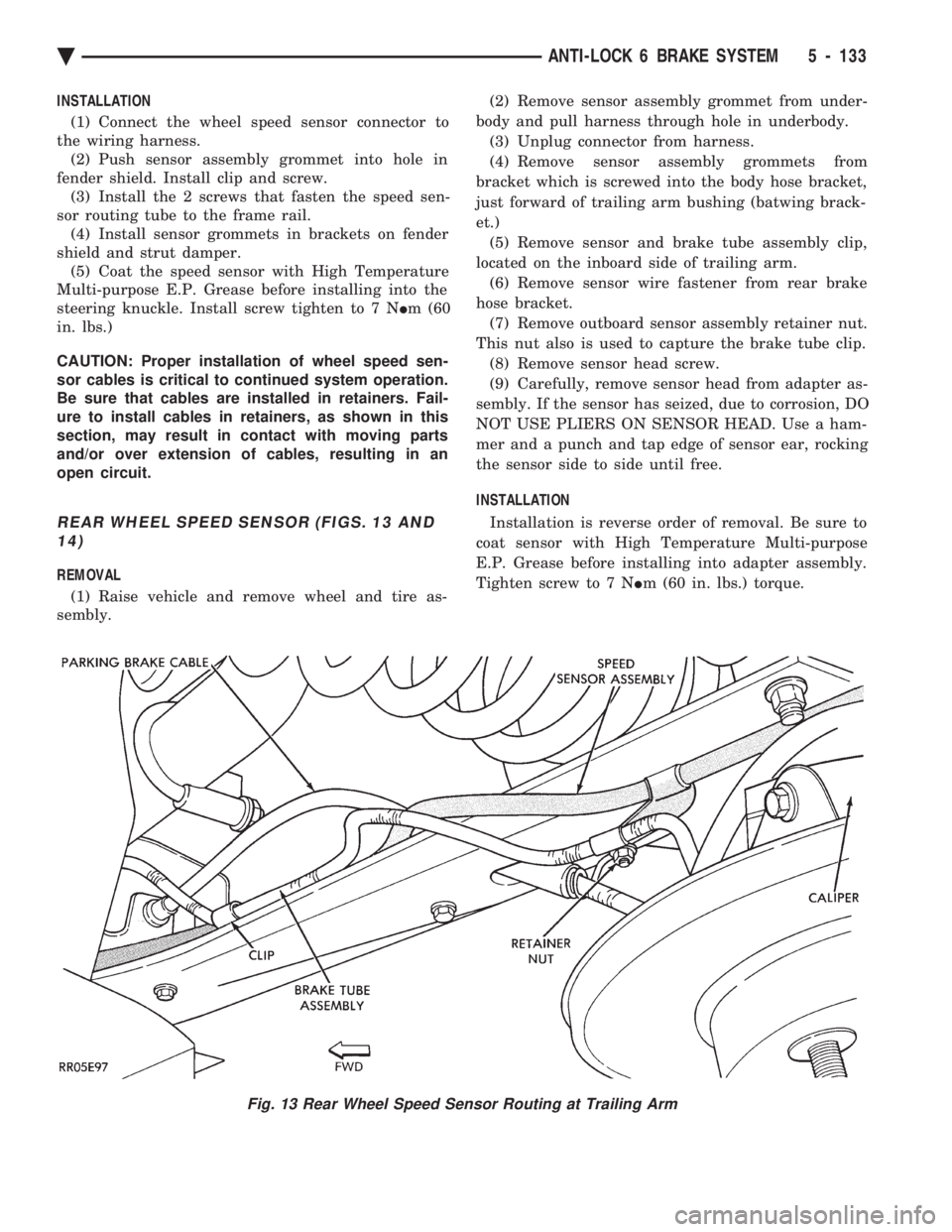
REAR WHEEL SPEED SENSOR (FIGS. 13 AND 14)
REMOVAL
(1) Raise vehicle and remove wheel and tire as-
sembly. (2) Remove sensor assembly grommet from under-
body and pull harness through hole in underbody. (3) Unplug connector from harness.
(4) Remove sensor assembly grommets from
bracket which is screwed into the body hose bracket,
just forward of trailing arm bushing (batwing brack-
et.) (5) Remove sensor and brake tube assembly clip,
located on the inboard side of trailing arm. (6) Remove sensor wire fastener from rear brake
hose bracket. (7) Remove outboard sensor assembly retainer nut.
This nut also is used to capture the brake tube clip. (8) Remove sensor head screw.
(9) Carefully, remove sensor head from adapter as-
sembly. If the sensor has seized, due to corrosion, DO
NOT USE PLIERS ON SENSOR HEAD. Use a ham-
mer and a punch and tap edge of sensor ear, rocking
the sensor side to side until free.
INSTALLATION Installation is reverse order of removal. Be sure to
coat sensor with High Temperature Multi-purpose
E.P. Grease before installing into adapter assembly.
Tighten screw to 7 N Im (60 in. lbs.) torque.
Fig. 13 Rear Wheel Speed Sensor Routing at Trailing Arm
Ä ANTI-LOCK 6 BRAKE SYSTEM 5 - 133