torque CHEVROLET DYNASTY 1993 Workshop Manual
[x] Cancel search | Manufacturer: CHEVROLET, Model Year: 1993, Model line: DYNASTY, Model: CHEVROLET DYNASTY 1993Pages: 2438, PDF Size: 74.98 MB
Page 241 of 2438
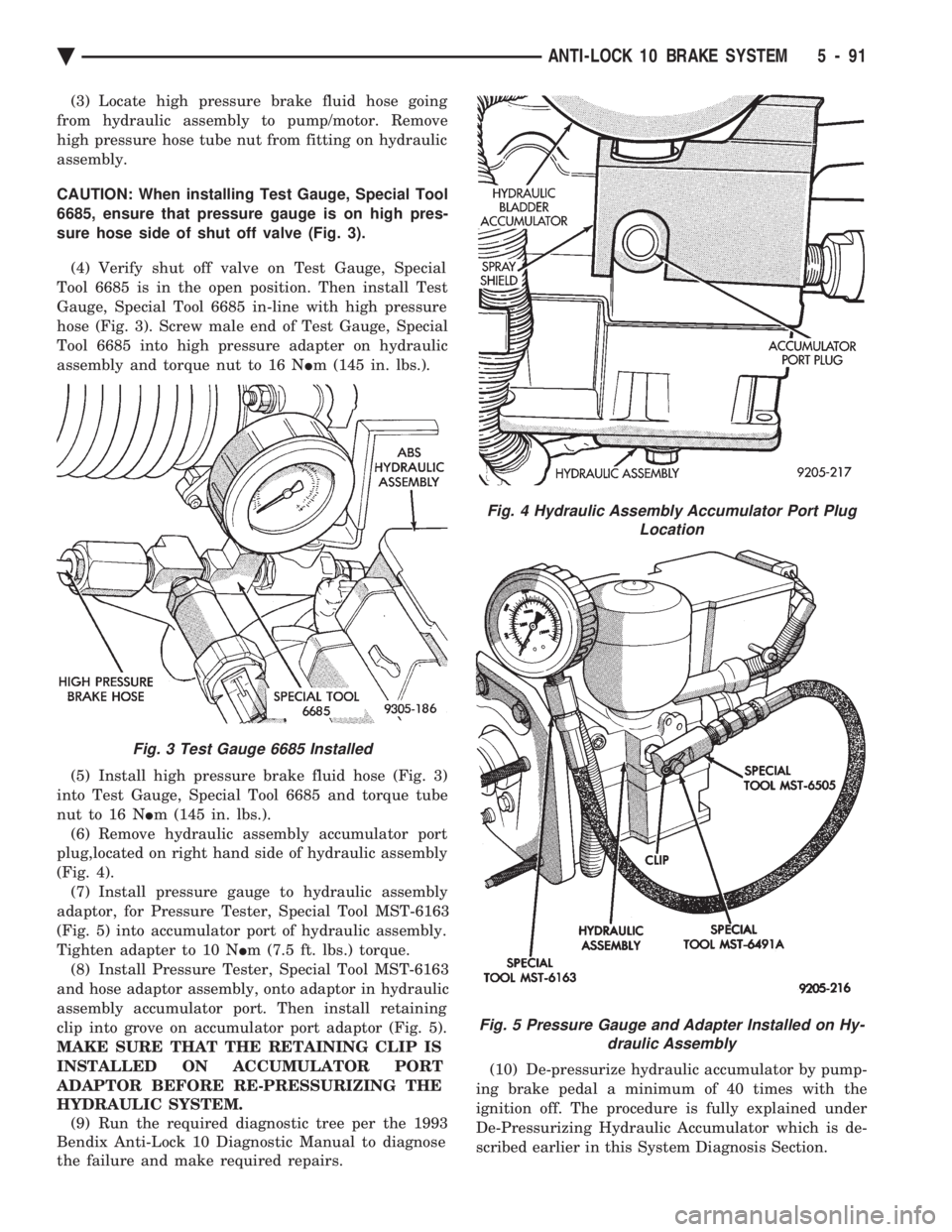
(3) Locate high pressure brake fluid hose going
from hydraulic assembly to pump/motor. Remove
high pressure hose tube nut from fitting on hydraulic
assembly.
CAUTION: When installing Test Gauge, Special Tool
6685, ensure that pressure gauge is on high pres-
sure hose side of shut off valve (Fig. 3).
(4) Verify shut off valve on Test Gauge, Special
Tool 6685 is in the open position. Then install Test
Gauge, Special Tool 6685 in-line with high pressure
hose (Fig. 3). Screw male end of Test Gauge, Special
Tool 6685 into high pressure adapter on hydraulic
assembly and torque nut to 16 N Im (145 in. lbs.).
(5) Install high pressure brake fluid hose (Fig. 3)
into Test Gauge, Special Tool 6685 and torque tube
nut to 16 N Im (145 in. lbs.).
(6) Remove hydraulic assembly accumulator port
plug,located on right hand side of hydraulic assembly
(Fig. 4). (7) Install pressure gauge to hydraulic assembly
adaptor, for Pressure Tester, Special Tool MST-6163
(Fig. 5) into accumulator port of hydraulic assembly.
Tighten adapter to 10 N Im (7.5 ft. lbs.) torque.
(8) Install Pressure Tester, Special Tool MST-6163
and hose adaptor assembly, onto adaptor in hydraulic
assembly accumulator port. Then install retaining
clip into grove on accumulator port adaptor (Fig. 5).
MAKE SURE THAT THE RETAINING CLIP IS
INSTALLED ON ACCUMULATOR PORT
ADAPTOR BEFORE RE-PRESSURIZING THE
HYDRAULIC SYSTEM. (9) Run the required diagnostic tree per the 1993
Bendix Anti-Lock 10 Diagnostic Manual to diagnose
the failure and make required repairs. (10) De-pressurize hydraulic accumulator by pump-
ing brake pedal a minimum of 40 times with the
ignition off. The procedure is fully explained under
De-Pressurizing Hydraulic Accumulator which is de-
scribed earlier in this System Diagnosis Section.
Fig. 3 Test Gauge 6685 Installed
Fig. 4 Hydraulic Assembly Accumulator Port Plug Location
Fig. 5 Pressure Gauge and Adapter Installed on Hy-draulic Assembly
Ä ANTI-LOCK 10 BRAKE SYSTEM 5 - 91
Page 242 of 2438
(11) Remove all special tools previously installed,
from the ABS hydraulic assembly. (12) Install accumulator port plug into hydraulic
assembly. Torque accumulator port plug to 12 N Im(9
ft. lbs.). (13) Install high pressure brake hose from the
pump motor assembly into hydraulic fitting on ABS
hydraulic assembly. Torque high pressure brake hose
tube nut to 16 N Im (145 in. lbs.).
(14) Turn ignition switch to the run position to en-
ergize the pump/motor assembly and pressurize hy-
draulic system. Check for leakage at the hydraulic
assembly to hydraulic bladder accumulator fitting. (15) Again de-pressurize accumulator by pumping
brake pedal a minimum of 40 times. Use procedure
described in De-Pressurizing Hydraulic Accumulator
in this section of the service manual. (16) Then check the brake fluid level in the hy-
draulic assembly reservoir. If brake fluid level is low,
fill reservoir to proper level with Mopar tbrake fluid
or equivalent conforming to DOT 3 requirements.
INTERMITTENT FAULTS
As with almost any electronic system, intermittent
faults in the ABS system may be difficult to accu-
rately diagnose. Most intermittent faults are caused by faulty elec-
trical connections or wiring. When an intermittent
fault is encountered, check suspect circuits for: (1) Poor mating of electrical connector halves, or
electrical terminals not fully seated in the connector
body. (2) Improperly formed or damaged electrical termi-
nals. All connector terminals in a suspect circuit
should be carefully reformed to increase contact ten-
sion. (3) Poor terminal to wire connection. This requires
removing the terminal from the connector body and
inspecting for proper terminal to wire connection. If a visual check does not find the cause of the
problem, operate the vehicle in an attempt to dupli-
cate the condition and record the Fault Code. Most failures of the ABS system will disable the
Anti-Lock function for the entire ignition cycle even
if the fault clears before ignition key-off. There are
some failure conditions however, which will allow
ABS operation to resume during the ignition cycle in
which a failure occurred. If the failure conditions are
no longer present. The following conditions may result in intermittent
illumination of the Red Brake Warning Lamp and/or
Amber Anti-Lock Warning Lamp. All other failures
will cause the lamp(s) to remain on until the ignition
switch is turned off. Circuits and or components in-
volving these inputs to the (CAB) should be investi-
gated if a complaint of intermittent warning system
operation is encountered. ²
Low system voltage. If low system voltage is de-
tected by the (CAB), the (CAB) will turn on the Am-
ber Anti-Lock Warning Lamp until normal system
voltage is achieved. Once normal voltage is seen at
the (CAB), normal operation resumes.
² Low Brake Fluid. A low brake fluid condition will
cause the Red Brake Warning Lamp to illuminate.
When the fluid sensor again indicates an acceptable
fluid level, the Red Brake Warning Lamp will go out.
This condition may exist during hard cornering or
while the vehicle is on a grade. If the vehicle is in
motion above 3 M.P.H. the Amber Anti-Lock Warn-
ing Lamp will also be turned on.
² Low Accumulator Pressure. Low Accumulator
Pressure will cause both the Red Brake Warning and
Amber Anti-Lock Warning Lamps to illuminate.
Once normal operating pressure is achieved, the
lamps will extinguish and the system will return to
normal operation. Additionally, any condition that results in an inter-
ruption of power to the (CAB) or hydraulic assembly.
May cause the Red Brake Warning and Amber Anti-
Lock Warning Lamps to illuminate intermittently. All the conditions (or faults) mentioned above, can
store a fault code in the (CAB) module.
ABS BRAKE SYSTEM DIAGNOSTIC FEATURES
SYSTEM SELF DIAGNOSIS
The ABS system is equipped with a diagnostic ca-
pability that may be used to assist in isolation of
ABS faults. The features of the diagnostics system
are described below.
CONTROLLER ANTI-LOCK BRAKE (CAB)
Fault codes are kept in a Non-Volatile memory un-
til either erased by the technician using the DRB II
or erased automatically after 50 ignition cycles (key
ON-OFF cycles). The only fault that will not be
erased after 50 (KEY CYCLES) is the (CAB) fault.
The (CAB) fault can only be erased by using the
DRB II diagnostic tester. More than one fault can be
stored at a time. The number of key cycles since the
most recent fault was stored is also displayed. Most
functions of the (CAB) and (ABS) system can be ac-
cessed by the technician for testing and diagnostic
purposes by using the DRB II Diagnostic Tester.
START-UP CYCLE
The START-UP CYCLE takes place immediately
after the ignition switch is turned on. It is an elec-
trical check of basic electrical functions such as the
System Relay and Anti-Lock Warning Lamp Relay.
During this check, the Amber Anti-Lock Warning
Lamp is turned on, then turned off at the end of the
test. The test takes approximatel y1-2seconds to
complete.
5 - 92 ANTI-LOCK 10 BRAKE SYSTEM Ä
Page 245 of 2438
(7) With the pressure bleeder turned on, open the
caliper bleed screw 3/4 to one full turn allowing brake
fluid to flow into the container. Leave bleed screw open
until a clear, bubble-free flow of brake fluid is coming
from the hose in the container. If the reservoir has been
drained or the hydraulic assembly removed from the
car before the bleeding operation. Slowly pump the
brake pedal one or two times while the bleed screw is
open and fluid is flowing. This will help purge any
trapped air from the hydraulic assembly. Tighten
bleeder screw to 10 N Im (7.5 ft. lbs.) torque.
(8) Step 7 above should be done at all wheel brakes,
following the order wheel by wheel as listed below. a) Left rear.
b) Right rear.
c) Left front.
d) Right front.
(9) After bleeding is completed at all four wheel
brakes. Remove pressure bleeding equipment and
adapter by closing pressure bleeder valve and slowly
unscrewing bleeder adapter from hydraulic assembly
reservoir. Failure to release pressure in the reser-
voir will cause spillage of brake fluid, and could
result in personal injury or damage to painted
surfaces. (10) Using a syringe or equivalent method, remove
excess fluid from the reservoir to bring the brake fluid
to the required fill level (Fig. 1). If brake fluid is below
the proper level add Mopar tbrake fluid or equivalent
conforming to DOT 3, requirements. (11) Install the reservoir caps and turn on the igni-
tion to allow the (ABS) pump to charge the accumula-
tor.
MANUAL BLEEDING
Brake lines can be bled, using the manual bleeding
method. Manual bleeding is a two person operation,
one to pump the brake pedal and the other to bleed
each wheel brake. The following procedure should be
used: De-pressurizing the hydraulic accumulator is done
by following the steps described below. (1) Verify that the ignition switch is in the off posi-
tion. (2) Fully de-pressurize the hydraulic accumulator by
pumping brake pedal a minimum of 40 times. Use the
procedure as described in De-Pressurizing Hydraulic
Accumulator listed earlier in this section.
WARNING: FAILURE TO DE-PRESSURIZE HYDRAU-
LIC ACCUMULATOR, PRIOR TO PERFORMING THIS
OPERATION, MAY RESULT IN PERSONAL INJURY
AND/OR DAMAGE TO PAINTED SURFACES.
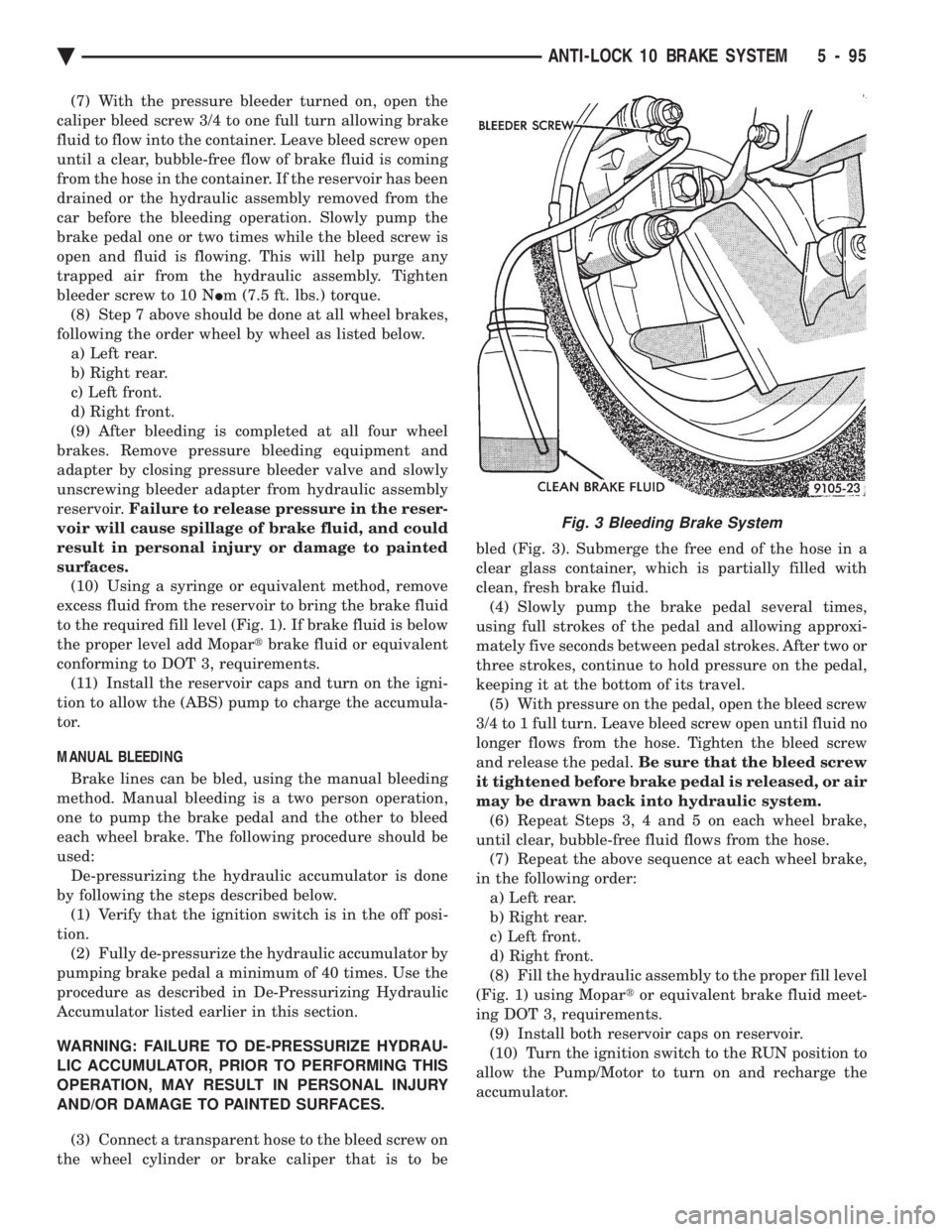
(3) Connect a transparent hose to the bleed screw on
the wheel cylinder or brake caliper that is to be bled (Fig. 3). Submerge the free end of the hose in a
clear glass container, which is partially filled with
clean, fresh brake fluid.
(4) Slowly pump the brake pedal several times,
using full strokes of the pedal and allowing approxi-
mately five seconds between pedal strokes. After two or
three strokes, continue to hold pressure on the pedal,
keeping it at the bottom of its travel. (5) With pressure on the pedal, open the bleed screw
3/4 to 1 full turn. Leave bleed screw open until fluid no
longer flows from the hose. Tighten the bleed screw
and release the pedal. Be sure that the bleed screw
it tightened before brake pedal is released, or air
may be drawn back into hydraulic system. (6) Repeat Steps 3, 4 and 5 on each wheel brake,
until clear, bubble-free fluid flows from the hose. (7) Repeat the above sequence at each wheel brake,
in the following order: a) Left rear.
b) Right rear.
c) Left front.
d) Right front.
(8) Fill the hydraulic assembly to the proper fill level
(Fig. 1) using Mopar tor equivalent brake fluid meet-
ing DOT 3, requirements. (9) Install both reservoir caps on reservoir.
(10) Turn the ignition switch to the RUN position to
allow the Pump/Motor to turn on and recharge the
accumulator.
Fig. 3 Bleeding Brake System
Ä ANTI-LOCK 10 BRAKE SYSTEM 5 - 95
Page 246 of 2438
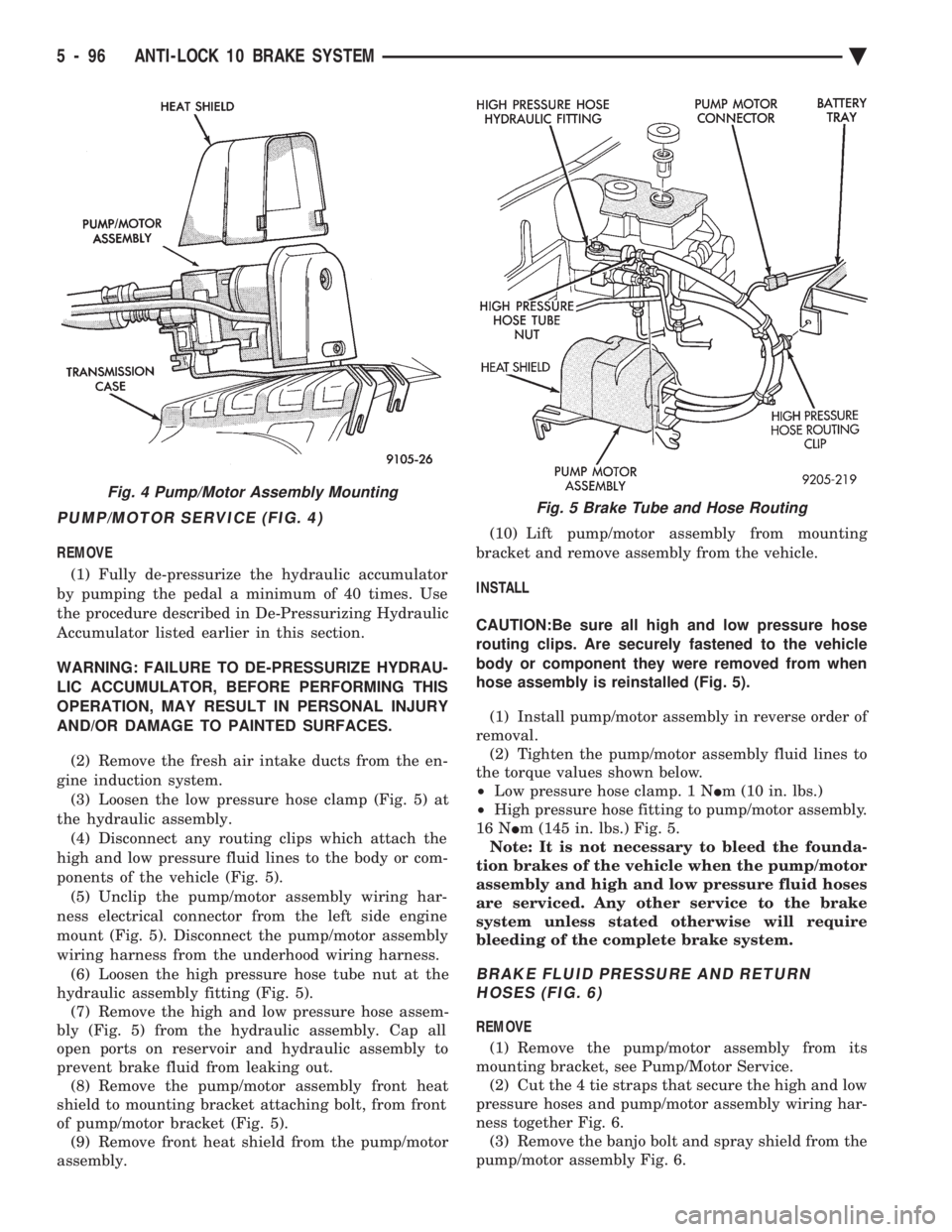
PUMP/MOTOR SERVICE (FIG. 4)
REMOVE (1) Fully de-pressurize the hydraulic accumulator
by pumping the pedal a minimum of 40 times. Use
the procedure described in De-Pressurizing Hydraulic
Accumulator listed earlier in this section.
WARNING: FAILURE TO DE-PRESSURIZE HYDRAU-
LIC ACCUMULATOR, BEFORE PERFORMING THIS
OPERATION, MAY RESULT IN PERSONAL INJURY
AND/OR DAMAGE TO PAINTED SURFACES.
(2) Remove the fresh air intake ducts from the en-
gine induction system. (3) Loosen the low pressure hose clamp (Fig. 5) at
the hydraulic assembly. (4) Disconnect any routing clips which attach the
high and low pressure fluid lines to the body or com-
ponents of the vehicle (Fig. 5). (5) Unclip the pump/motor assembly wiring har-
ness electrical connector from the left side engine
mount (Fig. 5). Disconnect the pump/motor assembly
wiring harness from the underhood wiring harness. (6) Loosen the high pressure hose tube nut at the
hydraulic assembly fitting (Fig. 5). (7) Remove the high and low pressure hose assem-
bly (Fig. 5) from the hydraulic assembly. Cap all
open ports on reservoir and hydraulic assembly to
prevent brake fluid from leaking out. (8) Remove the pump/motor assembly front heat
shield to mounting bracket attaching bolt, from front
of pump/motor bracket (Fig. 5). (9) Remove front heat shield from the pump/motor
assembly. (10) Lift pump/motor assembly from mounting
bracket and remove assembly from the vehicle.
INSTALL
CAUTION:Be sure all high and low pressure hose
routing clips. Are securely fastened to the vehicle
body or component they were removed from when
hose assembly is reinstalled (Fig. 5).
(1) Install pump/motor assembly in reverse order of
removal. (2) Tighten the pump/motor assembly fluid lines to
the torque values shown below.
² Low pressure hose clamp. 1 N Im (10 in. lbs.)
² High pressure hose fitting to pump/motor assembly.
16 N Im (145 in. lbs.) Fig. 5.
Note: It is not necessary to bleed the founda-
tion brakes of the vehicle when the pump/motor
assembly and high and low pressure fluid hoses
are serviced. Any other service to the brake
system unless stated otherwise will require
bleeding of the complete brake system.
BRAKE FLUID PRESSURE AND RETURN HOSES (FIG. 6)
REMOVE
(1) Remove the pump/motor assembly from its
mounting bracket, see Pump/Motor Service. (2) Cut the 4 tie straps that secure the high and low
pressure hoses and pump/motor assembly wiring har-
ness together Fig. 6. (3) Remove the banjo bolt and spray shield from the
pump/motor assembly Fig. 6.
Fig. 4 Pump/Motor Assembly MountingFig. 5 Brake Tube and Hose Routing
5 - 96 ANTI-LOCK 10 BRAKE SYSTEM Ä
Page 247 of 2438
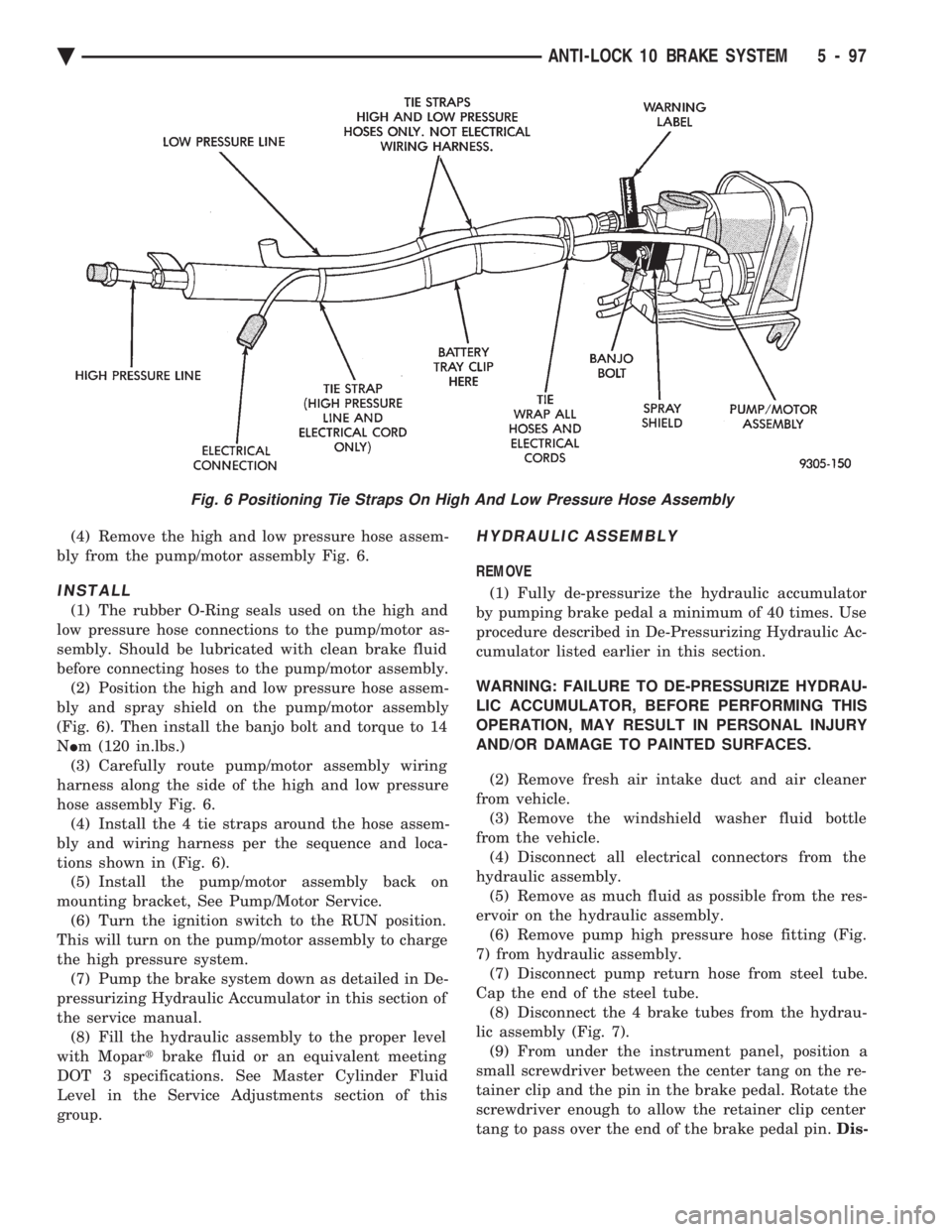
(4) Remove the high and low pressure hose assem-
bly from the pump/motor assembly Fig. 6.
INSTALL
(1) The rubber O-Ring seals used on the high and
low pressure hose connections to the pump/motor as-
sembly. Should be lubricated with clean brake fluid
before connecting hoses to the pump/motor assembly. (2) Position the high and low pressure hose assem-
bly and spray shield on the pump/motor assembly
(Fig. 6). Then install the banjo bolt and torque to 14
N Im (120 in.lbs.)
(3) Carefully route pump/motor assembly wiring
harness along the side of the high and low pressure
hose assembly Fig. 6. (4) Install the 4 tie straps around the hose assem-
bly and wiring harness per the sequence and loca-
tions shown in (Fig. 6). (5) Install the pump/motor assembly back on
mounting bracket, See Pump/Motor Service. (6) Turn the ignition switch to the RUN position.
This will turn on the pump/motor assembly to charge
the high pressure system. (7) Pump the brake system down as detailed in De-
pressurizing Hydraulic Accumulator in this section of
the service manual. (8) Fill the hydraulic assembly to the proper level
with Mopar tbrake fluid or an equivalent meeting
DOT 3 specifications. See Master Cylinder Fluid
Level in the Service Adjustments section of this
group.
HYDRAULIC ASSEMBLY
REMOVE
(1) Fully de-pressurize the hydraulic accumulator
by pumping brake pedal a minimum of 40 times. Use
procedure described in De-Pressurizing Hydraulic Ac-
cumulator listed earlier in this section.
WARNING: FAILURE TO DE-PRESSURIZE HYDRAU-
LIC ACCUMULATOR, BEFORE PERFORMING THIS
OPERATION, MAY RESULT IN PERSONAL INJURY
AND/OR DAMAGE TO PAINTED SURFACES.
(2) Remove fresh air intake duct and air cleaner
from vehicle. (3) Remove the windshield washer fluid bottle
from the vehicle. (4) Disconnect all electrical connectors from the
hydraulic assembly. (5) Remove as much fluid as possible from the res-
ervoir on the hydraulic assembly. (6) Remove pump high pressure hose fitting (Fig.
7) from hydraulic assembly. (7) Disconnect pump return hose from steel tube.
Cap the end of the steel tube. (8) Disconnect the 4 brake tubes from the hydrau-
lic assembly (Fig. 7). (9) From under the instrument panel, position a
small screwdriver between the center tang on the re-
tainer clip and the pin in the brake pedal. Rotate the
screwdriver enough to allow the retainer clip center
tang to pass over the end of the brake pedal pin. Dis-
Fig. 6 Positioning Tie Straps On High And Low Pressure Hose Assembly
Ä ANTI-LOCK 10 BRAKE SYSTEM 5 - 97
Page 248 of 2438
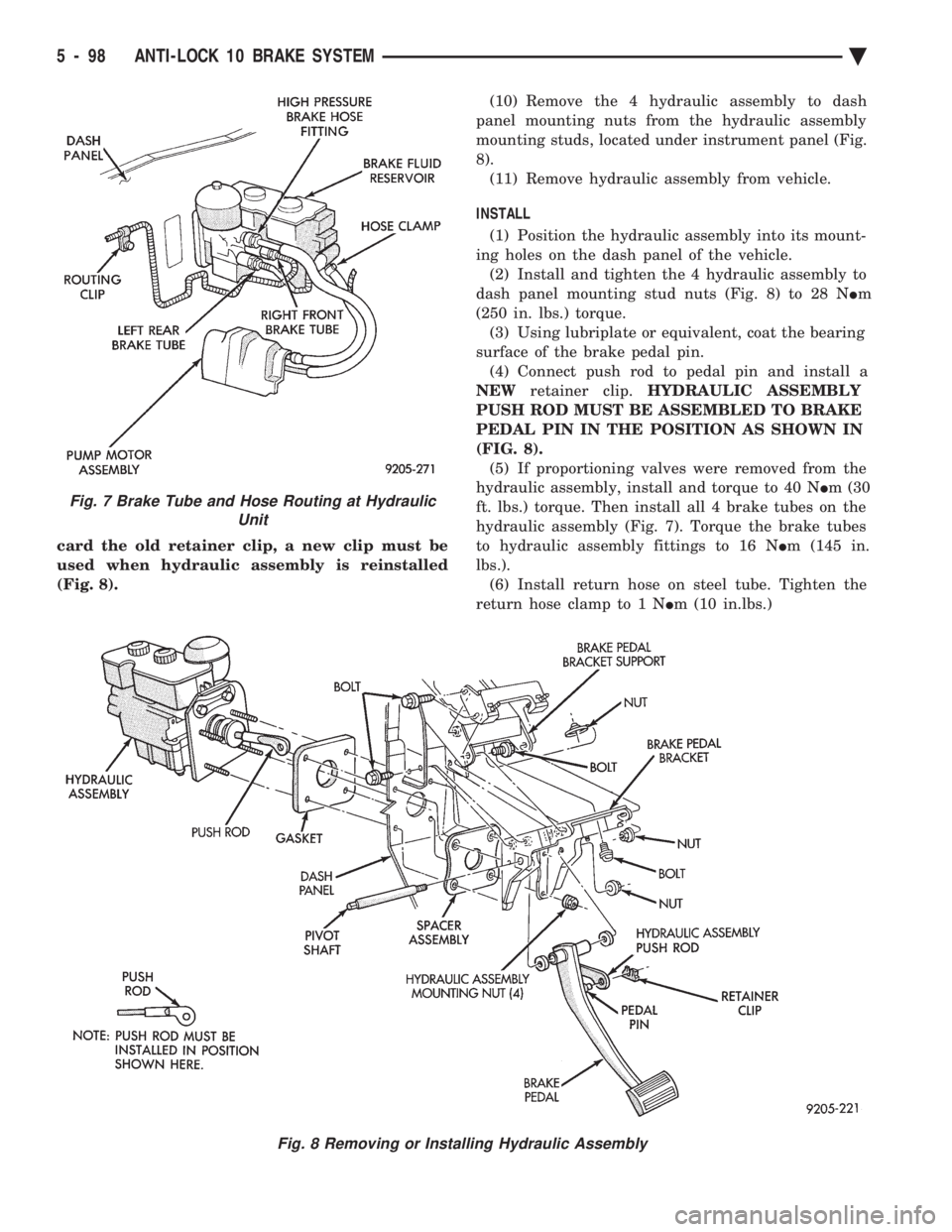
card the old retainer clip, a new clip must be
used when hydraulic assembly is reinstalled
(Fig. 8). (10) Remove the 4 hydraulic assembly to dash
panel mounting nuts from the hydraulic assembly
mounting studs, located under instrument panel (Fig.
8). (11) Remove hydraulic assembly from vehicle.
INSTALL (1) Position the hydraulic assembly into its mount-
ing holes on the dash panel of the vehicle. (2) Install and tighten the 4 hydraulic assembly to
dash panel mounting stud nuts (Fig. 8) to 28 N Im
(250 in. lbs.) torque. (3) Using lubriplate or equivalent, coat the bearing
surface of the brake pedal pin. (4) Connect push rod to pedal pin and install a
NEW retainer clip. HYDRAULIC ASSEMBLY
PUSH ROD MUST BE ASSEMBLED TO BRAKE
PEDAL PIN IN THE POSITION AS SHOWN IN
(FIG. 8). (5) If proportioning valves were removed from the
hydraulic assembly, install and torque to 40 N Im (30
ft. lbs.) torque. Then install all 4 brake tubes on the
hydraulic assembly (Fig. 7). Torque the brake tubes
to hydraulic assembly fittings to 16 N Im (145 in.
lbs.). (6) Install return hose on steel tube. Tighten the
return hose clamp to 1 N Im (10 in.lbs.)
Fig. 7 Brake Tube and Hose Routing at Hydraulic
Unit
Fig. 8 Removing or Installing Hydraulic Assembly
5 - 98 ANTI-LOCK 10 BRAKE SYSTEM Ä
Page 250 of 2438
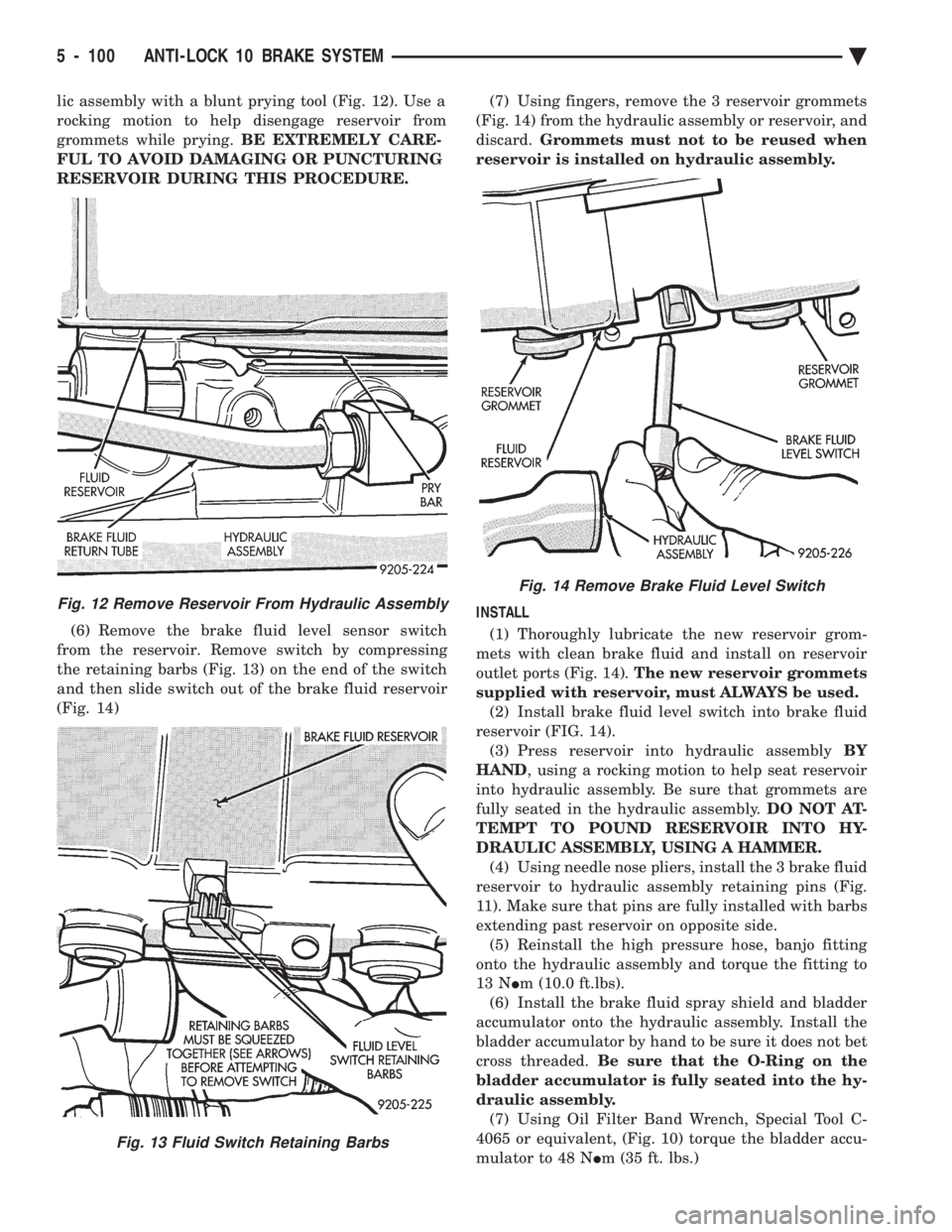
lic assembly with a blunt prying tool (Fig. 12). Use a
rocking motion to help disengage reservoir from
grommets while prying. BE EXTREMELY CARE-
FUL TO AVOID DAMAGING OR PUNCTURING
RESERVOIR DURING THIS PROCEDURE.
(6) Remove the brake fluid level sensor switch
from the reservoir. Remove switch by compressing
the retaining barbs (Fig. 13) on the end of the switch
and then slide switch out of the brake fluid reservoir
(Fig. 14) (7) Using fingers, remove the 3 reservoir grommets
(Fig. 14) from the hydraulic assembly or reservoir, and
discard. Grommets must not to be reused when
reservoir is installed on hydraulic assembly.
INSTALL (1) Thoroughly lubricate the new reservoir grom-
mets with clean brake fluid and install on reservoir
outlet ports (Fig. 14). The new reservoir grommets
supplied with reservoir, must ALWAYS be used. (2) Install brake fluid level switch into brake fluid
reservoir (FIG. 14). (3) Press reservoir into hydraulic assembly BY
HAND , using a rocking motion to help seat reservoir
into hydraulic assembly. Be sure that grommets are
fully seated in the hydraulic assembly. DO NOT AT-
TEMPT TO POUND RESERVOIR INTO HY-
DRAULIC ASSEMBLY, USING A HAMMER. (4) Using needle nose pliers, install the 3 brake fluid
reservoir to hydraulic assembly retaining pins (Fig.
11). Make sure that pins are fully installed with barbs
extending past reservoir on opposite side. (5) Reinstall the high pressure hose, banjo fitting
onto the hydraulic assembly and torque the fitting to
13 N Im (10.0 ft.lbs).
(6) Install the brake fluid spray shield and bladder
accumulator onto the hydraulic assembly. Install the
bladder accumulator by hand to be sure it does not bet
cross threaded. Be sure that the O-Ring on the
bladder accumulator is fully seated into the hy-
draulic assembly. (7) Using Oil Filter Band Wrench, Special Tool C-
4065 or equivalent, (Fig. 10) torque the bladder accu-
mulator to 48 N Im (35 ft. lbs.)
Fig. 12 Remove Reservoir From Hydraulic Assembly
Fig. 13 Fluid Switch Retaining Barbs
Fig. 14 Remove Brake Fluid Level Switch
5 - 100 ANTI-LOCK 10 BRAKE SYSTEM Ä
Page 251 of 2438
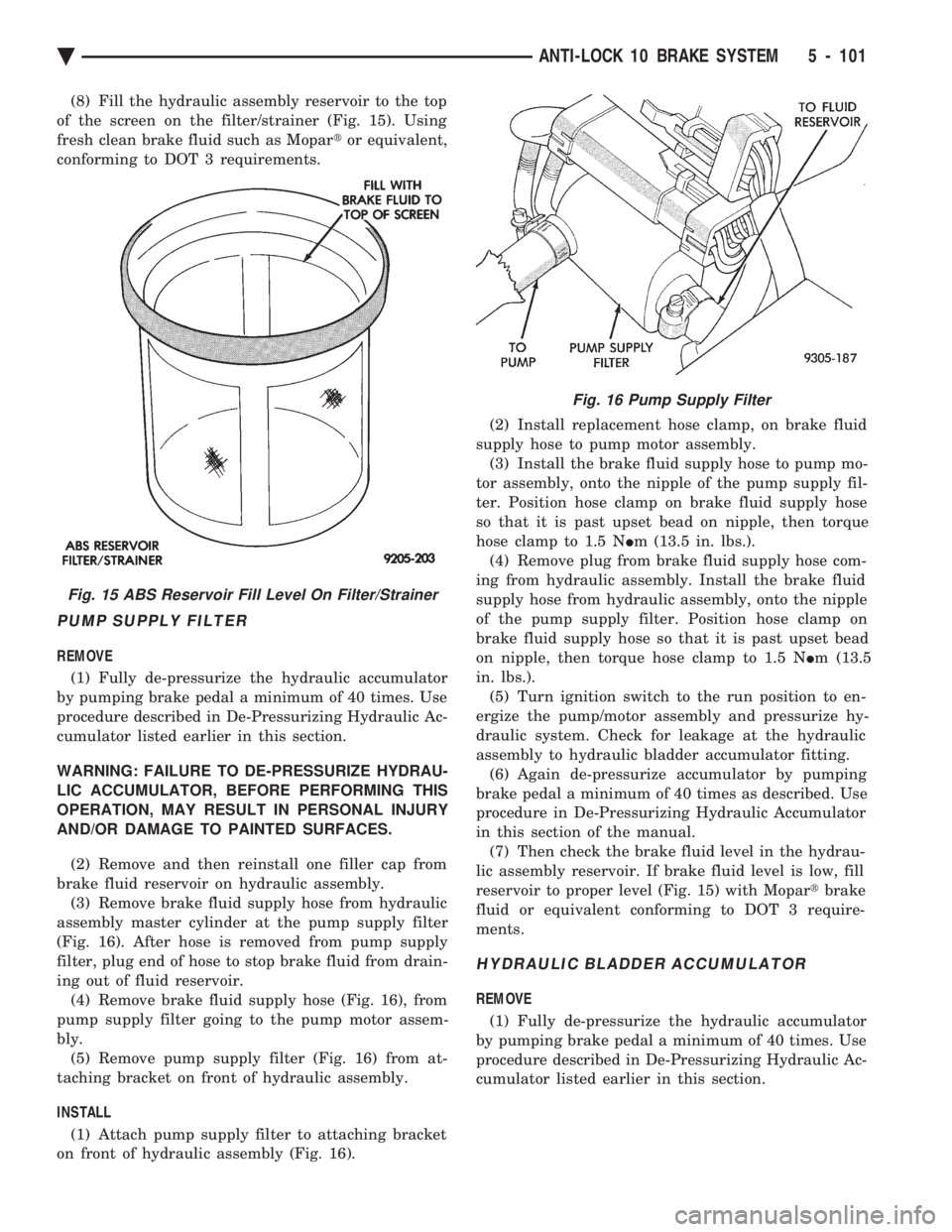
(8) Fill the hydraulic assembly reservoir to the top
of the screen on the filter/strainer (Fig. 15). Using
fresh clean brake fluid such as Mopar tor equivalent,
conforming to DOT 3 requirements.
PUMP SUPPLY FILTER
REMOVE
(1) Fully de-pressurize the hydraulic accumulator
by pumping brake pedal a minimum of 40 times. Use
procedure described in De-Pressurizing Hydraulic Ac-
cumulator listed earlier in this section.
WARNING: FAILURE TO DE-PRESSURIZE HYDRAU-
LIC ACCUMULATOR, BEFORE PERFORMING THIS
OPERATION, MAY RESULT IN PERSONAL INJURY
AND/OR DAMAGE TO PAINTED SURFACES.
(2) Remove and then reinstall one filler cap from
brake fluid reservoir on hydraulic assembly. (3) Remove brake fluid supply hose from hydraulic
assembly master cylinder at the pump supply filter
(Fig. 16). After hose is removed from pump supply
filter, plug end of hose to stop brake fluid from drain-
ing out of fluid reservoir. (4) Remove brake fluid supply hose (Fig. 16), from
pump supply filter going to the pump motor assem-
bly. (5) Remove pump supply filter (Fig. 16) from at-
taching bracket on front of hydraulic assembly.
INSTALL (1) Attach pump supply filter to attaching bracket
on front of hydraulic assembly (Fig. 16). (2) Install replacement hose clamp, on brake fluid
supply hose to pump motor assembly. (3) Install the brake fluid supply hose to pump mo-
tor assembly, onto the nipple of the pump supply fil-
ter. Position hose clamp on brake fluid supply hose
so that it is past upset bead on nipple, then torque
hose clamp to 1.5 N Im (13.5 in. lbs.).
(4) Remove plug from brake fluid supply hose com-
ing from hydraulic assembly. Install the brake fluid
supply hose from hydraulic assembly, onto the nipple
of the pump supply filter. Position hose clamp on
brake fluid supply hose so that it is past upset bead
on nipple, then torque hose clamp to 1.5 N Im (13.5
in. lbs.). (5) Turn ignition switch to the run position to en-
ergize the pump/motor assembly and pressurize hy-
draulic system. Check for leakage at the hydraulic
assembly to hydraulic bladder accumulator fitting. (6) Again de-pressurize accumulator by pumping
brake pedal a minimum of 40 times as described. Use
procedure in De-Pressurizing Hydraulic Accumulator
in this section of the manual. (7) Then check the brake fluid level in the hydrau-
lic assembly reservoir. If brake fluid level is low, fill
reservoir to proper level (Fig. 15) with Mopar tbrake
fluid or equivalent conforming to DOT 3 require-
ments.
HYDRAULIC BLADDER ACCUMULATOR
REMOVE
(1) Fully de-pressurize the hydraulic accumulator
by pumping brake pedal a minimum of 40 times. Use
procedure described in De-Pressurizing Hydraulic Ac-
cumulator listed earlier in this section.
Fig. 15 ABS Reservoir Fill Level On Filter/Strainer
Fig. 16 Pump Supply Filter
Ä ANTI-LOCK 10 BRAKE SYSTEM 5 - 101
Page 252 of 2438
WARNING: FAILURE TO DE-PRESSURIZE HYDRAU-
LIC ASSEMBLY/ACCUMULATOR PRIOR PERFORM-
ING THIS OPERATION. MAY RESULT IN PERSONAL
INJURY AND/OR DAMAGE TO PAINTED SURFACES
OF THE VEHICLE.
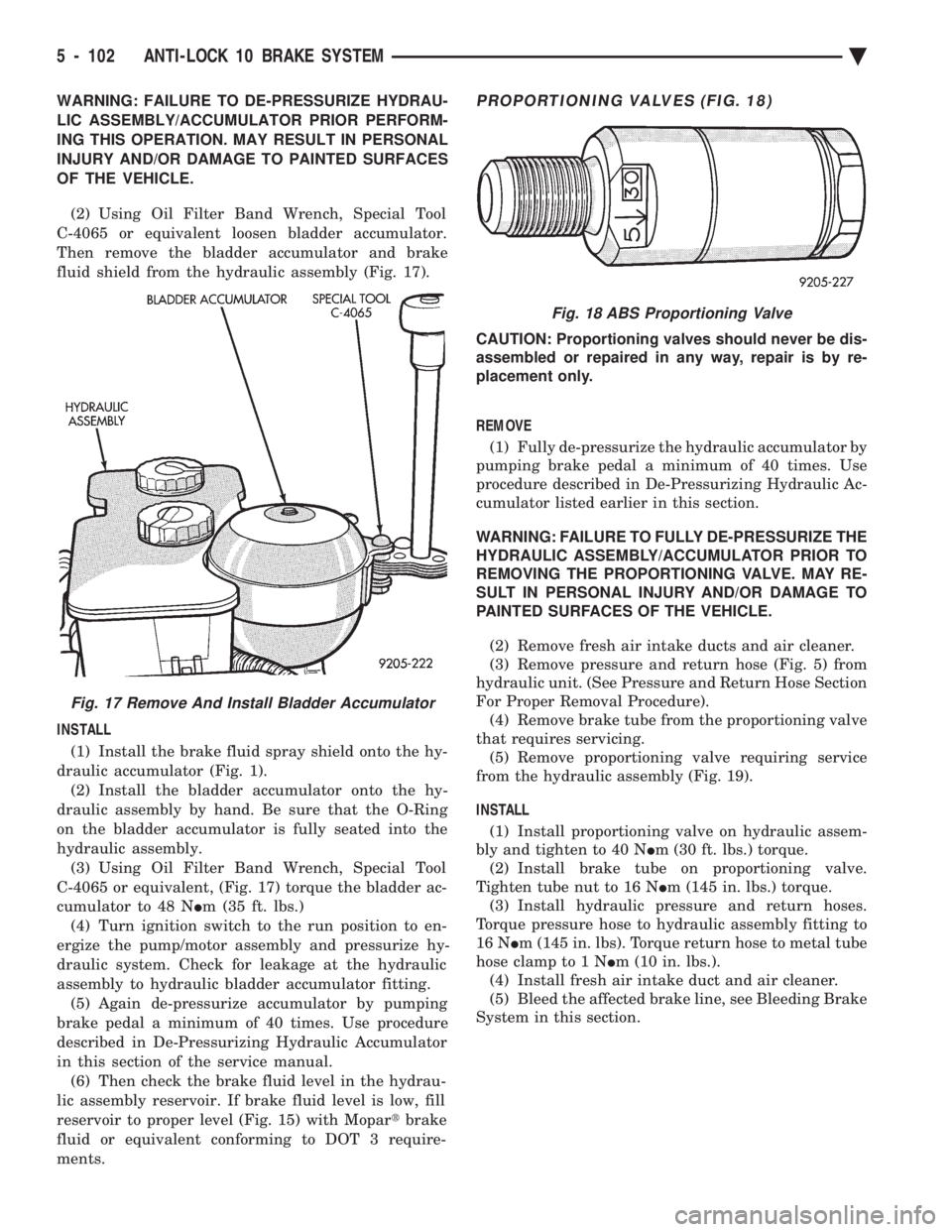
(2) Using Oil Filter Band Wrench, Special Tool
C-4065 or equivalent loosen bladder accumulator.
Then remove the bladder accumulator and brake
fluid shield from the hydraulic assembly (Fig. 17).
INSTALL
(1) Install the brake fluid spray shield onto the hy-
draulic accumulator (Fig. 1). (2) Install the bladder accumulator onto the hy-
draulic assembly by hand. Be sure that the O-Ring
on the bladder accumulator is fully seated into the
hydraulic assembly. (3) Using Oil Filter Band Wrench, Special Tool
C-4065 or equivalent, (Fig. 17) torque the bladder ac-
cumulator to 48 N Im (35 ft. lbs.)
(4) Turn ignition switch to the run position to en-
ergize the pump/motor assembly and pressurize hy-
draulic system. Check for leakage at the hydraulic
assembly to hydraulic bladder accumulator fitting. (5) Again de-pressurize accumulator by pumping
brake pedal a minimum of 40 times. Use procedure
described in De-Pressurizing Hydraulic Accumulator
in this section of the service manual. (6) Then check the brake fluid level in the hydrau-
lic assembly reservoir. If brake fluid level is low, fill
reservoir to proper level (Fig. 15) with Mopar tbrake
fluid or equivalent conforming to DOT 3 require-
ments.PROPORTIONING VALVES (FIG. 18)
CAUTION: Proportioning valves should never be dis-
assembled or repaired in any way, repair is by re-
placement only.
REMOVE (1) Fully de-pressurize the hydraulic accumulator by
pumping brake pedal a minimum of 40 times. Use
procedure described in De-Pressurizing Hydraulic Ac-
cumulator listed earlier in this section.
WARNING: FAILURE TO FULLY DE-PRESSURIZE THE
HYDRAULIC ASSEMBLY/ACCUMULATOR PRIOR TO
REMOVING THE PROPORTIONING VALVE. MAY RE-
SULT IN PERSONAL INJURY AND/OR DAMAGE TO
PAINTED SURFACES OF THE VEHICLE.
(2) Remove fresh air intake ducts and air cleaner.
(3) Remove pressure and return hose (Fig. 5) from
hydraulic unit. (See Pressure and Return Hose Section
For Proper Removal Procedure). (4) Remove brake tube from the proportioning valve
that requires servicing. (5) Remove proportioning valve requiring service
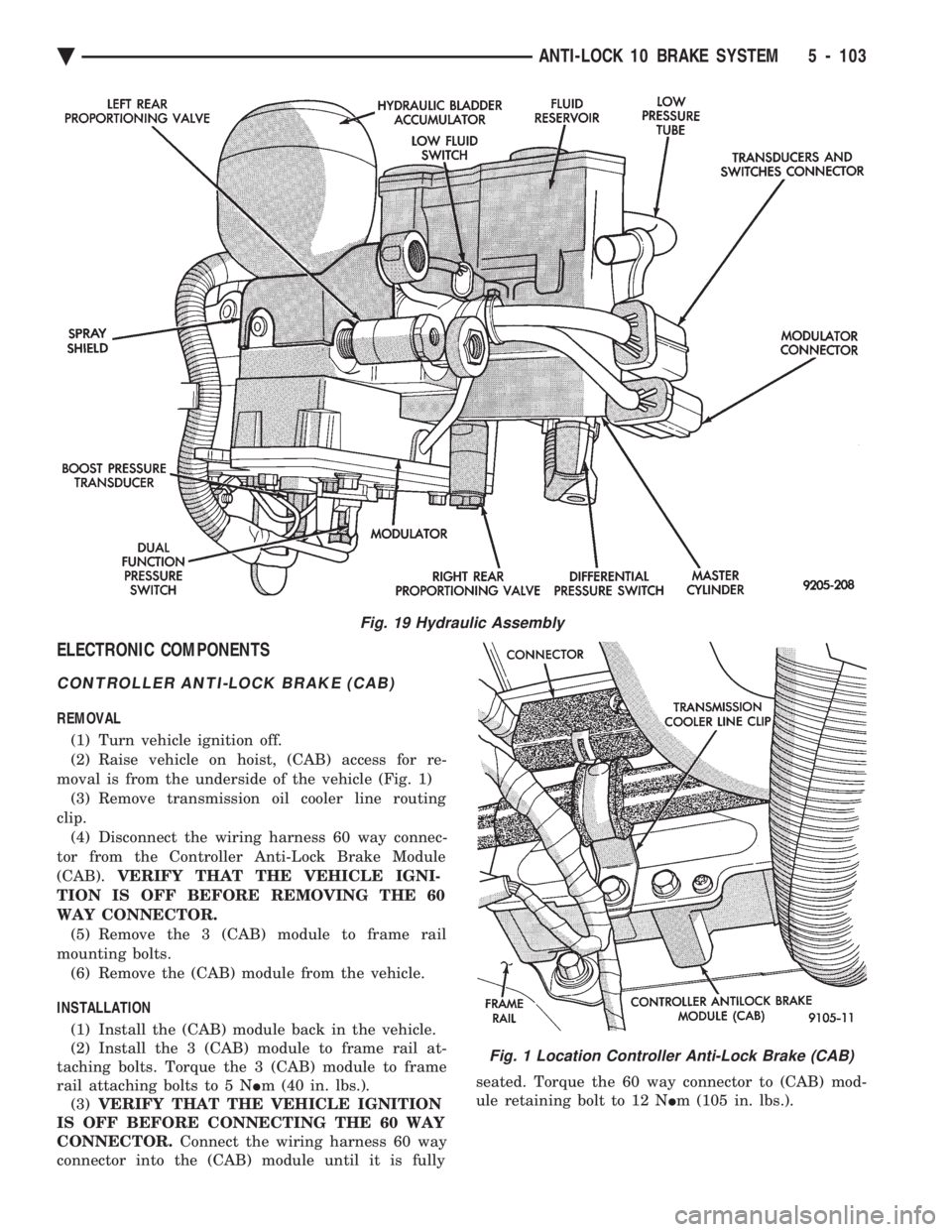
from the hydraulic assembly (Fig. 19).
INSTALL (1) Install proportioning valve on hydraulic assem-
bly and tighten to 40 N Im (30 ft. lbs.) torque.
(2) Install brake tube on proportioning valve.
Tighten tube nut to 16 N Im (145 in. lbs.) torque.
(3) Install hydraulic pressure and return hoses.
Torque pressure hose to hydraulic assembly fitting to
16 N Im (145 in. lbs). Torque return hose to metal tube
hose clamp to 1 N Im (10 in. lbs.).
(4) Install fresh air intake duct and air cleaner.
(5) Bleed the affected brake line, see Bleeding Brake
System in this section.
Fig. 17 Remove And Install Bladder Accumulator
Fig. 18 ABS Proportioning Valve
5 - 102 ANTI-LOCK 10 BRAKE SYSTEM Ä
Page 253 of 2438
ELECTRONIC COMPONENTS
CONTROLLER ANTI-LOCK BRAKE (CAB)
REMOVAL (1) Turn vehicle ignition off.
(2) Raise vehicle on hoist, (CAB) access for re-
moval is from the underside of the vehicle (Fig. 1) (3) Remove transmission oil cooler line routing
clip. (4) Disconnect the wiring harness 60 way connec-
tor from the Controller Anti-Lock Brake Module
(CAB). VERIFY THAT THE VEHICLE IGNI-
TION IS OFF BEFORE REMOVING THE 60
WAY CONNECTOR. (5) Remove the 3 (CAB) module to frame rail
mounting bolts. (6) Remove the (CAB) module from the vehicle.
INSTALLATION (1) Install the (CAB) module back in the vehicle.
(2) Install the 3 (CAB) module to frame rail at-
taching bolts. Torque the 3 (CAB) module to frame
rail attaching bolts to 5 N Im (40 in. lbs.).
(3) VERIFY THAT THE VEHICLE IGNITION
IS OFF BEFORE CONNECTING THE 60 WAY
CONNECTOR. Connect the wiring harness 60 way
connector into the (CAB) module until it is fully seated. Torque the 60 way connector to (CAB) mod-
ule retaining bolt to 12 N Im (105 in. lbs.).
Fig. 19 Hydraulic Assembly
Fig. 1 Location Controller Anti-Lock Brake (CAB)
Ä ANTI-LOCK 10 BRAKE SYSTEM 5 - 103