four CHEVROLET KODIAK 2007 Owner's Manual
[x] Cancel search | Manufacturer: CHEVROLET, Model Year: 2007, Model line: KODIAK, Model: CHEVROLET KODIAK 2007Pages: 430, PDF Size: 6.06 MB
Page 207 of 430

Drunken Driving
Death and injury associated with drinking and
driving is a national tragedy. It is the number
one contributor to the highway death toll,
claiming thousands of victims every year.
Alcohol affects four things that anyone needs to
drive a vehicle:
•Judgment
•Muscular Coordination
•Vision
•Attentiveness
Police records show that almost half of all motor
vehicle-related deaths involve alcohol. In most
cases, these deaths are the result of someone who
was drinking and driving. In recent years, more
than 16,000 annual motor vehicle-related deaths
have been associated with the use of alcohol,
with more than 300,000 people injured.Many adults — by some estimates, nearly half
the adult population — choose never to drink
alcohol, so they never drive after drinking.
For persons under 21, it is against the law in
every U.S. state to drink alcohol. There are good
medical, psychological, and developmental
reasons for these laws.
The obvious way to eliminate the leading highway
safety problem is for people never to drink
alcohol and then drive. But what if people do?
How much is “too much” if someone plans
to drive? It is a lot less than many might think.
Although it depends on each person and situation,
here is some general information on the problem.
The Blood Alcohol Concentration (BAC) of
someone who is drinking depends upon
four things:
•The amount of alcohol consumed
•The drinker’s body weight
•The amount of food that is consumed before
and during drinking
•The length of time it has taken the drinker to
consume the alcohol
207
Page 210 of 430
Control of a Vehicle
You have three systems that make your vehicle go
where you want it to go. They are the brakes, the
steering, and the accelerator. All three systems
have to do their work at the places where the tires
meet the road.
Sometimes, as when you are driving on snow or
ice, it is easy to ask more of those control systems
than the tires and road can provide. That means
you can lose control of your vehicle.
Braking
SeeBrake System Warning Light on page 169.
Braking action involves perception time and
reaction time.
First, you have to decide to push on the brake
pedal. That is perception time. Then you have to
bring up your foot and do it. That is reaction time.Average reaction time is about three-fourths of
a second. But that is only an average. It might
be less with one driver and as long as two or
three seconds or more with another. Age,
physical condition, alertness, coordination and
eyesight all play a part. So do alcohol, drugs
and frustration. But even in three-fourths of
a second, a vehicle moving at 60 mph (100 km/h)
travels 66 feet (20 m). That could be a lot of
distance in an emergency, so keeping enough
space between your vehicle and others is
important.
And, of course, actual stopping distances vary
greatly with the surface of the road, whether it is
pavement or gravel; the condition of the road,
whether it is wet, dry or icy; tire tread; the condition
of the brakes; the weight of the vehicle; the
weight of the load; and the amount of brake
force applied.
210
Page 233 of 430
If you have a four-wheel-drive vehicle, shift into
4HI. SeeFour-Wheel Drive on page 119.
If you have the Traction Control System (TCS),
it will improve your ability to accelerate when
driving on a slippery road. But you can turn the
TCS off if you ever need to. You should turn
the system off if your vehicle ever gets stuck in
sand, mud, ice, or snow. SeeIf Your Vehicle
is Stuck in Sand, Mud, Ice, or Snow on page 236.
Even though your vehicle has TCS, you will
want to slow down and adjust your driving to the
road conditions. Under certain conditions, you may
want to turn the TCS off, such as when driving
through deep snow and loose gravel, to help
maintain vehicle motion at lower speeds. See
Traction Control System (TCS) on page 216.
If you do not have TCS, accelerate gently. Try not
to break the fragile traction. If you accelerate
too fast, the drive wheels will spin and polish the
surface under the tires even more.
Unless you have the Anti-Lock Brake System
(ABS), you will want to brake very gently, too. If you
do have ABS, seeAnti-Lock Brake System (ABS)
on page 212. ABS improves your vehicle’s stability
when you make a hard stop on a slippery road.Whether you have ABS or not, you will want to
begin stopping sooner than you would on dry
pavement. Without ABS, if you feel your vehicle
begin to slide, let up on the brakes a little. Push the
brake pedal down steadily to get the most traction
you can.
Remember, unless you have ABS, if you brake so
hard that your wheels stop rolling, you will just
slide. Brake so your wheels always keep rolling
and you can still steer.
•Whatever your braking system, allow greater
following distance on any slippery road.
•Watch for slippery spots. The road might be
fine until you hit a spot that is covered with
ice. On an otherwise clear road, ice patches
may appear in shaded areas where the
sun cannot reach, such as around clumps of
trees, behind buildings, or under bridges.
Sometimes the surface of a curve or an
overpass may remain icy when the
surrounding roads are clear. If you see a
patch of ice ahead of you, brake before you
are on it. Try not to brake while you are
actually on the ice, and avoid sudden
steering maneuvers.
233
Page 236 of 430
If Your Vehicle is Stuck in Sand,
Mud, Ice, or Snow
In order to free your vehicle when it is stuck,
you will need to spin the wheels, but you do not
want to spin your wheels too fast. The method
known as rocking can help you get out when you
are stuck, but you must use caution.
{CAUTION:
If you let your vehicle’s tires spin at high
speed, they can explode, and you or others
could be injured. And, the transmission or
other parts of the vehicle can overheat.
That could cause an engine compartment
re or other damage. When you are stuck,
spin the wheels as little as possible. Do not
spin the wheels above 35 mph (55 km/h)
as shown on the speedometer.
Notice:Spinning the wheels can destroy
parts of your vehicle as well as the tires. If you
spin the wheels too fast while shifting the
transmission back and forth, you can destroy
the transmission.
Rocking Your Vehicle to Get It Out
First, turn the steering wheel left and right.
That will clear the area around the front wheels.
If you have a four-wheel-drive vehicle, shift
into 4HI. SeeFour-Wheel Drive on page 119.
If your vehicle has traction control, you should turn
the traction control system off. SeeTraction
Control System (TCS) on page 216. Then shift
back and forth between REVERSE (R) and
a forward gear, or with a manual transmission,
between FIRST (1) or SECOND (2) and
REVERSE (R), spinning the wheels as little as
possible. Release the accelerator pedal while you
shift, and press lightly on the accelerator pedal
when the transmission is in gear. By slowly
spinning the wheels in the forward and reverse
directions, you will cause a rocking motion
that may free your vehicle. If that does not get
your vehicle out after a few tries, it may need to
be towed out. If your vehicle does need to be
towed out, seeTowing Your Vehicle on page 241.
236
Page 246 of 430
Engine Overheating................................... 288
Cooling System (Gas and
DURAMAX
®/Isuzu Engines).................... 290
Engine Fan Noise..................................... 294
Power Steering Fluid................................. 295
Windshield Washer Fluid........................... 296
Brakes...................................................... 297
Battery...................................................... 304
Jump Starting............................................ 305
Rear Axle.................................................... 311
Rear Axle Shift Motor................................ 312
Four-Wheel Drive........................................ 312
Front Axle................................................... 313
Noise Control System................................. 314
Tampering with Noise Control System
Prohibited.............................................. 314
Bulb Replacement....................................... 315
Windshield Wiper Blade Replacement....... 316Other Service Items.................................... 317
Fuel Filter.................................................. 317
Primary Fuel Filter and Water Separator...... 317
Secondary Fuel Filter and Water
Separator/Heater (Caterpillar
®Diesel)...... 318
Automatic Ether Injection System
(Caterpillar
®Diesel)................................ 318
Front Wheel Bearings with
Oil-Filled Hubs....................................... 319
Air Conditioning System............................ 320
Tires............................................................ 321
Inflation - Tire Pressure............................. 322
Wheel Loading.......................................... 323
Dual Tire Operation................................... 323
When It Is Time for New Tires.................. 324
Wheel Alignment and Tire Balance............ 324
Tightening the Wheel Nuts........................ 325
Wheel Replacement.................................. 328
If a Tire Goes Flat.................................... 330
Section 5 Service and Appearance Care
246
Page 285 of 430
What to Use
Use a mixture of one-half clean, drinkable water
and one-half DEX-COOL®coolant which will
not damage aluminum parts. If you use this coolant
mixture, you do not need to add anything else.
{CAUTION:
Adding only plain water to your cooling
system can be dangerous. Plain water, or
some other liquid such as alcohol, can
boil before the proper coolant mixture will.
Your vehicle’s coolant warning system is
set for the proper coolant mixture. With
plain water or the wrong mixture, your
engine could get too hot but you would
not get the overheat warning. Your engine
could catch re and you or others could
be burned. Use a 50/50 mixture of clean,
drinkable water and DEX-COOL
®coolant.Notice:If you use an improper coolant
mixture, your engine could overheat and be
badly damaged. The repair cost would not be
covered by your warranty. Too much water
in the mixture can freeze and crack the engine,
radiator, heater core, and other parts.
If you have to add coolant more than four times a
year, have your dealer check your cooling system.
Notice:If you use extra inhibitors and/or
additives in your vehicle’s cooling system, you
could damage your vehicle. Use only the
proper mixture of the engine coolant listed in
this manual for the cooling system. See
Part C: Recommended Fluids and Lubricants
on page 397for more information.
285
Page 299 of 430
Four-Wheel Disc Brakes
(Hydraulic Only)
Your vehicle has four-wheel disc brakes.
Some driving conditions or climates may cause a
brake squeal when the brakes are first applied
or lightly applied. This does not mean something
is wrong with the brakes.
Brake linings should always be replaced as
complete axle sets.
Four-Wheel and Six-Wheel Drum
Brakes (Air Only)
The brake drums should be removed and
inspected each time the tires are removed for
rotation or changing. When you have the
front brakes replaced, have the rear brakes
inspected, too.
Brake linings should always be replaced as
complete axle sets.
Brake Pedal Travel
See your dealer if the brake pedal does not return
to normal height, or if there is a rapid increase in
pedal travel. This could be a sign that brake service
is needed.
Brake Adjustment
Every time you make a brake stop, the brakes
adjust for wear.
Brake Adjustment on Air Braked
Vehicles
Your vehicle has automatic slack adjusters.
Every time you make a brake stop, the brakes
automatically adjust for wear. Slack adjusters
should never be manually adjusted to correct
excessive brake chamber pushrod stroke.
Excessive brake chamber pushrod stroke means
that the brake system needs to be serviced by
a qualified service technician.
Notice:Do not manually adjust automatic slack
adjusters. Manual adjustment of the automatic
slack adjusters can result in a degradation of
the slack adjuster performance over time.
If the brake chamber pushrod stroke is out of
adjustment, the brake system needs to be
serviced by a qualied service technician.
299
Page 306 of 430
Notice:Ignoring these steps could result in
costly damage to your vehicle that would
not be covered by your warranty.
Trying to start your vehicle by pushing or
pulling it will not work, and it could damage
your vehicle.
1. Check the other vehicle. It must have a
12-volt battery (or batteries) with a negative
ground system.
Notice:If the other vehicle’s system is not a
12-volt system with a negative ground,
both vehicles can be damaged. Only use
vehicles with 12-volt systems with negative
grounds to jump start your vehicle.
If you have a diesel engine vehicle with
two batteries (or more), you should know
before you begin that, especially in cold
weather, you may not be able to get enough
power from a single battery in another
vehicle to start your diesel engine.
If your vehicle has more than one battery, use
the one closest to the starter — this will
reduce electrical resistance.2. Get the vehicles close enough so the jumper
cables can reach, but be sure the vehicles are
not touching each other. If they are, it could
cause a ground connection you do not
want. You would not be able to start your
vehicle, and the bad grounding could damage
the electrical systems.
To avoid the possibility of the vehicles rolling,
set the parking brake firmly on both vehicles
involved in the jump start procedure. Put
an automatic transmission in PARK (P) or a
manual transmission in NEUTRAL before
setting the parking brake. If you have a
four-wheel-drive vehicle, be sure the transfer
case is in a drive gear, not in NEUTRAL.
Notice:If you leave your radio or other
accessories on during the jump starting
procedure, they could be damaged. The repairs
would not be covered by your warranty.
Always turn off your radio and other
accessories when jump starting your vehicle.
3. Turn off the ignition on both vehicles. Unplug
unnecessary accessories plugged into the
cigarette lighter or accessory power outlets.
306
Page 312 of 430
Rear Axle Shift Motor
When to Check and Change Fluid
If you have an optional air-shift two-speed,
controlled traction, or locking differential type rear
axle, a good time to check the fluid level in the axle
shift motor is when the rear axle lubricant is
checked.
How to Check Fluid
Remove the plug on the front plate of the axle
shift motor, add enough fluid to raise the level to
the bottom of the filler plug hole, then replace
the plug.
What to Use
Refer to your Maintenance Schedule to determine
what kind of lubricant to use. SeePart C:
Recommended Fluids and Lubricants on page 397.
Four-Wheel Drive
Transfer Case
When to Check Lubricant
It is not necessary to regularly check transfer case
fluid unless you suspect there is a leak or you
hear an unusual noise. A fluid loss could indicate
a problem. Have it inspected and repaired.
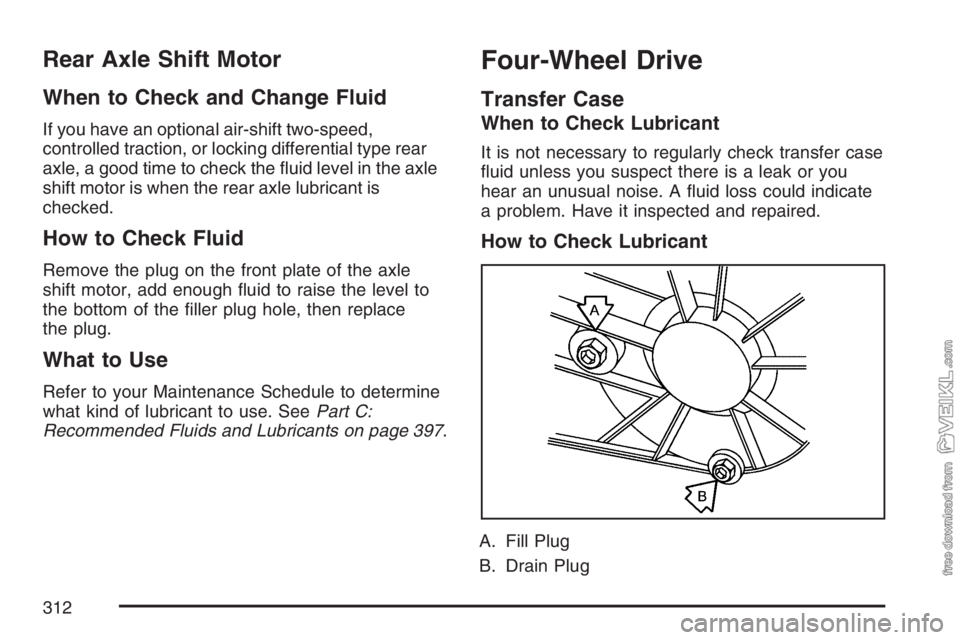
How to Check Lubricant
A. Fill Plug
B. Drain Plug
312
Page 324 of 430
When It Is Time for New Tires
Replace your tires when the tread depth is down
to 1/8 of an inch (3.2 mm) for the front tires,
or 1/16 of an inch (1.6 mm) for a rear tire. Also,
you need a new tire if:
•You can see cord or fabric showing through
the tire’s rubber.
•The tread or sidewall is cracked, cut or
snagged deep enough to show cord or fabric.
•The tire has a bump, bulge or split.
•The tire has a puncture, cut or other damage
that cannot be repaired well because of the
size or location of the damage.
{CAUTION:
Mixing tires could cause you to lose
control while driving. If you mix tires of
different types — like radial and
bias-belted tires — the vehicle may not
handle properly, and you could have a
crash. Be sure to use the same type of
tires all around.When you replace tires, make sure they are the
same size, load range, speed rating and
construction type (bias, bias-belted or radial) as
your original tires.
If your vehicle has four-wheel drive, the axle
differentials, propshafts and transfer case may be
damaged if tires of different sizes, brands or
tread types are installed on the front and rear
axles. That damage would not be covered under
your warranty.
Wheel Alignment and Tire Balance
The wheels on your vehicle were aligned at
the factory to give you the longest tire life and
best overall performance.
Proper front wheel alignment must be maintained
in order to ensure efficient steering, good
directional stability, and prevent abnormal tire
wear. If you notice unusual tire wear or your
vehicle is pulling one way or the other, the
alignment may need to be reset. If you notice your
vehicle vibrating when driving on a smooth
road, your wheels may need to be balanced.
324