light CHEVROLET KODIAK 2009 Owner's Guide
[x] Cancel search | Manufacturer: CHEVROLET, Model Year: 2009, Model line: KODIAK, Model: CHEVROLET KODIAK 2009Pages: 376, PDF Size: 5.39 MB
Page 110 of 376
Diesel Particulate Filter
The vehicle has a Diesel Particulate Filter (DPF) as part
of the exhaust system to reduce vehicle emissions. The
DPF requires a unique exhaust tailpipe with an exhaust
cooler. The exhaust cooler mixes air with the exhaust to
lower the temperature before it leaves the tailpipe.
The DPF, the tailpipe, or other exhaust system
components must not be altered. Inspect regularly and
clean any mud or dirt from the exhaust cooler,
especially where the exhaust cooler connects to the
tailpipe and the openings where fresh air enters
the cooler. See “Exhaust System Inspection” underAt
Least Twice a Year on page 6-27.
The DPF will clean itself as part of normal operation.
Several factors including fuel consumed, hours of engine
operation and miles driven are monitored by the Engine
Control Module (ECM). The self cleaning occurs
approximately once per tank of fuel.
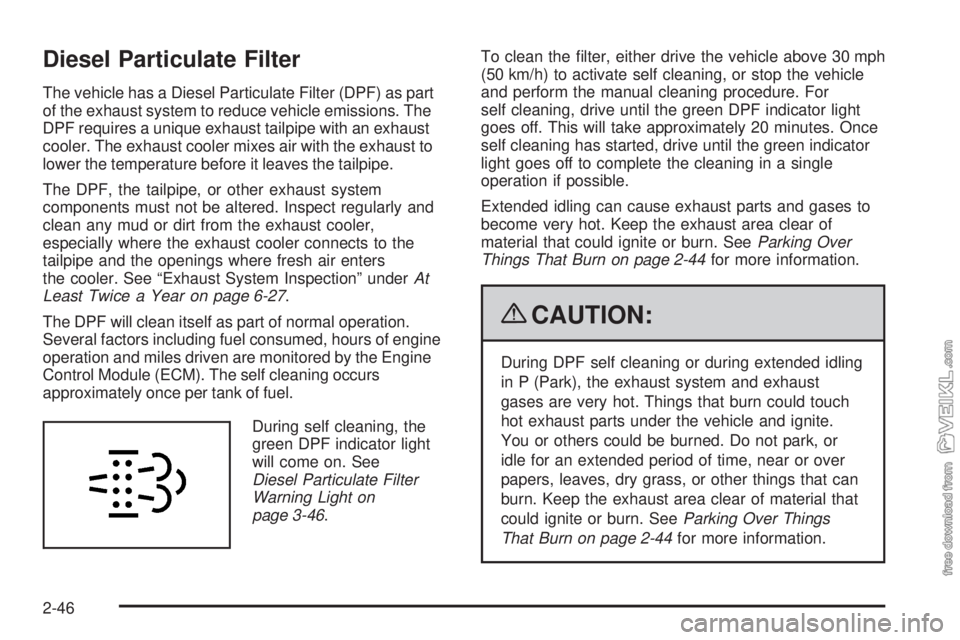
During self cleaning, the
green DPF indicator light
will come on. See
Diesel Particulate Filter
Warning Light on
page 3-46.To clean the filter, either drive the vehicle above 30 mph
(50 km/h) to activate self cleaning, or stop the vehicle
and perform the manual cleaning procedure. For
self cleaning, drive until the green DPF indicator light
goes off. This will take approximately 20 minutes. Once
self cleaning has started, drive until the green indicator
light goes off to complete the cleaning in a single
operation if possible.
Extended idling can cause exhaust parts and gases to
become very hot. Keep the exhaust area clear of
material that could ignite or burn. SeeParking Over
Things That Burn on page 2-44for more information.
{CAUTION:
During DPF self cleaning or during extended idling
in P (Park), the exhaust system and exhaust
gases are very hot. Things that burn could touch
hot exhaust parts under the vehicle and ignite.
You or others could be burned. Do not park, or
idle for an extended period of time, near or over
papers, leaves, dry grass, or other things that can
burn. Keep the exhaust area clear of material that
could ignite or burn. SeeParking Over Things
That Burn on page 2-44for more information.
2-46
Page 111 of 376
Notice:Extended idle should be avoided because
the DPF system is not capable of self cleaning at
idle. During extended idle operation, monitor the
instrument panel telltale lights and Driver Information
Center for messages and take appropriate indicated
action. Continued idling with the warning light/
message on could cause irreversible damage to the
DPF requiring repair and possible replacement that
might not be covered by the vehicle warranty.
When the yellow DPF indicator comes on, the filter is
dirty and needs cleaning. You will also notice a change
in the exhaust sound and engine idle speed. This is
normal. If you continue to drive and the exhaust filter is
not cleaned as required, the DPF indicator will change
from yellow to red. Continuing to drive the vehicle
with the red indicator can cause filter damage.
Vehicles with DPF have specific fuel and engine oil
requirements. SeeWhat Fuel to Use on page 5-8and
Engine Oil (DURAMAX Diesel Engine) on page 5-24
orEngine Oil (Caterpillar Diesel Engine) on page 5-27or
Engine Oil (Isuzu Diesel Engine) on page 5-28or
Engine Oil (Gasoline Engine) on page 5-32for more
information on those requirements.Notice:Permanent damage can occur to the DPF
or related components if the required Ultra Low
Sulfur Diesel (15 ppm sulfur maximum) or low ash
CJ-4 engine oil is not used. This damage would
not be covered by the vehicle warranty.
For vehicles with Power Take-Off (PTO), monitor the
instrument panel cluster for lights related to the DPF.
All engines consume some amount of engine oil. Ash
is the by-product of engine oil consumption. The ash will
become trapped in the DPF over the life of the vehicle.
Eventually, the buildup of ash will restrict the exhaust
gases and the DPF will need to be cleaned or replaced.
SeeAccessories and Modifications on page 5-3for
important information if you are considering adding
accessories or modifying the vehicle.
2-47
Page 112 of 376

Manual Cleaning Procedure
{CAUTION:
During DPF self cleaning, the exhaust system and
exhaust gases are very hot. Stay clear of the
tailpipe area and do not park over things that burn.
You or others could be burned or the vehicle could
catch fire. SeeParking Over Things That Burn on
page 2-44.
If the yellow or red DPF indicator is on, you can clean
the DPF by performing a manual cleaning.When it is safe to do so, stop the vehicle. Perform DPF
manual cleaning in a well ventilated area. DPF Manual
cleaning must be performed outdoors, as follows. Once
manual cleaning is started, complete the manual cleaning
in a single operation if possible. If manual cleaning is not
completed, as indicated by the green DPF indicator going
off, and the yellow or red indicator light remains on, self
cleaning might not be allowed until the vehicle is stopped
and manual cleaning is performed until completed.
1. Check engine oil and engine coolant levels to be
sure they are at proper operating levels.
2. To prevent running out of fuel during manual
cleaning, make sure there is at least a quarter of a
tank of fuel.
3. Check to make sure the area near the exhaust
tailpipe and under the exhaust system are clear
of any materials that could catch fire. Keep people
away from the area of the exhaust system and
exhaust gases.
2-48
Page 113 of 376
4. Fully set the parking brake.
5. Shift the transmission to P (Park) or N (Neutral).
6. Idle the engine. If you used the idling control knob to
increase the engine speed, restore it all the way to
the left to reduce the engine speed.
7. If the vehicle has a Power Take Off (PTO), turn the
PTO off. SeePower Take-Off (PTO) on page 2-30.
8. Press the DPF switch in the instrument panel
switchbank. SeeInstrument Panel Switchbank
on page 3-18. The green DPF indicator light comes
on, the exhaust gas control valve operates,
engine idle speed automatically increases, and DPF
cleaning begins. Do not leave the vehicle
unattended during manual cleaning.9. When both the green and the yellow or red DPF
indicator lights go off, cleaning is completed.
Manual cleaning is normally completed in about
30 minutes.
Under certain operating conditions, manual cleaning
might not be able to be performed, even if the soot level
in the DPF requires cleaning. This can occur because of
low coolant temperature, low battery voltage, high
exhaust temperature or immediately after starting the
vehicle. When manual cleaning is requested and coolant
temperature is low, an engine warm-up cycle is started.
The green indicator light will come on, the exhaust gas
control valve operates, and engine rpm increases to help
raise engine coolant temperature. When operating
conditions allow, cleaning will begin.
2-49
Page 116 of 376
Outside Convex Mirrors
{CAUTION:
A convex mirror can make things (like other
vehicles) look farther away than they really are.
If you cut too sharply into the right or left lane, you
could hit a vehicle. Check the regular outside
mirrors (or the inside mirror, if you have one)
before changing lanes.
The vehicle may have convex mirrors on both the driver
side and the passenger side. They are curved to
allow more to be seen from the driver seat.
Outside Heated Mirrors
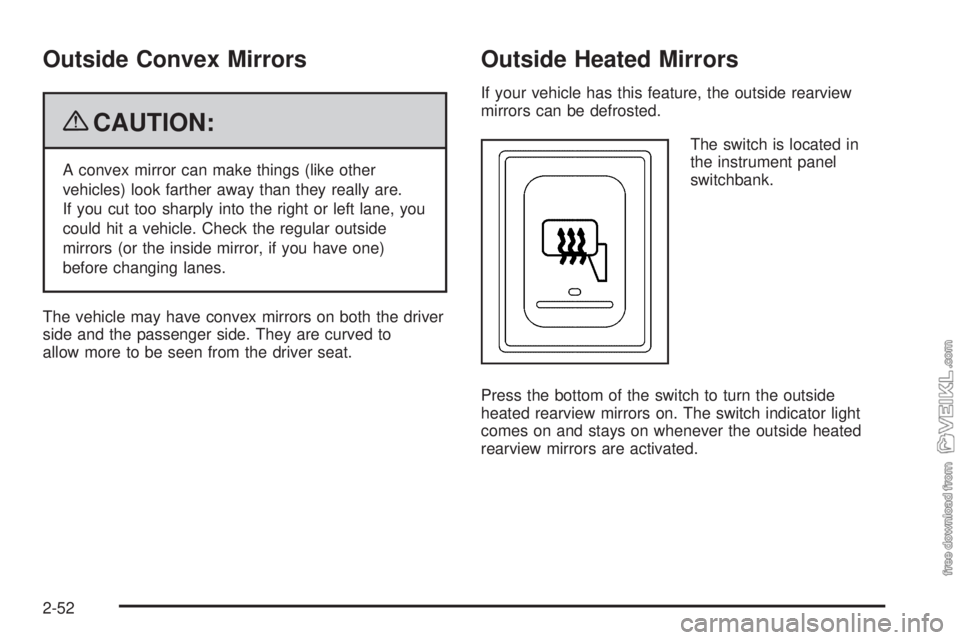
If your vehicle has this feature, the outside rearview
mirrors can be defrosted.
The switch is located in
the instrument panel
switchbank.
Press the bottom of the switch to turn the outside
heated rearview mirrors on. The switch indicator light
comes on and stays on whenever the outside heated
rearview mirrors are activated.
2-52
Page 119 of 376
Instrument Panel Overview...............................3-4
Hazard Warning Flashers................................3-6
Horn .............................................................3-6
Tilt Wheel.....................................................3-6
Turn Signal/Multifunction Lever.........................3-7
Turn and Lane-Change Signals........................3-7
Headlamp High/Low-Beam Changer..................3-8
Windshield Wipers..........................................3-8
Windshield Washer.........................................3-9
Cruise Control..............................................3-10
Exterior Lamps.............................................3-14
Headlamps on Reminder................................3-14
Daytime Running Lamps (DRL).......................3-15
Marker Lamps..............................................3-16
Instrument Panel Brightness...........................3-16
Dome Lamps ...............................................3-16
Entry Lighting...............................................3-17
Reading Lamps............................................3-17
Instrument Panel Switchbank..........................3-18
Accessory Power Outlet(s).............................3-19
Ashtray(s) and Cigarette Lighter......................3-19Climate Controls............................................3-20
Climate Control System.................................3-20
Outlet Adjustment.........................................3-22
Rear Heating System....................................3-23
Warning Lights, Gages, and Indicators............3-23
Instrument Panel Cluster................................3-24
Speedometer and Odometer...........................3-25
Trip Odometer..............................................3-25
Tachometer.................................................3-25
Engine Speed Limiter....................................3-25
Safety Belt Reminders...................................3-26
Airbag Readiness Light..................................3-27
Airbag Off Light............................................3-28
Charging System Light
..................................3-29
Voltmeter Gage............................................3-30
Service Transmission Warning Light................3-30
Range Inhibit Warning Indicator......................3-31
Brake System Warning Light..........................3-31
Antilock Brake System (ABS) Warning Light........3-33
Trailer Antilock Brake System Warning Light.......3-34
Engine Coolant Temperature Gage..................3-34
Section 3 Instrument Panel
3-1
Page 120 of 376
Low Coolant Warning Light............................3-35
Wait to Start Light........................................3-35
Malfunction Indicator Lamp.............................3-36
Oil Pressure Gage........................................3-38
Low Oil Level Light.......................................3-39
Change Engine Oil Light................................3-39
Engine Overspeed Warning Light....................3-40
Engine Shutdown Warning Light.....................3-40
Transmission Temperature Gage.....................3-40
Exhaust Brake Indicator Light.........................3-41
Differential Lock Indicator Light.......................3-41
Reduced Engine Power Light.........................3-42
Highbeam On Light.......................................3-42
Daytime Running Lamps (DRL)
Indicator Light...........................................3-42
Low Washer Fluid Warning Light.....................3-43
Power Take-Off Light (PTO)...........................3-43Check Gages Warning Light...........................3-43
Fuel Gage...................................................3-44
Water in Fuel Warning Light...........................3-45
Change Fuel Filter Warning Light....................3-45
Diesel Particulate Filter Warning Light..............3-46
Air Filter Restriction Indicator..........................3-46
Air Pressure Gage........................................3-47
Hourmeter Gage...........................................3-47
Audio System(s).............................................3-48
Setting the Clock..........................................3-48
Radio(s)......................................................3-49
Theft-Deterrent Feature..................................3-57
Radio Reception...........................................3-58
Fixed Mast Antenna......................................3-58
Chime Level Adjustment................................3-58
Section 3 Instrument Panel
3-2
Page 123 of 376
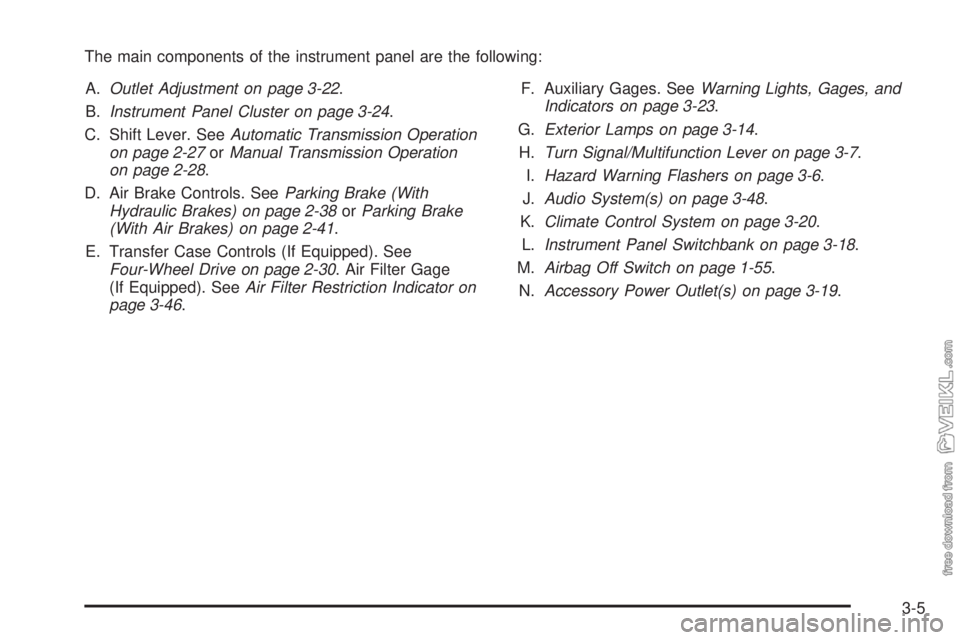
The main components of the instrument panel are the following:
A.Outlet Adjustment on page 3-22.
B.Instrument Panel Cluster on page 3-24.
C. Shift Lever. SeeAutomatic Transmission Operation
on page 2-27orManual Transmission Operation
on page 2-28.
D. Air Brake Controls. SeeParking Brake (With
Hydraulic Brakes) on page 2-38orParking Brake
(With Air Brakes) on page 2-41.
E. Transfer Case Controls (If Equipped). See
Four-Wheel Drive on page 2-30. Air Filter Gage
(If Equipped). SeeAir Filter Restriction Indicator on
page 3-46.F. Auxiliary Gages. SeeWarning Lights, Gages, and
Indicators on page 3-23.
G.Exterior Lamps on page 3-14.
H.Turn Signal/Multifunction Lever on page 3-7.
I.Hazard Warning Flashers on page 3-6.
J.Audio System(s) on page 3-48.
K.Climate Control System on page 3-20.
L.Instrument Panel Switchbank on page 3-18.
M.Airbag Off Switch on page 1-55.
N.Accessory Power Outlet(s) on page 3-19.
3-5
Page 126 of 376
Headlamp High/Low-Beam Changer
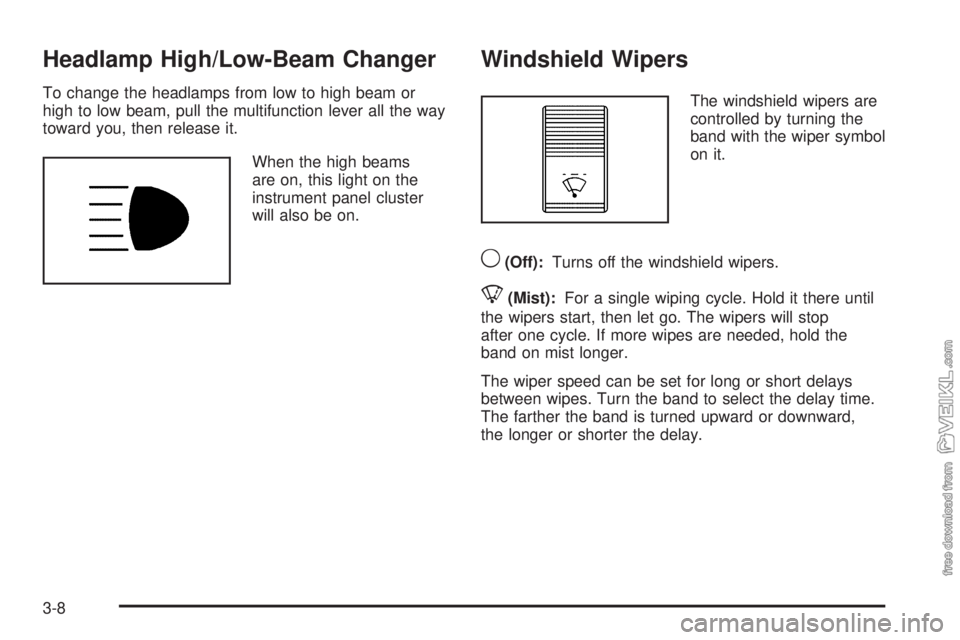
To change the headlamps from low to high beam or
high to low beam, pull the multifunction lever all the way
toward you, then release it.
When the high beams
are on, this light on the
instrument panel cluster
will also be on.
Windshield Wipers
The windshield wipers are
controlled by turning the
band with the wiper symbol
on it.
9(Off):Turns off the windshield wipers.
8(Mist):For a single wiping cycle. Hold it there until
the wipers start, then let go. The wipers will stop
after one cycle. If more wipes are needed, hold the
band on mist longer.
The wiper speed can be set for long or short delays
between wipes. Turn the band to select the delay time.
The farther the band is turned upward or downward,
the longer or shorter the delay.
3-8
Page 131 of 376
Using Cruise Control on Hills
How well the cruise control works on hills depends upon
the vehicles speed, load and the steepness of the hills.
When going up steep hills, you may want to step on the
accelerator pedal to maintain your speed. When going
downhill, you may have to brake or shift to a lower gear to
keep your speed down. When the brake or clutch is
applied the cruise control will shut off.
For vehicles with the exhaust brake option and the
exhaust brake is turned on, the exhaust brake may come
on and try to slow down the vehicle to the set cruise
control speed if the vehicle has accelerated past the set
cruise control speed while going downhill.
Ending Cruise Control
There are four different ways to turn off the cruise
control:
•Step lightly on the brake pedal (manual and
automatic transmissions).
•Press the clutch pedal to the floor (manual
transmissions).
•Move the cruise switch to9.
•Shift the transmission to N (Neutral).
Erasing Speed Memory
The cruise control set speed memory is erased when
the ignition is turned off.
3-13