brake CHEVROLET TRACKER 1994 User Guide
[x] Cancel search | Manufacturer: CHEVROLET, Model Year: 1994, Model line: TRACKER, Model: CHEVROLET TRACKER 1994Pages: 258, PDF Size: 14.43 MB
Page 62 of 258
--- -_________- ----
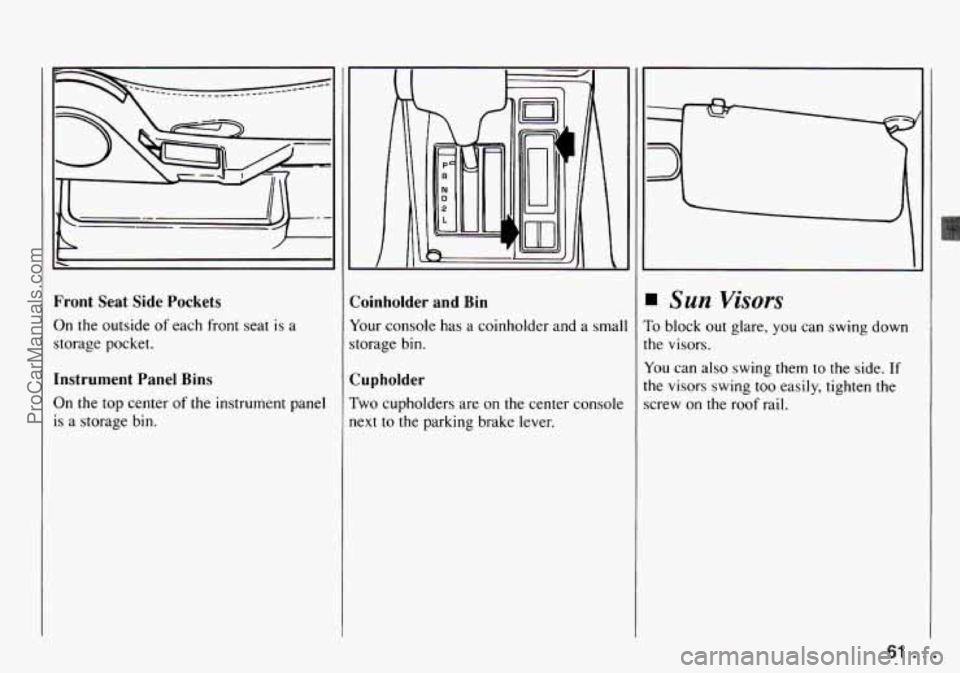
Front Seat Side Pockets
On the outside
of each front seat is a
storage pocket.
Instrument Panel Bins
On
the top center of the instrument panel
is a storage bin. Coinholder
and Bin
Your console
has a coinholder and a smal
storage bin.
Cupholder
Two cupholders are on the center console
next to the parking brake lever.
Sun Visors
To block out glare, you can swing down
the visors.
You can also swing them to the side.
If
the visors swing too easily, tighten the
screw on the roof rail.
61 ...
ProCarManuals.com
Page 66 of 258

Instrument Panel
1. Air Vent
2. Side Defroster Vent
3. Turn Signalbights Control/Headlight
4. Instrument Cluster
5. Hazard Warning Flasher
6. Windshield Wipermasher Lever
7. Rear Window Wiper Switch
8. Comfort Controls
Beam
Lever
9. Audio System
10. Lighter
11. Assist Grip
12. Glove Box
13. Transmission Shift Lever
14. Coinholder and Bin
15. Transfer Case Shift Lever
16. Parking Brake Lever
17. Ashtray
18. Rear Window Washer Switch
19. Ignition Switch
20. Horn
21. Fuse Block
22. Rear Window Defogger Switch
23. Brightness Control
65 ...
ProCarManuals.com
Page 70 of 258

1s I FUELONLY UNLEADED [I
UNLEADED-
J
FUEL ONLY
Fuel Gage
Your fuel gage shows about how much
fuel is in your tank. When the gage first
indicates “E,” you still have a little fuel
left (about one or two gallons), but you
need to get more right away.
Here are four concerns some owners have
had about the fuel gage. All these
situations are normal and do not indicate
that anything is wrong with the
fuel gage,
At the gas station, the fuel pump shuts
off before the gage reads
“F.”
It takes more (or less) fuel to fill up
than
the gage reads. For example, the
gage reads half full, but it took more
(or less) than half
of the tank’s
capacity to fill it.
J
0
0
The gage moves a little when you
turn, stop
or speed up.
When you turn the engine
off, the
gage doesn’t go back to “E.”
~~
Brake System Warning Light
four Geo’s hydraulic brake system is
livided into two parts. If one part isn’t
vorking, the other part can still work and
;top you. For good braking, though, you
leed both parts working well.
four vehicle also has rear-wheel anti-lock
)rakes. If the warning light comes on,
here could be a brake problem with eithel
[our regular or rear-wheel anti-lock
)rakes, or both. Have your brake system
nspected right away.
rhis light should come on as you start the
lehicle.
If it doesn’t come on then, have ii
ixed
so it will be ready to warn you if
here’s a problem.
r
69 ...
ProCarManuals.com
Page 71 of 258

Features and Controls
If the light comes on while you are
driving,
pull off the road and stop
carefully. You may notice that the pedal is
harder
to push. Or, the pedal may go
closer to the floor. It may take longer to
stop. If the light is still on. have the
vehicle towed for service. (See “Towing
Your Vehicle“
in the Index.)
p CAUTION:
Your brake system may not be work-
ing properly if the brake system
warning light is on, Driving with the
brake system warning light on can
lead
to an accident. If the light is still
on after you’ve pulled off the road
and stopped carefully, have the
vehicle towed
for service.
The brake system warning light will also
come
on when you set your parking
brake, and
it will stay on if your parking
brake doesn’t release
fully. If it stays on
after your parking brake is fully released.
it means you have a brake problem.
‘ngine Coolant Temperature Gage
rhis gage shows the engine coolanl
emperature.
If the gage pointer moves to
he
”H” (red) side. your engine is too hot!
t means that your engine coolant has
)verheatcd and you should
stop your
ehicle and
turn off the engine HS soo~
Iossible.
1 as
HOT COOLANT CAN BURN YOU
BADLY!
In “Problems on the Road.” this manual
shows what to do. See ”Engine
Overheating”
in the Index.
Charging System Light
This light will come on briefly when you
turn on the ignition, but the engine is not
running, as
a check to show you it is
working. Then
it should go out when the
engine starts. If it stays on or comes on
while you are driving, you may have a
problem with the electrical charging
system.
It could indicate that you have a
loose generator drive
belt or another
electrical problem. Have
it checked right
away. Driving while this light is on could
drain
your battery.
If you must drive a short distance with
this light on,
be certain to turn off all your
accessories. such as
the radio and air
conditioner.
. . .70
ProCarManuals.com
Page 101 of 258
Your Driving and the Road
Defensive Driving
The best advice anyone can give about
driving is: Drive defensively.
Please start with a very important safety
device
in your Geo: Buckle up. (See
“Safety Belts”
in the Index.)
Defensive driving really means “be ready
for anything.” On city streets, rural roads,
or freeways,
it means “always expect the
unexpected.”
Assume that pedestrians or other drivers
are going to be careless and make
mistakes. Anticipate what they might do.
Be ready for their mistakes.
Rear-end
collisions are about the most
preventable of accidents. Yet they are
common. Allow enough following
distance.
It’s the best defensive driving
maneuver,
in both city and rural driving.
You never know when the vehicle
in front
of you is going to brake or turn suddenly.
Drunken Driving
Death and injury associated with drinking
and driving is a national tragedy. It‘s the
number one contributor
to the highway
death
toll, claiming thousands of victims
every year. Alcohol takes away three
things that anyone needs to drive a
vehicle:
0 Judgment
0 Muscular Coordination
Vision
Police records show that almost half of
all motor vehicle-related deaths involve
alcohol
- a driver, a passenger or
someone else, such as a pedestrian, had
been drinking.
In most cases, these
deaths are the result of someone who
was drinking and driving. About
20,000
motor vehicle-related deaths occur’each
year because of alcohol, and thousands
of people are injured.
Just how much alcohol is too much ifa
person plans to drive‘? Ideally, no one
should drink alcohol and then drive.
But
if one does, then what’s “too much”‘? It
:an be a lot less than many might think.
Although
it depends on each person and
situation, here is some general
information on
the problem. The
Blood Alcohol Content (BAC j of
someone who is drinking depends upon
four things:
How much alcohol is
in the drink.
The drinker’s body weight.
The amount of food that is consumed
before and during drinking.
The length of time
it has taken the
drinker to consume the alcohol.
. . ,100
ProCarManuals.com
Page 103 of 258
Your Driving and the Road
There’s something else about drinking
and driving that many people don’t know.
Medical research shows that alcohol
in a
person’s system can make crash injuries
worse. That’s especially true for brain,
spinal cord and heart injuries. That means
that if anyone who has been drinking
-
driver or passenger - is in a crash, the
chance of being killed or permanently
disabled is higher than if that person had
not been drinking. And we’ve already
seen that the chance of a crash itself is
higher for drinking drivers.
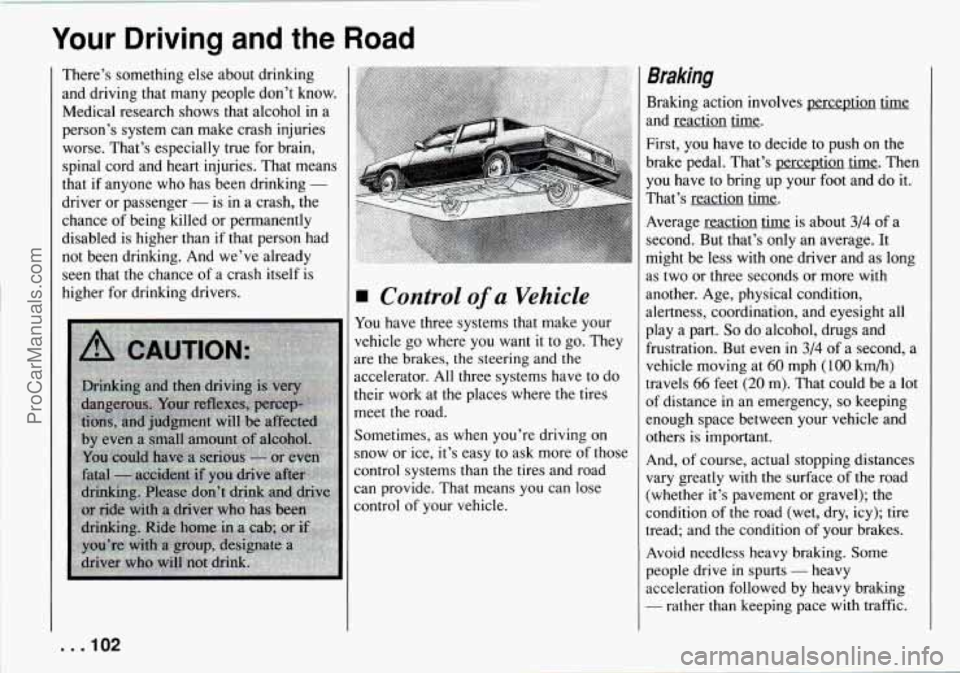
Control of a Vehicle
You have three systems that make your
vehicle go where you want it to go. They
are the brakes, the steering and the
accelerator. All three systems have to
do
their work at the places where the tires
meet the road.
Sometimes, as when you’re driving on
snow or ice, it’s easy to ask more
of those
control systems than the tires and road
can provide. That means you can lose
control
of your vehicle.
Braking
Braking action involves perception time
and reaction time.
First, you have to decide to push on the
brake pedal. That’s perception
time. Then
you have to bring
up your foot and do it.
That’s reaction
time.
Average reaction time is about 3/4 of a
second. But that’s only an average. It
might be less with one driver and as long
as two or three seconds or more with
another. Age, physical condition,
alertness, coordination, and eyesight all
play a part.
So do alcohol, drugs and
frustration. But even in
3/4 of a second, a
vehicle moving at
60 mph (100 km/h)
travels
66 feet (20 m). That could be a lot
of distance in an emergency,
so keeping
enough space between your vehicle and
others is important.
And,
of course, actual stopping distances
vary greatly with the surface of the road
(whether it’s pavement or gravel); the
condition of
the road (wet, dry, icy); tire
tread; and the condition of your brakes.
Avoid needless heavy braking. Some
people drive in spurts
- heavy
acceleration followed by heavy braking
- rather than keeping pace with traffic.
. . .IO2
ProCarManuals.com
Page 104 of 258
This is a mistake. Your brakes may not
have time
to cool between hard stops.
Your brakes will wear
out much faster if
you do a lot of heavy braking. If you keep
pace with
the traffic and allow realistic
following distances,
you will eliminate a
lot of unnecessary braking. That means
better braking and longer brake life.
If your engine ever stops while you’re
driving, brake normally but don’t pump
your brakes. If you do, the pedal may get
harder to push down.
If your engine stops,
you will still have some power brake
assist.
But you will use it when you brake.
Once
the power assist is used up, ir may
take longer to stop and the brake pedal
will be harder to push.
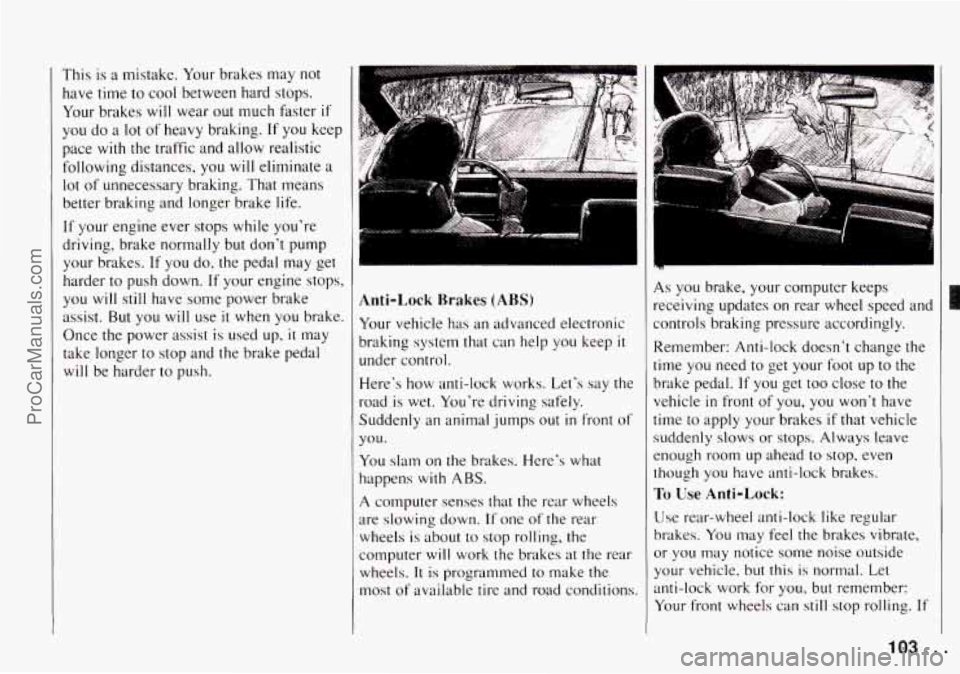
Anti-Lock Brakes (ABS)
Your vehicle has an advanced electronic
braking system that can help you keep
it
under control.
Here‘s
how anti-lock works. Let’s say the
road is wet. You‘re driving safely.
Suddenly an animal jumps out
in front of
you.
You slam on the brakes. Here’s what
happens
with ABS.
A computer senses that the rear wheels
are slowing down.
If one of the rear
wheels
is about to stop rolling, the
computer will work the brakes at the rear
wheels.
It is programmed to make the
most of available tire and road conditions.
R
As you brake, your computer keeps
receiving updates
on rear wheel speed and
controls braking pressure accordingly.
Remember: Anti-lock doesn‘t change the
time you need
to get your foot up to the
brake pedal.
If you get too close to the
vehicle in front of you, you won’t have
time to apply your brakes
if that vehicle
suddenly
slows or stops. Always leave
enough room up ahead to stop. even
though you have anti-lock brakes.
To Use Anti-Lock:
Use rear-wheel anti-lock like regular
brakes. You may feel the brakes vibrate,
or
you may notice some noise outside
your vehicle, but
this is normal. Let
anti-lock work for
you, but remember:
Your front wheels
can still stop rolling. If
103..
ProCarManuals.com
Page 105 of 258
Your Driving and the Road
that happens, release enough pressure on
the brakes to get the wheels rolling again
so that you can steer.
With the four-wheel drive option, you
won’t have anti-lock braking when you
shift into four-wheel drive. But
you will
have regular braking. When you shift
back into two-wheel drive, you will have
anti-lock again.
Braking in Emergencies
At some time, nearly every driver gets
into a situation that requires hard braking.
You have the rear-wheel anti-lock braking
system. Your front wheels can stop rolling
when you brake
very hard. Once they do,
the vehicle can’t respond to your steering.
Momentum
will carry it in whatever
direction it was headed when the front
wheels stopped rolling. That could be off
the road, into the very thing you were
trying to avoid, or into traffic.
So, use a “squeeze” braking technique.
This will give you maximum braking
while maintaining steering control.
You
do this by pushing on the brake pedal
with steadily increasing pressure. When
you do, it will help maintain steering
control. In many emergencies, steering
can help you more than even the
very best
braking.
. . .lo4
Steering
Power Steering
If you lose power steering assist because
the engine stops or the system is not
functioning, you can steer but
it will take
much more effort.
Steering Tips
Driving on Curves
It’s important to take curves at a
reasonable speed.
A lot of the “driver lost control” accidents
mentioned on the news happen on curves.
Here’s why:
Experienced driver or beginner, each of
us is subject to the same laws of physics
when driving on curves. The traction of
the tires against the road surface makes
it
possible for the vehicle to change its path
when you
turn the front wheels. If there’s
no traction, inertia will keep the vehicle
going
in the same direction. If you’ve
ever tried to steer a vehicle on wet ice,
you’ll understand this.
The traction you can get in a curve
depends on the condition of your tires and
the road surface, the angle at which
the
curve is banked, and your speed. While you’re
in a curve, speed
is the one factor
you can control.
Suppose you’re steering through a sharp
curve. Then
you suddenly apply the
brakes. Both control systems
- steering
and braking
- have to do their work
where the tires meet the road. Adding the
hard braking can demand too much at
those places.
You can lose control.
The same thing can happen if you’re
steering through a sharp curve and you
suddenly accelerate. Those two control
systems
- steering and acceleration -
can overwhelm those places where the
tires meet
the road and make you lose
control.
What should
you do if this ever happens?
Ease up on the brake or accelerator pedal,
steer the vehicle the way you want it to
go, and slow down.
Speed limit signs near curves warn that
you should adjust your speed. Of course,
the posted speeds are based on good
weather and road conditions. Under less
favorable conditions you’ll want to go
slower.
If you need to reduce your speed as you
approach a curve, do
it before you enter
ProCarManuals.com
Page 106 of 258
the curve, while your front wheels are
straight ahead.
Try to adjust your speed
so you can
“drive” through the curve. Maintain a
reasonable, steady speed. Wait to
accelerate until you are out of the curve,
and then accelerate gently into the
straightaway.
Steering in Emergencies
There are times when steering can be
more effective than braking. For example,
you come over a hill and find a truck
stopped in your lane, or a car suddenly
pulls out from nowhere, or a child darts
out from between parked cars and stops
right
in front of you. You can avoid these
problems by braking
- if you can stop in
time. But sometimes you can’t; there isn’t
room. That’s the time for evasive action
- steering around the problem.
Your Geo can perform very well in
emergencies like these. First apply your
brakes, but not enough
to lock your front
wheels. It is better to remove as much
speed as you can from a possible
collision. Then steer around the problem,
to the left or right depending on the space
available. 4n
emergency like this requires close
ittention and a quick decision.
If you are
holding the steering wheel at the
recommended
9 and 3 o’clock positions,
you can turn it a full
180 degrees very
quickly without removing either hand.
But you have to act fast, steer quickly,
and just as quickly straighten the wheel
once
you have avoided the object.
The fact that such emergency situations
are always possible is
a good reason to
practice defensive driving at all times and
wear safety belts properly.
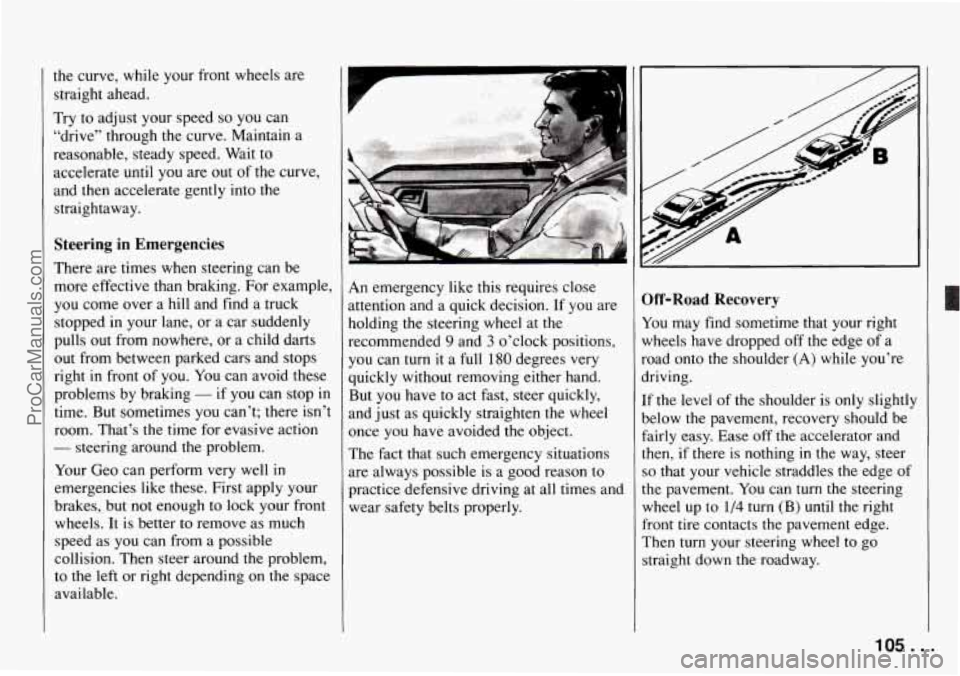
Iff-Road Recovery
7ou may find sometime that your right
,heels have dropped off the edge of a
oad onto the shoulder
(A) while you’re
riving.
f the level of the shoulder is only slightl:
lelow the pavement, recovery should be
airly easy. Ease off the accelerator and
hen, if there is nothing in the way, steer
o that your vehicle straddles the edge of
he pavement. You can turn the steering
vheel up to
1/4 turn (B) until the right
ront tire contacts the pavement edge.
?hen turn your steering wheel to go
traight down the roadway.
105 ...
ProCarManuals.com
Page 107 of 258

Your Driving and the Road
Passing
The driver of a vehicle about to pass
another on a two-lane highway waits for
just
the right moment, accelerates, moves
around the vehicle ahead, then goes back
into the right lane again.
A simple
maneuver?
Not necessarily! Passing another vehicle
on a two-lane highway is
a potentially
dangerous move, since the passing
vehicle occupies the same lane as
oncoming traffic for several seconds.
A
miscalculation, an error in judgment, or a
brief surrender to frustration or anger can
suddenly put the passing driver face to
face with the worst of
all traffic accidents
- the head-on collision.
So here are some tips for passing:
“Drive ahead.’’ Look down the road,
to the sides, and to crossroads for
situations that might affect your
passing patterns. If you have any
doubt whatsoever about making a
successful pass, wait for a better time.
Watch for traffic signs, pavement
markings, and lines.
If you can see a
sign up ahead that might indicate
a
turn or an intersection, delay your
pass. A broken center line usually
0
0
indicates it’s all right to pass
(providing the road ahead is clear).
Never cross
a solid line on your side
of the lane or a double solid line, even
if the road seems empty of
approaching traffic.
Do not get too close to the vehicle you
want
to pass while you’re awaiting an
opportunity. For one thing, following
too closely reduces your area of
vision, especially
if you’re following a
larger vehicle.
Also, you won‘t have
adequate space if the vehicle ahead
suddenly slows or stops. Keep back a
reasonable distance.
When
it looks like a chance to pass is
coming up, start to accelerate but stay
in the right lane and don’t get too
close. Time your move so you will be
increasing speed
as the time comes to
move into the other lane. If the way is
clear
to pass, you will have a “running
start” that more than makes up for the
distance you would lose
by dropping
back. And if something happens to
cause you
to cancel your pass, you
need only slow down and drop back
again and wait for another
opportunity.
0
0
0
0
0
If other cars are lined up to pass a
slow vehicle, wait your turn.
But take
care that someone isn’t trying to pass
you as you pull out to pass the
slow
vehicle. Remember to glance over your
shoulder and check the blind spot.
Check your mirrors, glance over your
shoulder, and start your left lane
change signal before moving out
of
the right lane to pass. When you are
far enough ahead of the passed vehicle
to see its front
in your inside mirror,
activate your right lane change signal
and move back into the right lane.
(Remember that your right outside
mirror is convex. The vehicle you just
passed may seem
to be farther away
from you than
it really is.)
Try not to pass more than one vehicle
at a time on two-lane roads. Reconsider
before passing the next vehicle.
Don’t overtake a slowly moving
vehicle
too rapidly. Even though the
brake lights are not flashing,
it may
be slowing down or starting to
turn.
If you’re being passed, make it easy
for the following driver to get ahead
of you. Perhaps you can ease
a little
to the right.
. . .lo6
ProCarManuals.com