brake CHEVROLET TRACKER 1994 Owner's Manual
[x] Cancel search | Manufacturer: CHEVROLET, Model Year: 1994, Model line: TRACKER, Model: CHEVROLET TRACKER 1994Pages: 258, PDF Size: 14.43 MB
Page 108 of 258
loss of Control
Let's review what driving experts say
about
what happens when the three
control system (brakes, steering and
acceleration) don't have enough friction
where
the tires meet the road to do what
the driver has asked.
In any emergency. don't give up. Keep
trying
to steer and constantly seek an
escape route or area
of less danger.
Skidding
In a skid. a driver can lose control of the
vehicle. Defensive drivers avoid most
skids by taking reasonable care suited
to
existing conditions. and by not
"overdriving" those conditions. But skids
are always possible.
The three types
of skids correspond to
your Geo's three control systems. In the
braking skid your wheels are.n't rolling.
In
the steering or cornering skid, too much
speed or steering
in a curve causes tires to
slip and lose cornering force. And
in the
acceleration skid too much throttle causes
the driving wheels
to spin.
A cornering skid and an acceleration skid
are best handled by easing your foot off
the accelerator pedal.
If your vehicle starts to slide, ease your
foot 011' the accelerator pedal and quickly
steer the way
you want the vehicle to go.
If you start steering quickly enough. your
vehicle
may straighten out. 41ways be
ready for
;I sccond skid if it occurs.
Of course, traction is reduced when water,
snow. ice. gravel. or other material is on
the road. For safety, you'll want to slow
down and adjust your driving
to these
conditions.
It is important to slow down
on slippery surfaces because stopping
distance will be longer
and vehicle
control more limited.
While driving on
a surface with reduced
traction.
try your best to avoid sudden
steering, acceleration,
or braking
(including engine braking by shifting
EO a
lower gear).
Any sudden changes could
cause the tires to slide. You may
not
realize the surface is slippery until yout-
vehicle is skidding. Learn
to recognize
warning clues
~ such as enough water,
ice or packed snow
on the road to make ;1
"nlir~-or.ed surf'rlce" - and slow down
when you have any doubt.
Remember: The rex-wheel anti-lock
braking system (RWAL) helps avoid
only
a rear braking skid. In a braking skid
(where the front wheels are
no longer rolling),
release enough pressure
on the
brakes to get the front wheels rolling
again. This restores steering control. Push
the brake pedal down steadily when you
have
to stop suddenly. As long as the
I'ront wheels are rolling,
you will have
sleering control.
Driving Guidelines
This multipurpose passenger vehicle is
defined as a utility vehicle in Consumer
Information Regulations issued
by the
National I-lighway Traffic Safety
Administration (NHTSA)
of the United
States Department of Transportation.
Utility vehicles have higher ground
clearance and a narrower track to make
them capable of performing
in a wide
variety
of off-road applications. Specific
design characteristics give them a higher
center of gravity than ordinary cars. An
advantage
of the higher ground clearance
is
a better view of the road allowing you
to anticipate problems. They are not
designed for cornering
at the same speeds
as conventional 2-wheel drive vehicles
any no re than low-slunl 7 .'p '-, orts cars are
designed
to perform satisfitctorily under
off-road conditions.
If at all possible,
avoid shurp turns or abrupt maneuvers.
107 ...
ProCarManuals.com
Page 109 of 258
Your Driving and the Road
As with other vehicles of this type, failure
to operate this vehicle correctly may
result
in loss of control or vehicle
rollover.
Off-Road Driving with
Your Geo Four-wheel
Drive Vehicle
This off-road guide is for vehicles that
have four-wheel drive.
Also, see “Anti-lock Brakes”
in the Index.
If your vehicle doesn’t have four-wheel
drive, you shouldn’t drive off-road unless
you’re
on a level, solid surface.
Off-road driving can be great fun. But
it
does have some definite hazards. The
greatest of these is the terrain itself.
“Off-roading” means
you’ve left the great
North American road system behind.
Traffic lanes aren‘t marked. Curves aren’t
banked. There are no road signs. Surfwes
can be slippery, rough, uphill
or downhill.
In short, you’ve gone right back to nature.
Off-road driving involves
some new
skills. And that’s
why it’s very important
that
you read this guide. You’ll find many
driving tips and suggestions. These
will
help make your off-road driving safer and
more enjoyable.
=. .lo8
Before You Go Off-Roading
There are some things to do before you
go out. For example, be sure to have all
necessary maintenance and service work
done. Be sure you read all the information
about your four-wheel drive vehicle in
this manual. Is there enough fuel? Is the
spare tire
fully inflated‘? Are the fluid
levels up where they should
be‘? What are
the local laws
that apply to off-roacting
where you’ll be driving?
If you don’t
know, you should check with law
enforcement people
in the area. Will you
be on someone’s private land?
If so, be
sure
to get the necessary permission.
Loading Your Vehicle for Off-Road
Driving
There are some important things to
remember
about how to load your
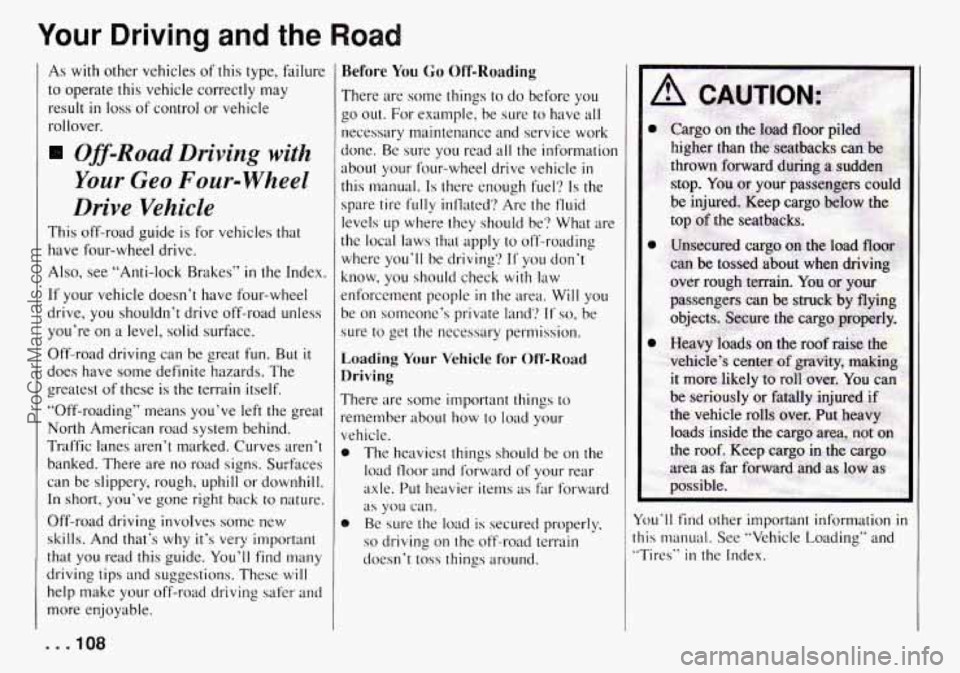
vehicle. The heavies1 things should
be on the
load floor and forward of your rear
axle. Put heavier items
as far forward
as you can.
e Be sure the load is secured properly,
so driving on the off-road terrain
doesn’t
toss things around.
You’ll find other important information in
this manual. See “Vehicle Loading” and
”Tires”
in the Index.
ProCarManuals.com
Page 112 of 258
0 Is the hill simply too rough‘? Steep hills
often have ruts, gullies, troughs and
exposed rocks because
they are more
susceptible
to the effects of erosion.
Driving Uphill
Once you decide you can safely drive up
the hill,
you need to take some special
steps.
0 Use a low gear and get a firm grip on
the steering wheel.
Get a smooth start up the hill and try
to maintain your speed. Don’t use
more power than
you need, because
you don’t want your wheels
to start
spinning or sliding.
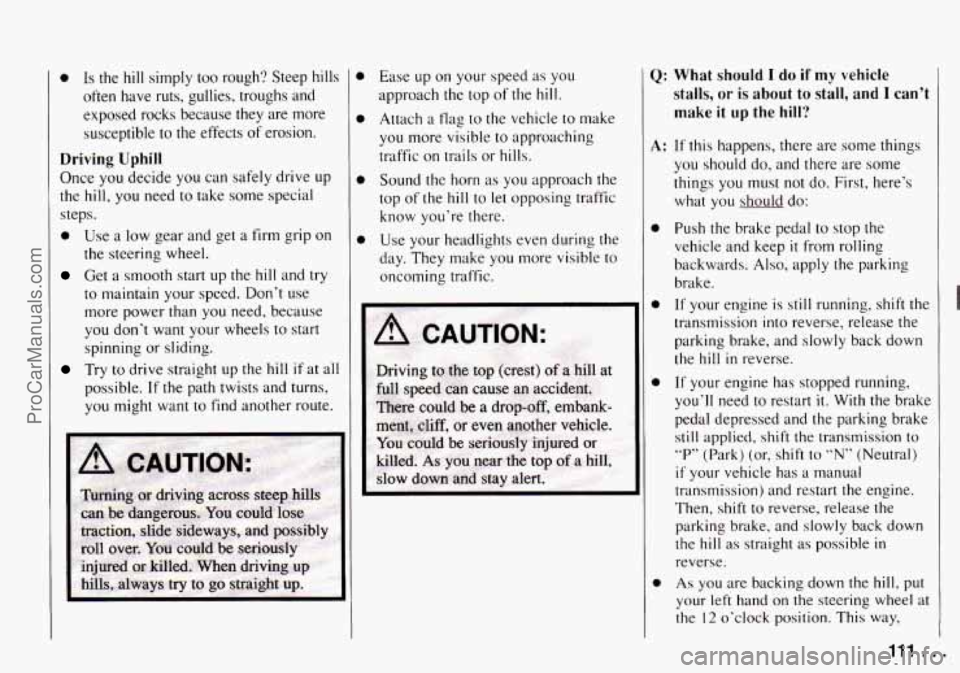
Try to drive straight up the hill if at a1
possible.
If the path twists and turns,
you might want to find another route.
0
0
0
0
Ease up on your speed as you
approach the top
of the hill.
Attach a flag to the vehicle to tnake
you more visible to approaching
traffic on trails
or hills.
Sound the
horn as you approach the
top
of the hill to let opposing traffic
know you’re there.
Use your headlights even during the
day. They make you more visible
to
oncoming traffic.
Q: What should I do if my vehicle
A:
0
0
0
0
stalls, or is about to stall, and I can’t
make
it up the hill?
If this happens, there are some things
you should do, and there are some
things you must not do. First, here’s
what you should do:
Push the brake pedal
to stop the
vehicle and keep
it from rolling
backwards. Also, apply
the parking
brake.
If your engine is still running, shift the
transmission into reverse, release the
parking brake, and slowly back down
the
hill in reverse.
If your engine has stopped running,
you’ll need to restart it. With the brake
pedal depressed and
the parking brake
still applied,
shift the transmission to
“P” (Park) (or, shift to “N” (Neutral)
if your vehicle has a manual
transmission) and restart
the engine.
Then, shift
to reverse, release the
parking brake, and slowly back down
the
hill as straight as possible in
reverse.
As you are backing down the hill, put
your left hand
on the steering wheel at
the
12 o’clock position. This way,
111 . . .
ProCarManuals.com
Page 113 of 258
Your Driving and the Road
you'll be able to tell if your wheels are
stl-aisht and maneuver
as you back
down. It's best thur ~LI i);\c.l; c'lown the
hill with your wheeis straight rather
than
in the left or right direction.
Turning the wheel
too far to the left or
right will increase the possibility of a
rollover.
Here are some things you must
not do if
you stall, or are about to stall, when going
up a
hill.
0
Never attempt to prevent a stall by
shifting
into "N" (Neutral) (or
depressing
the clutch. if you have a
manual transmission) to "rev-up" the
engine and regain forward rnornentum.
This won't work. Your vehicle
will
roll backwards very quickly and you
could
go out of control. Instead. apply
the regular brake to stop the vehicle.
Then apply the parking brake. Shift into reverse, release the parking brake,
and slowly back straight down.
Never attempt
to turn around if you
are about
to stall when going up a hill.
If the hill is steep enough to stall your
vehicle, it's steep enough to cause
you
to roll over if you turn around. If you
can't make
it up the hill, you must
back straight down the
hill.
0: Suppose, after stalling, I try to back
down the hill and decide
I just can't
do it. What should I do?
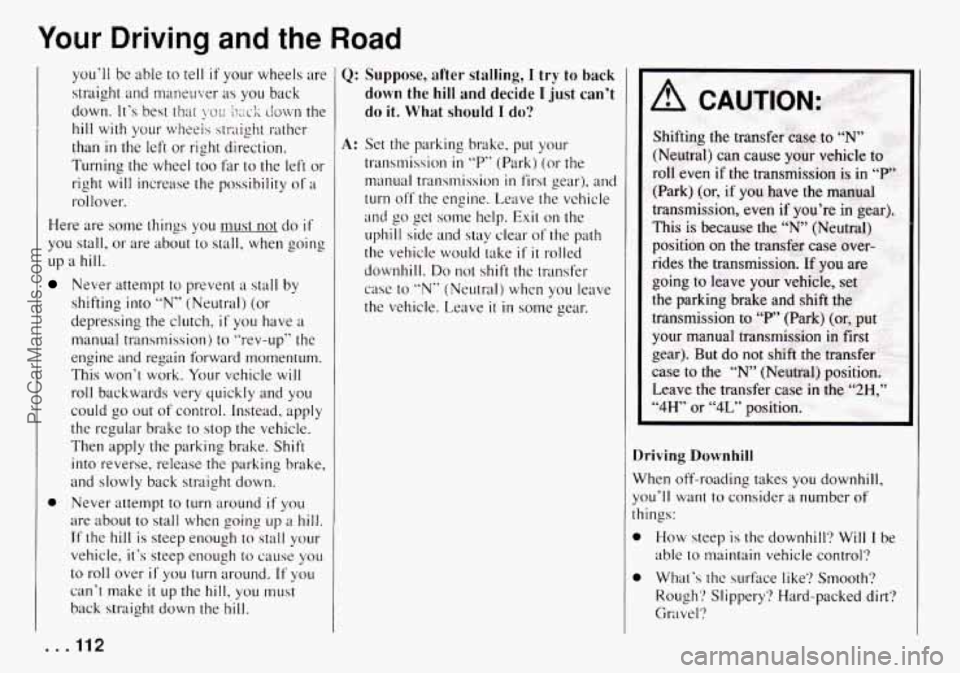
A: Set the parking brake, put your
transmission
in "P'* (Park) (or the
manual transmission in first gear). and
turn off the engine. Leave the vehicle
and go get some help. Exit on the
uphill side and
stay clear of the path
the vehicle would take
if it rolled
downhill.
Do not shift thc transfer
case
to "N" (Neutral) when you leave
the vehicle. Leave it in some gear.
Driving Downhill
When off-roading takes you downhill,
JOU'II want to consider a number of
hings:
D How steep is the downhill'? Will I be
able
to maintain vehicle control'?
D What's the surfilce like? Smooth?
Rough'! Slippery'? Hard-packed dirt?
Gravel'?
. . .112
ProCarManuals.com
Page 114 of 258
0 Are there hidden surface obstacles?
Ruts? Logs? Boulders?
0 What’s at the bottom of the hill? Is
there a hidden creek bank or even a
river bottom with large rocks?
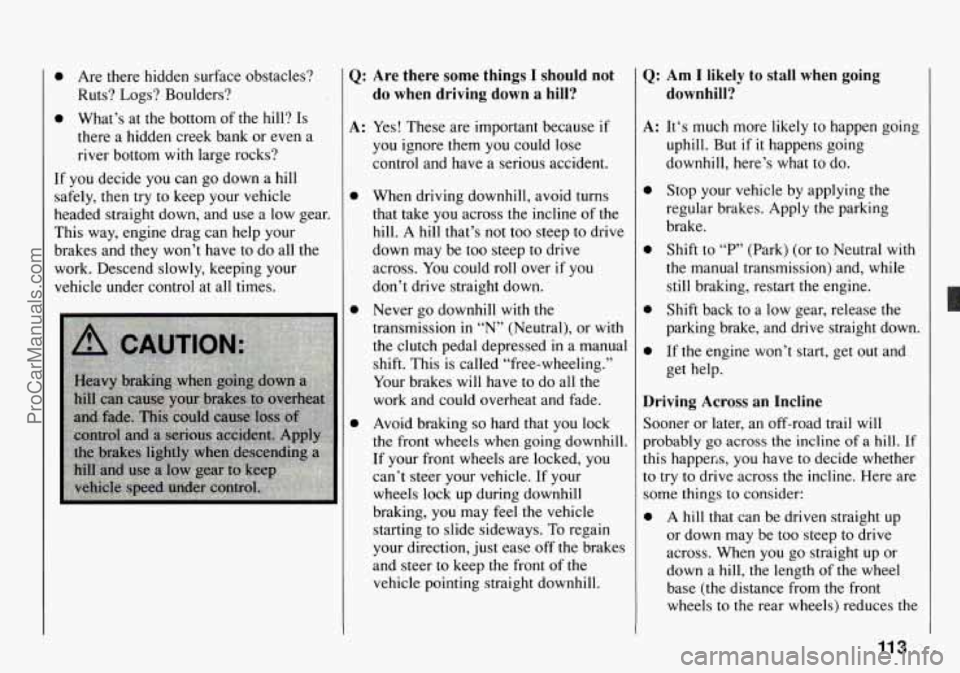
If you decide you can go down a
hill
safely, then try to keep your vehicle
headed straight down, and use a low gear.
This way, engine drag can help your
brakes and they won’t have to do all the
work. Descend slowly, keeping your
vehicle under control at all times.
Q: Are there some things I should not
do when driving down
a hill?
A: Yes! These are important because if
you ignore them you could lose
control and have a serious accident.
When driving downhill, avoid turns
that take you across the incline
of the
hill.
A hill that’s not too steep to drive
down may be too steep to drive
across. You could roll over if you
don’t drive straight down.
Never go downhill with the
transmission in “N” (Neutral), or with
the clutch pedal depressed in a manual
shift. This is called “free-wheeling.”
Your brakes will have to do all the
work and could overheat and fade.
Avoid braking
so hard that you lock
the front wheels when going downhill.
If your front wheels are locked, you
can’t steer your vehicle. If your
wheels lock up during downhill
braking, you may feel the vehicle
starting to slide sideways.
To regain
your direction, just ease
off the brakes
and steer to keep the front of the
vehicle pointing straight downhill.
Q: Am I likely to stall when going
downhill?
A:
0
0
0
0
It‘s much more likely to happen going
uphill.
But if it happens going
downhill, here’s what to do.
Stop your vehicle by applying the
regular brakes. Apply the parking
brake.
Shift to
“P” (Park) (or to Neutral with
the manual transmission) and, while
still braking, restart the engine.
Shift back to a low gear, release the
parking brake, and drive straight down.
If the engine won’t start, get out and
get help.
Driving Across an Incline
Sooner or later, an off-road trail will
probably go across the incline
of a hill. If
this happeris, you have to decide whether
to try to drive across the incline. Here are
some things to consider:
0 A hill that can be driven straight up
or down may be too steep to drive
across. When you go straight up or
down a hill, the length
of the wheel
base (the distance from the front
wheels to the rear wheels) reduces the
113 :. .
ProCarManuals.com
Page 117 of 258
Your Driving and the Road
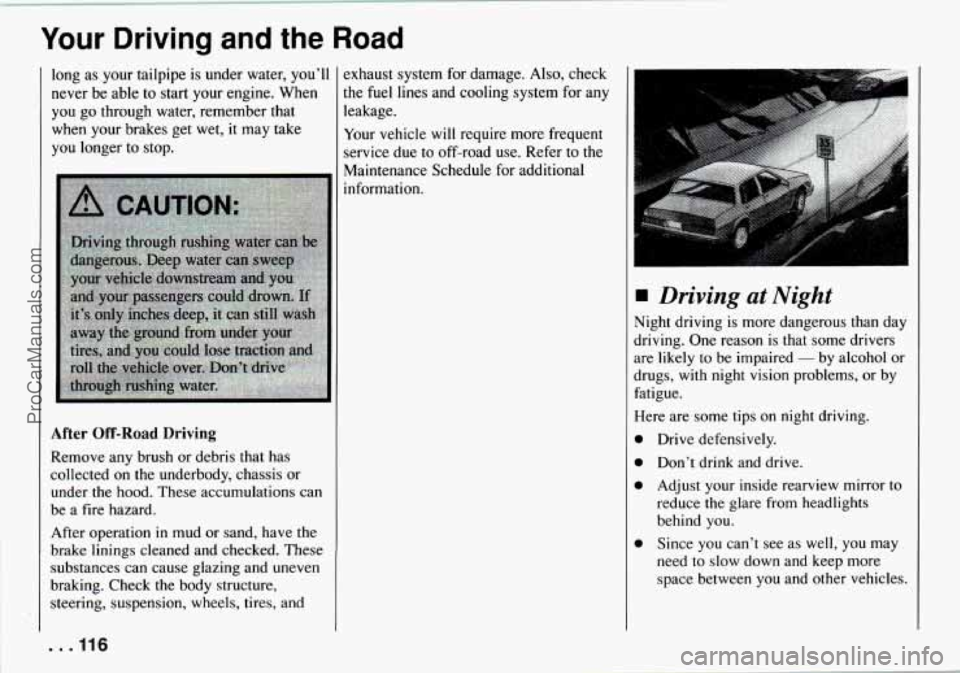
long as your tailpipe is under water, you'll
never be able to
start your engine. When
you go through water, remember that
when your brakes get wet, it may take
you longer to stop.
After Off-Road Driving
Remove any brush or debris that has
collected
on the underbody, chassis or
under the hood. These accumulations can
be a fire hazard.
After operation in mud or sand, have the
brake linings cleaned and checked. These
substances can cause glazing and uneven
braking. Check the body structure,
steering, suspension, wheels, tires, and exhaust system
for damage.
Also, check
the fuel lines and cooling system for any
leakage.
Your vehicle will require more frequent
service due to off-road
use. Refer to the
Maintenance Schedule for additional
information.
4 Driving at Night
Night driving is more dangerous than day
driving. One reason is that some drivers
are likely
to be impaired - by alcohol or
drugs, with night vision problems, or by
fatigue.
Here are some tips on night driving.
Drive defensively.
Don't drink and drive.
Adjust your inside rearview mirror to
reduce the glare from headlights
behind you.
Since you can't see as well,
you may
need to slow down and keep more space between
you and other vehicles.
. . .116
ProCarManuals.com
Page 119 of 258
Your Driving and the Road
It’s wise to keep your wiping equipment
in good shape and keep your windshield
washer tank filled. Replace your
windshield wiper inserts when they show
signs of streaking or missing areas on the
windshield, or when strips of rubber start
to separate from the inserts.
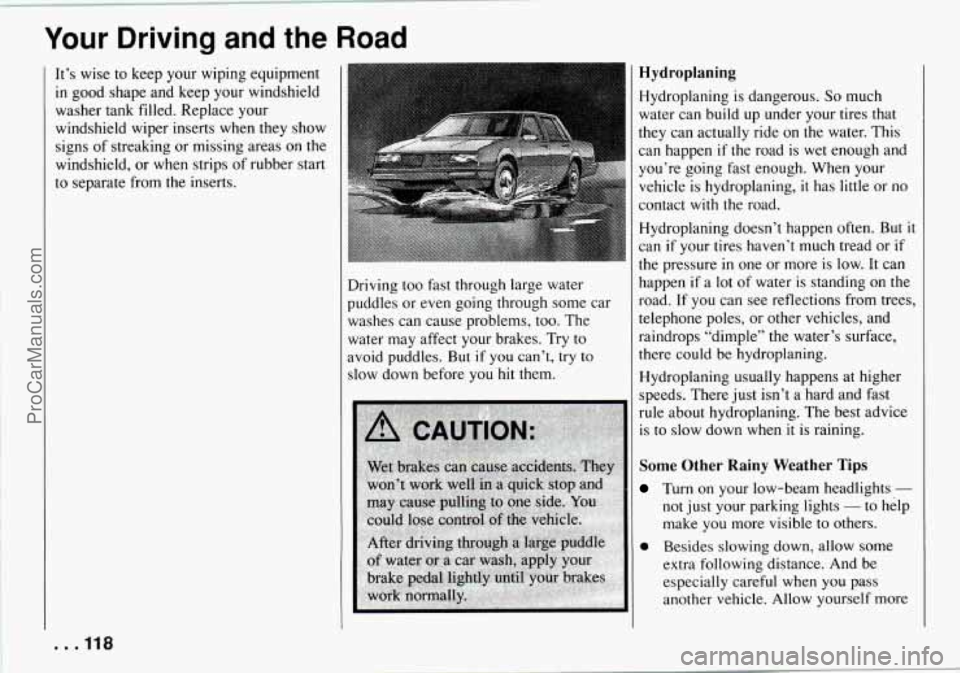
Driving too fast through large water
puddles or even going through some car
washes can cause problems, too. The
water may affect your brakes. Try to
avoid puddles. But
if you can’t, try to
slow down before you hit them.
Hydroplaning
Hydroplaning is dangerous. So much
water can build
up under your tires that
they can actually ride on the water. This
can happen if the road is
wet enough and
you’re going fast enough. When your
vehicle is hydroplaning,
it has little or no
contact
with the road.
Hydroplaning doesn’t happen often.
But it
can if your tires haven’t much tread or
if
the pressure in one or more is low. It can
happen
if a lot of water is standing on the
road.
If you can see reflections from trees,
telephone poles, or other vehicles, and
raindrops “dimple” the water’s surface,
there could be hydroplaning.
Hydroplaning usually happens at higher speeds. There just isn’t a hard and fast
rule about hydroplaning. The best advice
is to slow down when it is raining.
Some Other Rainy Weather Tips
Turn on your low-beam headlights -
not just your parking lights - to help
make you more visible to others.
0 Besides slowing down, allow some
extra following distance. And be
especially careful when you pass
another vehicle. Allow yourself more
. . .I18
ProCarManuals.com
Page 122 of 258
0
0
Wiper Blades: Are they in good
shape?
Fuel, Engine Oil, Other Fluids:
Have you checked all levels?
Lights: Are they all working? Are the
lenses clean?
Tires: They are vitally important to a
safe, trouble-free trip. Is the tread
good enough for long-distance
driving? Are the tires all inflated to
the recommended pressure?
Weather Forecasts: What’s the
weather outlook along your route?
Should you delay your trip a short
time to avoid a major storm system?
Maps: Do you have up-to-date
maps?
Highway Hypnosis
Is there actually such a condition as
“highway hypnosis”? Or is it just plain
falling asleep at the wheel? Call
it
highway hypnosis, lack of awareness, or
whatever.
There is something about an easy stretch
of road with
the same scenery, along with
the hum of the tires
on the road, the drone
of the engine, and the rush of the wind
against the vehicle that can make you sleepy. Don’t let it happen
to you! If it
does, your vehicle can leave the road in
less than a second, and
you could crash
and be injured.
What can you do about highway
hypnosis? First, be aware that
it can
happen.
Then here are some tips:
0 Make sure your vehicle is well
ventilated, with a comfortably cool
interior.
0 Keep your eyes moving. Scan the
road ahead and to
the sides. Check
your mirrors and your instruments
frequently.
0 If you get sleepy, pull off the road into
a rest, service, or parking area and
take a nap, get some exercise,
or both.
For safety, treat drowsiness on the
highway as an emergency.
Hill and Mountain
Roads
Driving on steep hills or mountains is
different from driving
in flat or rolling
terrain. If you drive regularly in steep
country, or
if you’re planning to visit
there, here are some tips that can make
your trips safer and more enjoyable.
(See “Off-Road Driving” in the Index
for information about driving off-road.)
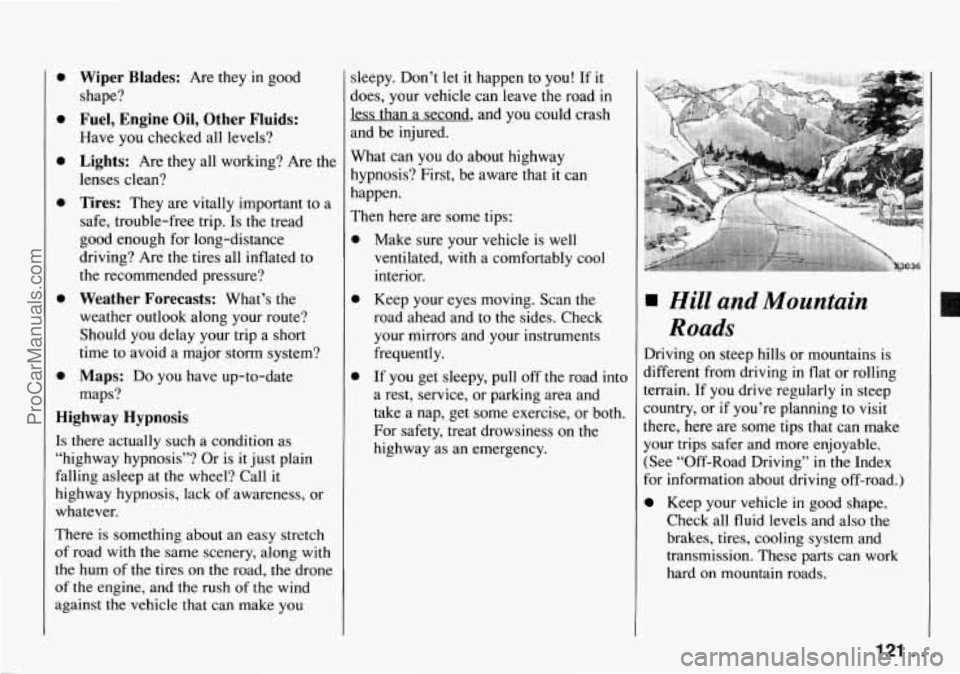
Keep your vehicle in good shape.
Check all fluid levels and also the
brakes, tires, cooling system and
transmission. These parts can work
hard
on mountain roads.
ILI . . .
ProCarManuals.com
Page 123 of 258

Your Driving and the Road
0 Know how to go down hills. The mosl
important thing
to know is this: let
your engine do some of the slowing
down. Shift
to a lower gear when you
go down a steep or long hill.
If you don’t shift down, your brakes
could get so hot that they wouldn’t
work well.
You would then have poor
braking
or even none going down a
hill. You could crash. Shift down to
let your engine assist your brakes on
a steep downhill slope.
A CAUTION:
t 0
1
0
0
0
Coasting downhill in “N” (Neutral)
or with the ignition off is dangerous.
Your brakes will have to do all the
work of slowing down. They could
get
so hot that they wouldn’t work
well.
You could crash. Always have
your engine running and your vehicle
in gear when you go downhill. Know how to
go
uphill. You may
want to shift down
to a lower gear.
The lower gears help cool your engine
and transmission. and you can climb the
hill better.
Stay
in yo~~r own lane when driving
on two-lane roads
in hills or
mountains.
Don’t swing wide or cut
~tcross
[he center of the road. Drive at
speeds
that let you stay in your own
lane.
As you go over the top of a hill. be
alert. There could be something
in
your lane. like a stalled car or an
accident.
You n~ay see highway signs
on
mountains that warn of special
problems. Examples are long grades,
passing or no-passing zones,
a falling
rocks area, or winding roads.
Be alert
to these and take appropriate action.
Winter Driving
Here are some tips for winter driving:
Have your Geo
in good shape for
winter.
Be sure your engine coolant
mix is correct.
You may want
to put winter
emergency supplies
in your vehicle.
. . .122
ProCarManuals.com
Page 124 of 258
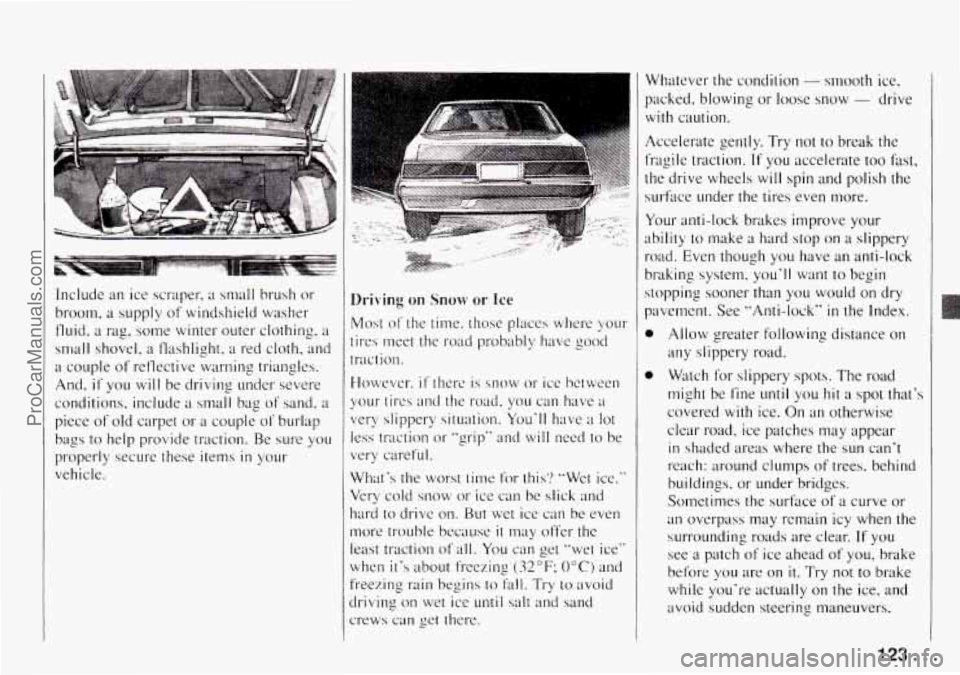
Include an ice scraper7 a small brush or
broom. a supply of windshield washer
fluid,
a rag, some winter outer clothing, a
small shovel, a flashlight, a red cloth, and
a couple of reflective warning triangles.
And,
if you will be driving under severe
conditions, include
:I small bag of sand, ;I
piece of old carpet or a couple of burlap
bags to
help provide traction. Be sure yo11
properl}, secure these item in your
vehicle.
Driving on Snow or Ice
Most of the time. those placcs where your
tires meet the road probably have good
traction.
Howe\w-.
it’ thcrc is snow or ice between
your tires antl the road, you can Iwve ;I
very slippery situation. You‘ll have ;t lot
less traction or “grip“ and will need to be
very careful.
What‘s the worst time
for this’? “Wet ice.”
Very cold snow
or ice can be slick and
hurd to drive on. Rut wet ice can be even
more trouble because
it nlay offer the
least traction
of all. You can get ”wet ice”
when it’s about freezing
(32°F; 0°C) and
freezing rain begins to fall. Try to avoid
hiving on wet ice
until salt and sand
:rews
can get there. Whatever the condition
- smooth ice.
packed. blowing or loose snow
- drive
with caution.
Accelerate gently. Try not
to break the
fragile traction. If you accelerate too fast,
the drive wheels will spin and polish the
surface under the tires even more.
Your anti-lock brakes improve your
ability
to make a hard stop on a slippery
road. Even though you have
an anti-lock
braking system.
you’ll want to begin
stopping sooner than
you would on dry
pavement.
See “Anti-lock” in the Index.
0
0
Allow greater following distance on
any slippery road.
Watch for slippery spots. The road
might be fine
until you hit H spot that’s
covered with ice.
On an otherwise
clear road. ice patches may appear
in shaded areas where the sun can’t
reach: around clumps
of trees. behind
buildings, or under bridges.
Sometimes the surftlce
of a curve or
an overpass may remain icy when the
surrounding roads are clear.
If you
see a patch of ice ahead of you, brake
before you are on
it. Try not to brake
while
you’re actually on the ice, and
avoid sudden steerins maneuvers.
123 ...
ProCarManuals.com