brake CHEVROLET TRACKER 1994 Owner's Guide
[x] Cancel search | Manufacturer: CHEVROLET, Model Year: 1994, Model line: TRACKER, Model: CHEVROLET TRACKER 1994Pages: 258, PDF Size: 14.43 MB
Page 128 of 258

0
distance is less than 12 inches, take
the foot off the trailer tongue.
Will you have to make any holes
in
the body of your vehicle when you
install a trailer hitch?
If you do, then
be sure
to seal the holes later when
you remove the hitch. If you don't
seal them, deadly carbon monoxide
(CO) from your exhaust can get into
your vehicle (see "Carbon Monoxide"
in the Index). Dirt and water can, too.
Safety Chains
You should always attach chains between
your vehicle and your trailer. Cross the
safety chains under the tongue of the
trailer
so that the tongue will not drop to
the road if
it becomes separated from the
hitch. Instructions about safety chains
may be provided by the hitch
manufacturer
or by the trailer
manufacturer. Follow the manufacturer's
recommendation
for attaching safety
chains. Always leave just enough slack
so
you can turn with pour rig. And, never
allow safety chains
to drag on the ground.
Trailer Brakes
If your trailer weighs more than 1,000
pounds (450 kg) loaded, then it needs its
own brakes -and they must be adequate.
Be sure
to read and follow the instructions
for the trailer brakes so you'll be able to
install, ad-just and maintain them properly.
Don't tap into your vehicle's brake
system
if the trailer's brake system
will use more than 0.02 cubic inch
(0.3 cc) of fluid from your vehicle's
master cylinder.
If it does. both
systems won't work well. You could
even lose your brakes.
Will the trailer brake parts take
3,000
psi (20 650 kPa) of pressure? If not,
the trailer brake system must not be
used
with your vehicle.
If everything checks out this far. then
make the brake fluid tap at the port on
the master cylinder that sends fluid
to
the rear brakes. But don't use copper
tubing for
this. If you do, it will bend
and finally break off. Use steel brake
tubing.
Driving with a Trailer
Towing a trailer requires a certain amount
of experience. Before setting out for the
open road, you'll want
to get to know
your rig. Acquaint yourself
with the feel
of handling and braking with the added
weight
of the trailer. And always keep in
mind that the vehicle you are driving is
now a good deal longer and not nearly so
responsive as your vehicle is by itself.
Before you start, check the trailer hitch
and platform. safety chains, electrical
contwxtor. lights, tires and mirror
adjustment. If the trailer has electric
brakes, start your vehicle and trailer
moving and then apply the trailer brake
controller by hand to be sure the brakes
are working. This lets you check your
electrical connection
at the same time.
During your trip, check occasionally to be
sure that the load is secure. and that the
lights and any trailer brakes are
still
working.
Following Distance
Stay at least twice as far behind the
vehicle ahead as
you would when driving
your vehicle without
a trailer. This can
help you avoid situations that require
heavy braking and sudden turns.
Passing
You'll need more passing distance up
ahead when you're towing a tnliler. And.
because you're
B good deal longer, you'll
need to go much farther beyond the
127 ...
ProCarManuals.com
Page 129 of 258

Your Driving and the Road
passed vehicle before vou can return to
your lane.
Backing Up
Hold the bottom of the steering wheel
with one hand. Then, to move the trailer
to the left, just move that hand to the left.
To move
the trailer to the right, move
your hand to the right. Always back up
slowly and,
if possible, have someone
guide you.
Making Turns
When you’re turning with a trailer, make
wider turns than normal.
Do this so your
trailer won’t strike soft shoulders, curbs,
road signs, trees, or other objects. Avoid
jerky or sudden maneuvers. Signal well
in
advance.
Turn Signals When Towing a Trailer
When you tow a trailer, your vehicle has
to have a different turn signal flasher and
extra wiring. The green arrows on your
instrument panel will flash whenever you
signal a turn or lane change. Properly
hooked up, the trailer lights will also
flash, telling other drivers you’re about to
turn, change lanes or stop. When towing
a trailer, the green arrows
on your instrument panel will flash for
turns even
if the bulbs on the trailer are
burned out. Thus, you may think drivers
behind you are seeing your signal when
they are not. It’s important to check
occasionally to be sure the trailer bulbs
are still working.
Driving on Grades
Reduce speed and shift to a lower gear
before you start down a long or steep
downgrade. If you don’t shift down, you
might have to use your brakes
so much
that they would get hot and no longer
work well.
On a long uphill grade, shift down and
reduce your speed to around
45 mph
(70 km/h) to reduce the possibility of
engine and transmission overheating.
If
you are towing a trailer and you have
a manual transmission with fifth gear,
you may prefer not
to use fifth gear. Just
drive in fourth gear (or, as
you need to,
.a lower gear).
Parking on Hills
You really should not park your vehicle,
with a trailer attached, on a hill. If
something goes wrong, your
rig could start
to move. People can be injured, and
both your vehicle and the trailer can be
damaged.
But if you ever have to park
your rig on a
hill, here’s how to do it:
1. Apply your regular brakes, but don’t
shift into
“F’” (Park) yet, or into gear
for a manual transmission.
2. Have someone place chocks under the
3. When the wheel chocks are in place,
release the regular brakes until the
chocks absorb the load.
trailer wheels.
4. Reapply the regular brakes.
Then
apply your parking brake, and then
shift to
‘T” (Park), or “R” (Reverse)
for a manual transmission.
5. If you have a four-wheel-drive
vehicle, be sure the transfer case is
in
a drive gear - not in “N” (Neutral).
6. Release the regular brakes.
. .-’ . 1 28
ProCarManuals.com
Page 130 of 258
When You Are Ready to Leave after
Parking
on a Hill
1. Apply your regular brakes and hold
the pedal down while you:
Start your engine;
Shift into a gear; and
0 Release the parking brake.
2. Let up on the brake pedal.
3. Drive slowly until the trailer is clear
4. Stop and have someone pick up and
of the chocks.
store the chocks.
Maintenance When Trailer Towing
Your vehicle will need service more often
when you're pulling
a trailer. See the
Maintenance Schedule for more
on this.
rhings that are especially important in
:railer operation are automatic
.ransmission lluid (don't overfill), engine
oil? axle lubricant, belts, cooling system,
and brake adjustment. Each of these
is
covered in this manual, and the Index will
help you find them quickly. If you're
trailering, it's a good idea to review these
sections before you start
your trip.
Check periodically
to see that all hitch
nuts and bolts are tight.
I
I
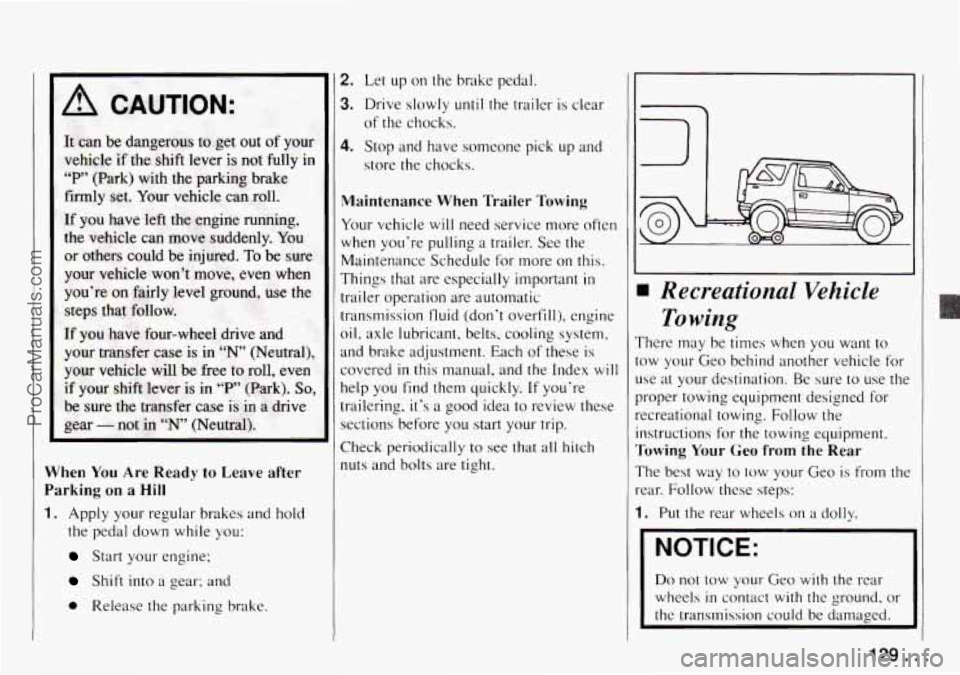
Recreational Vehicle
To wing
There may be times when you want to
:ow your Geo behind another vehicle for
Jse at your destination. Be sure to use the
proper towing equipment designed for
-ecreational towing. Follow the Instructions for the towing equipment.
rowing Your Geo from the Rear
rhe best way to tow your Geo is from the
-ear. Follow these steps:
1. Put the rear wheels on a dolly.
I NOTICE:
I
Do not tow your Geo with the rear
wheels
in contact with the ground. or
the transmission could be damaged. 1
.. 129. ProCarManuals.com
Page 131 of 258

Your Driving and the Road
2. Set the parking brake.
3. If your Geo is a four-wheel-drive
vehicle, set your manual freewheeling
hubs
to ”FREE” or unlock your
automatic I‘reewheeling hubs. See “Four-wheel Drive”
in the Index.
4. Turn the ignilion key to ”ACC’‘ to
unlock the steering wheel.
5. Clamp the steering wheel in a
straight-ahead position, with a
clamping device designed for towing.
6. Release the parking brake.
I NOTICE:
I
Make sure that the towing speed does
not exceed
55 mph (90 km/h), or
your Geo could be badly damaged.
~~
Towing Your Geo from the Front
NOTICE:
If your vehicle has automatic free-
wheeling hubs
or two-wheel drive,
do not tow
it on all four wheels. If
you do, your transmission could be
damaged.
If you have a four-wheel-drive vehicle
with manual freewheeling hubs, it can be
towed from the front with
all four wheels
on the ground. Follow these steps:
1. Set the parking brake.
2. Turn the ignition key to “ACC” to
unlock the steering wheel.
3. Shift your automatic transmission into
“P” (Park), or your manual
transmission into “2” (Second).
4. Shift the transfer case to “N”
(Neutral).
“Four-wheel Drive”
in the Index.
5. Set the hubs to “FREE.” See
6. Reledse the parking brake,
Stop towing every 200 miles
(300 km)
and start the engine. Leave the transfer
case shift lever
in ”N” (Neutral). Shift
your automatic transmission
to “D”
(Drive); leave a manual transmission
in
“2” (Second) and release the clutch. Run
the engine
at medium speed for one
minute to circulate the oil in the transfer
case. Turn the ignition key to
“ACC.”
Now, you can continue towing your Geo.
I
NOTICE:
I
Make sure the towing speed does not
exceed
SO mph (80 km/h), or your
Geo could be badly damaged.
I
. . .130
ProCarManuals.com
Page 138 of 258

G
A CAUTION:
To help avoid injury to you or others:
0
i.
0
0
0
0
Never let passengers ride in a
vehicle that
is being towed.
Never
tow faster than safe or
Never tow with damaged parts
not fully secured.
Never get under
your vehicle
after
it has been lifted by the tow
truck.
Always use seperate safety
chains
on each side when towing
a vehicle.
Never use
T-hooks. Use “J”
hooks instead.
posted speeds.
When your vehicle is being towed, have
the ignition key
off. The steering wheel
should
be clamped in a straight-ahead
position, with a clamping device designed
for towing service.
Do not use the
vehicle’s steering column
lock for this.
The transmi.ssion and transfer case,
if you
have one, should be in “Neutral” and the
parking brake released.
Don’t have
your vehicle towed with the
rear wheels
in contact with the ground. If
a vehicle must be towed from the front
with sling-type or wheel lift equipment,
the rear wheels
must be supported on a
If your vehicle has four-wheel drive,
don’t have
it towed on the front wheels
unless
you must. If a vehicle with
four-wheel drive
must be towed on the
front wheels,
set your tnanual,
freewheeling hubs
to “FREE” or unlock
your automatic freewheeling hubs, and set
your transfer case to two-wheel drive. If
your vehicle must be towed on the front
wheels, don‘t
go more than 55 rnph (90
km/h).
dolly.
131 . . . ProCarManuals.com
Page 140 of 258
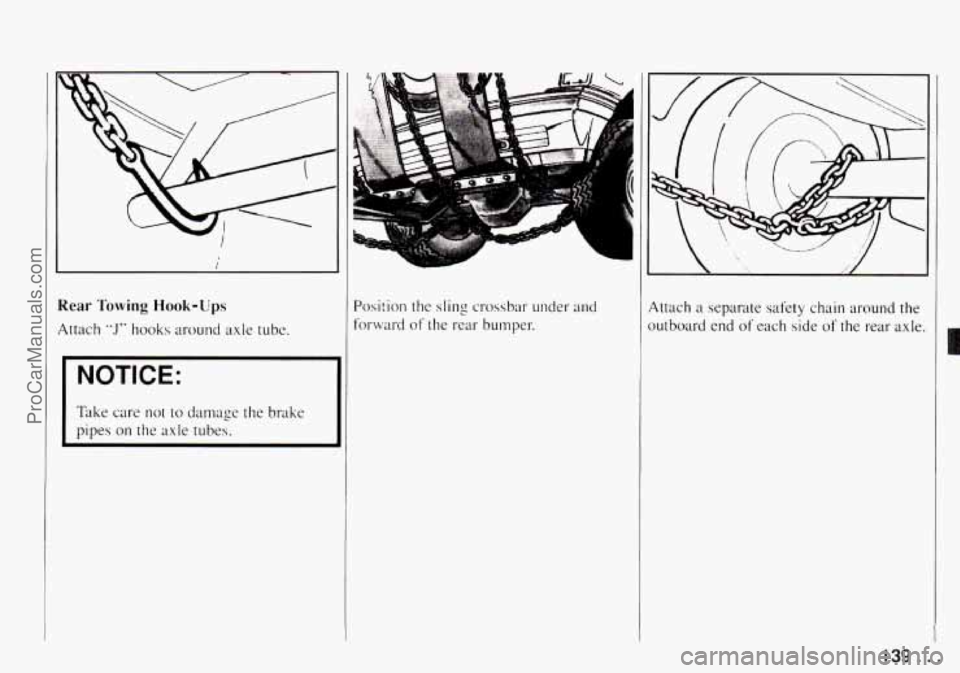
Rear Towing Hook-Ups
Attach “J” hooks around axle tube.
I
NOTICE:
I
Take care not to darnage the brake
pipes on the axle tubes.
Position the sling crossbar under and
forward of the rear bumper. Attach
a separate safety chain around the
outboard end of each side of the rear axle.
139 ... ProCarManuals.com
Page 147 of 258
Problems on the Road
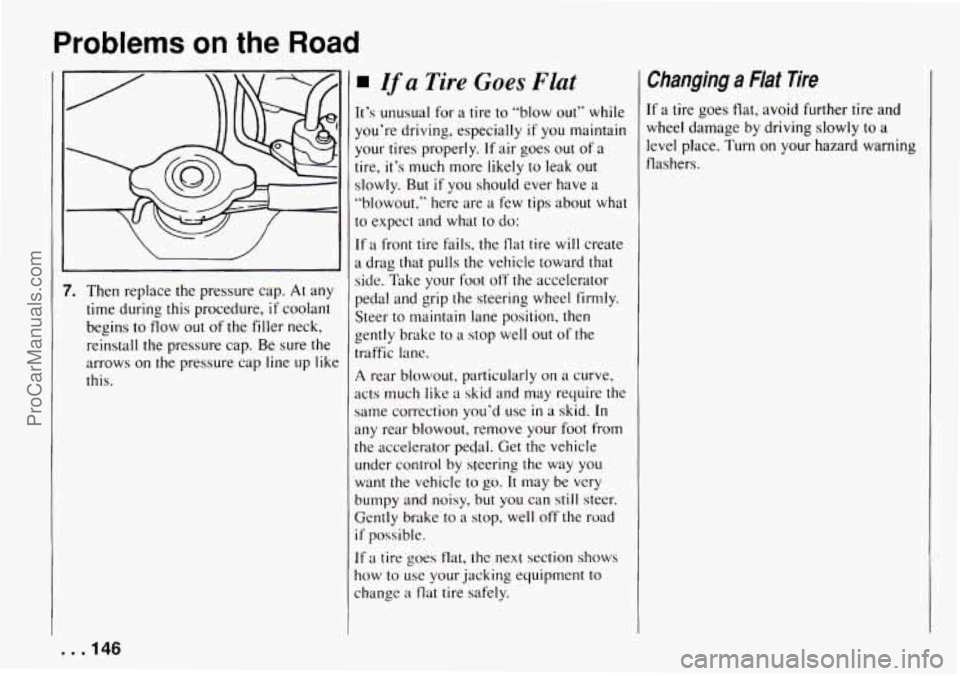
7, Then replace the pressure cap. At any
time during this procedure,
if coolant
begins
to flow out of the filler neck,
reinstall
the pressure cap. Be sure the
arrows on
the pressure cap line up like
this.
. .I46
If a Tire Goes Flat
It’s unusual for a tire to “blow out” while
you’re driving, especially
if you maintain
your tires properly.
If air goes out of a
tire, it’s much more likely to leak out
slowly.
But if you should ever have a
“blowout.” here are a few tips about what
to expect and what to do:
If a front tire Fails, the flat tire will create
a drag that pulls the vehicle toward that
side. Tdke your foot off
the accelerator
pedal and grip the steering wheel firmly.
Steer
to maintain lane position, then
gently brake to a stop well out
of the
traffic lane.
A rear blowout, particularly on a curve,
acts much like
a skid and may require the
same correction you’d use
in a skid. In
any rear blowout, remove your foot from
the accelerator pedal. Get the vehicle under control by steering
the way you
want the vehicle to go. It rnay be very
bumpy and noisy, but
you can still steer.
fently brake to a stop, well off the road
if possible.
If a tire goes tlat, the next section shows
how to use your jacking equipment
to
:hange a tlat tire safely.
Changing a Flat Tire
If a tire goes tlat, avoid further tire and
wheel damage by driving slowly
to a
level place.
Turn on your hazard warning
flashers.
ProCarManuals.com
Page 148 of 258
... .v ,
A CAUTION:
Changing a tire can cause an injury. The vehicle can slip off the jack and roll
over
you or other people. You and they could be badly injured. Find a level
place to change your tire.
To help prevent the vehicle from moving:
1. Set the parking brake firmly.
2. Put an automatic transmission shift lever in T“ (Park), or shift a manual
3. If you have a four-wheel-drive vehicle, be sure the transfer case is in a drive
4. Turn off the engine.
transmission
to “ 1” (First) or “R” (Reverse).
gear
- not in “N’ (Neutral).
To be even more certain the vehicle won’t move, you can put chocks at the front
and rear
of the tire farthest away from the one being changed. That would be the
tire
on the other side of the vehicle, at the opposite end. The
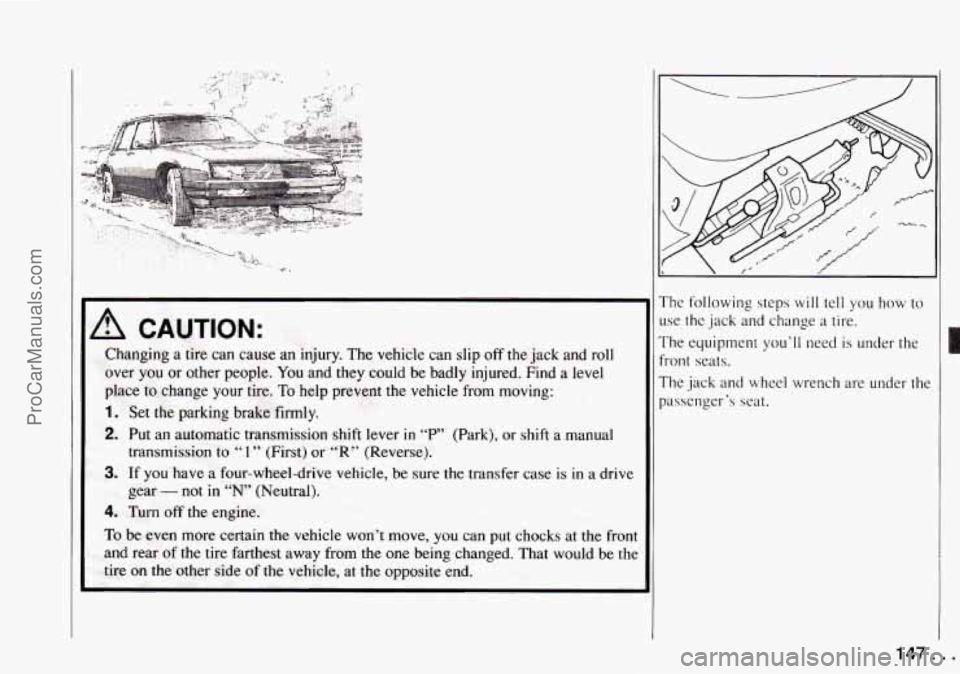
following steps
will tell you how to
.rse the jack and change
a tire.
The equipment you’ll need is under the
ront seats.
rhejack and wheel wrench
are under the
passenger’s
seat.
147 ...
ProCarManuals.com
Page 156 of 258
Here you will find information
about the care of your Geo
. This
part begins with service and fuel
information. and then it shows
how to check important fluid and
lubricant levels
. There is also
technical information about your
vehicle. and a section devoted
to its appearance care
.
Service & Appearance Care
Service ........................................................
Fuel ..........................................................
Checking Things under the Hood ...................................
HoodRelease .................................................
Engineoil ...................................................
Aircleaner ...................................................
Automatic Transmission Fluid ....................................
Manual Transmission Fluid ......................................
Clutch Adjustment .............................................
RearAxle ....................................................
Four-WheelDrive .............................................
Enginecoolant ................................................
Power Steering Fluid ...........................................
Windshield Washer Fluid ........................................
Brake Master Cylinder ..........................................
Bulb Replacement ...............................................
Loading Your Vehicle ..........................................
Tires ........................................................
Appearance Care Materials Chart ...................................
Vehicle Identification Number (VIN) ................................
Service Parts Identification Label ...................................
Add-on Electrical Equipment ......................................
Fuses and Circuit Breakers ........................................
Capacities and Specifications .......................................
Battery ......................................................
Appearancecare ................................................
ReplacementBulbs ..............................................
156
156
159
159
162
165
167
168
169 169
170 170
173
174
174
176 177
181
183
189 195 196
196
196
196
199
200
155 ...
ProCarManuals.com
Page 161 of 258
Service and Appearance Care
6% CAUTION:
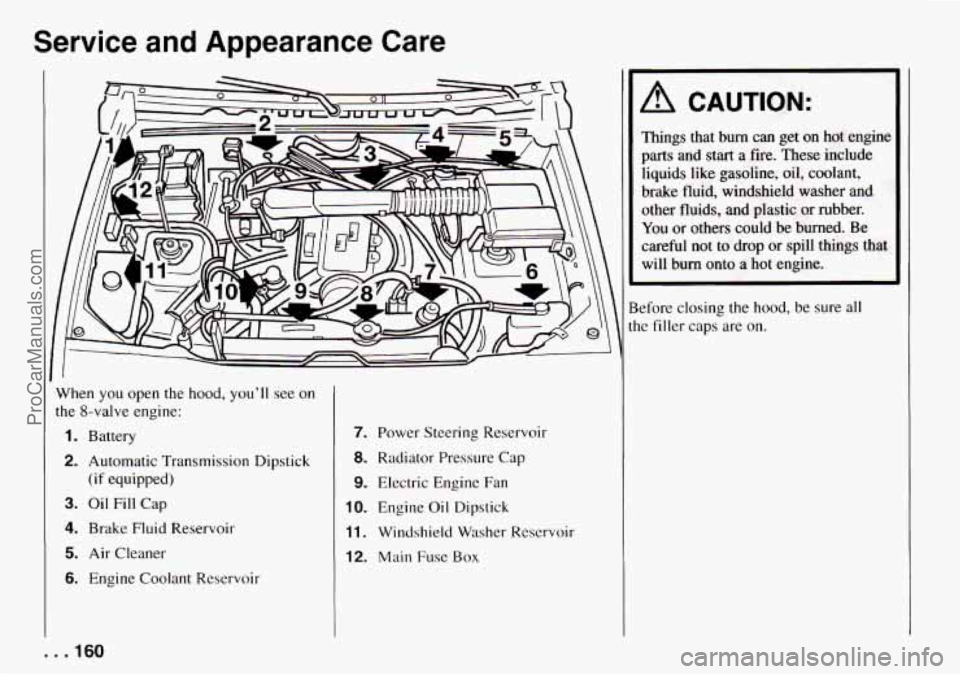
When you open the hood, you’ll see on
the 8-valve engine:
1. Battery
2. Automatic Transmission Dipstick
3. Oil Fill Cap
4. Brake Fluid Reservoir
5. Air Cleaner
6. Engine Coolant Reservoir
(if equipped)
7. Power Steering Reservoir
8. Radiator Pressure Cap
9. Electric Engine Fan
IO. Engine Oi I Dipstick
11. Windshield Washer Rescrvoir
12. Main Fuse Box
Things that burn can get on hot engine
parts and start a fire. These include
liquids like gasoline, oil, coolant,
brake fluid, windshield washer and
other fluids, and pXastic OT rubber.
You or others could be burned. Be
careful not to drop or spill things that
will burn onto a hot engine.
Before closing the hood, be sure all
the filler caps are on.
. . .160
ProCarManuals.com