ignition CHRYSLER CONCORDE 2004 2.G Workshop Manual
[x] Cancel search | Manufacturer: CHRYSLER, Model Year: 2004, Model line: CONCORDE, Model: CHRYSLER CONCORDE 2004 2.GPages: 273, PDF Size: 6 MB
Page 184 of 273
Check the Battery Test Indicator. If a light or bright
colored dot is visible in the indicator, DO NOT jump-start
the battery.
If the indicator is dark or shows a green dot, proceed as
follows:
1. Wear eye protection and remove any metal jewelry
such as watch bands or bracelets that might make an
inadvertent electrical contact.
2. When boost is provided by a battery in another
vehicle, park that vehicle within booster cable reach but
without letting the vehicles touch. Set parking brake,
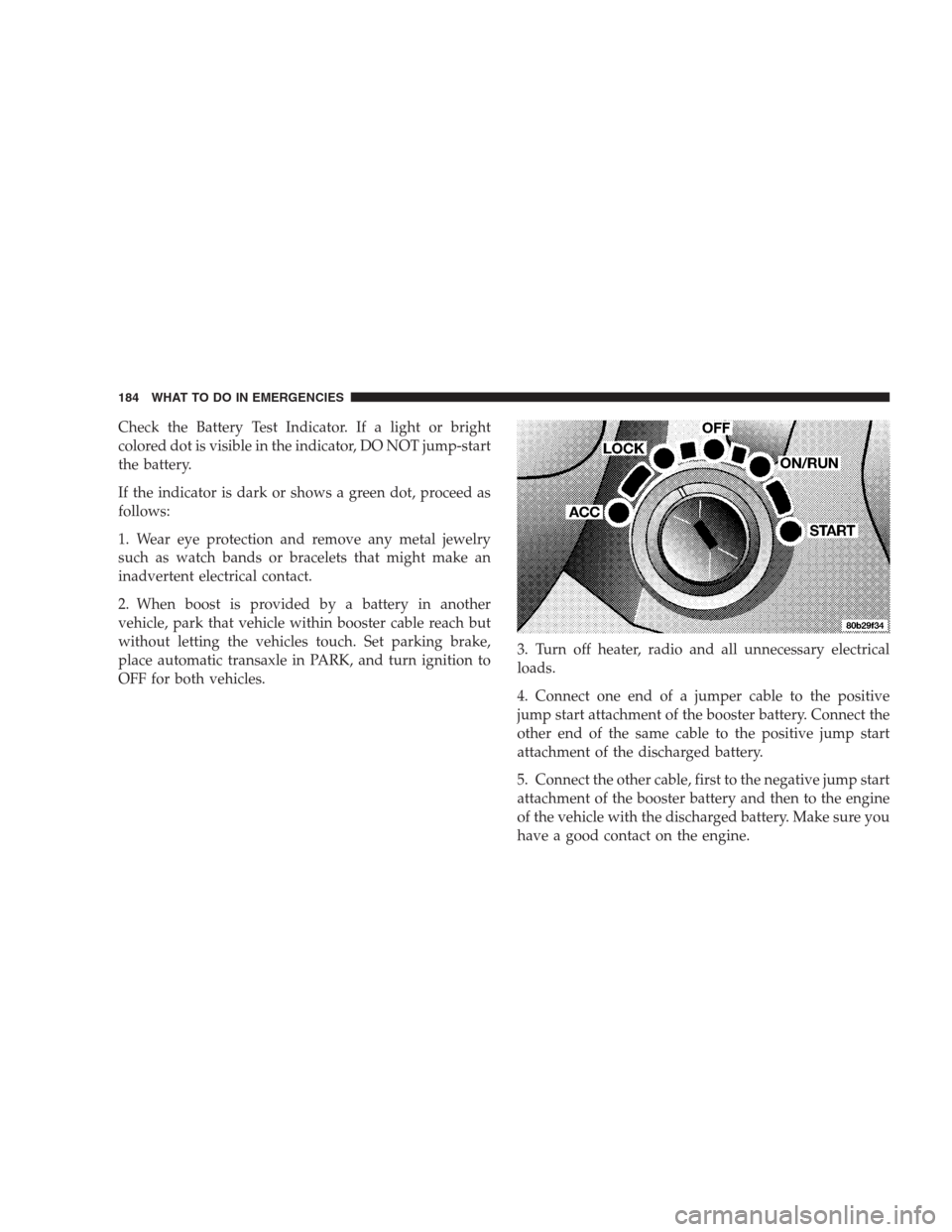
place automatic transaxle in PARK, and turn ignition to
OFF for both vehicles.3. Turn off heater, radio and all unnecessary electrical
loads.
4. Connect one end of a jumper cable to the positive
jump start attachment of the booster battery. Connect the
other end of the same cable to the positive jump start
attachment of the discharged battery.
5. Connect the other cable, first to the negative jump start
attachment of the booster battery and then to the engine
of the vehicle with the discharged battery. Make sure you
have a good contact on the engine.
184 WHAT TO DO IN EMERGENCIES
Page 192 of 273
EMISSIONS INSPECTION AND MAINTENANCE
PROGRAMS
In some localities, it may be a legal requirement to pass
an inspection of your vehicle’s emissions control system.
Failure to pass could prevent vehicle registration.
For states which have an I/M (Inspection and
Maintenance) requirement, this check verifies the
following: the MIL (Malfunction Indicator Lamp)
is functioning and is not on when the engine is running,
and that the OBD (On Board Diagnostic) system is ready
for testing.
Normally, the OBD system will be ready. The OBD
system maynotbe ready if your vehicle was recently
serviced, if you recently had a dead battery, or a battery
replacement. If the OBD system should be determined
not ready for the I/M test, your vehicle may fail the test.
Your vehicle has a simple ignition key actuated test
which you can use prior to going to the test station. To
check if your vehicle’s OBD system is ready, you must do
the following:
1. Insert your ignition key into the ignition switch.2. Turn the ignition to the ON position, but do not crank
or start the engine.
3. If you crank or start the engine, you will have to start
this test over.
4. As soon as you turn your key to the ON position, you
will see your MIL symbol come on as part of a normal
bulb check.
5. Approximately 15 seconds later, one of two things will
happen:
a. The MIL will flash for about 10 seconds and then
return to being fully illuminated until you turn off
the ignition key or start the engine. This means that
your vehicle’s OBD system isnot readyand you
shouldnotproceed to the I/M station.
b. The MIL will not flash at all and will remain fully
illuminated until you turn off the ignition key or
start the engine. This means that your vehicle’s OBD
system isreadyand you can proceed to the I/M
station.
192 MAINTAINING YOUR VEHICLE
Page 201 of 273

Under normal operating conditions, the catalytic con-
verter will not require maintenance. However, it is im-
portant to seek service to assure proper catalyst operation
and prevent possible catalyst damage. If the Malfunction
Indicator light is flashing, immediate service is required.
CAUTION!
Damage to the catalytic converter can result if your
vehicle is not kept in proper operating condition. In
the event of engine malfunction, particularly involv-
ing engine misfire or other apparent loss of perfor-
mance, have your vehicle serviced promptly. Contin-
ued operation of your vehicle with a severe
malfunction could cause the converter to overheat,
resulting in possible damage to the converter and the
vehicle.
WARNING!
A hot exhaust system can start a fire if you park over
materials that can burn. Such materials might be
grass or leaves coming into contact with your ex-
haust system. Do not park or operate your vehicle in
areas where your exhaust system can contact any-
thing that can burn.
In unusual situations involving grossly malfunctioning
engine operation, a scorching odor may suggest severe
and abnormal catalyst overheating. If this occurs, stop
the vehicle, turn off the engine and allow it to cool.
Service, including a tune up to manufacturer’s specifica-
tions, should be obtained immediately.
To minimize the possibility of catalyst damage:
•Do not shut off the engine or interrupt the ignition
when the transaxle is in gear and the vehicle is in
motion.
•Do not try to start the engine by pushing or towing the
vehicle.
MAINTAINING YOUR VEHICLE 201
7
Page 210 of 273
Exhaust System
The best protection against carbon monoxide entry into
the vehicle body is a properly maintained engine exhaust
system.
If you notice a change in the sound of the exhaust system;
or if exhaust fumes can be detected inside the vehicle; or
when the underside or rear of the vehicle is damaged;
have a competent mechanic inspect the complete exhaust
system and adjacent body areas for broken, damaged,
deteriorated, or mispositioned parts. Open seams or
loose connections could permit exhaust fumes to seep
into the passenger compartment. In addition, inspect the
exhaust system each time the vehicle is raised for lubri-
cation or oil change. Replace as required.
WARNING!
Exhaust gases can injure or kill. They contain carbon
monoxide which is colorless and odorless. Breathing
it can make you unconscious and can eventually
poison you. Follow the above precautions to keep
your exhaust system as safe as possible.
Cooling System
WARNING!
•When working near the radiator cooling fan, dis-
connect the fan motor lead or turn the ignition key
to the OFF position. The fan is temperature con-
trolled and can start at any time the ignition key is
in the ON position.
•You or others can be badly burned by hot coolant
or steam from your radiator. If you see or hear
steam coming from under the hood, don’t open
the hood until the radiator has had time to cool.
Never try to open a cooling system pressure cap
when the radiator is hot.
Coolant Checks
Check coolant protection every 12 months (before the
onset of freezing weather, where applicable). If coolant is
dirty or rusty in appearance, the system should be
drained, flushed and refilled with fresh coolant.
210 MAINTAINING YOUR VEHICLE
Page 267 of 273
Homelink Transmitter..................76,81
Hood Release.......................... 64
Hook, Coat............................ 55
Hoses............................214,217
Ignition
Key ................................ 12
Lock............................... 13
Illuminated Entry....................... 14
Infant Restraint......................... 42
Instrument Cluster................107,108,109
Instrument Panel and Controls..........105,106
Instrument Panel Cover.................. 223
Instrument Panel Lens Cleaning............ 223
Interior Fuses.......................... 225
Interior Lights.......................65,226
Intermittent Wipers...................... 70
Introduction............................ 4
Jack Operation......................... 178
Jump Starting......................... 182
Key, Sentry............................. 9Key-In Reminder........................ 12
Keyless Entry System..................... 18
Keys.................................. 9
Knee Bolster........................... 33
Lap/Shoulder Belts...................... 28
LATCH
(Lower Anchors and Tether for CHildren)..... 45
Leaks, Fluid............................ 50
Light Bulbs........................226,227
Lights
Airbag.........................37,49,111
Anti-Lock........................... 112
Automatic Off......................65,66
Back-Up............................ 231
Battery Saver.......................65,66
Brake Warning.................... 112,156
Center Mounted Stop.................. 231
Check Engine........................ 111
Courtesy/Reading..................... 66
Cruise...........................73,110
Daytime Running...................... 68
Dimmer Switch, Headlight............... 69
INDEX 267
10