shaft CHRYSLER VOYAGER 1996 Service Manual
[x] Cancel search | Manufacturer: CHRYSLER, Model Year: 1996, Model line: VOYAGER, Model: CHRYSLER VOYAGER 1996Pages: 1938, PDF Size: 55.84 MB
Page 1113 of 1938
FITTING CONNECTING ROD BEARINGS
CONNECTING ROD CLEARANCE
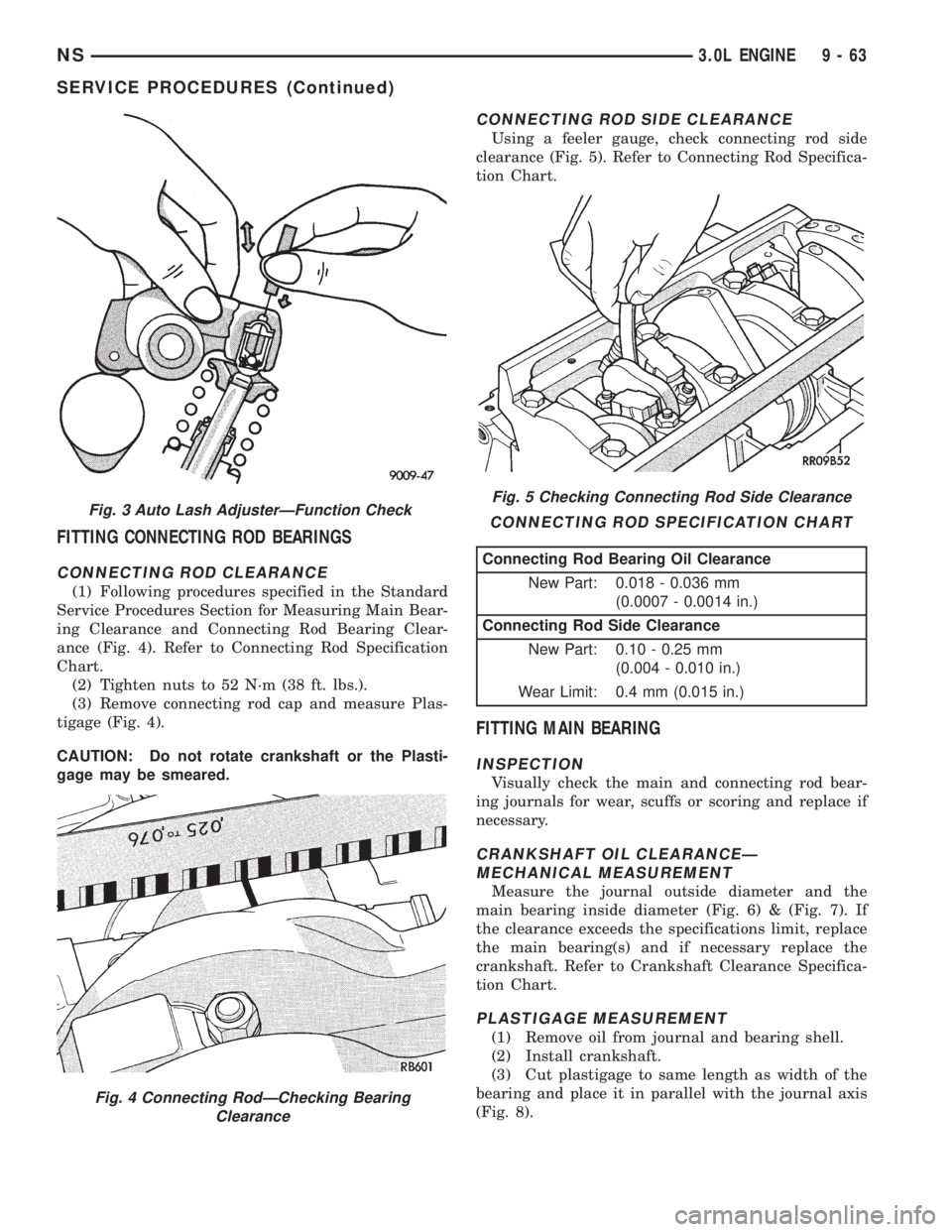
(1) Following procedures specified in the Standard
Service Procedures Section for Measuring Main Bear-
ing Clearance and Connecting Rod Bearing Clear-
ance (Fig. 4). Refer to Connecting Rod Specification
Chart.
(2) Tighten nuts to 52 N´m (38 ft. lbs.).
(3) Remove connecting rod cap and measure Plas-
tigage (Fig. 4).
CAUTION: Do not rotate crankshaft or the Plasti-
gage may be smeared.
CONNECTING ROD SIDE CLEARANCE
Using a feeler gauge, check connecting rod side
clearance (Fig. 5). Refer to Connecting Rod Specifica-
tion Chart.
FITTING MAIN BEARING
INSPECTION
Visually check the main and connecting rod bear-
ing journals for wear, scuffs or scoring and replace if
necessary.
CRANKSHAFT OIL CLEARANCEÐ
MECHANICAL MEASUREMENT
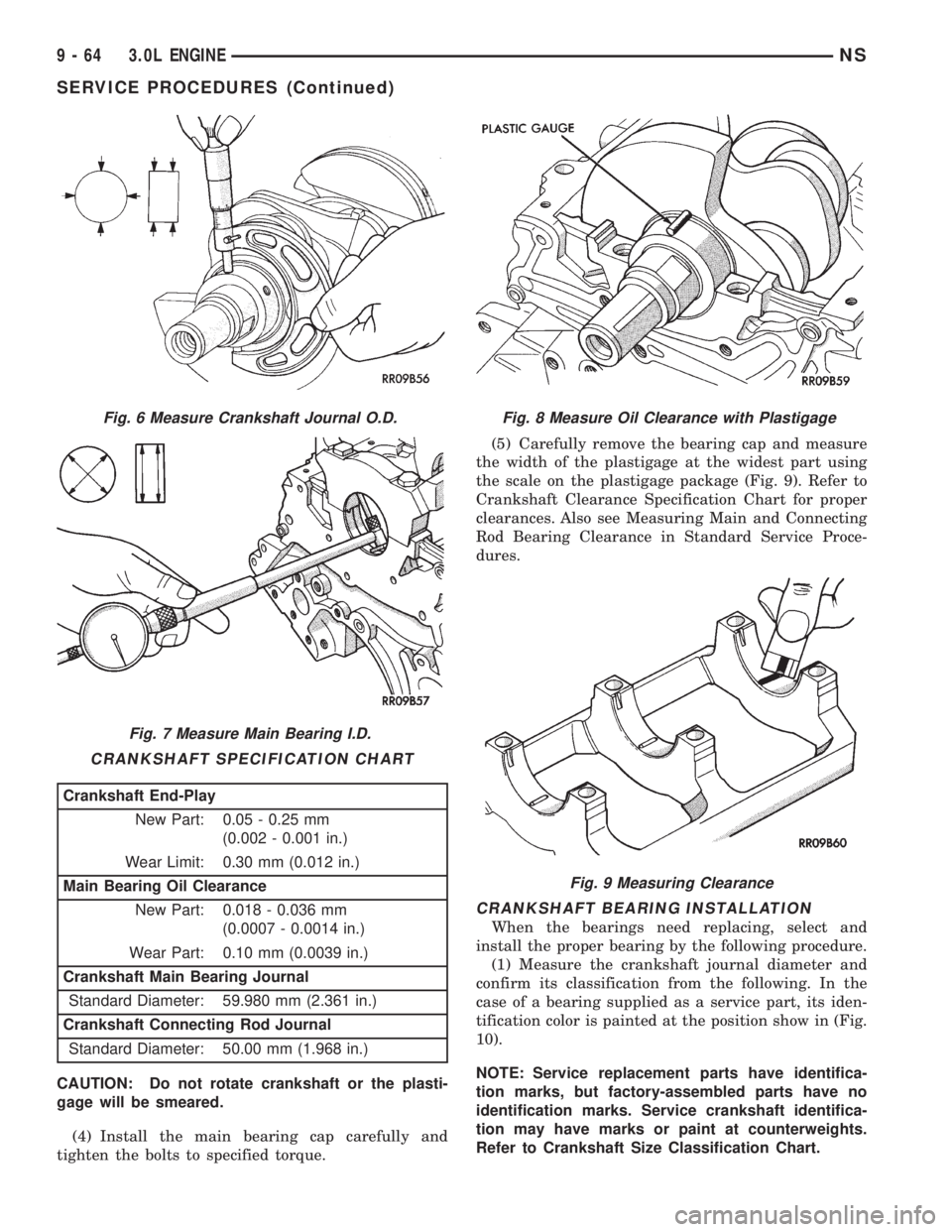
Measure the journal outside diameter and the
main bearing inside diameter (Fig. 6) & (Fig. 7). If
the clearance exceeds the specifications limit, replace
the main bearing(s) and if necessary replace the
crankshaft. Refer to Crankshaft Clearance Specifica-
tion Chart.
PLASTIGAGE MEASUREMENT
(1) Remove oil from journal and bearing shell.
(2) Install crankshaft.
(3) Cut plastigage to same length as width of the
bearing and place it in parallel with the journal axis
(Fig. 8).
Fig. 3 Auto Lash AdjusterÐFunction Check
Fig. 4 Connecting RodÐChecking Bearing
Clearance
Fig. 5 Checking Connecting Rod Side Clearance
CONNECTING ROD SPECIFICATION CHART
Connecting Rod Bearing Oil Clearance
New Part: 0.018 - 0.036 mm
(0.0007 - 0.0014 in.)
Connecting Rod Side Clearance
New Part: 0.10 - 0.25 mm
(0.004 - 0.010 in.)
Wear Limit: 0.4 mm (0.015 in.)
NS3.0L ENGINE 9 - 63
SERVICE PROCEDURES (Continued)
Page 1114 of 1938
CAUTION: Do not rotate crankshaft or the plasti-
gage will be smeared.
(4) Install the main bearing cap carefully and
tighten the bolts to specified torque.(5) Carefully remove the bearing cap and measure
the width of the plastigage at the widest part using
the scale on the plastigage package (Fig. 9). Refer to
Crankshaft Clearance Specification Chart for proper
clearances. Also see Measuring Main and Connecting
Rod Bearing Clearance in Standard Service Proce-
dures.
CRANKSHAFT BEARING INSTALLATION
When the bearings need replacing, select and
install the proper bearing by the following procedure.
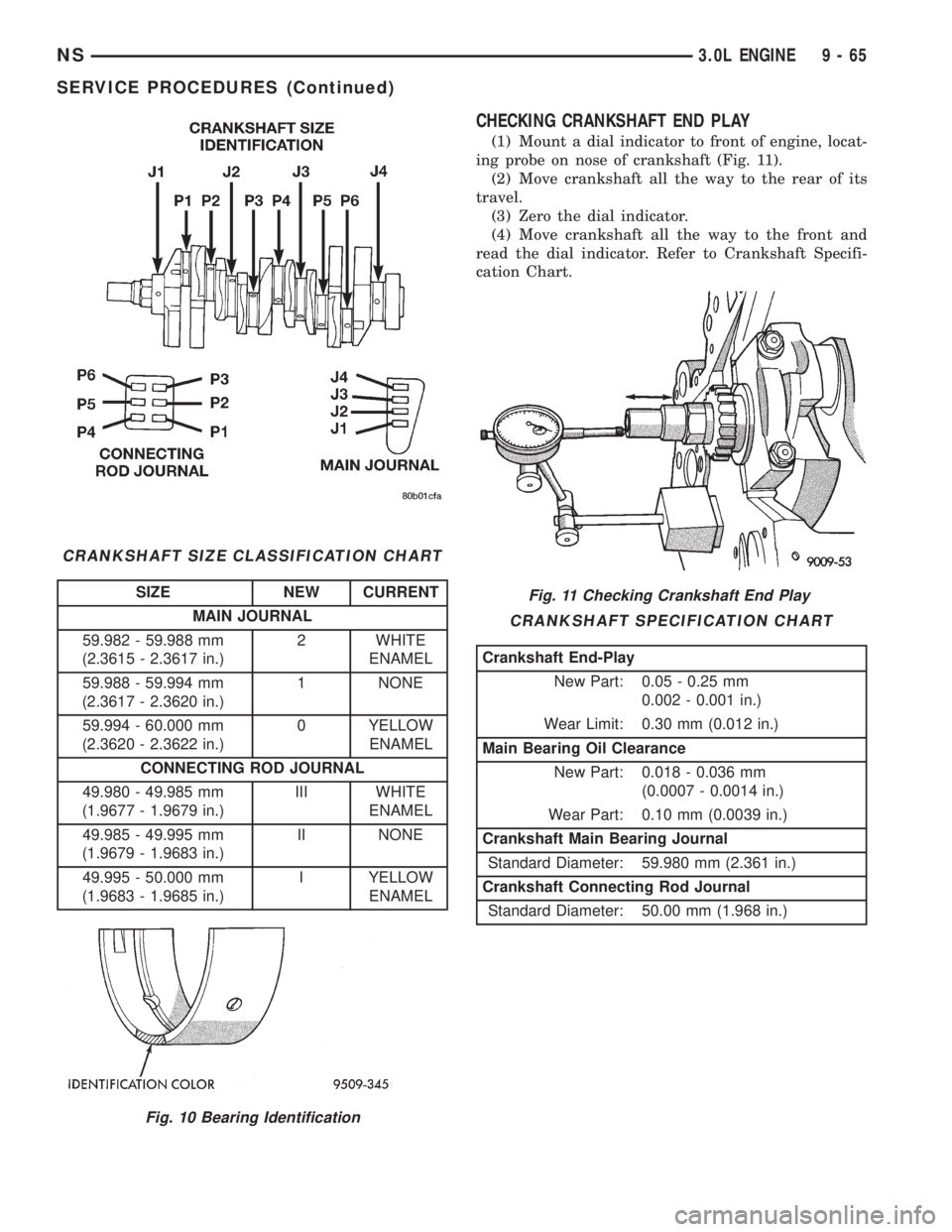
(1) Measure the crankshaft journal diameter and
confirm its classification from the following. In the
case of a bearing supplied as a service part, its iden-
tification color is painted at the position show in (Fig.
10).
NOTE: Service replacement parts have identifica-
tion marks, but factory-assembled parts have no
identification marks. Service crankshaft identifica-
tion may have marks or paint at counterweights.
Refer to Crankshaft Size Classification Chart.
Fig. 6 Measure Crankshaft Journal O.D.
Fig. 7 Measure Main Bearing I.D.
CRANKSHAFT SPECIFICATION CHART
Crankshaft End-Play
New Part: 0.05 - 0.25 mm
(0.002 - 0.001 in.)
Wear Limit: 0.30 mm (0.012 in.)
Main Bearing Oil Clearance
New Part: 0.018 - 0.036 mm
(0.0007 - 0.0014 in.)
Wear Part: 0.10 mm (0.0039 in.)
Crankshaft Main Bearing Journal
Standard Diameter: 59.980 mm (2.361 in.)
Crankshaft Connecting Rod Journal
Standard Diameter: 50.00 mm (1.968 in.)
Fig. 8 Measure Oil Clearance with Plastigage
Fig. 9 Measuring Clearance
9 - 64 3.0L ENGINENS
SERVICE PROCEDURES (Continued)
Page 1115 of 1938
CHECKING CRANKSHAFT END PLAY
(1) Mount a dial indicator to front of engine, locat-
ing probe on nose of crankshaft (Fig. 11).
(2) Move crankshaft all the way to the rear of its
travel.
(3) Zero the dial indicator.
(4) Move crankshaft all the way to the front and
read the dial indicator. Refer to Crankshaft Specifi-
cation Chart.
CRANKSHAFT SIZE CLASSIFICATION CHART
SIZE NEW CURRENT
MAIN JOURNAL
59.982 - 59.988 mm
(2.3615 - 2.3617 in.)2 WHITE
ENAMEL
59.988 - 59.994 mm
(2.3617 - 2.3620 in.)1 NONE
59.994 - 60.000 mm
(2.3620 - 2.3622 in.)0 YELLOW
ENAMEL
CONNECTING ROD JOURNAL
49.980 - 49.985 mm
(1.9677 - 1.9679 in.)III WHITE
ENAMEL
49.985 - 49.995 mm
(1.9679 - 1.9683 in.)II NONE
49.995 - 50.000 mm
(1.9683 - 1.9685 in.)I YELLOW
ENAMEL
Fig. 10 Bearing Identification
Fig. 11 Checking Crankshaft End Play
CRANKSHAFT SPECIFICATION CHART
Crankshaft End-Play
New Part: 0.05 - 0.25 mm
0.002 - 0.001 in.)
Wear Limit: 0.30 mm (0.012 in.)
Main Bearing Oil Clearance
New Part: 0.018 - 0.036 mm
(0.0007 - 0.0014 in.)
Wear Part: 0.10 mm (0.0039 in.)
Crankshaft Main Bearing Journal
Standard Diameter: 59.980 mm (2.361 in.)
Crankshaft Connecting Rod Journal
Standard Diameter: 50.00 mm (1.968 in.)
NS3.0L ENGINE 9 - 65
SERVICE PROCEDURES (Continued)
Page 1119 of 1938
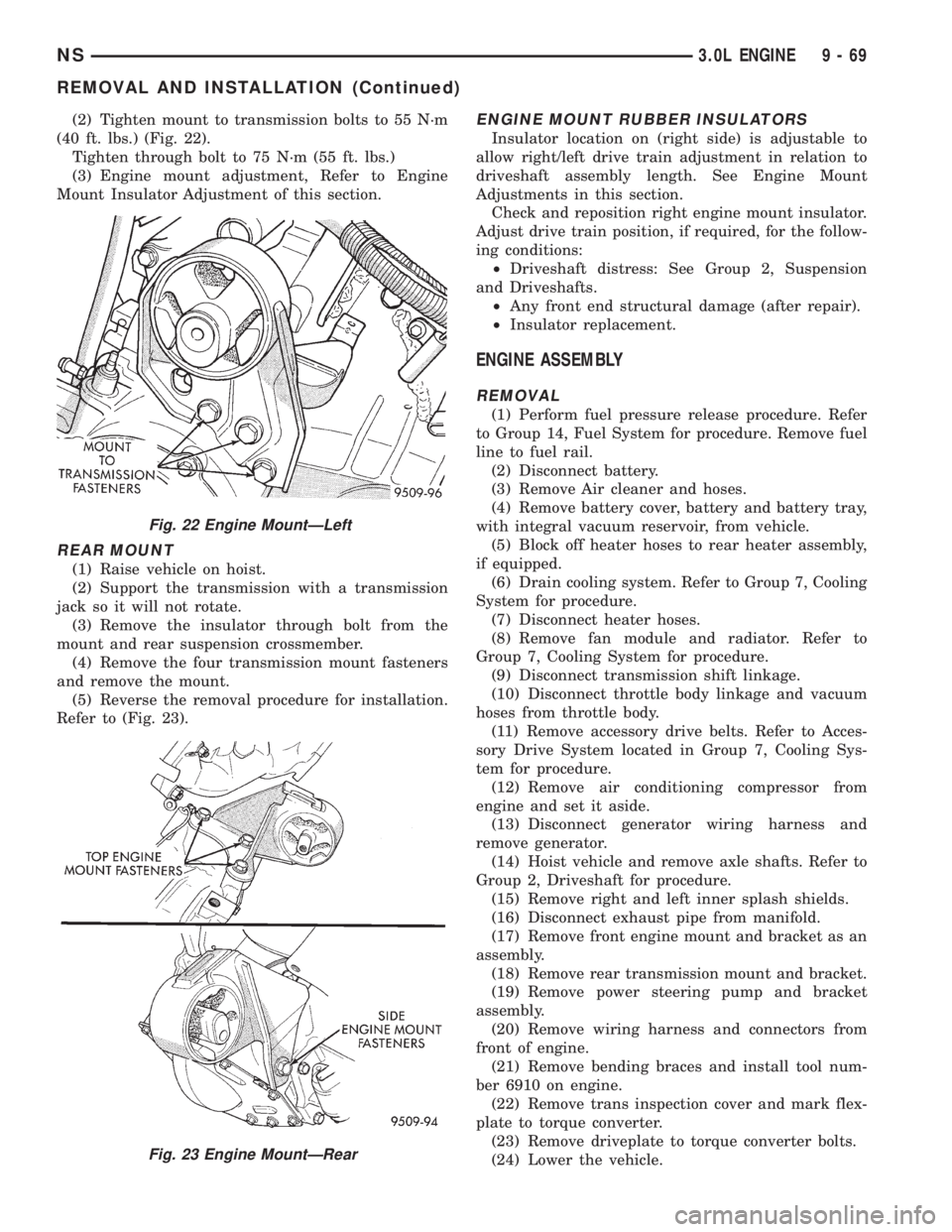
(2) Tighten mount to transmission bolts to 55 N´m
(40 ft. lbs.) (Fig. 22).
Tighten through bolt to 75 N´m (55 ft. lbs.)
(3) Engine mount adjustment, Refer to Engine
Mount Insulator Adjustment of this section.
REAR MOUNT
(1) Raise vehicle on hoist.
(2) Support the transmission with a transmission
jack so it will not rotate.
(3) Remove the insulator through bolt from the
mount and rear suspension crossmember.
(4) Remove the four transmission mount fasteners
and remove the mount.
(5) Reverse the removal procedure for installation.
Refer to (Fig. 23).
ENGINE MOUNT RUBBER INSULATORS
Insulator location on (right side) is adjustable to
allow right/left drive train adjustment in relation to
driveshaft assembly length. See Engine Mount
Adjustments in this section.
Check and reposition right engine mount insulator.
Adjust drive train position, if required, for the follow-
ing conditions:
²Driveshaft distress: See Group 2, Suspension
and Driveshafts.
²Any front end structural damage (after repair).
²Insulator replacement.
ENGINE ASSEMBLY
REMOVAL
(1) Perform fuel pressure release procedure. Refer
to Group 14, Fuel System for procedure. Remove fuel
line to fuel rail.
(2) Disconnect battery.
(3) Remove Air cleaner and hoses.
(4) Remove battery cover, battery and battery tray,
with integral vacuum reservoir, from vehicle.
(5) Block off heater hoses to rear heater assembly,
if equipped.
(6) Drain cooling system. Refer to Group 7, Cooling
System for procedure.
(7) Disconnect heater hoses.
(8) Remove fan module and radiator. Refer to
Group 7, Cooling System for procedure.
(9) Disconnect transmission shift linkage.
(10) Disconnect throttle body linkage and vacuum
hoses from throttle body.
(11) Remove accessory drive belts. Refer to Acces-
sory Drive System located in Group 7, Cooling Sys-
tem for procedure.
(12) Remove air conditioning compressor from
engine and set it aside.
(13) Disconnect generator wiring harness and
remove generator.
(14) Hoist vehicle and remove axle shafts. Refer to
Group 2, Driveshaft for procedure.
(15) Remove right and left inner splash shields.
(16) Disconnect exhaust pipe from manifold.
(17) Remove front engine mount and bracket as an
assembly.
(18) Remove rear transmission mount and bracket.
(19) Remove power steering pump and bracket
assembly.
(20) Remove wiring harness and connectors from
front of engine.
(21) Remove bending braces and install tool num-
ber 6910 on engine.
(22) Remove trans inspection cover and mark flex-
plate to torque converter.
(23) Remove driveplate to torque converter bolts.
(24) Lower the vehicle.
Fig. 22 Engine MountÐLeft
Fig. 23 Engine MountÐRear
NS3.0L ENGINE 9 - 69
REMOVAL AND INSTALLATION (Continued)
Page 1120 of 1938
(25) Remove ground straps to body.
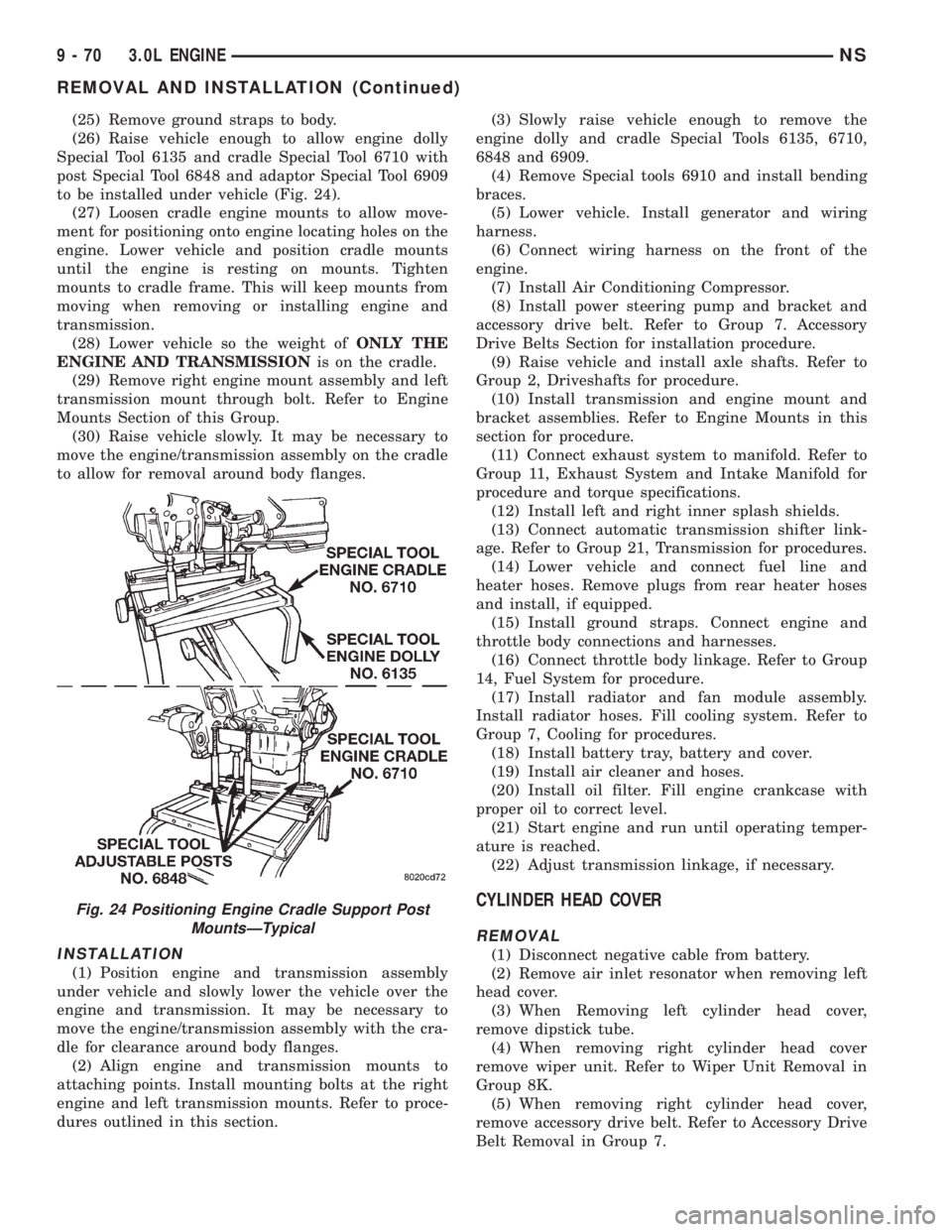
(26) Raise vehicle enough to allow engine dolly
Special Tool 6135 and cradle Special Tool 6710 with
post Special Tool 6848 and adaptor Special Tool 6909
to be installed under vehicle (Fig. 24).
(27) Loosen cradle engine mounts to allow move-
ment for positioning onto engine locating holes on the
engine. Lower vehicle and position cradle mounts
until the engine is resting on mounts. Tighten
mounts to cradle frame. This will keep mounts from
moving when removing or installing engine and
transmission.
(28) Lower vehicle so the weight ofONLY THE
ENGINE AND TRANSMISSIONis on the cradle.
(29) Remove right engine mount assembly and left
transmission mount through bolt. Refer to Engine
Mounts Section of this Group.
(30) Raise vehicle slowly. It may be necessary to
move the engine/transmission assembly on the cradle
to allow for removal around body flanges.
INSTALLATION
(1) Position engine and transmission assembly
under vehicle and slowly lower the vehicle over the
engine and transmission. It may be necessary to
move the engine/transmission assembly with the cra-
dle for clearance around body flanges.
(2) Align engine and transmission mounts to
attaching points. Install mounting bolts at the right
engine and left transmission mounts. Refer to proce-
dures outlined in this section.(3) Slowly raise vehicle enough to remove the
engine dolly and cradle Special Tools 6135, 6710,
6848 and 6909.
(4) Remove Special tools 6910 and install bending
braces.
(5) Lower vehicle. Install generator and wiring
harness.
(6) Connect wiring harness on the front of the
engine.
(7) Install Air Conditioning Compressor.
(8) Install power steering pump and bracket and
accessory drive belt. Refer to Group 7. Accessory
Drive Belts Section for installation procedure.
(9) Raise vehicle and install axle shafts. Refer to
Group 2, Driveshafts for procedure.
(10) Install transmission and engine mount and
bracket assemblies. Refer to Engine Mounts in this
section for procedure.
(11) Connect exhaust system to manifold. Refer to
Group 11, Exhaust System and Intake Manifold for
procedure and torque specifications.
(12) Install left and right inner splash shields.
(13) Connect automatic transmission shifter link-
age. Refer to Group 21, Transmission for procedures.
(14) Lower vehicle and connect fuel line and
heater hoses. Remove plugs from rear heater hoses
and install, if equipped.
(15) Install ground straps. Connect engine and
throttle body connections and harnesses.
(16) Connect throttle body linkage. Refer to Group
14, Fuel System for procedure.
(17) Install radiator and fan module assembly.
Install radiator hoses. Fill cooling system. Refer to
Group 7, Cooling for procedures.
(18) Install battery tray, battery and cover.
(19) Install air cleaner and hoses.
(20) Install oil filter. Fill engine crankcase with
proper oil to correct level.
(21) Start engine and run until operating temper-
ature is reached.
(22) Adjust transmission linkage, if necessary.
CYLINDER HEAD COVER
REMOVAL
(1) Disconnect negative cable from battery.
(2) Remove air inlet resonator when removing left
head cover.
(3) When Removing left cylinder head cover,
remove dipstick tube.
(4) When removing right cylinder head cover
remove wiper unit. Refer to Wiper Unit Removal in
Group 8K.
(5) When removing right cylinder head cover,
remove accessory drive belt. Refer to Accessory Drive
Belt Removal in Group 7.
Fig. 24 Positioning Engine Cradle Support Post
MountsÐTypical
9 - 70 3.0L ENGINENS
REMOVAL AND INSTALLATION (Continued)
Page 1121 of 1938
(6) When removing right cylinder head cover, dis-
connect generator wiring and remove generator.
(7) Relocate spark plug wires.
(8) Remove vacuum connections.
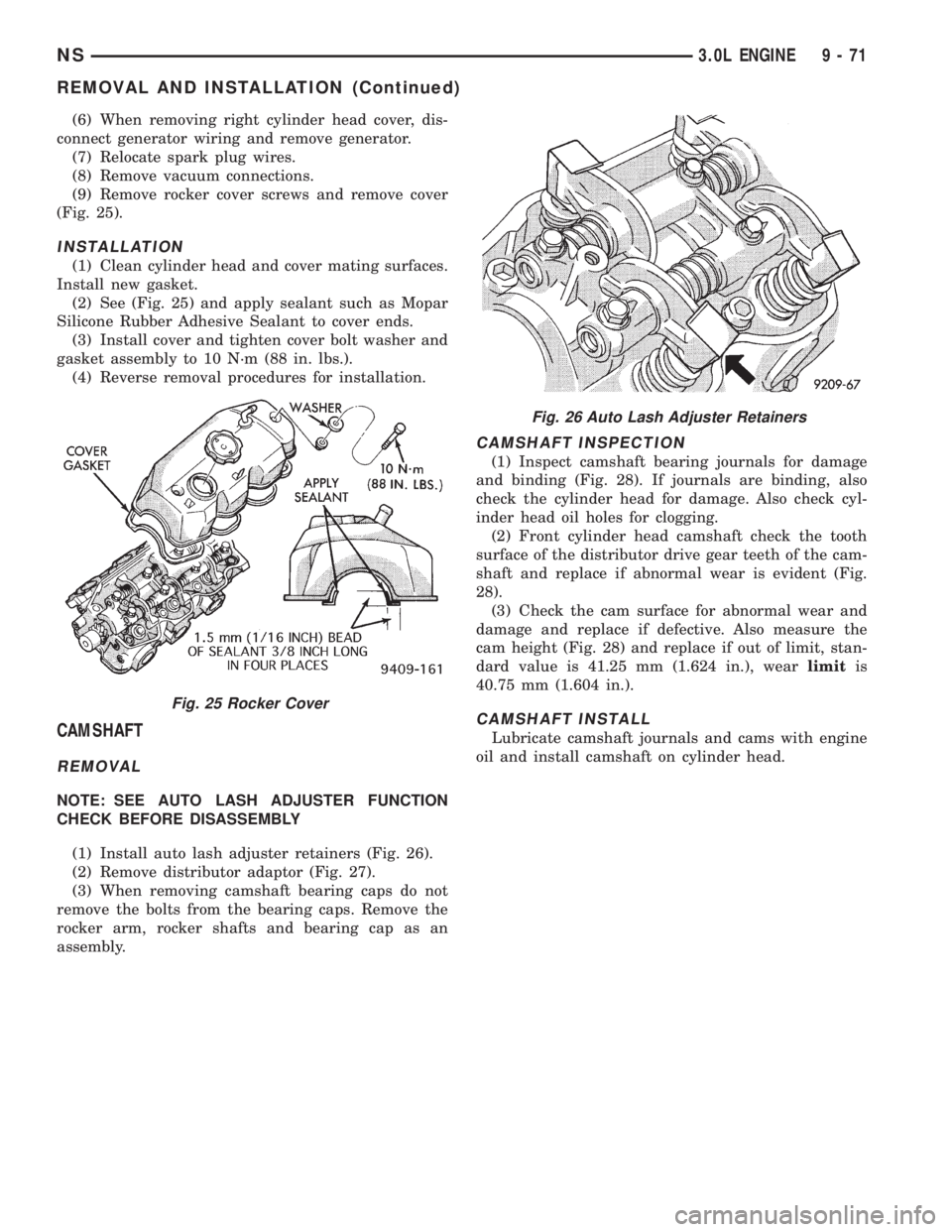
(9) Remove rocker cover screws and remove cover
(Fig. 25).
INSTALLATION
(1) Clean cylinder head and cover mating surfaces.
Install new gasket.
(2) See (Fig. 25) and apply sealant such as Mopar
Silicone Rubber Adhesive Sealant to cover ends.
(3) Install cover and tighten cover bolt washer and
gasket assembly to 10 N´m (88 in. lbs.).
(4) Reverse removal procedures for installation.
CAMSHAFT
REMOVAL
NOTE: SEE AUTO LASH ADJUSTER FUNCTION
CHECK BEFORE DISASSEMBLY
(1) Install auto lash adjuster retainers (Fig. 26).
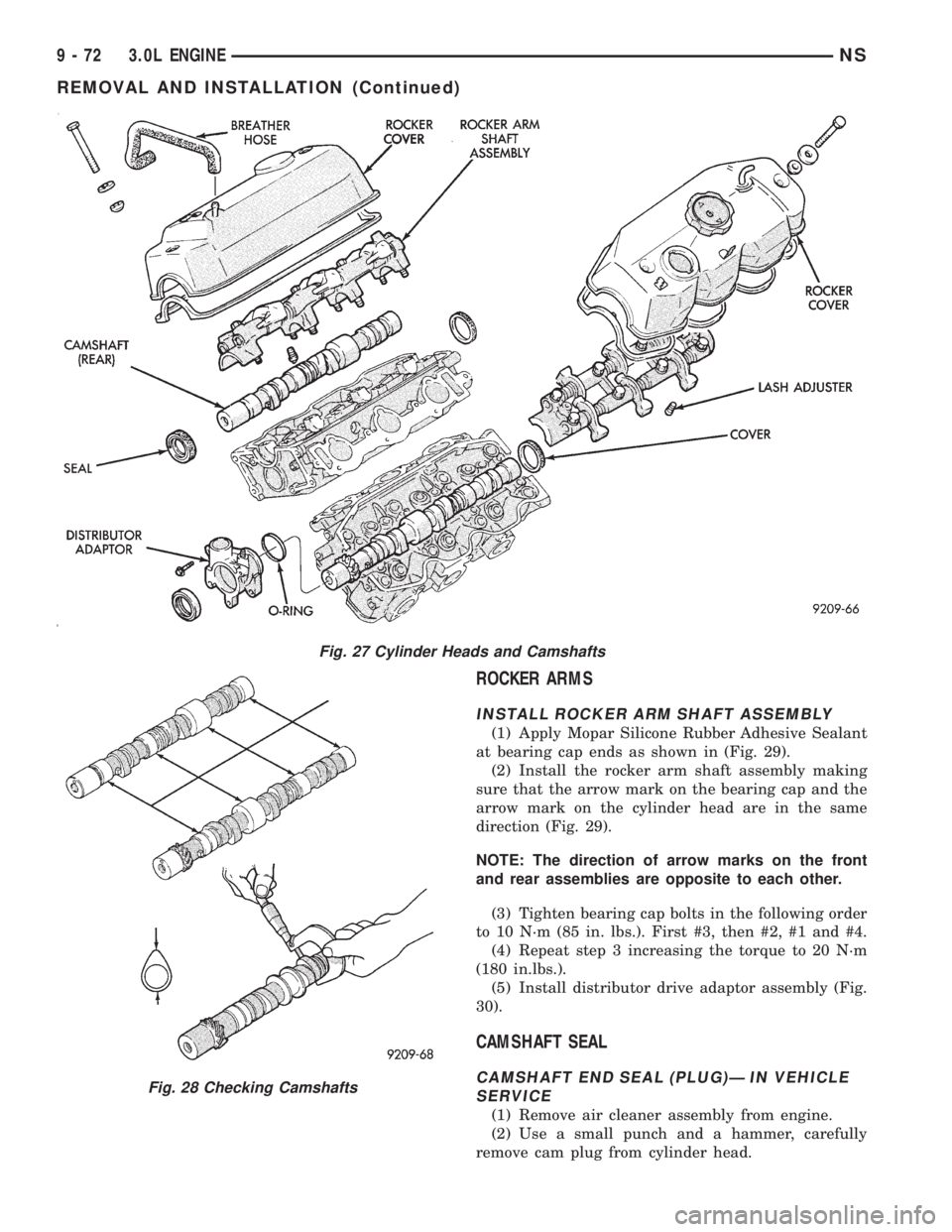
(2) Remove distributor adaptor (Fig. 27).
(3) When removing camshaft bearing caps do not
remove the bolts from the bearing caps. Remove the
rocker arm, rocker shafts and bearing cap as an
assembly.
CAMSHAFT INSPECTION
(1) Inspect camshaft bearing journals for damage
and binding (Fig. 28). If journals are binding, also
check the cylinder head for damage. Also check cyl-
inder head oil holes for clogging.
(2) Front cylinder head camshaft check the tooth
surface of the distributor drive gear teeth of the cam-
shaft and replace if abnormal wear is evident (Fig.
28).
(3) Check the cam surface for abnormal wear and
damage and replace if defective. Also measure the
cam height (Fig. 28) and replace if out of limit, stan-
dard value is 41.25 mm (1.624 in.), wearlimitis
40.75 mm (1.604 in.).
CAMSHAFT INSTALL
Lubricate camshaft journals and cams with engine
oil and install camshaft on cylinder head.
Fig. 25 Rocker Cover
Fig. 26 Auto Lash Adjuster Retainers
NS3.0L ENGINE 9 - 71
REMOVAL AND INSTALLATION (Continued)
Page 1122 of 1938
ROCKER ARMS
INSTALL ROCKER ARM SHAFT ASSEMBLY
(1) Apply Mopar Silicone Rubber Adhesive Sealant
at bearing cap ends as shown in (Fig. 29).
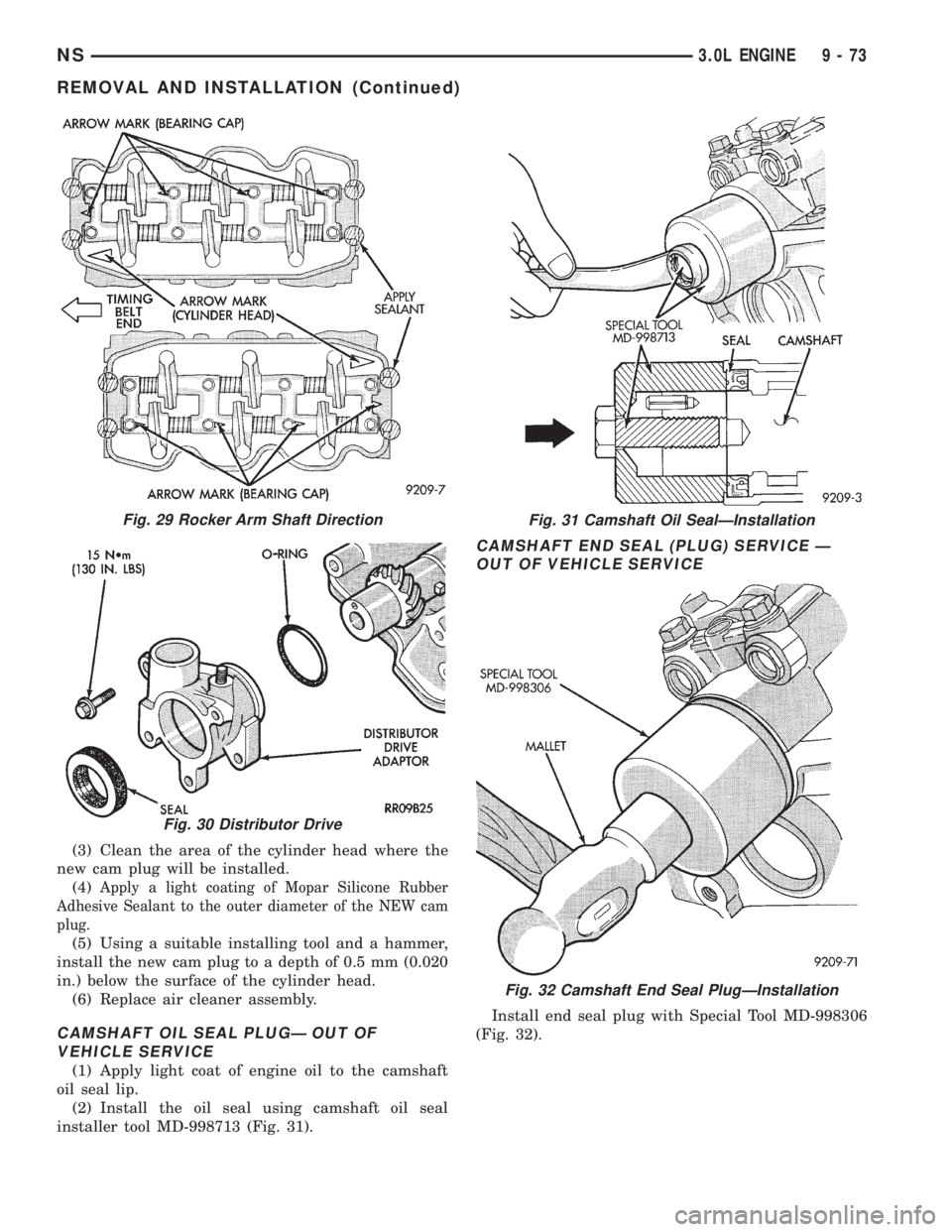
(2) Install the rocker arm shaft assembly making
sure that the arrow mark on the bearing cap and the
arrow mark on the cylinder head are in the same
direction (Fig. 29).
NOTE: The direction of arrow marks on the front
and rear assemblies are opposite to each other.
(3) Tighten bearing cap bolts in the following order
to 10 N´m (85 in. lbs.). First #3, then #2, #1 and #4.
(4) Repeat step 3 increasing the torque to 20 N´m
(180 in.lbs.).
(5) Install distributor drive adaptor assembly (Fig.
30).
CAMSHAFT SEAL
CAMSHAFT END SEAL (PLUG)Ð IN VEHICLE
SERVICE
(1) Remove air cleaner assembly from engine.
(2) Use a small punch and a hammer, carefully
remove cam plug from cylinder head.
Fig. 27 Cylinder Heads and Camshafts
Fig. 28 Checking Camshafts
9 - 72 3.0L ENGINENS
REMOVAL AND INSTALLATION (Continued)
Page 1123 of 1938
(3) Clean the area of the cylinder head where the
new cam plug will be installed.
(4)
Apply a light coating of Mopar Silicone Rubber
Adhesive Sealant to the outer diameter of the NEW cam
plug.
(5) Using a suitable installing tool and a hammer,
install the new cam plug to a depth of 0.5 mm (0.020
in.) below the surface of the cylinder head.
(6) Replace air cleaner assembly.
CAMSHAFT OIL SEAL PLUGÐ OUT OF
VEHICLE SERVICE
(1) Apply light coat of engine oil to the camshaft
oil seal lip.
(2) Install the oil seal using camshaft oil seal
installer tool MD-998713 (Fig. 31).
CAMSHAFT END SEAL (PLUG) SERVICE Ð
OUT OF VEHICLE SERVICE
Install end seal plug with Special Tool MD-998306
(Fig. 32).
Fig. 29 Rocker Arm Shaft Direction
Fig. 30 Distributor Drive
Fig. 31 Camshaft Oil SealÐInstallation
Fig. 32 Camshaft End Seal PlugÐInstallation
NS3.0L ENGINE 9 - 73
REMOVAL AND INSTALLATION (Continued)
Page 1124 of 1938
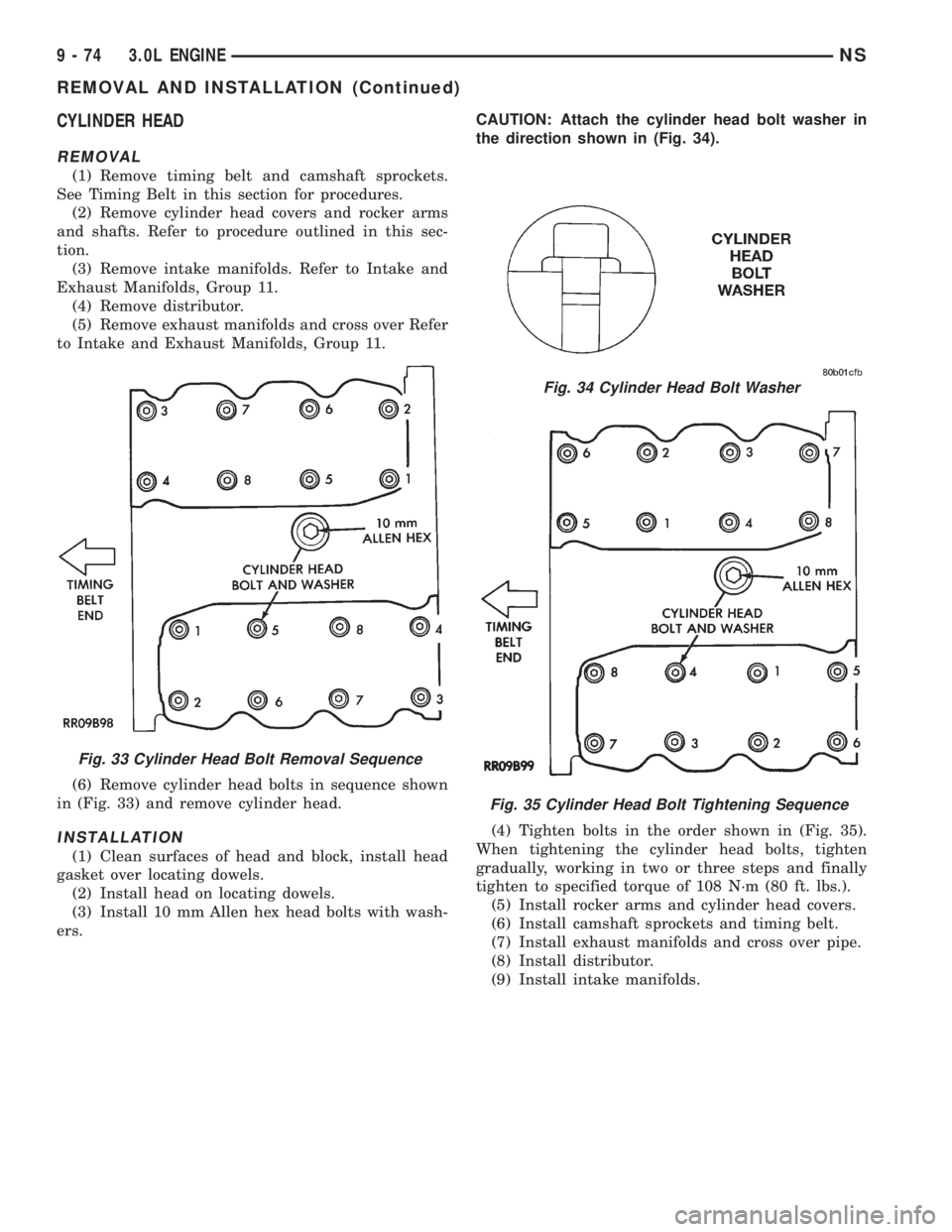
CYLINDER HEAD
REMOVAL
(1) Remove timing belt and camshaft sprockets.
See Timing Belt in this section for procedures.
(2) Remove cylinder head covers and rocker arms
and shafts. Refer to procedure outlined in this sec-
tion.
(3) Remove intake manifolds. Refer to Intake and
Exhaust Manifolds, Group 11.
(4) Remove distributor.
(5) Remove exhaust manifolds and cross over Refer
to Intake and Exhaust Manifolds, Group 11.
(6) Remove cylinder head bolts in sequence shown
in (Fig. 33) and remove cylinder head.
INSTALLATION
(1) Clean surfaces of head and block, install head
gasket over locating dowels.
(2) Install head on locating dowels.
(3) Install 10 mm Allen hex head bolts with wash-
ers.CAUTION: Attach the cylinder head bolt washer in
the direction shown in (Fig. 34).
(4) Tighten bolts in the order shown in (Fig. 35).
When tightening the cylinder head bolts, tighten
gradually, working in two or three steps and finally
tighten to specified torque of 108 N´m (80 ft. lbs.).
(5) Install rocker arms and cylinder head covers.
(6) Install camshaft sprockets and timing belt.
(7) Install exhaust manifolds and cross over pipe.
(8) Install distributor.
(9) Install intake manifolds.
Fig. 33 Cylinder Head Bolt Removal Sequence
Fig. 34 Cylinder Head Bolt Washer
Fig. 35 Cylinder Head Bolt Tightening Sequence
9 - 74 3.0L ENGINENS
REMOVAL AND INSTALLATION (Continued)
Page 1125 of 1938
TIMING BELT
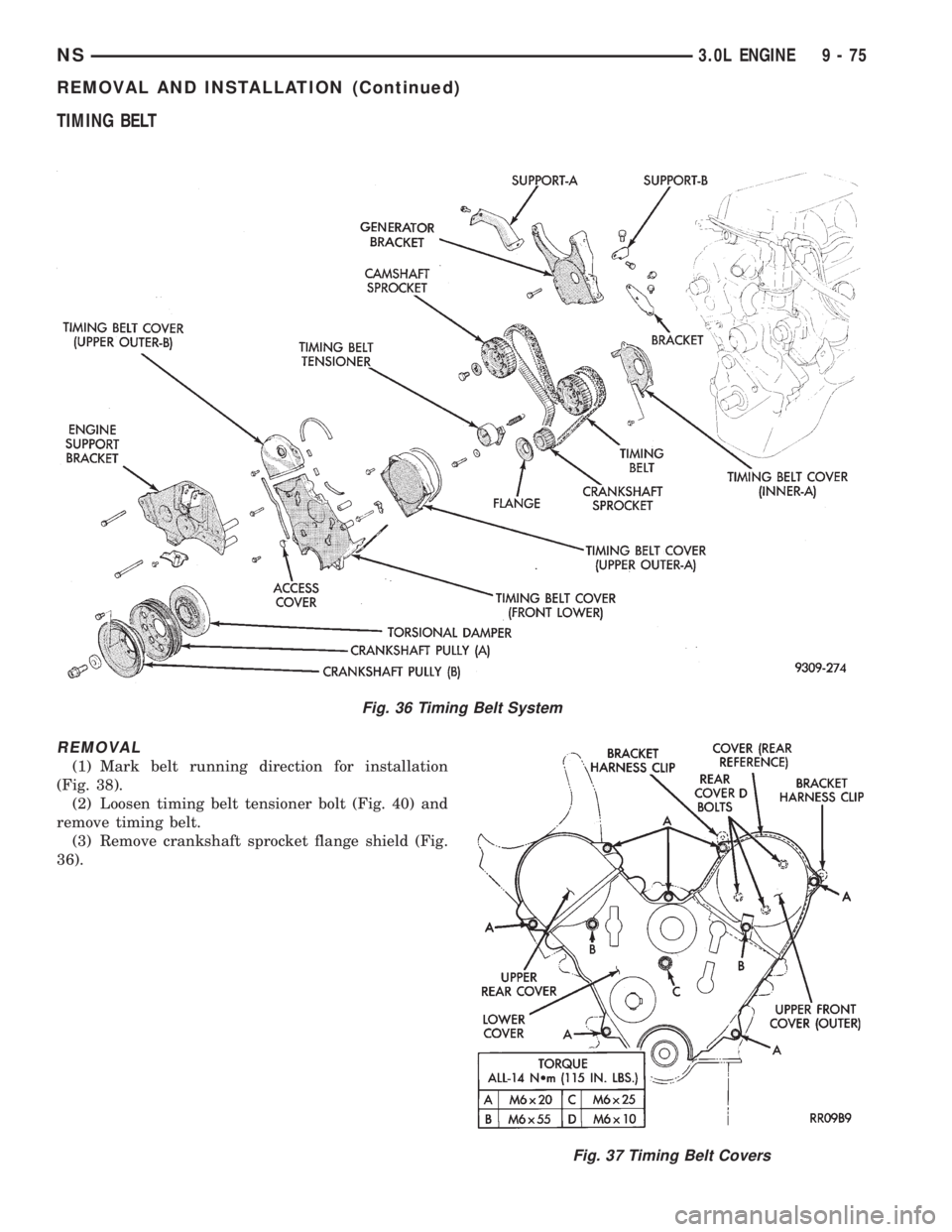
REMOVAL
(1) Mark belt running direction for installation
(Fig. 38).
(2) Loosen timing belt tensioner bolt (Fig. 40) and
remove timing belt.
(3) Remove crankshaft sprocket flange shield (Fig.
36).
Fig. 36 Timing Belt System
Fig. 37 Timing Belt Covers
NS3.0L ENGINE 9 - 75
REMOVAL AND INSTALLATION (Continued)