light CHRYSLER VOYAGER 1996 Workshop Manual
[x] Cancel search | Manufacturer: CHRYSLER, Model Year: 1996, Model line: VOYAGER, Model: CHRYSLER VOYAGER 1996Pages: 1938, PDF Size: 55.84 MB
Page 373 of 1938
INSTRUMENT PANEL AND SYSTEMS
CONTENTS
page page
GENERAL INFORMATION
INTRODUCTION........................ 1
DESCRIPTION AND OPERATION
HEADLAMP AND POWER MIRROR
SWITCH LAMP(S)..................... 1
INSTRUMENT CLUSTER................. 2
DIAGNOSIS AND TESTING
DIAGNOSTIC PROCEDURES.............. 2
HEADLAMP SWITCH.................... 2
SELF DIAGNOSTIC TEST................. 3
REMOVAL AND INSTALLATION
ASH RECEIVER ± CONVENIENCE
BIN LAMP MODULE.................. 15
BODY CONTROL MODULE (BCM)......... 16
CIGAR LIGHTER BASE.................. 16
CONVENIENCE BIN.................... 15
CONVENIENCE BIN - CUP HOLDER....... 15
GLOVE BOX.......................... 17
GLOVE BOX LAMP AND SWITCH......... 17
GLOVE BOX LOCK STRIKER............. 17
HEADLAMP SWITCH................... 18
HEADLAMP SWITCH LAMP(S)........... 18
HVAC CONTROL LAMP................. 18
INSTRUMENT CLUSTER................ 20INSTRUMENT CLUSTER BACK PANEL..... 18
INSTRUMENT CLUSTER BEZEL.......... 18
INSTRUMENT CLUSTER LENS........... 19
INSTRUMENT CLUSTER PRINTED
CIRCUIT BOARD..................... 19
INSTRUMENT CLUSTER SUBDIAL........ 20
INSTRUMENT PANEL................... 20
INSTRUMENT PANEL LEFT END COVER.... 22
INSTRUMENT PANEL LOUVERS.......... 22
INSTRUMENT PANEL RIGHT END COVER . . 25
INSTRUMENT PANEL TOP COVER........ 24
JUNCTION BLOCK..................... 25
KNEE BLOCKER REINFORCEMENT........ 25
LOWER CONSOLE..................... 26
LOWER INSTRUMENT PANEL............ 26
LOWER STEERING COLUMN COVER...... 27
MESSAGE CENTER.................... 27
OVER STEERING COLUMN BEZEL........ 28
POWER MIRROR SWITCH.............. 28
POWER MIRROR SWITCH LAMP......... 28
RADIO BEZEL AND HVAC CONTROL....... 29
REAR HEATER-A/C SWITCH............. 29
REAR HEATER-A/C SWITCH LAMP........ 29
GENERAL INFORMATION
INTRODUCTION
The instrumentation gauges on GS vehicles are
contained in a subdial assemblies within the instru-
ment cluster. The individual gauges are not serviced
separately. If one of the cluster gauges becomes
faulty the entire subdial would require replacement
and all gauges will have to be calibrated. Refer to the
proper Body Diagnostic Procedure Manual for cali-
bration procedures.
DESCRIPTION AND OPERATION
HEADLAMP AND POWER MIRROR SWITCH
LAMP(S)
The Headlamp Switch and Power Mirror Switch
lamps are shown in (Fig. 1). For replacement of the
lamp(s) refer to Headlamp Switch Lamp(s) Removal
and Installation procedures below. Refer to Group 8T,
Power Mirrors for mirror test procedures.
NS/GSINSTRUMENT PANEL AND SYSTEMS 8E - 1
Page 388 of 1938
INSTALLATION
For installation, reverse the above procedures.
BODY CONTROL MODULE (BCM)
REMOVAL
(1) Disconnect battery negative cable.
(2) Remove lower steering column cover and knee
blocker reinforcement.
(3) Disconnect two wire connectors from bottom of
Body Control Module (BCM)
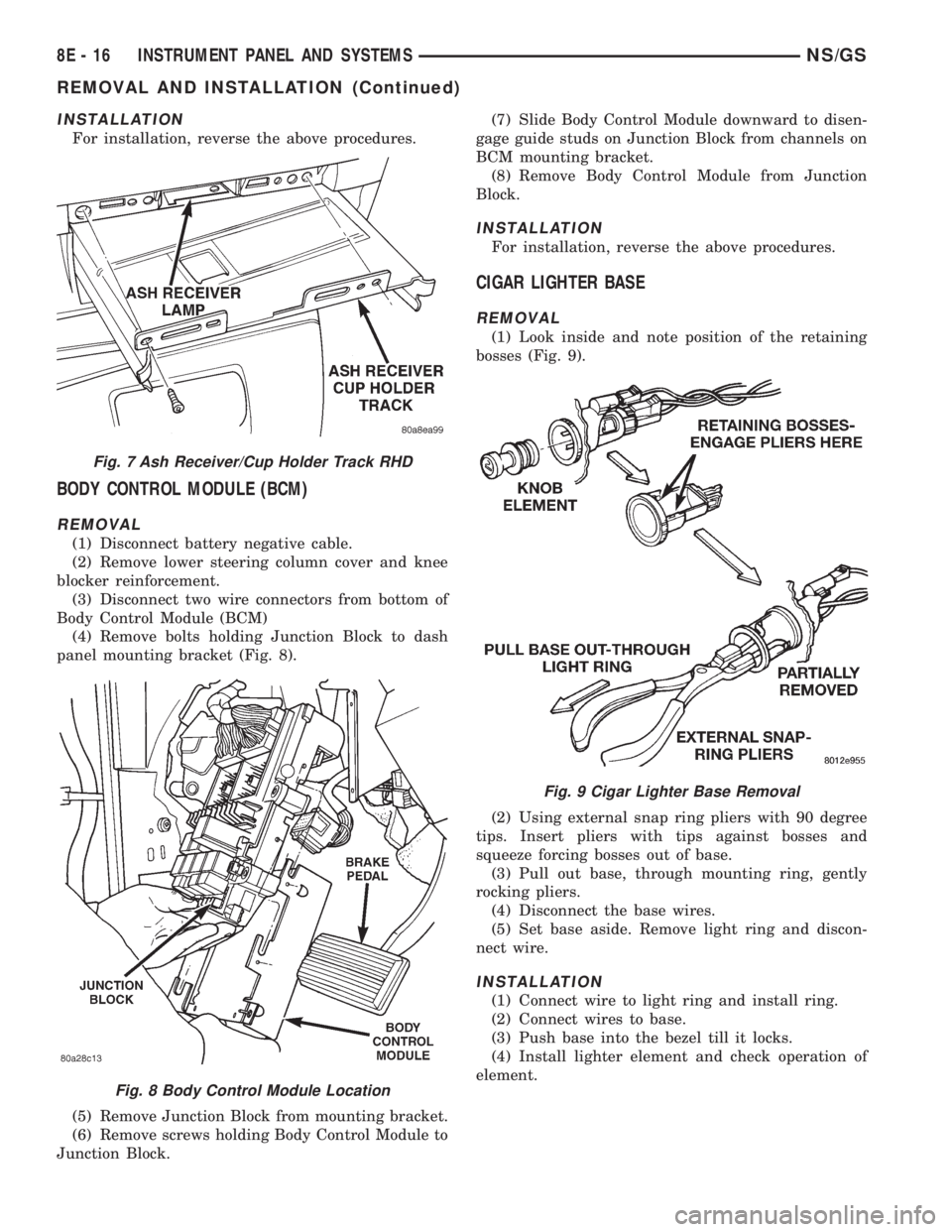
(4) Remove bolts holding Junction Block to dash
panel mounting bracket (Fig. 8).
(5) Remove Junction Block from mounting bracket.
(6) Remove screws holding Body Control Module to
Junction Block.(7) Slide Body Control Module downward to disen-
gage guide studs on Junction Block from channels on
BCM mounting bracket.
(8) Remove Body Control Module from Junction
Block.
INSTALLATION
For installation, reverse the above procedures.
CIGAR LIGHTER BASE
REMOVAL
(1) Look inside and note position of the retaining
bosses (Fig. 9).
(2) Using external snap ring pliers with 90 degree
tips. Insert pliers with tips against bosses and
squeeze forcing bosses out of base.
(3) Pull out base, through mounting ring, gently
rocking pliers.
(4) Disconnect the base wires.
(5) Set base aside. Remove light ring and discon-
nect wire.
INSTALLATION
(1) Connect wire to light ring and install ring.
(2) Connect wires to base.
(3) Push base into the bezel till it locks.
(4) Install lighter element and check operation of
element.
Fig. 7 Ash Receiver/Cup Holder Track RHD
Fig. 8 Body Control Module Location
Fig. 9 Cigar Lighter Base Removal
8E - 16 INSTRUMENT PANEL AND SYSTEMSNS/GS
REMOVAL AND INSTALLATION (Continued)
Page 389 of 1938
GLOVE BOX
REMOVAL (FIG. 4)
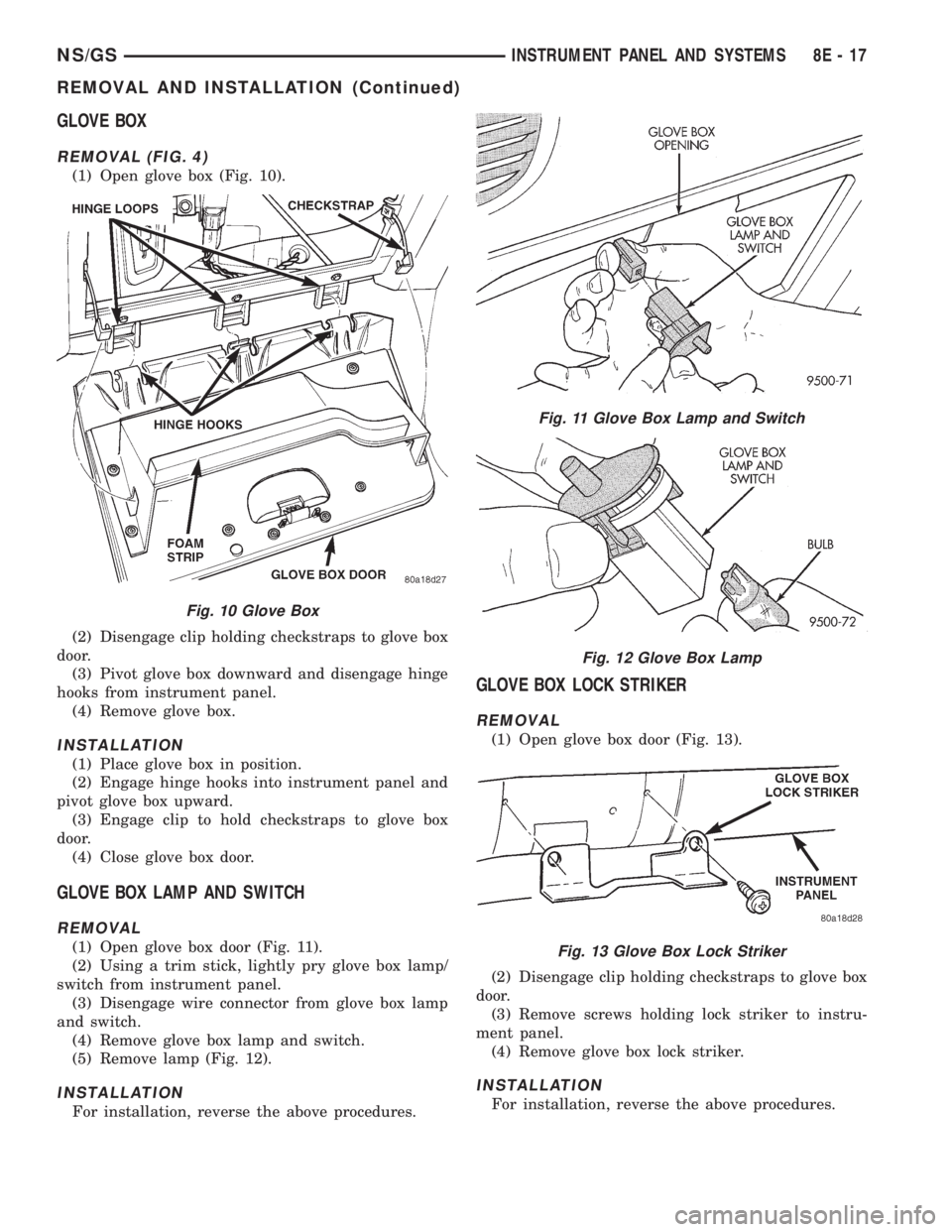
(1) Open glove box (Fig. 10).
(2) Disengage clip holding checkstraps to glove box
door.
(3) Pivot glove box downward and disengage hinge
hooks from instrument panel.
(4) Remove glove box.
INSTALLATION
(1) Place glove box in position.
(2) Engage hinge hooks into instrument panel and
pivot glove box upward.
(3) Engage clip to hold checkstraps to glove box
door.
(4) Close glove box door.
GLOVE BOX LAMP AND SWITCH
REMOVAL
(1) Open glove box door (Fig. 11).
(2) Using a trim stick, lightly pry glove box lamp/
switch from instrument panel.
(3) Disengage wire connector from glove box lamp
and switch.
(4) Remove glove box lamp and switch.
(5) Remove lamp (Fig. 12).
INSTALLATION
For installation, reverse the above procedures.
GLOVE BOX LOCK STRIKER
REMOVAL
(1) Open glove box door (Fig. 13).
(2) Disengage clip holding checkstraps to glove box
door.
(3) Remove screws holding lock striker to instru-
ment panel.
(4) Remove glove box lock striker.
INSTALLATION
For installation, reverse the above procedures.
Fig. 10 Glove Box
Fig. 11 Glove Box Lamp and Switch
Fig. 12 Glove Box Lamp
Fig. 13 Glove Box Lock Striker
NS/GSINSTRUMENT PANEL AND SYSTEMS 8E - 17
REMOVAL AND INSTALLATION (Continued)
Page 396 of 1938
INSTALLATION
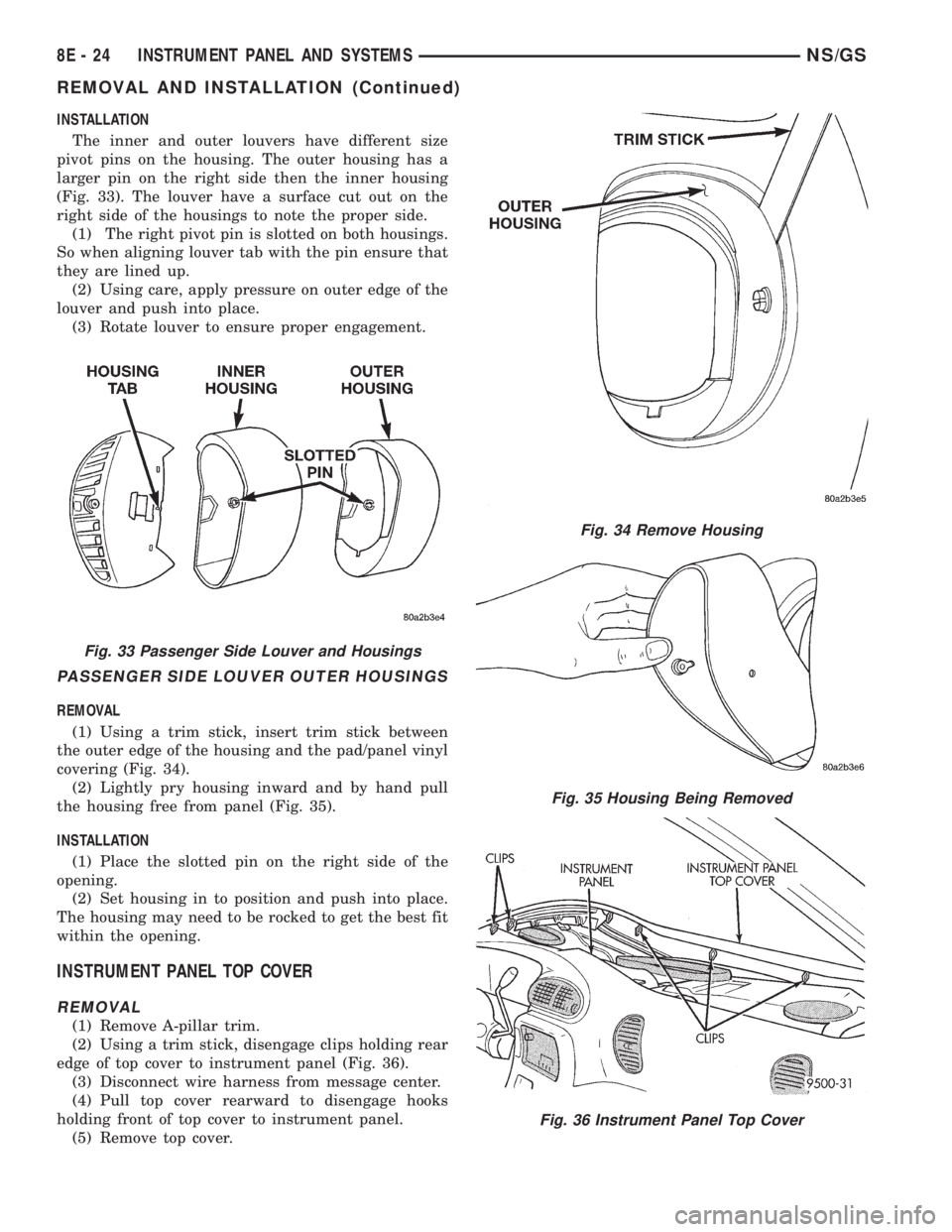
The inner and outer louvers have different size
pivot pins on the housing. The outer housing has a
larger pin on the right side then the inner housing
(Fig. 33). The louver have a surface cut out on the
right side of the housings to note the proper side.
(1) The right pivot pin is slotted on both housings.
So when aligning louver tab with the pin ensure that
they are lined up.
(2) Using care, apply pressure on outer edge of the
louver and push into place.
(3) Rotate louver to ensure proper engagement.
PASSENGER SIDE LOUVER OUTER HOUSINGS
REMOVAL
(1) Using a trim stick, insert trim stick between
the outer edge of the housing and the pad/panel vinyl
covering (Fig. 34).
(2) Lightly pry housing inward and by hand pull
the housing free from panel (Fig. 35).
INSTALLATION
(1) Place the slotted pin on the right side of the
opening.
(2) Set housing in to position and push into place.
The housing may need to be rocked to get the best fit
within the opening.
INSTRUMENT PANEL TOP COVER
REMOVAL
(1) Remove A-pillar trim.
(2) Using a trim stick, disengage clips holding rear
edge of top cover to instrument panel (Fig. 36).
(3) Disconnect wire harness from message center.
(4) Pull top cover rearward to disengage hooks
holding front of top cover to instrument panel.
(5) Remove top cover.
Fig. 33 Passenger Side Louver and Housings
Fig. 34 Remove Housing
Fig. 35 Housing Being Removed
Fig. 36 Instrument Panel Top Cover
8E - 24 INSTRUMENT PANEL AND SYSTEMSNS/GS
REMOVAL AND INSTALLATION (Continued)
Page 419 of 1938

STEP IS NOT DONE A DIAGONSTIC TROUBLE
CODE (DTC) MAY BE SET.
VACUUM RESERVOIR
The reservoir contains a one-way check valve to
trap engine vacuum in the reservoir. When engine
vacuum drops, as in climbing a grade while driving,
the reservoir supplies the vacuum needed to main-
tain proper speed control operation. The vacuum res-
ervoir cannot be repaired and must be replaced if
faulty.
VEHICLE SPEED AND DISTANCE
The 4 speed automatic Transmission Control Mod-
ule (TCM) supplies the speed input to the PCM. The
PCM determines acceleration rates. The speed con-
trol software in the PCM uses vehicle speed and
acceleration to control to the set speed.
Vehicles with a 3 speed automatic or manual trans-
mission have a vehicle speed sensor (VSS) mounted
to an adapter near the transmission output shaft.
The sensor is driven through the adapter by a speed-
ometer pinion gear. The VSS pulse signal is moni-
tored by the PCM to determine vehicle speed and to
maintain speed control set speed. Refer to the appro-
priate Powertrain Diagnostic Procedures manual for
diagnosis and testing of this component. Refer to
group 14, Fuel System for Removal/Installation
DIAGNOSIS AND TESTING
ROAD TEST
Perform a vehicle road test to verify reports of
speed control system malfunction. The road test
should include attention to the speedometer. Speed-
ometer operation should be smooth and without flut-
ter at all speeds.
Flutter in the speedometer indicates a problem
which might cause surging in the speed control sys-
tem. The cause of any speedometer problems should
be corrected before proceeding. Refer to Group 8E,
Instrument Panel and Gauges for speedometer diag-
nosis.
If a road test verifies a surge following a set and
the speedometer operates properly see ªOvershoot/
Undershoot on speed control setº.
If a road test verifies an inoperative system, and
the speedometer operates properly, check for:
²A Diagnostic Trouble Code (DTC). If a DTC
exists, conduct tests per the Powertrain Diagnostic
Procedures service manual.
²A misadjusted brake (stop) lamp switch. This
could also cause an intermittent problem.
²Loose or corroded electrical connections at the
servo. Corrosion should be removed from electricalterminals and a light coating of Mopar Multipurpose
Grease, or equivalent, applied.
²Leaking vacuum reservoir.
²Loose or leaking vacuum hoses or connections.
²Defective one-way vacuum check valve.
²Secure attachment at both ends of the speed
control servo cable.
²Smooth operation of throttle linkage and throttle
body air valve.
²Conduct electrical test at PCM.
²Failed speed control servo. Do the servo vacuum
test.
CAUTION: When test probing for voltage or conti-
nuity at electrical connectors, care must be taken
not to damage connector, terminals or seals. If
these components are damaged, intermittent or
complete system failure may occur.
OVERSHOOT/UNDERSHOOT FOLLOWING SPEED
CONTROL SET
If the operator repeatedly presses and releases the
set button with their foot off of the accelerator (a ªlift
foot setº to begin speed control operation), the vehicle
may accelerate and exceed the desired set speed by
up to 5 MPH (8 km/h) and then decelerate to less
than the desired set speed before finally achieving
the desired set speed.
The Speed Control has an adaptive strategy that
compensates for vehicle-to-vehicle variations in speed
control cable lengths. When the speed control is set
with the vehicle operators foot off of the accelerator
pedal, the speed control thinks there is excessive
speed control cable slack and adapts. If the lift foot
sets are continually used, the speed control over-
shoot/undershoot condition will develop.
To ªunlearnº the overshoot/undershoot condition,
the vehicle operator has to press and release the set
button while maintaining the desired set speed with
the accelerator pedal (not decelerating or accelerat-
ing), and then turn the cruise control switch to the
OFF position (or press the CANCEL button if
equipped) after waiting 10 seconds. This procedure
must be performed approximately 10±15 times to
completely unlearn the overshoot/undershoot condi-
tion.
CHECKING FOR DIAGNOSTIC CODES
When trying to verify a speed control system elec-
tronic malfunction: Connect a DRB scan tool if avail-
able to the data link connector. The connector is
located at left side of the steering column, and at
lower edge of the panel.
(1) A speed control malfunction may occur without
a diagnostic code being indicated.
NSVEHICLE SPEED CONTROL SYSTEM 8H - 3
DESCRIPTION AND OPERATION (Continued)
Page 420 of 1938

Refer to Group 25, for further information and use-
age of the DRB scan tool and a more complete list of
Diagnostic Trouble Code.
SPEED CONTROL SLOWS DOWN BY ITSELF
Test vehicle speed sensor, refer to group 8E. If sen-
sor fails replace sensor, if it passes perform the fol-
lowing test:
(1) Perform the speed control switch test on the
DECEL switch, if it fails replace switch.
(2) If the switch passes, conduct the vacuum sup-
ply test.
(3) If it passes, conduct the servo vacuum test. If it
fails replace servo.
(4) If continuity, replace the PCM.
SPEED CONTROL ELECTRICAL TEST
Electronic speed control systems may be tested
using two different methods. One involves use of a
DRB. If this test method is desired, refer to the Pow-
ertrain Diagnostic Test Procedures for charging and
speed control system manual.The other test method uses a volt/ohm meter. The
volt/ohm meter method is described in the following
tests.
If any information is needed concerning wiring,
refer to Group 8W, Wiring Diagrams (Fig. 2).
CAUTION: When test probing for voltage or conti-
nuity at electrical connectors, care must be taken
not to damage connector, terminals, or seals. If
these components are damaged, intermittent or
complete system failure may occur.
When electrical connections are removed, corrosion
should be removed from electrical terminals and a
light coating of Mopar Multi-Purpose Grease, or
equivalent, applied. Inspect connectors for damage
terminals.
A poor connection can cause a complete or inter-
mittent malfunction and is also the only connection
in the circuit, that can not be tested. For this reason,
a loose connection may be misdiagnosed as a compo-
nent malfunction.
SPEED CONTROL DIAGNOSTIC TROUBLE CODES
Hex Code DRB Scan Tool Display Description of Diagnostic Trouble
Code
23 No Vehicle Speed Sensor Signal No vehicle distance (speed) sensor
signal detected during road load
conditions.
OF Speed Control Solenoid Circuits An open or shorted condition
detected in the Speed Control
vacuum or vent solenoid circuits.
56 MUX S/C Switch High Speed Control switch input above
the maximum acceptable voltage.
57 MUX S/C Switch Low Speed Control switch input below
the minimum acceptable voltage.
52 S/C Power Relay Or 12V Driver
CircuitMalfunction detected with power
feed to speed control servo solnoids.
Check Engine Lamp will illuminate during engine operation if this Diagnostic Trouble Code was recorded.
8H - 4 VEHICLE SPEED CONTROL SYSTEMNS
DIAGNOSIS AND TESTING (Continued)
Page 430 of 1938

take advantage of low current switching require-
ments in the vehicle. It is plugged into the Junction
Block at positions 4 (Fig. 1) where all wiring associ-
ated with its operation is terminated. The Junction
Block is adjacent to and left of the steering column of
the vehicle.
To gain access to the device, remove the lower
steering column cover and knee blocker, refer to
Group 8E, Instrument Panel and Systems.
The combination flasher may be operated in its
hazard warning mode either with or without the igni-
tion circuit being active. However, in order to operate
in the turn signal mode, the ignition circuit must be
completed to the module.
While the combination flasher is idle, there is no
current drawn through the module. The device does
not become active until a signal ground circuit is
supplied to either of the turn signal inputs or the
hazard warning input.
Typical flash rate for the flasher is 90 flashes per
minute.
When a lamp is burnt out for a given side of the
vehicle or a wire is open to a lamp, the flash rate will
increase to 180 flashes per minute when in the turn
signal mode. When in the hazard warning signal
mode the flash rate remains at 90 flashes per
minute.
Turn signal inputs that actuate the flasher are low
current grounds, each drawing a maximum of 300
mA., and are provided to the flasher through the
Junction Block from the multi-function switch that is
mounted to the steering column. The hazard warning
signal input is a low current ground drawing a max-
imum of 600 mA. through the multi-function switch.
COMBINATION FLASHER / DAYTIME RUNNING
LAMPS (DRL) MODULE
The Combination Flasher/DRL is a module provid-
ing turn signal, hazard warning, and daytime run-
ning light functions, and has been designed with
internal relays to take advantage of low current
switching requirements in the vehicle. It is plugged
into the junction block at positions 3 AND 4 (Fig. 2)
where all wiring associated with its operation is ter-
minated. The Junction Block is adjacent to and left of
the steering column of the vehicle.
To gain access to the device, remove the lower
steering column cover and knee blocker, refer to
Group 8E, Instrument Panel and Gauges.
The combination flasher/DRL may be operated in
its hazard warning mode either with or without the
ignition circuit being active. However, in order to
operate in the turn signal mode or the DRL mode,
the ignition circuit must be completed to the module.
While the combination flasher portion is idle, there
is no current drawn through the module. The devicedoes not become active in the turn signal or hazard
warning modes until a signal ground circuit is sup-
plied to either of the turn signal inputs or the hazard
warning input. With the ignition OFF, there is no
current drawn through the module.
While the ignition is ON, the front turn signal fil-
aments are illuminated steadily thus providing the
DRL function. The DRL function may be inhibited by
applying a signal ground input from either the park
brake circuit or the headlamp relay activation circuit.
Typical flash rate for the flasher is 90 flashes per
minute.
When a lamp is burnt out for a given side of the
vehicle or a wire is open to a lamp, the flash rate will
increase to 180 flashes per minute when in the turn
signal mode. When in the hazard warning signal
mode the flash rate remains at 90 flashes per
minute.
Turn signal inputs that actuate the flasher are low
current grounds, each could draw a maximum of 300
mA., and are provided to the flasher through the
Junction Block from the multi-function switch that is
mounted to the steering column. The hazard warning
signal input is a low current ground that could draw
a maximum of 600 mA. through the multi-function
switch.
DIAGNOSIS AND TESTING
TURN SIGNAL MULTI-FUNCTION SWITCH
To test turn signal, headlamp beam select and opti-
cal horn portion of the multi-function switch:
(1) Remove the multi-function switch, refer to
removal procedures.
(2) Using an ohmmeter check continuity reading
between multi-function switch pins. Refer to (Fig. 3)
for proper pin numbers and Turn Signal Multi-Func-
tion Switch Test chart.
Fig. 2 Junction Block Terminal Pins
8J - 2 TURN SIGNAL AND FLASHERSNS
DESCRIPTION AND OPERATION (Continued)
Page 438 of 1938
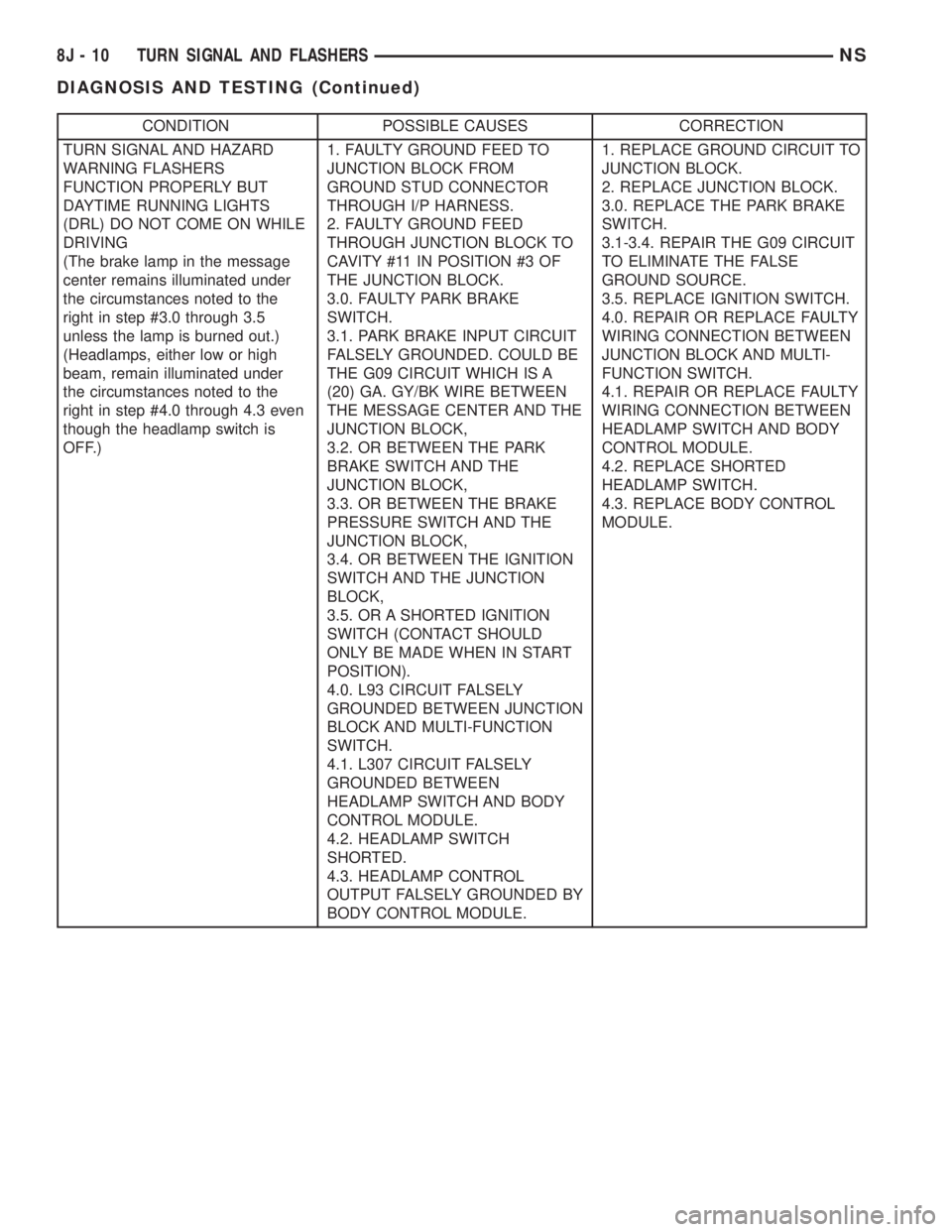
CONDITION POSSIBLE CAUSES CORRECTION
TURN SIGNAL AND HAZARD
WARNING FLASHERS
FUNCTION PROPERLY BUT
DAYTIME RUNNING LIGHTS
(DRL) DO NOT COME ON WHILE
DRIVING
(The brake lamp in the message
center remains illuminated under
the circumstances noted to the
right in step #3.0 through 3.5
unless the lamp is burned out.)
(Headlamps, either low or high
beam, remain illuminated under
the circumstances noted to the
right in step #4.0 through 4.3 even
though the headlamp switch is
OFF.)1. FAULTY GROUND FEED TO
JUNCTION BLOCK FROM
GROUND STUD CONNECTOR
THROUGH I/P HARNESS.
2. FAULTY GROUND FEED
THROUGH JUNCTION BLOCK TO
CAVITY #11 IN POSITION #3 OF
THE JUNCTION BLOCK.
3.0. FAULTY PARK BRAKE
SWITCH.
3.1. PARK BRAKE INPUT CIRCUIT
FALSELY GROUNDED. COULD BE
THE G09 CIRCUIT WHICH IS A
(20) GA. GY/BK WIRE BETWEEN
THE MESSAGE CENTER AND THE
JUNCTION BLOCK,
3.2. OR BETWEEN THE PARK
BRAKE SWITCH AND THE
JUNCTION BLOCK,
3.3. OR BETWEEN THE BRAKE
PRESSURE SWITCH AND THE
JUNCTION BLOCK,
3.4. OR BETWEEN THE IGNITION
SWITCH AND THE JUNCTION
BLOCK,
3.5. OR A SHORTED IGNITION
SWITCH (CONTACT SHOULD
ONLY BE MADE WHEN IN START
POSITION).
4.0. L93 CIRCUIT FALSELY
GROUNDED BETWEEN JUNCTION
BLOCK AND MULTI-FUNCTION
SWITCH.
4.1. L307 CIRCUIT FALSELY
GROUNDED BETWEEN
HEADLAMP SWITCH AND BODY
CONTROL MODULE.
4.2. HEADLAMP SWITCH
SHORTED.
4.3. HEADLAMP CONTROL
OUTPUT FALSELY GROUNDED BY
BODY CONTROL MODULE.1. REPLACE GROUND CIRCUIT TO
JUNCTION BLOCK.
2. REPLACE JUNCTION BLOCK.
3.0. REPLACE THE PARK BRAKE
SWITCH.
3.1-3.4. REPAIR THE G09 CIRCUIT
TO ELIMINATE THE FALSE
GROUND SOURCE.
3.5. REPLACE IGNITION SWITCH.
4.0. REPAIR OR REPLACE FAULTY
WIRING CONNECTION BETWEEN
JUNCTION BLOCK AND MULTI-
FUNCTION SWITCH.
4.1. REPAIR OR REPLACE FAULTY
WIRING CONNECTION BETWEEN
HEADLAMP SWITCH AND BODY
CONTROL MODULE.
4.2. REPLACE SHORTED
HEADLAMP SWITCH.
4.3. REPLACE BODY CONTROL
MODULE.
8J - 10 TURN SIGNAL AND FLASHERSNS
DIAGNOSIS AND TESTING (Continued)
Page 448 of 1938
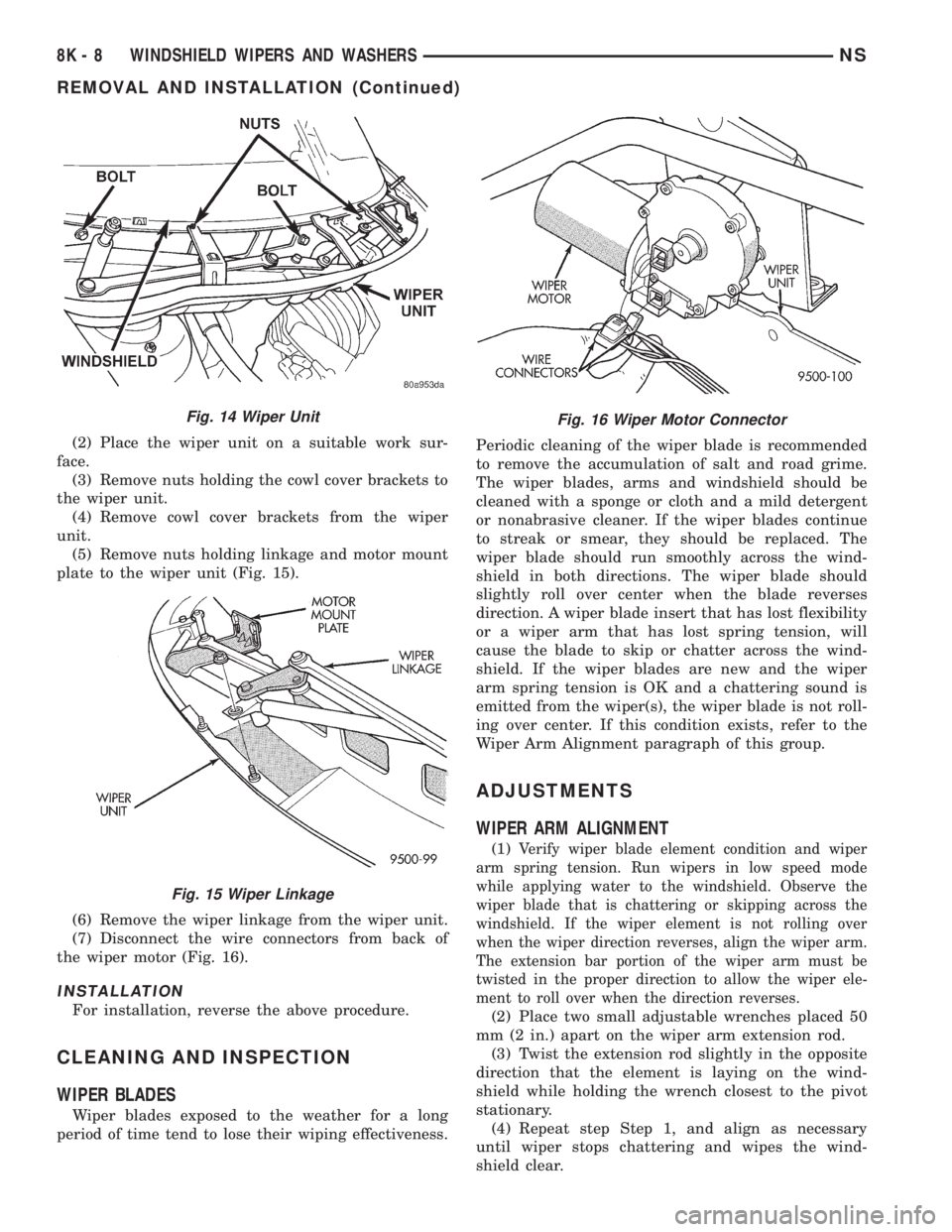
(2) Place the wiper unit on a suitable work sur-
face.
(3) Remove nuts holding the cowl cover brackets to
the wiper unit.
(4) Remove cowl cover brackets from the wiper
unit.
(5) Remove nuts holding linkage and motor mount
plate to the wiper unit (Fig. 15).
(6) Remove the wiper linkage from the wiper unit.
(7) Disconnect the wire connectors from back of
the wiper motor (Fig. 16).
INSTALLATION
For installation, reverse the above procedure.
CLEANING AND INSPECTION
WIPER BLADES
Wiper blades exposed to the weather for a long
period of time tend to lose their wiping effectiveness.Periodic cleaning of the wiper blade is recommended
to remove the accumulation of salt and road grime.
The wiper blades, arms and windshield should be
cleaned with a sponge or cloth and a mild detergent
or nonabrasive cleaner. If the wiper blades continue
to streak or smear, they should be replaced. The
wiper blade should run smoothly across the wind-
shield in both directions. The wiper blade should
slightly roll over center when the blade reverses
direction. A wiper blade insert that has lost flexibility
or a wiper arm that has lost spring tension, will
cause the blade to skip or chatter across the wind-
shield. If the wiper blades are new and the wiper
arm spring tension is OK and a chattering sound is
emitted from the wiper(s), the wiper blade is not roll-
ing over center. If this condition exists, refer to the
Wiper Arm Alignment paragraph of this group.
ADJUSTMENTS
WIPER ARM ALIGNMENT
(1)Verify wiper blade element condition and wiper
arm spring tension. Run wipers in low speed mode
while applying water to the windshield. Observe the
wiper blade that is chattering or skipping across the
windshield. If the wiper element is not rolling over
when the wiper direction reverses, align the wiper arm.
The extension bar portion of the wiper arm must be
twisted in the proper direction to allow the wiper ele-
ment to roll over when the direction reverses.
(2) Place two small adjustable wrenches placed 50
mm (2 in.) apart on the wiper arm extension rod.
(3) Twist the extension rod slightly in the opposite
direction that the element is laying on the wind-
shield while holding the wrench closest to the pivot
stationary.
(4) Repeat step Step 1, and align as necessary
until wiper stops chattering and wipes the wind-
shield clear.
Fig. 14 Wiper Unit
Fig. 15 Wiper Linkage
Fig. 16 Wiper Motor Connector
8K - 8 WINDSHIELD WIPERS AND WASHERSNS
REMOVAL AND INSTALLATION (Continued)
Page 453 of 1938

LAMPS
CONTENTS
page page
BULB APPLICATION...................... 25
EXTERIOR LAMP BULB SERVICE............ 9
EXTERIOR LAMP SERVICE................. 14HEADLAMP ALIGNMENT................... 5
INTERIOR LAMPS........................ 18
LAMP DIAGNOSIS........................ 1
LAMP DIAGNOSIS
INDEX
page page
GENERAL INFORMATION
ELECTRONIC DAYTIME RUNNING LIGHT (DRL).1
GENERAL INFORMATION.................. 1SAFETY PRECAUTIONS................... 1
DIAGNOSIS AND TESTING
DIAGNOSTIC PROCEDURES................ 2
GENERAL INFORMATION
GENERAL INFORMATION
NS vehicles use lighting on the interior and exte-
rior of the vehicle for illuminating and indicating
purposes. Lighting circuits are protected by fuses.
Lighting circuits require an overload protected power
source, on/off device, lamps and body ground to oper-
ate properly. Plastic lamps require a wire in the har-
ness to supply body ground to the lamp socket.
Replace sockets and bulbs that are corroded.
Some of the interior and exterior lighting functions
are governed by the body controller. The headlamp,
dome, and the door ajar switches provide signals to
the body controller. The body controller in turn acti-
vates relay(s) in order to provide either a ground or
feed line to the appropriate lamp(s).
Wire connectors can make intermittent contact or
become corroded. Before coupling wire connectors,
inspect the terminals inside the connector. Male ter-
minals should not be bent or disengaged from the
insulator. Female terminals should not be sprung
open or disengaged from the insulator. Bent and
sprung terminals can be repaired using needle nose
pliers and pick tool. Corroded terminals appear
chalky or green. Corroded terminals should be
replaced to avoid recurrence of the problem symp-
toms.
Begin electrical system failure diagnosis by testing
related fuses in the fuse block and power distribution
center. Verify that bulbs are in good condition andtest continuity of the circuit ground. Refer to Group
8W, Wiring Diagrams, for component location and cir-
cuit information.SAFETY PRECAUTIONS
WARNING: EYE PROTECTION SHOULD BE USED
WHEN SERVICING GLASS COMPONENTS. PER-
SONAL INJURY CAN RESULT.
CAUTION: Do not touch the glass of halogen bulbs
with fingers or other possibly oily surface, reduced
bulb life will result.
Do not use bulbs with higher candle power than
indicated in the Bulb Application table at the end of
this group. Damage to lamp and/or Daytime Run-
ning Lamp Module can result.
Do not use fuses, circuit breakers or relays hav-
ing greater amperage value than indicated on the
fuse panel or in the Owners Manual.
When it is necessary to remove components to ser-
vice another, it should not be necessary to apply
excessive force or bend a component to remove it.
Before damaging a trim component, verify hidden
fasteners or captured edges are not holding the com-
ponent in place.
ELECTRONIC DAYTIME RUNNING LIGHT (DRL)
The Combination Flasher/DRL is a module provid-
ing turn signal, hazard warning, and daytime run-
NSLAMPS 8L - 1