radiator CHRYSLER VOYAGER 1996 Manual Online
[x] Cancel search | Manufacturer: CHRYSLER, Model Year: 1996, Model line: VOYAGER, Model: CHRYSLER VOYAGER 1996Pages: 1938, PDF Size: 55.84 MB
Page 1238 of 1938
(36) Operate the engine with the radiator cap off.
Inspect for leaks and continue operating the engine
until the thermostat opens. Add coolant, if required.
VALVES AND VALVE SPRINGSÐHEAD OFF
This procedure is done with the engine cylinder
head removed from the block.
REMOVAL
(1) Remove the engine cylinder head from the cyl-
inder block. Refer to cylinder head removal in this
section.
(2) Use Valve Spring Compressor Tool and com-
press each valve spring.
(3) Remove the valve locks, retainers, and springs.
(4) Use an Arkansas smooth stone or a jewelers
file to remove any burrs on the top of the valve stem,
especially around the groove for the locks.
(5) Remove the valves, and place them in a rack in
the same order as removed.
INSTALLATION
(1) Fit each valve to its respective valve guide.
NOTE: If valves and valve seats have been refaced
refer to Service Procedures in this section. Follow
The Valve Stand Down procedure.
(2) Install lower, washer and spring.
(3) Install upper spring collar, and compress valve
spring with spring compressor tool. Install split cone
retainers.
HYDRAULIC TAPPETS
REMOVAL
(1) Remove coolant pressure bottle.
(2) Remove cylinder head cover. Refer to cylinder
head cover removal in this section.
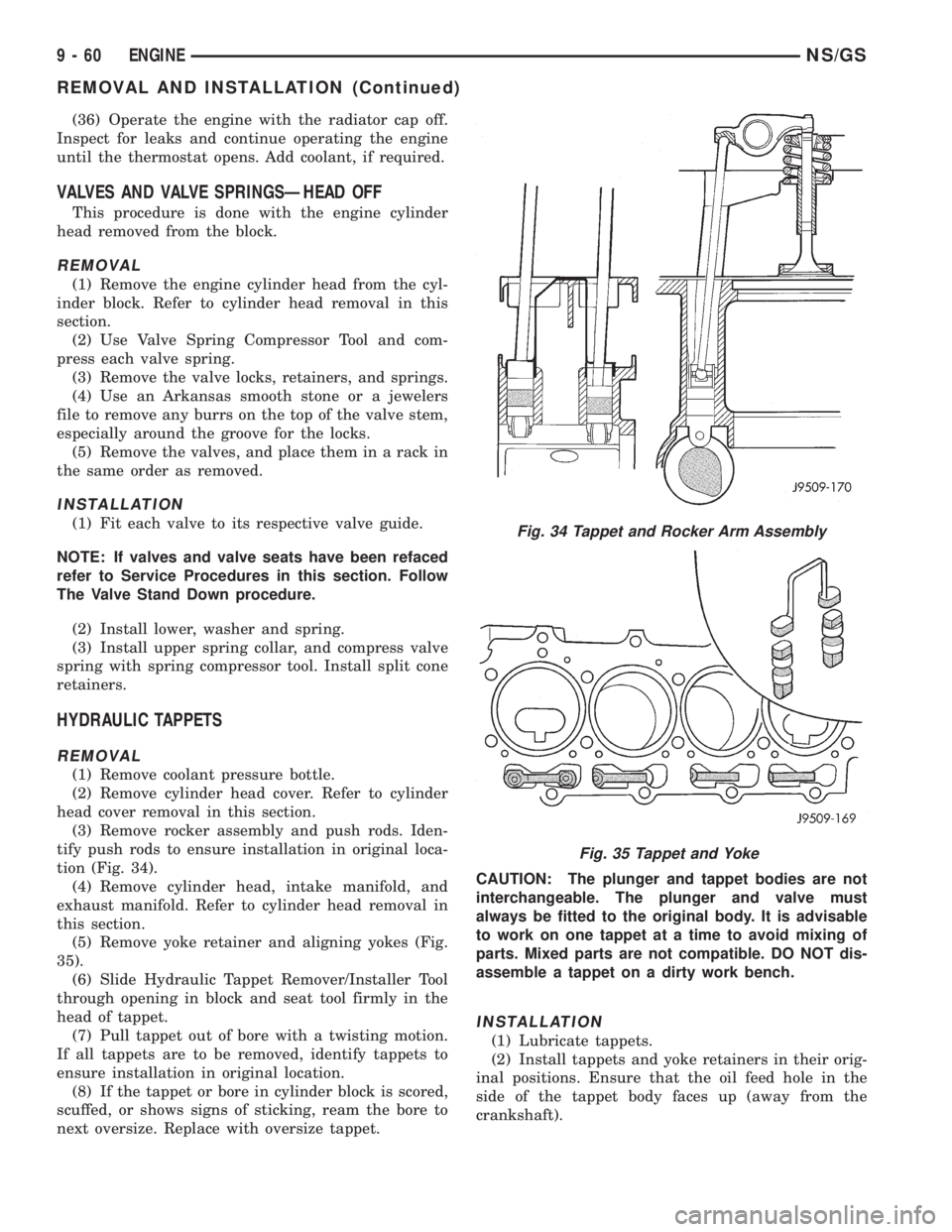
(3) Remove rocker assembly and push rods. Iden-
tify push rods to ensure installation in original loca-
tion (Fig. 34).
(4) Remove cylinder head, intake manifold, and
exhaust manifold. Refer to cylinder head removal in
this section.
(5) Remove yoke retainer and aligning yokes (Fig.
35).
(6) Slide Hydraulic Tappet Remover/Installer Tool
through opening in block and seat tool firmly in the
head of tappet.
(7) Pull tappet out of bore with a twisting motion.
If all tappets are to be removed, identify tappets to
ensure installation in original location.
(8) If the tappet or bore in cylinder block is scored,
scuffed, or shows signs of sticking, ream the bore to
next oversize. Replace with oversize tappet.CAUTION: The plunger and tappet bodies are not
interchangeable. The plunger and valve must
always be fitted to the original body. It is advisable
to work on one tappet at a time to avoid mixing of
parts. Mixed parts are not compatible. DO NOT dis-
assemble a tappet on a dirty work bench.
INSTALLATION
(1) Lubricate tappets.
(2) Install tappets and yoke retainers in their orig-
inal positions. Ensure that the oil feed hole in the
side of the tappet body faces up (away from the
crankshaft).
Fig. 34 Tappet and Rocker Arm Assembly
Fig. 35 Tappet and Yoke
9 - 60 ENGINENS/GS
REMOVAL AND INSTALLATION (Continued)
Page 1269 of 1938
(5) Drain cooling system. Refer to Group 7, Cool-
ing System for procedure.
(6) Remove heater, and upper radiator hoses at
intake manifold.
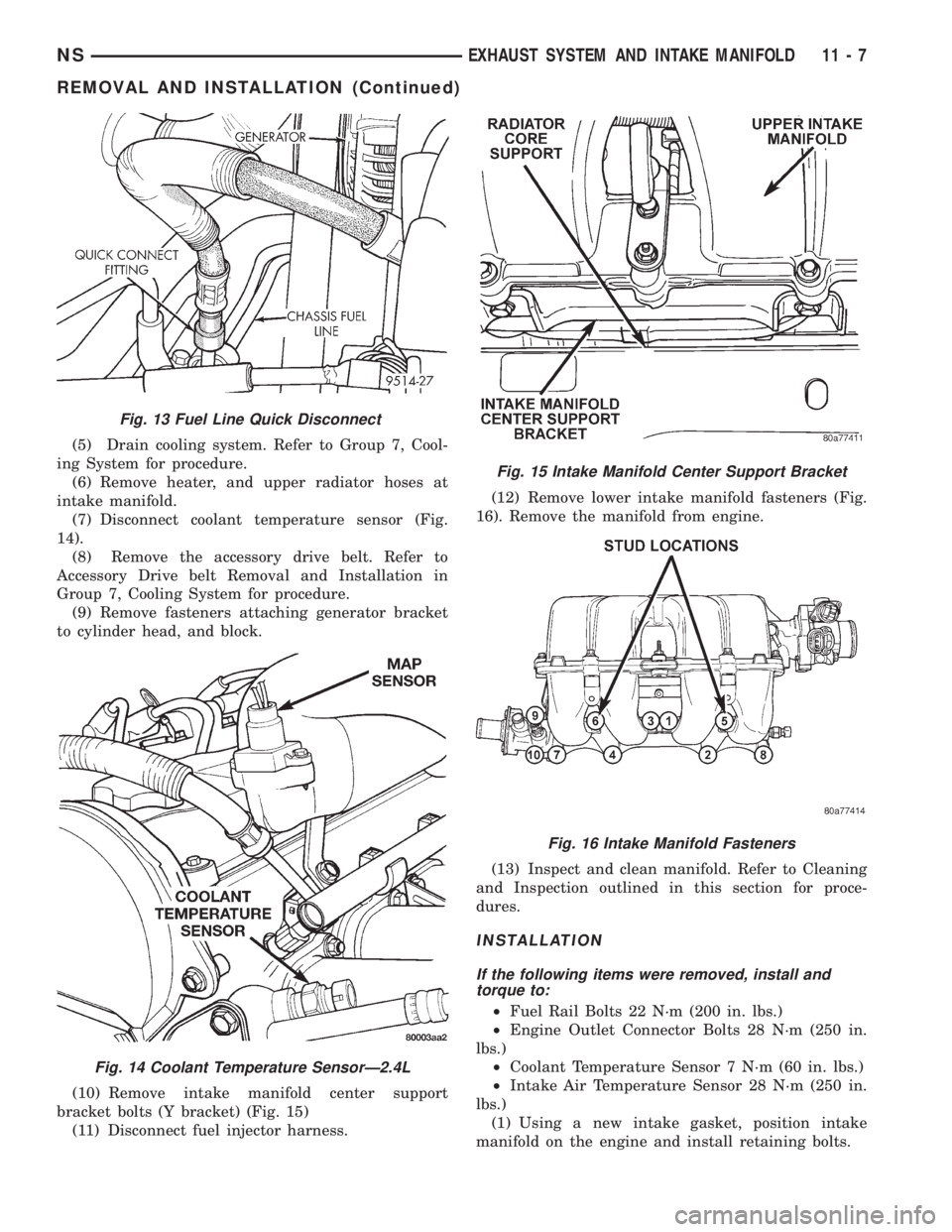
(7) Disconnect coolant temperature sensor (Fig.
14).
(8) Remove the accessory drive belt. Refer to
Accessory Drive belt Removal and Installation in
Group 7, Cooling System for procedure.
(9) Remove fasteners attaching generator bracket
to cylinder head, and block.
(10) Remove intake manifold center support
bracket bolts (Y bracket) (Fig. 15)
(11) Disconnect fuel injector harness.(12) Remove lower intake manifold fasteners (Fig.
16). Remove the manifold from engine.
(13) Inspect and clean manifold. Refer to Cleaning
and Inspection outlined in this section for proce-
dures.
INSTALLATION
If the following items were removed, install and
torque to:
²Fuel Rail Bolts 22 N´m (200 in. lbs.)
²Engine Outlet Connector Bolts 28 N´m (250 in.
lbs.)
²Coolant Temperature Sensor 7 N´m (60 in. lbs.)
²Intake Air Temperature Sensor 28 N´m (250 in.
lbs.)
(1) Using a new intake gasket, position intake
manifold on the engine and install retaining bolts.
Fig. 13 Fuel Line Quick Disconnect
Fig. 14 Coolant Temperature SensorÐ2.4L
Fig. 15 Intake Manifold Center Support Bracket
Fig. 16 Intake Manifold Fasteners
NSEXHAUST SYSTEM AND INTAKE MANIFOLD 11 - 7
REMOVAL AND INSTALLATION (Continued)
Page 1272 of 1938
(16) Remove fuel rail attaching bolts and lift fuel
rail assembly from intake manifold.
(17) Separate radiator hose from thermostat hous-
ing and heater hose from heater pipe.
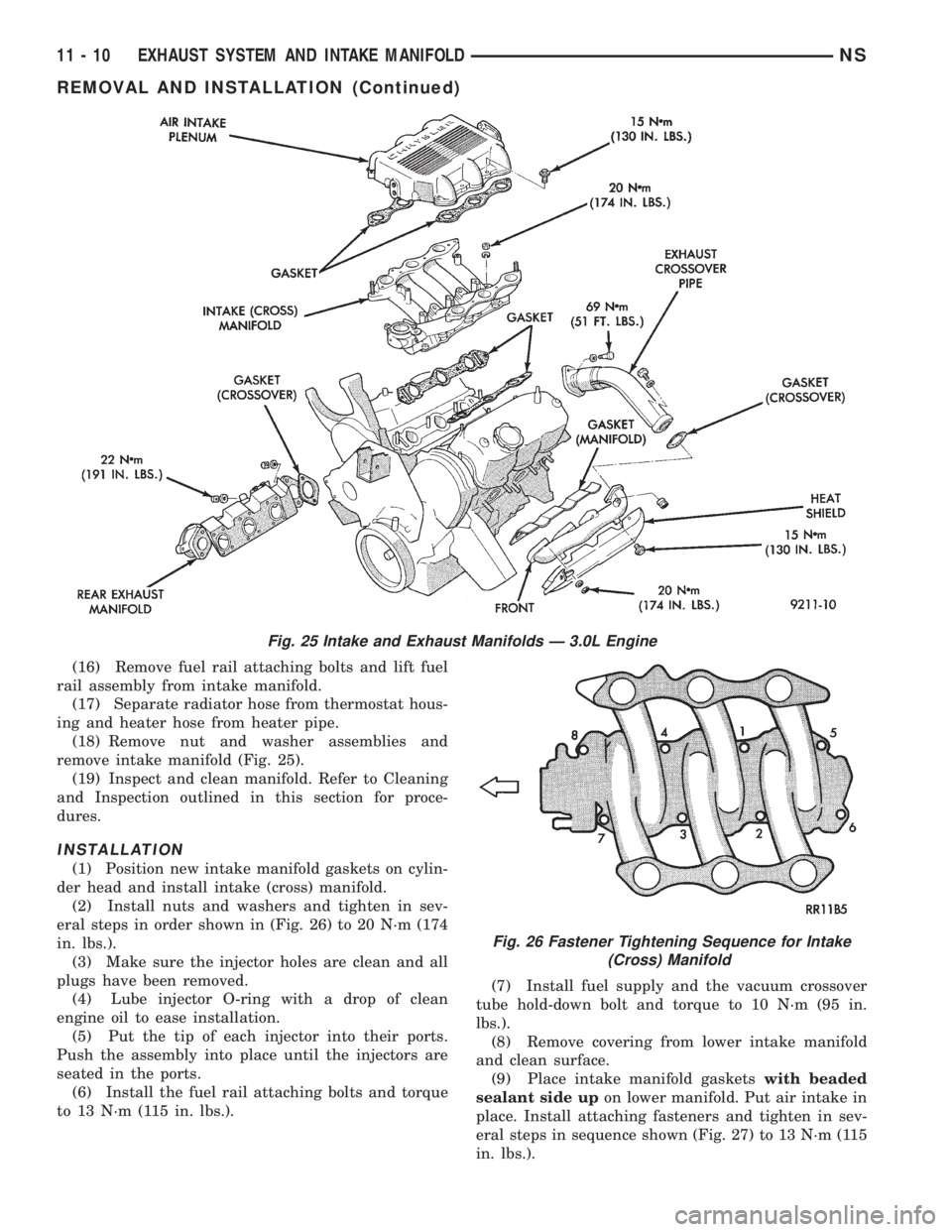
(18) Remove nut and washer assemblies and
remove intake manifold (Fig. 25).
(19) Inspect and clean manifold. Refer to Cleaning
and Inspection outlined in this section for proce-
dures.
INSTALLATION
(1) Position new intake manifold gaskets on cylin-
der head and install intake (cross) manifold.
(2) Install nuts and washers and tighten in sev-
eral steps in order shown in (Fig. 26) to 20 N´m (174
in. lbs.).
(3) Make sure the injector holes are clean and all
plugs have been removed.
(4) Lube injector O-ring with a drop of clean
engine oil to ease installation.
(5) Put the tip of each injector into their ports.
Push the assembly into place until the injectors are
seated in the ports.
(6) Install the fuel rail attaching bolts and torque
to 13 N´m (115 in. lbs.).(7) Install fuel supply and the vacuum crossover
tube hold-down bolt and torque to 10 N´m (95 in.
lbs.).
(8) Remove covering from lower intake manifold
and clean surface.
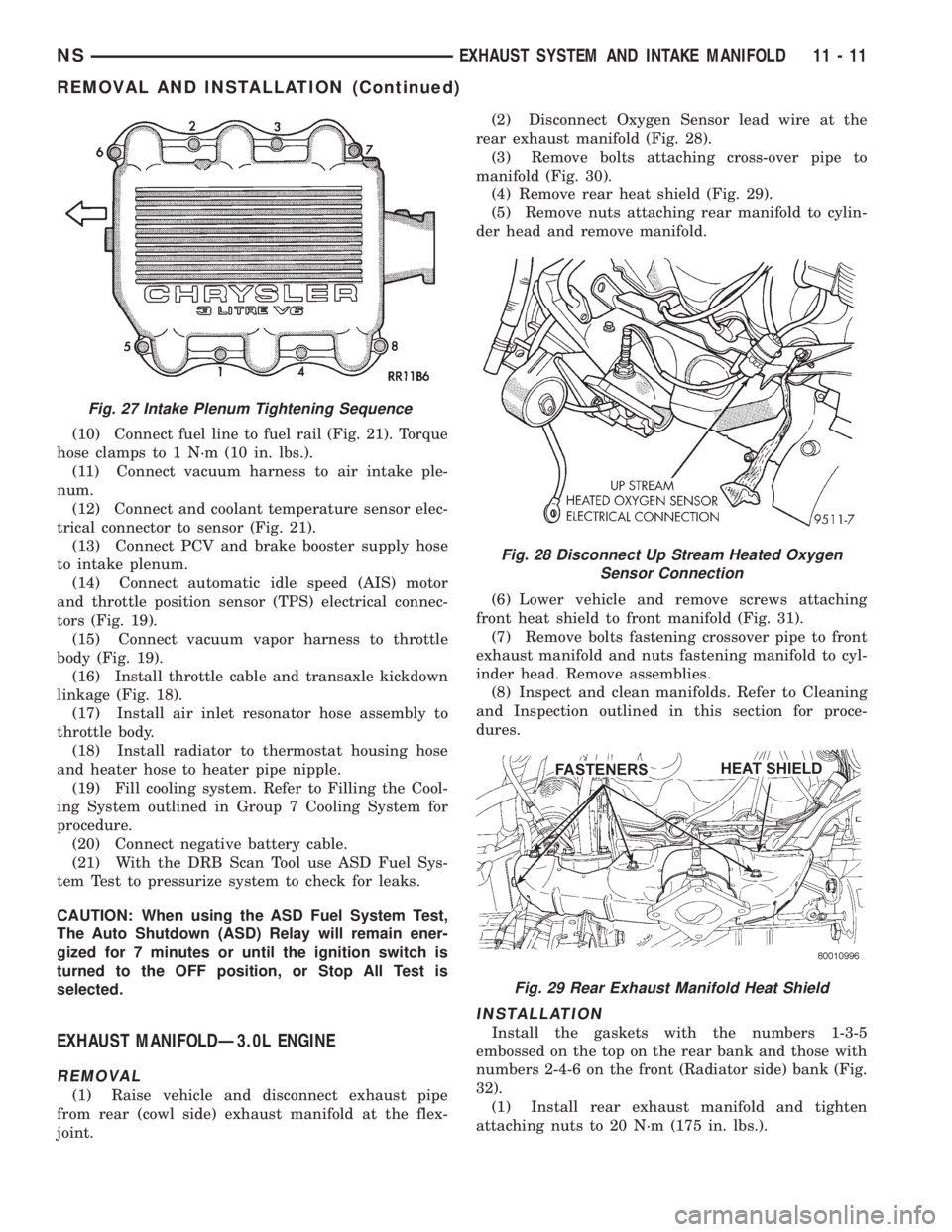
(9) Place intake manifold gasketswith beaded
sealant side upon lower manifold. Put air intake in
place. Install attaching fasteners and tighten in sev-
eral steps in sequence shown (Fig. 27) to 13 N´m (115
in. lbs.).
Fig. 25 Intake and Exhaust Manifolds Ð 3.0L Engine
Fig. 26 Fastener Tightening Sequence for Intake
(Cross) Manifold
11 - 10 EXHAUST SYSTEM AND INTAKE MANIFOLDNS
REMOVAL AND INSTALLATION (Continued)
Page 1273 of 1938
(10) Connect fuel line to fuel rail (Fig. 21). Torque
hose clamps to 1 N´m (10 in. lbs.).
(11) Connect vacuum harness to air intake ple-
num.
(12) Connect and coolant temperature sensor elec-
trical connector to sensor (Fig. 21).
(13) Connect PCV and brake booster supply hose
to intake plenum.
(14) Connect automatic idle speed (AIS) motor
and throttle position sensor (TPS) electrical connec-
tors (Fig. 19).
(15) Connect vacuum vapor harness to throttle
body (Fig. 19).
(16) Install throttle cable and transaxle kickdown
linkage (Fig. 18).
(17) Install air inlet resonator hose assembly to
throttle body.
(18) Install radiator to thermostat housing hose
and heater hose to heater pipe nipple.
(19) Fill cooling system. Refer to Filling the Cool-
ing System outlined in Group 7 Cooling System for
procedure.
(20) Connect negative battery cable.
(21) With the DRB Scan Tool use ASD Fuel Sys-
tem Test to pressurize system to check for leaks.
CAUTION: When using the ASD Fuel System Test,
The Auto Shutdown (ASD) Relay will remain ener-
gized for 7 minutes or until the ignition switch is
turned to the OFF position, or Stop All Test is
selected.
EXHAUST MANIFOLDÐ3.0L ENGINE
REMOVAL
(1) Raise vehicle and disconnect exhaust pipe
from rear (cowl side) exhaust manifold at the flex-
joint.(2) Disconnect Oxygen Sensor lead wire at the
rear exhaust manifold (Fig. 28).
(3) Remove bolts attaching cross-over pipe to
manifold (Fig. 30).
(4) Remove rear heat shield (Fig. 29).
(5) Remove nuts attaching rear manifold to cylin-
der head and remove manifold.
(6) Lower vehicle and remove screws attaching
front heat shield to front manifold (Fig. 31).
(7) Remove bolts fastening crossover pipe to front
exhaust manifold and nuts fastening manifold to cyl-
inder head. Remove assemblies.
(8) Inspect and clean manifolds. Refer to Cleaning
and Inspection outlined in this section for proce-
dures.
INSTALLATION
Install the gaskets with the numbers 1-3-5
embossed on the top on the rear bank and those with
numbers 2-4-6 on the front (Radiator side) bank (Fig.
32).
(1) Install rear exhaust manifold and tighten
attaching nuts to 20 N´m (175 in. lbs.).
Fig. 27 Intake Plenum Tightening Sequence
Fig. 28 Disconnect Up Stream Heated Oxygen
Sensor Connection
Fig. 29 Rear Exhaust Manifold Heat Shield
NSEXHAUST SYSTEM AND INTAKE MANIFOLD 11 - 11
REMOVAL AND INSTALLATION (Continued)
Page 1275 of 1938
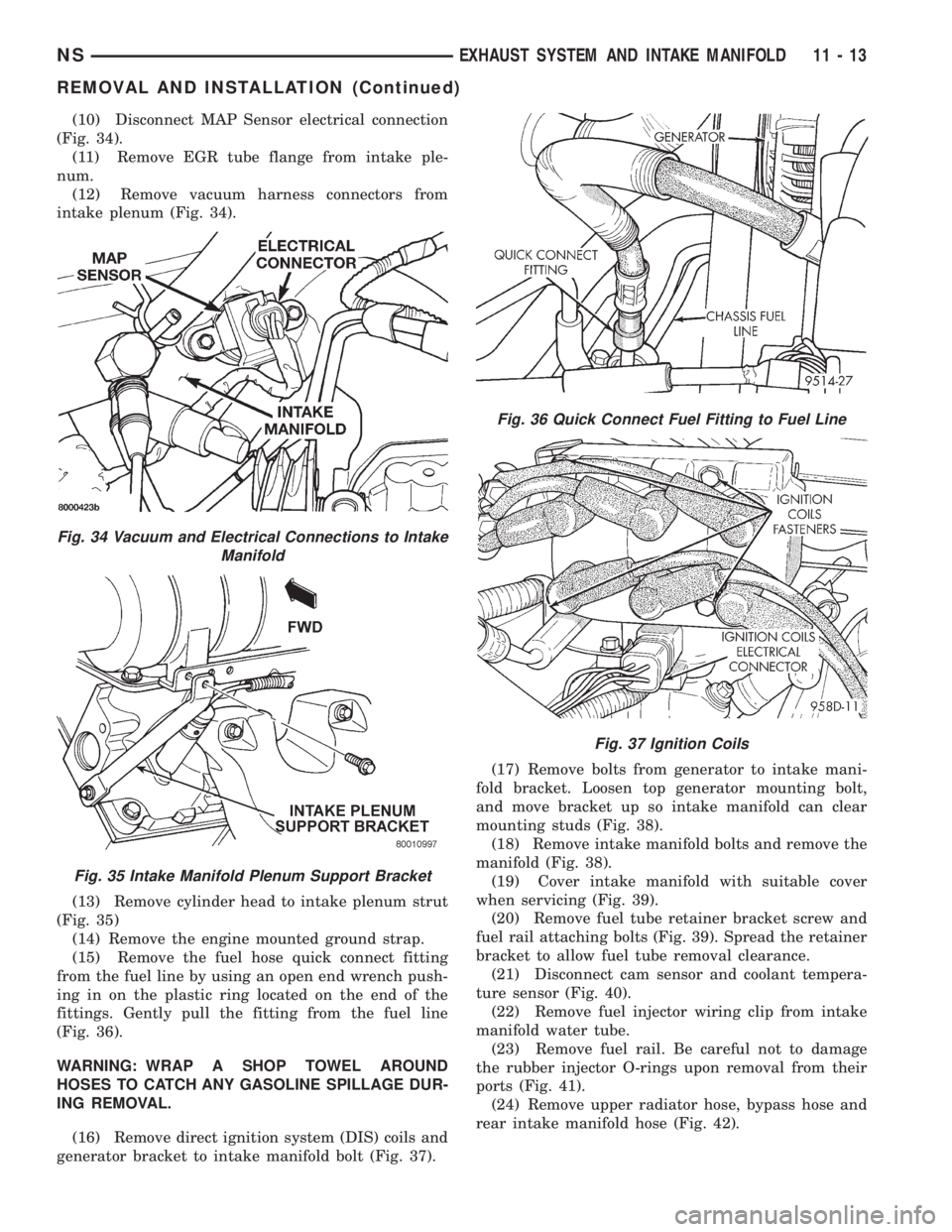
(10) Disconnect MAP Sensor electrical connection
(Fig. 34).
(11) Remove EGR tube flange from intake ple-
num.
(12) Remove vacuum harness connectors from
intake plenum (Fig. 34).
(13) Remove cylinder head to intake plenum strut
(Fig. 35)
(14) Remove the engine mounted ground strap.
(15) Remove the fuel hose quick connect fitting
from the fuel line by using an open end wrench push-
ing in on the plastic ring located on the end of the
fittings. Gently pull the fitting from the fuel line
(Fig. 36).
WARNING: WRAP A SHOP TOWEL AROUND
HOSES TO CATCH ANY GASOLINE SPILLAGE DUR-
ING REMOVAL.
(16) Remove direct ignition system (DIS) coils and
generator bracket to intake manifold bolt (Fig. 37).(17) Remove bolts from generator to intake mani-
fold bracket. Loosen top generator mounting bolt,
and move bracket up so intake manifold can clear
mounting studs (Fig. 38).
(18) Remove intake manifold bolts and remove the
manifold (Fig. 38).
(19) Cover intake manifold with suitable cover
when servicing (Fig. 39).
(20) Remove fuel tube retainer bracket screw and
fuel rail attaching bolts (Fig. 39). Spread the retainer
bracket to allow fuel tube removal clearance.
(21) Disconnect cam sensor and coolant tempera-
ture sensor (Fig. 40).
(22) Remove fuel injector wiring clip from intake
manifold water tube.
(23) Remove fuel rail. Be careful not to damage
the rubber injector O-rings upon removal from their
ports (Fig. 41).
(24) Remove upper radiator hose, bypass hose and
rear intake manifold hose (Fig. 42).
Fig. 34 Vacuum and Electrical Connections to Intake
Manifold
Fig. 35 Intake Manifold Plenum Support Bracket
Fig. 36 Quick Connect Fuel Fitting to Fuel Line
Fig. 37 Ignition Coils
NSEXHAUST SYSTEM AND INTAKE MANIFOLD 11 - 13
REMOVAL AND INSTALLATION (Continued)
Page 1281 of 1938
FRAME AND BUMPERS
CONTENTS
page page
BUMPERS AND FASCIA.................... 1FRAME................................. 3
BUMPERS AND FASCIA
INDEX
page page
REMOVAL AND INSTALLATION
FRONT BUMPER FASCIA.................. 1
FRONT BUMPER REINFORCEMENT.......... 1REAR BUMPER FASCIA................... 2
REAR BUMPER REINFORCEMENT........... 2
REMOVAL AND INSTALLATION
FRONT BUMPER FASCIA
REMOVAL
(1) Release hood latch and open hood.
(2) Remove bolts holding fascia to headlamp
mounting panel at each side of grille.
(3) Hoist and support vehicle on safety stands.
(4) Remove front wheels. Refer to Group 22,
Wheels and Tires, for proper procedures and
sequence.
(5) Remove front wheelhouse splash shields fasten-
ers as necessary to gain access to bolts holding front
fascia to fender. Refer to Group 23, Body, for proper
procedures.
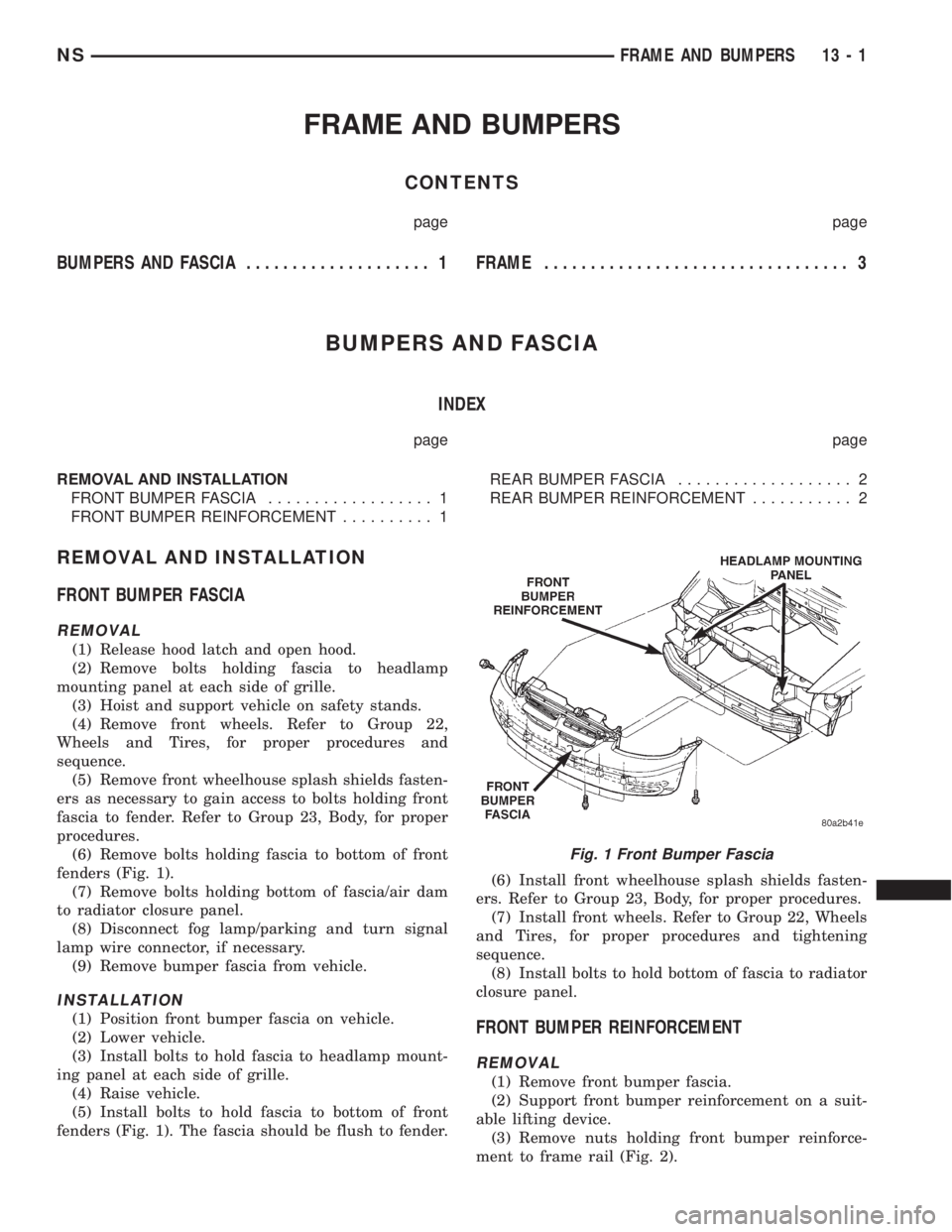
(6) Remove bolts holding fascia to bottom of front
fenders (Fig. 1).
(7) Remove bolts holding bottom of fascia/air dam
to radiator closure panel.
(8) Disconnect fog lamp/parking and turn signal
lamp wire connector, if necessary.
(9) Remove bumper fascia from vehicle.
INSTALLATION
(1) Position front bumper fascia on vehicle.
(2) Lower vehicle.
(3) Install bolts to hold fascia to headlamp mount-
ing panel at each side of grille.
(4) Raise vehicle.
(5) Install bolts to hold fascia to bottom of front
fenders (Fig. 1). The fascia should be flush to fender.(6) Install front wheelhouse splash shields fasten-
ers. Refer to Group 23, Body, for proper procedures.
(7) Install front wheels. Refer to Group 22, Wheels
and Tires, for proper procedures and tightening
sequence.
(8) Install bolts to hold bottom of fascia to radiator
closure panel.FRONT BUMPER REINFORCEMENT
REMOVAL
(1) Remove front bumper fascia.
(2) Support front bumper reinforcement on a suit-
able lifting device.
(3) Remove nuts holding front bumper reinforce-
ment to frame rail (Fig. 2).
Fig. 1 Front Bumper Fascia
NSFRAME AND BUMPERS 13 - 1
Page 1293 of 1938
FRAME AND BUMPERS
CONTENTS
page
FRAME................................ 1
FRAME
INDEX
page page
REMOVAL AND INSTALLATION
FRONT TOW HOOK BRACKET............. 1REAR TOW HOOK BRACKET.............. 1
REMOVAL AND INSTALLATION
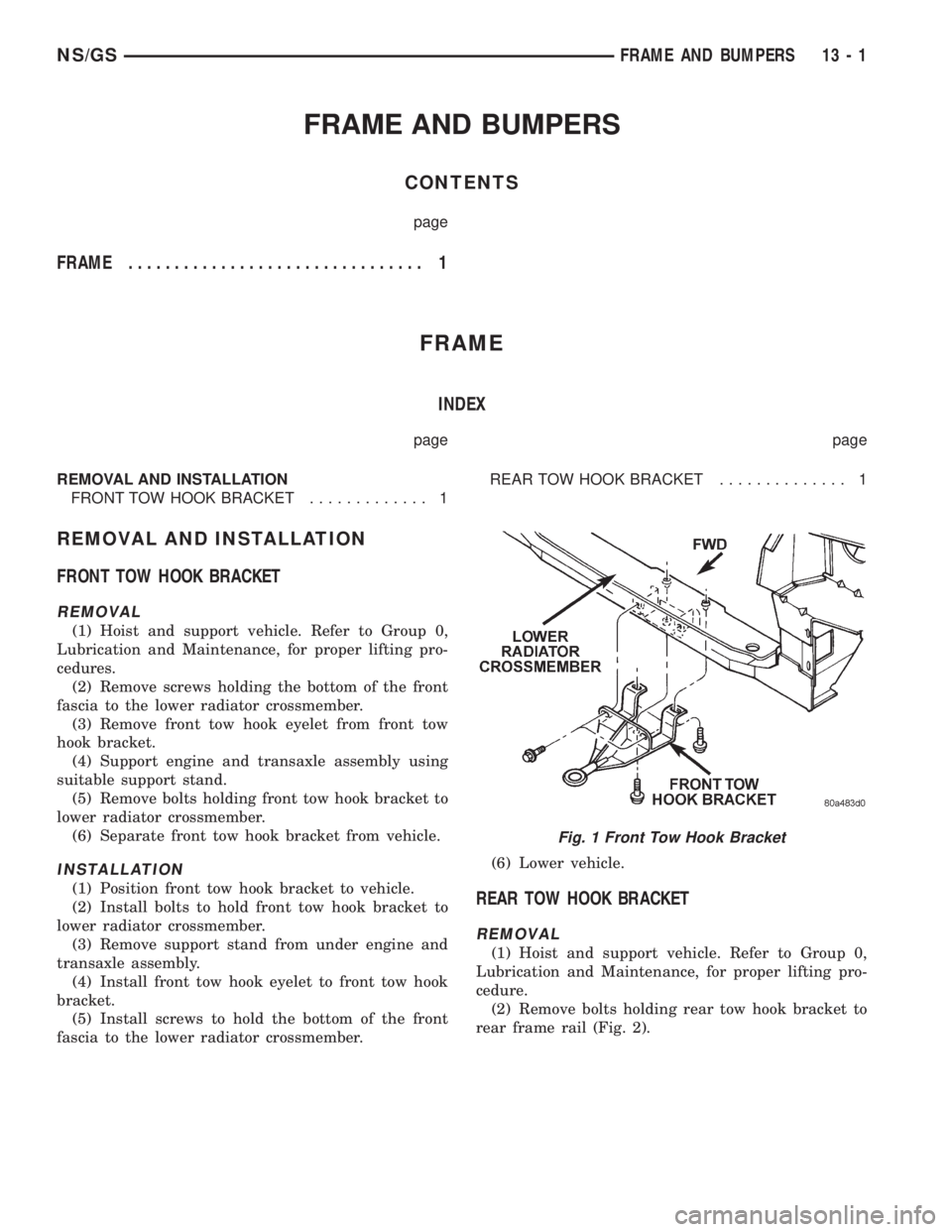
FRONT TOW HOOK BRACKET
REMOVAL
(1) Hoist and support vehicle. Refer to Group 0,
Lubrication and Maintenance, for proper lifting pro-
cedures.
(2) Remove screws holding the bottom of the front
fascia to the lower radiator crossmember.
(3) Remove front tow hook eyelet from front tow
hook bracket.
(4) Support engine and transaxle assembly using
suitable support stand.
(5) Remove bolts holding front tow hook bracket to
lower radiator crossmember.
(6) Separate front tow hook bracket from vehicle.
INSTALLATION
(1) Position front tow hook bracket to vehicle.
(2) Install bolts to hold front tow hook bracket to
lower radiator crossmember.
(3) Remove support stand from under engine and
transaxle assembly.
(4) Install front tow hook eyelet to front tow hook
bracket.
(5) Install screws to hold the bottom of the front
fascia to the lower radiator crossmember.(6) Lower vehicle.REAR TOW HOOK BRACKET
REMOVAL
(1) Hoist and support vehicle. Refer to Group 0,
Lubrication and Maintenance, for proper lifting pro-
cedure.
(2) Remove bolts holding rear tow hook bracket to
rear frame rail (Fig. 2).
Fig. 1 Front Tow Hook Bracket
NS/GSFRAME AND BUMPERS 13 - 1
Page 1326 of 1938
IGNITION SWITCH OFF MODE
When the ignition switch is turned to the OFF
position, the following occurs:
²All outputs are turned off.
²No inputs are monitored.
²The PCM shuts down.
DESCRIPTION AND OPERATION
SYSTEM DIAGNOSIS
The PCM can test many of its own input and out-
put circuits. If the PCM senses a fault in a major
system, the PCM stores a Diagnostic Trouble Code
(DTC) in memory.
For DTC information, refer to Group 25, Emission
Control Systems. See On-Board Diagnostics.
CCD BUS
Various controllers and modules exchange informa-
tion through a communications port called the CCD
Bus. The PCM transmits the malfunction indicator
(check engine) lamp On/Off signal, engine RPM and
vehicle load information on the CCD Bus.
POWERTRAIN CONTROL MODULE (PCM)
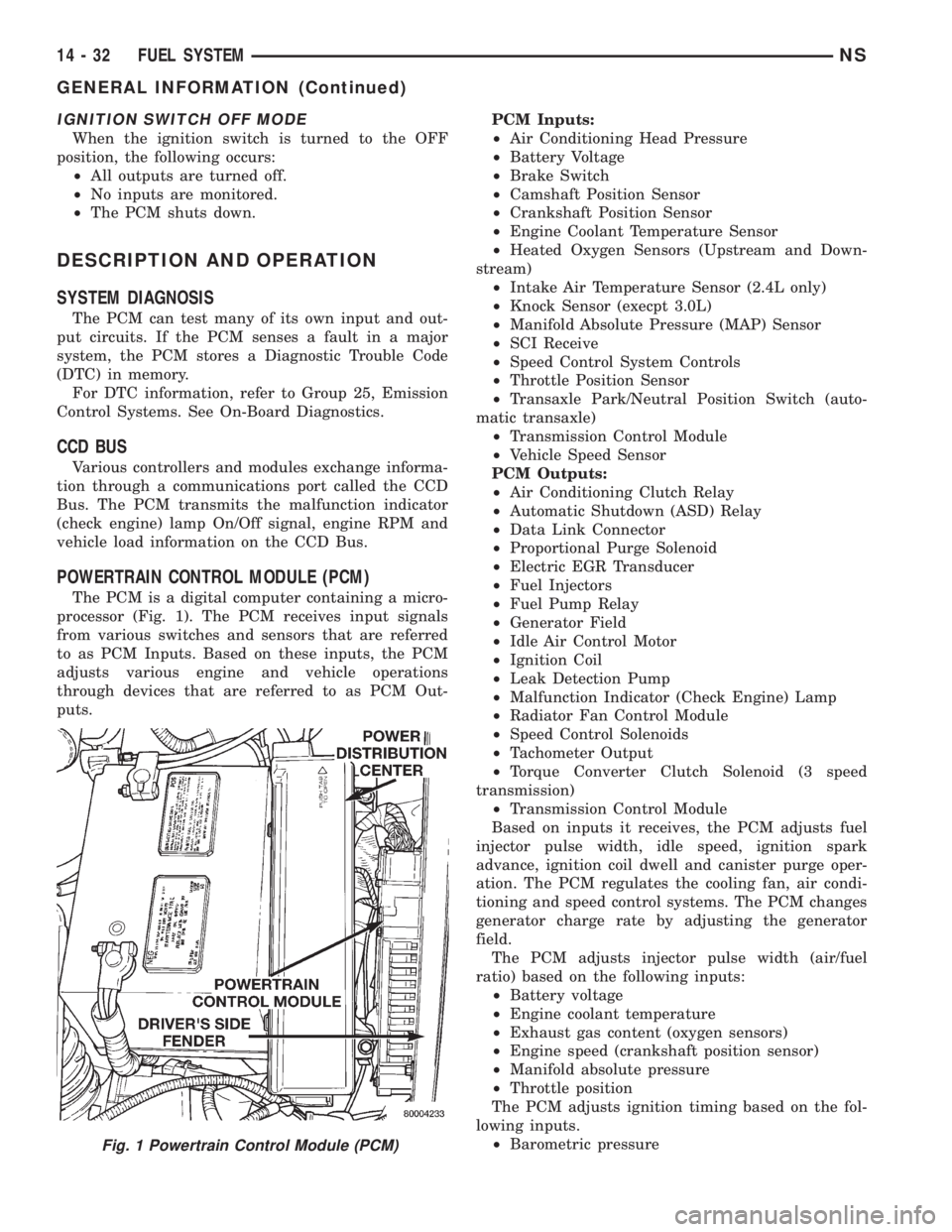
The PCM is a digital computer containing a micro-
processor (Fig. 1). The PCM receives input signals
from various switches and sensors that are referred
to as PCM Inputs. Based on these inputs, the PCM
adjusts various engine and vehicle operations
through devices that are referred to as PCM Out-
puts.PCM Inputs:
²Air Conditioning Head Pressure
²Battery Voltage
²Brake Switch
²Camshaft Position Sensor
²Crankshaft Position Sensor
²Engine Coolant Temperature Sensor
²Heated Oxygen Sensors (Upstream and Down-
stream)
²Intake Air Temperature Sensor (2.4L only)
²Knock Sensor (execpt 3.0L)
²Manifold Absolute Pressure (MAP) Sensor
²SCI Receive
²Speed Control System Controls
²Throttle Position Sensor
²Transaxle Park/Neutral Position Switch (auto-
matic transaxle)
²Transmission Control Module
²Vehicle Speed Sensor
PCM Outputs:
²Air Conditioning Clutch Relay
²Automatic Shutdown (ASD) Relay
²Data Link Connector
²Proportional Purge Solenoid
²Electric EGR Transducer
²Fuel Injectors
²Fuel Pump Relay
²Generator Field
²Idle Air Control Motor
²Ignition Coil
²Leak Detection Pump
²Malfunction Indicator (Check Engine) Lamp
²Radiator Fan Control Module
²Speed Control Solenoids
²Tachometer Output
²Torque Converter Clutch Solenoid (3 speed
transmission)
²Transmission Control Module
Based on inputs it receives, the PCM adjusts fuel
injector pulse width, idle speed, ignition spark
advance, ignition coil dwell and canister purge oper-
ation. The PCM regulates the cooling fan, air condi-
tioning and speed control systems. The PCM changes
generator charge rate by adjusting the generator
field.
The PCM adjusts injector pulse width (air/fuel
ratio) based on the following inputs:
²Battery voltage
²Engine coolant temperature
²Exhaust gas content (oxygen sensors)
²Engine speed (crankshaft position sensor)
²Manifold absolute pressure
²Throttle position
The PCM adjusts ignition timing based on the fol-
lowing inputs.
²Barometric pressure
Fig. 1 Powertrain Control Module (PCM)
14 - 32 FUEL SYSTEMNS
GENERAL INFORMATION (Continued)
Page 1335 of 1938
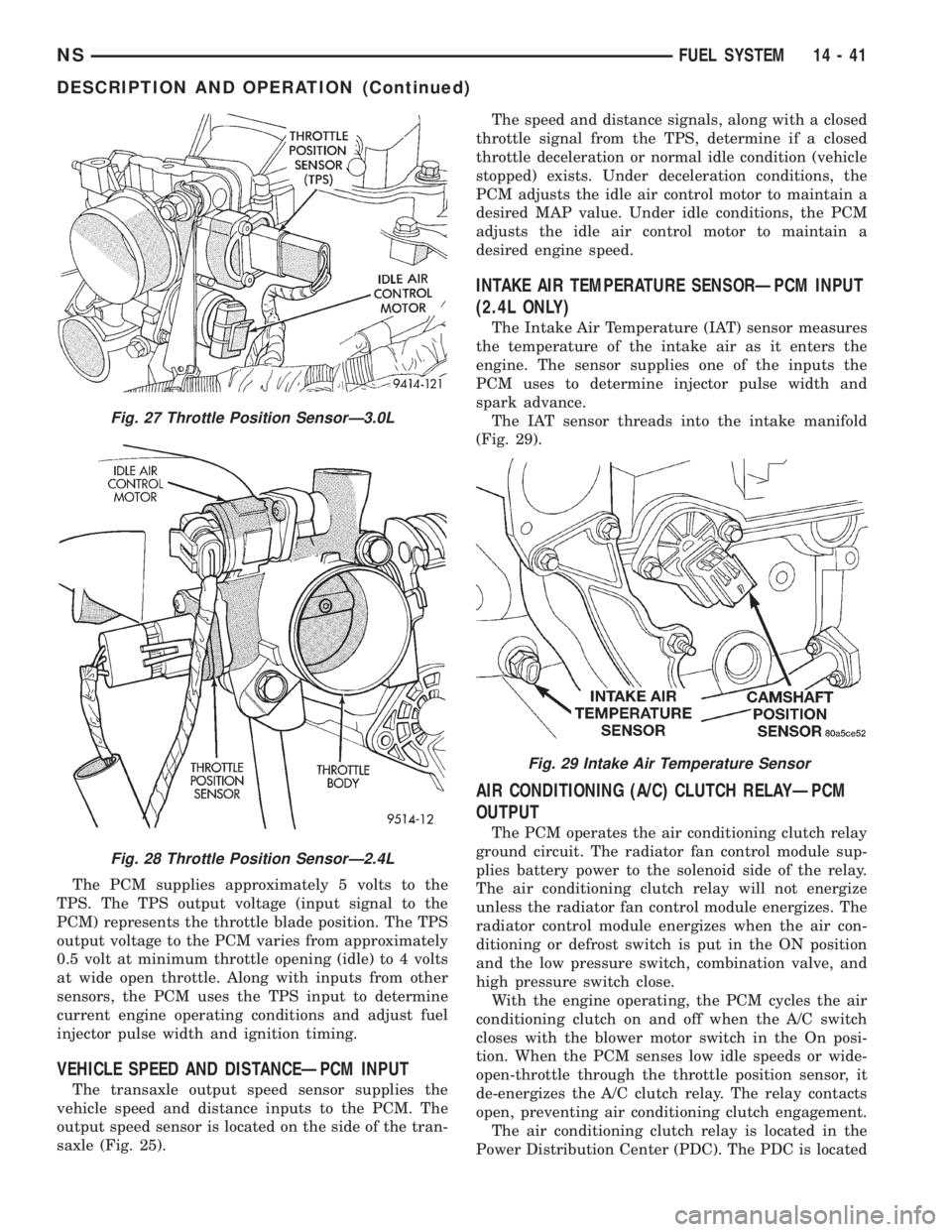
The PCM supplies approximately 5 volts to the
TPS. The TPS output voltage (input signal to the
PCM) represents the throttle blade position. The TPS
output voltage to the PCM varies from approximately
0.5 volt at minimum throttle opening (idle) to 4 volts
at wide open throttle. Along with inputs from other
sensors, the PCM uses the TPS input to determine
current engine operating conditions and adjust fuel
injector pulse width and ignition timing.
VEHICLE SPEED AND DISTANCEÐPCM INPUT
The transaxle output speed sensor supplies the
vehicle speed and distance inputs to the PCM. The
output speed sensor is located on the side of the tran-
saxle (Fig. 25).The speed and distance signals, along with a closed
throttle signal from the TPS, determine if a closed
throttle deceleration or normal idle condition (vehicle
stopped) exists. Under deceleration conditions, the
PCM adjusts the idle air control motor to maintain a
desired MAP value. Under idle conditions, the PCM
adjusts the idle air control motor to maintain a
desired engine speed.
INTAKE AIR TEMPERATURE SENSORÐPCM INPUT
(2.4L ONLY)
The Intake Air Temperature (IAT) sensor measures
the temperature of the intake air as it enters the
engine. The sensor supplies one of the inputs the
PCM uses to determine injector pulse width and
spark advance.
The IAT sensor threads into the intake manifold
(Fig. 29).
AIR CONDITIONING (A/C) CLUTCH RELAYÐPCM
OUTPUT
The PCM operates the air conditioning clutch relay
ground circuit. The radiator fan control module sup-
plies battery power to the solenoid side of the relay.
The air conditioning clutch relay will not energize
unless the radiator fan control module energizes. The
radiator control module energizes when the air con-
ditioning or defrost switch is put in the ON position
and the low pressure switch, combination valve, and
high pressure switch close.
With the engine operating, the PCM cycles the air
conditioning clutch on and off when the A/C switch
closes with the blower motor switch in the On posi-
tion. When the PCM senses low idle speeds or wide-
open-throttle through the throttle position sensor, it
de-energizes the A/C clutch relay. The relay contacts
open, preventing air conditioning clutch engagement.
The air conditioning clutch relay is located in the
Power Distribution Center (PDC). The PDC is located
Fig. 27 Throttle Position SensorÐ3.0L
Fig. 28 Throttle Position SensorÐ2.4L
Fig. 29 Intake Air Temperature Sensor
NSFUEL SYSTEM 14 - 41
DESCRIPTION AND OPERATION (Continued)
Page 1340 of 1938
Shutdown (ASD) RelayÐPCM Output in this section
for relay operation.
TORQUE CONVERTER CLUTCH SOLENOIDÐPCM
OUTPUT
Three-speed automatic transaxles use a torque con-
verter clutch solenoid. The PCM controls the engage-
ment of the torque converter clutch through the
solenoid. The torque converter clutch is engaged only
in direct drive mode. Refer to Group 21 for transaxle
information.
MALFUNCTION INDICATOR (CHECK ENGINE)
LAMPÐPCM OUTPUT
The PCM supplies the malfunction indicator (check
engine) lamp on/off signal to the instrument panel
through the CCD Bus. The CCD Bus is a communi-
cations port. Various modules use the CCD Bus to
exchange information.
The Check Engine lamp comes on each time the
ignition key is turned ON and stays on for 3 seconds
as a bulb test.
The Malfunction Indicator Lamp (MIL) stays on
continuously, when the PCM has entered a Limp-In
mode or identified a failed emission component. Dur-
ing Limp-in Mode, the PCM attempts to keep the
system operational. The MIL signals the need for
immediate service. In limp-in mode, the PCM com-
pensates for the failure of certain components that
send incorrect signals. The PCM substitutes for the
incorrect signals with inputs from other sensors.
If the PCM detects active engine misfire severe
enough to cause catalyst damage, it flashes the MIL.
At the same time the PCM also sets a Diagnostic
Trouble Code (DTC).
For signals that can trigger the MIL (Check
Engine Lamp) refer to Group 25, On-Board
Dianostics.
SOLID STATE FAN RELAYÐPCM OUTPUT
The radiator fan runs at a variable speed depend-
ing on coolant temperature and A/C system pressure.
The radiator fan circuit contains a Solid State Fan
Relay (SSFR). Refer to the Group 8W for a circuit
schematic.
A 5 volt signal is supplied to the SSFR. The PCM
provides a pulsed ground for the SSFR. Depending
upon the amount of pulse on time, the SSFR puts out
a proportional voltage to the fan motor at the lower
speed. For instance, if the on time is 30 percent, then
the voltage to the fan motor will be 3.6 volts.
When engine coolant reaches approximately 102ÉC
(215ÉF) the PCM grounds the SSFR relay. If engine
coolant reaches 207ÉC (225ÉF) the PCM grounds the
high speed ground relay and high speed fan relay. If
the fan operates at high speed, the PCM de-energizes
the high speed relay and high speed ground relay
when coolant temperature drops to approximately
101ÉC (214ÉF). When coolant temperature drops to
101ÉC (214ÉF) the fan operates at low speed. The
PCM de-energizes the low speed relay when coolant
temperature drops to approximately 93ÉC (199ÉF).
Also, when the air conditioning pressure switch
closes, the fan operates at high speed. The air condi-
tioning switch closes at 285 psi610 psi. When air
conditioning pressure drops approximately 40 psi, the
pressure switch opens and the fan operates at low
speed.
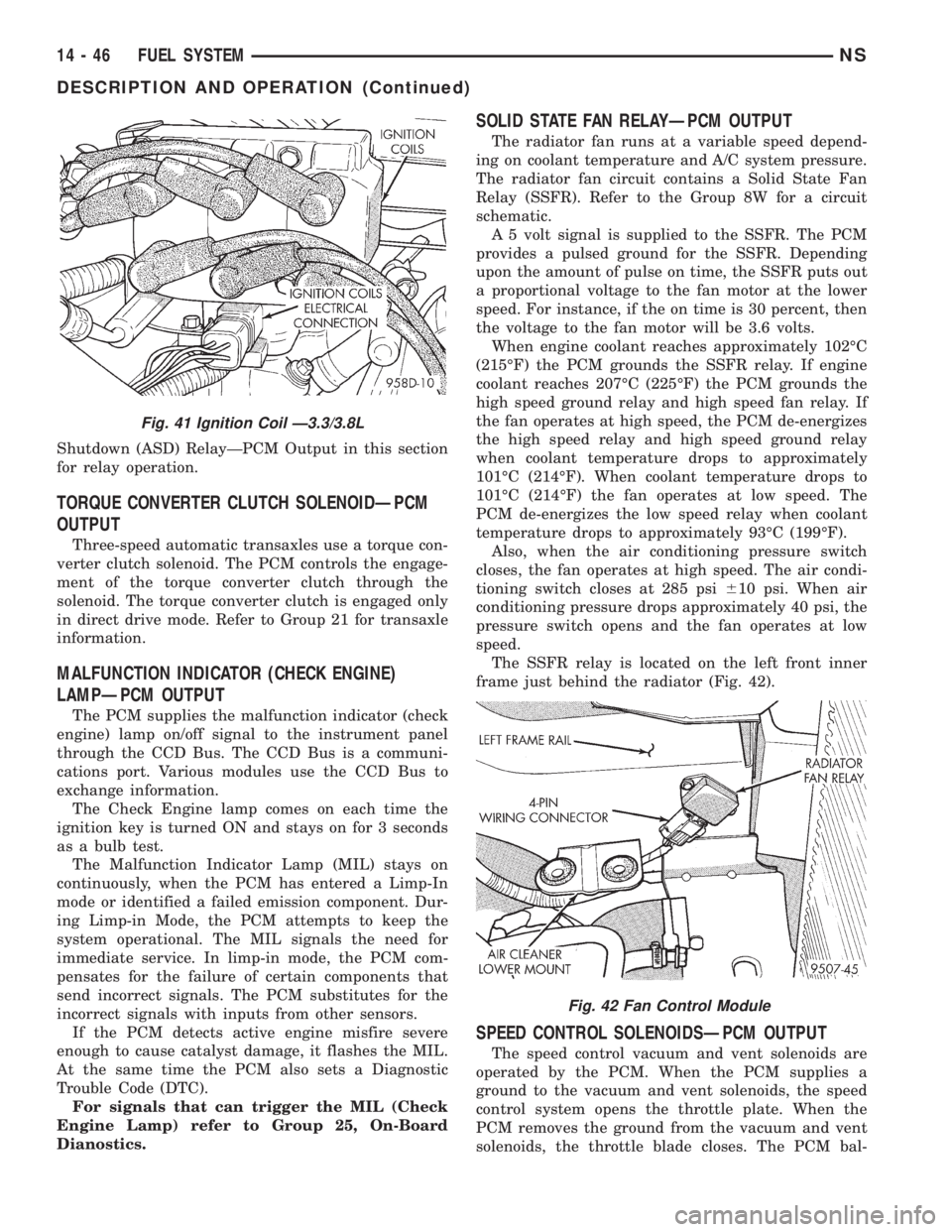
The SSFR relay is located on the left front inner
frame just behind the radiator (Fig. 42).
SPEED CONTROL SOLENOIDSÐPCM OUTPUT
The speed control vacuum and vent solenoids are
operated by the PCM. When the PCM supplies a
ground to the vacuum and vent solenoids, the speed
control system opens the throttle plate. When the
PCM removes the ground from the vacuum and vent
solenoids, the throttle blade closes. The PCM bal-
Fig. 41 Ignition Coil Ð3.3/3.8L
Fig. 42 Fan Control Module
14 - 46 FUEL SYSTEMNS
DESCRIPTION AND OPERATION (Continued)