change time CHRYSLER VOYAGER 2001 Manual Online
[x] Cancel search | Manufacturer: CHRYSLER, Model Year: 2001, Model line: VOYAGER, Model: CHRYSLER VOYAGER 2001Pages: 4284, PDF Size: 83.53 MB
Page 1294 of 4284
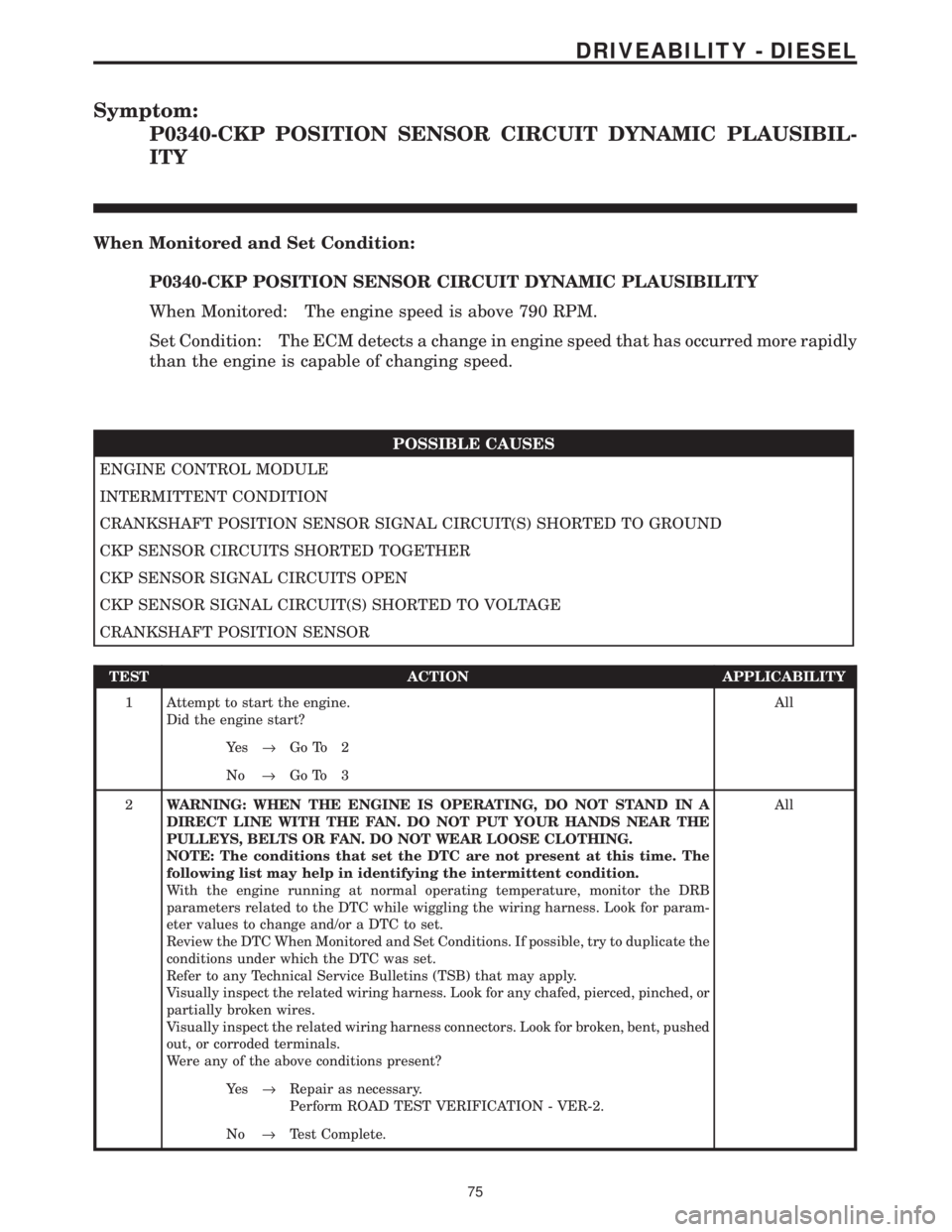
Symptom:
P0340-CKP POSITION SENSOR CIRCUIT DYNAMIC PLAUSIBIL-
ITY
When Monitored and Set Condition:
P0340-CKP POSITION SENSOR CIRCUIT DYNAMIC PLAUSIBILITY
When Monitored: The engine speed is above 790 RPM.
Set Condition: The ECM detects a change in engine speed that has occurred more rapidly
than the engine is capable of changing speed.
POSSIBLE CAUSES
ENGINE CONTROL MODULE
INTERMITTENT CONDITION
CRANKSHAFT POSITION SENSOR SIGNAL CIRCUIT(S) SHORTED TO GROUND
CKP SENSOR CIRCUITS SHORTED TOGETHER
CKP SENSOR SIGNAL CIRCUITS OPEN
CKP SENSOR SIGNAL CIRCUIT(S) SHORTED TO VOLTAGE
CRANKSHAFT POSITION SENSOR
TEST ACTION APPLICABILITY
1 Attempt to start the engine.
Did the engine start?All
Ye s®Go To 2
No®Go To 3
2WARNING: WHEN THE ENGINE IS OPERATING, DO NOT STAND IN A
DIRECT LINE WITH THE FAN. DO NOT PUT YOUR HANDS NEAR THE
PULLEYS, BELTS OR FAN. DO NOT WEAR LOOSE CLOTHING.
NOTE: The conditions that set the DTC are not present at this time. The
following list may help in identifying the intermittent condition.
With the engine running at normal operating temperature, monitor the DRB
parameters related to the DTC while wiggling the wiring harness. Look for param-
eter values to change and/or a DTC to set.
Review the DTC When Monitored and Set Conditions. If possible, try to duplicate the
conditions under which the DTC was set.
Refer to any Technical Service Bulletins (TSB) that may apply.
Visually inspect the related wiring harness. Look for any chafed, pierced, pinched, or
partially broken wires.
Visually inspect the related wiring harness connectors. Look for broken, bent, pushed
out, or corroded terminals.
Were any of the above conditions present?All
Ye s®Repair as necessary.
Perform ROAD TEST VERIFICATION - VER-2.
No®Test Complete.
75
DRIVEABILITY - DIESEL
Page 1298 of 4284
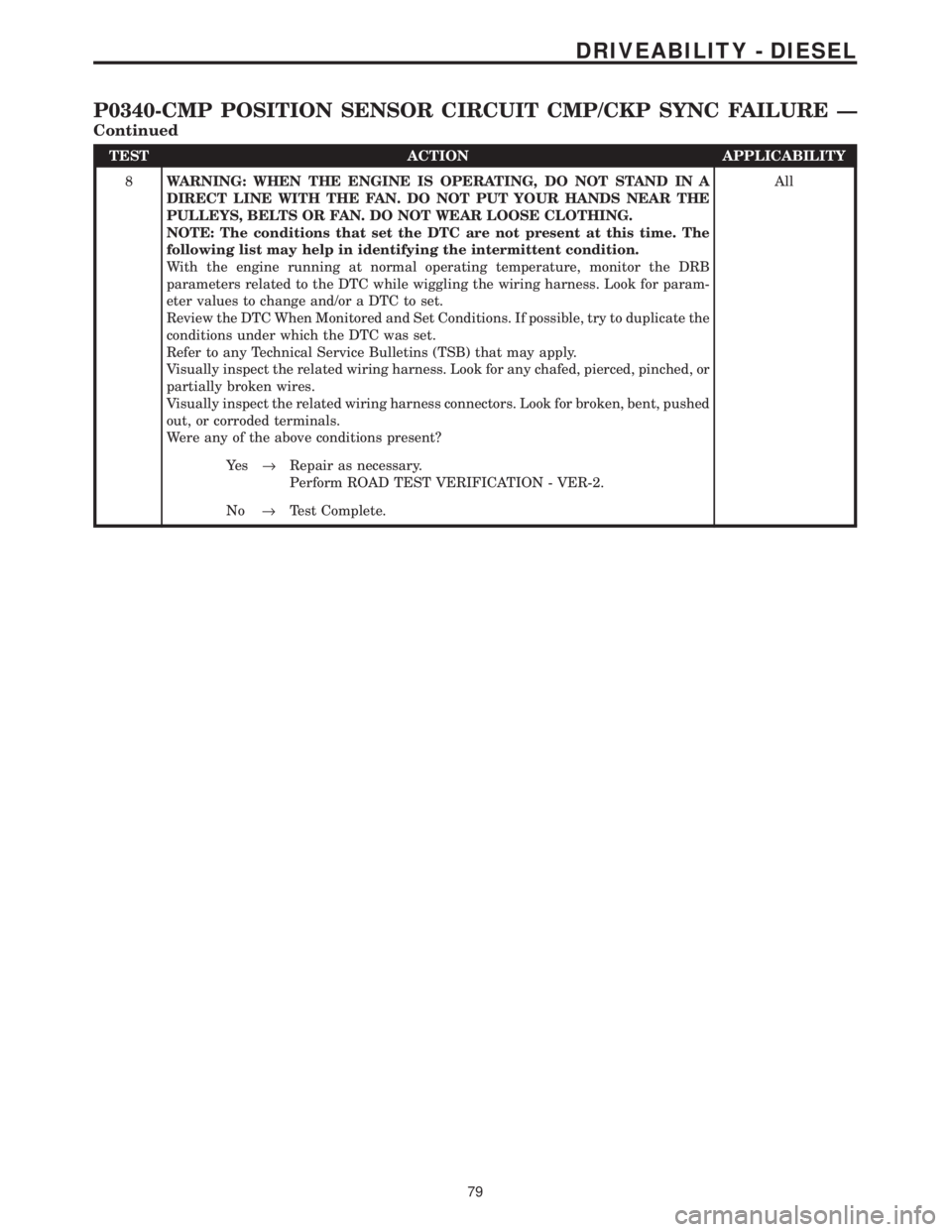
TEST ACTION APPLICABILITY
8WARNING: WHEN THE ENGINE IS OPERATING, DO NOT STAND IN A
DIRECT LINE WITH THE FAN. DO NOT PUT YOUR HANDS NEAR THE
PULLEYS, BELTS OR FAN. DO NOT WEAR LOOSE CLOTHING.
NOTE: The conditions that set the DTC are not present at this time. The
following list may help in identifying the intermittent condition.
With the engine running at normal operating temperature, monitor the DRB
parameters related to the DTC while wiggling the wiring harness. Look for param-
eter values to change and/or a DTC to set.
Review the DTC When Monitored and Set Conditions. If possible, try to duplicate the
conditions under which the DTC was set.
Refer to any Technical Service Bulletins (TSB) that may apply.
Visually inspect the related wiring harness. Look for any chafed, pierced, pinched, or
partially broken wires.
Visually inspect the related wiring harness connectors. Look for broken, bent, pushed
out, or corroded terminals.
Were any of the above conditions present?All
Ye s®Repair as necessary.
Perform ROAD TEST VERIFICATION - VER-2.
No®Test Complete.
79
DRIVEABILITY - DIESEL
P0340-CMP POSITION SENSOR CIRCUIT CMP/CKP SYNC FAILURE Ð
Continued
Page 1301 of 4284
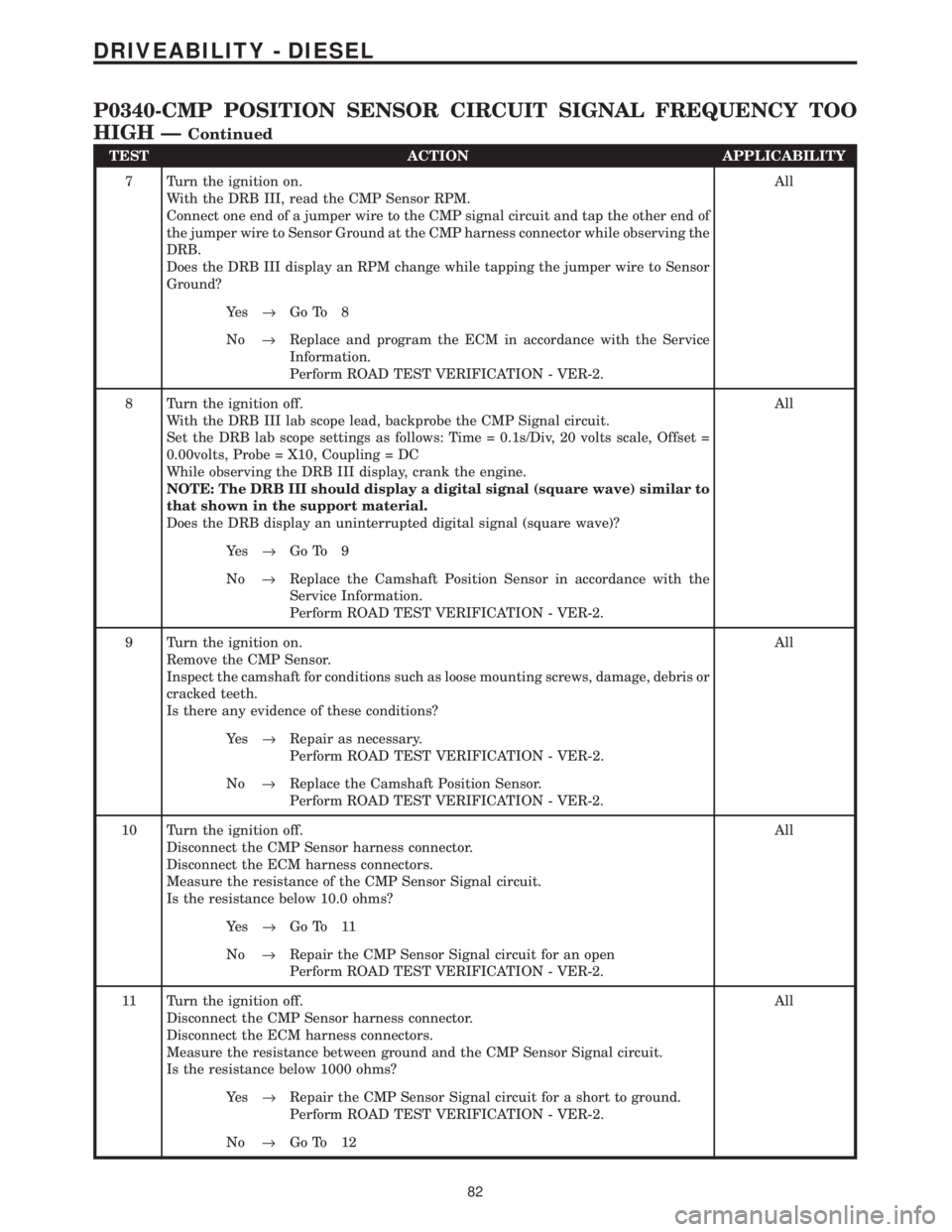
TEST ACTION APPLICABILITY
7 Turn the ignition on.
With the DRB III, read the CMP Sensor RPM.
Connect one end of a jumper wire to the CMP signal circuit and tap the other end of
the jumper wire to Sensor Ground at the CMP harness connector while observing the
DRB.
Does the DRB III display an RPM change while tapping the jumper wire to Sensor
Ground?All
Ye s®Go To 8
No®Replace and program the ECM in accordance with the Service
Information.
Perform ROAD TEST VERIFICATION - VER-2.
8 Turn the ignition off.
With the DRB III lab scope lead, backprobe the CMP Signal circuit.
Set the DRB lab scope settings as follows: Time = 0.1s/Div, 20 volts scale, Offset =
0.00volts, Probe = X10, Coupling = DC
While observing the DRB III display, crank the engine.
NOTE: The DRB III should display a digital signal (square wave) similar to
that shown in the support material.
Does the DRB display an uninterrupted digital signal (square wave)?All
Ye s®Go To 9
No®Replace the Camshaft Position Sensor in accordance with the
Service Information.
Perform ROAD TEST VERIFICATION - VER-2.
9 Turn the ignition on.
Remove the CMP Sensor.
Inspect the camshaft for conditions such as loose mounting screws, damage, debris or
cracked teeth.
Is there any evidence of these conditions?All
Ye s®Repair as necessary.
Perform ROAD TEST VERIFICATION - VER-2.
No®Replace the Camshaft Position Sensor.
Perform ROAD TEST VERIFICATION - VER-2.
10 Turn the ignition off.
Disconnect the CMP Sensor harness connector.
Disconnect the ECM harness connectors.
Measure the resistance of the CMP Sensor Signal circuit.
Is the resistance below 10.0 ohms?All
Ye s®Go To 11
No®Repair the CMP Sensor Signal circuit for an open
Perform ROAD TEST VERIFICATION - VER-2.
11 Turn the ignition off.
Disconnect the CMP Sensor harness connector.
Disconnect the ECM harness connectors.
Measure the resistance between ground and the CMP Sensor Signal circuit.
Is the resistance below 1000 ohms?All
Ye s®Repair the CMP Sensor Signal circuit for a short to ground.
Perform ROAD TEST VERIFICATION - VER-2.
No®Go To 12
82
DRIVEABILITY - DIESEL
P0340-CMP POSITION SENSOR CIRCUIT SIGNAL FREQUENCY TOO
HIGH Ð
Continued
Page 1302 of 4284

TEST ACTION APPLICABILITY
12 Turn the ignition off.
Disconnect the CMP Sensor harness connector.
Disconnect the ECM harness connectors.
Measure the resistance between the CMP Sensor Signal circuit and the Sensor
Ground circuit at of the CMP Sensor harness connector.
Is the resistance below 1000 ohms?All
Ye s®Repair the CMP Sensor Signal and Sensor Ground circuits for a
short together.
Perform ROAD TEST VERIFICATION - VER-2.
No®Replace and program the Engine Control Module in accordance
with the Service Information.
Perform ROAD TEST VERIFICATION - VER-2.
13WARNING: WHEN THE ENGINE IS OPERATING, DO NOT STAND IN A
DIRECT LINE WITH THE FAN. DO NOT PUT YOUR HANDS NEAR THE
PULLEYS, BELTS OR FAN. DO NOT WEAR LOOSE CLOTHING.
NOTE: The conditions that set the DTC are not present at this time. The
following list may help in identifying the intermittent condition.
With the engine running and at normal operating temperature, monitor the DRB
parameters related to the DTC while wiggling the wiring harness. Look for param-
eter values to change and/or a DTC to set.
Remove the CMP Sensor and the CKP Sensor, checking for loose mounting screws
and debris on the sensor magnets that can corrupt the sensor signal.
Review the DTC When Monitored and Set Conditions. If possible, try to duplicate the
conditions under which the DTC was set.
Refer to any Technical Service Bulletins (TSB) that may apply.
Visually inspect the related wiring harness. Look for any chafed, pierced, pinched, or
partially broken wires.
Visually inspect the related wiring harness connectors. Look for broken, bent, pushed
out, or corroded terminals.
Were any of the above conditions present?All
Ye s®Repair as necessary.
Perform ROAD TEST VERIFICATION - VER-2.
No®Test Complete.
83
DRIVEABILITY - DIESEL
P0340-CMP POSITION SENSOR CIRCUIT SIGNAL FREQUENCY TOO
HIGH Ð
Continued
Page 1304 of 4284

TEST ACTION APPLICABILITY
2WARNING: WHEN THE ENGINE IS OPERATING, DO NOT STAND IN A
DIRECT LINE WITH THE FAN. DO NOT PUT YOUR HANDS NEAR THE
PULLEYS, BELTS OR FAN. DO NOT WEAR LOOSE CLOTHING.
NOTE: The conditions that set the DTC are not present at this time. The
following list may help in identifying the intermittent condition.
With the engine running at normal operating temperature, monitor the DRB
parameters related to the DTC while wiggling the wiring harness. Look for param-
eter values to change and/or a DTC to set.
Review the DTC When Monitored and Set Conditions. If possible, try to duplicate the
conditions under which the DTC was set.
Refer to any Technical Service Bulletins (TSB) that may apply.
Visually inspect the related wiring harness. Look for any chafed, pierced, pinched, or
partially broken wires.
Visually inspect the related wiring harness connectors. Look for broken, bent, pushed
out, or corroded terminals.
Were any of the above conditions present?All
Ye s®Repair as necessary.
Perform ROAD TEST VERIFICATION - VER-2.
No®Test Complete.
3 Turn the ignition off.
Disconnect the Glow Plug Relay harness connector.
Turn the ignition on.
Using a 12-volt test light connected to ground, check the ECM/PCM Relay Output
circuit.
Does the test light illuminate brightly?All
Ye s®Go To 4
No®Repair the ECM/PCM Relay Output circuit for an open.
Perform ROAD TEST VERIFICATION - VER-2.
4 Turn the ignition off.
Install a substitute relay in place of the Glow Plug Relay.
Perform several ignition key cycles, pausing for at least 10 seconds between each
cycle.
Turn the ignition on.
With the DRB, read ECM DTCs.
Did this DTC reset?All
Ye s®Go To 5
No®Replace the Glow Plug Relay.
Perform ROAD TEST VERIFICATION - VER-2.
5 Turn the ignition off.
Disconnect the ECM harness connectors.
Disconnect the Glow Plug Relay harness connector.
Remove the ECM/PCM Relay from the IPM.
Connect a jumper wire between cavity 1 and cavity 4 of the ECM/PCM Relay
connector.
Turn the ignition on.
Measure the voltage on the Glow Plug Relay Control circuit.
Is the voltage above 1.0 volt?All
Ye s®Repair the Glow Plug Relay Control circuit for a short to voltage.
Perform ROAD TEST VERIFICATION - VER-2.
No®Go To 6
85
DRIVEABILITY - DIESEL
P0380-GLOW PLUG CIRCUIT A OPEN CIRCUIT ÐContinued
Page 1308 of 4284

TEST ACTION APPLICABILITY
7WARNING: WHEN THE ENGINE IS OPERATING, DO NOT STAND IN A
DIRECT LINE WITH THE FAN. DO NOT PUT YOUR HANDS NEAR THE
PULLEYS, BELTS OR FAN. DO NOT WEAR LOOSE CLOTHING.
NOTE: The conditions that set the DTC are not present at this time.The
following list may help in identifying the intermittent condition.
With the engine running at normal operating temperature, monitor the DRB
parameters related to the DTC while wiggling the wiring harness. Look for param-
eter values to change and/or a DTC to set.
Review the DTC When Monitored and Set Conditions. If possible, try to duplicate the
conditions under which the DTC was set.
Refer to any Technical Service Bulletins (TSB) that may apply.
Visually inspect the related wiring harness. Look for any chafed, pierced, pinched, or
partially broken wires.
Visually inspect the related wiring harness connectors. Look for broken, bent, pushed
out, or corroded terminals.
Were any of the above conditions present?All
Ye s®Repair as necessary.
Perform ROAD TEST VERIFICATION - VER-2.
No®Test Complete.
89
DRIVEABILITY - DIESEL
P0403-EGR SOLENOID CIRCUIT OPEN CIRCUIT ÐContinued
Page 1310 of 4284

TEST ACTION APPLICABILITY
4 Turn the ignition off.
Disconnect the EGR Solenoid harness connector.
Disconnect the ECM harness connectors.
Remove the ECM/PCM Relay from the PDC.
Connect a jumper wire between cavity 30 and cavity 87 of the ECM/PCM Relay
connector.
Turn the ignition on.
Measure the voltage of the EGR Solenoid Control circuit.
Is the voltage below 0.5 volt?All
Ye s®Replace and program the Engine Control Module in accordance
with the Service Information.
Perform ROAD TEST VERIFICATION - VER-2.
No®Repair the EGR Solenoid Control circuit for a short to voltage.
Perform ROAD TEST VERIFICATION - VER-2.
5WARNING: WHEN THE ENGINE IS OPERATING, DO NOT STAND IN A
DIRECT LINE WITH THE FAN. DO NOT PUT YOUR HANDS NEAR THE
PULLEYS, BELTS OR FAN. DO NOT WEAR LOOSE CLOTHING.
NOTE: The conditions that set the DTC are not present at this time. The
following list may help in identifying the intermittent condition.
With the engine running at normal operating temperature, monitor the DRB
parameters related to the DTC while wiggling the wiring harness. Look for param-
eter values to change and/or a DTC to set.
Review the DTC When Monitored and Set Conditions. If possible, try to duplicate the
conditions under which the DTC was set.
Refer to any Technical Service Bulletins (TSB) that may apply.
Visually inspect the related wiring harness. Look for any chafed, pierced, pinched, or
partially broken wires.
Visually inspect the related wiring harness connectors. Look for broken, bent, pushed
out, or corroded terminals.
Were any of the above conditions present?All
Ye s®Repair as necessary.
Perform ROAD TEST VERIFICATION - VER-2.
No®Test Complete.
91
DRIVEABILITY - DIESEL
P0403-EGR SOLENOID CIRCUIT SHORT CIRCUIT ÐContinued
Page 1311 of 4284

Symptom:
P0480-FAN 1 CONTROL CIRCUIT OPEN CIRCUIT
When Monitored and Set Condition:
P0480-FAN 1 CONTROL CIRCUIT OPEN CIRCUIT
When Monitored: With the ignition on.
Set Condition: The ECM detects an open or short to ground on the Radiator Fan Relay
No. 1 Control circuit.
POSSIBLE CAUSES
INTERMITTENT CONDITION
ECM/PCM RELAY OUTPUT CIRCUIT OPEN
RADIATOR FAN RELAY NO. 1
LOW SPEED RADIATOR FAN CONTROL CIRCUIT SHORTED TO GROUND
LOW SPEED RADIATOR FAN CONTROL CIRCUIT OPEN
ENGINE CONTROL MODULE
TEST ACTION APPLICABILITY
1 Turn the ignition on.
With the DRB, actuate the Low Speed Radiator Fan Relay.
Does the Radiator Fan cycle on and off?All
Ye s®Go To 2
No®Go To 3
2WARNING: WHEN THE ENGINE IS OPERATING, DO NOT STAND IN A
DIRECT LINE WITH THE FAN. DO NOT PUT YOUR HANDS NEAR THE
PULLEYS, BELTS OR FAN. DO NOT WEAR LOOSE CLOTHING.
NOTE: The conditions that set the DTC are not present at this time. The
following list may help in identifying the intermittent condition.
With the engine running at normal operating temperature, monitor the DRB
parameters related to the DTC while wiggling the wiring harness. Look for param-
eter values to change and/or a DTC to set.
Review the DTC When Monitored and Set Conditions. If possible, try to duplicate the
conditions under which the DTC was set.
Refer to any Technical Service Bulletins (TSB) that may apply.
Visually inspect the related wiring harness. Look for any chafed, pierced, pinched, or
partially broken wires.
Visually inspect the related wiring harness connectors. Look for broken, bent, pushed
out, or corroded terminals.
Were any of the above conditions present?All
Ye s®Repair as necessary.
Perform ROAD TEST VERIFICATION - VER-2.
No®Test Complete.
92
DRIVEABILITY - DIESEL
Page 1313 of 4284

Symptom:
P0480-FAN 1 CONTROL CIRCUIT SHORT CIRCUIT
When Monitored and Set Condition:
P0480-FAN 1 CONTROL CIRCUIT SHORT CIRCUIT
When Monitored: With the ignition on.
Set Condition: The ECM detects a short to voltage on the Radiator Fan Relay No. 1
Control circuit.
POSSIBLE CAUSES
INTERMITTENT CONDITION
RADIATOR FAN RELAY NO. 1
LOW SPEED RADIATOR FAN CONTROL CIRCUIT SHORTED TO VOLTAGE
ENGINE CONTROL MODULE
TEST ACTION APPLICABILITY
1 Turn the ignition on.
With the DRB, actuate the Low Speed Radiator Fan Relay.
Does the Radiator Fan cycle on and off?All
Ye s®Go To 2
No®Go To 3
2WARNING: WHEN THE ENGINE IS OPERATING, DO NOT STAND IN A
DIRECT LINE WITH THE FAN. DO NOT PUT YOUR HANDS NEAR THE
PULLEYS, BELTS OR FAN. DO NOT WEAR LOOSE CLOTHING.
NOTE: The conditions that set the DTC are not present at this time. The
following list may help in identifying the intermittent condition.
With the engine running at normal operating temperature, monitor the DRB
parameters related to the DTC while wiggling the wiring harness. Look for param-
eter values to change and/or a DTC to set.
Review the DTC When Monitored and Set Conditions. If possible, try to duplicate the
conditions under which the DTC was set.
Refer to any Technical Service Bulletins (TSB) that may apply.
Visually inspect the related wiring harness. Look for any chafed, pierced, pinched, or
partially broken wires.
Visually inspect the related wiring harness connectors. Look for broken, bent, pushed
out, or corroded terminals.
Were any of the above conditions present?All
Ye s®Repair as necessary.
Perform ROAD TEST VERIFICATION - VER-2.
No®Test Complete.
94
DRIVEABILITY - DIESEL
Page 1315 of 4284

Symptom:
P0481-FAN 2 CONTROL CIRCUIT OPEN CIRCUIT
When Monitored and Set Condition:
P0481-FAN 2 CONTROL CIRCUIT OPEN CIRCUIT
When Monitored: With the ignition on.
Set Condition: The ECM detects an open or short to ground on the Radiator Fan Relay
No. 2 Control circuit.
POSSIBLE CAUSES
INTERMITTENT CONDITION
ECM/PCM RELAY OUTPUT CIRCUIT OPEN
RADIATOR FAN RELAY NO. 2 OR 3
HIGH SPEED RADIATOR FAN CONTROL CIRCUIT SHORTED TO GROUND
HIGH SPEED RADIATOR FAN CONTROL CIRCUIT OPEN
ENGINE CONTROL MODULE
TEST ACTION APPLICABILITY
1 Turn the ignition on.
With the DRB, actuate the High Speed Radiator Fan Relay.
Does the Radiator Fan cycle on and off?All
Ye s®Go To 2
No®Go To 3
2WARNING: WHEN THE ENGINE IS OPERATING, DO NOT STAND IN A
DIRECT LINE WITH THE FAN. DO NOT PUT YOUR HANDS NEAR THE
PULLEYS, BELTS OR FAN. DO NOT WEAR LOOSE CLOTHING.
NOTE: The conditions that set the DTC are not present at this time. The
following list may help in identifying the intermittent condition.
With the engine running at normal operating temperature, monitor the DRB
parameters related to the DTC while wiggling the wiring harness. Look for param-
eter values to change and/or a DTC to set.
Review the DTC When Monitored and Set Conditions. If possible, try to duplicate the
conditions under which the DTC was set.
Refer to any Technical Service Bulletins (TSB) that may apply.
Visually inspect the related wiring harness. Look for any chafed, pierced, pinched, or
partially broken wires.
Visually inspect the related wiring harness connectors. Look for broken, bent, pushed
out, or corroded terminals.
Were any of the above conditions present?All
Ye s®Repair as necessary.
Perform ROAD TEST VERIFICATION - VER-2.
No®Test Complete.
96
DRIVEABILITY - DIESEL