park assist CITROEN BERLINGO VAN 2021 Handbook (in English)
[x] Cancel search | Manufacturer: CITROEN, Model Year: 2021, Model line: BERLINGO VAN, Model: CITROEN BERLINGO VAN 2021Pages: 260, PDF Size: 7.57 MB
Page 4 of 260
2
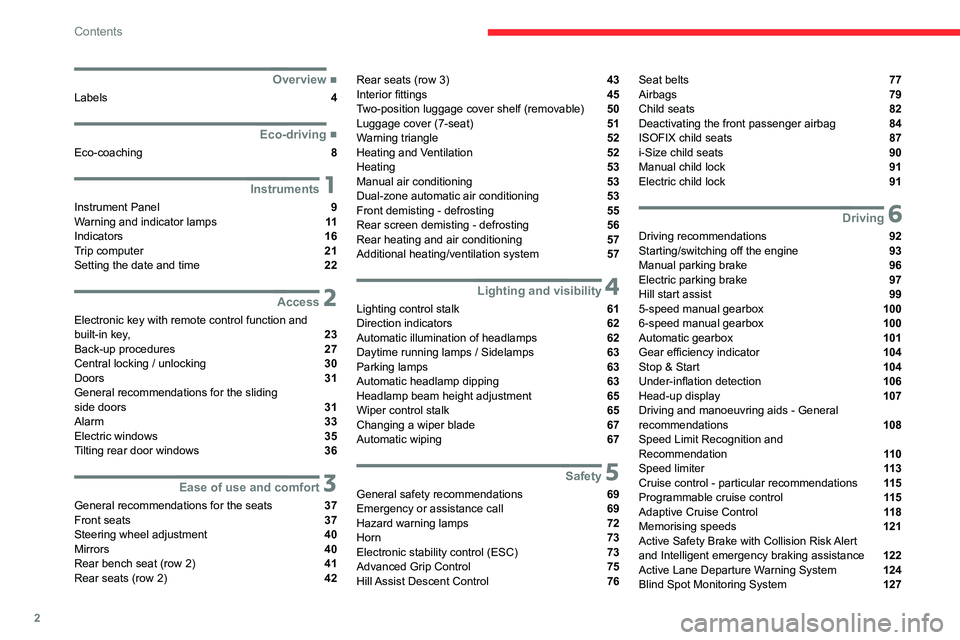
Contents
■
Overview
Labels 4
■
Eco-driving
Eco-coaching 8
1Instruments
Instrument Panel 9
Warning and indicator lamps 11
Indicators 16
Trip computer 21
Setting the date and time 22
2Access
Electronic key with remote control function and
built-in key, 23
Back-up procedures 27
Central locking / unlocking 30
Doors 31
General recommendations for the sliding
side doors
31
Alarm 33
Electric windows 35
Tilting rear door windows 36
3Ease of use and comfort
General recommendations for the seats 37
Front seats 37
Steering wheel adjustment 40
Mirrors 40
Rear bench seat (row 2) 41
Rear seats (row 2) 42
Rear seats (row 3) 43
Interior fittings 45
Two-position luggage cover shelf (removable) 50
Luggage cover (7-seat) 51
Warning triangle 52
Heating and Ventilation 52
Heating 53
Manual air conditioning 53
Dual-zone automatic air conditioning 53
Front demisting - defrosting 55
Rear screen demisting - defrosting 56
Rear heating and air conditioning 57
Additional heating/ventilation system 57
4Lighting and visibility
Lighting control stalk 61
Direction indicators 62
Automatic illumination of headlamps 62
Daytime running lamps / Sidelamps 63
Parking lamps 63
Automatic headlamp dipping 63
Headlamp beam height adjustment 65
Wiper control stalk 65
Changing a wiper blade 67
Automatic wiping 67
5Safety
General safety recommendations 69
Emergency or assistance call 69
Hazard warning lamps 72
Horn 73
Electronic stability control (ESC) 73
Advanced Grip Control 75
Hill Assist Descent Control 76
Seat belts 77
Airbags 79
Child seats 82
Deactivating the front passenger airbag 84
ISOFIX child seats 87
i-Size child seats 90
Manual child lock 91
Electric child lock 91
6Driving
Driving recommendations 92
Starting/switching off the engine 93
Manual parking brake 96
Electric parking brake 97
Hill start assist 99
5-speed manual gearbox 100
6-speed manual gearbox 100
Automatic gearbox 101
Gear efficiency indicator 104
Stop & Start 104
Under-inflation detection 106
Head-up display 107
Driving and manoeuvring aids - General
recommendations
108
Speed Limit Recognition and
Recommendation
11 0
Speed limiter 11 3
Cruise control - particular recommendations 11 5
Programmable cruise control 11 5
Adaptive Cruise Control 11 8
Memorising speeds 121
Active Safety Brake with Collision Risk Alert
and Intelligent emergency braking assistance
122
Active Lane Departure Warning System 124
Blind Spot Monitoring System 127
Page 5 of 260

3
Contents
bit.ly/helpPSA
Active Blind Spot Monitoring System 129
Distraction detection 129
Parking sensors 130
Top Rear Vision 132
Park Assist 134
7Practical information
Compatibility of fuels 140
Refuelling 140
Misfuel prevention (Diesel) 141
Snow chains 142
Towing device 142
Towing device with quickly detachable towball 144
Energy economy mode 144
Roof bars / Roof rack 145
Bonnet 146
Engine compartment 147
Checking levels 147
Speed checks 149
AdBlue® (BlueHDi) 151
Free-wheeling 153
Advice on care and maintenance 153
8In the event of a breakdown
Running out of fuel (Diesel) 155
Tool kit 155
Temporary puncture repair kit 156
Spare wheel 158
Changing a bulb 161
Changing a fuse 167
12
V battery 169
Towing 172
9Technical data
Dimensions 175
Engine technical data and towed loads 176
Identification markings 181
10Bluetooth® audio system
First steps 182
Steering mounted controls 182
Menus 183
Radio 184
DAB (Digital Audio Broadcasting) radio 185
Media 186
Telephone 188
Frequently asked questions 191
11CITROËN Connect Radio
First steps 194
Steering mounted controls 195
Menus 196
Applications 197
Radio 197
DAB (Digital Audio Broadcasting) radio 199
Media 199
Telephone 201
Settings 204
Frequently asked questions 206
12CITROËN Connect Nav
First steps 208
Steering mounted controls 209
Menus 209
Voice commands 2 11
Navigation 214
Connected navigation 217
Applications 219
Radio 222
DAB (Digital Audio Broadcasting) radio 223
Media 224
Telephone 225
Settings 228
Frequently asked questions 229
■
Alphabetical index
Access to additional videos
Page 7 of 260
5
Overview
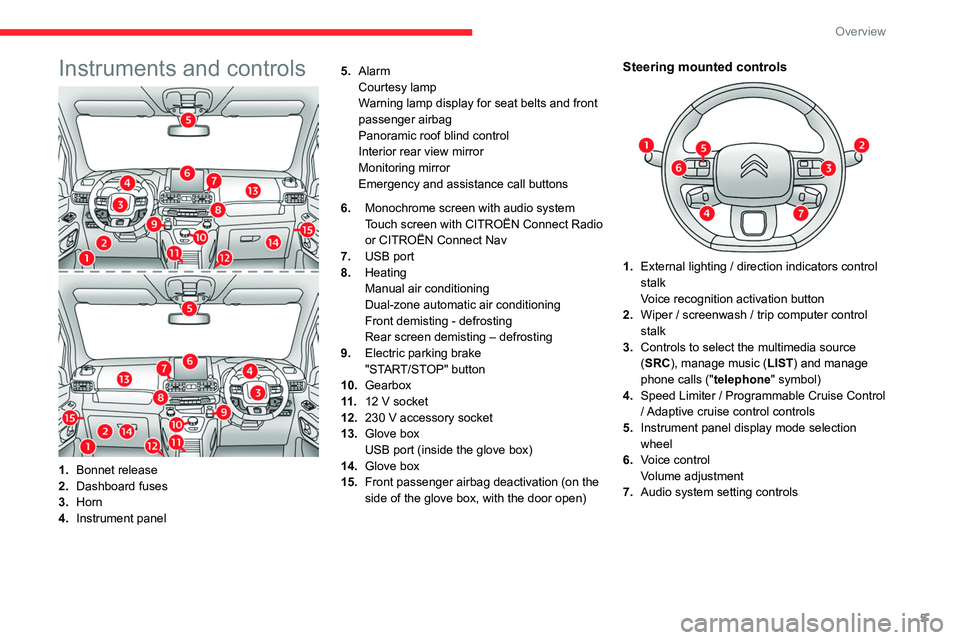
Instruments and controls
1.Bonnet release
2. Dashboard fuses
3. Horn
4. Instrument panel 5.
Alarm
Courtesy lamp
Warning lamp display for seat belts and front
passenger airbag
Panoramic roof blind control
Interior rear view mirror
Monitoring mirror
Emergency and assistance call buttons
6. Monochrome screen with audio system
Touch screen with CITROËN Connect Radio
or CITROËN Connect Nav
7. USB port
8. Heating
Manual air conditioning
Dual-zone automatic air conditioning
Front demisting - defrosting
Rear screen demisting – defrosting
9. Electric parking brake
"START/STOP" button
10. Gearbox
11 . 12 V socket
12. 230 V accessory socket
13. Glove box
USB port (inside the glove box)
14. Glove box
15. Front passenger airbag deactivation (on the
side of the glove box, with the door open)
Steering mounted controls
1.External lighting / direction indicators control
stalk
Voice recognition activation button
2. Wiper / screenwash / trip computer control
stalk
3. Controls to select the multimedia source
(SRC), manage music (LIST) and manage
phone calls (" telephone" symbol)
4. Speed Limiter / Programmable Cruise Control
/ Adaptive cruise control controls
5. Instrument panel display mode selection
wheel
6. Voice control
Volume adjustment
7. Audio system setting controls
Page 8 of 260

6
Overview
Side switch panel
1.Manual headlamp beam height adjustment
2. DSC / ASR systems
3. Stop & Start
4. Parking sensors
5. Additional heating / ventilation
6. Active Lane Departure Warning System
7. Tyre under-inflation detection
8. Electric child lock
9. Heated windscreen
10. Head-up display
Control on the driver's door
Electric child lock
Central switch panel
1.Hazard warning lamps
2. Locking / unlocking from the inside
3. Hill Assist Descent
4. Eco mode
5. Advanced Grip Control
6. Electric parking brake
7. Starting / switching off the engine
Page 16 of 260

14
Instruments
Particle filter (Diesel)Fixed, accompanied by an audible signal
and a message about the risk of particle
filter blockage.
The particle filter is beginning to saturate.
As soon as traffic conditions allow, regenerate
the filter by driving at a speed of at least 40 mph
(60 km/h) until the warning lamp goes off.
Fixed, accompanied by an audible signal
and a message signalling that the additive
level in the particle filter is too low.
The minimum level of the additive reservoir has
been reached.
Top up as soon as possible: carry out (3).
AirbagsFixed.
One of the airbags or seat belt
pyrotechnic pretensioners is faulty.
Carry out (3).
Front passenger airbag (ON)Fixed.
The front passenger airbag is activated.
The control is in the "ON" position.
In this case, do NOT install a "rearward
facing" child seat on the front passenger seat
- Risk of serious injury!
Front passenger airbag(OFF)Fixed.
The front passenger airbag is deactivated.
The control is in the "OFF" position. You can install a "rearward facing" child seat,
unless there is a fault with the airbags (airbag
warning lamp on).
Dynamic stability control (DSC) and anti-
slip regulation (ASR)
Fixed.
The system is deactivated.
Press the button to reactivate it.
The DSC/ASR system is activated automatically
when the vehicle is started, and from around 30
mph (50
km/h).
Flashing.
DSC/ASR regulation is activated in the
event of a loss of grip or trajectory.
Fixed.
The DSC/ASR system has a fault.
Carry out (3).
Hill start assistFixed, accompanied by the
message "Anti roll-back system
fault".
The system has a fault.
Carry out (3).
Emergency brake malfunction (with
electric parking brake)
Fixed, accompanied by the
message "Parking brake fault".
Emergency braking does not deliver optimal
performance.
If automatic release is not available, use manual
release or carry out (3).
Active Lane Departure Warning SystemFixed.
The system has been automatically
deactivated or placed on standby.
Flashing indicator.
You are about to cross a broken
lane marking without operating the direction
indicators.
The system is activated, then corrects the
trajectory on the side of the lane marking
detected.
Fixed.
The system has a fault.
Carry out (3).
AdBlue® (with 1.6 BlueHDi Euro 6.1)Fixed, on switching on the ignition,
accompanied by an audible signal and a
message indicating the driving range.
The driving range is between 1,500 and 370
miles (2,400 and 600
km).
You must quickly top up the AdBlue
®, or carry
out (3).
AdBlue® warning lamp flashing and
Service warning lamp fixed,
accompanied by an audible signal and a
message indicating the driving range.
The driving range is less than 375 miles
(600
km).
You must top up the AdBlue
® to avoid a
breakdown, or carry out (3).
AdBlue® warning lamp flashing and
Service warning lamp fixed,
accompanied by an audible signal and a
Page 18 of 260
16
Instruments
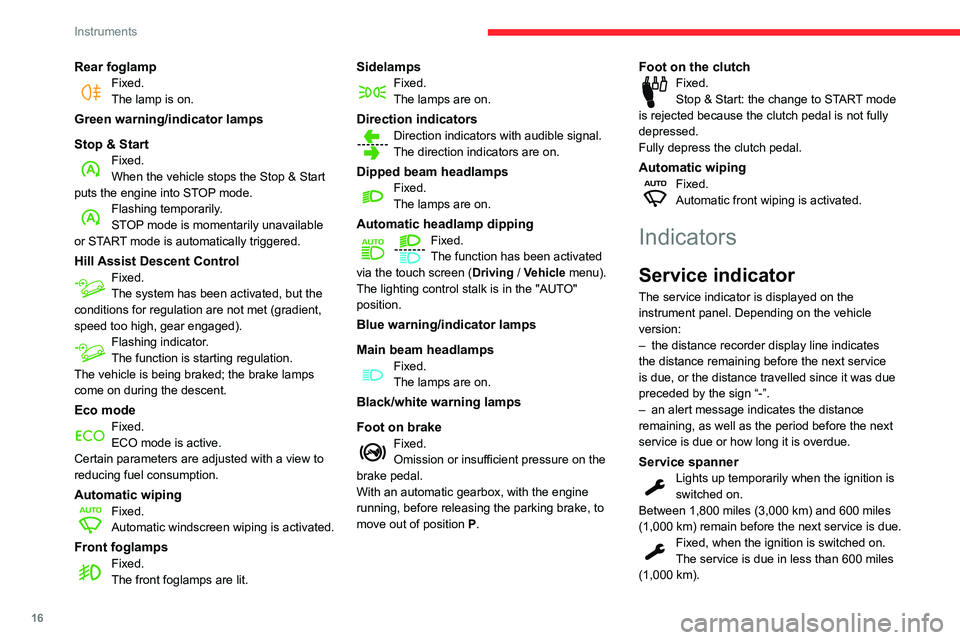
Rear foglampFixed.
The lamp is on.
Green warning/indicator lamps
Stop & Start
Fixed.
When the vehicle stops the Stop & Start
puts the engine into STOP mode.
Flashing temporarily.
STOP mode is momentarily unavailable
or START mode is automatically triggered.
Hill Assist Descent ControlFixed.
The system has been activated, but the
conditions for regulation are not met (gradient,
speed too high, gear engaged).
Flashing indicator.
The function is starting regulation.
The vehicle is being braked; the brake lamps
come on during the descent.
Eco modeFixed.
ECO mode is active.
Certain parameters are adjusted with a view to
reducing fuel consumption.
Automatic wipingFixed.
Automatic windscreen wiping is activated.
Front foglampsFixed.
The front foglamps are lit.
SidelampsFixed.
The lamps are on.
Direction indicatorsDirection indicators with audible signal.
The direction indicators are on.
Dipped beam headlampsFixed.
The lamps are on.
Automatic headlamp dippingFixed.
The function has been activated
via the touch screen (Driving
/ Vehicle menu).
The lighting control stalk is in the "AUTO"
position.
Blue warning/indicator lamps
Main beam headlamps
Fixed.
The lamps are on.
Black/white warning lamps
Foot on brake
Fixed.
Omission or insufficient pressure on the
brake pedal.
With an automatic gearbox, with the engine
running, before releasing the parking brake, to
move out of position P.
Foot on the clutchFixed.
Stop & Start: the change to START mode
is rejected because the clutch pedal is not fully
depressed.
Fully depress the clutch pedal.
Automatic wipingFixed.
Automatic front wiping is activated.
Indicators
Service indicator
The service indicator is displayed on the
instrument panel. Depending on the vehicle
version:
–
the distance recorder display line indicates
the distance remaining before the next service
is due, or the distance travelled since it was due
preceded by the sign “-”.
–
an alert message indicates the distance
remaining, as well as the period before the next
service is due or how long it is overdue.
Service spannerLights up temporarily when the ignition is
switched on.
Between 1,800 miles (3,000 km) and 600 miles
(1,000 km) remain before the next service is due.
Fixed, when the ignition is switched on.
The service is due in less than 600 miles
(1,000 km).
Page 97 of 260

95
Driving
6climatic conditions, it is advised to follow the
recommendations below:
–
In mild conditions, do not leave the engine
at idle to warm up but move off straight away
and drive at moderate speed.
–
Depending on version, if the air
conditioning is activated and when the
exterior temperature exceeds 35°C, the idle
engine speed can accelerate up to 1,300
rpm depending on the air conditioning
requirements.
–
In wintry conditions, when the ignition is
switched on, the duration of lighting of the
preheating indicator lamp is extended. W
ait
until it goes off before starting the engine.
–
In very severe wintry
conditions
(temperature below -23°C), to
ensure correct operation and durability of
the mechanical components of the vehicle,
engine and gearbox, leave the engine
running for 4 minutes before moving off.
Never leave the engine running in an
enclosed area without adequate ventilation:
internal combustion engines emit toxic
exhaust gases, such as carbon monoxide.
Danger of poisoning and death!
With petrol engines , after a cold start,
preheating the catalytic converter can
cause noticeable engine vibrations for
anything up to 2 minutes while stationary with
the engine running (accelerated idle speed).
For Diesel vehicles, when the
temperature is below zero,
starting will only occur once the preheating
warning lamp is off.
If this warning lamp comes on after pressing
the "START/STOP" button, press down on the
brake or clutch pedal until the warning lamp
goes off, without pressing the "START/STOP"
button again, until the engine starts and runs.
The presence of the “Keyless Entry and Starting” system remote control is
imperative in the recognition zone.
Never leave the vehicle with the engine
running and with the remote control on your
person.
If the remote control leaves the recognition
zone, a message is displayed.
Move the remote control into the zone in
order to be able to start the engine.
If one of the starting conditions is not
met, a message is displayed in the
instrument panel. In some circumstances, it is
necessary to turn the steering wheel while
pressing the "START/STOP" button to assist
unlocking of the steering column. A message
is displayed.
Switching off
► Immobilise the vehicle, with the engine at
idle.
► With a manual gearbox, ideally put the gear
lever into neutral.
►
With an automatic gearbox, ideally select
position
P
.
With the conventional key/With the
remote control key
► Turn the key all the way to position 1 (Stop)
and remove it from the ignition.
►
T
o lock the steering column, turn the steering
wheel until it locks.
To facilitate unlocking of the steering column, it is recommended that the
wheels be returned to the straight ahead
position before switching off the engine.
►
Check that the parking brake is correctly
applied, particularly on sloping ground.
Never switch off the ignition before the
complete immobilisation of the vehicle.
With the engine off, the braking and steering
assistance systems are also turned off: risk of
loss of control of the vehicle.
As a safety measure, never leave the vehicle without taking the remote control
with you, even for a short time.
Avoid attaching heavy objects to the key or the remote control, which would weigh
down on its blade in the ignition switch and
could cause a malfunction.
Page 101 of 260

99
Driving
6Parking the vehicle with the brake
released
In very cold conditions (ice), applying the
parking brake is not recommended.
To immobilise the vehicle, engage a gear or
place the chocks against one of the wheels.
With an automatic gearbox, mode P is
automatically selected when the ignition
is switched off. The wheels are blocked.
For more information on Free-wheeling, refer
to the corresponding section.
With an automatic gearbox, while mode
N is selected, opening the driver’s door
triggers an audible signal. It stops when the
driver's door closes again.
Deactivating automatic
operation
In some situations, for example when it is
extremely cold or when towing (e.g. caravan,
breakdown), it may be necessary to deactivate
automatic operation of the system.
►
Start the engine.
►
Apply the parking brake with the control lever
,
if it is released.
►
T
ake your foot fully off the brake pedal. ►
Push and hold the control lever in the release
direction for at least 10 seconds and no more
than 15
seconds.
►
Release the control lever
.
►
Press and hold the brake pedal.
►
Pull the control lever in the application
direction for 2
seconds.
Deactivation of the automatic functions is
confirmed by illumination of this indicator
lamp in the instrument panel.
►
Release the control lever and the brake
pedal.
From now on, the parking brake can only be
applied and released manually using the control
lever
.
Repeat this procedure to reactivate automatic
operation (confirmed by the indicator lamp in the
instrument panel going off).
Emergency braking
In the event of a fault with the brake pedal or
in an exceptional situation (e.g. driver taken ill,
driver under instruction), a continuous pull on
the electric parking brake control lever will brake
the vehicle. Braking takes place while the control
lever is being pulled; it is interrupted when the
control lever is released.
The ABS and DSC systems ensure stability of
the vehicle during emergency braking.
If the emergency braking malfunctions, the
message "Parking brake control faulty" will be
displayed in the instrument panel.
If the ABS and DSC systems malfunction,
signalled by the illumination of one or both
warning lamps in the instrument panel, then
stability of the vehicle is no longer guaranteed.
In this event, stability must be assured by the
driver by repeating alternate "pull-release"
actions on the control lever until the vehicle is
immobilised.
Hill start assist
This system keeps your vehicle briefly stationary
(for approximately 2 seconds) when making a hill
start, while you transfer your foot from the brake
pedal to the accelerator pedal.
This system is only active when:
–
the vehicle is completely stationary
, with your
foot on the brake pedal,
–
certain slope conditions are met,
–
the driver
’s door is closed.
Do not leave the vehicle while it is being
held temporarily by hill start assist.
If someone needs to get out of the vehicle
with the engine running, apply the parking
brake manually. After that, ensure that the
parking brake indicator lamp and the indicator
lamp
P in the electric parking brake control
lever are on fixed.
Page 102 of 260

100
Driving
The hill start assist function cannot be deactivated. However, use of the parking
brake to immobilise the vehicle interrupts its
operation.
Operation
Facing uphill, with the vehicle stationary,
the vehicle is held for a short time when you
release the brake pedal:
–
provided you are in first gear or neutral with a
manual gearbox.
–
provided you are in mode D
or M with an
automatic gearbox.
Facing downhill, with the vehicle stationary
and reverse gear engaged, the vehicle is held
for a short time when you release the brake
pedal.
Malfunction
These warning lamps come on in the event of a malfunction.
Contact a CITROËN dealer or a qualified
workshop to have the system checked.
5-speed manual gearbox
Engaging reverse gear
► With the clutch pedal fully depressed, you
must place the gear lever in neutral.
►
Move the gear lever to the right, then pull it
back.
Only engage reverse gear when the
vehicle is stationary with the engine at
idle.
As a safety precaution and to facilitate engine starting:
–
always select neutral,
–
depress the clutch pedal.
6-speed manual gearbox
Engaging 5th or 6th gear
► Move the gear selector fully to the right to
engage 5th or 6th gear.
Failure to follow this instruction could
cause permanent damage to the gearbox
(inadvertent engagement of 3
rd or 4th gear).
Engaging reverse gear
► Raise the ring under the knob and move the
gear lever to the left, then forwards.
Only engage reverse gear when the
vehicle is stationary with the engine at
idle.
As a safety precaution and to facilitate engine starting:
– always select neutral,
– depress the clutch pedal.
Automatic gearbox
8-speed automatic gearbox which offers a choice
between the comfort of automatic operation or
manual gear changing.
Two driving modes are available:
– Automatic operation for electronic
management of the gears by the gearbox:
Page 120 of 260

11 8
Driving
To activate the system again, with the vehicle
speed above 25 mph (40 km/h), press button
4.
Switching off
► Turn the thumbwheel 1 to the "0” position: the
cruise control information disappears from the
screen.
Malfunction
Dashes are displayed (flashing, initially, then
fixed) in the event of a cruise control system
malfunction.
Have the system checked by a CITROËN dealer
or a qualified workshop.
Adaptive Cruise Control
Refer to the General recommendations on the
use of driving and manoeuvring aids and to
Cruise control - particular recommendations.
This system automatically maintains the speed
of your vehicle at a value which you set (speed
setting), while keeping a safe distance from the
vehicle in front (target vehicle), and which has
been set beforehand by the driver. The system
automatically manages the acceleration and
deceleration of the vehicle.
With the Stop function , the system manages
the braking until the vehicle comes to a complete
stop.
To do so, it has a camera located at the top of
the windscreen and, depending on version, a
radar located in the front bumper.
Primarily designed for driving on main
roads and motorways, this system only
works with moving vehicles driving in the
same direction as your vehicle.
If the driver operates a direction indicator
to overtake a slower vehicle, the cruise
control allows the vehicle to temporarily
approach the vehicle in front to assist the
overtaking manoeuvre, without ever
exceeding the speed setting.
Some vehicles present on the road may
not be properly seen or may be poorly
interpreted by the camera and/or radar (e.g. a
lorry), which may lead to a poor assessment
of the distances and lead to the vehicle
inappropriately accelerating or braking.
Steering mounted control
1. ON (CRUISE position) / OFF (position0)
2. Activation of cruise control at the current
speed / decrease speed setting
3. Activation of cruise control at the current
speed / increase speed setting
4. Pausing / resumption of cruise control with
the speed setting previously stored
5. Depending on version:
Display of speed thresholds recorded using
Memorising speeds
or
Use the speed suggested by the Speed Limit
Recognition and Recommendation ( (MEM
display)
6. Display and adjustment of the distance
setting to the vehicle in front
Use
Activation of the system (pause)
► With the engine running, turn the knob 1
downwards to the CRUISE position. Cruise
control is ready to operate (grey display).
Switching on of cruise control and choice
of speed setting
With a manual gearbox, your speed must be
between 19 and 99 mph (30 and 160 km/h).
With an automatic gearbox, mode D or M must
be selected and your speed must be between 19
and 112 mph (30 and 180 km/h).
► Press button 2 or 3: the current speed
becomes the speed setting (minimum 19 mph
(30 km/h)) and cruise control is immediately in
operation (green display).
► Press 3 to increase or 2 to decrease the
speed setting (steps of 5 mph (km/h) if held
pressed).
Pressing and holding button 2 or
3 results in a rapid change in the speed
of the vehicle.
Pausing / resumption of cruise control
► Press 4 or press the brake pedal. To pause
cruise control, it is also possible to: • shift from mode D to N;
• press the clutch pedal for more than 10
seconds;
• press the electric parking brake control;