ignition Citroen C4 2014.5 2.G Service Manual
[x] Cancel search | Manufacturer: CITROEN, Model Year: 2014.5, Model line: C4, Model: Citroen C4 2014.5 2.GPages: 494, PDF Size: 21.47 MB
Page 133 of 494
131
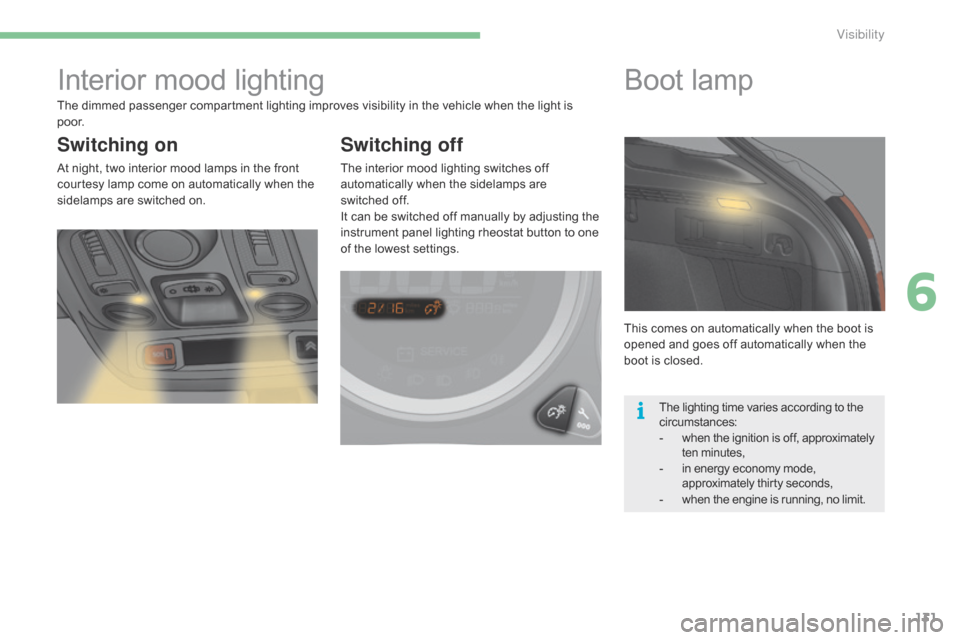
Interior mood lighting
Switching on
At night, two interior mood lamps in the front c
ourtesy lamp come on automatically when the
s
idelamps are switched on.
Switching off
The interior mood lighting switches off automatically when the sidelamps are
switched
off.
It
can be switched off manually by adjusting the
i
nstrument panel lighting rheostat button to one
o
f the lowest settings. This
comes on automatically when the boot is
o
pened and goes off automatically when the
b
oot is closed.
Boot lamp
The lighting time varies according to the circumstances:
-
w
hen the ignition is off, approximately
t
en
m
inutes,
-
i
n energy economy mode,
a
pproximately thirty seconds,
-
w
hen the engine is running, no limit.
The
dimmed
passenger
compartment
lighting
improves
visibility
in
the
vehicle
when
the
light
is
p
o o r.
6
Visibility
Page 148 of 494
146
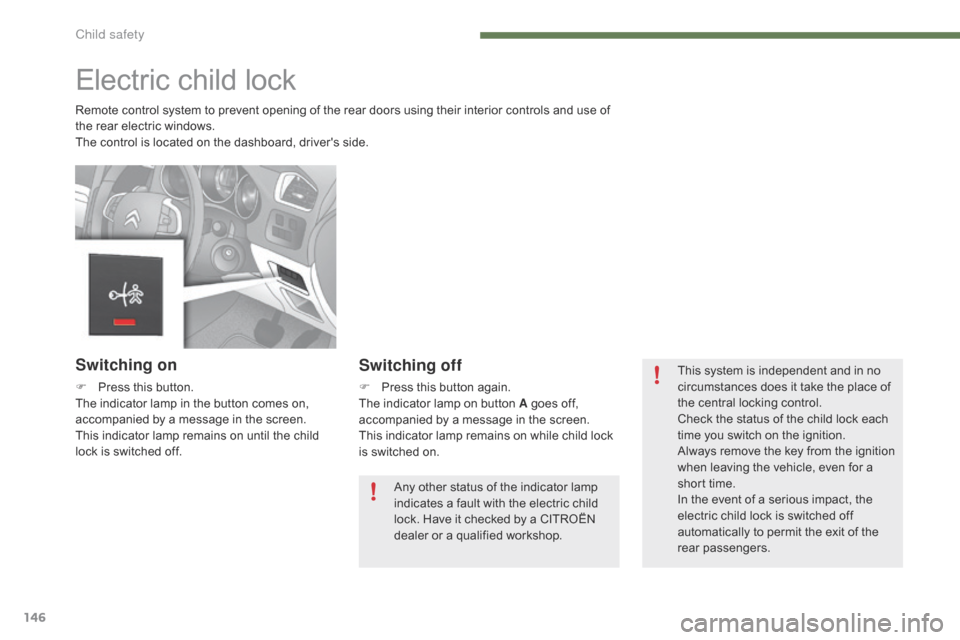
Electric child lock
Switching on
F Press this button.
The indicator lamp in the button comes on,
a
ccompanied by a message in the screen.
This
indicator lamp remains on until the child
l
ock is switched off.
Switching off
F Press this button again.
The indicator lamp on button A goes off,
a
ccompanied by a message in the screen.
This
indicator lamp remains on while child lock
i
s switched on. This
system is independent and in no c
ircumstances does it take the place of t
he central locking control.
Check
the status of the child lock each
t
ime you switch on the ignition.
Always
remove the key from the ignition
w
hen leaving the vehicle, even for a
s
hort time.
In
the event of a serious impact, the
e
lectric child lock is switched off
a
utomatically to permit the exit of the
r
ear
p
assengers.
Remote
control
system
to
prevent
opening
of
the
rear doors using their interior controls and use of
t
he
rear
electric
windows.
The
control
is
located
on
the
dashboard,
driver's
side.
Any other status of the indicator lamp
i
ndicates a fault with the electric child
l
ock. Have it checked by a CITROËN
d
ealer or a qualified workshop.
Child safety
Page 149 of 494
147
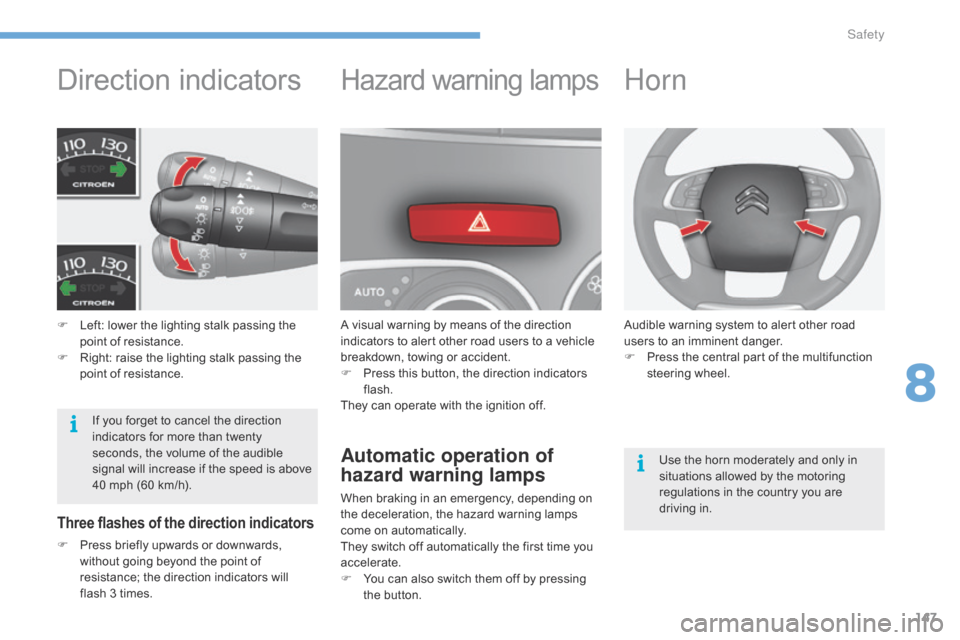
Direction indicators
F Left: lower the lighting stalk passing the p
oint of resistance.
F
R
ight: raise the lighting stalk passing the
p
oint of resistance.
Hazard warning lam ps
A visual warning by means of the direction i
ndicators to alert other road users to a vehicle
b
reakdown, towing or accident.
F
P
ress this button, the direction indicators
f
lash.
They
can operate with the ignition off.
Automatic operation of
hazard warning lamps
When braking in an emergency, depending on the deceleration, the hazard warning lamps
c
ome on automatically.
They
switch off automatically the first time you
a
ccelerate.
F
Y
ou can also switch them off by pressing
t
he button.
Horn
Three flashes of the direction indicators
F Press briefly upwards or downwards, w
ithout going beyond the point of
r
esistance; the direction indicators will
f
lash 3 times. Audible
warning system to alert other road
u
sers to an imminent danger.
F
P
ress the central part of the multifunction
s
teering
w
heel.
Use the horn moderately and only in
s
ituations allowed by the motoring
r
egulations in the country you are
d
riving in.
If you forget to cancel the direction
i
ndicators for more than twenty
s
econds, the volume of the audible
s
ignal will increase if the speed is above
4
0 mph (60 km/h).
8
Safety
Page 152 of 494
150
Reactivation
These systems are reactivated automatically each time the ignition is switched back on or
f
rom 30 mph (50 km/h).
F
P
ress this button again to reactivate them
m
anually.
The
illumination of the indicator
l
amps in the instrument panel and
i
n this button, accompanied by an
a
udible signal and a message in the
s
creen, indicates a fault with these
s
ystems.
Operating fault
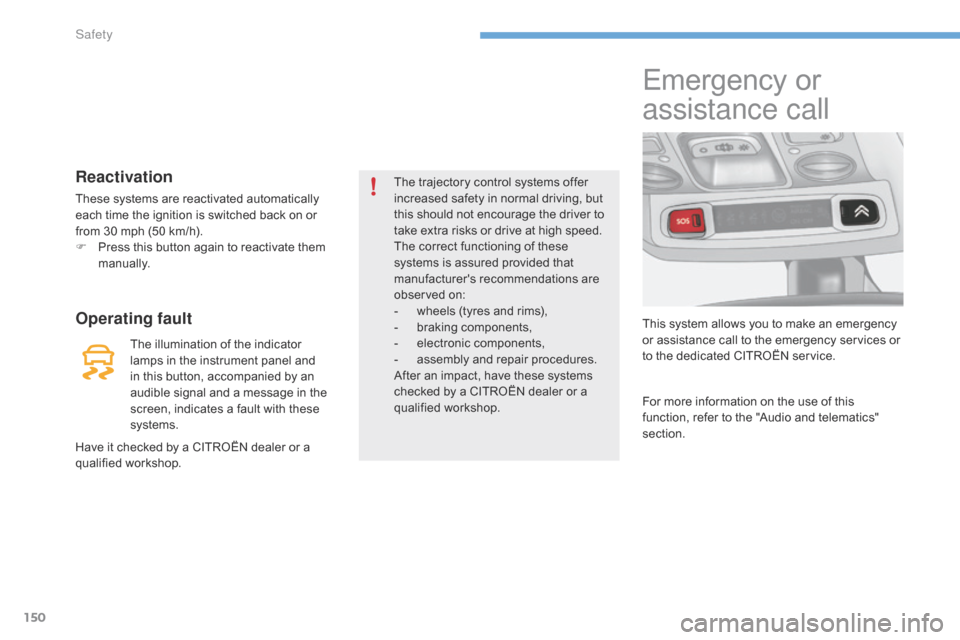
Emergency o r
a ssistance call
This system allows you to make an emergency o
r assistance call to the emergency services or
t
o the dedicated CITROËN service.
For
more information on the use of this
f
unction, refer to the "Audio and telematics"
s
ection.
The
trajectory
control
systems
offer
i
ncreased
safety
in
normal
driving,
but
t
his
should
not
encourage
the
driver
to
t
ake
extra
risks
or
drive
at
high
speed.
The
correct
functioning
of
these
s
ystems
is
assured
provided
that
m
anufacturer's
recommendations
are
ob
served
on
:
-
w
heels
(tyres
and
rims),
-
b
raking
components,
-
el
ectronic
c
omponents,
-
a
ssembly
and
repair
procedures.
After
an
impact,
have
these
systems
c
hecked
by
a
CITROËN
dealer
or
a
q
ualified
w
orkshop.
Have
it
checked
by
a
CITROËN
dealer
or
a
q
ualified
w
orkshop.
Safety
Page 153 of 494
151
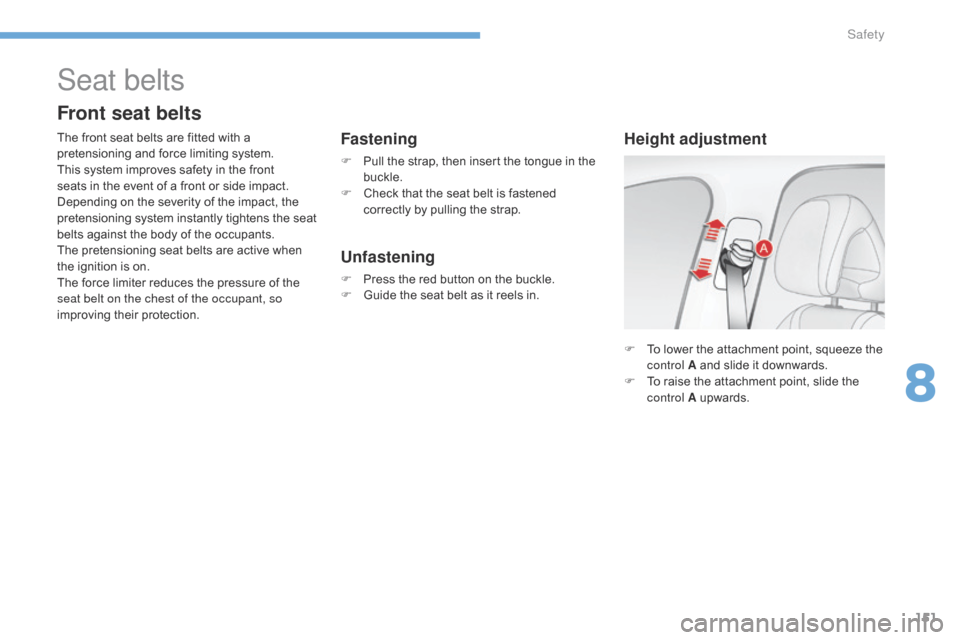
F To lower the attachment point, squeeze the c
ontrol A and slide it downwards.
F
T
o raise the attachment point, slide the
c
ontrol A
up
wards.
Height adjustment
Seat belts
Front seat belts
The front seat belts are fitted with a pretensioning and force limiting system.
This
system improves safety in the front
s
eats in the event of a front or side impact.
D
epending on the severity of the impact, the
p
retensioning system instantly tightens the seat
b
elts against the body of the occupants.
The
pretensioning seat belts are active when
t
he ignition is on.
The
force limiter reduces the pressure of the
s
eat belt on the chest of the occupant, so
improving
their protection.Fastening
F Pull the strap, then insert the tongue in the buc
kle.
F
C
heck that the seat belt is fastened
c
orrectly by pulling the strap.
Unfastening
F Press the red button on the buckle.
F G uide the seat belt as it reels in.
8
Safety
Page 154 of 494
152
Seat belt not fastened / unfastened
warning lamp in the instrument
panel
When the ignition is switched on, this warning lamp comes on in the instrument p
anel if the driver and/or the front
p
assenger has not fastened their seat belt.
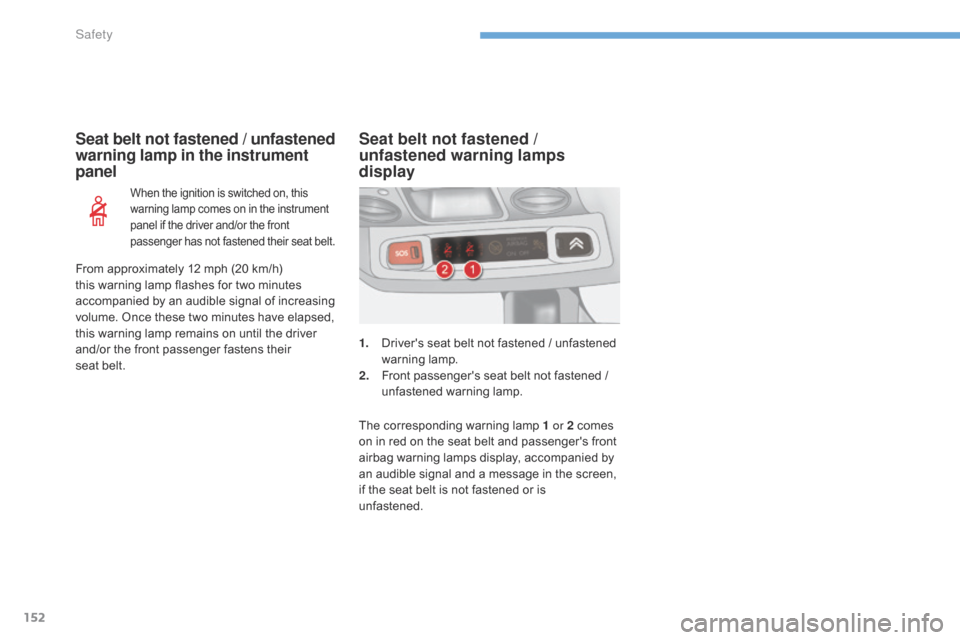
1. Driver's seat belt not fastened / unfastened w
arning lam p.
2.
F
ront passenger's seat belt not fastened /
u
nfastened warning lamp.
Seat belt not fastened /
unfastened warning lamps
display
The corresponding warning lamp 1 or 2 comes on in red on the seat belt and passenger's front
a
irbag warning lamps display, accompanied by
a
n audible signal and a message in the screen,
i
f the seat belt is not fastened or is
unfastened.
From
approximately
12
mph
(20 km/h)
t
his
warning
lamp
flashes
for
two
minutes
a
ccompanied
by
an
audible
signal
of
increasing
v
olume.
Once
these
two
minutes
have
elapsed,
t
his
warning
lamp
remains
on
until
the
driver
a
nd/or
the
front
passenger
fastens
their
seat
belt.
Safety
Page 155 of 494
153
Rear seat
belts
Fastening
F Pull the strap, then insert the tongue in the buc
kle.
F
C
heck that the seat belt is fastened
c
orrectly by pulling the strap.
Unfastening
F Press the red button on the buckle.
F G uide the seat belt as it reels in.
F
o
n t
he outer seat belts, raise the bar to the
top
of the backrest to prevent the tongue
f
rom knocking against the side trim.
This
warning lamp comes on in the
i
nstrument
panel
when
one
or
more
rear
p
assengers
u
nfasten
t
heir
sea
t
b
elt.
Seat belt unfastened warning
lamp in the instrument panelSeat belt unfastened warning
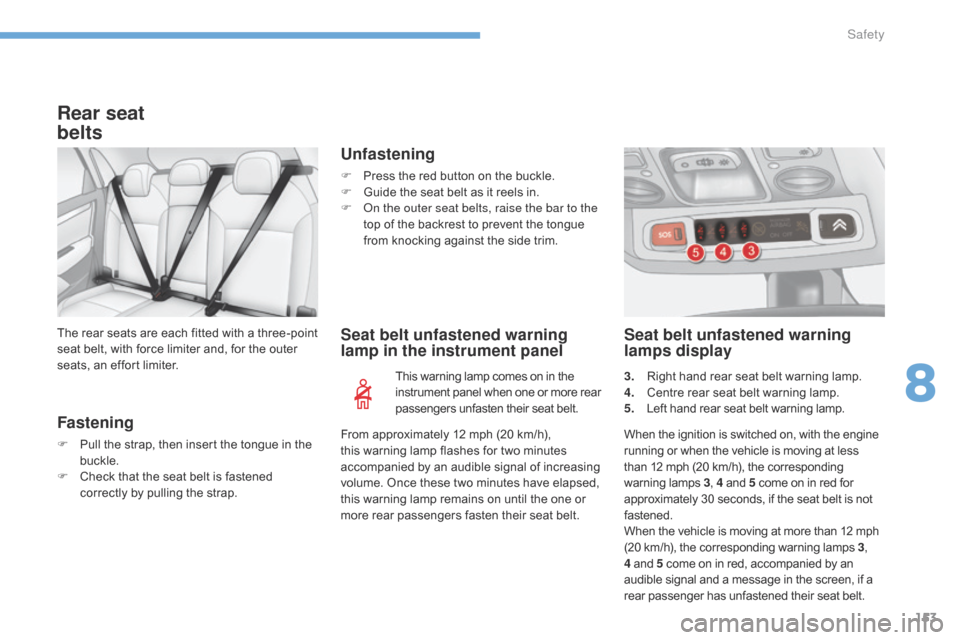
lamps display
3. Right
hand rear seat belt warning lamp.
4. C entre rear seat belt warning lamp.
5.
L
eft hand rear seat belt warning lamp.
From
approximately
12 mph
(20 km/h),
t
his
warning
lamp
flashes
for
two
minutes
a
ccompanied
by
an
audible
signal
of
increasing
v
olume.
Once
these
two
minutes
have
elapsed,
t
his
warning
lamp
remains
on
until
the
one
or
m
ore
rear
passengers
fasten
their
seat
belt.
The
rear
seats
are
each
fitted
with
a
three-point
s
eat
belt,
with
force
limiter
and,
for
the
outer
s
eats,
an
effort
limiter.
When the ignition is switched on, with the engine
r
unning or when the vehicle is moving at less
t
han 12 mph (20 km/h), the corresponding
w
arning
lam
ps
3, 4
and 5
come on in red for
a
pproximately 30 seconds, if the seat belt is not
f
astened.
When
the vehicle is moving at more than 12 mph
(
20 km/h), the corresponding warning lamps 3,
4
and 5
come on in red, accompanied by an
a
udible signal and a message in the screen, if a
r
ear passenger has unfastened their seat belt.
8
Safety
Page 157 of 494
155
Airbags
System designed to contribute towards improving the safety of the occupants (with
t
he exception of the rear centre passenger)
i
n the event of violent collisions. The airbags
s
upplement the action of the force-limiting
s
eat belts (with the exception of the centre rear
p
assenger).
If
a collision occurs, the electronic detectors
r
ecord and analyse the front and side impacts
s
ustained in the impact detection zones:
-
i
n the case of a serious impact, the airbags
a
re deployed instantly and contribute
t
owards better protection of the occupants
o
f the vehicle (with the exception of the
r
ear centre passenger); immediately after
t
he impact, the airbags deflate rapidly so
t
hat they do not hinder visibility or the exit
o
f the occupants,
-
i
n the case of a minor or rear impact or in
c
ertain roll-over conditions, the airbags
m
ay not be deployed; the seat belt
a
lone contributes towards ensuring your
p
rotection in these situations.
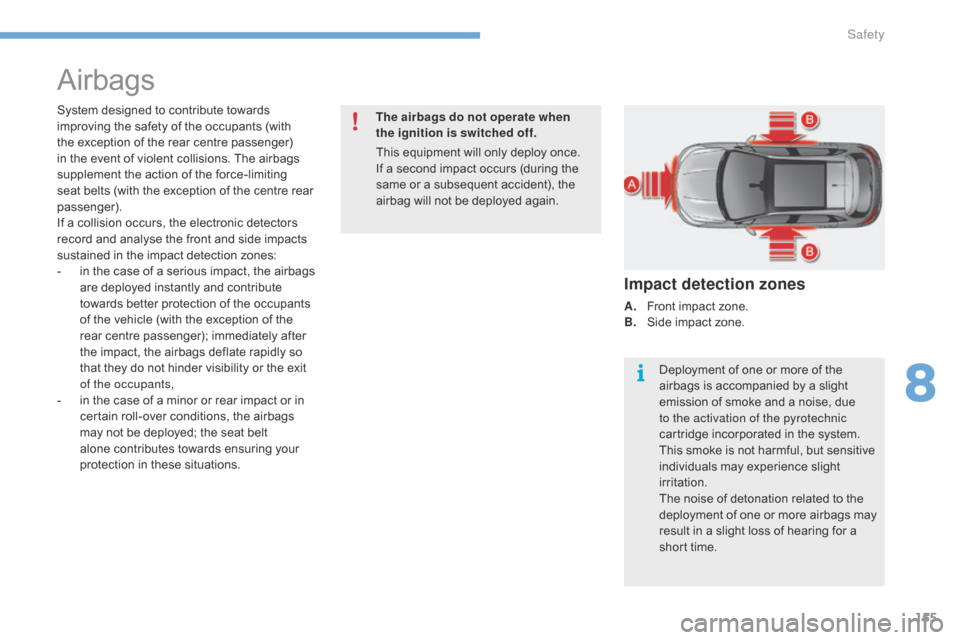
Impact detection zones
A. Front impact zone.
B. S ide impact zone.
The airbags do not operate when
the
ignition is switched off.
This
equipment
will
only
deploy
once.
I
f
a
second
impact
occurs
(during
the
s
ame
or
a
subsequent
accident),
the
a
irbag
will
not
be
deployed
again.
Deployment of one or more of the
a
irbags is accompanied by a slight
e
mission of smoke and a noise, due
t
o the activation of the pyrotechnic
cartridge
incorporated in the system.
This
smoke is not harmful, but sensitive
i
ndividuals may experience slight
ir
ritation.
The
noise of detonation related to the
d
eployment of one or more airbags may
r
esult in a slight loss of hearing for a
s
hort time.
8
Safety
Page 158 of 494
156
Deactivation
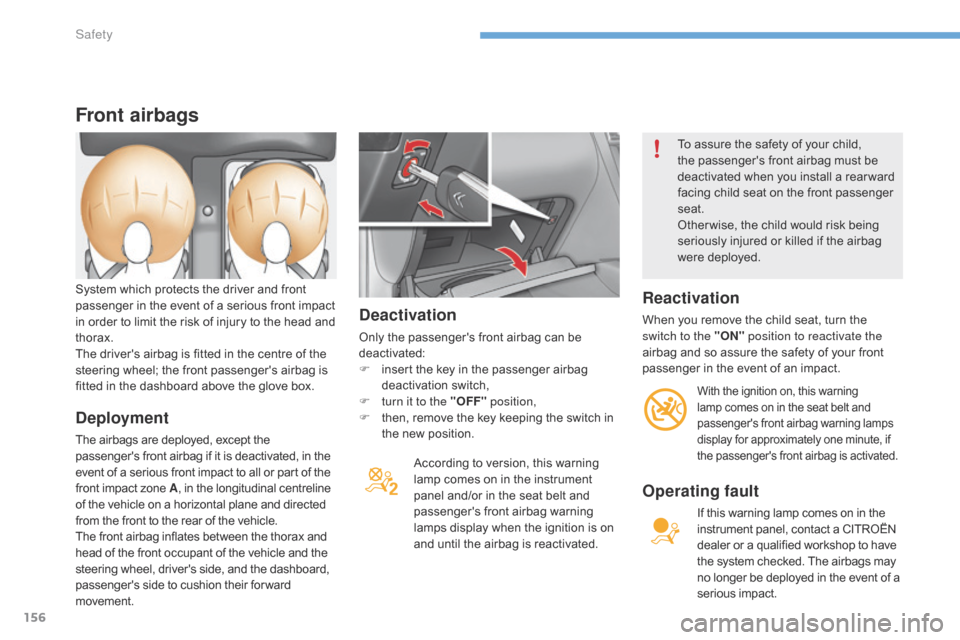
Only the passenger's front airbag can be deactivated:
F
i
nsert the key in the passenger airbag
d
eactivation
s
witch,
F
t
urn it to the "OFF" position,
F
t
hen, remove the key keeping the switch in
t
he new position.
According
to version, this warning
l
amp comes on in the instrument
p
anel and/or in the seat belt and
p
assenger's front airbag warning
l
amps display when the ignition is on
a
nd until the airbag is reactivated.
Front airbags
Deployment
The airbags are deployed, except the passenger's front airbag if it is deactivated, in the e
vent of a serious front impact to all or part of the
f
ront impact zone A,
in the longitudinal centreline
o
f the vehicle on a horizontal plane and directed
f
rom the front to the rear of the vehicle.
The
front airbag inflates between the thorax and
h
ead of the front occupant of the vehicle and the
s
teering wheel, driver's side, and the dashboard,
p
assenger's side to cushion their for ward
m
ovement. To
assure the safety of your child,
t
he passenger's front airbag must be
d
eactivated when you install a rear ward
f
acing child seat on the front passenger
sea
t.
Other wise, the child would risk being
s
eriously injured or killed if the airbag
w
ere deployed.
System which protects the driver and front
p
assenger in the event of a serious front impact
i
n order to limit the risk of injury to the head and
t
horax.
The driver's airbag is fitted in the centre of the
s
teering wheel; the front passenger's airbag is
f
itted in the dashboard above the glove box.
Reactivation
When you remove the child seat, turn the s
witch to the "ON" position to reactivate the
airbag
and so assure the safety of your front
p
assenger in the event of an impact.
With the ignition on, this warning lamp comes on in the seat belt and p
assenger's front airbag warning lamps
d
isplay for approximately one minute, if
t
he passenger's front airbag is activated.
Operating fault
If this warning lamp comes on in the instrument panel, contact a CITROËN d
ealer or a qualified workshop to have
t
he system checked. The airbags may
n
o longer be deployed in the event of a
s
erious
im
pact.
Safety
Page 162 of 494
160
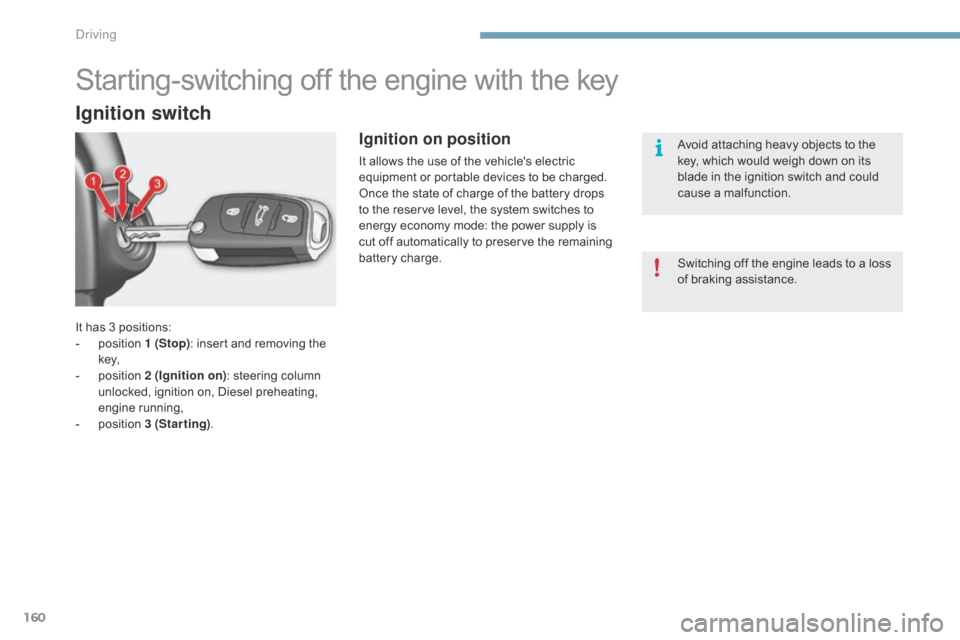
It has 3 positions:
- p osition 1 (Stop):
insert and removing the
k
ey,
-
p
osition 2 (Ignition on) :
steering column
u
nlocked, ignition on, Diesel preheating,
e
ngine
r
unning,
-
p
osition 3 (Starting).
Ignition on position
It allows the use of the vehicle's electric e
quipment or portable devices to be charged.
Once
the state of charge of the battery drops
t
o the reserve level, the system switches to
e
nergy economy mode: the power supply is
c
ut off automatically to preserve the remaining
b
attery charge.
Starting-switching off the engine with the key
Ignition switch
Avoid attaching heavy objects to the key, which would weigh down on its
b
lade in the ignition switch and could
c
ause a malfunction.
Switching
off the engine leads to a loss
o
f braking assistance.
Driving