ignition Citroen C4 2014.5 2.G Workshop Manual
[x] Cancel search | Manufacturer: CITROEN, Model Year: 2014.5, Model line: C4, Model: Citroen C4 2014.5 2.GPages: 494, PDF Size: 21.47 MB
Page 163 of 494
161
Starting the engine
F With a petrol engine, operate the starter m
otor by turning the key to position 3
without
pressing the accelerator pedal,
u
ntil the engine starts. Once the engine is
r
unning, release the key. F
W
ith a Diesel engine, turn the key to
p
osition 2
, ignition on, to operate the
eng
ine
p
re-heating
s
ystem.
Wait until this warning lamp goes off
i
n the instrument panel then operate
t
he starter motor by turning the key
t
o position 3 without pressing the
a
ccelerator pedal, until the engine
s
tarts. Once the engine is running,
r
elease the key.
If the engine does not start straight
a
way, switch off the ignition. Wait a
f
ew moments before operating the
s
tarter motor again. If the engine does
n
ot start after several attempts, do not
k
eep trying: you risk damaging the
s
tarter motor or the engine. Contact
a
CITROËN dealer or a qualified
w
orkshop.Never
leave the engine running in
a
n enclosed area without adequate
v
entilation:
in
ternal
c
ombustion
e
ngines emit toxic exhaust gases,
s
uch as carbon monoxide. Danger of
i
ntoxication and death.
In very severe wintry conditions
(
temperatures below -23°C), to ensure
t
he correct operation and durability of
t
he mechanical components of your
v
ehicle, engine and gearbox, it is n
ecessary to leave the engine running f
or 4 minutes before moving off.
In
certain cases, you may have to apply
m
ore force to the steering (wheels on
f
ull lock, for example).
In wintry conditions, the warning lamp
c
an stay on for a longer period. When
t
he engine is hot, the warning lamp
d
oes not come on.In temperate conditions, do not leave
t
he engine at idle to warm up but move
o
ff straight away and drive at moderate
s
peed.
With the parking brake applied and the gearbox
i
n neutral or position N or P
:
F
d
epress the clutch pedal fully (manual
g
earbox),
or
F
p
ress the brake pedal firmly (electronic or
a
utomatic gearbox),
F
i
nsert the key into the ignition switch; the
s
ystem recognises the code,
F
u
nlock the steering column by
s
imultaneously turning the steering and the
k
ey.
9
Driving
Page 164 of 494
162
Switching off the engine
Energy economy mode
After switching off the engine (position 1- Stop),
for a maximum of 30 minutes you can still use
f
unctions such as the audio and telematic
s
ystem, the wipers, dipped beam headlamps,
c
ourtesy lamps, ...
F
C
heck
that
the
parking
brake
is
correctly
a
pplied,
particularly
on
sloping
ground.
Never
switch
off
the
ignition
before
the
v
ehicle
is
at
a
complete
stop.
With
the
e
ngine
off,
the
braking
and
steering
a
ssistance
systems
are
also
cut
off:
risk
o
f
loss
of
control
of
the
vehicle.
To
facilitate
unlocking
of
the
steering
c
olumn,
it
is
recommended
that
the
w
heels
be
returned
to
the
straight
ahead
p
osition
before
switching
off
the
engine.
When
you
leave
the
vehicle,
keep
the
k
ey
with
you
and
lock
the
vehicle. For
more information, refer to the
"
Practical information" section, under
"
Energy economy mode".Key left in the "Ignition on"
position
If the key has been left in the ignition switch at position 2 (Ignition on) ,
the
ignition will be switched off
a
utomatically after one hour.
To
switch the ignition back on, turn the
k
ey to position 1 (Stop),
then back to
p
osition 2 (Ignition on) .
F
S
top
the
vehicle.
F
W
ith
the
engine
running
at
idle,
turn
the
key
t
o position 1
.
F
R
emove
the
key
from
the
ignition
switch.
F
T
o
lock
the
steering
column,
turn
the
s
teering
until
it
locks.
Driving
Page 167 of 494
165
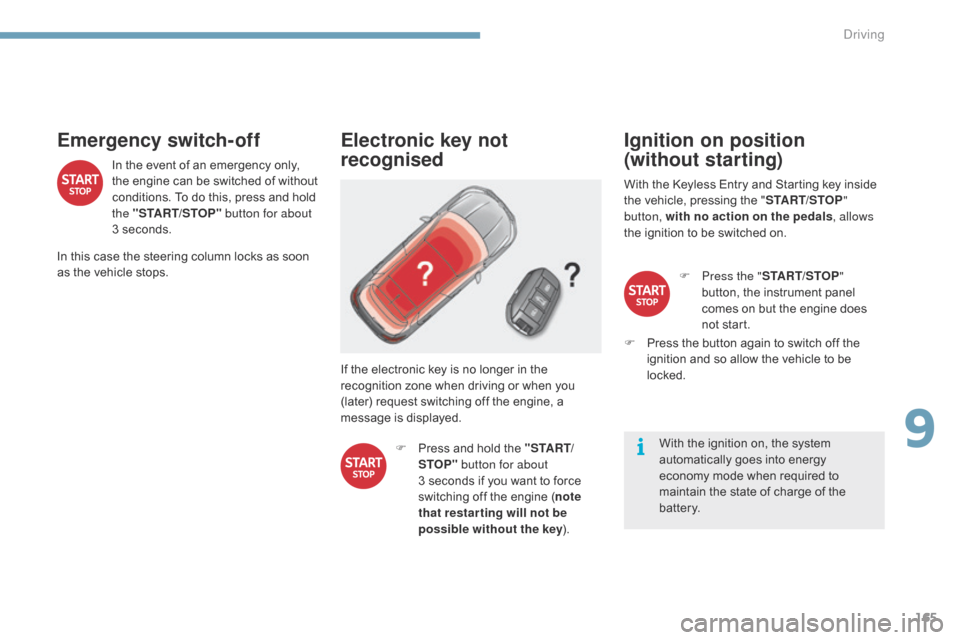
Emergency switch-off
In the event of an emergency only, the e ngine c an b e s witched o f w ithout
c
onditions. To do this, press and hold
t
he "START/STOP" button for about
3
seconds.
In
this
case the steering column locks as soon
a
s
the
vehicle stops.
Electronic key not
recognised
If the electronic key is no longer in the recognition zone when driving or when you
(
later) request switching off the engine, a
m
essage is displayed.
F
P
ress and hold the " S TA R T/
STOP" button for about
3 seconds
if you want to force
s
witching off the engine (note
that restar ting will not be
possible without the key ).
Ignition on position
(without starting)
With the Keyless Entry and Starting key inside t
he vehicle, pressing the "START/STOP "
button, with no action on the pedals , allows
the
ignition to be switched on.
With
the ignition on, the system
a
utomatically goes into energy
e
conomy mode when required to
m
aintain the state of charge of the
b
attery.F
P
ress the "START/STOP "
button,
the instrument panel
c
omes on but the engine does
n
ot start.
F
P
ress the button again to switch off the
i
gnition and so allow the vehicle to be
lo
cked.
9
Driving
Page 168 of 494
166
Anti-theft protection
Electronic engine immobiliser
Keep safely, away from your vehicle, the label attached to the keys given to
y
ou on acquisition of the vehicle.
The
keys
contain
an
electronic
chip
which
has
a
special
code.
When
the
ignition
is
switched
o
n,
this
code
must
be
recognised
for
engine
s
tarting
to
be
authorised.
This
electronic
engine
immobiliser
locks
the
e
ngine
management
system
a
few
minutes
a
fter
the
ignition
is
switched
off
and
prevents
s
tarting
of
the
engine
by
anyone
who
does
not
h
ave
the
key. In the event of a fault, you are
informed
by
illumination
of
this
w
arning
lamp,
an
audible
signal
a
nd/or
the
display
of
a
message,
d
epending
o
n
v
ersion.
In
this
case,
your
vehicle
will
not
start;
contact
a
CITROËN
dealer
as
soon
as
possible.
Driving
Page 170 of 494
168
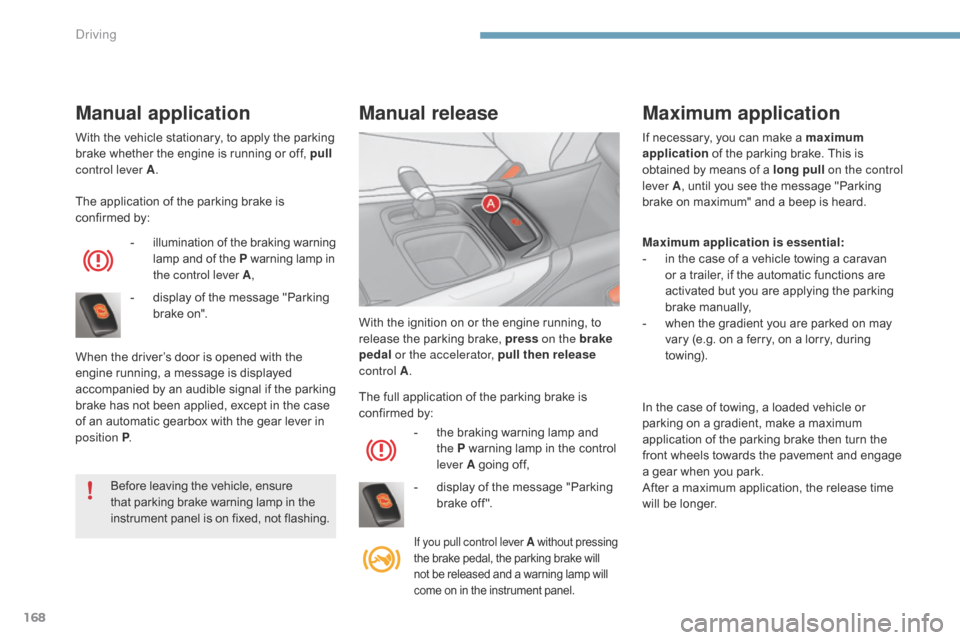
With the vehicle stationary, to apply the parking brake whether the engine is running or off, pull
control lever A .
The
application of the parking brake is
c
onfirmed by:
-
i
llumination
o
f
t
he
b
raking
w
arning
l
amp and of the P
warning lamp in
t
he control lever A ,
-
d
isplay of the message "Parking
b
rake on".
When
the driver’s door is opened with the
e
ngine running, a message is displayed
a
ccompanied by an audible signal if the parking
b
rake has not been applied, except in the case
o
f an automatic gearbox with the gear lever in
p
osition P .
Before
leaving the vehicle, ensure
t
hat parking brake warning lamp in the
i
nstrument panel is on fixed, not flashing.
Manual applicationManual release
The full application of the parking brake is c
onfirmed by:
-
t
he braking warning lamp and
t
he P warning lamp in the control
l
ever A going off,
-
d
isplay of the message "Parking
b
rake off ".
If you pull control lever A without pressing t
he brake pedal, the parking brake will n
ot be released and a warning lamp will
c
ome on in the instrument panel.
With the ignition on or the engine running, to release the parking brake, press on the brake
pedal or the accelerator, pull then release
control A . If
necessary, you can make a maximum
application
of the parking brake. This is
o
btained
by m
eans
o
f
a long
pull
on the control
lever A , until you see the message "Parking
b
rake on maximum" and a beep is heard.
In the case of towing, a loaded vehicle or
p
arking on a gradient, make a maximum
a
pplication of the parking brake then turn the
f
ront wheels towards the pavement and engage
a
gear when you park.
After
a maximum application, the release time
w
ill be longer.
Maximum application
Maximum application is essential:
- i n the case of a vehicle towing a caravan
o
r a trailer, if the automatic functions are
a
ctivated but you are applying the parking
b
rake
m
anually,
-
w
hen the gradient you are parked on may
v
ary (e.g. on a ferry, on a lorry, during
tow
ing).
Driving
Page 171 of 494
169
Automatic release
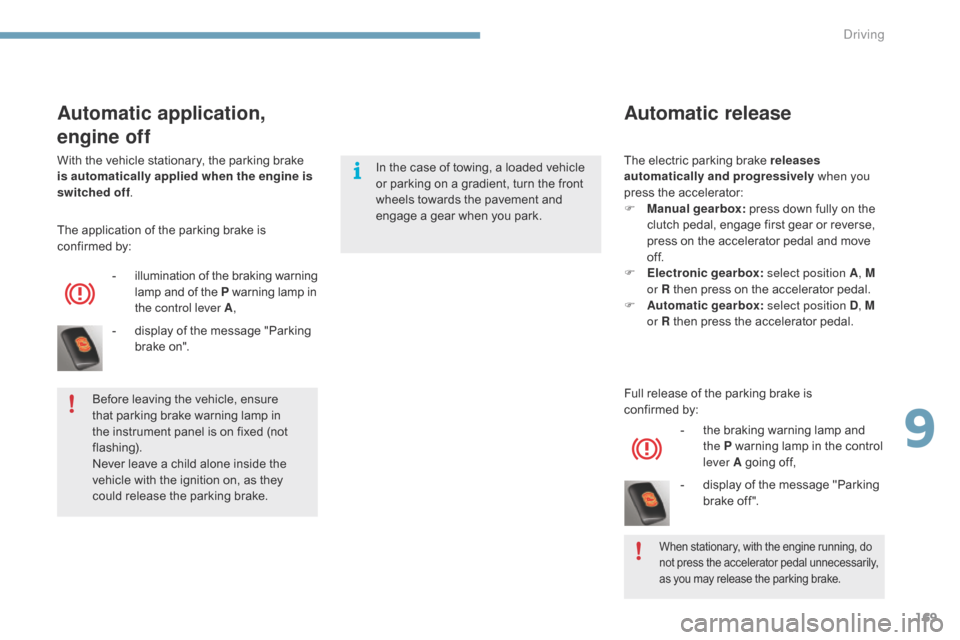
Full release of the parking brake is
c onfirmed by:
-
t
he braking warning lamp and
t
he P warning lamp in the control
l
ever A going off,
-
d
isplay of the message "Parking
b
rake off ".
Automatic application,
engine off
- illumination of t he b raking w arning l
amp and of the P warning lamp in t
he control lever A ,
-
d
isplay of the message "Parking
b
rake on".
The
application of the parking brake is
c
onfirmed by:
With
the
vehicle stationary, the parking brake
i
s automatically applied when the engine is
switched off .
Before leaving the vehicle, ensure
t
hat parking brake warning lamp in
t
he
instrument panel is on fixed (not
f
lashing).
Never
leave a child alone inside the
v
ehicle with the ignition on, as they
c
ould release the parking brake.
When stationary, with the engine running, do not press the accelerator pedal unnecessarily, a
s you may release the parking brake.
In the case of towing, a loaded vehicle or parking on a gradient, turn the front
w
heels towards the pavement and
e
ngage a gear when you park.The
electric parking brake releases
automatically and progressively when you
press
the accelerator:
F
M
anual gearbox:
press down fully on the
c
lutch pedal, engage first gear or reverse,
p
ress on the accelerator pedal and move
o
f f.
F
E
lectronic gearbox: select position A, M
or R
then press on the accelerator pedal.
F
A
utomatic gearbox: select position D, M
or R
then press the accelerator pedal.
9
Driving
Page 172 of 494
170
Immobilising the vehicle,
engine running
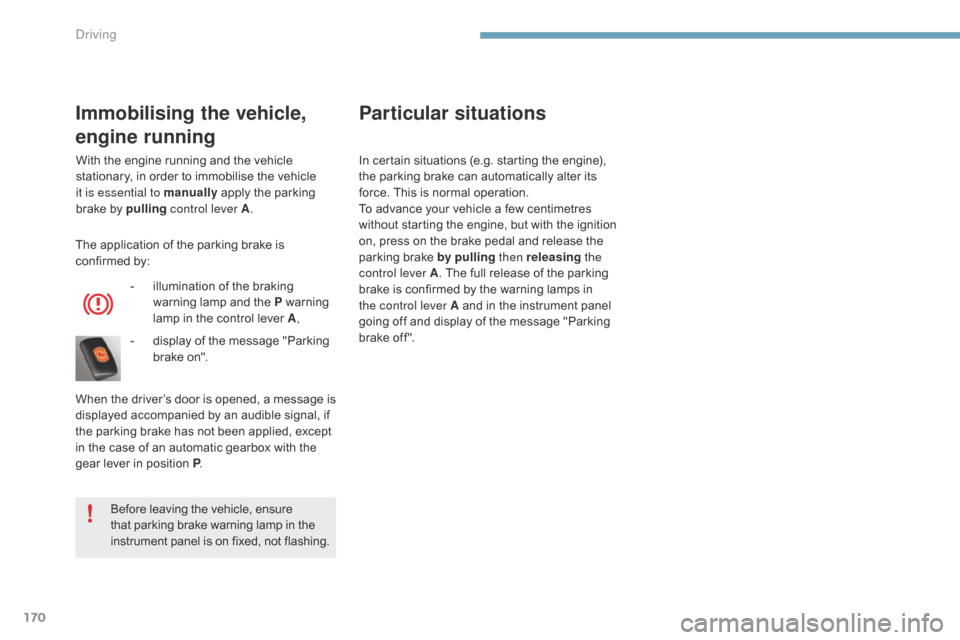
- illumination of the braking w
arning lamp and the P warning
l
amp in the control lever A,
-
d
isplay of the message "Parking
b
rake on".
Particular situations
In certain situations (e.g. starting the engine), the parking brake can automatically alter its
f
orce. This is normal operation.
To
advance your vehicle a few centimetres
w
ithout starting the engine, but with the ignition
o
n, press on the brake pedal and release the
p
arking brake by pulling then releasing the
control lever A .
The full release of the parking
b
rake is confirmed by the warning lamps in
t
he control lever A and in the instrument panel
g
oing off and display of the message "Parking
b
rake off ".
When
the
driver’s
door
is
opened,
a
message
is
d
isplayed
accompanied
by
an
audible
signal,
if
t
he
parking
brake
has
not
been
applied,
except
i
n
the
case
of
an
automatic
gearbox
with
the
g
ear
lever
in
position
P .
The
application
of
the
parking
brake
is
c
onfirmed
by:
With
the
engine
running
and
the
vehicle
s
tationary,
in
order
to
immobilise
the
vehicle
i
t is essential to manually
apply
the
parking
b
rake
by
pulling control lever A .
Before
leaving
the
vehicle,
ensure
t
hat
parking
brake
warning
lamp
in
the
i
nstrument
panel
is
on
fixed,
not
flashing.
Driving
Page 175 of 494
173
SituationsConsequences
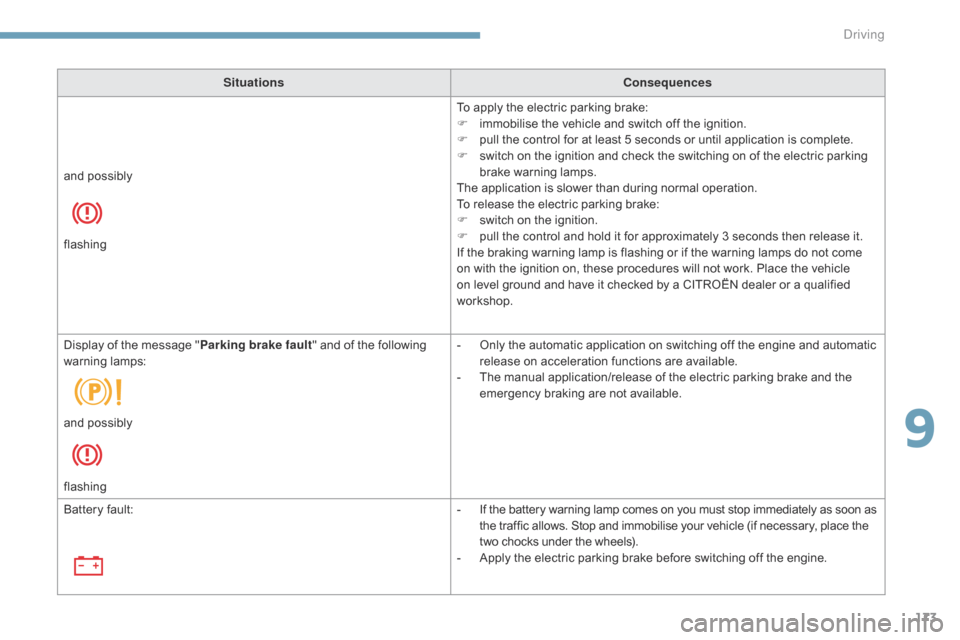
To apply the electric parking brake:
F
i
mmobilise the vehicle and switch off the ignition.
F
p
ull the control for at least 5 seconds or until application is complete.
F
s
witch on the ignition and check the switching on of the electric parking
b
rake warning lamps.
The
application is slower than during normal operation.
To
release the electric parking brake:
F
s
witch on the ignition.
F
p
ull the control and hold it for approximately 3 seconds then release it.
If
the braking warning lamp is flashing or if the warning lamps do not come
o
n with the ignition on, these procedures will not work. Place the vehicle
o
n level ground and have it checked by a CITROËN dealer or a qualified
w
orkshop.
and
possibly
flashing
Display
of
the
message
" Parking brake fault "
and of the following
w
arning
lam
ps: -
O
nly the automatic application on switching off the engine and automatic
r
elease on acceleration functions are available.
-
T
he manual application/release of the electric parking brake and the
e
mergency braking are not available.
and
possibly
flashing
Battery
fault: -
I
f the battery warning lamp comes on you must stop immediately as soon as
t
he traffic allows. Stop and immobilise your vehicle (if necessary, place the
t
wo chocks under the wheels).
-
A
pply the electric parking brake before switching off the engine.
9
Driving
Page 176 of 494
174
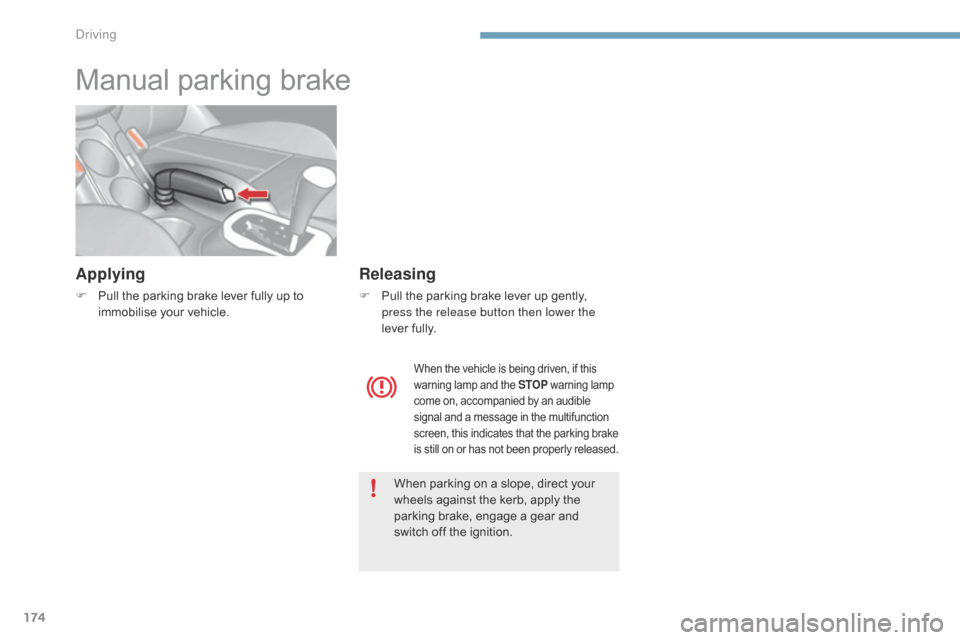
Manual parking brake
Applying
F Pull the parking brake lever fully up to i
mmobilise your vehicle.
Releasing
F Pull the parking brake lever up gently, p
ress the release button then lower the
lever
f
ully.
When the vehicle is being driven, if this warning lamp and the STOP w arning lam p c
ome on, accompanied by an audible
s
ignal and a message in the multifunction
s
creen, this indicates that the parking brake
i
s still on or has not been properly released.
When parking on a slope, direct your wheels against the kerb, apply the
p
arking brake, engage a gear and
s
witch off the ignition.
Driving
Page 181 of 494
179
At low high speed, if reverse gear is requested, the N indicator flashes and the gearbox goes
i
nto neutral automatically. To engage reverse,
p
ut the gear lever in position N, then position R .
Reverse
To engage reverse gear R, the vehicle must be i
mmobilised with your foot on the brake pedal.
F
Sel
ect position R .
Operating fault
Stopping the vehicle
When immobilising the vehicle, with t
he engine running, you must place the
g
ear lever in neutral N.
Before
carrying out any work in the
e
ngine compartment, ensure that the
g
ear lever is in neutral N and that the
p
arking brake is applied.
Whatever
the circumstances, you must
m
anually apply the parking brake when
p
arking, unless the parking brake is
p
rogrammed in automatic mode.
Before
switching off the engine, you can:
-
m
ove to position N to engage neutral,
or
-
l
eave the gear engaged; in this case, it will
n
ot be possible to move the vehicle.
In both cases, you must apply the parking
brake
to immobilise the vehicle.
With the ignition on, the flashing of AUTO
,
accompanied by an audible signal and a
m
essage in the screen, indicates a malfunction
o
f the gearbox.
Have it checked by a CITROËN dealer or a
q
ualified
w
orkshop.
9
driving