ESP Citroen C4 2016 2.G Workshop Manual
[x] Cancel search | Manufacturer: CITROEN, Model Year: 2016, Model line: C4, Model: Citroen C4 2016 2.GPages: 396, PDF Size: 10.22 MB
Page 217 of 396
215
C4-2_en_Chap07_infos-pratiques_ed02-2015
Before each use
Check that the towball is correctly fitted by verifying the following points:
- t he towball is correctly locked in place (position A),
-
t
he security key lock is on and the key removed; the locking wheel can no longer be
ope
rated,
-
t
he towball must no longer move at all in its carrier; try to shake it by hand.
During use
Never unlock the device when a trailer or load carrier is fitted to the towball.
N ever exceed the maximum authorised weight for the vehicle plus trailer (Gross Train
W
eight - GTW).
Before
driving, check the adjustment of the headlamp beam height.
For
more information on adjusting the headlamps, refer to the corresponding section.
After use
For journeys made without a trailer or load carrier, the trailer harness socket must be folded away, the towball removed and the blanking plug inserted in the carrier. This measure
a
pplies particularly if the towball could hinder visibility of the number plate or lighting.
7
Practical information
Page 221 of 396
219
C4-2_en_Chap07_infos-pratiques_ed02-2015
Load reduction modeE nergy ec onomy m ode
Switching to economy mode
Once this period has elapsed, a message a
ppears in the screen indicating that the
v
ehicle has switched to economy mode and the
a
ctive functions are put on standby.
Exiting economy mode
These functions are reactivated automatically the next time the vehicle is driven.
F
I
n order to resume the use of these
f
unctions immediately, start the engine and
l
et it run for a few minutes.
The
time available to you will then be double
t
he period for which the engine is left running.
H
owever, this period will always be between
five
and thirty minutes.
System
which
manages
the
use
of
certain
f
unctions
according
to
the
level
of
charge
r
emaining
in
the
battery.
When
the
vehicle
is
being
driven,
the
load
r
eduction
function
temporarily
deactivates
c
ertain
functions,
such
as
the
air
conditioning,
t
he
heated
rear
screen...
The deactivated functions are reactivated
automatically
as
soon
as
conditions
permit. System
which
manages
the
period
of
use
of
certain
functions to conserve a sufficient level of
c
harge
in
the
battery.
After
the
engine
has
stopped,
you
can
still
use
functions such as the audio equipment, windscreen
w
ipers,
dipped
beam
headlamps, courtesy
lamps,
etc. for a maximum combined period of
t
hirty minutes.
A flat battery prevents the engine from
s
tarting.
For
more information on the 12 V
b
attery, refer to the corresponding
s
ection.
This
period
may
be
greatly
reduced
if
t
he
battery
is
not
fully
charged.
If
the
telephone
is
being
used
at
the
s
ame
time
with
the
touch
screen
tablet,
i
t
will
be
interrupted
after
10
minutes.
7
Practical information
Page 223 of 396
221
C4-2_en_Chap07_infos-pratiques_ed02-2015
Changing a wiper blade
Before removing a front
wiper blade
F Within one minute after switching off t
he ignition, operate the wiper stalk to
p
osition the wiper blades vertically on the
windscreen.
Removing
F Raise the corresponding wiper arm.
F U nclip the wiper blade and remove it.
Fitting
F Put the corresponding new wiper blade in p
lace and clip it.
F
F
old down the wiper arm carefully.
After fitting a front wiper
blade
F Switch on the ignition.
F O perate the wiper stalk again to park the
w
iper blades.
7
Practical information
Page 228 of 396
226
C4-2_en_Chap07_infos-pratiques_ed02-2015
Checking levels
The check is carried out either when the ignition is switched on using the
o
il level indicator in the instrument
p
anel for vehicles so equipped, or
u
sing the dipstick.
Engine oil level
Checking using
the dipstick
Check all of these levels regularly, in line with the manufacturer's service schedule. Top them up if necessary, unless other wise indicated.
I f a level drops significantly, have the corresponding system checked by a CITROËN dealer or a qualified workshop.
It
is normal to top up the oil level between
t
wo services (or oil changes). CITROËN
r
ecommends that you check the level, and top
u
p if necessary, every 3 000 miles (5 000 kms).A = MA X
B = MIN If you find that the level is above the A
mark or
belo
w the B mark, do not star t the engine.
-
I
f the level is above the MAX
mark (risk
o
f damage to the engine), contact a
C
ITROËN dealer or a qualified workshop.
-
I
f the level is below the MIN
mark, you
m
ust top up the engine oil.
Oil grade
Before topping-up the oil or changing the oil, check that the oil is the correct grade for your
e
ngine and conforms to the manufacturer's
r
ecommendations.
Take
care
when
working
under
the
b
onnet,
as
certain
areas
of
the
engine
m
ay
be
extremely
hot
(risk
of
burns)
and
t
he
cooling
fan
could
start
at
any
time
(
even
with
the
ignition
off).
To
ensure
that
the
reading
is
correct,
y
our
vehicle
must
be
parked
on
a
level
s
ur face
with
the
engine
having
been
off
f
or
more
than
30
minutes. F
L
ocate
the
dipstick
in
the
engine
c
ompartment
of
your
vehicle.
For
more
information
on
the
petrol
or
Diesel
e
ngine,
refer
to
the
corresponding
section.
F
T
ake
the
dipstick
by
its
coloured
grip
and
r
emove
it
completely.
F
W
ipe
the
end
of
the
dipstick
using
a
clean
n
on-fluffy
cloth.
F
R
efit
the
dipstick
and
push
fully
down,
then
p
ull
it
out
again
to
make
the
visual
check:
t
he
correct
level
is
between
the
marks
A
and B .
Practical information
Page 229 of 396
227
C4-2_en_Chap07_infos-pratiques_ed02-2015
Topping-up the engine oil level
F Locate the oil filler cap in the engine c
ompartment of your vehicle.
For
more information on the petrol or Diesel
e
ngine, refer to the corresponding section.
F
U
nscrew the oil filler cap to reveal the filler
a
perture.
F
A
dd oil in small quantities, avoiding any
s
pills on engine components (risk of fire).
F
W
ait a few minutes before checking the
l
evel again using the dipstick.
F
A
dd more oil if necessary.
F
A
fter checking the level, carefully refit the
o
il filler cap and the dipstick in its tube.
After
topping-up the oil, the check when
s
witching on the ignition with the oil level
i
ndicator in the instrument panel is not valid
d
uring the 30 minutes after topping up.
Engine oil change
Refer to the manufacturer's service schedule for details of the interval for this operation.
In
order to maintain the reliability of the engine
a
nd emission control system, never use
a
dditives in the engine oil.
Brake fluid level
Changing the fluid
Refer to the manufacturer's service schedule for details of the interval for this operation.
Fluid specification
The brake fluid must conform to the manufacturer's r ecommendations.
The
brake fluid level should be close
t
o the "MA X" mark. If it is not, check
t
he brake pad wear.
Power steering
fluid level
The power steering fluid level should b
e close to the "MA X" mark. With
t
he engine cold, unscrew the cap to
c
heck the level.
7
Practical information
Page 233 of 396
231
C4-2_en_Chap07_infos-pratiques_ed02-2015
Automatic gearbox
The gearbox does not require any maintenance (no oil change).
Refer
to the manufacturer's
s
ervice schedule for details of
the
level checking interval for this
c
omponent.
Electric parking brake
This system does not require any routine servicing. However, in
t
he event of a problem, have the
s
ystem checked by a CITROËN
d
ealer or a qualified workshop.
Manual parking brake
If a loss of effectiveness of this
system i s n oticed, t he p arking b rake
m
ust be checked, even between
t
wo services.
Brake pads
Brake wear depends on the style of driving, particularly in the case
o
f vehicles used in town, over short
distances.
It may be necessary to
Brake disc wear
For information on checking brake disc wear, contact a CITROËN
dealer
or a qualified workshop.
For
more information on the electric parking
b
rake, refer to the corresponding section.
Manual gearbox
The gearbox does not require any maintenance (no oil change).
Refer
to the manufacturer's service
s
chedule for the checking interval
f
or this component.
Only
use products recommended by
C
ITROËN or products of equivalent
q
uality
an
d
sp
ecification.
In
order to optimise the operation of
u
nits as important as those in the
b
raking system, CITROËN selects and
o
ffers very specific products.
After
washing the vehicle, dampness,
o
r in wintry conditions, ice can form
o
n the brake discs and pads: braking
e
fficiency may be reduced. Make light
b
rake applications to dry and defrost
t
he brakes.
have
the
condition of the brakes checked, even
b
etween
v
ehicle
s
ervices.
Unless
there is a leak in the circuit, a drop in
t
he
brake
fluid level indicates that the brake
p
ads
are
worn. Checking
this system must be done by a
C
ITROËN dealer or a qualified workshop.
7
Practical information
Page 234 of 396
232
C4-2_en_Chap07_infos-pratiques_ed02-2015
AdBlue® additive and SCR system
f
or
BlueHDi Diesel engines
To assure respect for the environment and c
onformity with the new Euro 6 emissions
s
tandard, without adversely affecting the
p
er formance or fuel consumption of Diesel
e
ngines, CITROËN has taken the decision to
e
quip its vehicles with an effective system that
a
ssociates SCR (Selective Catalytic Reduction)
w
ith a particle filter (FAP) for the treatment of
e
xhaust gases.
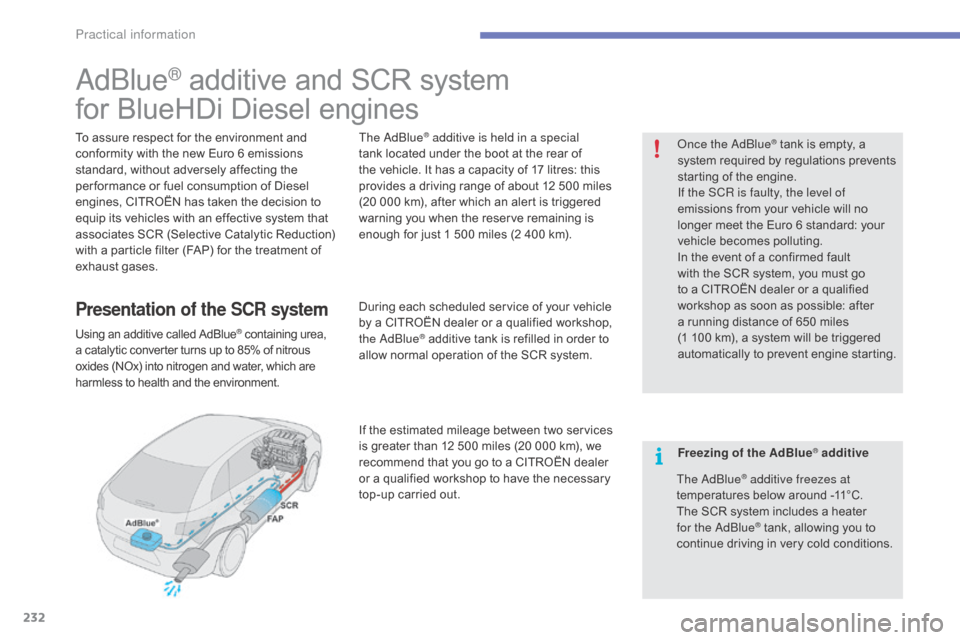
Presentation of the SCR system
Using an additive called AdBlue® containing urea, a
catalytic
converter
turns
up
to
85% of nitrous o
xides
(NOx)
into
nitrogen
and
water, which are
h
armless
to
health
and
the
environment.
The AdBlue® additive is held in a special
tank
located
under the boot at the rear of
t
he
vehicle.
It has a capacity of 17 litres: this
p
rovides
a
driving range of about 12 500 miles
(
20
000
km),
after which an alert is triggered
w
arning
you
when the reserve remaining is
e
nough
for
just 1 500 miles (2 400 km).
During
each
scheduled service of your vehicle
b
y
a
CITROËN dealer or a qualified workshop,
t
he AdBlue
® additive tank is refilled in order to a
llow
normal operation of the SCR system.
If
the
estimated mileage between two services
i
s
greater
than 12 500 miles (20 000 km), we
r
ecommend
that you go to a CITROËN dealer
o
r
a
qualified workshop to have the necessary
t
op-up
carried out. Once the AdBlue
® tank is empty, a s
ystem
required
by regulations prevents
s
tarting
of
the
engine.
If the SCR is faulty, the level of
emissions
from
your vehicle will no
l
onger
meet
the
Euro 6 standard: your
v
ehicle
becomes
polluting.
In
the
event
of
a
confirmed fault
w
ith
the
SCR
system, you must go
t
o
a
CITROËN
dealer or a qualified
w
orkshop
as
soon as possible: after
a
running
distance of 650 miles
(
1 100
km),
a
system will be triggered
a
utomatically
to
prevent engine starting.
Freezing of the AdBlue
® additive
The AdBlue
® additive freezes at
temperatures below around -11°C.
The
SCR
system includes a heater
f
or the AdBlue
® tank, allowing you to c
ontinue
driving in very cold conditions.
Practical information
Page 240 of 396
238
C4-2_en_Chap08_en-cas-de-panne_ed02-2015
Running out of fuel (Diesel)
Other HDi engines
(except BlueHDi version)
On
vehicles
fitted
with
Diesel
engines,
the
fuel
s
ystem
must
be
primed
if
you
run
out
of
fuel.
For all versions other than BlueHDi, refer to the
corresponding
engine
compartment
view.
For
more
information
on
the
Diesel
m
isfuel
prevention
device,
refer
to
the
c
orresponding
s
ection.
BlueHDi engines
If the engine does not start first time, d on't keep trying but start the procedure
a
gain from the beginning. F
A
dd at least five litres of Diesel fuel to the
tank.
F
O
pen the bonnet.
F
I
f necessary, unclip the styling cover for
a
ccess to the priming pump.
F
S
queeze and release the priming pump
r
epeatedly until resistance is felt (there
m
ay be resistance at the first press).
F
O
perate the starter to start the engine
(
if the engine does not start at the first
a
ttempt, wait around 15 seconds before t
rying ag ain).
F I f the engine does not start after a few
a
ttempts, operate the priming pump again
t
hen start the engine.
F
R
efit the styling cover and clip it in place.
F
C
lose the bonnet.
F
F
ill the fuel tank with at least five litres of
D
iesel.
F
S
witch on the ignition (without starting the
e
ngine).
F
W
ait around 6 seconds and switch off the
ig
nition.
F
R
epeat the operation 10 times.
F
O
perate the starter to run the engine.
In the event of a breakdown
Page 259 of 396
257
C4-2_en_Chap08_en-cas-de-panne_ed02-2015
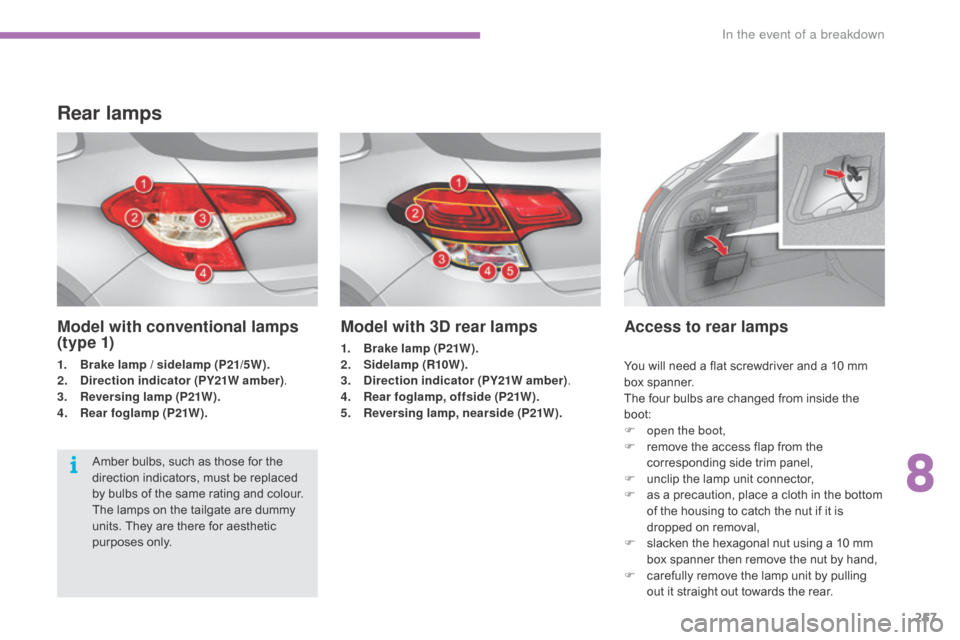
Model with 3D rear lamps
1. Brake lamp (P21W).
2. Sidelamp (R10W ).
3.
D
irection indicator (PY21W amber) .
4.
R
ear foglamp, offside (P21W).
5.
R
eversing lamp, nearside (P21W).
Access to rear lamps
Amber bulbs, such as those for the direction indicators, must be replaced
b
y bulbs of the same rating and colour.
The
lamps on the tailgate are dummy
u
nits. They are there for aesthetic
p
urposes only.
Rear lamps
Model with conventional lamps
(t y p e 1)
1. Brake lamp / sidelamp (P21/5W).
2. Direction indicator (PY21W amber) .
3.
R
eversing lamp (P21W).
4.
R
ear foglamp (P21W). You
will need a flat screwdriver and a 10 mm
b
ox
span
ner.
The
four bulbs are changed from inside the
b
oot:
F
o
pen the boot,
F
r
emove the access flap from the
c
orresponding side trim panel,
F
u
nclip the lamp unit connector,
F
a
s a precaution, place a cloth in the bottom
o
f the housing to catch the nut if it is
d
ropped on removal,
F
s
lacken the hexagonal nut using a 10 mm
b
ox spanner then remove the nut by hand,
F
c
arefully remove the lamp unit by pulling
o
ut it straight out towards the rear.
8
In the event of a breakdown
Page 263 of 396
261
C4-2_en_Chap08_en-cas-de-panne_ed02-2015
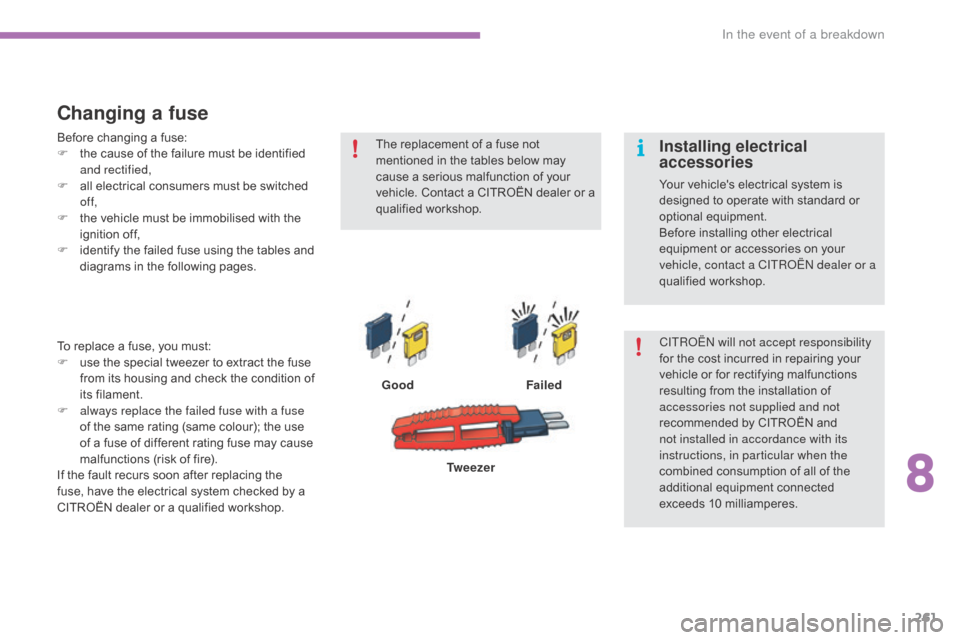
Changing a fuse
GoodFailed
To
replace
a
fuse,
you
must:
F
u
se
the
special
tweezer
to
extract
the
fuse
f
rom
its
housing
and
check
the
condition
of
it
s f
ilament.
F
a
lways replace the failed fuse with a fuse
of
the
same
rating
(same
colour);
the
use
o
f
a
fuse
of
different
rating
fuse
may
cause
m
alfunctions
(risk
of
fire).
If
the
fault
recurs
soon
after
replacing
the
f
use,
have
the
electrical
system
checked
by
a
C
ITROËN
dealer
or
a
qualified
workshop. Tw e e z e r
The
replacement of a fuse not
m
entioned in the tables below may
c
ause a serious malfunction of your
v
ehicle. Contact a CITROËN dealer or a
q
ualified
w
orkshop.
CITROËN will not accept responsibility
for the cost incurred in repairing your v
ehicle or for rectifying malfunctions r
esulting from the installation of
a
ccessories not supplied and not
recommended
by CITROËN and
n
ot installed in accordance with its
instructions, in particular when the
combined
consumption of all of the
a
dditional equipment connected
e
xceeds
1
0
mil
liamperes.
Installing electrical
accessories
Your vehicle's electrical system is designed to operate with standard or
o
ptional
e
quipment.
Before
installing other electrical
e
quipment or accessories on your
v
ehicle, contact a CITROËN dealer or a
qualified
w
orkshop.
Before
changing
a
fuse:
F
t
he
cause
of
the
failure
must
be
identified
a
nd rectified,
F
a
ll
electrical
consumers
must
be
switched
o
f f,
F
t
he
vehicle
must
be
immobilised
with
the
ig
nition
o
ff,
F
i
dentify
the
failed
fuse
using
the
tables
and
d
iagrams
in
the
following
pages.
8
In the event of a breakdown