maintenance DAEWOO LACETTI 2004 Service Manual Online
[x] Cancel search | Manufacturer: DAEWOO, Model Year: 2004, Model line: LACETTI, Model: DAEWOO LACETTI 2004Pages: 2643, PDF Size: 80.54 MB
Page 2330 of 2643

SECTION : 9F
AUDIO SYSTEMS
CAUTION : Disconnect the negative battery cable before removing or installing any electrical unit or when a tool
or equipment could easily come in contact with exposed electrical terminals. Disconnecting this cable will help
prevent personal injury and damage to the vehicle. The ignition must also be in LOCK unless otherwise noted.
TABLE OF CONTENTS
SPECIFICATIONS9F–1 . . . . . . . . . . . . . . . . . . . . . . . . . .
Fastener Tightening Specifications 9F–1. . . . . . . . . . .
SCHEMATIC AND ROUTING DIAGRAMS9F–2 . . . . .
Audio System Circuit 9F–2. . . . . . . . . . . . . . . . . . . . . . .
DIAGNOSIS9F–3 . . . . . . . . . . . . . . . . . . . . . . . . . . . . . . . .
Stereo Cassette AM/FM Radio 9F–3. . . . . . . . . . . . . .
Speakers 9F–5. . . . . . . . . . . . . . . . . . . . . . . . . . . . . . . . .
MAINTENANCE AND REPAIR9F–7 . . . . . . . . . . . . . . .
ON–VEHICLE SERVICE 9F–7. . . . . . . . . . . . . . . . . . . . .
Stereo Cassette AM/FM Radio 9F–7. . . . . . . . . . . . . .
Audio Remote Controller 9F–7. . . . . . . . . . . . . . . . . . . . Notchback CD Changer 9F–8. . . . . . . . . . . . . . . . . . . .
Door Speakers 9F–8. . . . . . . . . . . . . . . . . . . . . . . . . . . .
Tweeter Speakers 9F–9. . . . . . . . . . . . . . . . . . . . . . . . .
Glass Antenna Module 9F–9. . . . . . . . . . . . . . . . . . . . .
Hatchback Windshield Antenna Module 9F–10. . . . . .
GENERAL DESCRIPTION AND SYSTEM
OPERATION9F–11 . . . . . . . . . . . . . . . . . . . . . . . . . . . . . .
Stereo Cassette AM/FM Radio 9F–11. . . . . . . . . . . . . .
Audio Scurity System 9F–11. . . . . . . . . . . . . . . . . . . . . .
Speakers 9F–11. . . . . . . . . . . . . . . . . . . . . . . . . . . . . . . . .
Tape Player and Cassette Care 9F–11. . . . . . . . . . . . . .
Compact Disc Care 9F–11. . . . . . . . . . . . . . . . . . . . . . . .
SPECIFICATIONS
FASTENER TIGHTENING SPECIFICATIONS
ApplicationNSmLb–FtLb–In
Door Speaker Screws2–18
Rear Speaker Screws2–18
Glass Antenna Screws2–18
Page 2336 of 2643
AUDIO SYSTEMS 9F – 7
DAEWOO V–121 BL4
MAINTENANCE AND REPAIR
ON–VEHICLE SERVICE
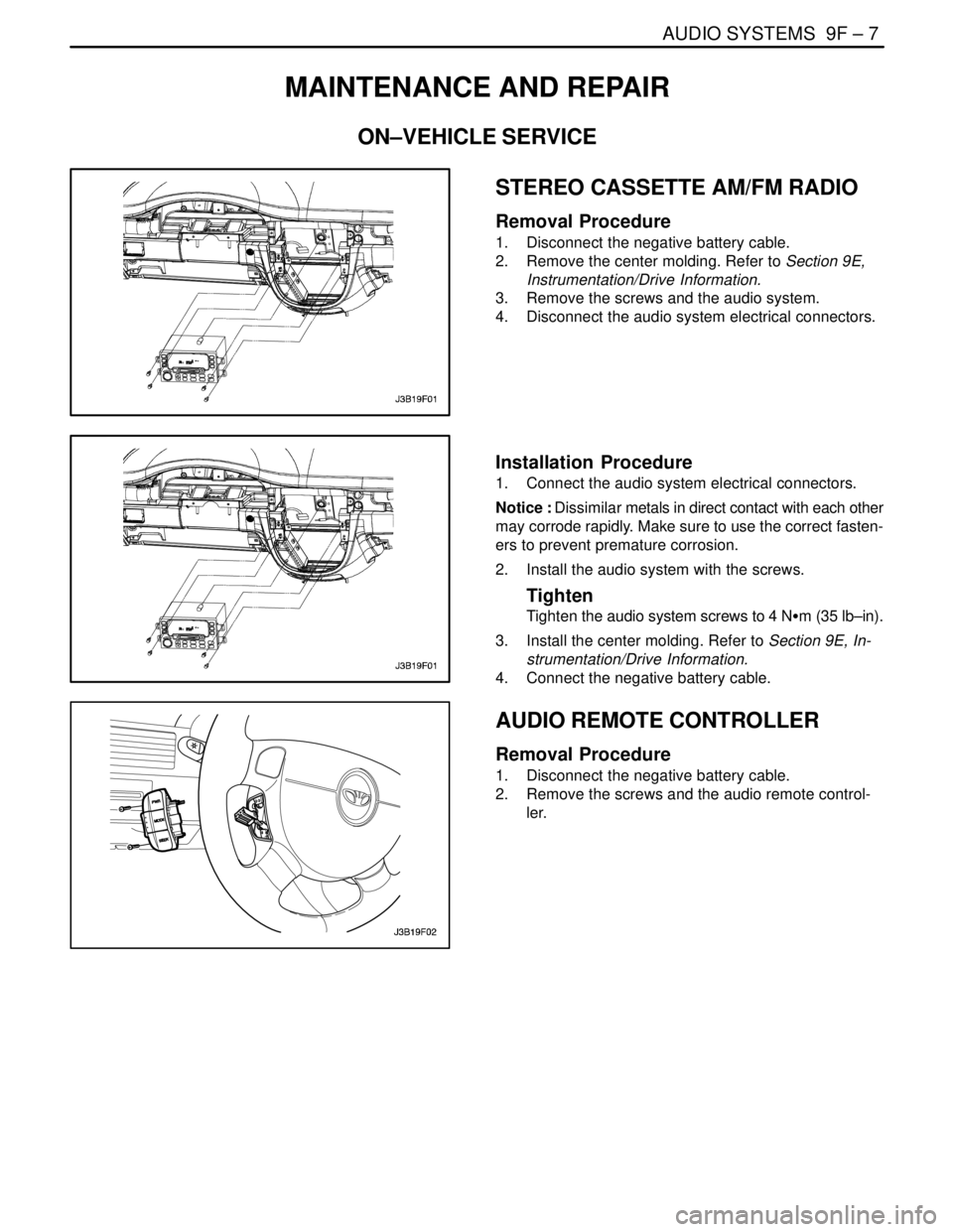
STEREO CASSETTE AM/FM RADIO
Removal Procedure
1. Disconnect the negative battery cable.
2. Remove the center molding. Refer to Section 9E,
Instrumentation/Drive Information.
3. Remove the screws and the audio system.
4. Disconnect the audio system electrical connectors.
Installation Procedure
1. Connect the audio system electrical connectors.
Notice : Dissimilar metals in direct contact with each other
may corrode rapidly. Make sure to use the correct fasten-
ers to prevent premature corrosion.
2. Install the audio system with the screws.
Tighten
Tighten the audio system screws to 4 NSm (35 lb–in).
3. Install the center molding. Refer to Section 9E, In-
strumentation/Drive Information.
4. Connect the negative battery cable.
AUDIO REMOTE CONTROLLER
Removal Procedure
1. Disconnect the negative battery cable.
2. Remove the screws and the audio remote control-
ler.
Page 2341 of 2643

SECTION : 9G
INTERIOR TRIM
CAUTION : Disconnect the negative battery cable before removing or installing any electrical unit or when a tool
or equipment could easily come in contact with exposed electrical terminals. Disconnecting this cable will help
prevent personal injury and damage to the vehicle. The ignition must also be in LOCK unless otherwise noted.
TABLE OF CONTENTS
SPECIFICATIONS9G–1 . . . . . . . . . . . . . . . . . . . . . . . . . .
Fastener Tightening Specifications 9G–1. . . . . . . . . . .
SPECIAL TOOLS9G–2 . . . . . . . . . . . . . . . . . . . . . . . . . . .
Special Tools Table 9G–2. . . . . . . . . . . . . . . . . . . . . . . .
MAINTENANCE AND REPAIR9G–3 . . . . . . . . . . . . . . .
ON–VEHICLE SERVICE 9G–3. . . . . . . . . . . . . . . . . . . . .
Front Door Trim Panel 9G–3. . . . . . . . . . . . . . . . . . . . . .
Rear Door Trim Panel 9G–4. . . . . . . . . . . . . . . . . . . . . .
A–pillar Trim Panel 9G–4. . . . . . . . . . . . . . . . . . . . . . . . .
Upper B–pillar Trim Panel 9G–5. . . . . . . . . . . . . . . . . . .
Lower B–pillar Trim Panel 9G–5. . . . . . . . . . . . . . . . . . .
C–pillar Trim Panel 9G–6. . . . . . . . . . . . . . . . . . . . . . . . .
Deck Lid Sill Plate Cover 9G–6. . . . . . . . . . . . . . . . . . .
Front Rocker Trim Panel 9G–7. . . . . . . . . . . . . . . . . . . .
Rear Rocker Trim Panel 9G–7. . . . . . . . . . . . . . . . . . . .
Front Wheelhouse Trim 9G–8. . . . . . . . . . . . . . . . . . . . .
Rear Wheelhouse Trim 9G–8. . . . . . . . . . . . . . . . . . . . .
Floor Console 9G–9. . . . . . . . . . . . . . . . . . . . . . . . . . . . . Floor Carpet 9G–10. . . . . . . . . . . . . . . . . . . . . . . . . . . . .
Luggage Compartment Rear Low Cover 9G–11. . . . .
Luggage Compartment Wheelhouse Trim
Panel 9G–12. . . . . . . . . . . . . . . . . . . . . . . . . . . . . . . . . .
Driver’s Side Knee Bolster 9G–12. . . . . . . . . . . . . . . . .
Hatchback Door Lower Garnish Molding 9G–13. . . . .
Hatchback Door Upper Garnish Molding 9G–14. . . . .
Luggage Compartment Wheelhouse Trim Panel
(HATCHBACK) 9G–14. . . . . . . . . . . . . . . . . . . . . . . . .
Luggage Compartment Rear Trim Panel 9G–14. . . . .
GENERAL DESCRIPTION AND SYSTEM
OPERATION9G–16 . . . . . . . . . . . . . . . . . . . . . . . . . . . . .
Interior Trim Panels 9G–16. . . . . . . . . . . . . . . . . . . . . . .
Pressure Relief Vent 9G–16. . . . . . . . . . . . . . . . . . . . . .
Floor Console 9G–16. . . . . . . . . . . . . . . . . . . . . . . . . . . .
Floor Carpet 9G–16. . . . . . . . . . . . . . . . . . . . . . . . . . . . .
Rear Compartment Security Cover
(HATCHBACK) 9G–16. . . . . . . . . . . . . . . . . . . . . . . . .
SPECIFICATIONS
FASTENER TIGHTENING SPECIFICATIONS
ApplicationNSmLb–FtLb–In
Door Trim Panel Screws2.5–22
Driver’s Side Knee Bolster Mounting Bolts10–89
Floor Console Screws2.5–22
Gearshift Housing Bolts8–70
Hood Latch Release Handle Mounting Screw3–27
Seat Belt Anchor Bolt3828–
Page 2343 of 2643
INTERIOR TRIM 9G – 3
DAEWOO V–121 BL4
MAINTENANCE AND REPAIR
ON–VEHICLE SERVICE
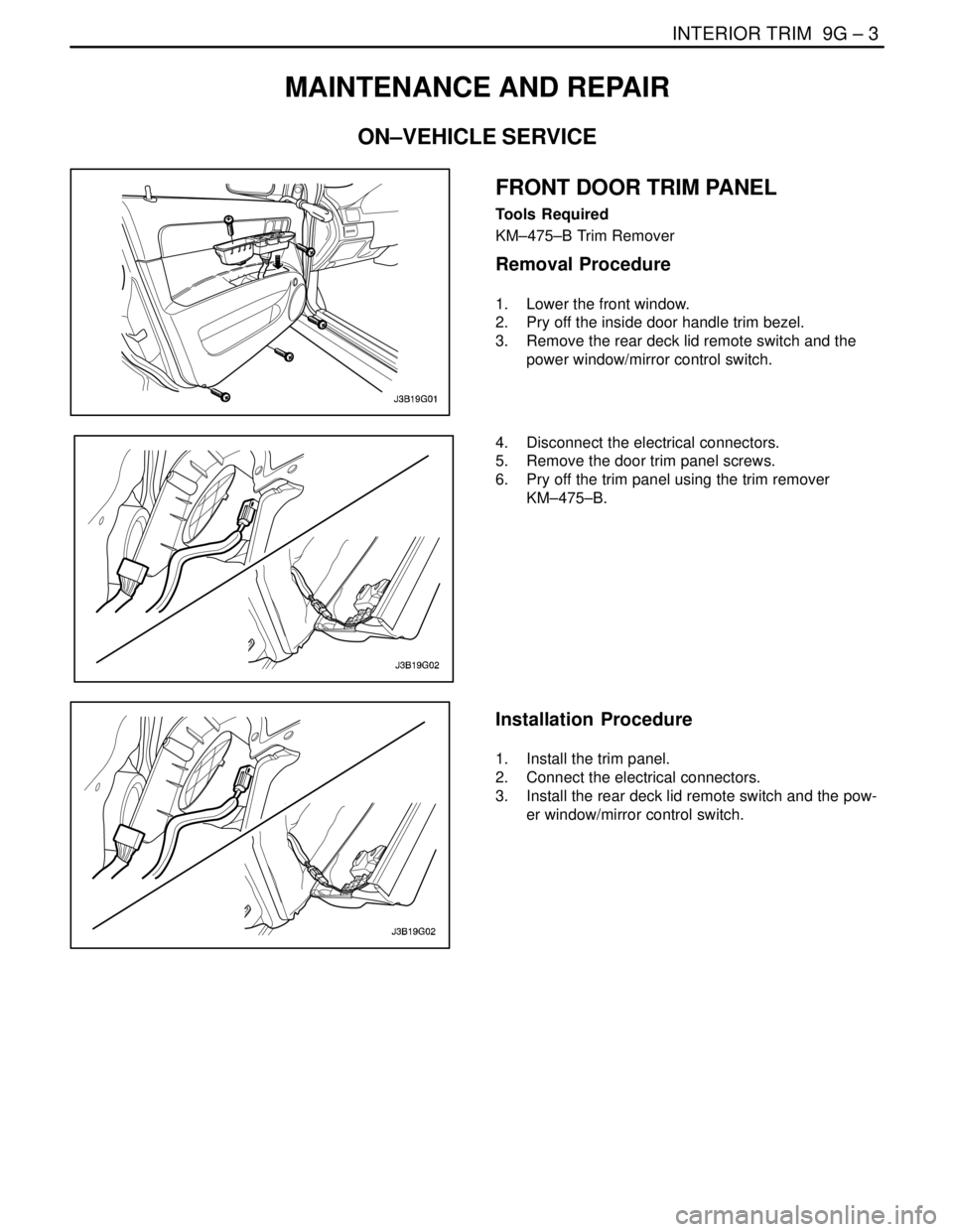
FRONT DOOR TRIM PANEL
Tools Required
KM–475–B Trim Remover
Removal Procedure
1. Lower the front window.
2. Pry off the inside door handle trim bezel.
3. Remove the rear deck lid remote switch and the
power window/mirror control switch.
4. Disconnect the electrical connectors.
5. Remove the door trim panel screws.
6. Pry off the trim panel using the trim remover
KM–475–B.
Installation Procedure
1. Install the trim panel.
2. Connect the electrical connectors.
3. Install the rear deck lid remote switch and the pow-
er window/mirror control switch.
Page 2357 of 2643

SECTION : 9H
SEATS
CAUTION : Disconnect the negative battery cable before removing or installing any electrical unit or when a tool
or equipment could easily come in contact with exposed electrical terminals. Disconnecting this cable will help
prevent personal injury and damage to the vehicle. The ignition must also be in LOCK unless otherwise noted.
TABLE OF CONTENTS
SPECIFICATIONS9H–2 . . . . . . . . . . . . . . . . . . . . . . . . . .
Fastener Tightening Specifications 9H–2. . . . . . . . . . .
MAINTENANCE AND REPAIR9H–3 . . . . . . . . . . . . . . .
ON–VEHICLE SERVICE 9H–3. . . . . . . . . . . . . . . . . . . . .
Front Bucket Seat 9H–3. . . . . . . . . . . . . . . . . . . . . . . . .
Front Seatback 9H–4. . . . . . . . . . . . . . . . . . . . . . . . . . . .
Front Seat Cushion 9H–5. . . . . . . . . . . . . . . . . . . . . . . .
Lumbar Support Lever 9H–5. . . . . . . . . . . . . . . . . . . . . .
Height Adjustment Knobs 9H–6. . . . . . . . . . . . . . . . . . .
Front Seat Trim 9H–6. . . . . . . . . . . . . . . . . . . . . . . . . . . . Head Restraint 9H–7. . . . . . . . . . . . . . . . . . . . . . . . . . . .
Rear Seat Cushion 9H–8. . . . . . . . . . . . . . . . . . . . . . . . .
Split Rear Seatback 9H–8. . . . . . . . . . . . . . . . . . . . . . . .
Split Rear Seatback Hinge 9H–9. . . . . . . . . . . . . . . . . .
Rear Seat Center Armrest 9H–9. . . . . . . . . . . . . . . . . .
Seat Covers 9H–10. . . . . . . . . . . . . . . . . . . . . . . . . . . . .
Child Seat Anchorage 9H–10. . . . . . . . . . . . . . . . . . . . .
Hatchback Child Seat Anchorage 9H–11. . . . . . . . . . .
GENERAL DESCRIPTION AND SYSTEM
OPERATION9H–12 . . . . . . . . . . . . . . . . . . . . . . . . . . . . .
Seats 9H–12. . . . . . . . . . . . . . . . . . . . . . . . . . . . . . . . . . .
Page 2359 of 2643
SEATS 9H – 3
DAEWOO V–121 BL4
MAINTENANCE AND REPAIR
ON–VEHICLE SERVICE
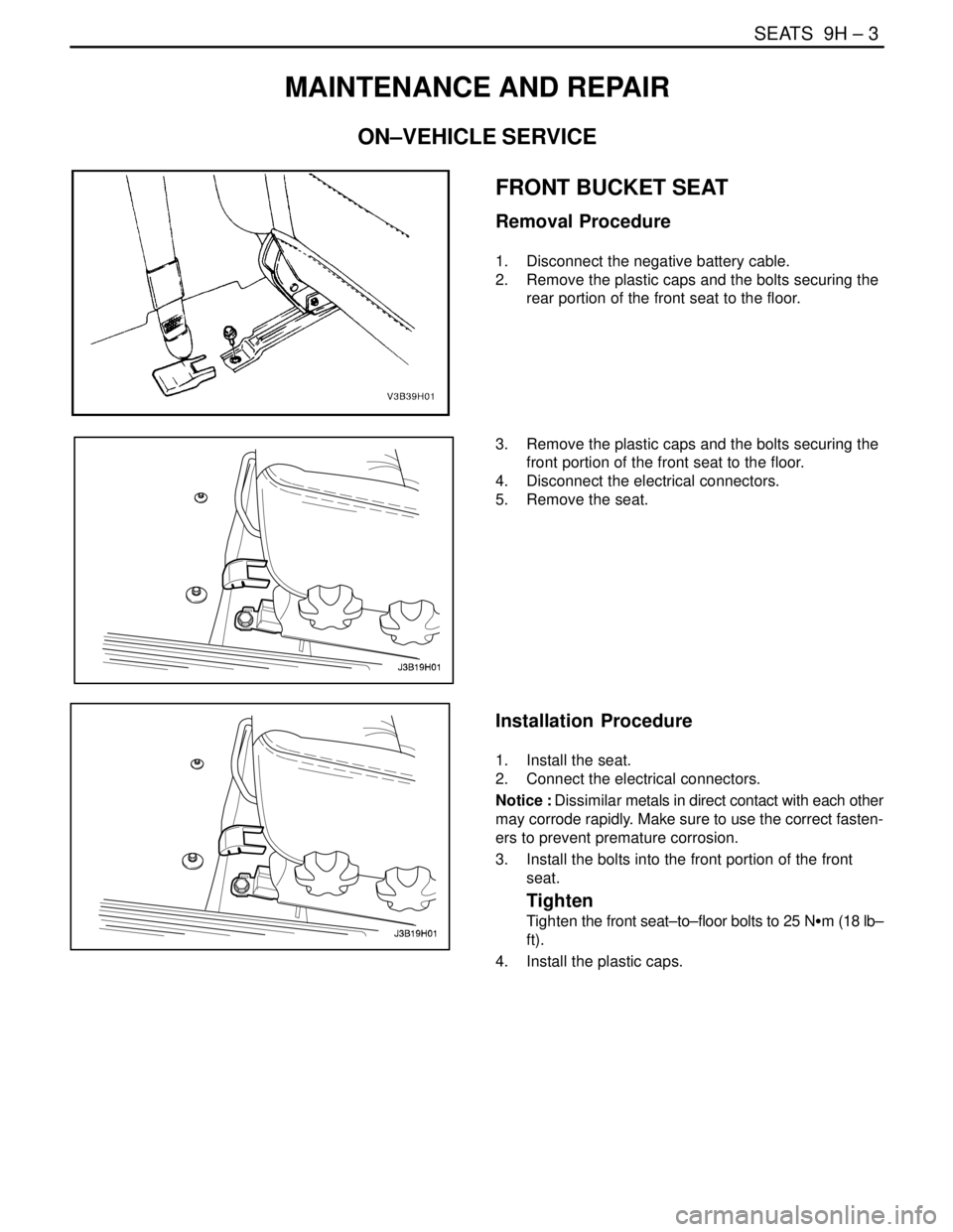
FRONT BUCKET SEAT
Removal Procedure
1. Disconnect the negative battery cable.
2. Remove the plastic caps and the bolts securing the
rear portion of the front seat to the floor.
3. Remove the plastic caps and the bolts securing the
front portion of the front seat to the floor.
4. Disconnect the electrical connectors.
5. Remove the seat.
Installation Procedure
1. Install the seat.
2. Connect the electrical connectors.
Notice : Dissimilar metals in direct contact with each other
may corrode rapidly. Make sure to use the correct fasten-
ers to prevent premature corrosion.
3. Install the bolts into the front portion of the front
seat.
Tighten
Tighten the front seat–to–floor bolts to 25 NSm (18 lb–
ft).
4. Install the plastic caps.
Page 2369 of 2643

SECTION : 9I
WATERLEAKS
TABLE OF CONTENTS
SPECIFICATIONS9I–1 . . . . . . . . . . . . . . . . . . . . . . . . . . .
Recommended Materials for Waterleak Repairs 9I–1.
Watertest Stand Specifications 9I–1. . . . . . . . . . . . . . .
DIAGNOSIS9I–2 . . . . . . . . . . . . . . . . . . . . . . . . . . . . . . . . . Waterleak Diagnosis 9I–2. . . . . . . . . . . . . . . . . . . . . . . .
MAINTENANCE AND REPAIR9I–5 . . . . . . . . . . . . . . . .
ON–VEHICLE SERVICE 9I–5. . . . . . . . . . . . . . . . . . . . . .
Waterleak Repair 9I–5. . . . . . . . . . . . . . . . . . . . . . . . . . .
SPECIFICATIONS
RECOMMENDED MATERIALS FOR WATERLEAK
REPAIRS
Leak Areas Repair Materials
Windshield, back windowUrethane adhesive, caulking kit, or the equivalent
Metal jointsBrushable seam sealer which can be painted
Ventilation ducts3Mnv Auto Bedding and Glazing Compound or the equiva-
lent
Small cracks and pin holes3Mnv Drip–Check Sealer or the equivalent
Large holes3Mnv Automotive Joint and Seam Sealer
Weatherstrips3Mnv 08011 Weatherstrip Adhesive or the equivalent
Bolts, studs, and screwsStrip caulk
WATERTEST STAND SPECIFICATIONS
ApplicationDescription
Nozzle TypeFull jet spray nozzle #1/2 GG–25 or equivalent with a 60°
included angle
Nozzle HeightApproximately 1 600 mm (63.0 in.) from the floor
Volume of Flow14L (3.7 gal) per minute
Pressure155 kPa (22.5 psi) measured at the nozzle
Windshield and A–Pillar Test Stand PositionApproximately 30° down, 45° toward the rear, and aimed
at the corner of the windshield
B–Pillar Test Stand PositionApproximately 30° down, 45° toward the rear, and aimed
at the center of the rear door
Back Window and Rear Deck Lid Test Stand PositionApproximately 30° down, 30° toward the front and aimed
approximately 610 mm (24.0 in.) from the corner of the
back window
Page 2373 of 2643
WATERLEAKS 9I – 5
DAEWOO V–121 BL4
MAINTENANCE AND REPAIR
ON–VEHICLE SERVICE
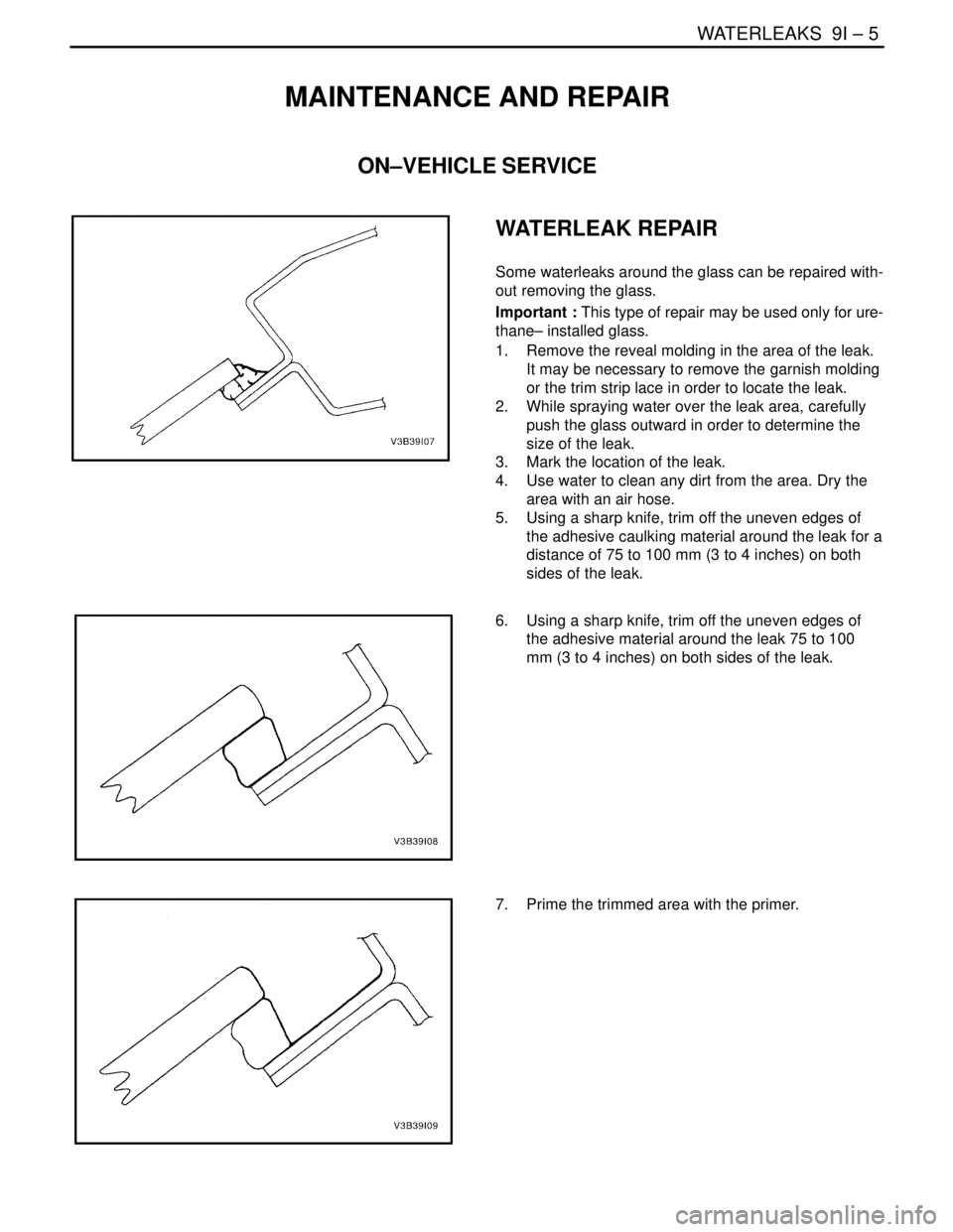
WATERLEAK REPAIR
Some waterleaks around the glass can be repaired with-
out removing the glass.
Important : This type of repair may be used only for ure-
thane– installed glass.
1. Remove the reveal molding in the area of the leak.
It may be necessary to remove the garnish molding
or the trim strip lace in order to locate the leak.
2. While spraying water over the leak area, carefully
push the glass outward in order to determine the
size of the leak.
3. Mark the location of the leak.
4. Use water to clean any dirt from the area. Dry the
area with an air hose.
5. Using a sharp knife, trim off the uneven edges of
the adhesive caulking material around the leak for a
distance of 75 to 100 mm (3 to 4 inches) on both
sides of the leak.
6. Using a sharp knife, trim off the uneven edges of
the adhesive material around the leak 75 to 100
mm (3 to 4 inches) on both sides of the leak.
7. Prime the trimmed area with the primer.
Page 2375 of 2643
SECTION : 9J
WINDNOISE
TABLE OF CONTENTS
DIAGNOSIS9J–1 . . . . . . . . . . . . . . . . . . . . . . . . . . . . . . . . .
Windnoise Diagnosis 9J–1. . . . . . . . . . . . . . . . . . . . . . . .
MAINTENANCE AND REPAIR9J–2 . . . . . . . . . . . . . . . . ON–VEHICLE SERVICE 9J–2. . . . . . . . . . . . . . . . . . . . . .
Windnoise Repair 9J–2. . . . . . . . . . . . . . . . . . . . . . . . . . .
DIAGNOSIS
WINDNOISE DIAGNOSIS
CAUTION : An assistant should drive the vehicle
while the technician checks for the location of the
windnoise, in order to prevent personal injury or ve-
hicle damage.
A test drive in the vehicle is necessary to accurately deter-
mine the location of the windnoise. Often there is a primary
leak and secondary leaks. Failure to repair all leaks will
only reduce the windnoise, not eliminate it.
During the test drive the technician should bring the follow-
ing items to aid in determining the location of the wind-
noise.
S A mechanics stethoscope or vacuum hose
S Masking tape
S Strip caulk
S A china marking pencil
S A screwdriver
Perform the following steps in order to conduct the road
test:
1. Choose a route that includes smooth straight
streets that run in all four directions (north, south,
east, and west).
2. Choose streets with little traffic or noise that would
interfere with the test.
3. Drive the vehicle at the speeds at which the noise
was noticed by the customer or until the noise is
produced. Do not exceed legal speed limits.
4. The windnoise is external if any of the following
conditions occur:
S The windnoise is caused by the wind.S The windnoise can be heard with the door glass
lowered and while the vehicle is being driven.
S The windnoise is eliminated when tape is placed
over various moldings and gaps.
5. Internal windnoise is air leaving the vehicle and
should be repaired in the following manner.
S In order to locate the leak, tape off the body lock
pillar pressure relief valves. This will cause air
pressure to build up inside the vehicle and en-
hance the windnoise.
S Use a stethoscope or a vacuum hose to locate
the leak.
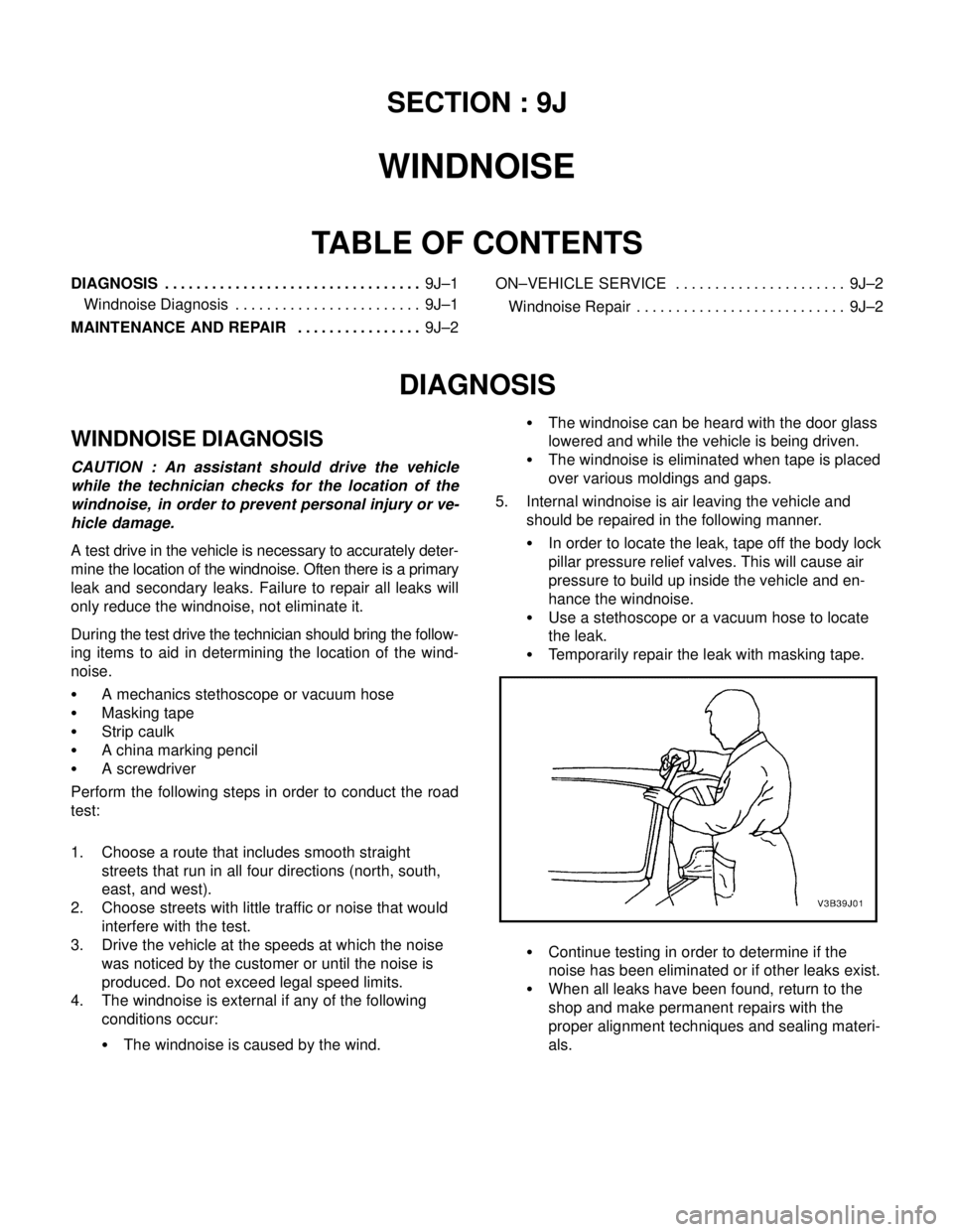
S Temporarily repair the leak with masking tape.
S Continue testing in order to determine if the
noise has been eliminated or if other leaks exist.
S When all leaks have been found, return to the
shop and make permanent repairs with the
proper alignment techniques and sealing materi-
als.
Page 2376 of 2643

9J – 2IWINDNOISE
DAEWOO V–121 BL4
MAINTENANCE AND REPAIR
ON–VEHICLE SERVICE
WINDNOISE REPAIR
Windnoise leak repairs are very similar to waterleak re-
pairs. Refer to Section 9I, Waterleaks. The actual proce-
dure depends on the type of seal being repaired.
Leaks around the door opening weatherstrips do not al-
ways indicate a faulty weatherstrip. A door or window ad-
justment may resolve the condition. Refer to Section 9P,
Doors or Section 9L, Glass and Mirrors.