oil filter DATSUN 210 1979 User Guide
[x] Cancel search | Manufacturer: DATSUN, Model Year: 1979, Model line: 210, Model: DATSUN 210 1979Pages: 548, PDF Size: 28.66 MB
Page 37 of 548
Engine
Tune
up
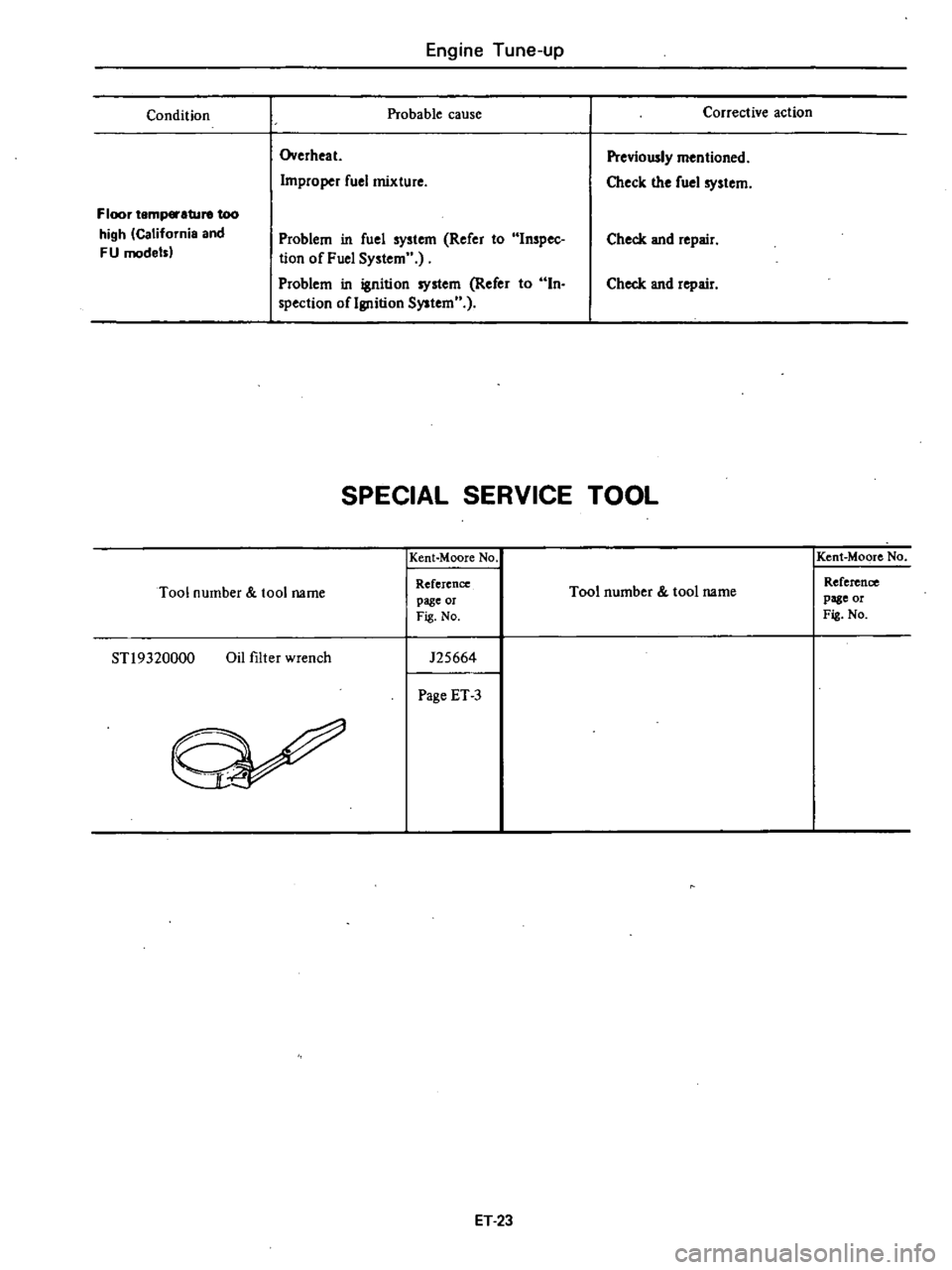
Condition
Probable
cause
Overheat
Improper
fuel
mixture
Floor
temp
ture
too
high
California
and
FU
model
Problem
in
fuel
system
Refer
to
Inspec
tion
of
Fuel
System
Problem
in
ignition
system
Refer
to
In
spection
oflgnition
System
Corrective
action
Previously
mentioned
Check
the
fuel
system
Check
and
repair
Check
and
repair
SPECIAL
SERVICE
TOOL
Kent
Moore
No
Tool
number
tool
name
Reference
page
or
Fig
No
STl9320000
Oil
filter
wrench
125664
Page
ET
3
ET
23
Kent
Moore
No
Tool
number
tool
name
Reference
page
or
Fig
No
Page 40 of 548
PRELIMINARY
CLEANING
AND
INSPECTION
Before
disassembling
engine
ob
serve
the
following
items
I
Prior
to
disassembling
check
outer
parts
for
sign
of
leak
past
their
gasketed
surfaces
2
Check
carburetor
and
fuel
pump
for
condition
fuel
hoses
for
deteriora
t
ion
cracks
or
otherwise
leakage
of
fuel
past
their
jointed
or
connected
surfaces
3
Wipe
dust
and
mud
off
engine
4
Inspect
outer
parts
for
visual
faults
and
broken
or
missing
parts
such
as
bolts
and
nuts
5
Check
piping
and
electrical
cir
cuits
for
deterioration
breakage
fittings
discontinuity
or
insulation
DISASSEMBLY
To
remove
engine
from
car
refer
to
Section
ER
for
Removal
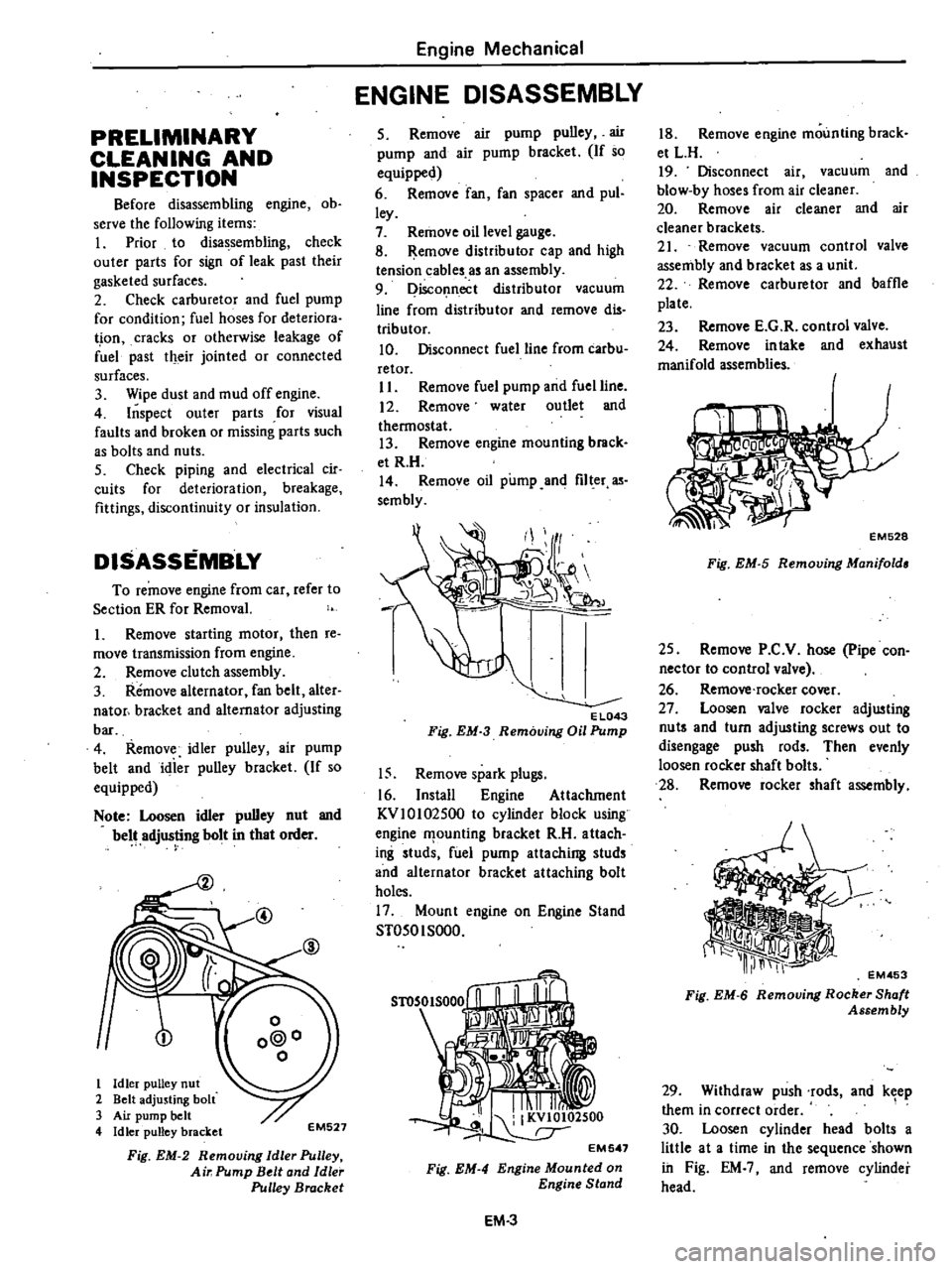
1
Remove
starting
motor
then
re
move
transmission
from
engine
2
Remove
clutch
assembly
3
Remove
alternator
fan
belt
alter
nator
bracket
and
alternator
adjusting
bar
4
Remove
idler
pulley
air
pump
belt
and
idier
pulley
bracket
If
so
equipped
Note
Loosen
idler
pulley
nut
and
belt
adjusting
bolt
in
that
order
@
1
Idler
pulley
nut
2
Belt
adjusting
bolt
3
Air
pump
belt
4
Idler
pulley
bracket
EM527
Fig
EM
2
Removing
Idle
Pulley
Air
Pump
Belt
and
Idle
Pulley
Bracket
Engine
Mechanical
ENGINE
DISASSEMBLY
5
Remove
air
pump
pulley
air
pump
and
air
pump
bracket
If
so
equipped
6
Remove
fan
fan
spacer
and
pul
ley
7
Remove
oil
level
gauge
8
Remove
distributor
cap
and
high
tension
cables
as
an
assembly
9
Disconnect
distributor
vacuum
line
from
distributor
and
remove
dis
tributor
10
Disconnect
fuel
line
from
carbu
retor
II
Remove
fuel
pump
and
fuel
line
12
Remove
water
outlet
and
thermostat
13
Remove
engine
mounting
brack
et
R
H
14
Remove
oil
pump
and
filter
as
sembly
EL043
Fig
EM
3
Removing
Oil
Pump
15
Remove
spark
plugs
16
Install
Engine
Attachment
KVlOI02500
to
cylinder
block
using
engine
f1
ounling
bracket
R
H
attach
ing
studs
fuel
pump
attaching
studs
and
alternator
bracket
attaching
bolt
holes
17
Mount
engine
on
Engine
Stand
ST050I
SOOO
Fig
EM
4
EM
3
18
Remove
engine
mounting
brack
et
L
H
19
Disconnect
air
vacuum
and
blow
by
hoses
from
air
cleaner
20
Remove
air
cleaner
and
air
cleaner
brackets
21
Remove
vacuum
control
valve
assembly
and
bracket
as
a
unit
22
Remove
carburetor
and
baffle
plate
23
Remove
E
G
R
control
valve
24
Remove
intake
and
exhaust
manifold
assemblies
EM528
Fig
EM
5
Removing
Manifold
25
Remove
P
C
V
hose
pipe
con
nector
to
control
valve
26
Remove
rocker
cover
27
Loosen
valve
rocker
adjusting
nut
and
turn
adjusting
screws
out
to
disengage
push
rods
Then
evenly
loosen
rocker
shaft
bolts
28
Remove
rocker
shaft
assembly
EM453
Fig
EM
6
Removing
Rocker
Shaft
Assembly
29
Withdraw
push
rods
and
keep
them
in
correct
order
1
30
Loosen
cylinder
head
bolts
a
little
at
a
time
in
the
sequence
shown
in
Fig
EM
and
remove
cylinder
head
Page 73 of 548

DATSUN
210
Model
8310
Series
SECTIONEL
ENGINE
LUBRICATION
SYSTEM
CONTENTS
ENGINE
LUBRICATION
SYSTEM
LUBRICATION
CIRCUIT
01
L
PUMP
OIL
PRESSURE
REGULATOR
VALVE
OIL
PRESSURE
RELIEF
VALVE
OIL
FILTER
OIL
PRESSURE
WARNING
SWITCH
EL
2
EL
2
EL
3
EL
4
EL
4
EL
4
EL
4
SERVICE
DATA
AND
SPECIFICATIONS
TROUBLE
DIAGNOSES
AND
CORRECTIONS
SPECIAL
SERVICE
TOOL
EL
5
EL
5
EL
6
Page 75 of 548
OIL
PUMP
The
oil
pump
and
filter
assembly
is
bolted
to
the
right
side
of
the
cylinder
block
and
can
be
removed
with
the
engine
in
pl
c
The
oil
pump
which
is
driven
by
a
gear
on
the
camshaft
has
the
full
flow
element
type
filter
in
stalled
to
the
oil
pump
cover
REMOVAL
I
Place
a
suitable
container
under
oil
pump
2
Remove
three
bolts
attaching
oil
pump
and
filter
assembly
and
with
draw
assembly
3
Separate
oil
filter
from
oil
pump
4
Ciean
off
old
gasket
from
mating
surfaces
i
E
L043
F
EL
2
R
moving
Oil
Pump
Asso
mbly
INSTALLATION
I
Install
oil
filter
to
oil
pump
2
Locate
oil
pump
and
filter
as
sembly
or
cylinder
block
using
a
spacer
and
new
gasket
Secure
with
three
bolts
l
l
Tightening
torque
Oil
pump
securing
bolts
0
9
to
1
4
kg
m
6
5
to
10
1
ft
lbl
3
Check
oil
level
and
add
oil
if
necessary
4
Start
engine
and
check
for
oil
leaks
5
Remove
the
container
Engine
Lubrication
System
DISASSEMBLY
AND
ASSEMBLY
I
Remove
bolt
securing
pump
cover
to
pump
body
Separate
pump
cover
from
pump
body
2
Slide
out
outer
rotor
from
pump
body
3
Remove
oil
pressure
regulator
plug
washer
shim
spring
and
valve
4
Assemble
oil
pump
in
reverse
order
of
disassembly
Note
a
When
placing
oil
pump
in
a
vice
use
extreme
care
not
to
distort
pump
body
and
cover
in
the
jaws
b
Do
not
pull
out
drive
shaft
pin
securing
drive
shaft
and
inner
rotor
Shaft
is
press
fitted
to
rotor
with
the
pin
caulked
EL044
Fig
EL
3
Oil
Pump
l
l
Tightening
torque
Oil
pump
cove
bolt
0
39
to
0
5
2
kltm
2
8
to
3
8
ti
Ib
Regulator
valve
plug
4
0
to
5
0
kltm
29
to
36
ft
bl
INSPECTION
Wash
all
parts
in
cleaning
solvent
and
dry
wiih
compressed
air
I
hispect
pump
body
and
cover
for
cracks
or
excessive
wear
2
Inspect
pump
rotors
for
excessive
wear
3
Check
inner
rotor
shaft
for
looseness
in
pump
body
4
Inspect
regulator
valve
for
wear
or
scoring
5
Check
regulator
spring
to
see
that
it
is
not
worn
on
its
side
or
collapsed
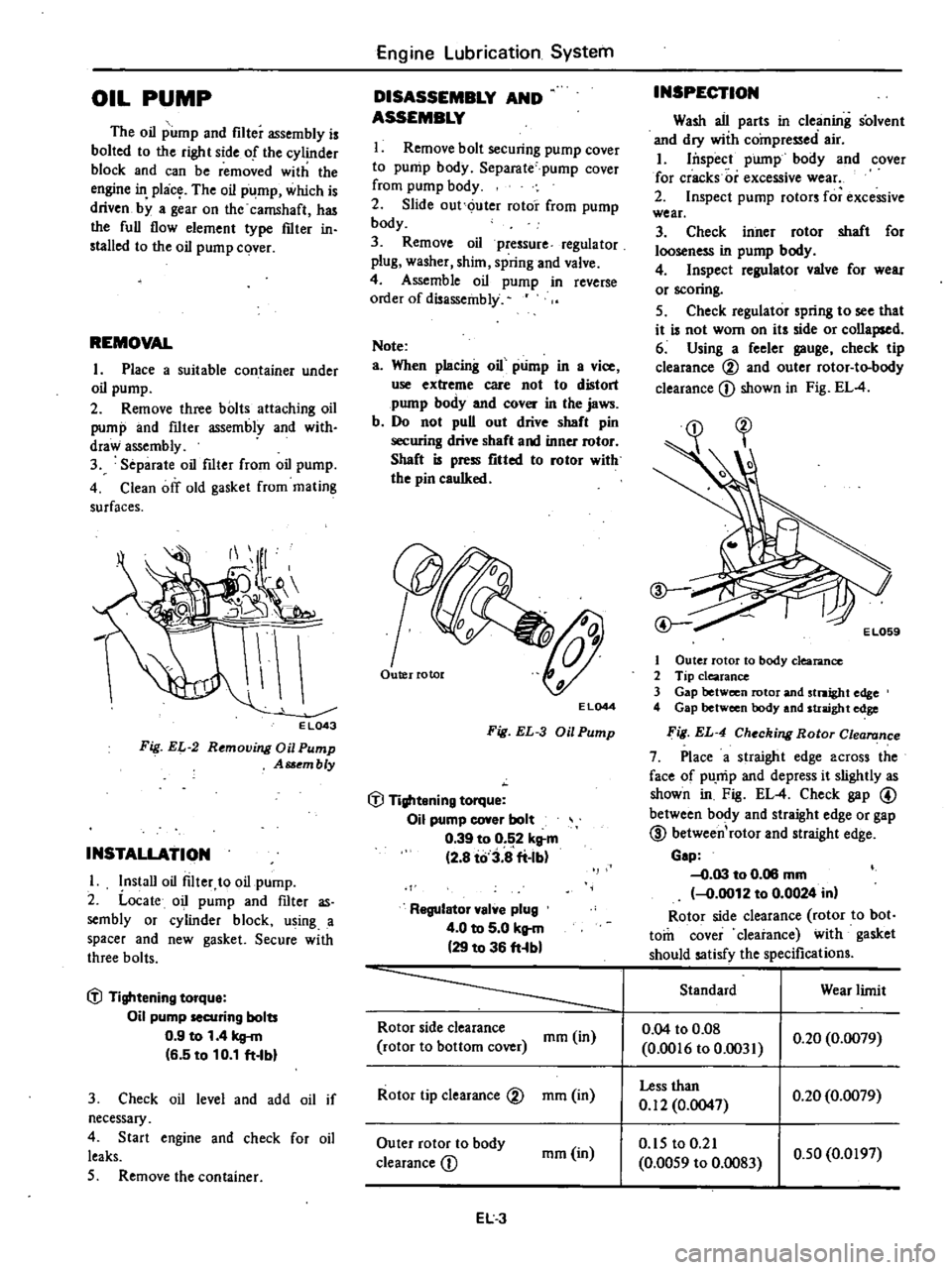
6
Using
a
feeler
gauge
check
tip
clearance
00
and
outer
rotor
to
body
clearance
CD
shown
in
Fig
EL
4
EL059
1
Outer
rotor
to
body
clearance
2
Tip
clearance
3
Gap
between
rotor
and
stnight
edge
4
Gap
between
body
and
straight
edge
ig
EL
4
Checking
Rotor
Clea
nce
7
Place
a
straight
edge
across
the
face
of
pU
mp
and
depress
it
slightly
as
shown
in
Fig
EL
4
Check
gap
@
between
body
and
straight
edge
or
gap
@
between
rotor
and
straight
edge
Gap
0
03
to
0
06
mm
0
0012
to
0
0024
in
Rotor
side
clearance
rotor
to
bot
tom
cover
clearance
with
gasket
should
satisfy
the
specifications
Standard
Wear
limit
Rotor
side
clearance
mm
in
0
04
to
0
08
rotor
to
bottom
cover
0
0016
to
0
031
0
20
0
0079
Rotor
tip
clearance
V
mm
in
Less
than
0
20
0
0079
0
12
0
0047
Outer
rotor
to
body
mm
in
0
15
to
0
21
0
50
0
0197
clearance
CD
0
0059
to
0
083
EL3
Page 76 of 548
Not
Pump
rotors
and
body
are
not
serv
iced
separatdy
If
pump
rotors
or
body
are
damaged
or
worn
replace
ment
of
the
entire
oil
pump
assembly
isnecessary
OIL
PRESSURE
REGULATOR
VALVE
The
oil
pressure
regulator
valve
is
not
adjustable
At
the
released
posi
tion
the
valve
permits
the
oil
to
by
pass
through
the
passage
in
the
pump
cover
to
the
inlet
side
of
the
pump
Check
regulator
valve
spring
to
ensure
that
spring
tension
is
correct
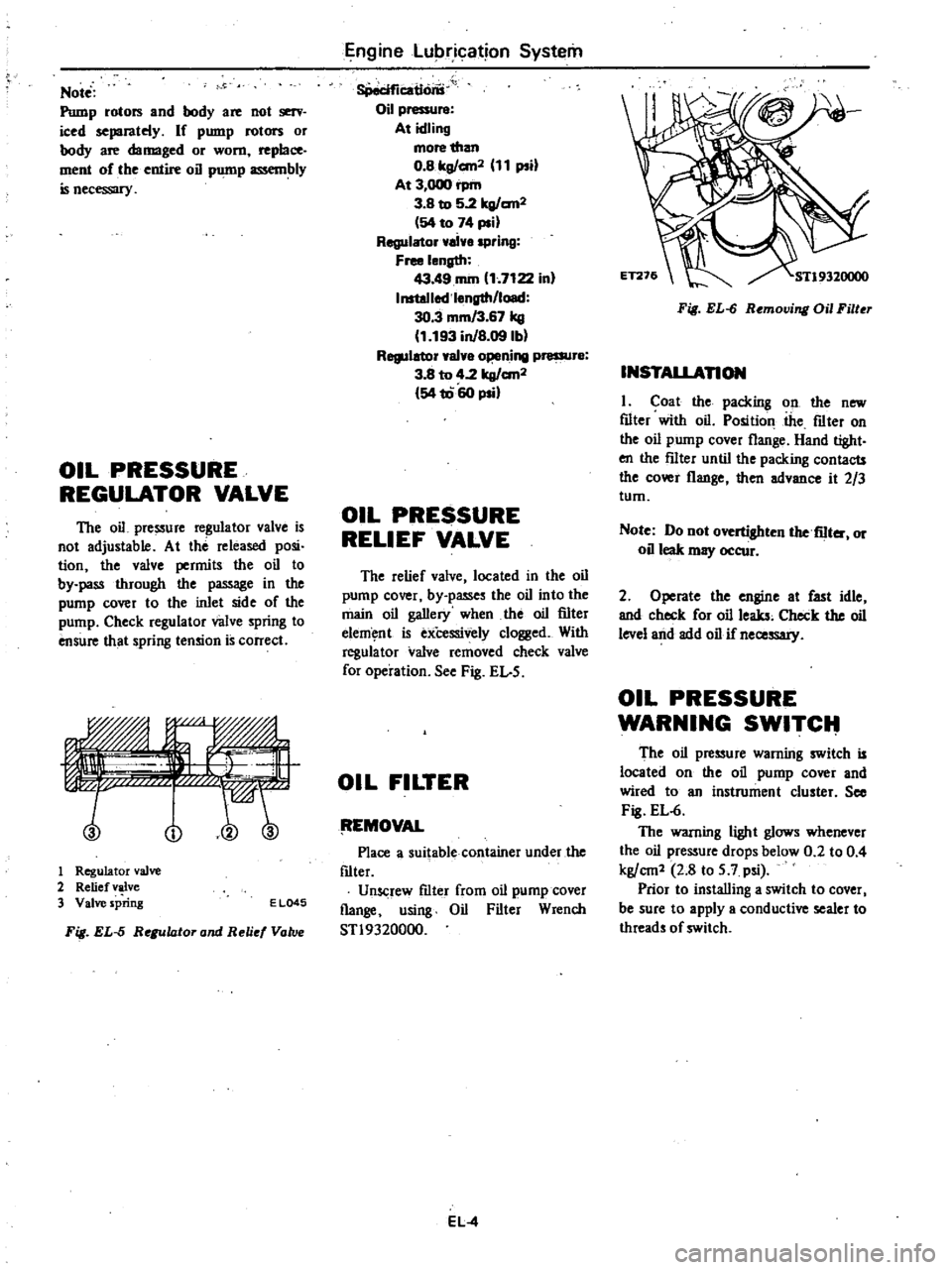
no
1
Regulator
valve
2
Relief
valve
3
Valve
spring
E
L045
Fig
EL
5
Regulator
and
Reli
Vatv
Engine
Lubrication
System
8Peciflcatlons
Oil
pressure
At
idling
more
than
O
Blrg
an2
11
psi
At
3
000
rpm
3
B
to
5
2lrg
an2
54
to
74
psi
Regulator
ai
spring
Free
length
43
49
rom
1
7122
in
InstoJlod
l
ngth
load
30
3
mm
3
67
kg
1
193
inJB
09lbl
Regulator
val
o
ning
pressur
3
8
to
4
2
lrg
an2
54
1060
psi
OIL
PRESSURE
RELIEF
VALVE
The
relief
valve
located
in
the
oil
pump
cover
by
passes
the
oil
into
the
main
oil
gallery
when
the
oil
filter
elem
nt
is
exCessively
clogged
With
regula
tor
valve
removed
check
valve
for
operation
See
Fig
EL
5
OIL
FILTER
tEMOVAL
Place
a
suitable
container
under
the
f1lter
Unscrew
f1lter
from
oil
pump
cover
flange
using
Oil
Filter
Wrench
STl9320000
EL
4
Fig
EL
6
Removing
Oil
Filter
INSTALLAnON
I
Coat
the
packing
on
the
new
f1lter
with
oil
Position
the
f1lter
on
the
oil
pump
cover
flange
Hand
tight
en
the
f11ter
until
the
packing
contacts
the
cover
flange
then
advance
it
2
3
tum
Note
Do
not
overtighten
the
fiIter
or
oil
leak
may
occur
2
Operate
the
engine
at
fast
idle
and
check
for
oil
leaks
Check
the
oil
level
and
add
oil
if
necessary
OIL
PRESSURE
WARNING
SWITCIt
The
oil
pressure
warning
switch
is
located
on
the
oil
pump
cover
and
wired
to
an
instrument
cluster
See
Fig
EL
6
The
warning
light
glows
whenever
the
oil
pressure
drops
below
0
2
to
0
4
kg
cm1
2
8
to
5
7
psi
Prior
to
installing
a
switch
to
cover
I
be
sure
to
apply
a
conductive
sealer
to
threads
of
switch
Page 78 of 548

Engine
Lubrication
System
SPECIAL
SERVICE
TOOLS
Kent
Moore
No
I
Kent
Moore
No
Tool
number
tool
name
Reference
Pile
or
Fig
No
Tool
number
tool
name
Reference
page
or
Fig
No
STl9320000
Oil
filter
wrench
J2S664
Fig
EL
6
EL
6
Page 125 of 548
Emission
Control
System
CRANKCASE
EMISSION
CONTROL
SYSTEM
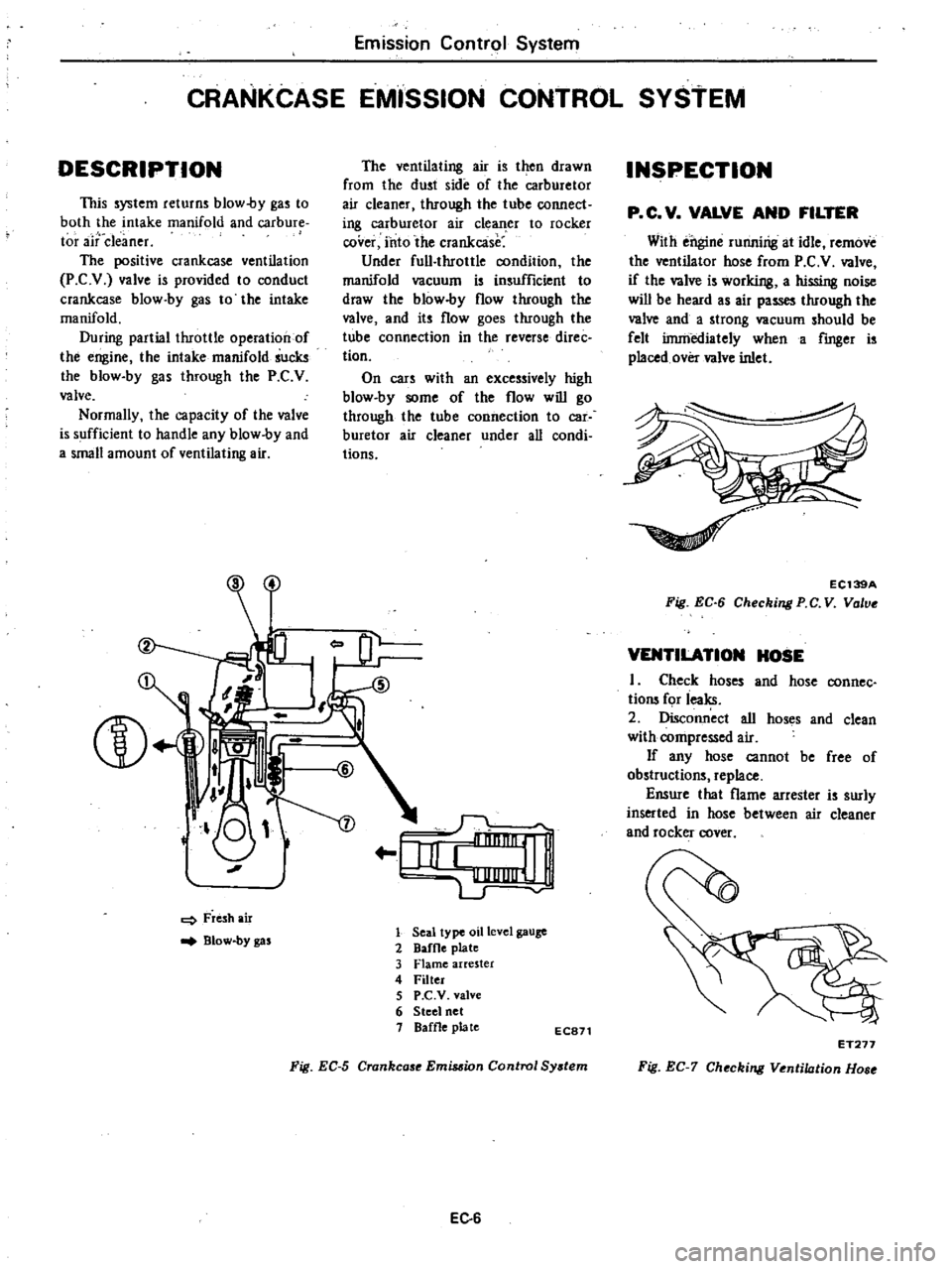
DESCRIPTION
This
system
returns
blow
by
gas
to
both
the
intake
manifold
and
carbure
tor
aitdeaner
The
positive
crankcase
ventilation
P
C
v
valve
is
provided
to
conduct
crankcase
blow
by
gas
to
the
intake
manifold
During
partial
throttle
operation
of
the
engine
the
intake
manifold
sucks
the
blow
by
gas
through
the
P
C
V
valve
Normally
the
capacity
of
the
valve
is
sufficient
to
handle
any
blow
by
and
a
small
amount
of
ventilating
air
L
J
J
o
I
Fresh
air
Blow
by
gas
The
ventilating
air
is
then
drawn
from
the
dust
side
of
the
carburetor
air
cleaner
through
the
tube
connect
ing
carburetor
air
cle
er
to
rocker
cover
into
the
crankcase
Under
full
throttle
condition
the
manifold
vacuum
is
insufficient
to
draw
the
blow
by
flow
through
the
valve
and
its
flow
goes
through
the
tube
connection
in
the
reverse
direc
tion
On
cars
with
an
excessively
high
blow
by
some
of
the
flow
will
go
through
the
tube
connection
to
car
buretor
air
cleaner
under
all
condi
tions
r
IiI
e
1
LJ
1
Seal
type
oil
level
gauge
2
DafOe
plate
3
Flame
arrester
4
Filter
5
P
C
V
valve
6
Steel
net
1
Baffle
plate
EC871
Fig
EC
5
Crankcase
Emis
ion
Control
Sy
tem
EC
6
INSPECTION
p
C
V
VALVE
AND
FILTER
With
ei
gine
runnirig
at
idle
remove
the
ventilator
hose
from
P
C
V
valve
if
the
valve
is
working
a
hissing
noise
wiD
be
heard
as
air
passes
through
the
valve
and
a
strong
vacuum
should
be
felt
irnniediately
when
a
fmger
is
placed
over
valve
inlet
EC139A
Fig
EC
6
Checking
PC
V
Vo
ve
VENTILATION
HOSE
I
Check
hoses
and
hose
connec
tions
for
ieaks
2
oisconn
ct
all
hoses
and
clean
with
compressed
air
If
any
hose
cannot
be
free
of
obstructions
replace
Ensure
that
flame
arrester
is
surly
inserted
in
hose
between
air
cleaner
and
rocker
rover
ET277
Fig
EC
7
Checking
Ventilation
Hose
Page 357 of 548
REMOVAL
I
Disconnect
wiring
to
brake
fluid
level
gauge
2
Disconnect
front
and
rear
brake
tubes
from
master
cylinder
CAUTION
When
removing
brake
tubes
use
suitable
tube
wrench
Never
use
open
end
or
edjustllble
wrench
Note
When
disconnecting
brake
tubes
be
sure
to
use
a
container
to
receive
draining
brake
fluid
Use
of
raga
is
also
suggested
to
keep
adjacent
perts
and
area
clean
3
Remove
master
cylinder
securing
nut
Master
cylinder
can
then
be
taken
out
DISASSEMBLY
1
Remove
reservoir
caps
and
filtern
and
drain
out
brake
fluid
2
Pry
off
stopper
ring
using
a
screwdriver
3
Remove
stopper
screw
and
take
out
stopper
primary
piston
assembly
spring
and
secondary
piston
assembly
in
the
order
shown
Note
Discard
caps
if
they
are
reo
moved
from
piston
assemblies
and
use
new
ones
4
Unscrew
pluga
to
gain
access
to
check
valve
for
disassembling
Note
a
Never
detach
reservoir
tanks
If
they
are
removed
for
any
reason
discard
them
and
install
new
ones
b
Do
not
remove
or
disassemble
brake
fluid
level
gauge
INSPECTION
Thoroughly
clean
all
parts
in
a
suitable
solvent
and
check
them
for
wear
or
damage
Replace
any
part
that
is
faulty
Brake
System
CAUTION
Use
brake
fluid
to
clean
Never
use
mineral
oil
I
Check
cylinder
and
pistons
for
evidence
of
abnonnal
wear
or
damage
Replace
if
found
faulty
2
Check
piston
to
cylinder
clear
ance
If
it
exceeds
the
specified
value
replace
either
piston
or
cylinder
Piston
to
cylinder
clearance
less
than
0
15
mm
0
0059
in
3
Check
springs
for
weakness
fatigue
or
damage
Replace
if
neces
sary
4
When
master
cylinder
is
disas
sembled
be
sure
to
discard
caps
and
valves
Replace
any
other
parts
which
show
evidence
of
deformation
wear
or
other
damage
S
Replace
damaged
oil
reservoirs
and
caps
ASSEMBLY
Assemble
master
cylinder
following
the
reverse
procedure
of
disassembly
paying
particular
attention
to
the
fol
lowing
note
Note
a
Replace
gaskets
and
packing
with
new
ones
b
Apply
brake
fluid
or
rubber
grease
to
sliding
contact
surface
of
parts
to
facilitate
assembly
of
master
cylinder
c
The
brake
master
cylinder
is
avail
able
in
both
NABCO
make
and
TOKICO
make
There
is
no
inter
changeability
of
repair
kits
or
com
ponent
parts
between
NABCO
and
TOKlCO
makes
When
replacing
the
repair
kit
or
component
parts
ascertain
the
brand
of
the
brake
master
cylinder
body
Be
sure
to
use
parts
of
the
same
make
as
the
fonner
ones
INSTALLATION
Install
master
cylinder
following
the
reverse
procedure
of
removal
After
installation
bleed
brake
system
BR
5
CAUTION
When
installing
Flare
Nut
6694310000
brake
tubes
use
Torque
Wrench
CiJ
Tightening
torque
Brake
master
cylinder
securing
nut
0
8
to
t
1
kg
m
5
8
to
8
0
ft
lb
Brake
tube
flare
nut
1
5
to
1
8
kg
m
11
to
13
ft
b
BRAKE
FLUID
LEVEL
GAUGE
Inspection
I
Disengage
hand
brake
control
lever
2
Raise
cap
and
make
sure
that
hand
brake
warning
lamp
goes
on
when
float
comes
into
contact
with
stopper
BRAKE
LINE
REMOVAL
I
Remove
flare
nuts
on
both
ends
and
remove
retainers
and
clips
CAUTION
When
removing
brake
tubes
and
hoses
use
suitable
tube
wrench
Never
use
open
end
or
adjustable
wrench
2
To
remove
brake
hose
first
re
move
flare
nut
securing
brake
tube
to
brake
hose
and
withdraw
lock
spring
End
of
hose
can
then
be
removed
from
bracket
Next
remuve
brake
hose
Do
not
twist
brake
hose
INSPECTION
Check
brake
lines
tubes
and
hoses
for
evidence
of
cracks
deterioration
or
other
damage
Replace
any
faulty
parts
Page 507 of 548
VACUUM
SYSTEM
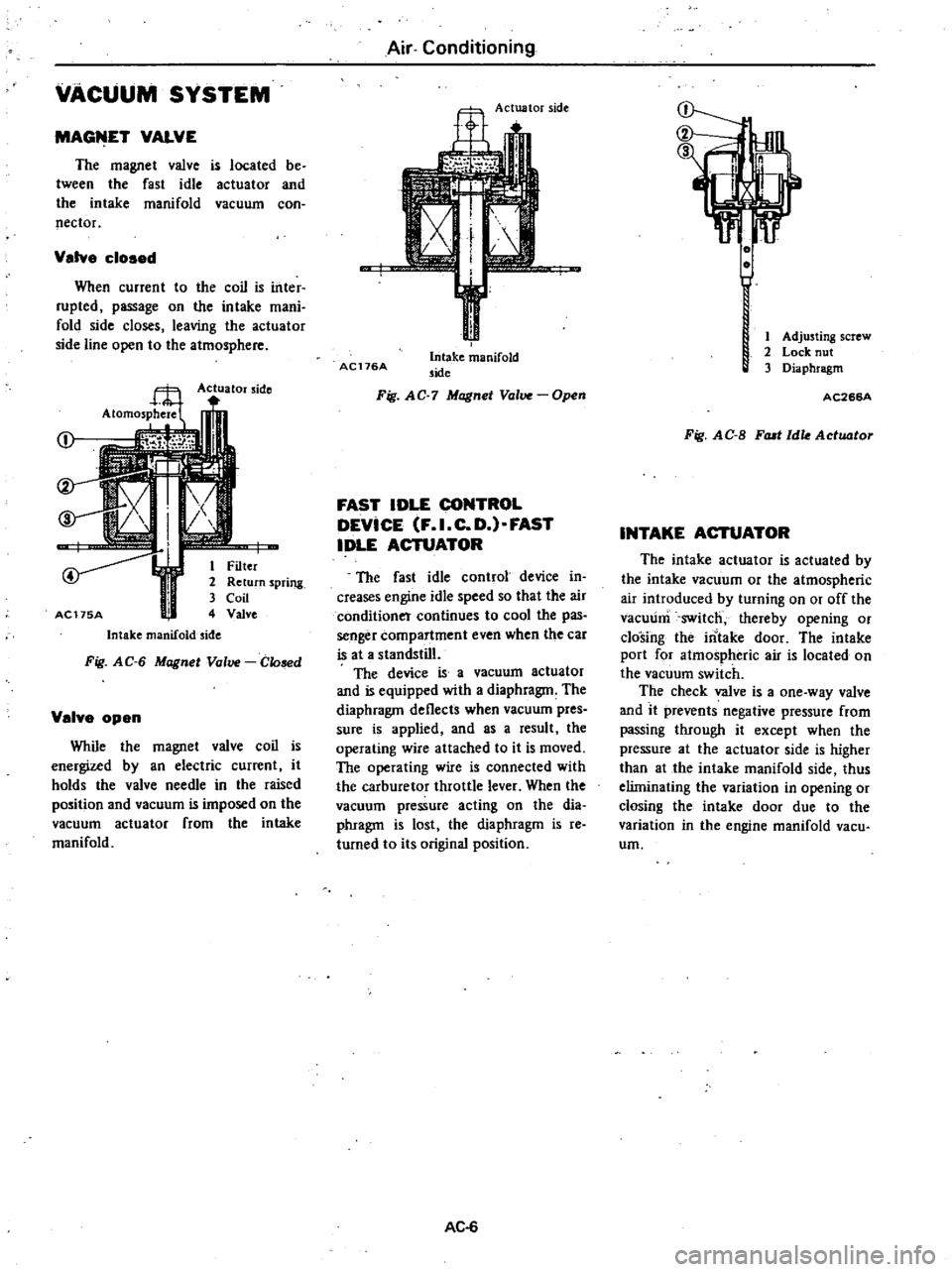
MAGfilET
VALVE
The
magnet
valve
is
located
be
tween
the
fast
idle
actuator
and
the
intake
manifold
vacuum
con
nector
Valve
cloaed
When
current
to
the
coil
is
inter
rupted
passage
on
the
intake
mani
fold
side
closes
leaving
the
actuator
side
line
open
to
the
atmosphere
Actuator
side
j
I
i
r
1
Filter
2
Return
spring
3
Coil
AC175A
4
Valve
Intake
manifold
side
Fig
AG
6
Magnet
Valve
Glosed
Velve
open
While
the
magnet
valve
coil
is
energized
by
an
electric
current
it
holds
the
valve
needle
in
the
raised
position
and
vacuum
is
imposed
on
the
vacuum
actuator
from
the
intake
manifold
Air
Conditioning
Actuator
side
AC176A
Intake
manifold
side
Fig
AG
7
Magnet
Valve
Open
FAST
IDLE
CONTROL
DEVICE
F
I
C
D
FAST
IDLE
ACTUATOR
The
fast
idle
control
device
in
creases
engine
idle
speed
so
that
the
air
conditioner
continues
to
cool
the
pas
senger
compartment
even
when
the
car
is
at
a
standstill
The
device
is
a
vacuum
actuator
and
is
equipped
with
a
diaphragm
The
diaphragm
deflects
when
vacuum
pres
sure
is
applied
and
as
a
result
the
operating
wire
attached
to
it
is
moved
The
operating
wire
is
connected
with
the
carburetor
throttle
lever
When
the
vacuum
pressure
acting
on
the
dia
phragm
is
lost
the
diaphragm
is
reo
turned
to
its
original
position
AC
6
1
Adjusting
screw
2
Lock
nut
3
Diaphragm
AC266A
Fig
AG
B
FlUI
Idle
Actuator
INTAKE
ACTUATOR
The
intake
actuator
is
actuated
by
the
intake
vacuum
or
the
atmospheric
air
introduced
by
turning
on
or
off
the
vacuum
switch
thereby
opening
or
closing
the
intake
door
The
intake
port
for
atmospheric
air
is
located
on
the
vacuum
switch
The
check
valve
is
a
one
way
valve
and
it
prevents
negative
pressure
from
passing
through
it
except
when
the
pressure
at
the
actuator
side
is
higher
than
at
the
intake
manifold
side
thus
eliminating
the
variation
in
opening
or
closing
the
intake
door
due
to
the
variation
in
the
engine
manifold
vacu
urn