radiator DATSUN 210 1979 User Guide
[x] Cancel search | Manufacturer: DATSUN, Model Year: 1979, Model line: 210, Model: DATSUN 210 1979Pages: 548, PDF Size: 28.66 MB
Page 199 of 548

REMOVAL
It
is
much
easier
to
remove
engine
and
transmission
as
a
single
unit
than
to
remove
alone
After
removal
engine
can
be
separated
from
the
transmission
assembly
WARNING
a
Place
wheel
chocks
in
fronl
of
front
wheels
and
in
rear
of
rear
wheels
b
Be
sure
to
hoist
engine
in
a
safe
manner
c
You
should
not
remove
engine
until
exhaust
system
has
com
pletely
cooled
off
Otherwise
you
may
burn
your
self
and
or
fire
may
break
out
in
fuel
line
Note
Fender
coven
should
be
used
to
protect
car
body
1
Disconnect
battery
ground
cable
from
battery
terminal
and
fusible
link
at
wire
connector
2
Remove
hood
as
follows
CAUTION
Have
an
assistant
help
you
so
as
to
prevent
damage
to
body
I
Mark
hood
hinge
locations
on
hood
to
facilitate
reinstallation
2
Support
hood
by
ltand
and
re
move
bolts
securing
it
to
hood
hinge
being
careful
not
to
let
hood
slip
when
bolts
are
removed
See
Fig
ER
2
3
Remove
hood
from
hood
hinge
f
Il
I
BF133A
Fig
ER
2
Removing
Hood
Remove
under
cover
Drain
radiator
coolant
and
engine
3
4
oil
5
Disconnect
upper
and
lower
hoses
from
radiator
and
disconnect
oil
cooler
hoses
automatic
transmission
only
6
Remove
four
bolts
securing
radia
Engine
Removal
Installation
tor
to
body
and
detach
radiator
after
removing
radiator
shroud
7
Remove
air
cleaner
assembly
from
carburetor
as
follows
1
Remove
fresh
air
duct
from
air
cleaner
2
Remove
hot
air
duct
from
air
cleaner
3
Loosen
air
cleaner
band
bolt
4
Disconnect
air
cleaner
to
air
pump
hose
at
air
cleaner
5
Disconnect
air
cleaner
ta
rocker
cover
hose
at
rocker
cover
6
Disconnect
air
cleaner
to
A
B
valve
hose
at
air
cleaner
7
Disconnect
air
cleaner
to
related
vacuum
hoses
at
air
cleaner
8
Disconnect
accelerator
control
wire
from
carburetor
9
Disconnect
the
following
cables
wires
and
hoses
Wire
to
auto
choke
heater
Wire
to
throttle
opener
cut
solenoid
or
throttle
switch
Wire
to
fuel
cut
solenoid
Wire
to
vacuum
switching
valve
High
tension
cable
between
igni
tion
coil
and
distributor
Battery
cable
to
starter
motor
Wire
to
distributor
Wire
to
thermal
transmitter
Wire
to
alternator
Engine
ground
cable
oil
pressure
switch
and
engine
harness
No
2
See
Fig
ER
3
o
1
Ground
cable
2
Engine
harness
No
2
3
Oil
pressure
switch
Fig
ER
3
EA368
Disconnecting
Cable
and
Wire
Fuel
hose
at
fuel
pump
and
fuel
return
hose
at
connection
Air
pump
air
cleaner
hose
Carbon
canister
hoses
Heater
inlet
and
outlet
hoses
if
so
equipped
ER
3
Vacuum
hose
of
brake
booster
at
intake
manifold
Air
conditioner
equipped
model
10
Remove
compressor
belt
To
remove
loosen
idler
pulley
nut
and
adjusting
bolt
1
Remove
air
pump
2
Remove
compressor
retaining
bolts
and
move
compressor
toward
fender
to
facilitate
removal
of
engine
Nole
Never
discharge
gas
from
com
pressor
while
work
is
being
per
formed
II
Compressor
EA478
Fig
ER
4
Location
of
Air
Compressor
3
Disconnect
vacuum
hose
of
air
conditioner
from
connector
of
intake
manifold
4
Remove
F
i
C
D
actuator
from
bracket
II
Remove
clutch
operating
cylin
der
from
clutch
housing
manual
trans
mission
only
dJ
Tightening
torque
Clutch
operating
cylinder
E
A3
to
clutch
housing
3
1
to
4
1
kg
22
to
30
ft
lbl
Fig
ER
5
Removing
Clutch
Operating
Cylinder
Page 254 of 548

The
3N71
B
trammission
is
a
fully
automatic
unit
consisting
primarily
of
a
3
element
hydraulic
torque
converter
and
two
planetary
gear
sets
Two
multiple
disc
c1utclies
a
multiple
disc
brake
brake
band
and
one
way
clutch
provide
the
friction
elements
necessary
to
obtain
the
desired
function
of
the
two
planetary
gear
ets
A
hydraulic
control
system
is
used
to
operate
the
friction
elements
and
automatic
shift
controls
TORQUE
CONVERTER
The
torque
converter
is
attached
to
the
crankshaft
through
a
flexible
drive
plate
Heat
generat
in
the
t
rque
converter
is
dissipated
by
circulating
the
transmission
fluid
through
an
oil
to
water
type
cooler
in
the
radiator
lower
tank
The
welded
comtruction
of
the
torque
co
verter
prevents
di
3
ssembly
or
service
unless
highly
specialized
equipment
is
available
Qj
gJ
Autpmatic
Trimsmissi6n
DEScRIPTION
FLUID
RECOMMENDAnON
Use
DEXRON
type
automatic
transmission
fluid
only
IDENTIFICATION
NUMBER
Stamped
position
The
plate
is
attached
to
the
right
han
side
of
transmission
case
AT
M
Fig
AT
l
Identification
Number
Identification
of
number
arranaemanta
JAPAJllUTOIlATlC
TRAJISIIISSIO
C8
Ull
MODEL
X
0
12
3
NO
7
6
0
1
2
34
Number
designation
76
0
I
2
34
L
Serial
productioo
number
for
the
month
Month
of
production
1
Jan
2
Feb
X
Oct
Y
Nov
Z
Dec
Lut
IJgUre
denotins
the
year
A
D
IJ
III
J
W
f
r
lrr
G
1
Transmission
case
2
Oil
pump
3
Front
clutch
4
Band
brake
5
Rear
dutch
6
Front
planetary
geat
7
Rear
planetary
gear
8
One
way
clutch
9
Low
4
Reverse
brake
10
Oil
distributor
11
Governor
12
utput
shaft
13
Rear
extension
14
Oil
pan
IS
Control
valve
16
Input
shaft
17
Torque
converter
18
Converter
housi
19
Drive
pia
te
Tightening
torque
T
of
bolts
and
nuts
kg
m
ft
lb
@
T
4
to
5
29
to
36
@
T
14
to
16
101
to
116
@
T
4
5
to
5
5
33
to
40
@
T
0
6
to
0
8
4
3
to
5
8
@
T
0
5
to
0
7
3
6
to
5
1
T
2
0
to
2
5
14
to
18
@
T
1
3
to
1
8
9
to
13
@
T
0
55
ta
0
75
4
0
to
5
4
CD
T
0
25
to
0
35
1
8
to
2
5
AT312
Fig
AT
2
3N71B
Automatic
Trammiuion
AT
2
Page 325 of 548
Fig
FA
3
Installing
Coller
Pin
II
Install
hub
cap
with
new
Q
ring
and
wheel
WHEEL
ALIGNMENT
Correct
front
wheel
alignment
as
sures
proper
car
handling
characteris
tics
and
minimum
steering
effort
with
the
least
amount
of
tire
wear
Before
adjusting
front
wheel
alignment
be
sure
to
make
preliminary
inspection
of
front
end
parts
Tire
pressure
and
balance
Wheel
bearings
and
wheel
bearing
nuts
Steering
gear
play
Steering
gear
housing
loose
at
frame
Steering
linkage
and
connections
Shock
absorber
operation
If
wrong
repair
or
replace
the
damaged
portion
or
parts
When
using
equipment
for
front
wheel
alignment
inspection
follow
the
instructions
furnished
with
equipment
Note
Inspection
should
be
made
with
the
car
set
Ievel
and
at
curb
weight
Cember
end
caster
Camber
and
caster
are
preset
at
factory
and
cannot
be
adjusted
The
car
requires
only
toe
in
and
car
posture
adjustment
Note
If
camber
or
caster
alignment
is
not
within
specifications
check
as
sociated
parts
Repair
or
replace
as
necessary
Front
Axle
Front
Suspension
Toe
In
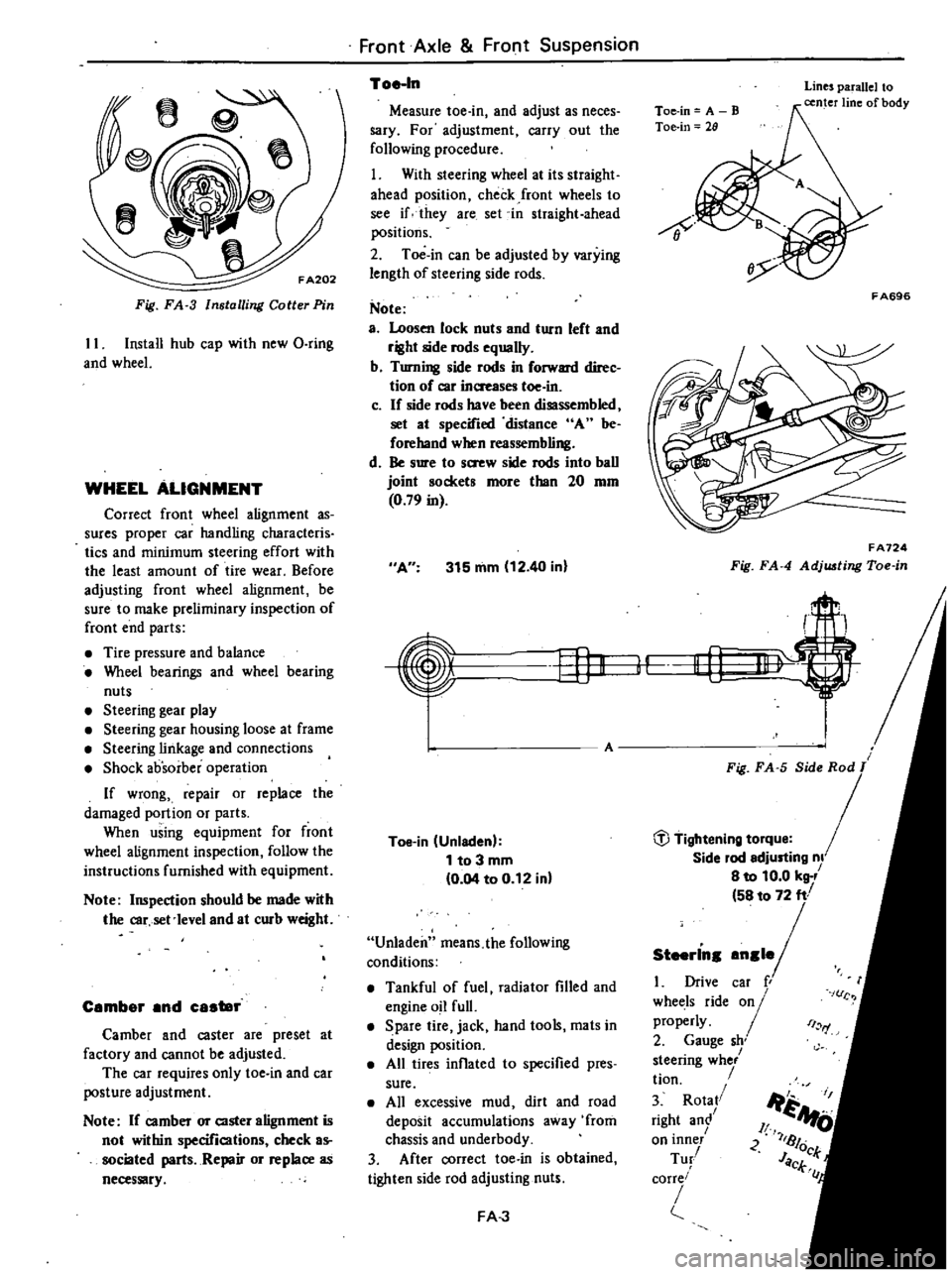
Measure
toe
in
and
adjust
as
neces
sary
For
adjustment
carry
out
the
following
procedure
1
With
steering
wheel
at
its
straight
ahead
position
check
front
wheels
to
see
if
they
are
set
in
straight
ahead
positions
2
Toe
in
can
be
adjusted
by
varying
length
of
steering
side
rods
Note
a
Loosen
lock
nuts
and
turn
left
and
right
side
rods
equally
b
Turning
side
rods
in
forward
direc
tion
of
car
inaeases
toe
in
c
If
side
rods
have
been
disassembled
set
at
specified
distance
A
be
forehand
when
reassembling
d
Be
sure
to
s
w
side
rods
into
ball
joint
sockets
more
than
20
mm
0
79
in
A
315
mm
12
40
in
EfJK
Toe
in
Unladen
1
to
3
mm
0
04
to
0
12
in
Unladen
means
the
following
conditions
Tankful
of
fuel
radiator
filled
and
engine
oil
full
Spare
tire
jack
hand
tools
mats
in
design
position
All
tires
inflated
to
specified
pres
sure
All
excessive
mud
dirt
and
road
deposit
accumulations
away
from
chassis
and
underbody
3
After
correct
toe
in
is
obtained
tighten
side
rod
adjusting
nuts
FA
J
Toe
in
A
B
Toe
in
28
Lines
parallel
to
center
line
of
body
8
F
A696
FA724
Fig
FA
4
Adj
ting
Toe
in
r
II
Li
1
t
Fig
FA
5
Side
Rod
T
Side
lod
edjusting
nl
8
to
10
0
kg
58
to
72
ft
1
Drive
caf
r
whet
ls
ride
01
properly
2
Gauge
sh
steenng
whe
tion
3
Rota
right
an
on
lOner
Tu
corre
i
I
rf
c
Ji
1
A
JI
U
2
7181
JOck
CL
C
Page 335 of 548
Front
Axle
Front
Suspension
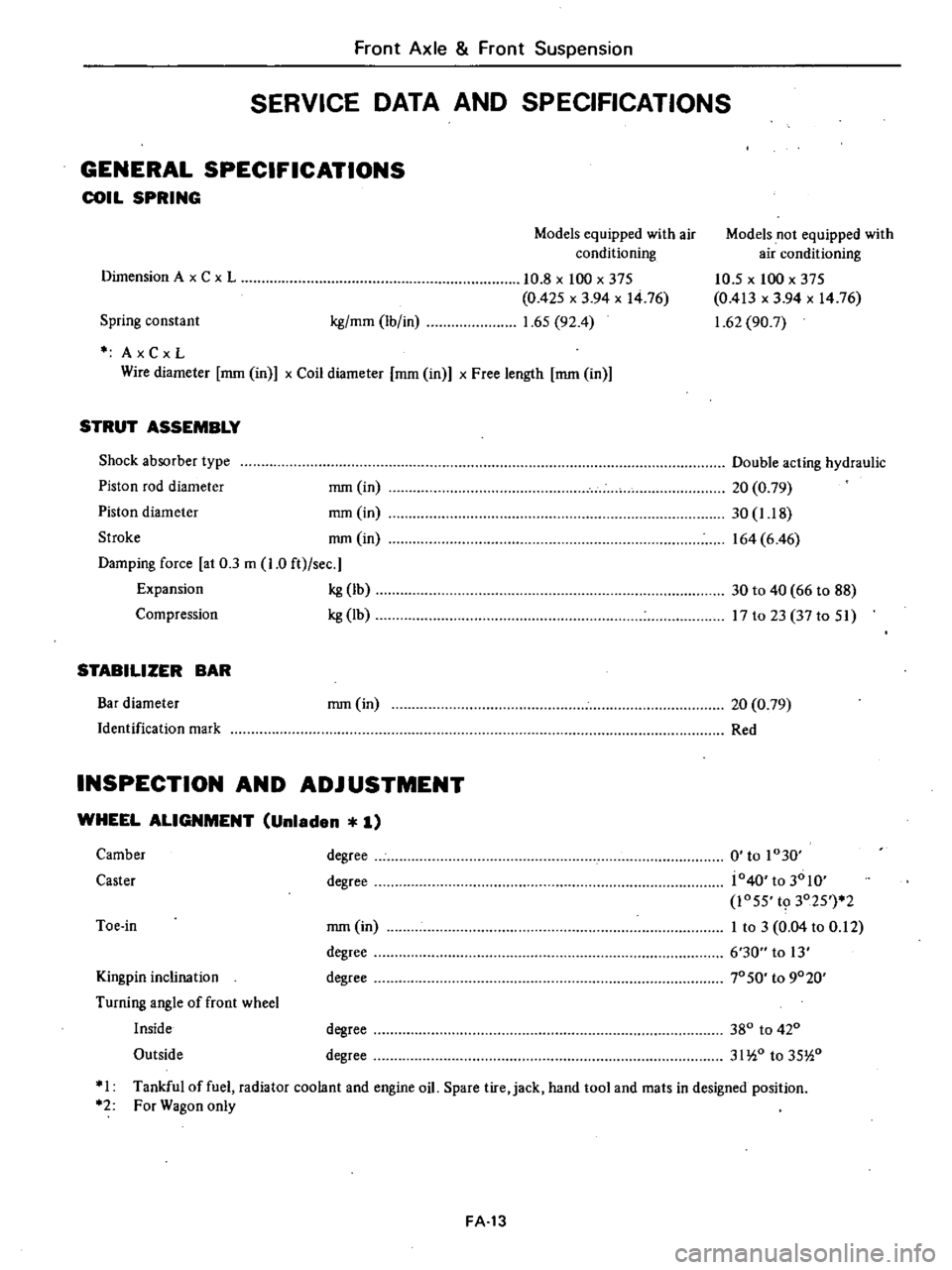
SERVICE
DATA
AND
SPECIFICATIONS
GENERAL
SPECIFICATIONS
COIL
SPRING
Models
equipped
with
air
conditioning
Models
not
equipped
with
air
conditioning
10
5
x
100
x
375
0
413
x
3
94
x
1476
1
62
90
7
Spring
constant
kg
mm
Ib
in
10
8
x
100
x
375
0
425
x
3
94
x
1476
1
65
92
4
Dimension
A
x
C
x
L
AxCxL
Wire
diameter
mm
in
x
Coil
diameter
mm
in
x
Free
length
mm
in
STRUT
ASSEMBLY
Shock
absorber
type
Piston
rod
diameter
mm
in
Piston
diameter
mm
in
Stroke
nun
in
Damping
force
at
0
3
m
1
0
ft
sec
Expansion
kg
Ib
Compression
kg
Ib
Double
acting
hydraulic
20
0
79
30
1
18
164
6
46
30
to
40
66
to
88
17
to
23
37
to
51
STABILIZER
BAR
Bar
diameter
Identification
mark
mm
in
20
0
79
Red
INSPECTION
AND
ADJUSTMENT
WHEEL
ALIGNMENT
Unladen
1
Kingpin
inclination
Turning
angle
of
front
wheel
Inside
Outside
mm
in
degree
degree
0
to
1030
j040
to
3010
1055
t9
3025
2
I
to
3
0
04
to
0
12
6
30
to
13
70
SO
to
9020
Camber
Caster
degree
degree
Toe
in
degree
degree
380
to
420
31
io
to
35
i0
I
Tankful
of
fuel
radiator
coolant
and
engine
oil
Spare
tire
jack
hand
tool
and
mats
in
designed
position
2
For
Wagon
only
FA
13
Page 412 of 548
DATSUN
210
Model
8310
Series
F
BODY
CONSTRUCTION
BODY
ALIGNMENT
BUMPER
DESCRIPTION
INSPECTION
FRONT
BUMPER
REAR
BUMPER
BODY
FRONT
END
RADIATOR
GRILLE
FRONT
APRON
COWL
TOP
GRILLE
FRONT
FENDER
FENDER
PROTECTOR
HOOD
HOOD
LOCK
CONTROL
DOORS
FRONT
DOOR
REAR
DOOR
4
door
Sedan
and
Wagon
BODY
REAR
END
TRUNK
LID
Sedan
SAC
K
000
R
Hatchabck
BODY
CONTENTS
BF
2
BF
4
BF
5
BF
5
BF
6
BF
8
SF
8
BF
9
BF
9
BF
9
BF
10
BF
10
BF
10
BF
11
BF
11
BF
12
BF
12
BF
15
BF
16
BF
16
BF
18
TAILGATE
Wagon
WINDSHIELD
AND
WINDOW
GLASS
WINDSHIELD
GLASS
REAR
WINDOW
GLASS
Sedan
and
Hatchback
REAR
WINDOW
GLASS
Wagon
SIDE
WINDOW
GLASS
2
Door
Sedan
and
Hatchback
REAR
QUARTER
WINDOW
GLASS
Hatchback
REAR
SIDE
WINDOW
GLASS
Wagon
INTERIOR
INSTRUMENT
PANEL
CONSOLE
BOX
SEAT
SEAT
BELT
TRIM
AND
MOLDING
ROOF
TRIMMING
BODY
SIDE
TRIM
AND
MOLDING
SPECIAL
SERVICE
TOOLS
BF
20
8F
21
SF
21
BF
22
SF
23
BF
26
BF
26
BF
27
SF
29
BF
29
SF
30
BF
30
BF
31
SF
32
BF
32
BF
32
BF
34
Page 420 of 548

RADIATOR
GRILLE
REMOVAL
AND
INSTALLATION
I
Open
hood
2
Remove
radiator
grille
attaching
screws
3
Detach
radiator
grille
from
front
end
of
car
4
Disconnect
front
combination
lamp
connectors
Then
remove
radia
tor
grille
S
Installation
is
in
the
reverse
order
of
removal
Note
a
Radiator
grille
is
made
of
plastic
so
do
not
use
excessive
force
b
Take
care
to
keep
any
oil
away
from
radiator
grille
FRONT
APRON
REMOVAL
AND
INSTALLATION
1
Remove
screws
attaching
front
apron
to
front
fender
2
Remove
screws
attaching
front
apron
to
hood
lock
stay
3
Remove
screws
attaching
front
apron
to
radiator
core
support
4
Remove
screws
attaching
front
apron
to
bracket
S
Installation
is
in
the
reverse
order
of
removal
Body
BODY
FRONT
END
8F7448
Fig
BF
11
Removing
RadiIJtor
Grille
S
1
i
oo
1
0
ole
I
Q
I
f
J
0
0
i
I
g
nl
o
A
BF
9
4
1
J
n
Jf
rf
BF745B
Fig
BF
12
Remouing
Front
Apron
Page 504 of 548
REFRIGERATION
SYSTEM
If
you
were
to
paint
your
rmger
with
alcohol
your
finger
would
feel
cold
This
is
because
the
liquid
alcohol
takes
heat
away
from
your
rmger
while
it
evaporates
If
a
quickly
evapo
rating
liquid
such
as
alcohol
is
placed
in
a
container
inside
a
box
the
tern
Air
Conditioning
perature
inside
the
box
will
drop
This
is
because
the
alcohol
is
evaporated
absorbing
the
heat
from
the
air
inside
the
box
If
the
gaseous
alcohol
is
collected
and
cooled
with
cold
water
it
will
be
changed
back
into
a
liquid
by
absorption
of
its
heat
by
the
cold
water
The
cooler
operates
on
this
princi
1
r
I
Outside
air
U
Condenser
r
lf
P
9
n
U
Receiver
drier
AC378A
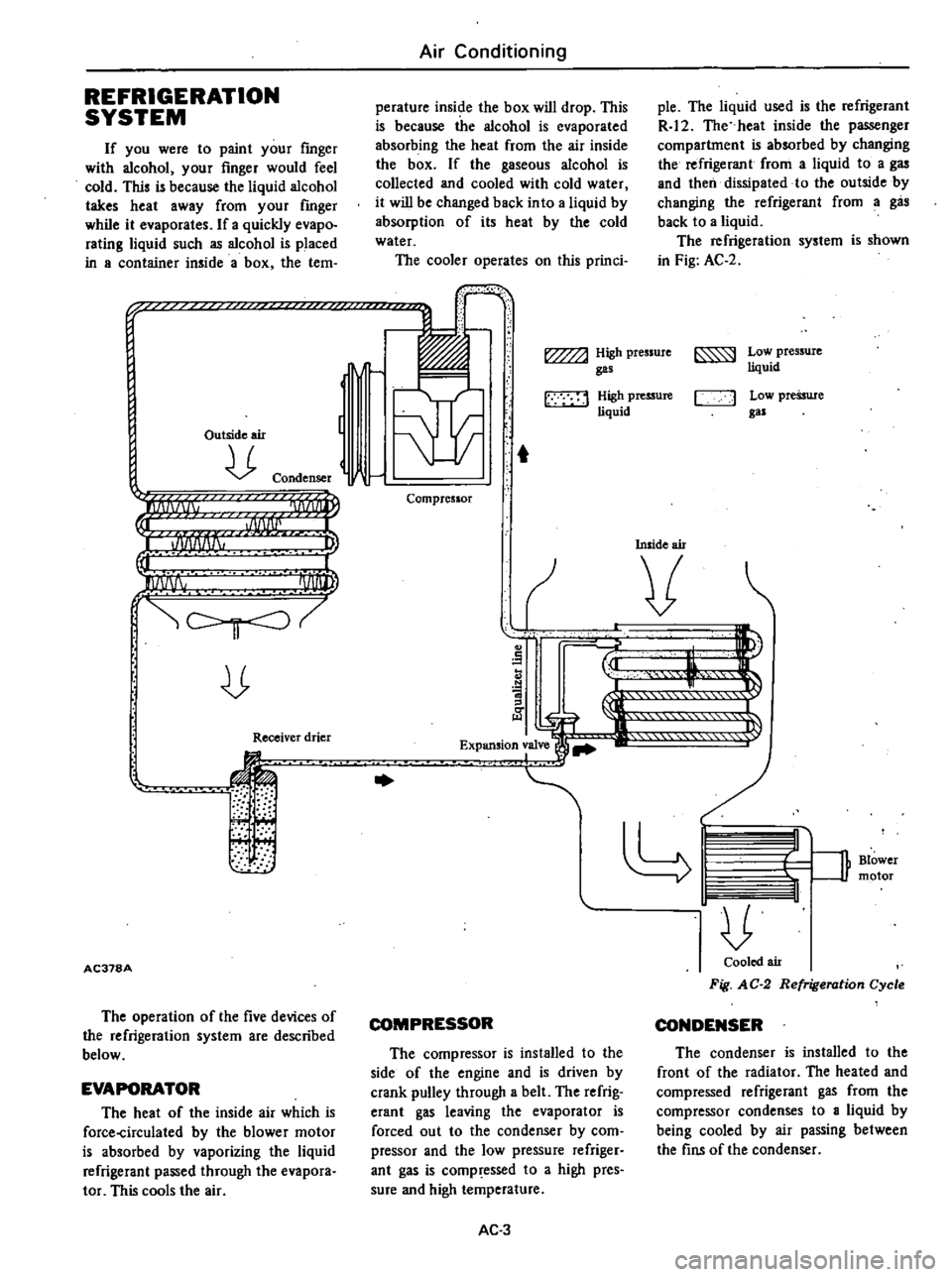
The
operation
of
the
five
devices
of
the
refrigeration
system
are
described
below
EVAPORATOR
The
heat
of
the
inside
air
which
is
force
irculated
by
the
blower
motor
is
absorbed
by
vaporizing
the
liquid
refrigerant
passed
through
the
evapora
tor
This
cools
the
air
l
t
High
pressure
gas
I
High
pressure
liquid
Compressor
Jj
COMPRESSOR
The
compressor
is
installed
to
the
side
of
the
engine
and
is
driven
by
crank
pulley
through
a
belt
The
refrig
erant
gas
leaving
the
evaporator
is
forced
out
to
the
condenser
by
com
pressor
and
the
low
pressure
refriger
ant
gas
is
compressed
to
a
high
pres
sure
and
high
temperature
AC3
pie
The
liquid
used
is
the
refrigerant
R
12
The
heat
inside
the
passenger
compartment
is
absorbed
by
changing
the
refrigerant
from
a
liquid
to
a
gas
and
then
dissipated
to
the
outside
by
changing
the
refrigerant
from
a
gas
back
to
a
liquid
The
refrigeration
system
is
shown
in
Fig
AC
2
Low
pressure
liquid
C
J
Low
pressure
gas
Inside
air
v
n
Blower
1f
motor
Cooled
air
Fig
AC
2
Refrigeration
Cycle
CONDENSER
The
condenser
is
installed
to
the
front
of
the
radiator
The
heated
and
compressed
refrigerant
gas
from
the
compressor
condenses
to
a
liquid
by
being
cooled
by
air
passing
between
the
fins
of
the
condenser
Page 521 of 548
INSTA
L1ATION
InstaU
in
the
reverse
order
of
removal
observing
the
following
I
When
installing
add
required
amount
Of
compressor
oil
Refer
to
Compressor
Oil
Level
Check
2
Apply
a
coat
of
fresh
compressor
oil
to
sealing
surfaces
of
pipe
joints
3
Check
tightening
torque
of
com
pressor
mounting
bolts
compressor
mounting
bracket
mounting
bolts
and
refrigerant
line
See
Figs
AC
27
and
AC
29
4
DO
not
remove
plugs
from
com
pressor
and
flexible
hose
before
connecting
hoses
S
Turn
compressor
several
times
before
installing
6
Adjust
compressor
drive
belt
tension
See
Fig
AC
2S
7
Evacuate
and
recharge
system
Refer
to
General
Service
for
evacuating
system
and
charging
re
frigerant
8
Conduct
leak
test
and
make
sure
that
there
is
no
leak
from
connections
CONDE
NSER
REMOVAL
Disconnect
battery
ground
cable
2
Discharge
system
Refer
to
Gen
eral
Service
for
discharging
system
3
Remove
radiator
grille
4
Remove
center
stay
5
Disconnect
refrigerant
lines
from
condenser
CAUTION
8
Use
wrench
to
fix
union
on
con
denser
and
then
loosen
flare
nut
of
refrigerant
line
with
another
wrench
b
Plug
up
all
openings
in
condenser
and
system
Air
COl1ditioning
6
Remove
mounting
bolts
ihen
remove
condenser
from
car
1a
11
AC384A
Fig
AC
28
Removing
Condenser
INSPECTION
Inspect
joints
of
inlet
and
outlet
pipes
for
cracks
and
scratches
Upon
finding
any
problem
which
may
cause
gas
to
leak
repair
or
replace
con
denser
Condenser
fins
or
air
passages
clog
ged
with
dirt
insects
or
leaves
will
reduce
cooling
effiCiency
of
con
denser
In
such
a
case
clean
fms
or
air
passages
with
compressed
air
CAUTION
Do
not
clean
condenser
with
ste8m
Be
sure
to
use
cold
water
or
com
pressed
air
INSTALLATION
Install
condenser
in
the
reverse
order
of
removal
observing
Ihe
follow
ing
I
When
replacing
condenser
add
same
amount
of
oil
as
was
drained
from
previous
condenser
to
com
pressor
AC
20
2
Keep
piugsin
place
until
im
mediately
before
connecting
work
is
started
3
Refer
to
Refrigerant
Line
for
tightening
torque
on
line
connec
tions
4
Refer
to
General
Service
for
evacuating
and
charging
system
5
Conduct
leak
test
and
make
sure
that
there
is
no
leak
from
connections
RECEIVER
DRIER
REMOVAL
AND
INS
ALLATION
See
Fig
AC
29
Disconnect
battery
ground
2
Discharge
system
Refer
to
Gen
eral
Service
for
discharging
system
3
Disconnect
refrigerant
lines
from
receiver
drier
CAUTION
Plug
all
openings
to
prevent
entrance
of
dirt
and
moisture
4
Remove
receiver
drier
mounting
screws
Remove
receiver
drier
5
Install
receiver
drier
in
the
reverse
order
of
removal
With
plugs
taken
off
immediately
before
connecting
work
is
started
connect
line
and
receiver
drier
Refer
to
Refrigerant
Une
for
tighten
ing
torque
6
Refer
to
General
Service
for
evacuating
and
charging
system
7
Conduct
leak
test
and
make
sure
that
there
is
no
leak
from
connections
INSPECTION
Check
receiver
drier
for
leaks
or
damage
If
necessary
replace