lock DATSUN B110 1973 Service Manual Online
[x] Cancel search | Manufacturer: DATSUN, Model Year: 1973, Model line: B110, Model: DATSUN B110 1973Pages: 513, PDF Size: 28.74 MB
Page 256 of 513
BODY
ElECTRICAL
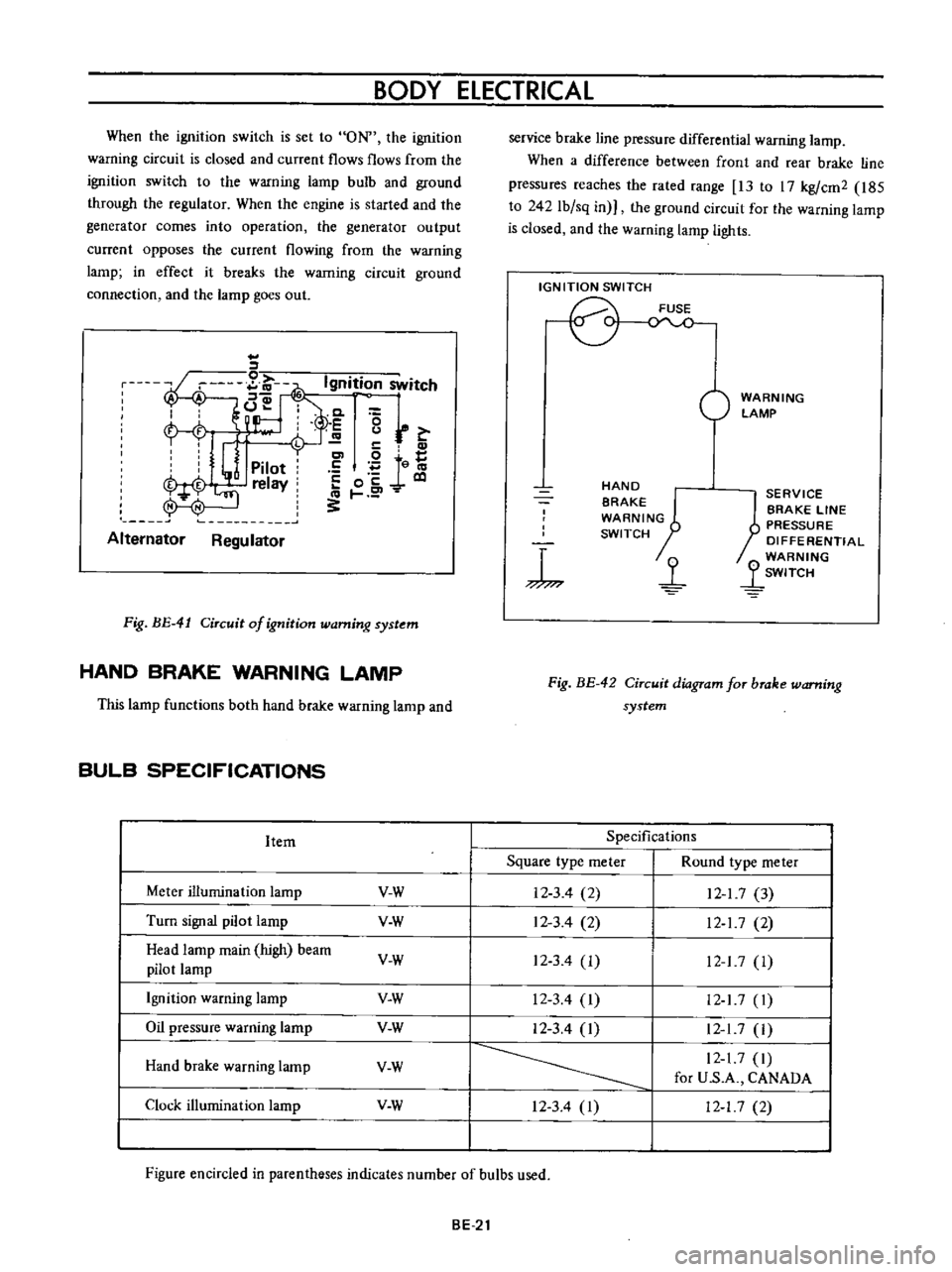
When
the
ignition
switch
is
set
to
ON
the
ignition
wa
rning
circuit
is
closed
and
current
flows
flows
from
the
ignition
switch
to
the
warning
lamp
bulb
and
ground
through
the
regulator
When
the
engine
is
started
and
the
generator
comes
into
operation
the
generator
output
current
opposes
the
current
flowing
from
the
warning
lamp
in
effect
it
breaks
the
warning
circuit
ground
connection
and
the
lamp
goes
out
l
r
hffi
u
z
Ignition
switch
I
Q
6
I
0
c
M
1
E
8
ca
i
L
g
PI
lot
c
P
I
j
co
rt
0
relay
E
0
5
y
y
1
N
N
3
Alternator
Regulator
Fig
BE
41
Circuit
of
ignition
warning
system
HAND
BRAKE
WARNING
LAMP
This
lamp
functions
both
hand
brake
warning
larnp
and
BULB
SPECIFICATIONS
service
brake
line
pressure
differential
warning
lamp
When
a
difference
between
front
and
rear
brake
line
pressures
reaches
the
rated
range
13
to
17
kgfcm2
185
to
242
lb
sq
in
the
ground
circuit
for
the
warning
lamp
is
closed
and
the
warning
lamp
lights
IGNITION
SWITCH
WARNING
LAMP
L
E
WARNING
SWITCH
1
SERVICE
BRAKE
LINE
PRESSU
R
E
DIFFERENTIAL
WARNING
J
SWITCH
Fig
BE
42
Circuit
diagram
for
brake
warning
system
tern
Specifications
Square
type
meter
Round
type
meter
Meter
illumination
larnp
VoW
12
3
4
2
12
1
7
3
Turn
signal
pilot
lamp
VoW
12
3
4
2
12
1
7
2
Head
lamp
main
high
beam
VoW
12
3
4
I
12
17
1
pilot
lamp
Ignition
warning
lamp
VoW
123
4
I
12
17
1
Oil
pressure
warning
lamp
VoW
12
3
4
1
12
1
7
1
Hand
brake
warning
lamp
VoW
12
1
7
1
for
U
S
A
CANADA
Clock
illumination
lamp
VoW
123
4
I
12
17
2
Figure
encircled
in
parentheses
indicates
number
of
bulbs
used
BE
21
Page 262 of 513
BODY
ELECTRICAL
Wiper
motor
replacement
First
of
all
remove
the
connector
plug
from
the
wiper
motoI
2
Remove
a
nut
used
to
connect
wiper
motor
worm
wheel
shaft
to
the
connecting
rod
from
passenger
compartment
side
dash
panel
3
Loosen
three
bolts
used
to
install
the
wiper
motor
on
the
cowl
dash
remove
the
wiper
motor
4
Reinstall
a
new
wiper
motor
in
reverse
sequence
of
removal
Fig
BE
44
Wiper
motor
Q
V
rt
ir
o
y
At
Jllif
Fig
BE
45
Wiper
motor
linkage
Wiper
blade
operating
range
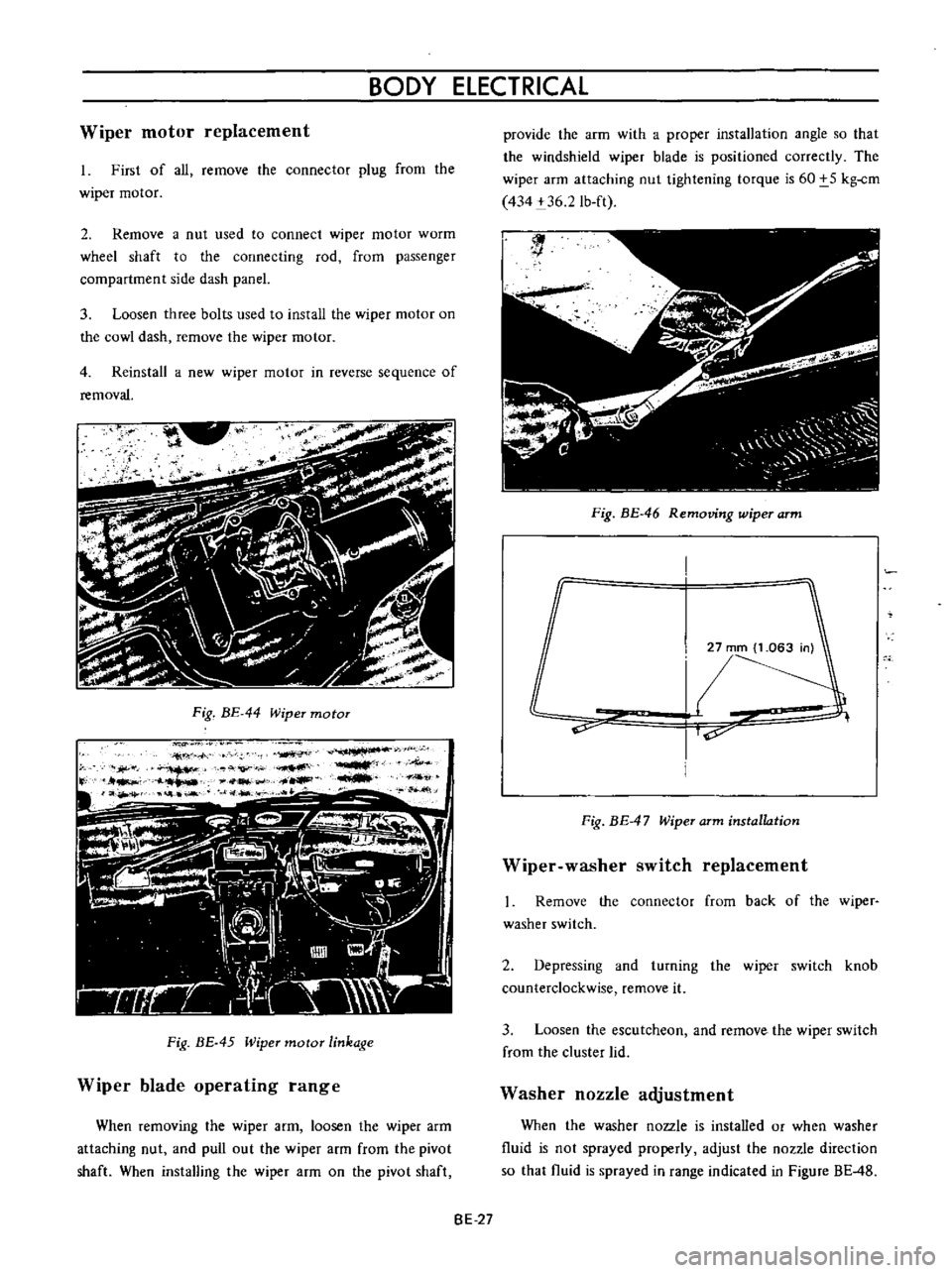
When
removing
the
wiper
arm
loosen
the
wiper
arm
attaching
nut
and
pull
out
the
wiper
arm
from
the
pivot
shaft
When
installing
the
wiper
arm
on
the
pivot
shaft
provide
the
arm
with
a
proper
installation
angle
so
that
the
windshield
wiper
blade
is
positioned
correctly
The
wiper
arm
attaching
nut
tightening
torque
is
60
5
kg
m
434
36
2lb
ft
Fig
BE
46
Removing
wiper
arm
00
I
i
Fig
BE
47
Wiper
arm
installation
Wiper
washer
switch
replacement
Remove
the
connector
from
back
of
the
wiper
washer
switch
2
Depressing
and
turning
the
wiper
switch
knob
counterclockwise
remove
it
3
Loosen
the
escutcheon
and
remove
the
wiper
switch
from
the
cluster
lid
Washer
nozzle
adjustment
When
the
washer
nozzle
is
installed
or
when
washer
fluid
is
not
sprayed
properly
adjust
the
nozzle
direction
so
that
fluid
is
sprayed
in
range
indicated
in
Figure
BE
48
BE
27
Page 264 of 513
BODY
ELECTRICAL
Improper
stop
position
of
wiper
arm
Improperly
positioned
blade
and
arm
Correct
position
Damaged
or
worn
auto
stop
point
Replace
motor
Improper
wiping
Worn
rubber
blade
Replace
blade
Inadequate
pressing
force
of
wiper
arm
Replace
wiper
arm
IGNITION
SWITCH
AND
STEERING
LOCK
CONTENTS
IGNITION
SWITCH
Removal
IGNITION
SWITCH
WITH
STEER
ING
LOCK
BE
29
BE
29
BE
29
IGNITION
SWITCH
This
3
or
4
position
switch
is
installed
on
the
ignition
switch
bracket
which
is
installed
on
the
instrument
panel
with
two
screws
and
controls
the
engine
ignition
system
and
most
of
electrical
equipment
Removal
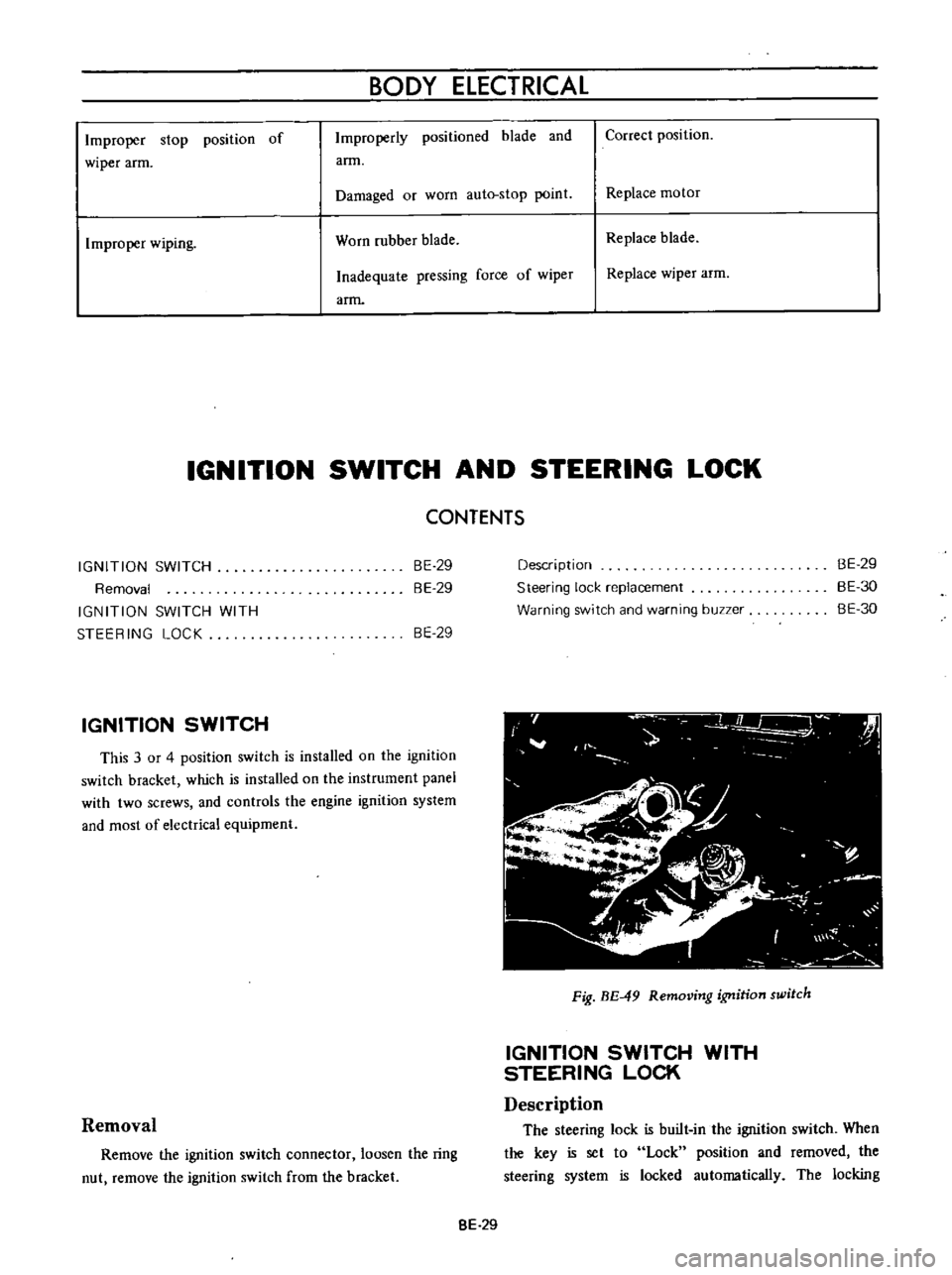
Remove
the
ignition
switch
connector
loosen
the
ring
nut
remove
the
ignition
switch
from
the
bracket
Description
Steering
lock
replacement
Warning
switch
and
warning
buzzer
BE
29
BE
30
BE
30
Fig
BE
49
Removing
ignition
switch
IGNITION
SWITCH
WITH
STEERING
LOCK
Description
The
steering
lock
is
built
in
the
ignition
switch
When
the
key
is
set
to
Lock
position
and
rernoved
the
steering
system
is
locked
automatically
The
locking
8E
29
Page 265 of 513
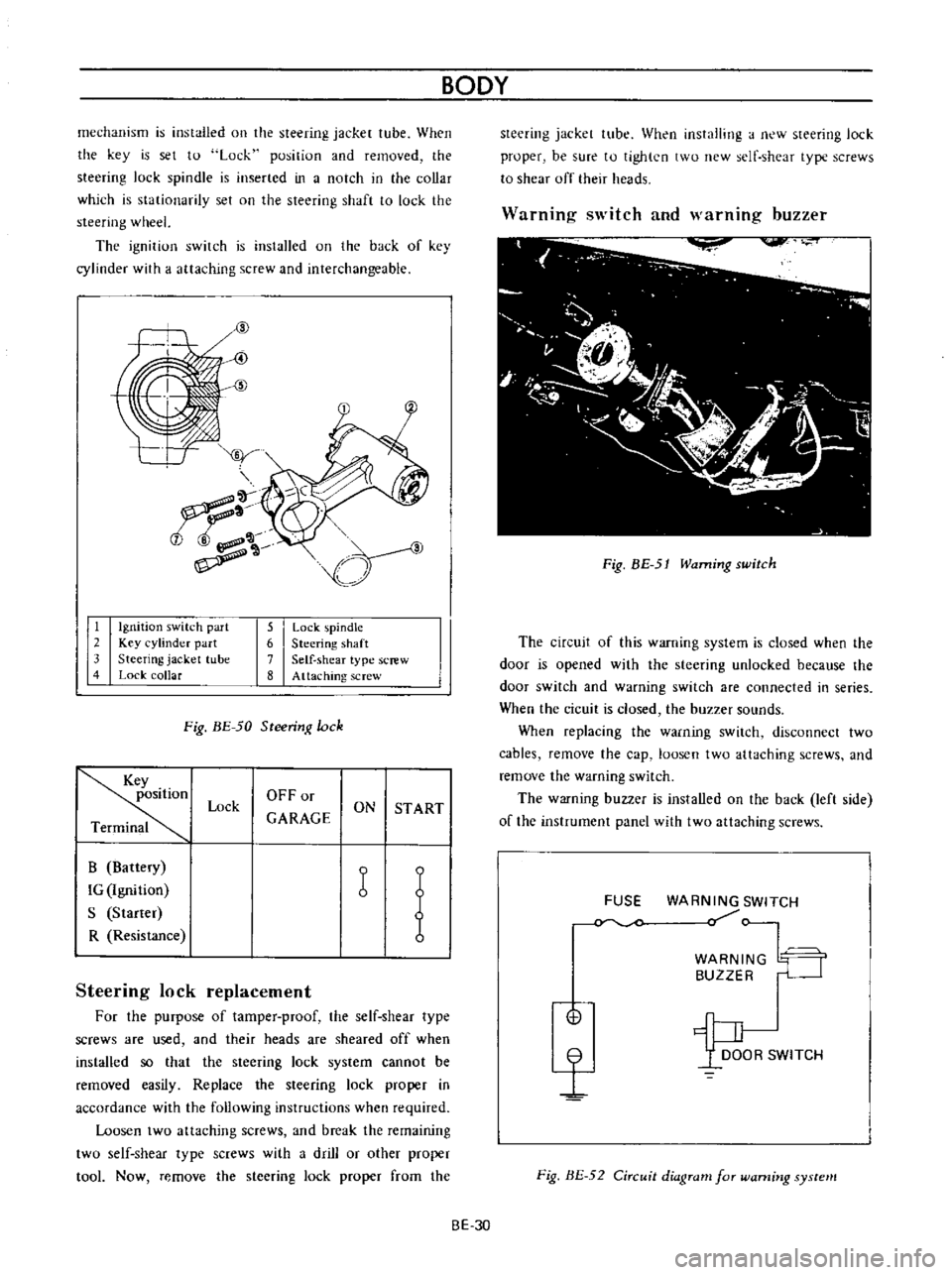
mechanism
is
installed
on
the
steering
jacket
tube
When
the
key
is
set
to
Lock
position
and
removed
the
steering
lock
spindle
is
inserted
in
a
notch
in
the
collar
which
is
stationarity
set
on
the
steering
shaft
to
lock
the
steering
wheel
The
ignitiun
switch
is
installed
on
the
back
of
key
cylinder
with
a
attaching
screw
and
interchangeable
tf
iY
t
7
a
1
Ignition
switch
part
2
Key
cylinder
part
3
Steering
jacket
tube
4
Lock
collar
5
Lock
pindle
6
Steering
shaft
7
Self
shear
type
screw
8
Attaching
screw
Fig
BE
50
Steering
lock
Key
position
Terminal
OFFor
GARAGE
Lock
ON
ST
ART
B
Battery
IG
Ignition
S
Starter
R
Resistance
b
1
Steering
lock
replacement
For
the
purpuse
of
tamper
proof
the
self
shear
type
screws
are
used
and
their
heads
are
sheared
off
when
installed
so
that
the
steering
lock
system
cannot
be
removed
easily
Replace
the
steering
lock
proper
in
accordance
with
the
following
instructions
when
required
Loosen
two
attaching
screws
and
break
the
remaining
twu
self
shear
type
screws
with
a
drill
or
other
proper
tool
Now
remove
the
steering
lock
proper
from
the
BODY
BE
30
steering
jacket
tube
When
installing
a
new
steering
lock
proper
be
sure
tu
tighten
two
new
self
shear
type
screws
to
shear
off
their
heads
Warning
switch
and
warnmg
buzzer
Fig
BE
51
Warning
switch
The
circuit
of
this
warning
system
is
closed
when
the
door
is
opened
with
the
steering
unlocked
because
the
door
switch
and
warning
switch
are
connected
in
series
When
the
cicuit
is
closed
the
buzzer
sounds
When
replacing
the
warning
switch
disconnect
two
cables
remove
the
cap
loosen
two
attaching
screws
and
remove
the
warning
switch
The
warning
buzzer
is
installed
on
the
back
left
side
of
the
instrument
panel
with
two
attaching
screws
FUSE
WARNING
SWITCH
WARN
BUZZ
G
n
WITCH
t
Fig
BE
52
Circuit
diagram
for
warning
system
Page 266 of 513
BODY
ELECTRICAL
CLOCK
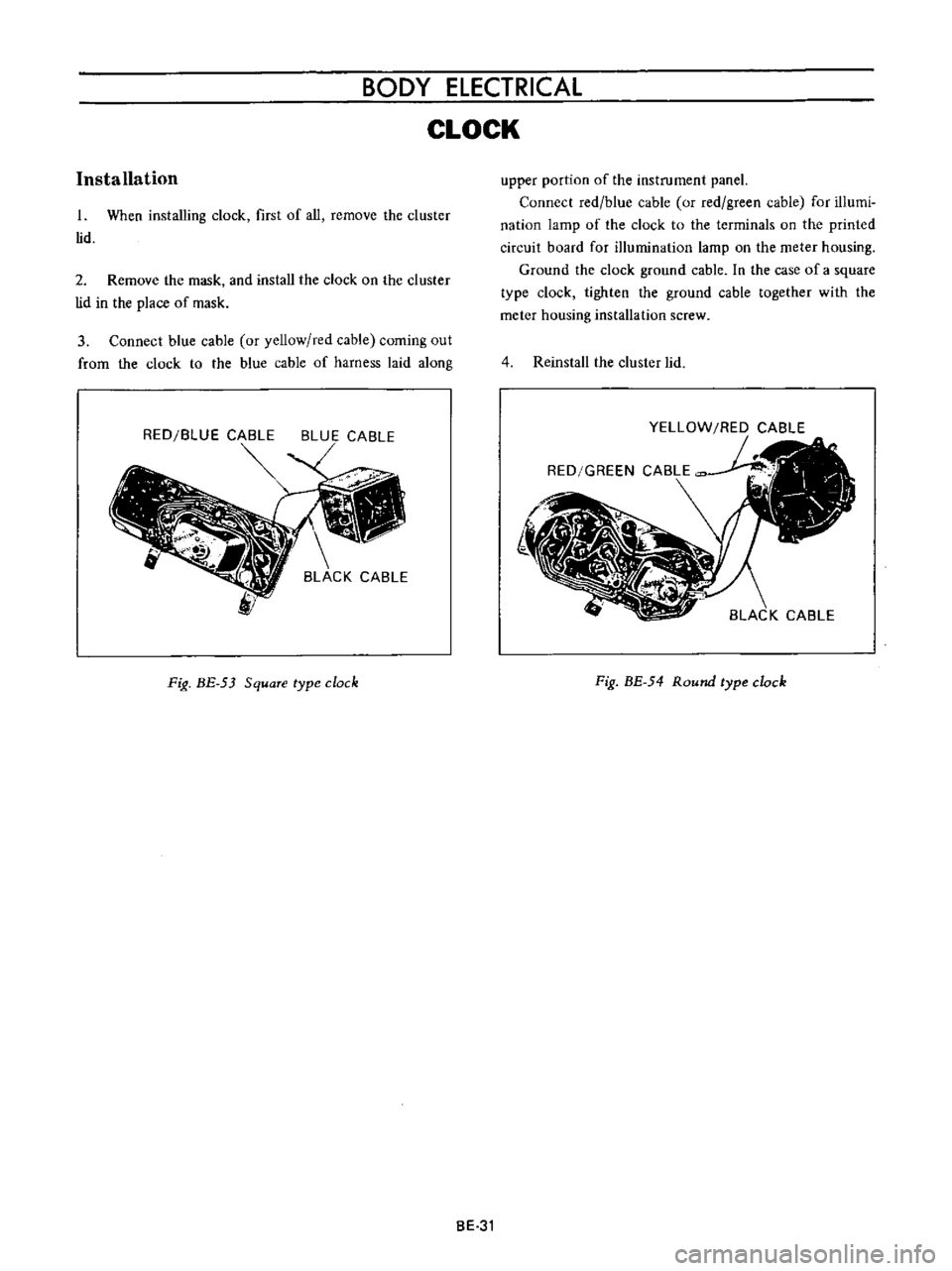
Installation
upper
portion
of
the
instrument
panel
Connect
red
blue
cable
or
red
green
cable
for
illumi
nation
lamp
of
the
clock
to
the
terminals
on
the
printed
circuit
board
for
illumination
lamp
on
the
meter
housing
Ground
the
clock
ground
cable
In
the
case
of
a
square
type
clock
tighten
the
ground
cable
together
with
the
meter
housing
installation
screw
1
When
installing
clock
first
of
all
remove
the
cluster
lid
2
Remove
the
mask
and
install
the
clock
on
the
cluster
lid
in
the
place
of
mask
3
Connect
blue
cable
or
yellow
red
cable
coming
out
from
the
clock
to
the
blue
cable
of
harness
laid
along
4
Reinstall
the
cluster
lid
RED
BLUE
CABLE
BLUE
CABLE
Fig
BE
53
Square
type
clock
Fig
BE
54
Round
type
clock
BE
31
Page 278 of 513
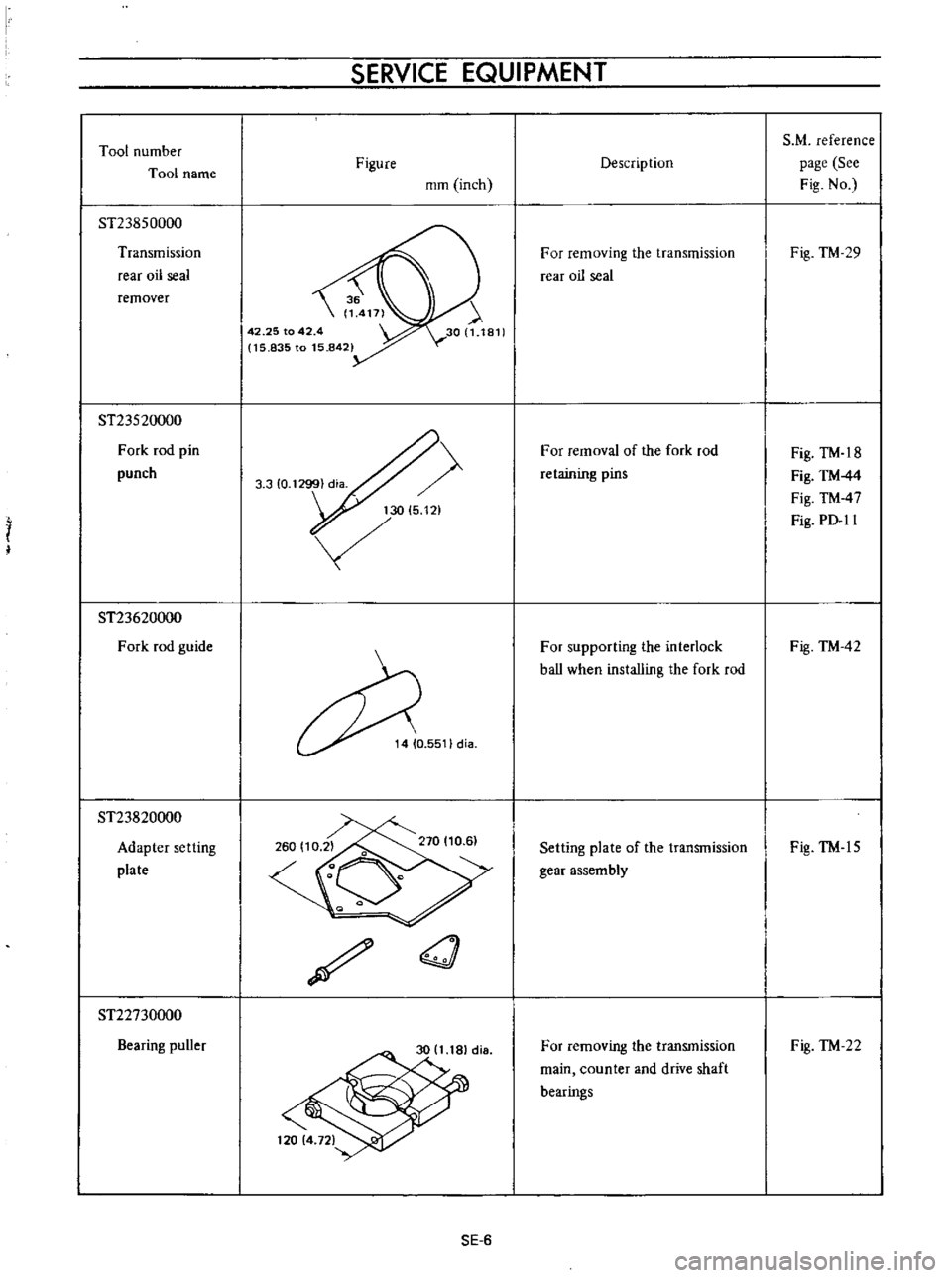
Tool
number
Tool
name
ST23850000
Transmission
rear
oil
seal
remover
ST23520000
Fork
rod
pin
punch
t
I
ST23620000
Fork
rod
guide
ST23820000
Adapter
setting
plate
ST22730000
Bearing
puller
SERVICE
EQUIPMENT
Figure
mm
inch
42
25
to
42
4
15
835
to
15
842
CJ
SE
6
Description
For
removing
the
transmission
rear
oil
seal
For
removal
of
the
fork
rod
retaining
pins
For
supporting
the
interlock
ball
when
installing
the
fork
rod
Setting
plate
of
the
transmission
gear
assembly
For
removing
the
transmission
main
counter
and
drive
shaft
bearings
S
M
reference
page
See
Fig
No
Fig
TM
29
Fig
TM
18
Fig
TM44
Fig
TM
47
Fig
PD
Il
Fig
TM
42
Fig
TM
15
Fig
TM
22
Page 298 of 513
GENERAL
INFORMATION
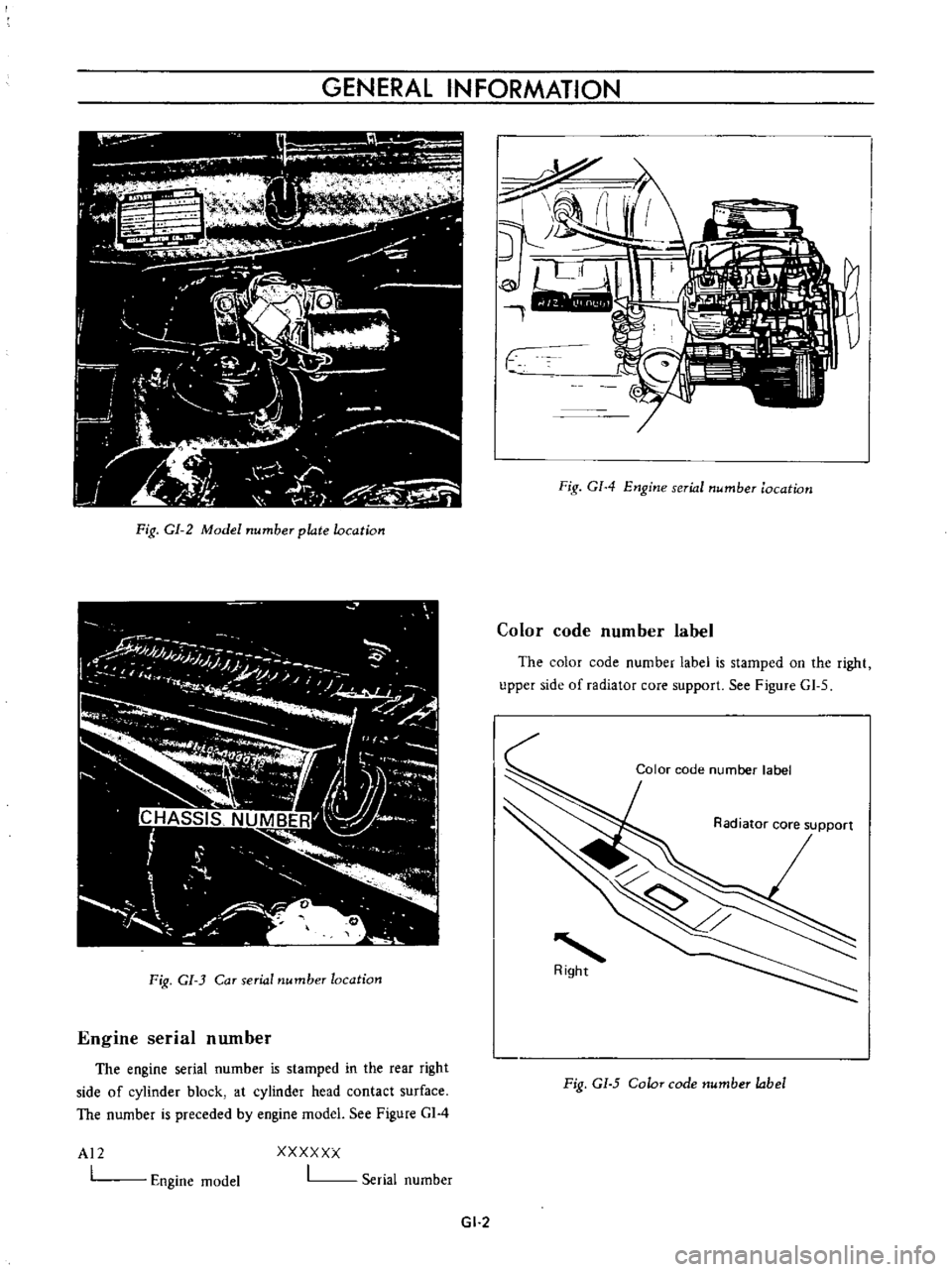
Fig
GI
2
Model
number
plate
location
Fig
GI
3
Car
serial
number
location
Engine
serial
number
The
engine
serial
number
is
stamped
in
the
rear
right
side
of
cylinder
block
at
cylinder
head
contact
surface
The
number
is
preceded
by
engine
model
See
Figure
GI
4
AI2
I
xxxxxx
I
Serial
number
Engine
model
c
Fig
G
44
Engine
serial
number
ioeation
Color
code
number
label
The
color
code
number
label
is
stamped
on
the
right
upper
side
of
radiator
core
support
See
Figure
GI
5
Color
code
number
label
Radiator
core
support
Fig
GI
5
Color
code
number
label
GI
2
Page 303 of 513
GENERAL
INFORMATION
NISSAN
LONG
LIFE
COOLANT
L
L
C
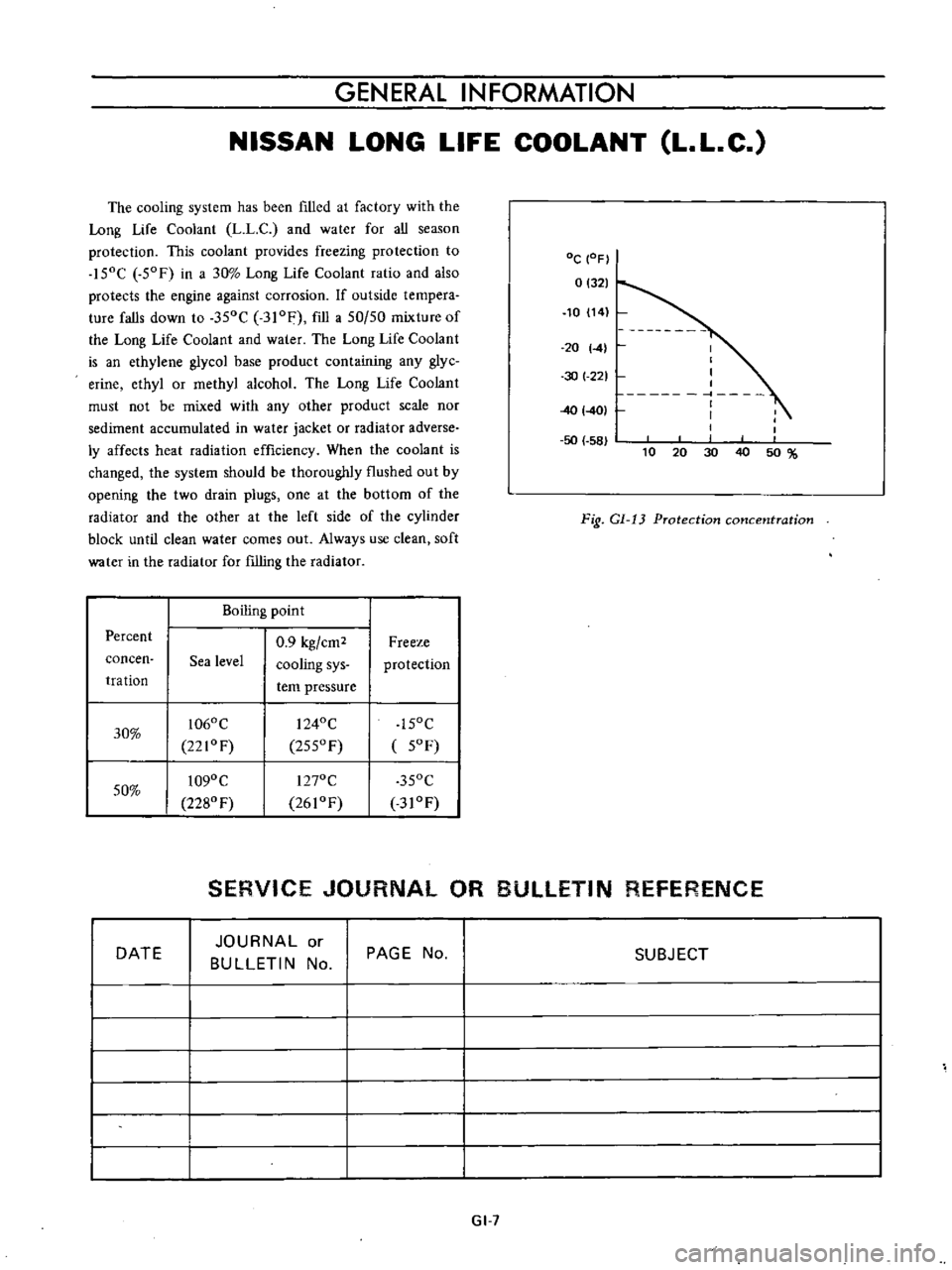
The
cooling
system
has
been
filled
at
factory
with
the
Long
Life
Coolant
L
L
C
and
water
for
aU
season
protection
This
coolant
provides
freezing
protection
to
150C
50F
in
a
30
Long
Life
Coolant
ratio
and
also
protects
the
engine
against
corrosion
If
outside
tempera
ture
falls
down
to
350C
3IOF
fill
a
50
50
mixture
of
the
Long
Life
Coolant
and
water
The
Long
Life
Coolant
is
an
ethylene
glycol
base
product
containing
any
glyc
erine
ethyl
or
methyl
alcohoL
The
Long
Life
Coolant
must
not
be
mixed
with
any
other
product
scale
nor
sediment
accumulated
in
water
jacket
or
radiator
adverse
ly
affects
heat
radiation
efficiency
When
the
coolant
is
changed
the
system
should
be
thoroughly
flushed
out
by
opening
the
two
drain
plugs
one
at
the
bottom
of
the
radiator
and
the
other
at
the
left
side
of
the
cylinder
block
until
clean
water
comes
out
Always
use
clean
soft
water
in
the
radiator
for
filling
the
radiator
DC
OF
01321
30
1
221
I
I
I
I
1
I
I
I
10
20
30
40
50
10
14
20
1
4
40
1
401
50
581
Fig
GI
13
Protection
concentration
Boiling
point
Percent
0
9
kg
cm2
Freeze
coneen
Sea
level
cooling
sys
protection
tratioo
tern
pressure
30
1060C
1240C
15OC
2210
F
2550
F
5OF
50
1090C
1270C
350C
2280
F
26IOF
3IOF
SERVICE
JOURNAL
OR
BULLETIN
REFERENCE
DATE
JOURNAL
or
BULLETIN
No
PAGE
No
SUBJECT
GI
7
Page 307 of 513
ENGINE
operating
mechanism
Adjust
valve
clearance
at
following
four
points
while
engine
is
still
hot
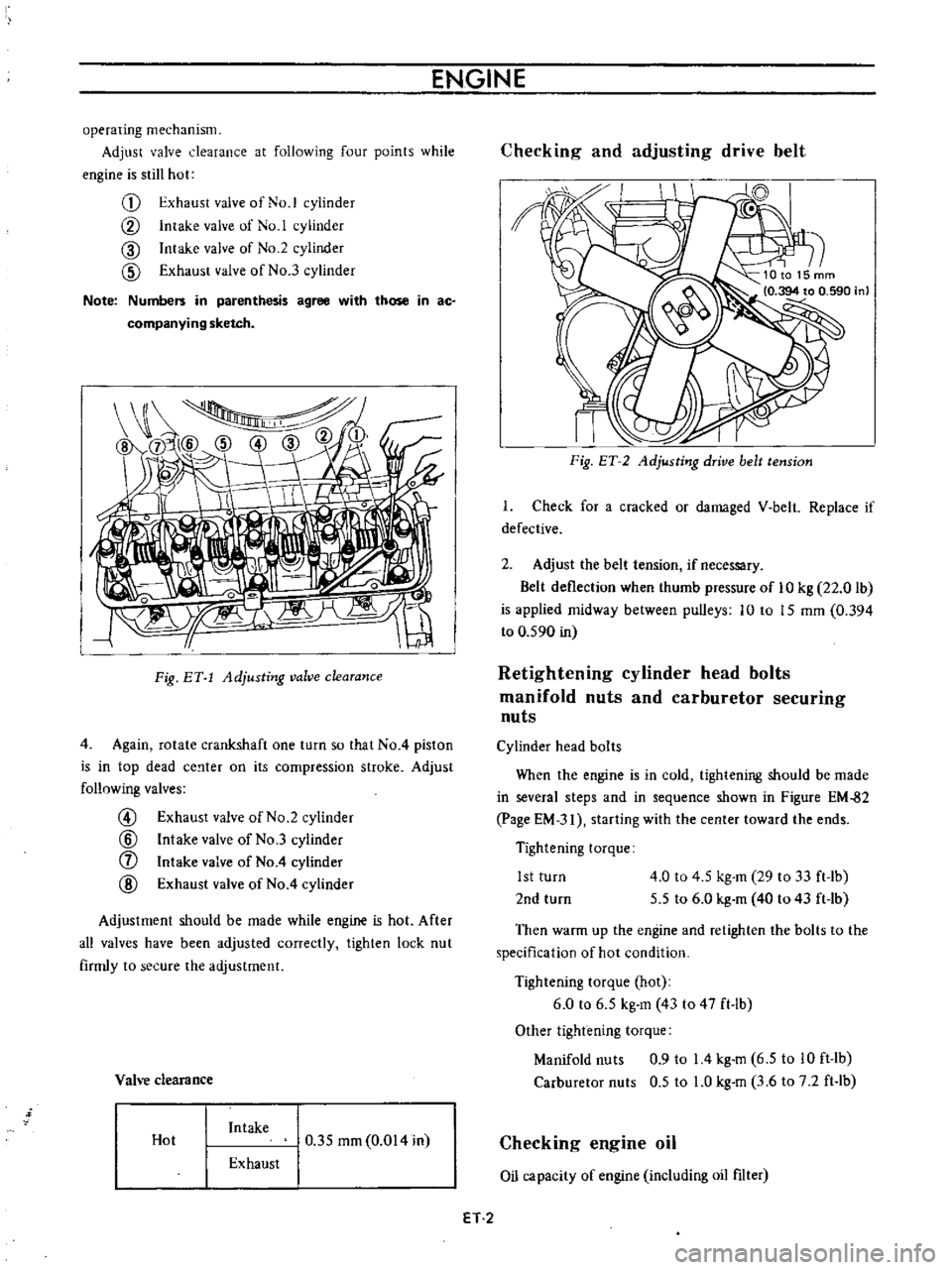
G
Exhaust
valve
of
No
1
cylinder
CV
Intake
valve
of
No
1
cylinder
CID
Intake
valve
of
No
2
cylinder
CID
Exhaust
valve
of
No
3
cylinder
Note
Numbers
in
parenthesis
agree
with
those
in
ac
companying
sketch
I
Fig
BY
1
Adjusting
valve
clearance
4
Again
rotate
crankshaft
one
turn
so
that
No
4
piston
is
in
top
dead
ce
lter
on
its
compression
stroke
Adjust
follnwing
valves
@
Exhaust
valve
of
No
2
cylinder
@
Intake
valve
of
No
3
cylinder
f
Intake
valve
of
No
4
cylinder
@
Exhaust
valve
of
No
4
cylinder
Adjustment
should
be
made
while
engine
is
hot
After
all
valves
have
been
adjusted
correctly
tighten
lock
nut
firmly
to
secure
the
adjustment
Vah
e
clearance
Hot
Intake
0
35
mm
0
014
in
Exhaust
Checking
and
adjusting
drive
belt
II
I
Fig
ET
2
Adjusting
drive
belt
tension
I
Check
for
a
cracked
or
damaged
V
belt
Replace
if
defective
2
Adjust
the
belt
tension
if
necessary
Belt
deflection
when
thumb
pressure
of
10
kg
22
0
lb
is
applied
midway
between
pulleys
10
to
15
mm
0
394
to
0
590
in
Retightening
cylinder
head
bolts
manifold
nuts
and
carburetor
securing
nuts
Cylinder
head
bolts
When
the
engine
is
in
cold
tightening
should
be
made
in
several
steps
and
in
sequence
shown
in
Figure
EM
82
page
EM
31
starting
with
the
center
toward
the
ends
Tightening
torque
1st
turn
2nd
turn
4
0
to
4
5
kg
m
29
to
33
ft
lb
5
5
to
6
0
kg
m
40
to
43
ft
lb
Then
warm
up
the
engine
and
retighten
the
bolts
to
the
specification
of
hot
condition
Tightening
torque
hot
6
0
to
6
5
kg
m
43
to
47
ft
lb
Other
tightening
torque
Manifold
nuts
0
9
to
14
kg
m
6
5
to
10
ft
lb
Carburetor
nuts
0
5
to
LO
kg
m
3
6
to
7
2
ft
lb
Checking
engine
oil
Oil
capacity
of
engine
including
oil
filter
ET
2
Page 311 of 513
ENGINE
4
Install
a
timing
light
on
No
cylinder
spark
plug
wire
and
install
a
tachometer
5
Set
idling
speed
to
approximately
800
rpm
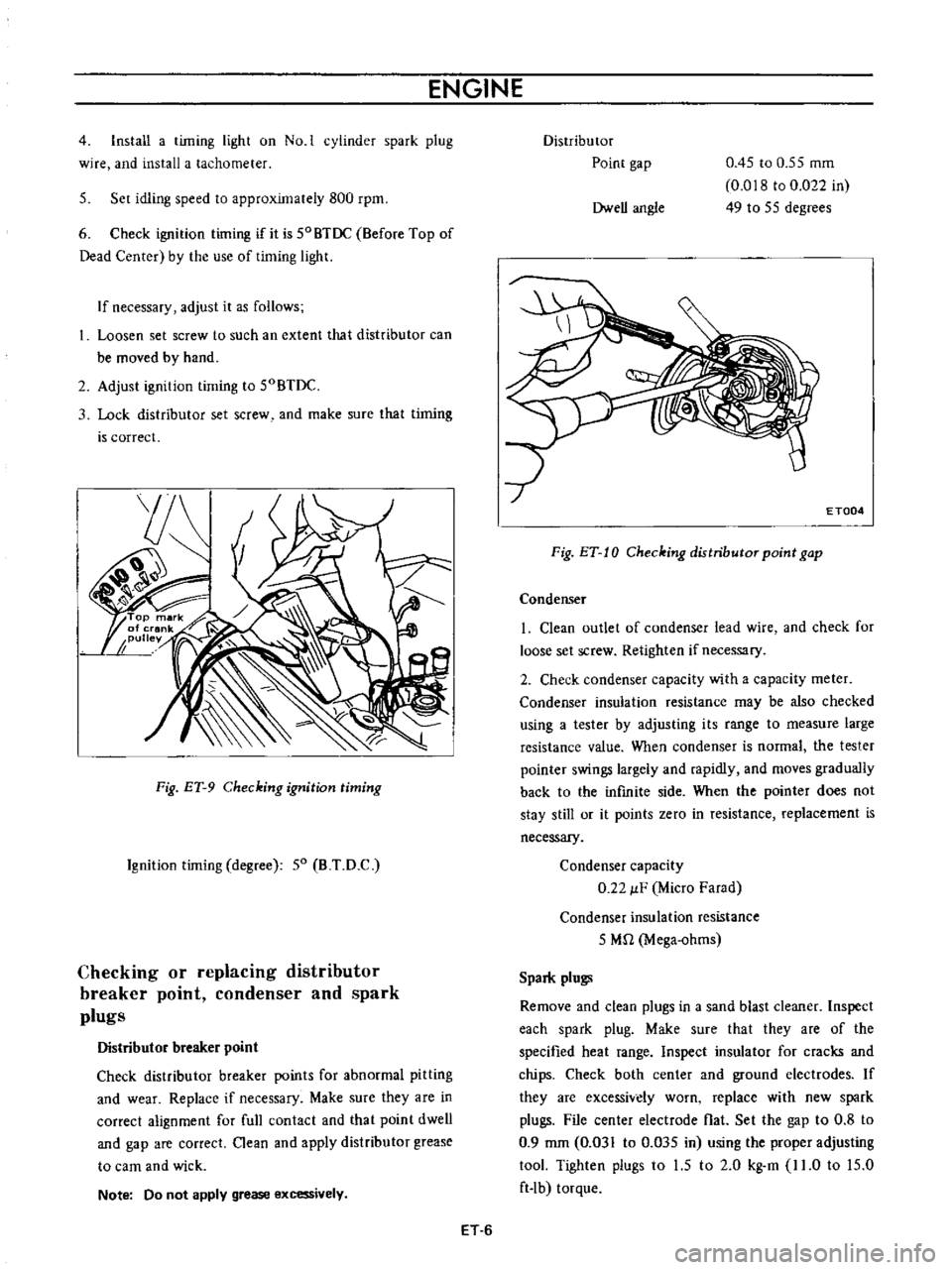
6
Check
ignition
timing
if
it
is
50BTDC
Before
Top
of
Dead
Center
by
the
use
of
timing
light
If
necessary
adjust
it
as
follows
Loosen
set
screw
to
such
an
extent
that
distributor
can
be
moved
by
hand
2
Adjust
ignition
timing
to
50BTDC
3
Lock
distributor
set
screw
and
make
sure
that
timing
is
correct
Fig
ET
9
Checking
ignition
timing
Ignition
timing
degree
50
B
T
D
C
Checking
or
replacing
distributor
breaker
point
condenser
and
spark
plugs
Distributor
breaker
point
Check
distributot
breaker
points
for
abnormal
pitting
and
wear
Replace
if
necessary
Make
sure
they
are
in
correct
alignment
for
full
contact
and
that
point
dwell
and
gap
are
correct
Clean
and
apply
distributor
grease
to
earn
and
wick
Note
Do
not
apply
grease
excessively
Distributor
Point
gap
0
45
to
0
55
mm
0
018
to
0
Q22
in
49
to
55
degrees
Dwell
angle
ET004
Fig
ET
10
Checking
distributor
point
gap
Condenser
I
Clean
outlet
of
condenser
lead
wire
and
check
for
loose
set
screw
Retighten
if
necessary
2
Check
condenser
capacity
with
a
capacity
meter
Condenser
insulation
resistance
may
be
also
checked
using
a
tester
by
adjusting
its
range
to
measure
large
resistance
value
When
condenser
is
normal
the
tester
pointer
swings
largely
and
rapidly
and
moves
gradually
back
to
the
infmite
side
When
the
pointet
does
not
stay
still
or
it
points
zero
in
resistance
replacement
is
necessary
Condenser
capacity
0
221LF
Micro
Farad
Condenser
insulation
resistance
5
Mn
Mega
ohms
Spark
plugs
Remove
and
clean
plugs
in
a
sand
blast
cleaner
Inspect
each
spark
plug
Make
sure
that
they
are
of
the
specified
heat
tange
Inspect
insulator
for
cracks
and
chips
Check
both
center
and
ground
electrodes
If
they
are
excessi
ely
worn
replace
with
new
spark
plugs
File
center
electrode
flat
Set
the
gap
to
0
8
to
0
9
rom
0
031
to
0
035
in
using
the
proper
adjusting
tool
Tighten
plugs
to
1
5
to
2
0
kg
m
11
0
to
15
0
ft
lb
torque
ET
6