ABS DATSUN B110 1973 Service Repair Manual
[x] Cancel search | Manufacturer: DATSUN, Model Year: 1973, Model line: B110, Model: DATSUN B110 1973Pages: 513, PDF Size: 28.74 MB
Page 20 of 513
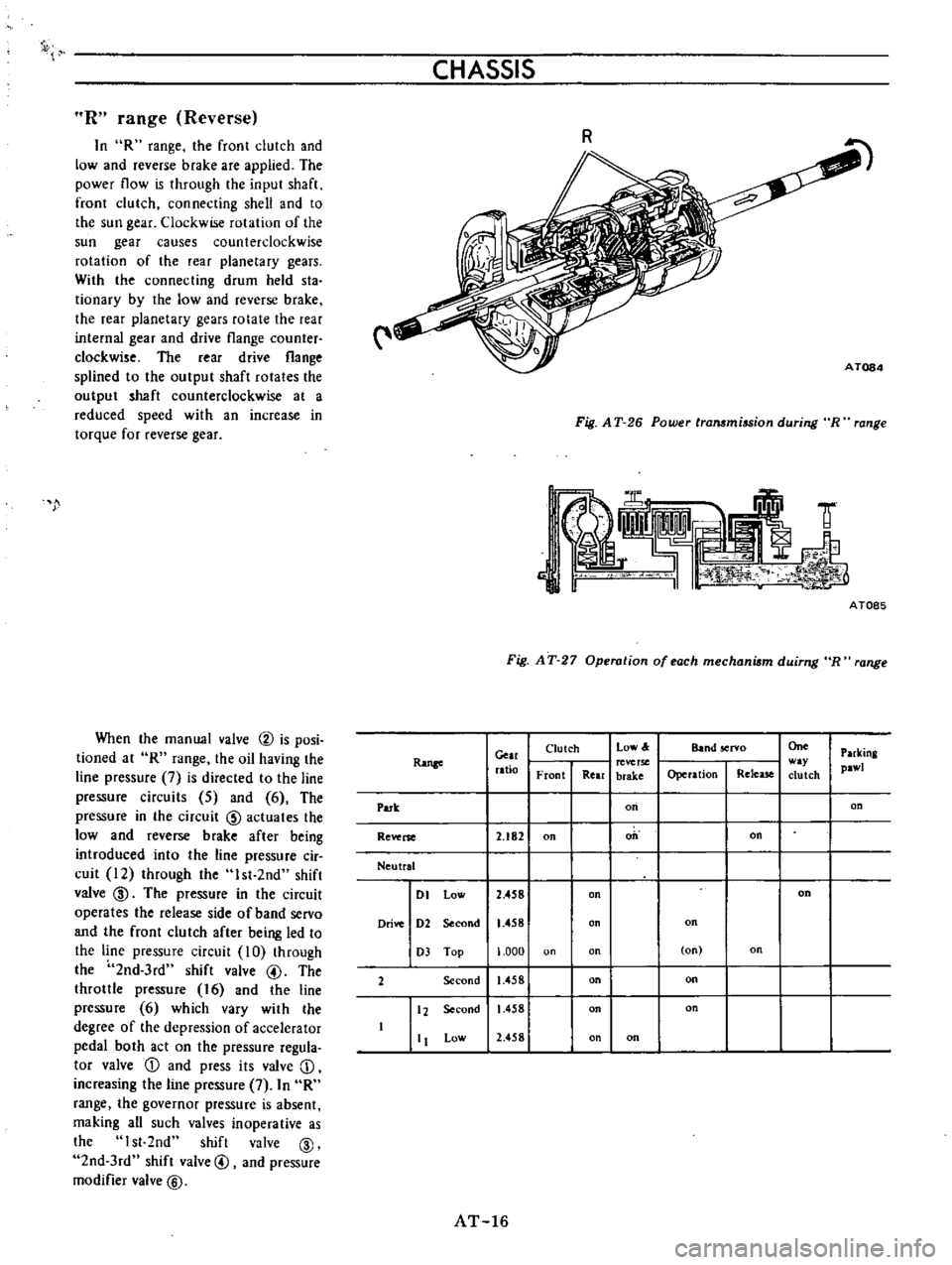
R
range
Reverse
In
R
range
the
front
clutch
and
low
and
reverse
brake
are
applied
The
power
flow
is
through
the
input
shaft
front
clutch
connecting
sheU
and
to
the
sun
gear
Clockwise
rotatiun
of
the
sun
gear
causes
counterclockwise
rotation
of
the
rear
planetary
gears
With
the
connecting
drum
held
sta
tionary
by
the
low
and
reverse
brake
the
rear
planetary
gears
rotate
the
rear
internal
gear
and
drive
flange
counter
clockwise
The
rear
drive
flange
splined
to
the
output
shaft
rotates
the
output
shaft
counterclockwise
at
a
reduced
speed
with
an
increase
in
torque
for
reverse
gear
J
When
the
manual
valve
V
is
posi
tioned
at
R
range
the
oil
having
the
line
pressure
7
is
directed
to
the
line
pressure
circuits
5
and
6
The
pressure
in
the
circuit
ID
actuates
the
low
and
reverse
brake
after
being
introduced
into
the
line
pressure
cir
cuit
I2
through
the
lst
2nd
shift
valve
ID
The
pressure
in
the
circuit
operates
the
release
side
ofband
servo
and
the
front
clutch
after
being
led
to
the
line
pressure
circuit
10
through
the
2nd
3rd
shift
valve
@
The
throttle
pressure
16
and
the
line
pressure
6
which
vary
with
the
degree
of
the
depression
of
accelerator
pedal
both
act
on
the
pressure
regula
tor
valve
CD
and
press
its
valve
CD
increasing
the
line
pressure
7
In
R
range
the
governor
pressure
is
absent
making
all
sllch
valves
inoperative
as
the
lst
2nd
shift
valve
@
2nd
3rd
shift
valve
and
pressure
modifier
valve
@
CHASSIS
R
C
Fig
AT
26
Power
transmission
during
R
range
lI
a
Go
I
w
L
AT085
Fig
AT
27
Operation
of
each
mechani6m
duirng
OR
range
Clutch
low
Band
servo
One
Parking
Ran
Gear
ratio
reverse
way
pawl
Front
Rear
brake
Operation
Release
clutch
Park
on
on
Reverse
2
182
on
on
on
Neutral
01
low
2
458
nn
on
Drive
D2
Second
458
nn
on
OJ
Top
1
000
on
on
2
Second
458
nn
t2
Second
458
on
tt
low
2
458
on
on
AT
16
Page 58 of 513
Judgement
in
measurmg
line
pressure
I
Low
idling
line
pressures
in
the
ranges
D
2
loR
and
P
It
can
be
artributed
to
trouble
in
the
pressure
supply
system
or
too
low
output
of
power
caused
by
1
A
worn
oil
pump
2
An
oil
pressure
leakage
in
the
oil
pump
valve
body
or
case
3
A
sticking
regulator
valve
2
Low
idling
line
pressures
in
cer
tain
ranges
only
It
is
caused
pressumabIy
by
an
oil
leakage
in
the
devices
or
circuits
con
nected
to
the
relevant
ranges
1
When
there
is
an
oil
leakage
in
the
rear
clutch
and
governor
the
line
pressures
in
D
2
and
I
are
low
but
the
pressure
is
normal
in
R
2
When
an
oil
leakage
occurs
in
the
low
and
reverse
brake
circuit
the
line
pressures
in
R
and
p
are
low
but
the
pressure
is
normal
in
0
2
and
I
3
High
idling
line
pressures
It
is
presumed
to
be
caused
by
an
increased
vacuum
throttle
pressure
owing
to
a
leakage
in
the
vacuum
tube
or
diaphragm
or
by
an
increased
line
pressure
due
to
a
sticking
regulator
CHASSIS
valve
Vacuum
leakage
is
checked
by
di
reetly
measuring
the
negative
pressure
after
removing
the
vacuum
pipe
A
puncture
of
the
vacuum
dia
phragm
can
be
easily
ascertained
because
the
torque
converter
oil
is
absorbed
into
the
engine
and
the
exhaust
pipe
blows
up
the
white
smoke
4
Checking
items
when
the
line
pressure
is
increasing
In
trJs
checking
the
line
pressure
should
be
measured
with
vacuums
of
450
mmHg
and
0
mmHg
in
accordance
with
the
stall
test
procedure
test
procedure
1
If
the
line
pressures
do
not
increase
despite
the
vacuum
decrease
check
whether
the
vacuum
rod
is
incorporated
2
If
the
line
pressures
do
not
meet
the
standard
it
is
caused
mostly
by
a
sticking
pressure
regulating
valve
pres
sure
regulating
valve
plug
or
amptifier
TROUBLE
SHOOTING
CHART
Inspecting
items
1
Inspection
with
automatic
trans
mission
on
vehicle
J
AT
54
A
Oil
level
B
Range
selecr
linkage
C
Inhibitor
switch
and
wiring
D
Vacuum
diaphragm
and
piping
E
Downshift
solenoid
kick
down
switch
and
wiring
F
Engine
idling
rpm
G
Oil
pressure
throttle
H
Engine
stall
rpm
I
Rear
lubrication
J
Control
valve
manual
K
Governor
valve
L
Band
servo
M
Transmission
air
check
N
Oil
quantity
o
Ignition
switch
and
starter
motor
P
Engine
adjustment
and
brake
in
spection
2
Inspection
after
inspecting
auto
matic
transmission
on
vehicle
m
Rear
clutch
n
Front
clutch
q
Band
brake
r
Low
and
reverse
brake
s
Oil
pump
Leakage
of
oil
passage
u
One
way
clutch
of
torque
converter
v
One
way
clutch
of
transmission
w
Front
clutch
check
ball
x
Parking
linkage
y
Planetary
gear
Page 88 of 513
CHASSIS
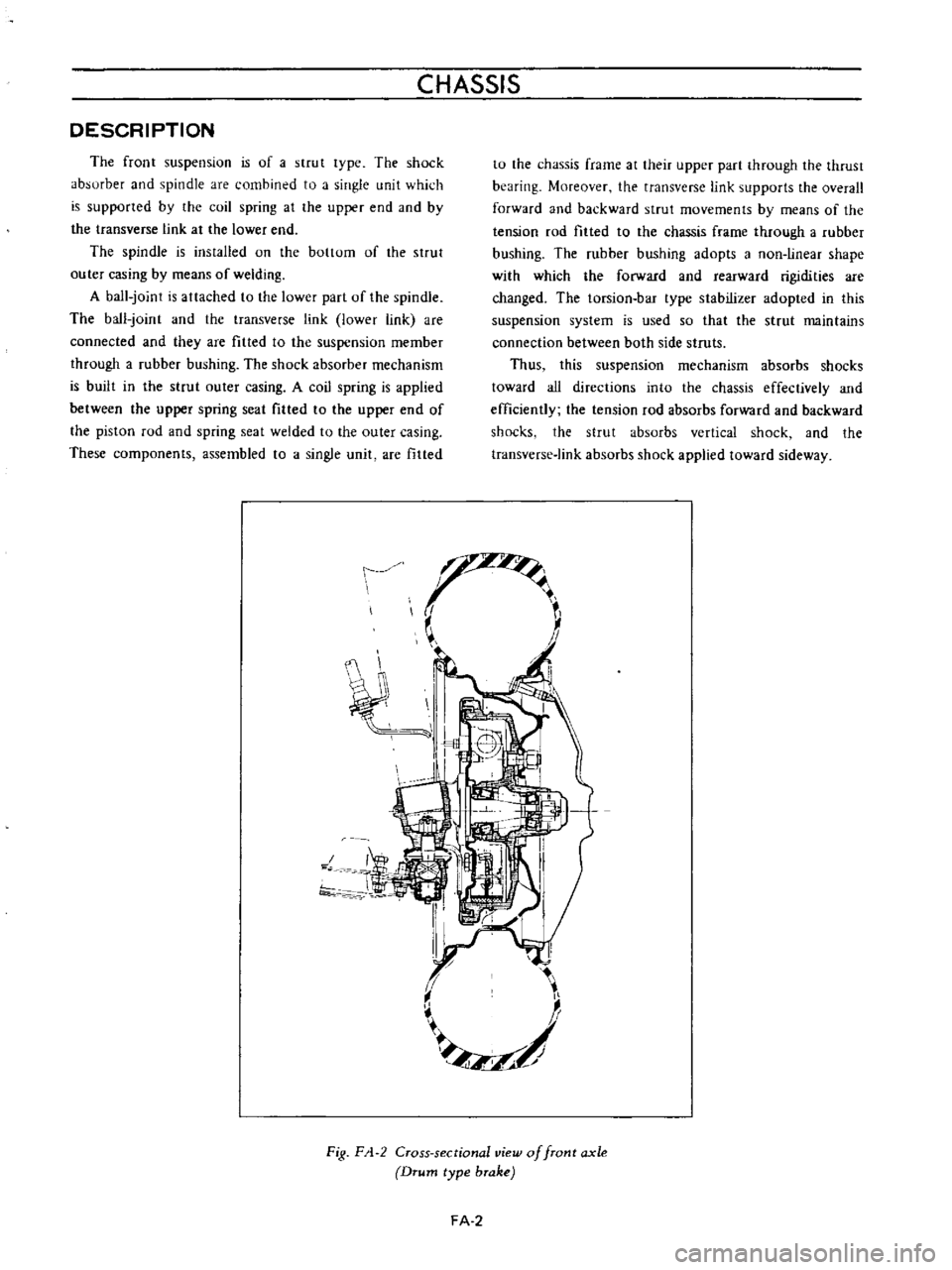
DESCRIPTION
The
front
suspension
is
of
a
strut
lype
The
shock
absurber
and
spindle
are
combined
to
a
single
unit
which
is
supported
by
the
coil
spring
at
the
upper
end
aod
by
the
transverse
link
at
the
lower
end
The
spindle
is
ins
tailed
on
the
bottom
of
the
strut
outer
casing
by
means
of
welding
A
ball
joint
is
attached
to
the
lower
part
of
the
spindle
The
ball
joint
and
the
transverse
link
lower
link
are
connected
and
they
are
fitted
to
the
suspension
member
through
a
rubber
bushing
The
shock
absorber
mechanism
is
built
in
the
strut
outer
casing
A
coil
spring
is
applied
between
the
upper
spring
seat
filled
to
the
upper
end
of
the
piston
rod
and
spring
seat
welded
to
the
outer
casing
These
components
assembled
to
a
single
unit
are
fitted
tu
the
chassis
frame
at
their
upper
part
through
the
thrust
bearing
Moreover
the
transverse
link
supports
the
overall
forward
and
backward
strut
movements
by
means
of
the
tension
rod
filled
to
the
chassis
frame
through
a
rubber
bushing
The
rubber
bushing
adopts
a
non
linear
shape
with
which
the
forward
and
rearward
rigidities
are
changed
The
torsion
bar
type
stabilizer
adopted
in
this
suspension
system
is
used
so
that
the
strut
maintains
connection
between
both
side
struts
Thus
this
suspension
mechanism
absorbs
shocks
toward
all
directions
into
the
chassis
effectively
and
efficiently
the
tension
rod
absorbs
forward
and
backward
shocks
the
strut
absorbs
vertical
shock
and
the
transverse
link
absorbs
shock
applied
toward
sideway
t
J
f
II
L
II
I
7
f
1
I
Fig
F
1
2
Cross
sectional
view
of
front
axle
Drum
type
brake
FA
2
Page 98 of 513
fl
i
i
I
1
I
I
i
2
4
L
thi7
lrr
I
1
1
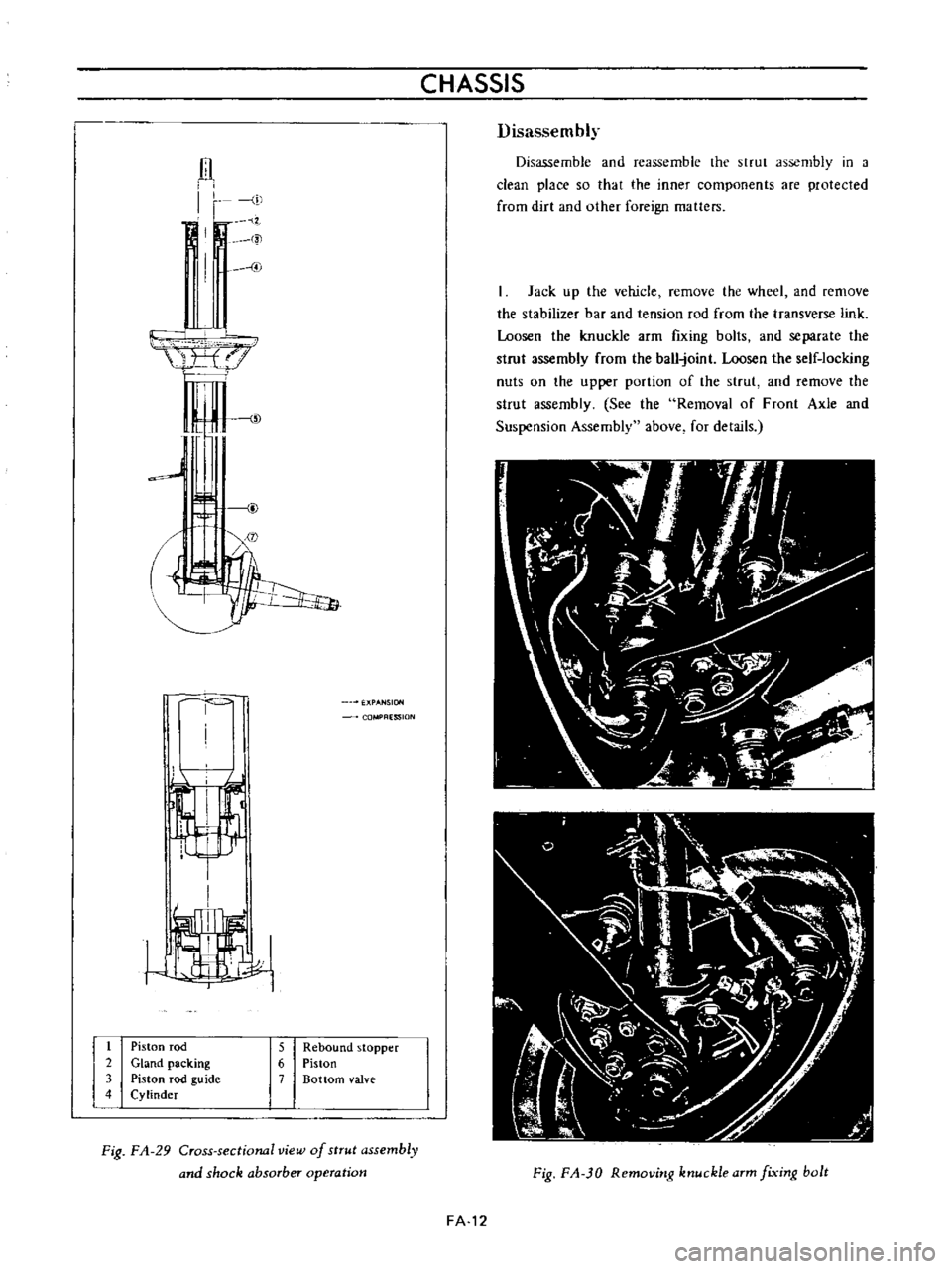
Piston
rod
2
Gland
packing
3
Piston
rod
guide
4
Cylinder
CHASSIS
ESSION
5
Rebound
stopper
6
Piston
7
Bottom
valve
Fig
FA
29
Cross
sectional
view
of
strut
assembly
and
shock
absorber
operation
Disassembly
Disassemble
and
reassemble
the
strut
assembly
in
a
clean
place
so
that
the
inner
components
are
protected
from
dirt
and
other
foreign
matters
Jack
up
the
vehicle
remove
the
wheel
and
remove
the
stabilizer
bar
and
tension
rod
from
the
transverse
link
Loosen
the
knuckle
arm
fIxing
bolts
and
separate
the
strut
assembly
from
the
ball
joint
Loosen
the
self
locking
nuts
on
the
upper
portion
of
the
strut
and
remove
the
strut
assembly
See
the
Removal
of
Front
Axle
and
Suspension
Assembly
above
for
details
Fig
FA
JO
Removitlg
ktluckle
arm
fixitlg
bolt
FA
12
Page 100 of 513
CHASSIS
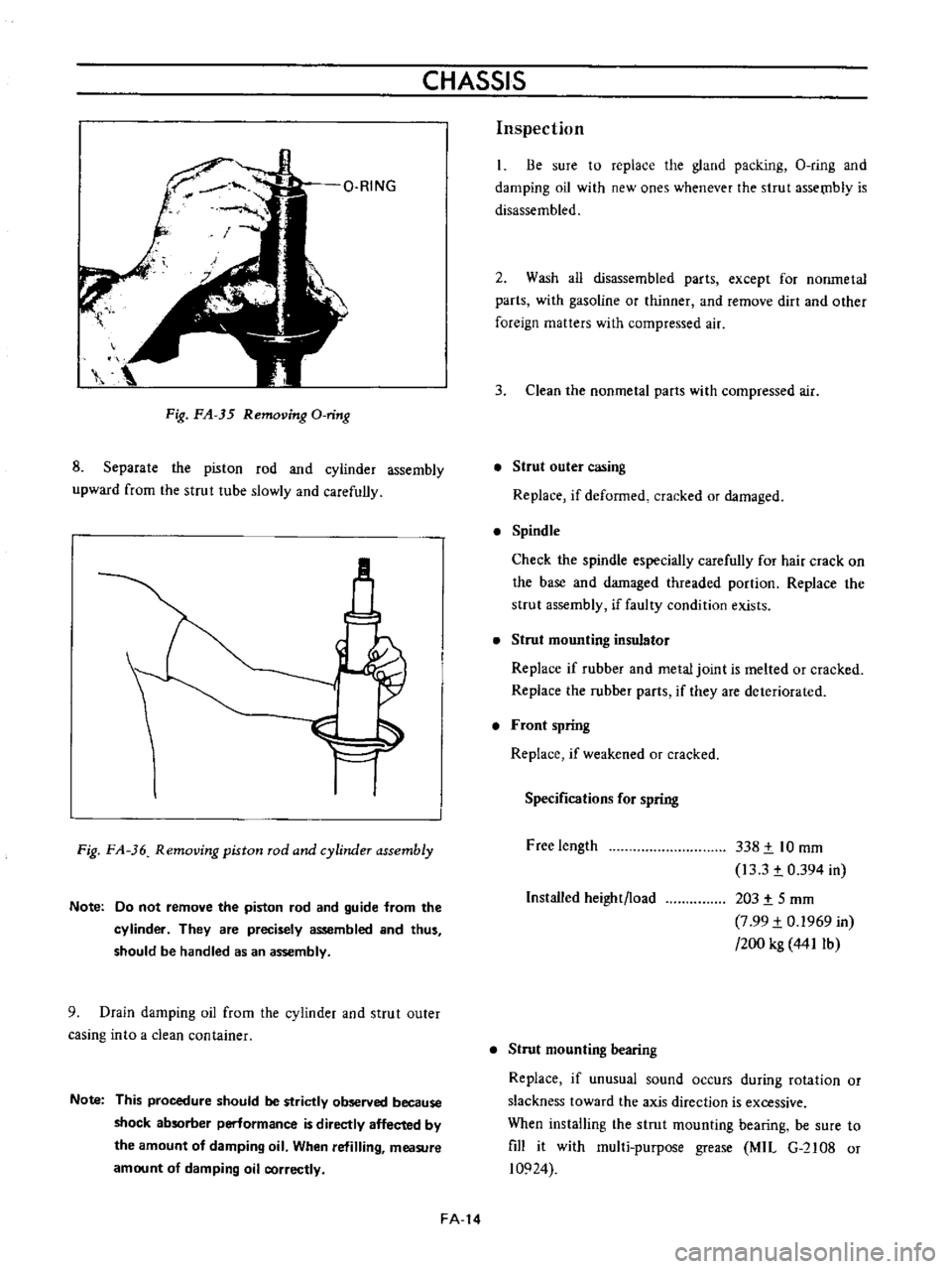
Fig
FA
35
Removing
O
ring
8
Separate
the
piston
rod
and
cyiinder
assembly
upward
from
the
strut
tube
slowly
and
carefully
M
Fig
FA
36
Removing
piston
rod
and
cylinder
assembly
Note
Do
not
remove
the
piston
rod
and
guide
from
the
cylinder
They
are
precisely
assembled
and
thus
should
be
handled
as
an
assembly
9
Drain
damping
oil
from
the
cylinder
and
strut
outer
casing
into
a
clean
container
Note
This
procedure
should
be
strictly
observed
because
shock
absorber
perlormance
is
directly
affected
by
the
amount
of
damping
oil
When
refilling
measure
amount
of
damping
oil
correctly
FA
14
Inspection
Be
sure
to
replace
the
gland
packing
O
ring
and
damping
oil
with
new
ones
whenever
the
strut
assetnb1y
is
disassembled
2
Wash
all
disassembled
parts
except
for
nonmetal
parts
with
gasoline
or
thinner
and
remove
dirt
and
other
foreign
matters
with
compressed
air
3
Clean
the
nonmetal
parts
with
compressed
air
Strut
outer
casing
Replace
if
deformed
cracked
or
damaged
Spindle
Check
the
spindle
especially
carefully
for
hair
crack
on
the
base
and
damaged
threaded
portion
Replace
the
strut
assembly
if
faulty
condition
exists
Strut
mounting
insulator
Replace
if
rubber
and
metal
joint
is
melted
or
cracked
Replace
the
rubber
parts
if
they
are
deteriorated
Front
spring
Replace
if
weakened
or
cracked
Specifications
for
spring
Free
length
338
t
10
mm
13
3
t
0
394
in
203
t
5
mm
7
99
t
0
1969
in
200
kg
441Ib
Installed
height
load
Strut
mounting
bearing
Replace
if
unusual
sound
occurs
during
rotation
or
slackness
toward
the
axis
direction
is
excessive
When
installing
the
strut
mounting
bearing
be
sure
to
fill
it
with
mul1i
purpose
grease
MIL
G
2108
or
10924
Page 101 of 513
FRONT
AXLE
FRONT
SUSPENSION
I
f
f
ij
Reassembly
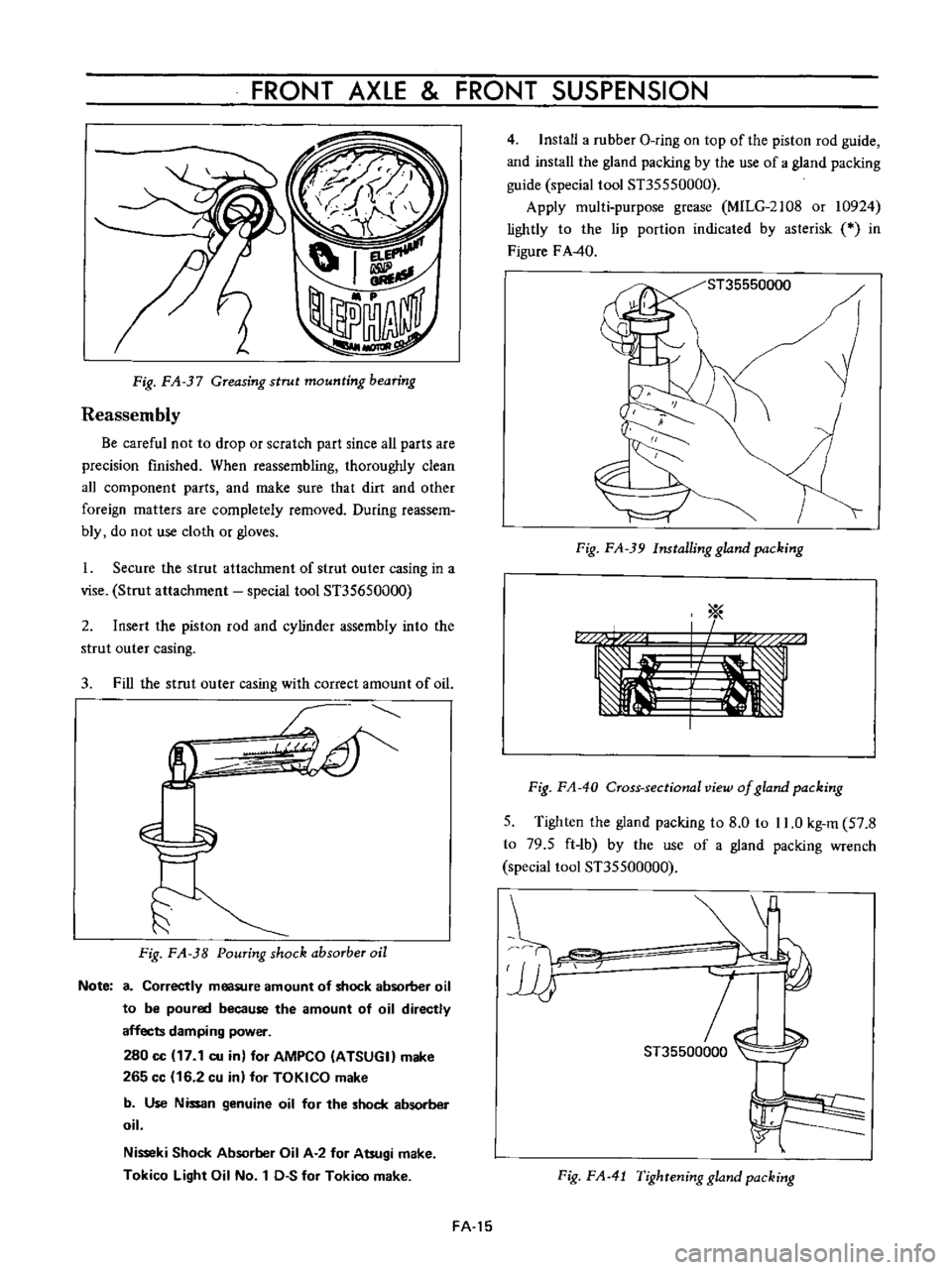
Fig
FA
37
Greasing
strut
mounting
bearing
Be
careful
not
to
drop
or
scratch
part
since
all
parts
are
precision
finished
When
reassembling
thoroughly
clean
all
component
parts
and
make
sure
that
dirt
and
other
foreign
matters
are
completely
removed
During
reassem
bly
do
not
use
cloth
or
gloves
I
Secure
the
strut
attachment
of
strut
Quter
casing
in
a
vise
Strut
attachment
special
tool
ST35650000
2
Insert
the
piston
rod
and
cylinder
assembly
into
the
strut
outer
casing
3
Fill
the
strut
outer
casing
with
correct
amount
of
oil
1
Fig
FA
38
Pouring
shock
absorber
oil
Note
a
Correctly
measure
amount
of
shock
absorber
oil
to
be
poured
because
the
amount
of
oil
directly
affects
damping
power
280
cc
17
1
cu
in
for
AMPCO
ATSUGI
make
265
cc
16
2
cu
in
for
TOKICO
make
b
Use
Nissan
genuine
oil
for
the
shock
absorber
oil
Nisseki
Shock
Absorber
Oil
A
2
for
Atsugi
make
Tokico
light
Oil
No
1
D
S
for
Tokico
make
FA
15
4
Install
a
rubber
O
ring
on
top
of
the
piston
rod
guide
and
install
the
gland
packing
by
the
use
of
a
gland
packing
guide
special
tool
ST35550000
Apply
multi
purpose
grease
MILG
2108
or
10924
lightly
to
the
lip
portion
indicated
by
asterisk
0
in
Figure
F
A40
ST35550000
1
Fig
FA
39
Installing
gland
packing
a
1
c
I
Fig
FA
40
Cross
sectional
view
of
gland
packing
5
Tighten
the
gland
packing
to
8
0
to
11
0
kg
m
57
8
to
79
5
ft
1b
by
the
use
of
a
gland
packing
wrench
special
tool
ST35500000
ST35500000
Fig
FA
41
Tighrening
gland
packing
Page 102 of 513
CHASSIS
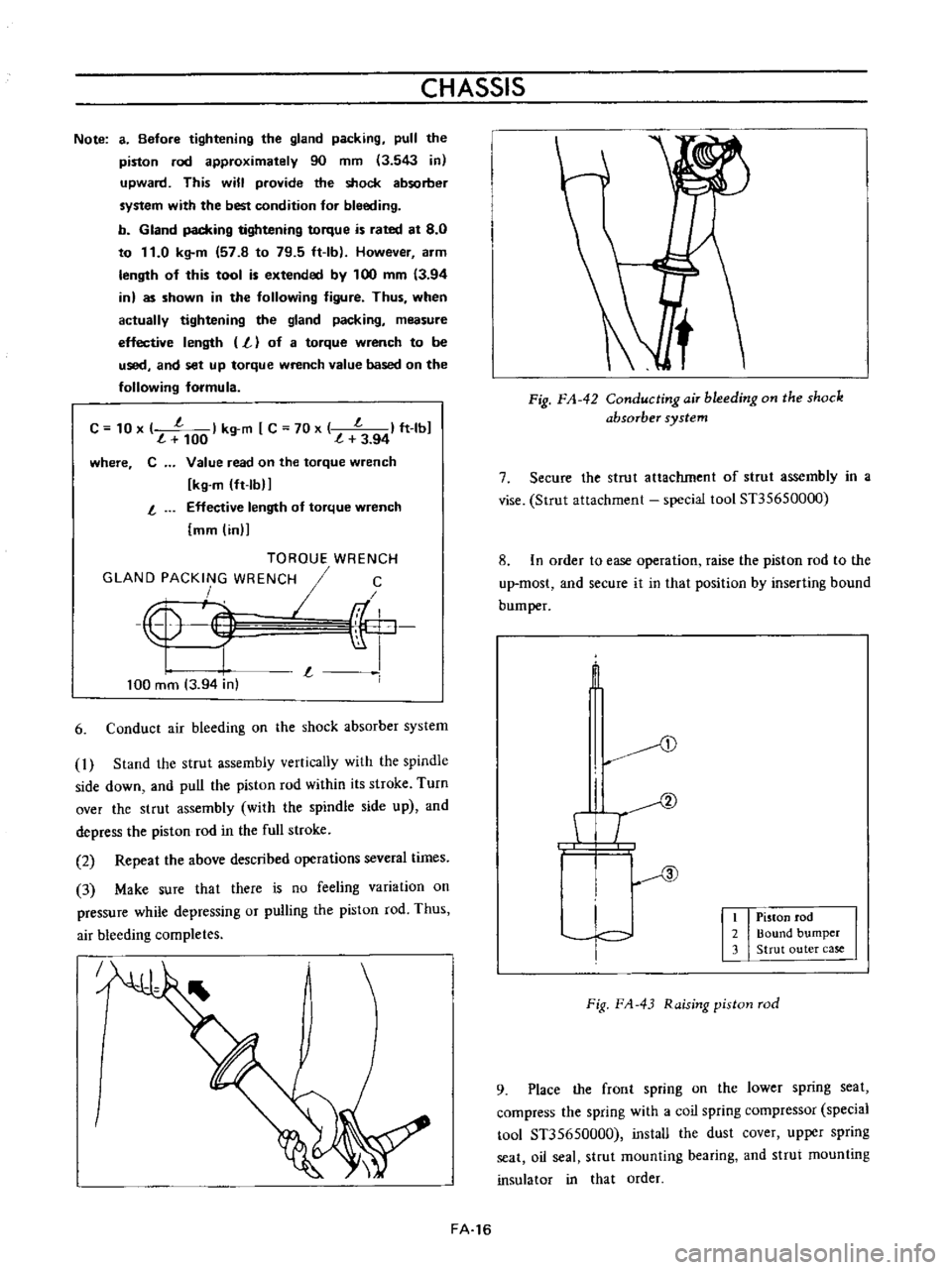
Note
a
Before
tightening
the
gland
packing
pull
the
piston
rod
approximately
90
mm
3
543
in
upward
This
will
provide
the
shock
absorber
system
with
the
best
condition
for
bleeding
b
Gland
packing
tightening
torque
is
rated
at
8
0
to
11
0
kg
m
57
8
to
79
5
ft
Ib
However
arm
length
of
this
tool
is
extended
by
100
mm
3
94
in
as
shown
in
the
following
figure
Thus
when
actually
tightening
the
gland
packing
measure
effective
length
L
of
a
torque
wrench
to
be
used
and
set
up
torque
wrench
value
based
on
the
following
formula
C
10
x
l
I
kg
m
C
70
x
l
I
ft
lbJ
100
l
3
94
where
C
Value
read
on
the
torque
wrench
kg
m
ft
lbIJ
Effective
length
of
torque
wrench
mm
in
l
TOROUE
WRENCH
GLAND
PACKING
WRENCH
I
C
4
F
r
I
L
I
100
mm
3
94
in
6
Conduct
air
bleeding
on
the
shock
absorber
system
1
Stand
the
strut
assembly
vertically
with
the
spindle
side
down
and
pull
the
piston
rod
within
its
stroke
Turn
over
the
strut
assembly
with
the
spindle
side
up
and
depress
the
piston
rod
in
the
full
stroke
2
Repeat
the
above
described
operations
several
times
3
Make
sure
that
there
is
no
feeling
variation
on
pressure
while
depressing
or
pulling
the
piston
rod
Thus
air
bleeding
completes
J
FA
16
Fig
FA
42
ConductingaiT
bleeding
on
the
shock
absorber
system
7
Secure
the
strut
attachment
of
strut
assembly
in
a
vise
Strut
attachment
special
tool
Sn5650000
8
In
order
to
ease
operation
raise
the
piston
rod
to
the
up
most
and
secure
it
in
that
position
by
inserting
bound
bum
per
t
D
I
T
I
c
I
Piston
rod
2
Bound
bumper
3
Strut
outer
case
Fig
FA
43
Raising
piston
rod
9
Place
the
front
spring
on
the
lower
spring
seat
compress
the
spring
with
a
coil
spring
compressor
special
tool
Sn5650000
install
the
dust
cover
upper
spring
seat
oil
seal
strut
mounting
bearing
and
strut
mounting
insulator
in
that
order
Page 112 of 513
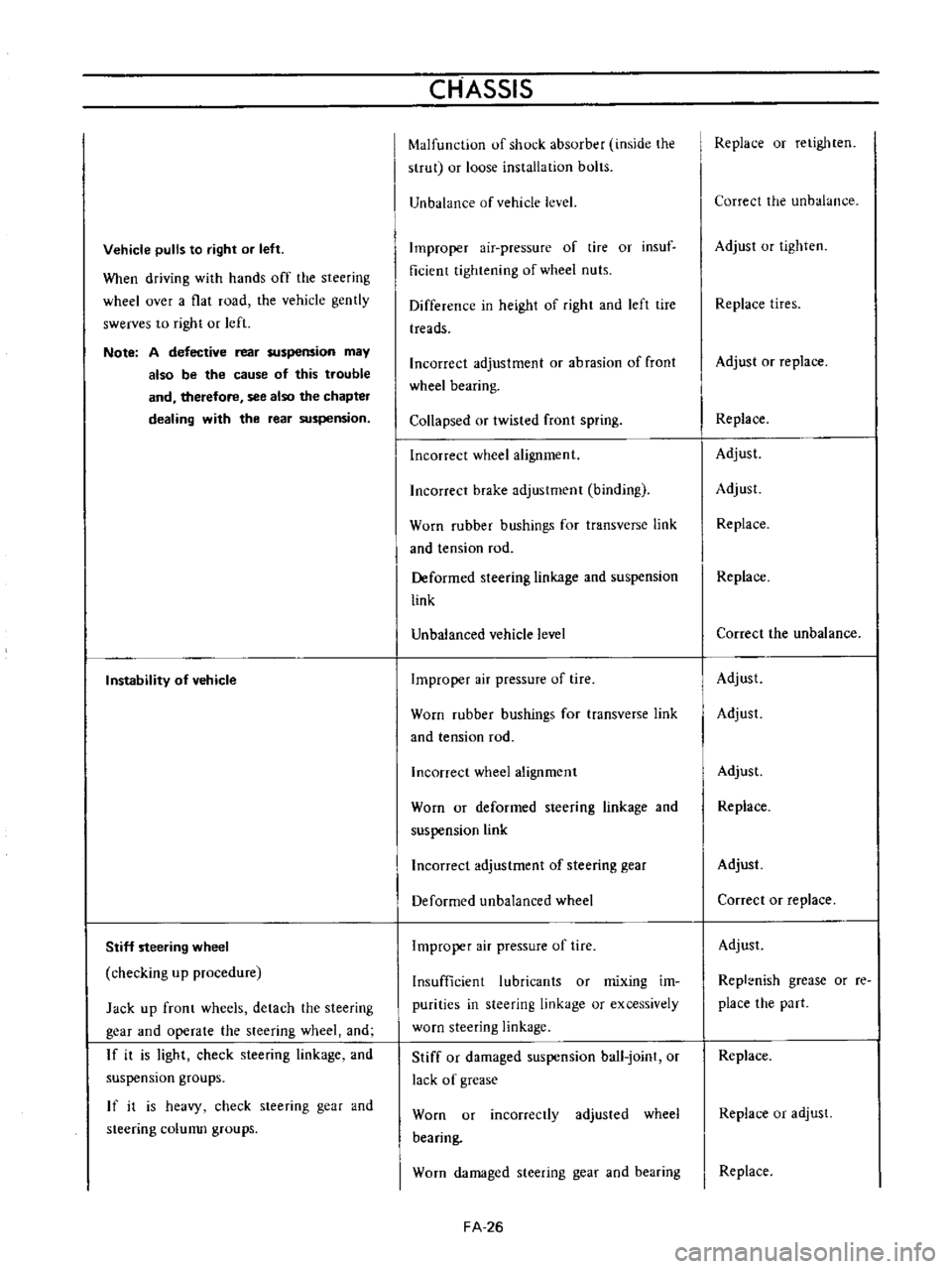
Vehicle
pulls
to
right
or
left
When
driving
with
hands
off
the
steering
wheel
over
a
flat
road
the
vehicle
gently
swerves
to
right
or
left
Note
A
defective
rear
suspension
may
also
be
the
cause
of
this
trouble
and
therefore
see
also
the
chapter
dealing
with
the
rear
suspension
Instability
of
vehicle
Stiff
steering
wheel
checking
up
procedure
Jack
up
front
wheels
detach
the
steering
gear
and
operate
the
steering
wheel
and
If
it
is
light
check
steering
linkage
and
suspension
groups
If
it
is
heavy
check
steering
gear
and
steering
colunm
groups
CHASSIS
Malfunction
of
shock
absorber
inside
the
strut
or
loose
installation
bolts
Unbalance
of
vehicle
level
Improper
air
pressure
of
tire
or
insuf
ficient
tightening
of
wheel
nuts
Difference
in
height
of
right
and
left
tire
treads
Incorrect
adjustment
or
abrasion
of
front
wheel
bearing
Collapsed
or
twisted
front
spring
Incorrect
wheel
alignment
Incorrect
brake
adjustment
binding
Worn
rubber
bushings
for
transverse
link
and
tension
rod
Deformed
steering
linkage
and
suspension
link
Unbalanced
vehicle
level
Improper
air
pressure
of
tire
Worn
rubber
bushings
for
transverse
link
and
tension
rod
Incorrect
wheel
alignment
Worn
or
deformed
steering
linkage
and
suspension
link
Incorrect
adjustment
of
steering
gear
Deformed
unbalanced
wheel
Improper
air
pressure
of
tire
Insufficient
lubricants
or
mixing
im
purities
in
steering
linkage
or
excessively
worn
steering
linkage
Stiff
or
damaged
suspension
ball
joint
or
lack
of
grease
Worn
or
incorrectly
adjusted
wheel
bearing
Worn
damaged
steering
gear
and
bearing
FA
26
Replace
or
retighten
Correct
the
unbalance
Adjust
or
tighten
Replace
tires
Adjust
or
replace
Replace
Adjust
Adjust
Replace
Replace
Correct
the
unbalance
Adjust
Adjust
Adjust
Replace
Adjust
Correct
or
replace
Adjust
Repl
nish
grease
or
re
place
the
part
Replace
Replace
or
adjust
Replace
Page 113 of 513
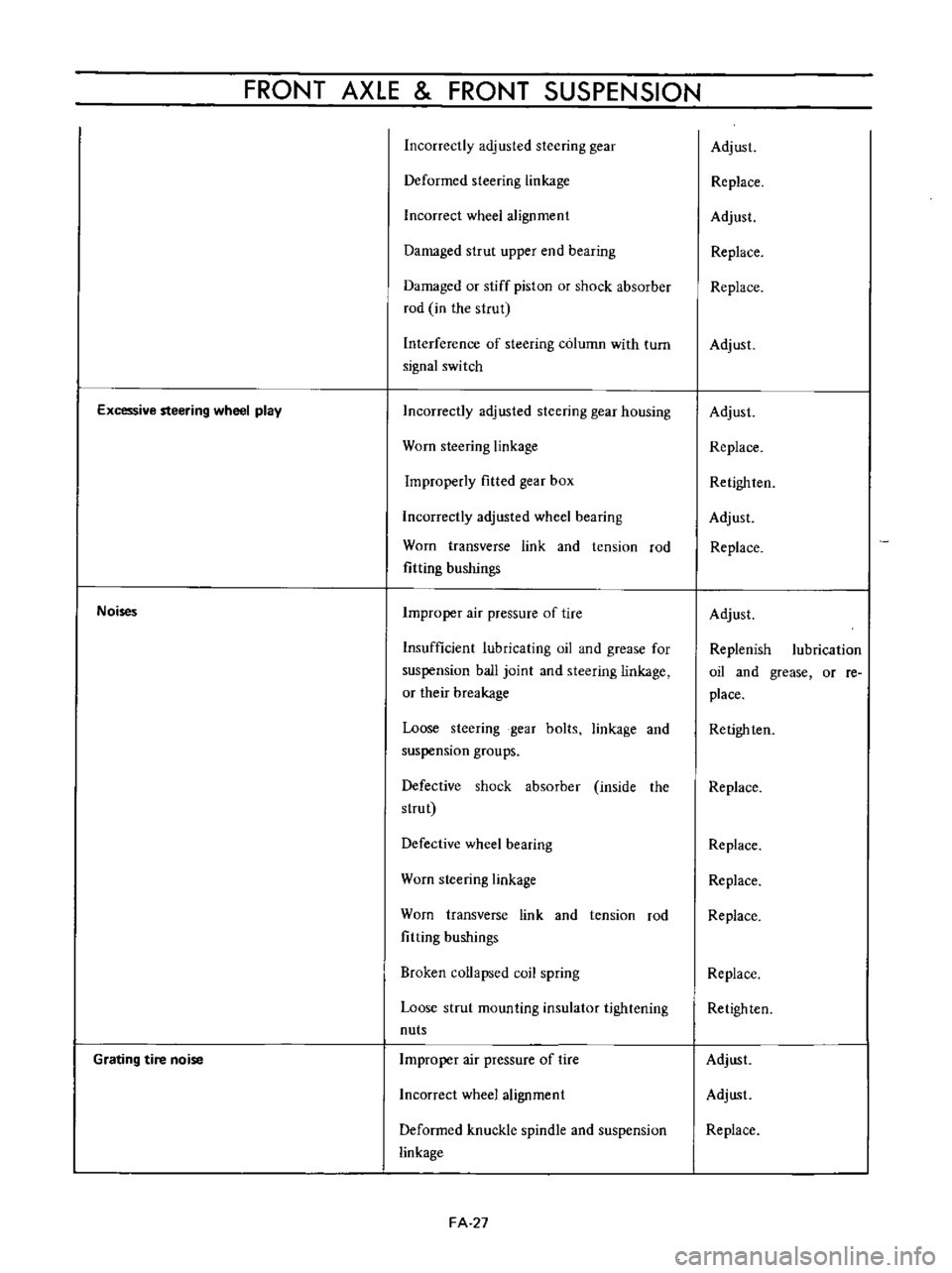
FRONT
AXLE
FRONT
SUSPENSION
Incorrectly
adjusted
steering
gear
Deformed
steering
linkage
Incorrect
wheel
alignment
Damaged
strut
upper
end
bearing
Damaged
or
stiff
piston
or
shock
absorber
rod
in
the
strut
Interference
of
steering
column
with
turn
signal
switch
Excessive
steering
wheel
play
Noises
Grating
tire
noise
Incorrectly
adjusted
steering
gear
housing
Worn
steering
linkage
Improperly
fitted
gear
box
Incorrectly
adjusted
wheel
bearing
Worn
transverse
link
and
tension
rod
fitting
bushings
Improper
air
pressure
of
tire
Insufficient
lubricating
oil
and
grease
for
suspension
ball
joint
and
steering
linkage
or
their
breakage
Loose
steering
gear
bolts
linkage
and
suspension
groups
Defective
shock
absorber
inside
the
strut
Defective
wheel
bearing
Worn
steering
linkage
Worn
transverse
link
and
tension
rod
fitting
bushings
Broken
collapsed
coil
spring
Loose
strut
mounting
insulator
tightening
nuts
Improper
air
pressure
of
tire
Incorrect
wheel
alignment
Deformed
knuckle
spindle
and
suspension
linkage
FA
27
Adjust
Replace
Adjust
Replace
Replace
Adjust
Adjust
Replace
Retighlen
Adjust
Replace
Adjust
Replenish
lubrication
oil
and
grease
or
re
place
Retighten
Replace
Replace
Replace
Replace
Replace
Retighten
Adjust
Adjust
Replace
Page 114 of 513
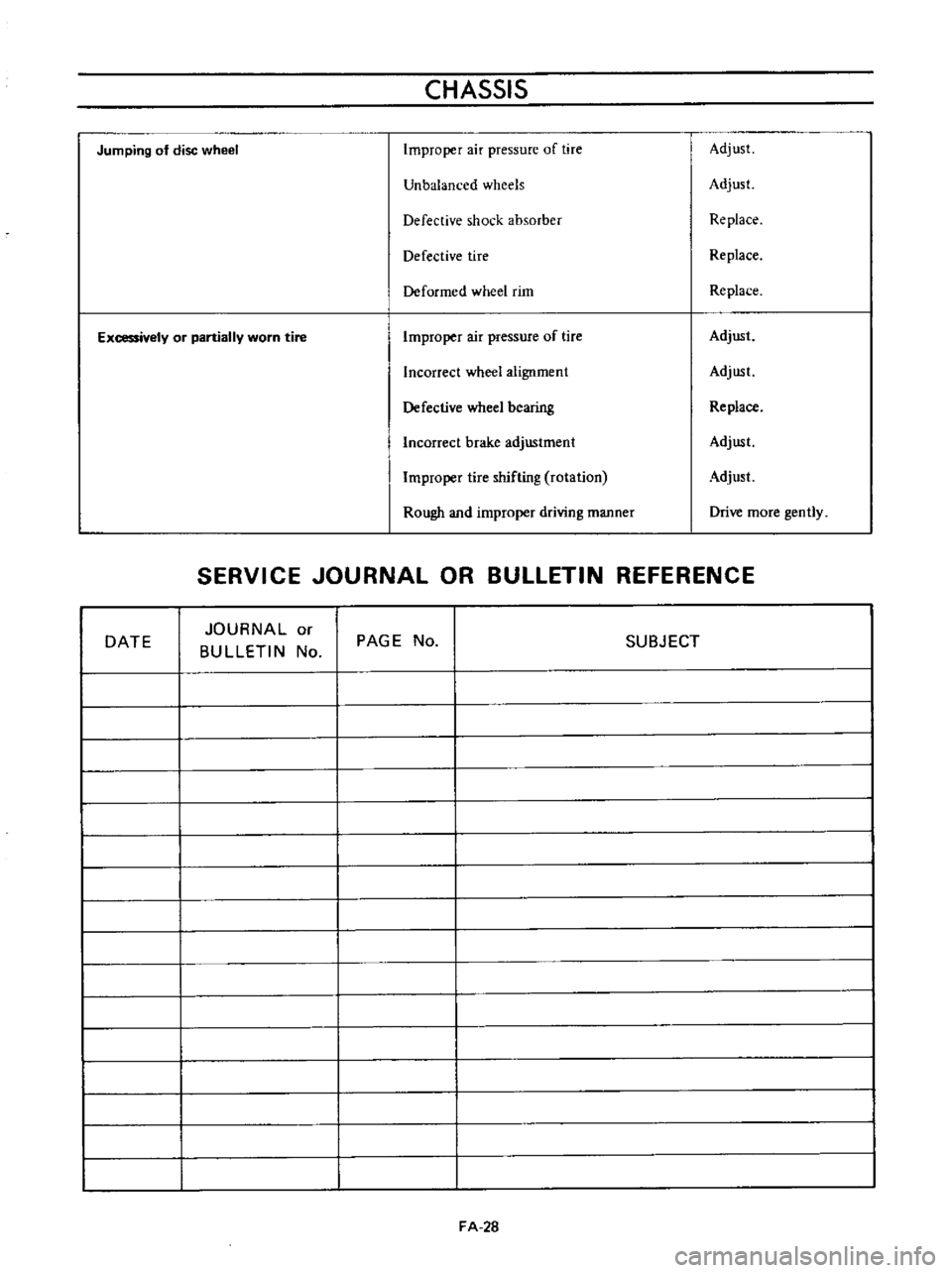
CHASSIS
Jumping
of
disc
wheel
Improper
air
pressure
of
tire
Adjust
Unbalanced
wheels
Adjust
Defective
shock
absorber
Replace
Defective
tire
Replace
Deformed
wheel
rim
Replace
Excessively
or
partially
worn
tire
Improper
air
pressure
of
tire
Adjust
Incorrect
wheel
alignment
Adjust
Defective
wheel
bearing
Replace
Incorrect
brake
adjustment
Adjust
Improper
tire
shifting
rotation
Adjust
Rough
and
improper
driving
manner
Drive
more
gently
SERVICE
JOURNAL
OR
BULLETIN
REFERENCE
DATE
JOURNAL
or
BULLETIN
No
PAGE
No
SUBJECT
FA
28