air condition DATSUN PICK-UP 1977 Workshop Manual
[x] Cancel search | Manufacturer: DATSUN, Model Year: 1977, Model line: PICK-UP, Model: DATSUN PICK-UP 1977Pages: 537, PDF Size: 35.48 MB
Page 186 of 537

Engine
Electrical
System
ALTERNATOR
TEST
Before
conducting
an
alternator
test
make
sure
th
tthe
battery
is
fully
charged
A
30
V
olt
voltmeter
and
suitable
test
probes
3re
necessary
for
the
test
Set
up
a
test
circuit
as
shown
in
Figure
EE45
and
test
auernator
in
the
manner
indica
ted
in
the
flow
chart
below
1
Disconnect
connectors
at
alternator
2
Connect
A
terminal
to
F
terminal
3
Connect
one
test
probe
from
voltmeter
positive
terminal
to
A
terminal
Connect
the
other
test
probe
to
ground
Make
sure
that
voltmeter
registers
battery
voltage
4
Turn
on
headlights
and
switch
to
High
Beam
5
Start
engine
6
Increase
engine
speed
gradually
until
it
is
approximately
1
100
rpm
and
take
the
voltmeter
reading
Measured
value
Below
12
5
Volts
Alternator
is
in
trouble
remove
and
check
it
for
condition
Measured
value
Over
12
5
Volts
Alternator
is
in
good
condition
Notes
a
Do
Dot
run
engine
at
the
speed
of
more
than
1
100
rpm
while
test
is
being
conducted
on
alternator
b
Do
not
race
engine
i
9
l
IV
I
Battery
EE052
Voltmeter
Fig
EE
45
Testing
alternator
SERVICE
DATA
AND
SPECIFICATIONS
Nominal
rating
V
A
LT138
IB
LTl35
36B
For
air
conditioner
1235
12
38
Negative
Negative
1
000
1
000
28
2
500
30
2
500
35
5
000
38
5
000
2
25
2
25
More
than
7
5
0
295
More
than
7
5
0
295
255
to
345
255
to
345
9
0
to
12
2
9
0
to
12
2
More
than
30
1
181
More
than
30
1
181
EE
19
Type
Ground
polarity
Minimum
revolution
when
generating
14V
with
no
load
rpm
Hot
output
current
Nrpm
Pulley
ratio
Brush
Length
Spring
pressure
mm
in
gr
oz
Slip
ring
outer
diameter
mm
in
Page 188 of 537
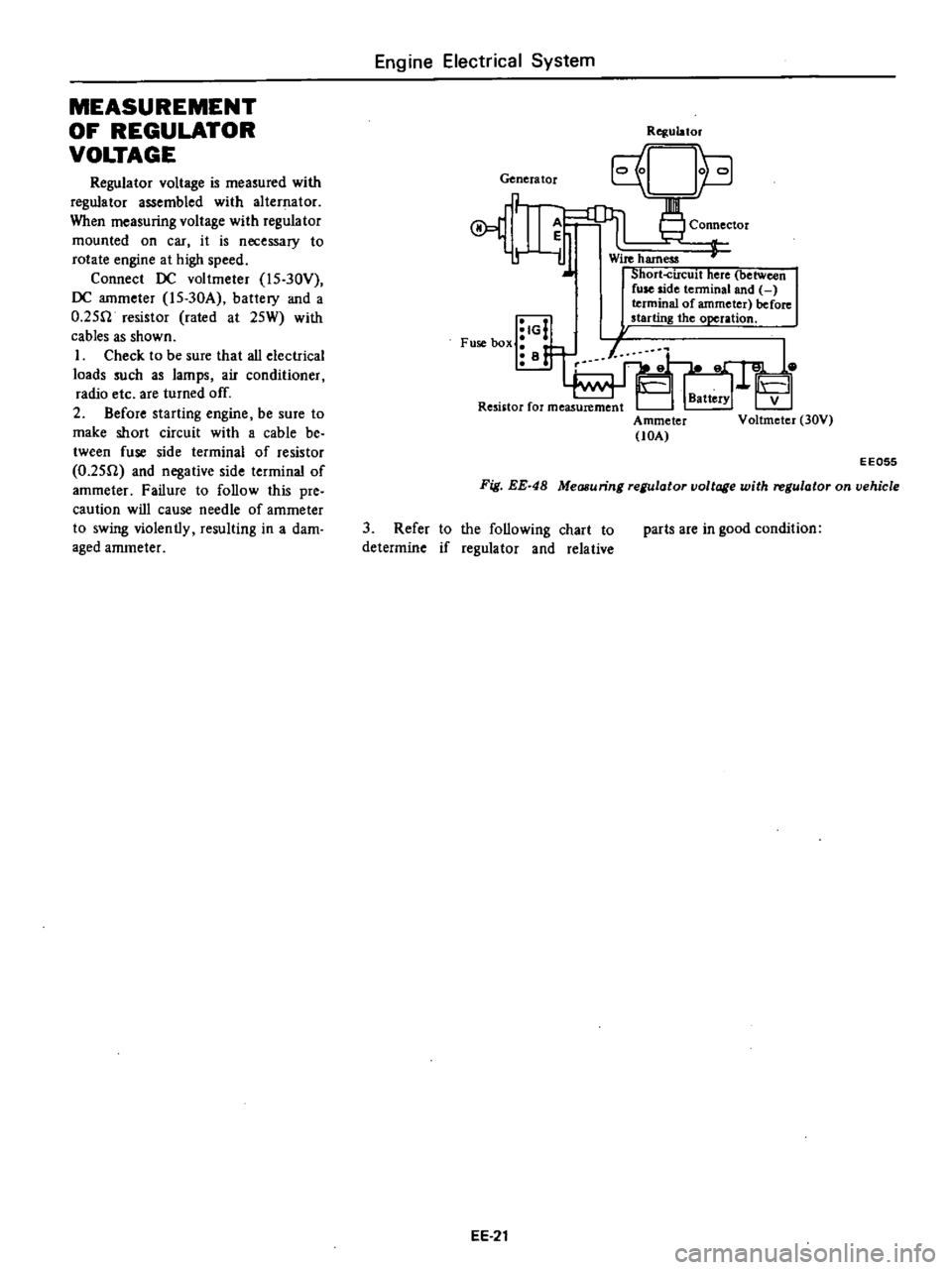
MEASUREMENT
OF
REGULATOR
VOLTAGE
Regulator
voltage
is
measured
with
regulator
assembled
with
alternator
When
measuring
voltage
with
regulator
mounted
on
car
it
is
necessary
to
rotate
engine
at
high
speed
Connect
DC
voltmeter
l5
30Y
DC
ammeter
l5
30A
battery
and
a
O
25fl
resistor
rated
at
25W
with
cables
as
shown
I
Check
to
be
sure
that
all
electrical
loads
such
as
lamps
air
conditioner
radio
etc
are
turned
off
2
Before
starting
engine
be
sure
to
make
short
circuit
with
a
cable
be
tween
fuse
side
terminal
of
resistor
O
25fl
and
negative
side
terminal
of
ammeter
Failure
to
follow
this
pre
caution
will
cause
needle
of
ammeter
to
swing
violently
resulting
in
a
dam
aged
ammeter
Engine
Electrical
System
Genera
tor
A
r
iJ
IG
Fuse
box
i
B
Rqulator
Connector
Wire
harness
Short
circuit
here
between
fuse
side
tenninal
and
terminal
of
ammeter
before
starting
the
operation
Ammeter
lOA
V
Voltmeter
30V
EE055
Fig
EE
48
Measuring
regulator
voltage
with
regulator
on
vehicle
3
Refer
to
the
following
chart
to
determine
if
regulator
and
relative
EE
21
parts
are
in
good
condition
Page 192 of 537

Engine
Electrical
System
TROUBLE
DIAGNOSES
AND
CORRECTIONS
Including
alternator
Condition
Probable
cause
No
output
Sticking
brushes
Dirty
brushes
and
slip
rings
Loose
connections
or
broken
leads
Open
sta
tor
winding
Open
rotor
winding
Open
diodes
Shorted
rotor
Shorted
stator
Grounded
A
terminal
Broken
fan
belt
Excessive
output
Broken
neutral
wire
COIOf
of
wire
is
yellow
Voltage
fegulator
breakdown
Poor
grounding
of
alternator
and
voltage
regulator
En
terminal
Broken
ground
wire
color
of
wire
is
black
Low
output
Loose
or
worn
fan
belt
Sticking
brushes
Low
brush
spring
tension
Voltage
regulator
breakdown
Dirty
slip
rings
Partial
short
ground
or
open
in
stator
winding
Partially
shorted
or
grounded
rotor
winding
Open
or
damaged
diode
Noisy
alternator
Loose
mounting
Loose
drive
pulley
Broken
ball
bearing
Improperly
seated
brushes
EE
25
Corrective
action
Correct
or
replace
brushes
and
brush
springs
Clean
Retighten
or
soldef
connections
Replace
leads
if
necessary
Repair
Of
replace
stator
Replace
rotor
Replace
Replace
rotor
Repair
or
replace
Replace
insulator
Replace
Replace
Check
regulator
operation
and
repair
or
replace
as
required
Retighten
terminal
connection
Replace
Retighten
or
replace
Correct
or
replace
brushes
and
springs
if
necessary
Replace
brush
springs
Check
regulator
OpefatiOn
and
repair
or
replace
as
required
Clean
Replace
stator
Replace
rotor
Replace
diode
Retighten
bolts
Retighten
Replace
Seat
correctly
Page 195 of 537
Primary
winding
1
Ignition
coo
I
Secondary
winding
CALIFORNIA
MODELS
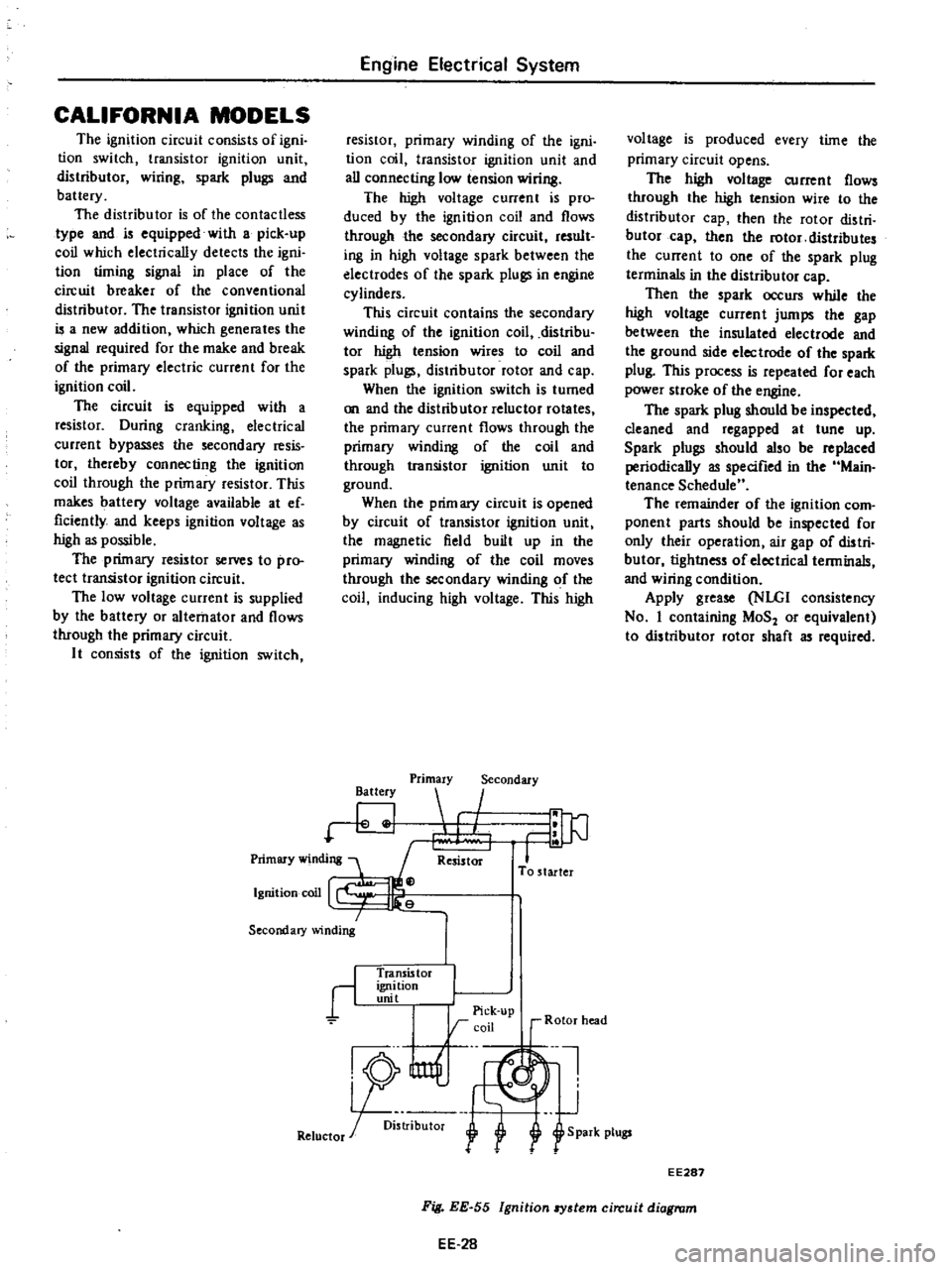
The
ignition
circuit
consists
of
igni
tion
switch
transistor
ignition
unit
distributor
wiring
spark
plugs
and
battery
The
distributor
is
of
the
contactless
type
and
is
equipped
with
a
pick
up
coil
which
electrically
detects
the
igni
tion
timing
signal
in
place
of
the
circuit
breaker
of
the
conventional
distributor
The
transistor
ignition
unit
is
a
new
addition
which
generates
the
signal
required
for
the
make
and
break
of
the
primary
electric
current
for
the
ignition
coil
The
circuit
is
equipped
with
a
resistor
During
cranking
electrical
current
bypasses
the
secondary
resis
tor
thereby
connecting
the
ignition
coil
through
the
primary
resistor
This
makes
battery
voltage
available
at
ef
ficiently
and
keeps
ignition
voltage
as
high
as
possible
The
primary
resistor
selVeS
to
pro
tect
transistor
ignition
circuit
The
low
voltage
current
is
supplied
by
the
battery
or
alternator
and
flows
through
the
primary
circuit
It
consists
of
the
ignition
switch
Engine
Electrical
System
resistor
primary
winding
of
the
igni
tion
coil
transistor
ignition
unit
and
all
connecting
low
tension
wiring
The
high
voltage
current
is
pro
duced
by
the
ignition
coil
and
flows
through
the
secondary
circuit
result
ing
in
high
voltage
spark
between
the
electrodes
of
the
spark
plugs
in
engine
cylinders
This
circuit
contains
the
secondary
winding
of
the
ignition
coil
distribu
tor
high
tension
wires
to
coil
and
spark
plugs
distributor
rotor
and
cap
When
the
ignition
switch
is
turned
on
and
the
distributor
reluctor
rotates
the
primary
current
flows
through
the
primary
winding
of
the
coil
and
through
transistor
ignition
unit
to
ground
When
the
prim
ary
circuit
is
opened
by
circuit
of
transistor
ignition
unit
the
magnetic
field
built
up
in
the
primary
winding
of
the
coil
moves
through
the
secondary
winding
of
the
coil
inducing
high
voltage
This
high
Battery
Primary
Secondary
I
Resistor
To
starter
r
Transis
tor
ignition
unit
I
I
Pick
up
rcoil
r
Rotor
head
nl
J
R5
U1f
1
Retuctor
r
oi
l
f
S
park
plugs
voltage
is
produced
every
time
the
primary
circuit
opens
The
high
voltage
current
flows
through
the
high
tension
wire
to
the
distributor
cap
then
the
rotor
distri
butor
cap
then
the
rotor
distributes
the
current
to
one
of
the
spark
plug
terminals
in
the
distributor
cap
Then
the
spark
occurs
while
the
high
voltage
current
jumps
the
gap
between
the
insulated
electrode
and
the
ground
side
electrode
of
the
spark
plug
This
process
is
repeated
for
each
power
stroke
of
the
engine
The
spark
plug
should
be
inspected
cleaned
and
regapped
at
tune
up
Spark
plugs
should
also
be
replaced
periodically
as
specified
in
the
Main
tenance
Schedule
The
remainder
of
the
ignition
com
ponent
parts
should
be
inspected
for
only
their
operation
air
gap
of
distri
butor
tightness
of
electrical
terminals
and
wiring
condition
Apply
grease
NLGI
consistency
No
I
containing
MoS
or
equivalent
to
distributor
rotor
shaft
as
required
EE287
EE
28
Fig
EE
55
Ignition
8Y3tem
circuit
diagram
Page 198 of 537
CHECKING
AND
ADJUSTMENT
CAP
AND
ROTOR
HEAD
Cap
and
rotor
head
should
be
in
spected
periodically
as
specified
in
the
Maintenance
Schedule
Remove
cap
and
clean
all
dust
and
carbon
deposits
from
cap
and
rotor
If
cap
is
cracked
or
is
leaking
replace
with
a
De
one
CONTACT
POINT
Contact
point
should
be
replaced
in
accordance
with
the
Maintenance
Schedule
Standard
point
gap
is
0
45
to
0
55
mm
O
OIS
to
0
022
in
In
case
size
is
off
the
standard
adjustment
is
made
by
loosening
point
screws
Gap
gauge
is
required
for
adjustment
When
point
surface
is
rough
take
off
any
irregularities
with
fine
sand
paper
of
No
500
or
600
or
with
oil
stone
When
wear
on
contact
points
is
noticeable
replace
points
together
with
contact
arm
To
replace
proceed
as
follows
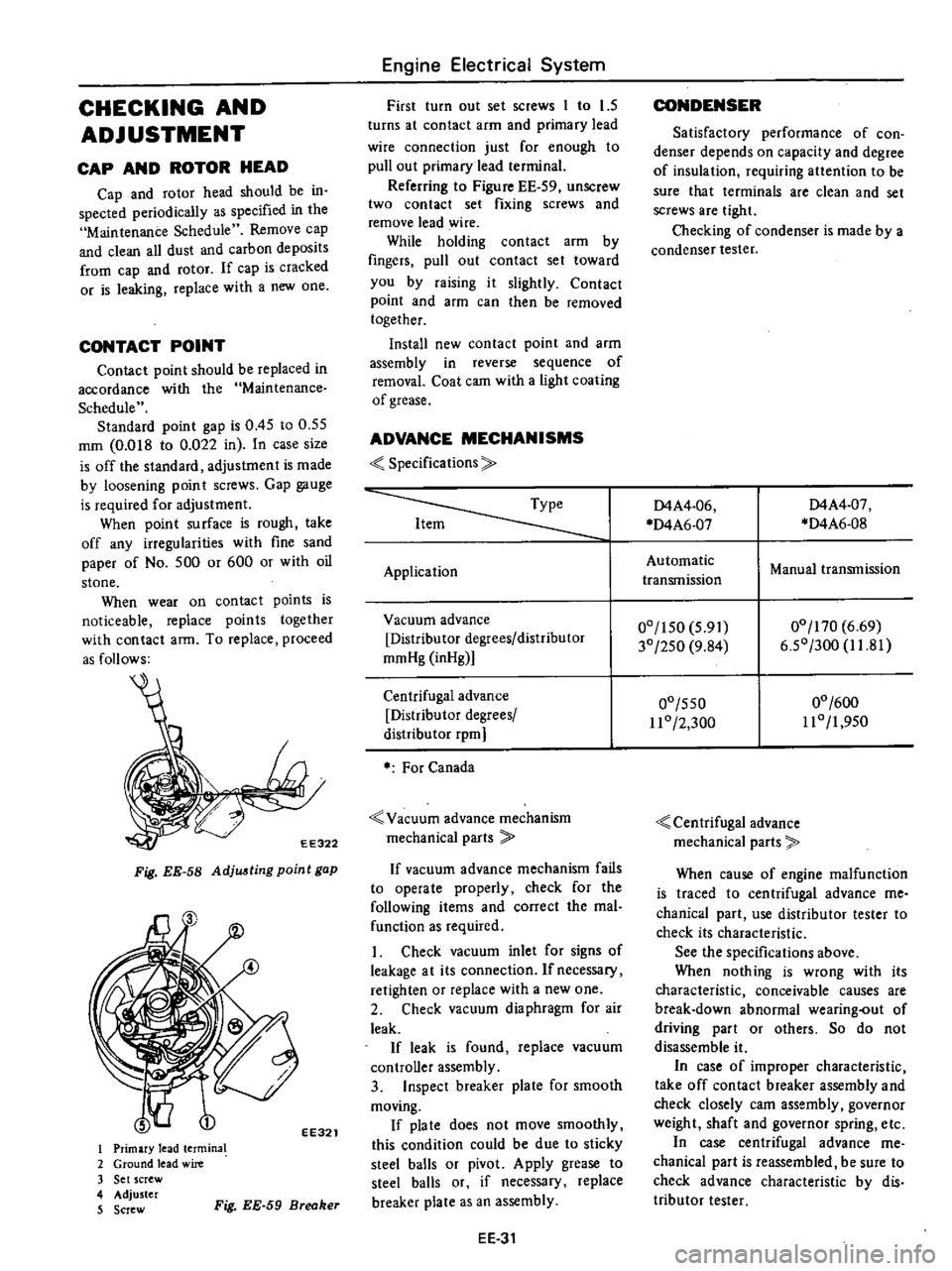
EE322
Fig
EE
58
Adju
ting
point
gap
EE321
I
Primary
lead
termina
2
Ground
lead
wire
3
Set
screw
4
Adjuster
5
Screw
Fig
EE
59
Breaker
Engine
Electrical
System
First
turn
out
set
screws
1
to
1
5
turns
at
contact
arm
and
primary
lead
wire
connection
just
for
enough
to
pull
out
primary
lead
terminal
Referring
to
Figure
EE
59
unSCrew
two
contact
set
fixing
screws
and
remove
lead
wire
While
holding
contact
arm
by
fingers
pull
out
contact
set
toward
you
by
raising
it
slightly
Contact
point
and
afm
can
then
be
removed
together
Install
new
contact
point
and
arm
assembly
in
reverse
sequence
of
removal
Coat
cam
with
a
light
coating
of
grease
ADVANCE
MECHANISMS
Specifications
Application
Vacuum
advance
Distributor
degrees
distributor
mmHg
inHg
Centrifugal
advance
Distributor
degrees
distribu
tor
rpm
For
Canada
Vacuum
advance
mechanism
mechanical
parts
If
vacuum
advance
mechanism
fails
to
operate
properly
check
for
the
following
items
and
correct
the
mal
function
as
required
1
Check
vacuum
inlet
for
signs
of
leakage
at
its
connection
Ifnecessacy
retighten
or
replace
with
a
new
one
2
Check
vacuum
diaphragm
for
air
leak
If
leak
is
found
replace
vacuum
controller
assembly
3
Inspect
breaker
plate
for
smooth
moving
If
pia
te
does
not
move
smoothly
this
condition
could
be
due
to
sticky
steel
balls
or
pivot
Apply
grease
to
steel
balls
or
if
necessary
replace
breaker
plate
as
an
assembly
EE
31
CONDENSER
Satisfactory
performance
of
con
denser
depends
on
capacity
and
degree
of
insulation
requiring
attention
to
be
sure
that
terminals
are
clean
and
set
screws
are
tight
Checking
of
condenser
is
made
by
a
condenser
tester
D4A4
06
D4A6
07
D4A4
07
D4A6
0S
Automatic
transmission
Manual
transmission
00
150
5
91
30
250
9
S4
00
170
6
69
6
50
300
1I
S1
00
550
11
0
2
300
00
600
110
1
950
Centrifugal
advance
mechanical
parts
When
cause
of
engine
malfunction
is
traced
to
centrifugal
advance
me
chanical
part
use
distributor
tester
to
check
its
characteristic
See
the
specifications
above
When
nothing
is
wrong
with
its
characteristic
conceivable
causes
are
break
down
abnormal
wearing
out
of
driving
part
or
others
So
do
not
disassemble
it
In
case
of
improper
characteristic
take
off
contact
breaker
assembly
and
check
closely
cam
assembly
governor
weight
shaft
and
governor
spring
etc
In
case
centrifugal
advance
me
chanical
part
is
reassembled
be
sure
to
check
advance
characteristic
by
dis
tributor
tester
Page 202 of 537
Vacuum
advance
mechanism
mechanical
parts
If
vacuum
advance
mechanism
fails
to
operate
properly
check
for
the
following
items
and
correct
the
prob
lem
as
required
1
Check
vacuum
inlet
for
signs
of
leakage
at
its
connection
If
necessary
retighten
or
replace
with
a
new
one
2
Check
vacuum
diaphragm
for
air
leak
If
leak
is
found
replace
vacuum
controller
assembly
3
Inspect
breaker
plate
for
smooth
moving
If
plate
does
not
move
smoothly
this
condition
could
be
due
to
sticky
steel
balls
or
pivot
Apply
grease
to
steel
balls
or
if
necessary
replace
distributor
assembly
Centrifugal
advance
mechanical
parts
When
cause
of
engine
malfunction
is
traced
to
centrifugal
advance
mecha
nical
parts
use
distributor
tester
to
check
its
characteristics
See
to
the
specifications
above
If
nothing
is
wrong
with
its
charac
teristics
conceivable
causes
are
faulty
or
abnormal
wear
of
driving
part
or
others
So
do
not
disassemble
it
In
the
event
of
improper
character
istics
check
closely
rotor
shaft
assem
bly
governor
weight
and
shaft
If
any
of
above
parts
are
malfunc
tioning
replace
distributor
assembly
DISASSEMBLY
To
disassemble
follow
the
pro
cedure
below
1
Take
off
cap
and
remove
rotor
head
2
Remove
two
screws
shown
in
Figure
EE
69
and
detach
vacuum
con
troller
Engine
Electrical
System
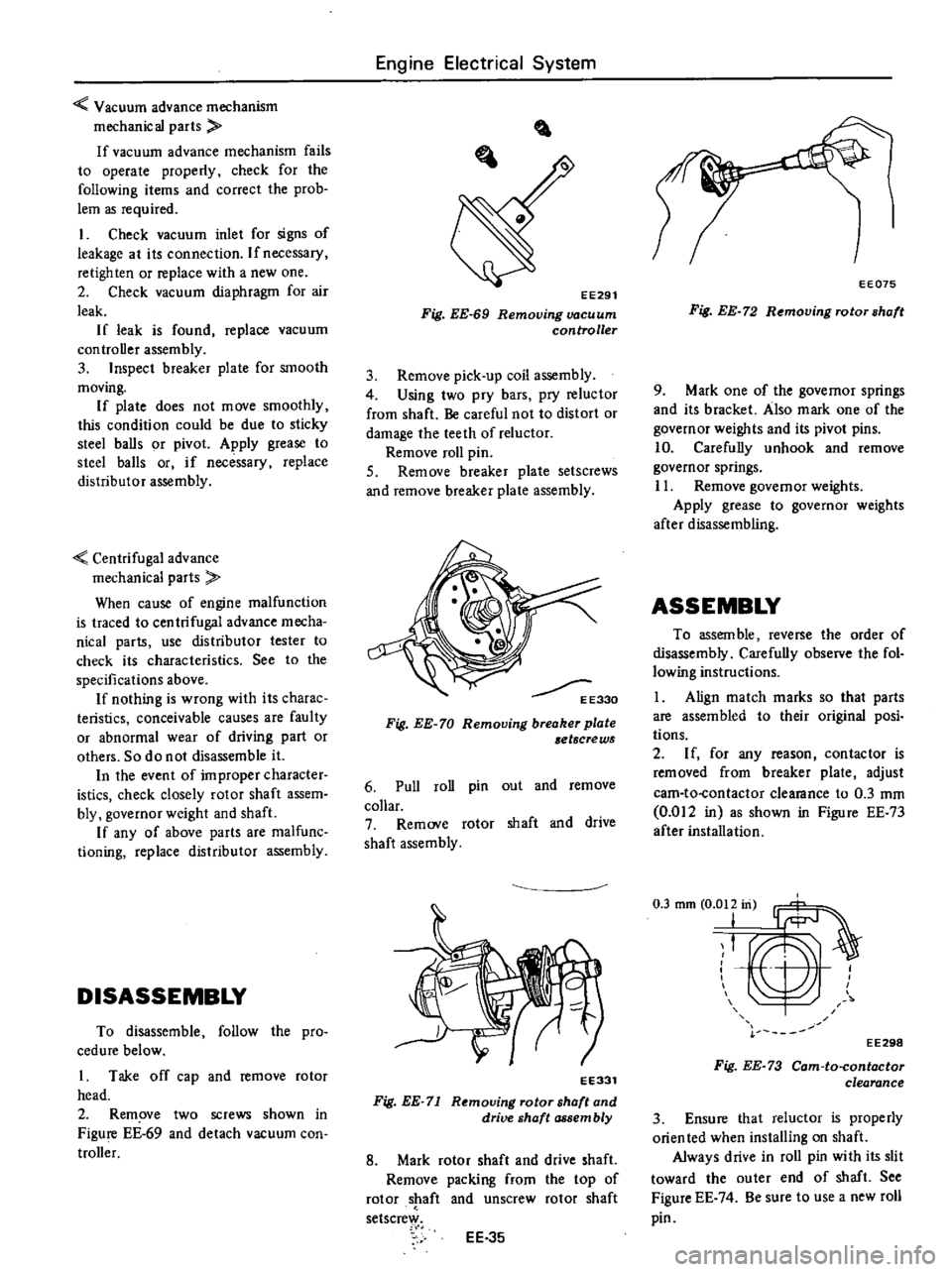
EE291
Fig
EE
69
Removing
vacuum
controller
3
Remove
pick
up
coil
assembly
4
Using
two
pry
bars
pry
reluctor
from
shaft
Be
careful
not
to
distort
or
damage
the
teeth
of
reluctor
Remove
roll
pin
S
Remove
breaker
plate
setscrews
and
remove
breaker
plate
assembly
E330
Fig
EE
70
Removing
breaker
plate
etscrews
6
Pull
roll
pin
out
and
remove
collar
7
Remove
rotor
shaft
and
drive
shaft
assembly
EE331
Fig
EE
71
Removing
rotor
shaft
and
drive
shaft
assembly
8
Mark
rotor
shaft
and
drive
shaft
Remove
packing
from
the
top
of
rotor
shaft
and
unscrew
rotor
shaft
setscrew
EE
35
EE075
Fig
EE
72
Removing
rotor
shaft
9
Mark
one
of
the
governor
springs
and
its
bracket
Also
mark
one
of
the
governor
weights
and
its
pivot
pins
10
Carefully
unhook
and
remove
governor
springs
11
Remove
governor
weights
Apply
grease
to
governor
weights
after
disassembling
ASSEMBLY
To
assem
ble
reverse
the
order
of
disassembly
Carefully
observe
the
fol
lowing
instructions
1
Align
match
marks
so
that
parts
are
assembled
to
their
original
posi
tions
2
If
for
any
reason
contactor
is
removed
from
breaker
plate
adjust
cam
to
contactor
clearance
to
0
3
mm
0
012
in
as
shown
in
Figure
EE
73
after
installation
T
EE298
Fig
EE
73
Cam
to
contactor
clearance
3
Ensure
that
reluctor
is
properly
orien
ted
when
installing
on
shaft
Always
drive
in
roll
pin
with
its
slit
toward
the
outer
end
of
shaft
See
Figure
EE
74
Be
sure
to
use
a
new
roll
pin
Page 214 of 537
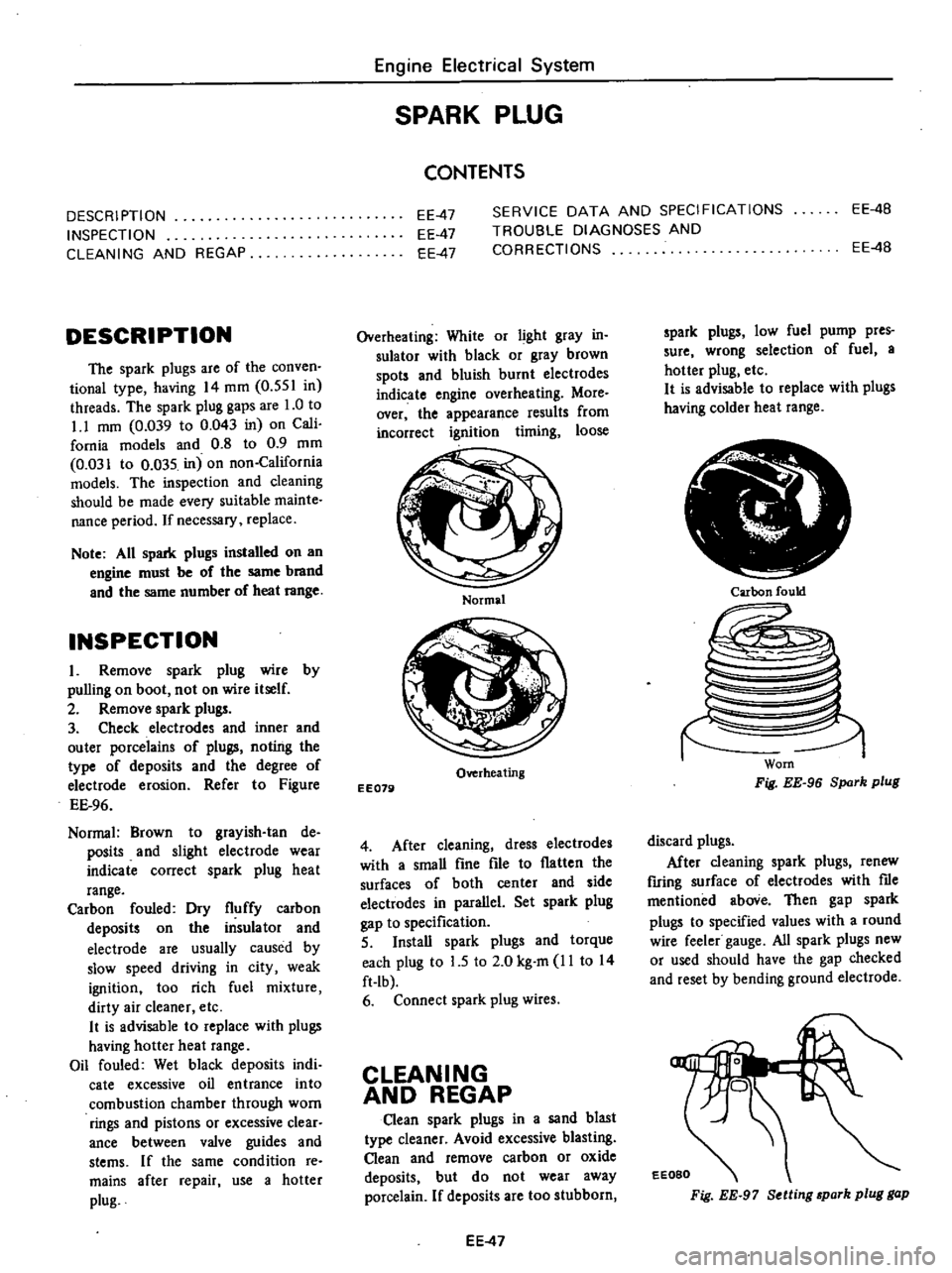
DESCRIPTION
INSPECTION
CLEANING
AND
REGAP
DESCRIPTION
The
spark
plugs
are
of
the
conven
tional
type
having
14
mm
0
551
in
threads
The
spark
plug
gaps
are
1
0
to
1
1
mm
0
039
to
0
043
in
on
Cali
fomia
models
and
0
8
to
0
9
mm
0
031
to
0
035
in
on
non
California
models
The
inspection
and
cleaning
should
be
made
every
suitable
mainte
nance
period
If
necessary
replace
Note
All
spark
plugs
installed
on
an
engine
must
be
of
the
same
brand
and
the
same
number
of
heat
range
INSPECTION
L
Remove
spark
plug
wire
by
pulling
on
boot
not
on
wire
itself
2
Remove
spark
plugs
3
Check
electrodes
and
inner
and
outer
porcelains
of
plugs
noting
the
type
of
deposits
and
the
degree
of
electrode
erosion
Refer
to
Figure
EE
96
Normal
Brown
to
grayish
tan
de
posits
and
slight
electrode
wear
indicate
correct
spark
plug
heat
range
Carbon
fouled
Dry
fluffy
carbon
deposits
on
the
insulator
and
electrode
are
usually
caused
by
slow
speed
driving
in
city
weak
ignition
too
rich
fuel
mixture
dirty
air
cleaner
etc
It
is
advisable
to
replace
with
plugs
having
hotter
heat
range
Oil
fouled
Wet
black
deposits
indi
cate
excessive
oil
entrance
into
combustion
chamber
through
worn
rings
and
pistons
or
excessive
clear
ance
between
valve
guides
and
stems
If
the
same
condition
re
mains
after
repair
use
a
hotter
plug
Engine
Electrical
System
SPARK
PLUG
CONTENTS
EE
4B
EE
47
EE
47
EE
47
SERVICE
DATA
AND
SPECIFICATIONS
TROUBLE
DIAGNOSES
AND
CORRECTIONS
EE
4B
Overheating
White
or
light
gray
in
sulator
with
black
or
gray
brown
spots
and
bluish
burnt
electrodes
indicate
engine
overheating
More
over
the
appearance
results
from
incorrect
ignition
timing
loose
Normal
Overheating
EE079
4
After
cleaning
dress
electrodes
with
a
smaU
fine
file
to
flatten
the
surfaces
of
both
center
and
side
electwdes
in
parallel
Set
spark
plug
gap
to
specification
5
InstaU
spark
plugs
and
torque
each
plug
to
L5
to
2
0
kg
m
11
to
14
ft
Ib
6
Connect
spark
plug
wires
CLEANING
AND
REGAP
Clean
spark
plugs
in
a
sand
blast
type
cleaner
Avoid
excessive
blasting
Clean
and
remove
carbon
or
oxide
deposits
but
do
not
wear
away
porcelain
If
deposits
are
too
stubborn
EE
47
spark
plugs
low
fuel
pump
pres
sure
wrong
selection
of
fuel
a
hotter
plug
etc
It
is
advisable
to
replace
with
plugs
having
colder
heat
range
Ir
i
Carbon
fould
Worn
Fig
EE
96
Spark
plug
discard
plugs
After
cleaning
spark
plugs
renew
firing
surface
of
electrodes
with
me
mentioned
aboVe
Then
gap
spark
plugs
to
specified
values
with
a
round
wire
feeler
gauge
All
spark
plugs
new
or
used
should
have
the
gap
checked
and
reset
by
bending
ground
electrode
EEOBO
Fig
EE
97
Setting
park
plug
gap
Page 215 of 537
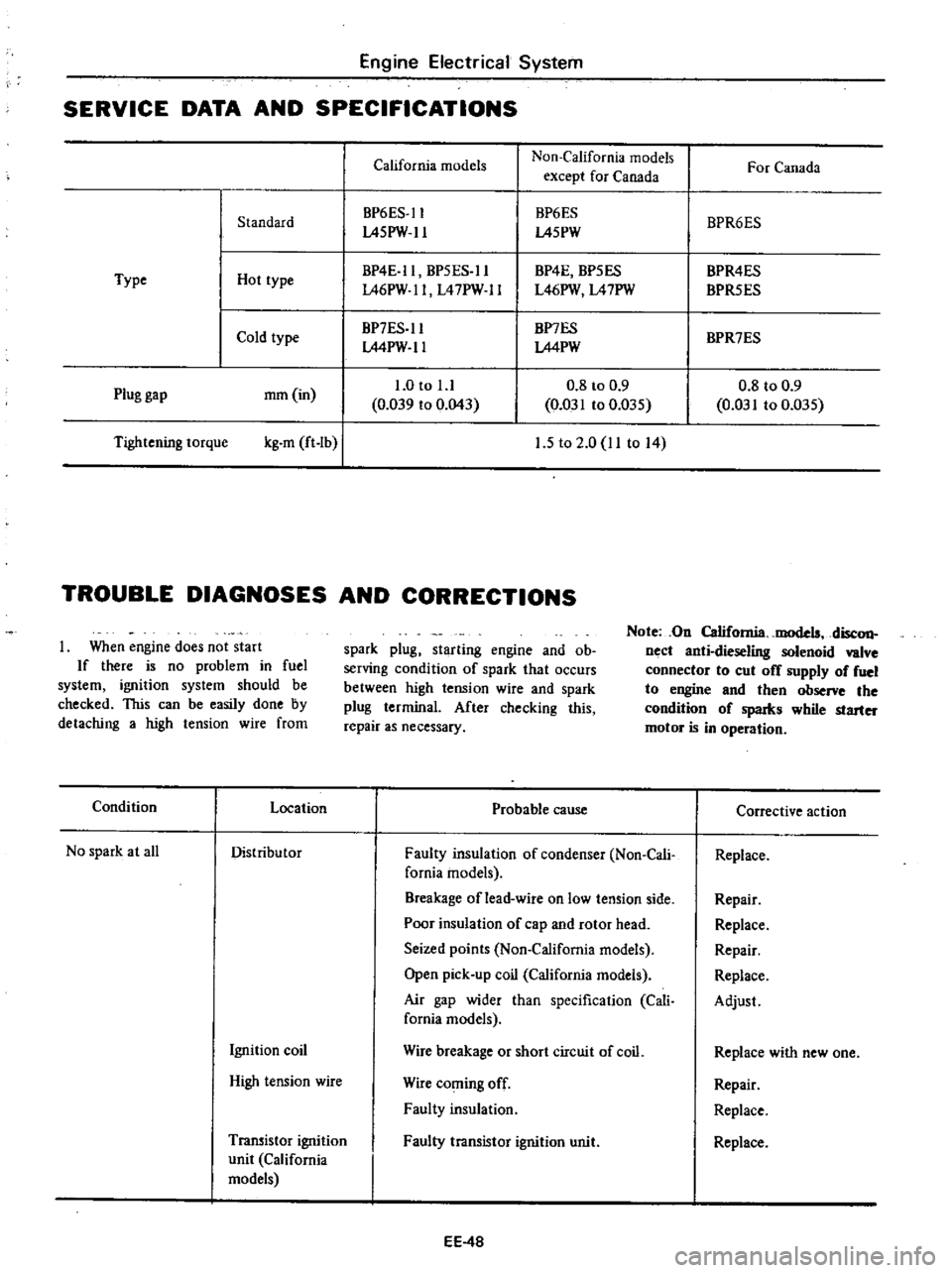
Engine
Electrical
System
SERVICE
DATA
AND
SPECIFICATIONS
California
models
Non
California
models
For
Canada
except
for
Canada
BP6ES
ll
BP6ES
BPR6ES
Standard
L45PW
ll
L45PW
BP4E
ll
BP5ES
ll
BP4E
BP5ES
BPR4ES
Type
Hot
type
L46PW
ll
L47PW
ll
L46PW
L47PW
BPR5ES
Cold
type
BP7ES
ll
BP7ES
BPR7ES
LMPW
ll
LMPW
1
0
to
l
l
0
8
to
0
9
0
8
to
0
9
Plug
gap
mm
in
0
039
to
0
043
0
031
to
0
D35
0
031
to
0
035
Tightening
torque
kg
m
ft
Ib
I
1
5
to
2
0
11
to
14
TROUBLE
DIAGNOSES
AND
CORRECTIONS
When
engine
does
not
start
If
there
is
no
problem
in
fuel
system
ignition
system
should
be
checked
This
can
be
easily
done
by
detaching
a
high
tension
wire
from
spark
plug
starting
engine
and
ob
serving
condition
of
spark
that
occurs
between
high
tension
wire
and
spark
plug
terminal
After
checking
this
repair
as
necessary
Note
On
California
models
disc
on
nect
anti
dieseling
solenoid
valve
connector
to
cut
off
supply
of
fuel
to
engine
and
then
observe
the
condition
of
spaIks
while
starter
motor
is
in
operation
Condition
Location
Probable
cause
Corrective
action
No
spark
at
all
Distributor
Faulty
insulation
of
condenser
Non
Cali
Replace
fomia
models
Breakage
of
lead
wire
on
low
tension
side
Repair
Poor
insulation
of
cap
and
rotor
head
Replace
Seized
points
Non
California
models
Repair
Open
pick
up
coil
California
models
Replace
Air
gap
wider
than
specification
Cali
Adjust
fornia
models
Ignition
coil
Wire
breakage
or
short
circuit
of
coil
Replace
with
new
one
High
tension
wire
Wire
coming
off
Repair
Faulty
insulation
Replace
Transistor
ignition
Faulty
transistor
ignition
unit
Replace
unit
California
models
EE
4B
Page 216 of 537
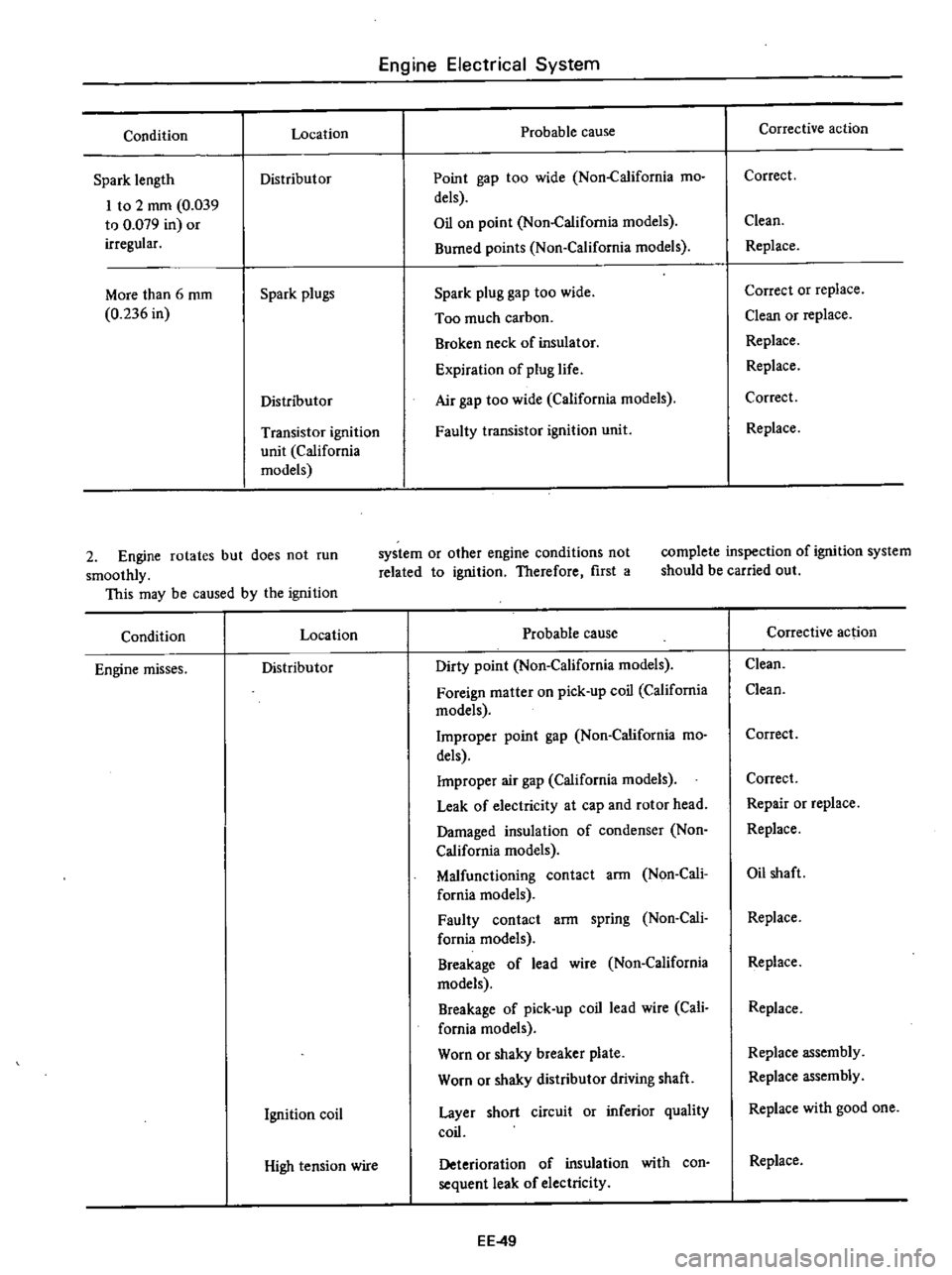
Condition
Spark
length
I
to
2
rnm
0
039
to
0
079
in
Of
irregular
More
than
6
rnm
0
236
in
Engine
Electrical
System
Location
Probable
cause
Distributor
Point
gap
too
wide
Non
California
mo
dels
Oil
on
point
Non
California
models
Burned
points
Non
California
models
Spark
plugs
Spark
plug
gap
too
wide
Too
much
carbon
Broken
neck
of
insulator
Expiration
of
plug
life
Air
gap
too
wide
California
models
Distributor
Transistor
ignition
unit
California
models
Faulty
transistor
ignition
unit
Corrective
action
Correct
Clean
Replace
Correct
or
replace
Clean
or
replace
Replace
Replace
Correct
Replace
2
Engine
rotates
but
does
not
run
smoothly
This
may
be
caused
by
the
ignition
system
or
other
engine
condi
Hons
not
related
to
ignition
Therefore
first
a
complete
inspection
of
ignition
system
should
be
carried
out
Condition
Engine
misses
Location
Probable
cause
Distributor
Dirty
point
Non
California
models
Foreign
mattef
on
pick
up
coil
California
models
Improper
point
gap
Non
California
mo
dels
Impropef
air
gap
California
models
Leak
of
electricity
at
cap
and
rotor
head
Damaged
insulation
of
condenser
Non
California
models
Malfunctioning
contact
arm
Non
Cali
fornia
models
Faulty
contact
arm
spring
Non
Cali
fornia
models
Breakage
of
lead
wire
Non
California
models
Breakage
of
pick
up
coil
lead
wire
Cali
fornia
models
Worn
or
shaky
breaker
plate
Worn
or
shaky
distributor
driving
shaft
Layer
short
circuit
or
inferior
quality
coil
Ignition
coil
High
tension
wire
Deterioration
of
insulation
with
con
sequent
leak
of
electricity
EE
49
Corrective
ac
ion
Clean
Clean
Correct
Correct
Repair
or
replace
Replace
Oil
shaft
Replace
Replace
Replace
Replace
assembly
Replace
assembly
Replace
with
good
one
Replace
Page 217 of 537
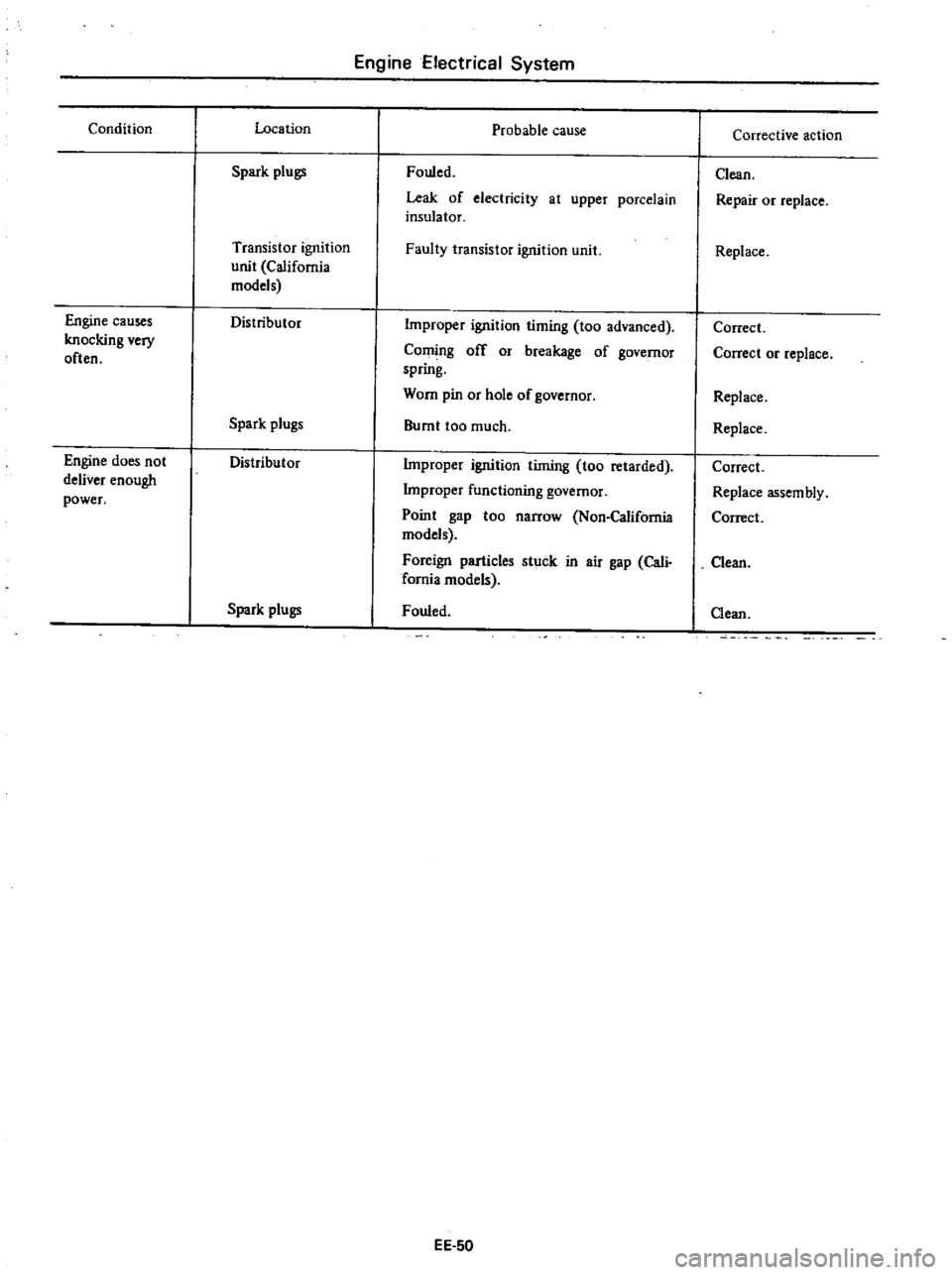
Condition
Engine
causes
knocking
very
often
Engine
does
not
deliver
enough
power
Location
Spark
plugs
Transistor
ignition
unit
California
models
Distributor
Spark
plugs
Distributor
Spark
plugs
Engine
Electrical
System
Probable
cause
Fouled
Leak
of
electricity
at
upper
porcelain
insulator
Faulty
transistor
ignition
unit
Improper
ignition
timing
too
advanced
Coming
off
or
breakage
of
governor
spring
Worn
pin
or
hole
of
governor
Burnt
too
much
Improper
ignition
timing
too
retarded
Improper
functioning
governor
Point
gap
too
narrow
Non
California
models
Foreign
particles
stuck
in
air
gap
Cali
fornia
models
Fouled
EE
50
Corrective
action
Clean
Repair
or
replace
Replace
Correct
Correct
or
replace
Replace
Replace
Correct
Replace
assembly
Correct
Oean
Oean