ABS DODGE NEON 1999 Service Repair Manual
[x] Cancel search | Manufacturer: DODGE, Model Year: 1999, Model line: NEON, Model: DODGE NEON 1999Pages: 1200, PDF Size: 35.29 MB
Page 892 of 1200
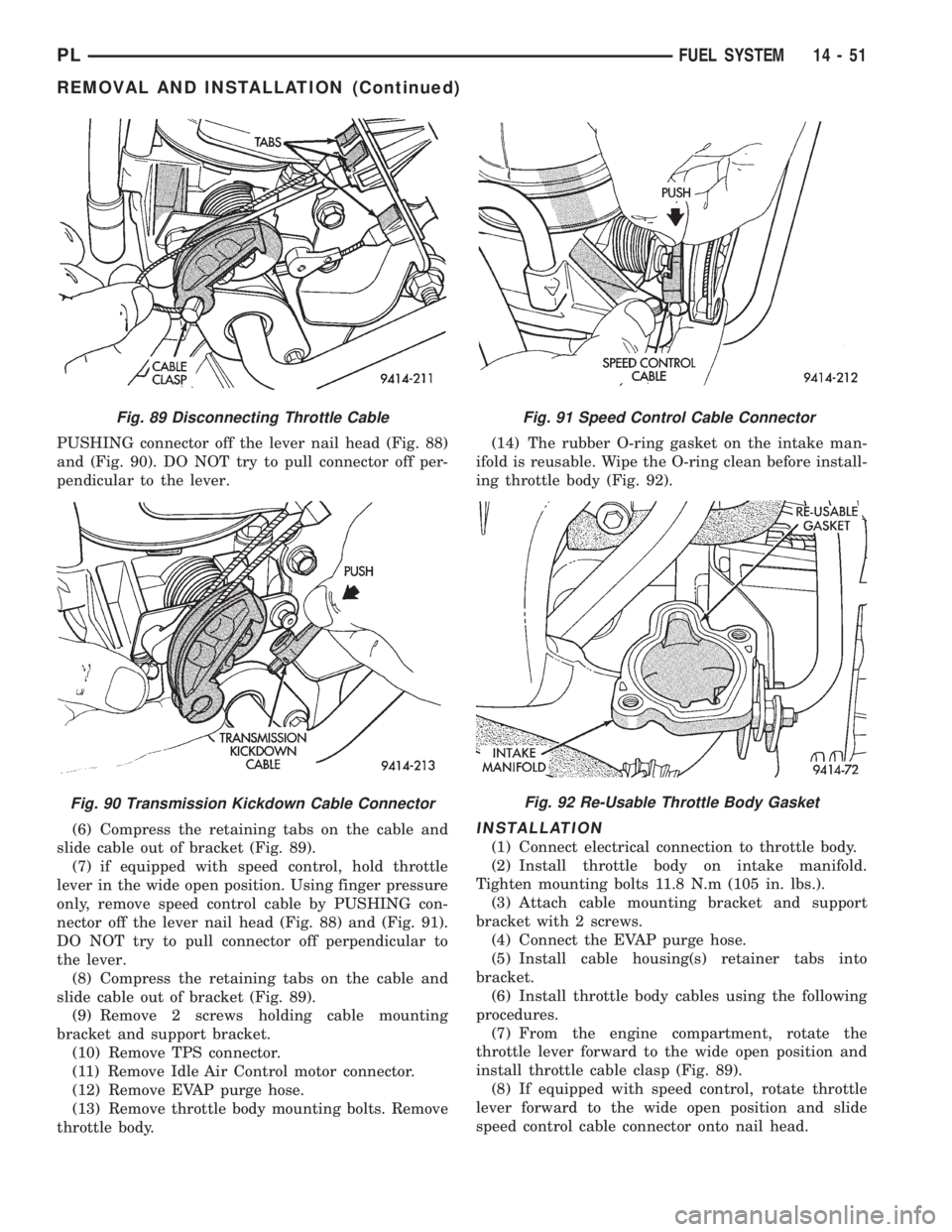
PUSHING connector off the lever nail head (Fig. 88)
and (Fig. 90). DO NOT try to pull connector off per-
pendicular to the lever.
(6) Compress the retaining tabs on the cable and
slide cable out of bracket (Fig. 89).
(7) if equipped with speed control, hold throttle
lever in the wide open position. Using finger pressure
only, remove speed control cable by PUSHING con-
nector off the lever nail head (Fig. 88) and (Fig. 91).
DO NOT try to pull connector off perpendicular to
the lever.
(8) Compress the retaining tabs on the cable and
slide cable out of bracket (Fig. 89).
(9) Remove 2 screws holding cable mounting
bracket and support bracket.
(10) Remove TPS connector.
(11) Remove Idle Air Control motor connector.
(12) Remove EVAP purge hose.
(13) Remove throttle body mounting bolts. Remove
throttle body.(14) The rubber O-ring gasket on the intake man-
ifold is reusable. Wipe the O-ring clean before install-
ing throttle body (Fig. 92).
INSTALLATION
(1) Connect electrical connection to throttle body.
(2) Install throttle body on intake manifold.
Tighten mounting bolts 11.8 N.m (105 in. lbs.).
(3) Attach cable mounting bracket and support
bracket with 2 screws.
(4) Connect the EVAP purge hose.
(5) Install cable housing(s) retainer tabs into
bracket.
(6) Install throttle body cables using the following
procedures.
(7) From the engine compartment, rotate the
throttle lever forward to the wide open position and
install throttle cable clasp (Fig. 89).
(8) If equipped with speed control, rotate throttle
lever forward to the wide open position and slide
speed control cable connector onto nail head.
Fig. 89 Disconnecting Throttle Cable
Fig. 90 Transmission Kickdown Cable Connector
Fig. 91 Speed Control Cable Connector
Fig. 92 Re-Usable Throttle Body Gasket
PLFUEL SYSTEM 14 - 51
REMOVAL AND INSTALLATION (Continued)
Page 893 of 1200
(9) Rotate throttle lever forward to the wide open
position and slide kickdown cable connector onto nail
head.
(10) Install throttle cable cover. Tighten bolt to 5.6
N´m (50 ins. lbs.).
THROTTLE POSITION SENSOR (TPS)
The throttle position sensor attaches to the side of
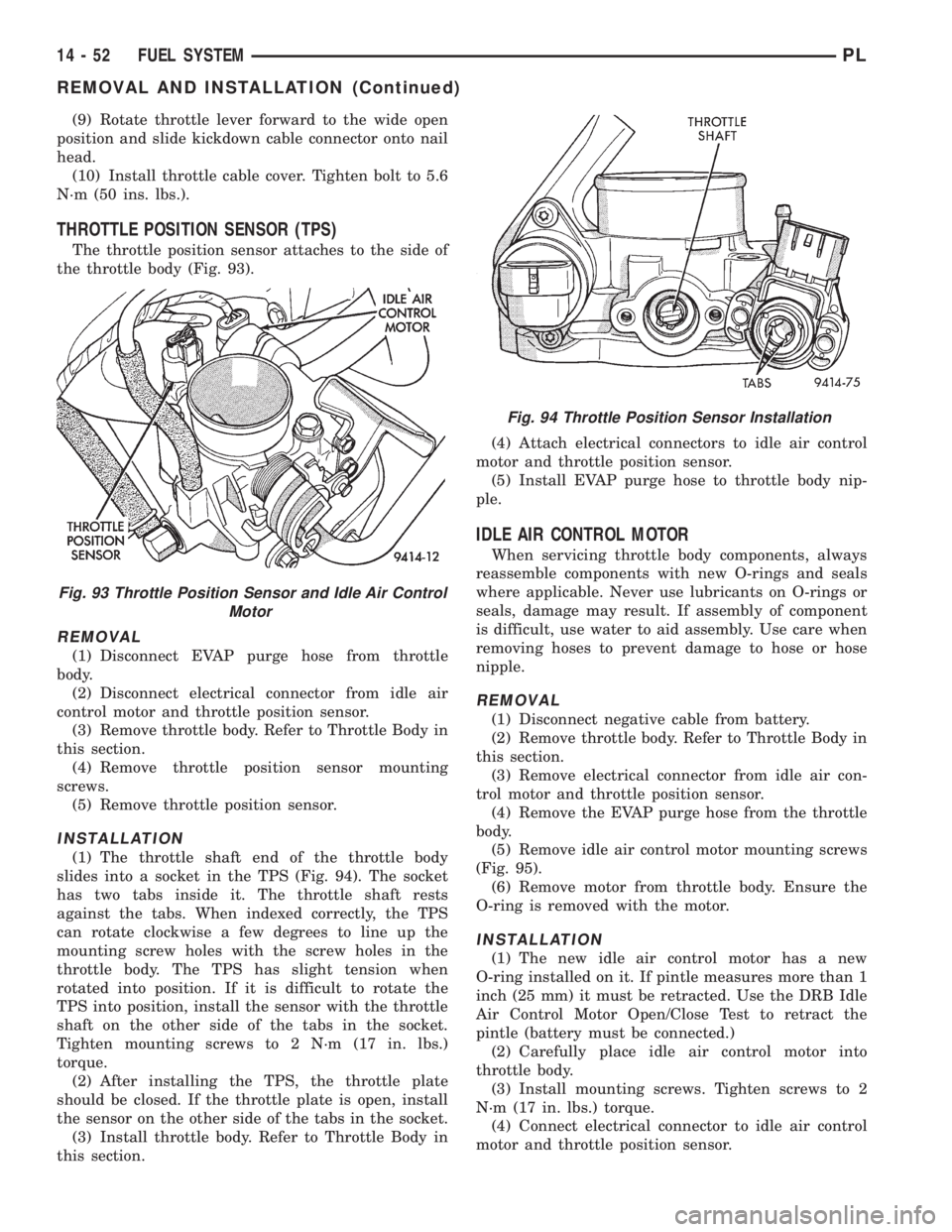
the throttle body (Fig. 93).
REMOVAL
(1) Disconnect EVAP purge hose from throttle
body.
(2) Disconnect electrical connector from idle air
control motor and throttle position sensor.
(3) Remove throttle body. Refer to Throttle Body in
this section.
(4) Remove throttle position sensor mounting
screws.
(5) Remove throttle position sensor.
INSTALLATION
(1) The throttle shaft end of the throttle body
slides into a socket in the TPS (Fig. 94). The socket
has two tabs inside it. The throttle shaft rests
against the tabs. When indexed correctly, the TPS
can rotate clockwise a few degrees to line up the
mounting screw holes with the screw holes in the
throttle body. The TPS has slight tension when
rotated into position. If it is difficult to rotate the
TPS into position, install the sensor with the throttle
shaft on the other side of the tabs in the socket.
Tighten mounting screws to 2 N´m (17 in. lbs.)
torque.
(2) After installing the TPS, the throttle plate
should be closed. If the throttle plate is open, install
the sensor on the other side of the tabs in the socket.
(3) Install throttle body. Refer to Throttle Body in
this section.(4) Attach electrical connectors to idle air control
motor and throttle position sensor.
(5) Install EVAP purge hose to throttle body nip-
ple.
IDLE AIR CONTROL MOTOR
When servicing throttle body components, always
reassemble components with new O-rings and seals
where applicable. Never use lubricants on O-rings or
seals, damage may result. If assembly of component
is difficult, use water to aid assembly. Use care when
removing hoses to prevent damage to hose or hose
nipple.
REMOVAL
(1) Disconnect negative cable from battery.
(2) Remove throttle body. Refer to Throttle Body in
this section.
(3) Remove electrical connector from idle air con-
trol motor and throttle position sensor.
(4) Remove the EVAP purge hose from the throttle
body.
(5) Remove idle air control motor mounting screws
(Fig. 95).
(6) Remove motor from throttle body. Ensure the
O-ring is removed with the motor.
INSTALLATION
(1) The new idle air control motor has a new
O-ring installed on it. If pintle measures more than 1
inch (25 mm) it must be retracted. Use the DRB Idle
Air Control Motor Open/Close Test to retract the
pintle (battery must be connected.)
(2) Carefully place idle air control motor into
throttle body.
(3) Install mounting screws. Tighten screws to 2
N´m (17 in. lbs.) torque.
(4) Connect electrical connector to idle air control
motor and throttle position sensor.
Fig. 93 Throttle Position Sensor and Idle Air Control
Motor
Fig. 94 Throttle Position Sensor Installation
14 - 52 FUEL SYSTEMPL
REMOVAL AND INSTALLATION (Continued)
Page 895 of 1200
(3) Remove solenoid from bracket.
INSTALLATION
The top of the solenoid has TOP printed on it. The
solenoid will not operate unless it is installed cor-
rectly.
(1) Install solenoid on bracket.
(2) Connect vacuum tube to solenoid.
(3) Connect electrical connector to solenoid.
POWERTRAIN CONTROL MODULE (PCM)
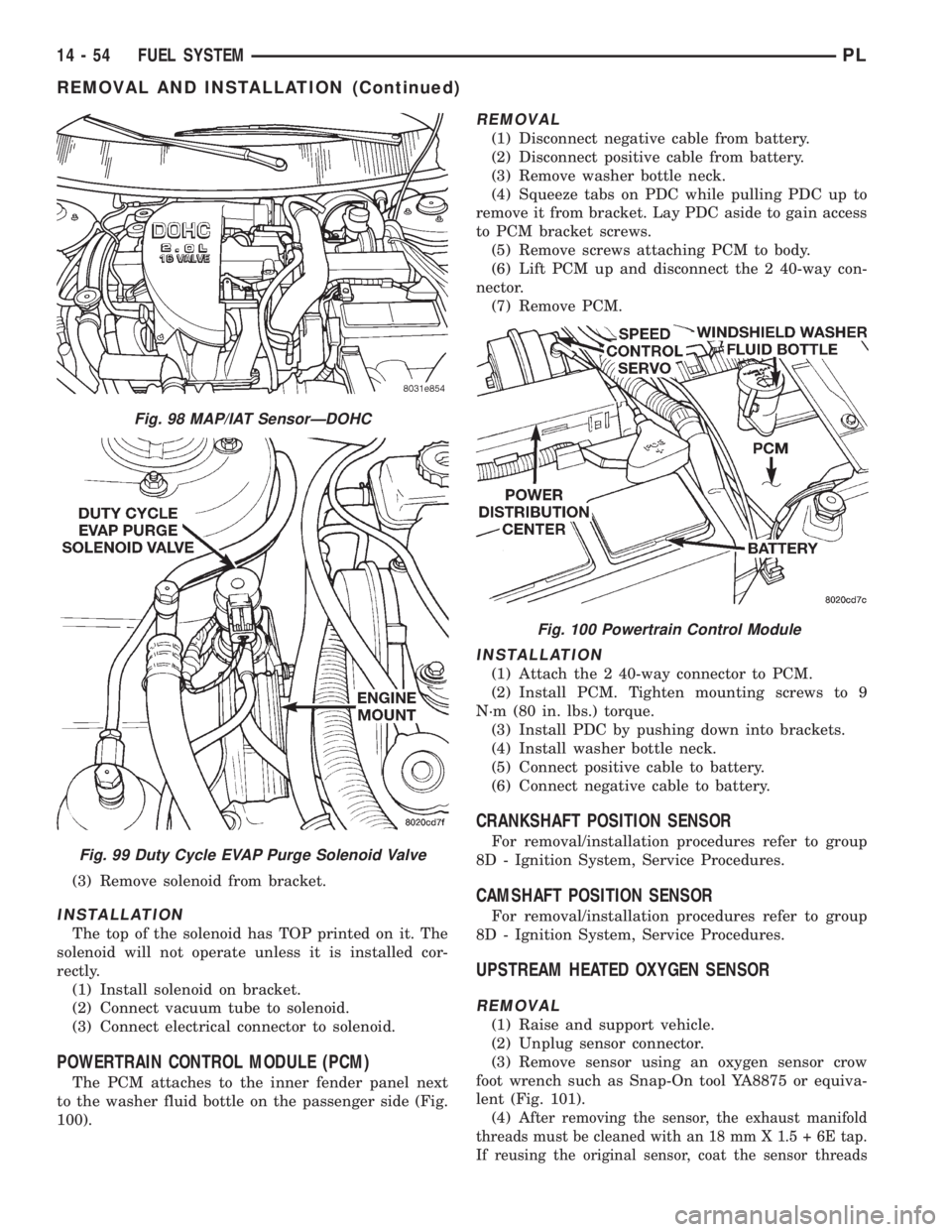
The PCM attaches to the inner fender panel next
to the washer fluid bottle on the passenger side (Fig.
100).
REMOVAL
(1) Disconnect negative cable from battery.
(2) Disconnect positive cable from battery.
(3) Remove washer bottle neck.
(4) Squeeze tabs on PDC while pulling PDC up to
remove it from bracket. Lay PDC aside to gain access
to PCM bracket screws.
(5) Remove screws attaching PCM to body.
(6) Lift PCM up and disconnect the 2 40-way con-
nector.
(7) Remove PCM.
INSTALLATION
(1) Attach the 2 40-way connector to PCM.
(2) Install PCM. Tighten mounting screws to 9
N´m (80 in. lbs.) torque.
(3) Install PDC by pushing down into brackets.
(4) Install washer bottle neck.
(5) Connect positive cable to battery.
(6) Connect negative cable to battery.
CRANKSHAFT POSITION SENSOR
For removal/installation procedures refer to group
8D - Ignition System, Service Procedures.
CAMSHAFT POSITION SENSOR
For removal/installation procedures refer to group
8D - Ignition System, Service Procedures.
UPSTREAM HEATED OXYGEN SENSOR
REMOVAL
(1) Raise and support vehicle.
(2) Unplug sensor connector.
(3) Remove sensor using an oxygen sensor crow
foot wrench such as Snap-On tool YA8875 or equiva-
lent (Fig. 101).
(4) A
fter removing the sensor, the exhaust manifold
threads must be cleaned with an 18 mm X 1.5 + 6E tap.
If reusing the original sensor, coat the sensor threads
Fig. 98 MAP/IAT SensorÐDOHC
Fig. 99 Duty Cycle EVAP Purge Solenoid Valve
Fig. 100 Powertrain Control Module
14 - 54 FUEL SYSTEMPL
REMOVAL AND INSTALLATION (Continued)
Page 897 of 1200
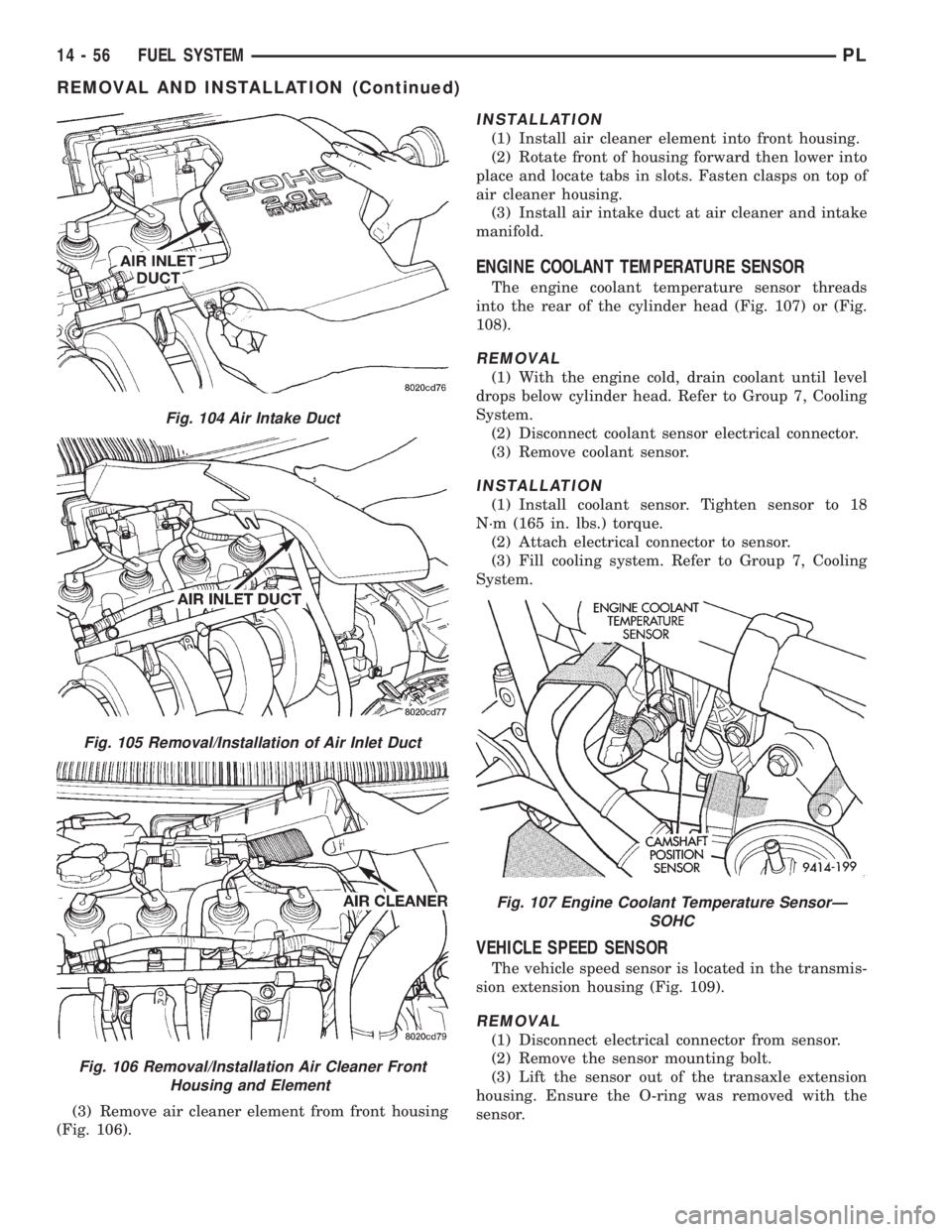
(3) Remove air cleaner element from front housing
(Fig. 106).
INSTALLATION
(1) Install air cleaner element into front housing.
(2) Rotate front of housing forward then lower into
place and locate tabs in slots. Fasten clasps on top of
air cleaner housing.
(3) Install air intake duct at air cleaner and intake
manifold.
ENGINE COOLANT TEMPERATURE SENSOR
The engine coolant temperature sensor threads
into the rear of the cylinder head (Fig. 107) or (Fig.
108).
REMOVAL
(1) With the engine cold, drain coolant until level
drops below cylinder head. Refer to Group 7, Cooling
System.
(2) Disconnect coolant sensor electrical connector.
(3) Remove coolant sensor.
INSTALLATION
(1) Install coolant sensor. Tighten sensor to 18
N´m (165 in. lbs.) torque.
(2) Attach electrical connector to sensor.
(3) Fill cooling system. Refer to Group 7, Cooling
System.
VEHICLE SPEED SENSOR
The vehicle speed sensor is located in the transmis-
sion extension housing (Fig. 109).
REMOVAL
(1) Disconnect electrical connector from sensor.
(2) Remove the sensor mounting bolt.
(3) Lift the sensor out of the transaxle extension
housing. Ensure the O-ring was removed with the
sensor.
Fig. 104 Air Intake Duct
Fig. 105 Removal/Installation of Air Inlet Duct
Fig. 106 Removal/Installation Air Cleaner Front
Housing and Element
Fig. 107 Engine Coolant Temperature SensorÐ
SOHC
14 - 56 FUEL SYSTEMPL
REMOVAL AND INSTALLATION (Continued)
Page 1002 of 1200
(6) If fluid flow is still found to be inadequate,
check the line pressure using the Transaxle Hydrau-
lic Pressure Test procedure.
REMOVAL AND INSTALLATION
GEARSHIFT CABLE
REMOVAL
(1) Disconnect both battery cables.
(2) Pull up and remove the power distribution cen-
ter.
(3) Remove the battery thermoguard.
(4) Remove the battery and battery holddown from
the battery tray.
(5) Remove the battery tray and cruise control
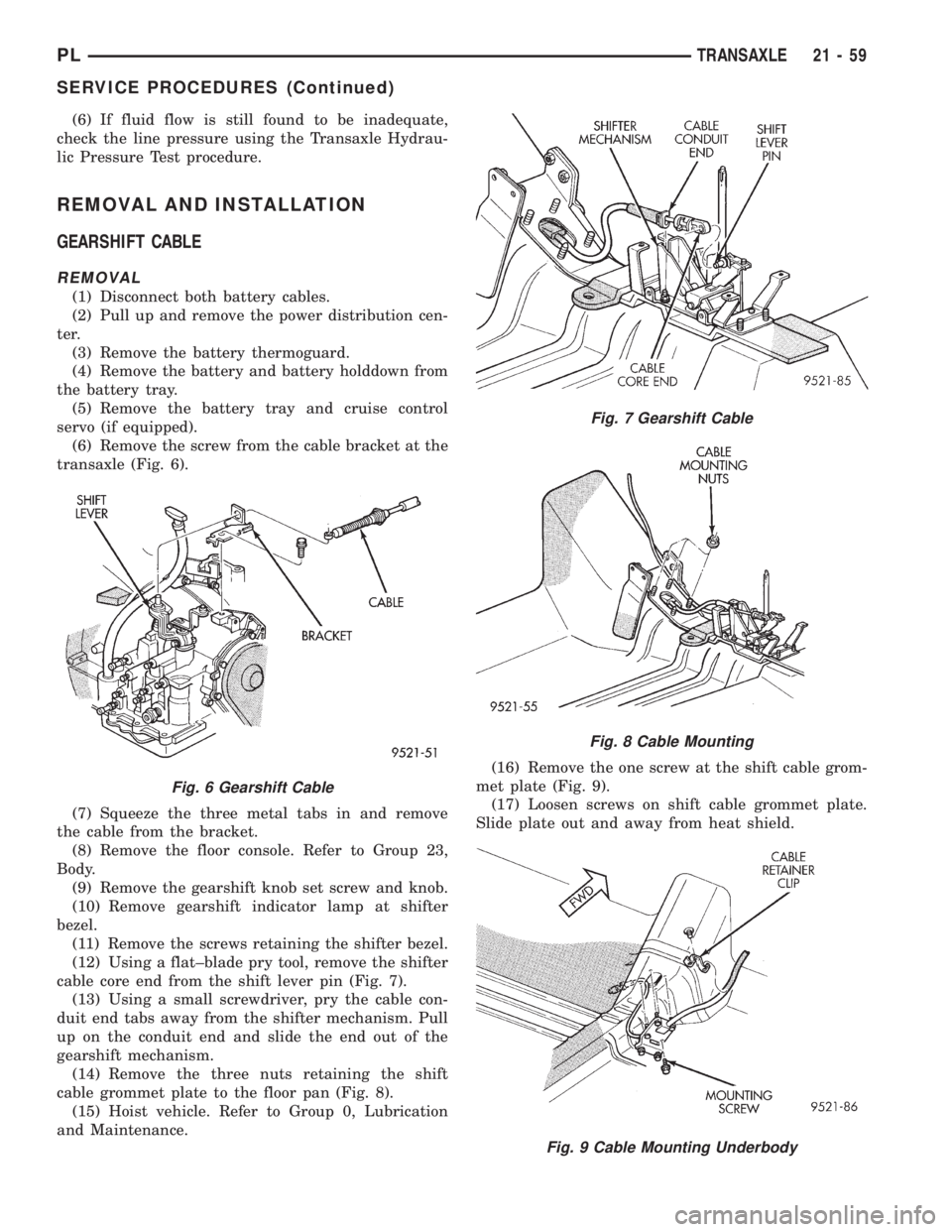
servo (if equipped).
(6) Remove the screw from the cable bracket at the
transaxle (Fig. 6).
(7) Squeeze the three metal tabs in and remove
the cable from the bracket.
(8) Remove the floor console. Refer to Group 23,
Body.
(9) Remove the gearshift knob set screw and knob.
(10) Remove gearshift indicator lamp at shifter
bezel.
(11) Remove the screws retaining the shifter bezel.
(12) Using a flat±blade pry tool, remove the shifter
cable core end from the shift lever pin (Fig. 7).
(13) Using a small screwdriver, pry the cable con-
duit end tabs away from the shifter mechanism. Pull
up on the conduit end and slide the end out of the
gearshift mechanism.
(14) Remove the three nuts retaining the shift
cable grommet plate to the floor pan (Fig. 8).
(15) Hoist vehicle. Refer to Group 0, Lubrication
and Maintenance.(16) Remove the one screw at the shift cable grom-
met plate (Fig. 9).
(17) Loosen screws on shift cable grommet plate.
Slide plate out and away from heat shield.
Fig. 6 Gearshift Cable
Fig. 7 Gearshift Cable
Fig. 8 Cable Mounting
Fig. 9 Cable Mounting Underbody
PLTRANSAXLE 21 - 59
SERVICE PROCEDURES (Continued)
Page 1003 of 1200
(18) Carefully remove the cable from the under-
body by unfolding the cable retainer clip as you go
along.
INSTALLATION
(1) To install gearshift cable, reverse removal pro-
cedure.
(2) Adjust gearshift cable using the adjustment
procedure in this Group.
GEARSHIFT MECHANISM
REMOVAL
(1) Disconnect battery negative cable and isolate.
(2) Remove console assembly. Refer to Group 23,
Body.
(3) Remove the gearshift knob set screw and knob.
(4) Remove the screws retaining the gearshift indi-
cator bezel and remove bezel and indicator lamp.
(5) Using a flat±blade pry tool, remove the shifter
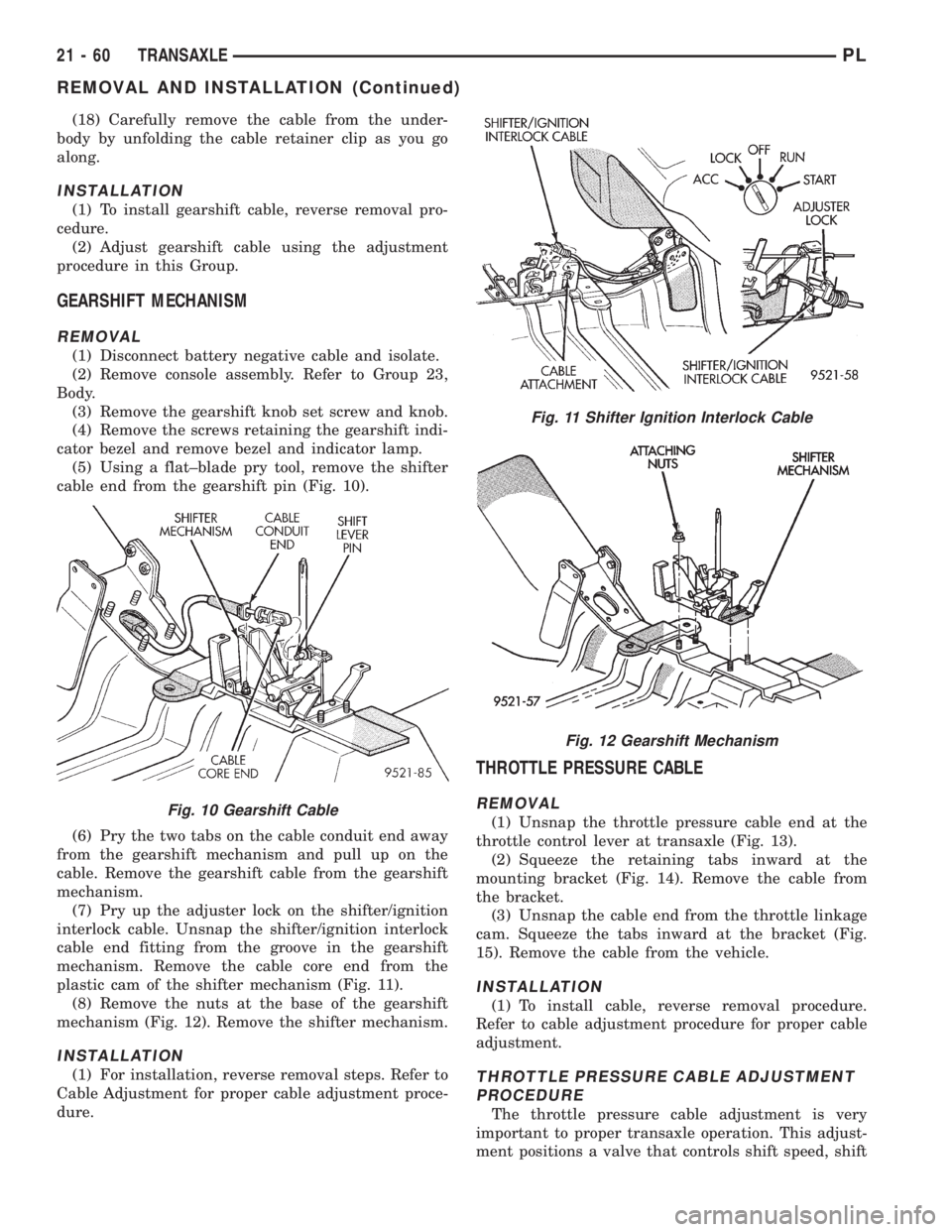
cable end from the gearshift pin (Fig. 10).
(6) Pry the two tabs on the cable conduit end away
from the gearshift mechanism and pull up on the
cable. Remove the gearshift cable from the gearshift
mechanism.
(7) Pry up the adjuster lock on the shifter/ignition
interlock cable. Unsnap the shifter/ignition interlock
cable end fitting from the groove in the gearshift
mechanism. Remove the cable core end from the
plastic cam of the shifter mechanism (Fig. 11).
(8) Remove the nuts at the base of the gearshift
mechanism (Fig. 12). Remove the shifter mechanism.
INSTALLATION
(1) For installation, reverse removal steps. Refer to
Cable Adjustment for proper cable adjustment proce-
dure.
THROTTLE PRESSURE CABLE
REMOVAL
(1) Unsnap the throttle pressure cable end at the
throttle control lever at transaxle (Fig. 13).
(2) Squeeze the retaining tabs inward at the
mounting bracket (Fig. 14). Remove the cable from
the bracket.
(3) Unsnap the cable end from the throttle linkage
cam. Squeeze the tabs inward at the bracket (Fig.
15). Remove the cable from the vehicle.
INSTALLATION
(1) To install cable, reverse removal procedure.
Refer to cable adjustment procedure for proper cable
adjustment.
THROTTLE PRESSURE CABLE ADJUSTMENT
PROCEDURE
The throttle pressure cable adjustment is very
important to proper transaxle operation. This adjust-
ment positions a valve that controls shift speed, shift
Fig. 10 Gearshift Cable
Fig. 11 Shifter Ignition Interlock Cable
Fig. 12 Gearshift Mechanism
21 - 60 TRANSAXLEPL
REMOVAL AND INSTALLATION (Continued)
Page 1027 of 1200
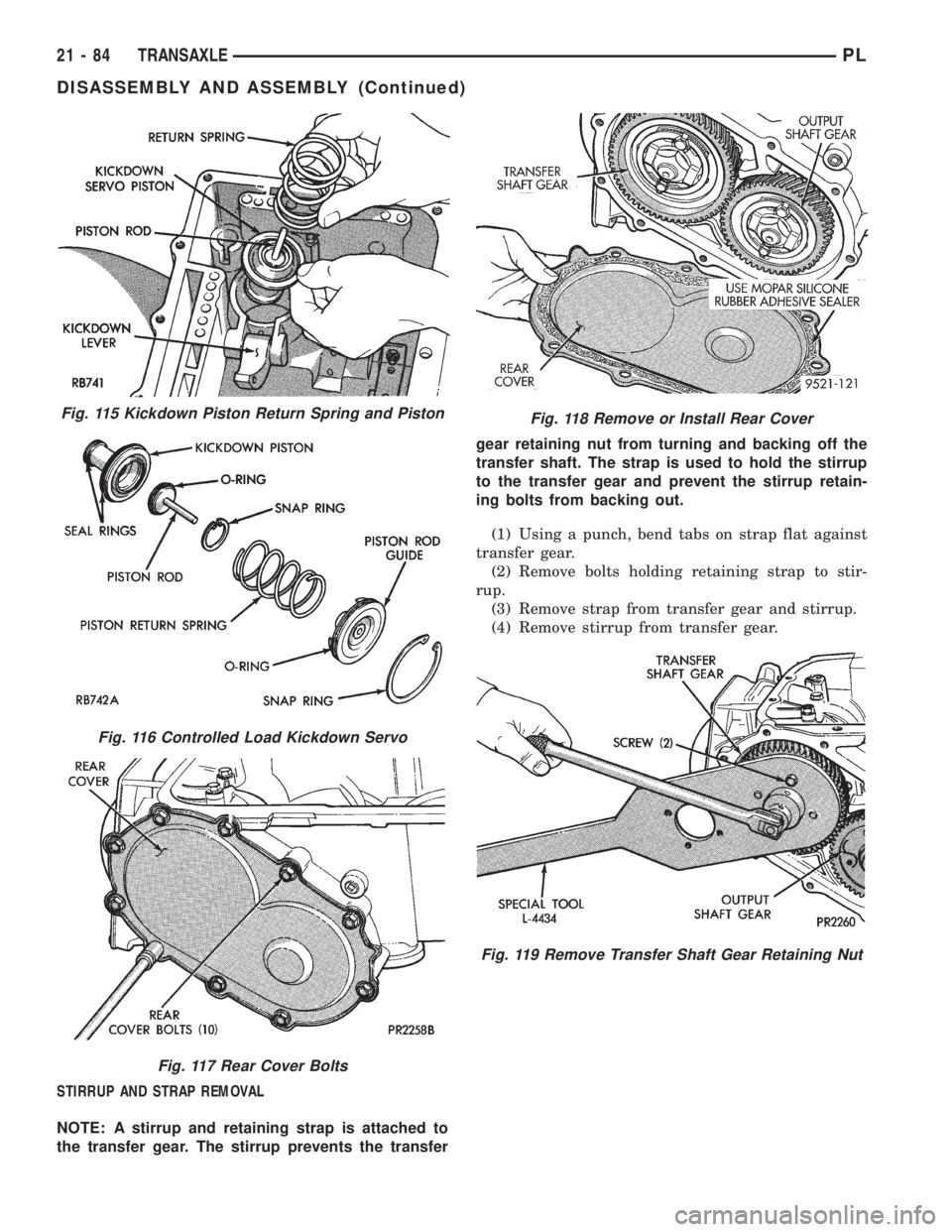
STIRRUP AND STRAP REMOVAL
NOTE: A stirrup and retaining strap is attached to
the transfer gear. The stirrup prevents the transfergear retaining nut from turning and backing off the
transfer shaft. The strap is used to hold the stirrup
to the transfer gear and prevent the stirrup retain-
ing bolts from backing out.
(1) Using a punch, bend tabs on strap flat against
transfer gear.
(2) Remove bolts holding retaining strap to stir-
rup.
(3) Remove strap from transfer gear and stirrup.
(4) Remove stirrup from transfer gear.
Fig. 115 Kickdown Piston Return Spring and Piston
Fig. 116 Controlled Load Kickdown Servo
Fig. 117 Rear Cover Bolts
Fig. 118 Remove or Install Rear Cover
Fig. 119 Remove Transfer Shaft Gear Retaining Nut
21 - 84 TRANSAXLEPL
DISASSEMBLY AND ASSEMBLY (Continued)
Page 1031 of 1200
DETERMINING SHIM THICKNESS
Shim thickness need be determined only if any of
the following parts are replaced:
²Transaxle case
²Transfer shaft
²Transfer shaft gear
²Transfer shaft bearings
²Governor support retainer
²Transfer shaft bearing retainer
²Retainer snap ring
²Governor support
Refer to Bearing Adjustment Procedure in rear of
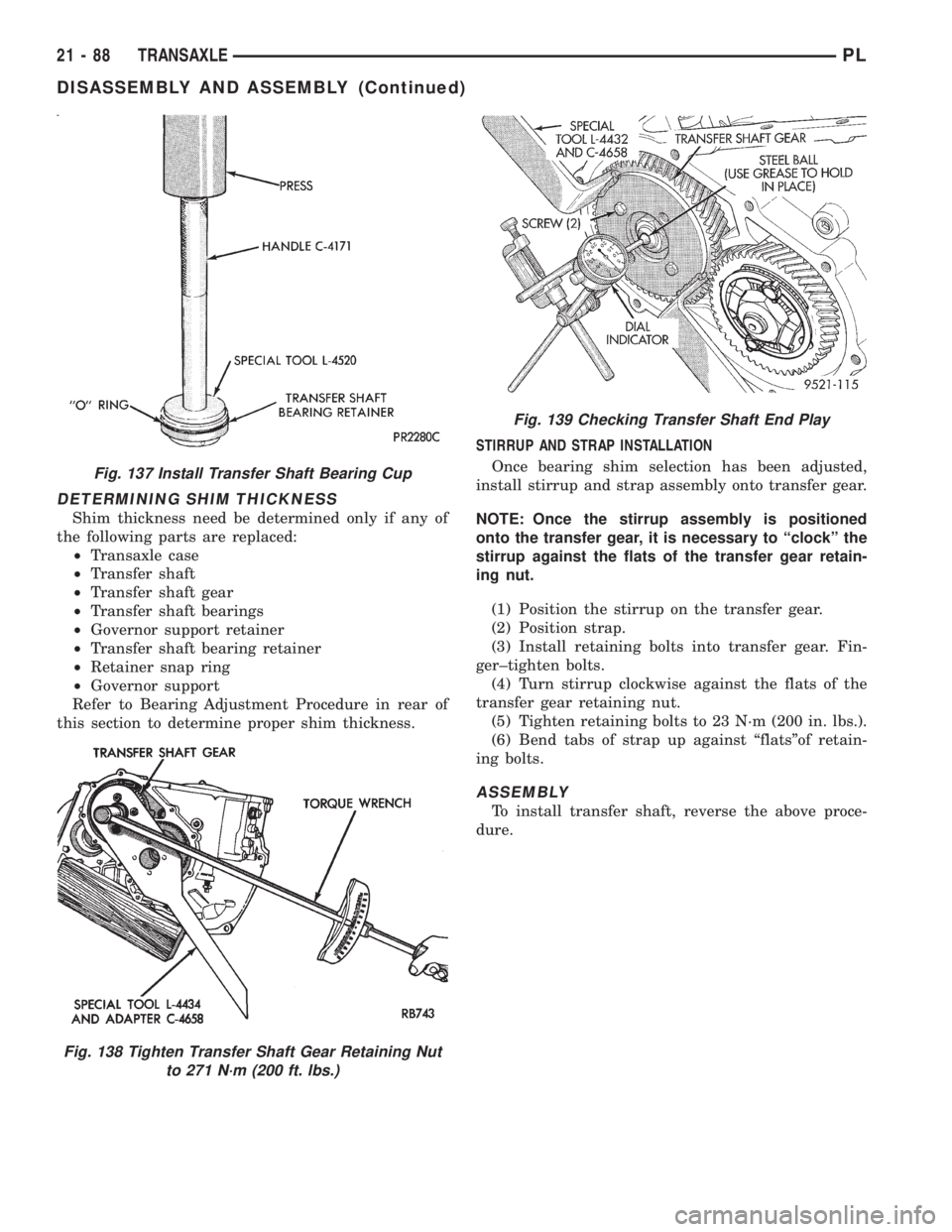
this section to determine proper shim thickness.STIRRUP AND STRAP INSTALLATION
Once bearing shim selection has been adjusted,
install stirrup and strap assembly onto transfer gear.
NOTE: Once the stirrup assembly is positioned
onto the transfer gear, it is necessary to ªclockº the
stirrup against the flats of the transfer gear retain-
ing nut.
(1) Position the stirrup on the transfer gear.
(2) Position strap.
(3) Install retaining bolts into transfer gear. Fin-
ger±tighten bolts.
(4) Turn stirrup clockwise against the flats of the
transfer gear retaining nut.
(5) Tighten retaining bolts to 23 N´m (200 in. lbs.).
(6) Bend tabs of strap up against ªflatsºof retain-
ing bolts.
ASSEMBLY
To install transfer shaft, reverse the above proce-
dure.
Fig. 137 Install Transfer Shaft Bearing Cup
Fig. 138 Tighten Transfer Shaft Gear Retaining Nut
to 271 N´m (200 ft. lbs.)
Fig. 139 Checking Transfer Shaft End Play
21 - 88 TRANSAXLEPL
DISASSEMBLY AND ASSEMBLY (Continued)
Page 1032 of 1200
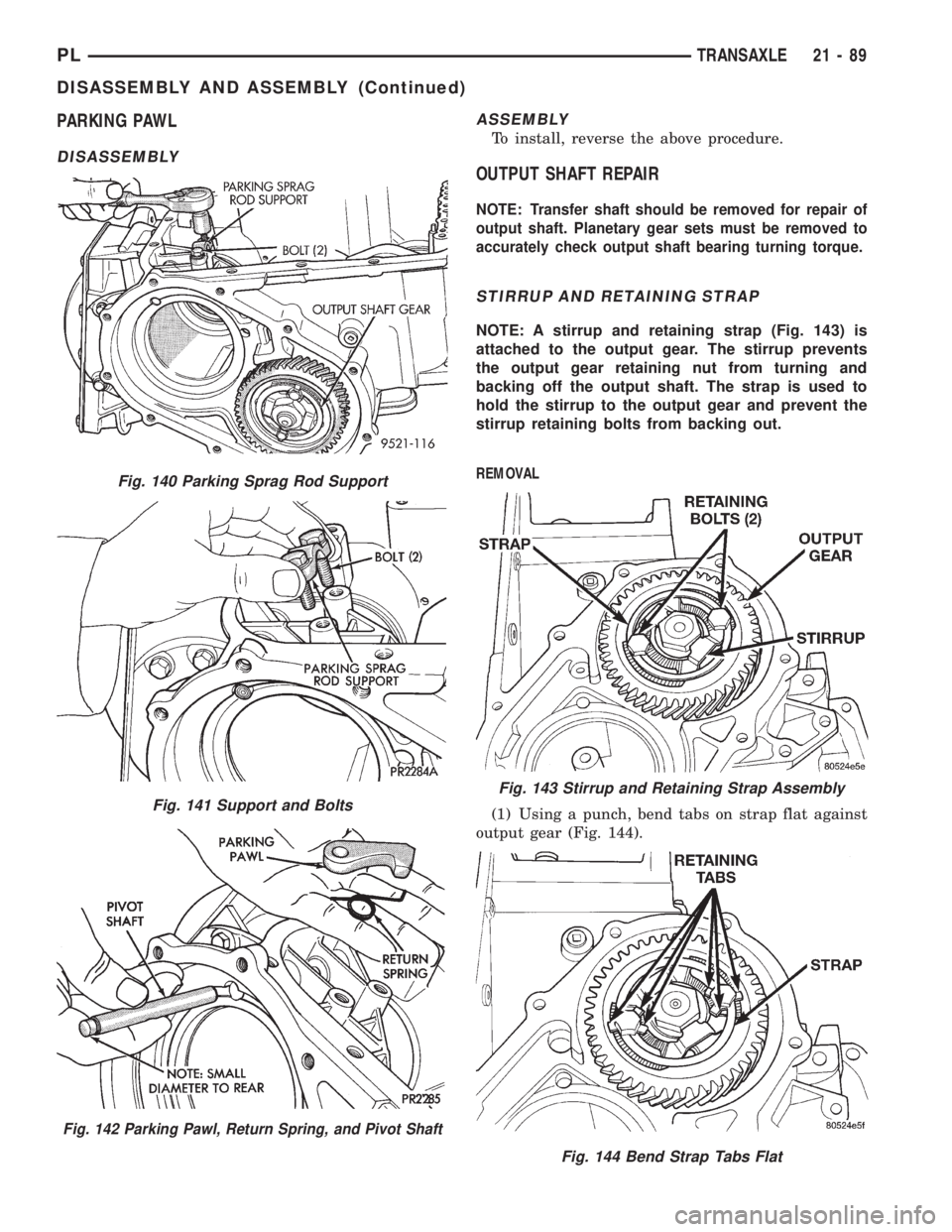
PARKING PAWL
DISASSEMBLYASSEMBLY
To install, reverse the above procedure.
OUTPUT SHAFT REPAIR
NOTE: Transfer shaft should be removed for repair of
output shaft. Planetary gear sets must be removed to
accurately check output shaft bearing turning torque.
STIRRUP AND RETAINING STRAP
NOTE: A stirrup and retaining strap (Fig. 143) is
attached to the output gear. The stirrup prevents
the output gear retaining nut from turning and
backing off the output shaft. The strap is used to
hold the stirrup to the output gear and prevent the
stirrup retaining bolts from backing out.
REMOVAL
(1) Using a punch, bend tabs on strap flat against
output gear (Fig. 144).
Fig. 140 Parking Sprag Rod Support
Fig. 141 Support and Bolts
Fig. 142 Parking Pawl, Return Spring, and Pivot Shaft
Fig. 143 Stirrup and Retaining Strap Assembly
Fig. 144 Bend Strap Tabs Flat
PLTRANSAXLE 21 - 89
DISASSEMBLY AND ASSEMBLY (Continued)
Page 1037 of 1200
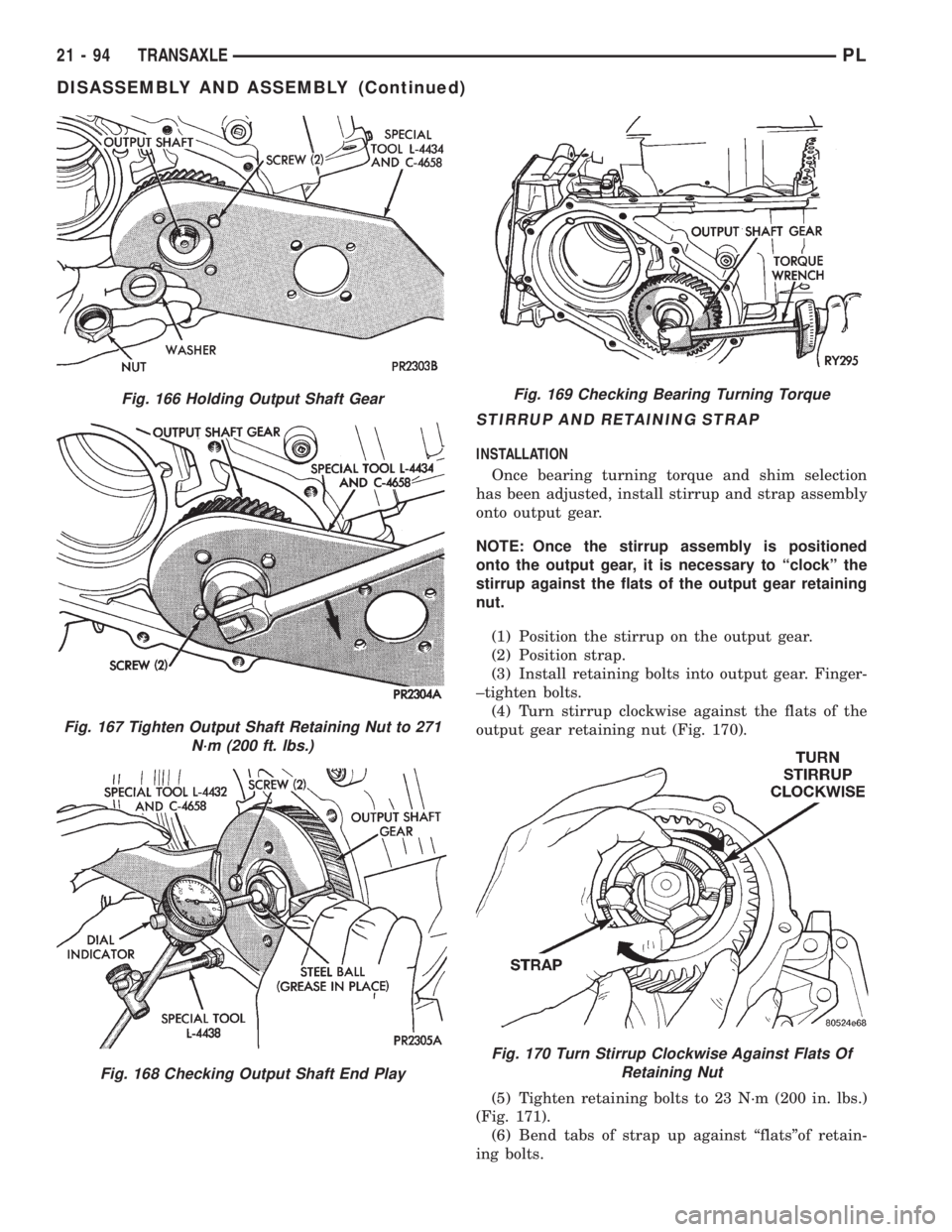
STIRRUP AND RETAINING STRAP
INSTALLATION
Once bearing turning torque and shim selection
has been adjusted, install stirrup and strap assembly
onto output gear.
NOTE: Once the stirrup assembly is positioned
onto the output gear, it is necessary to ªclockº the
stirrup against the flats of the output gear retaining
nut.
(1) Position the stirrup on the output gear.
(2) Position strap.
(3) Install retaining bolts into output gear. Finger-
±tighten bolts.
(4) Turn stirrup clockwise against the flats of the
output gear retaining nut (Fig. 170).
(5) Tighten retaining bolts to 23 N´m (200 in. lbs.)
(Fig. 171).
(6) Bend tabs of strap up against ªflatsºof retain-
ing bolts.
Fig. 166 Holding Output Shaft Gear
Fig. 167 Tighten Output Shaft Retaining Nut to 271
N´m (200 ft. lbs.)
Fig. 168 Checking Output Shaft End Play
Fig. 169 Checking Bearing Turning Torque
Fig. 170 Turn Stirrup Clockwise Against Flats Of
Retaining Nut
21 - 94 TRANSAXLEPL
DISASSEMBLY AND ASSEMBLY (Continued)