torque DODGE NEON 1999 Service Repair Manual
[x] Cancel search | Manufacturer: DODGE, Model Year: 1999, Model line: NEON, Model: DODGE NEON 1999Pages: 1200, PDF Size: 35.29 MB
Page 1081 of 1200
INSTALL
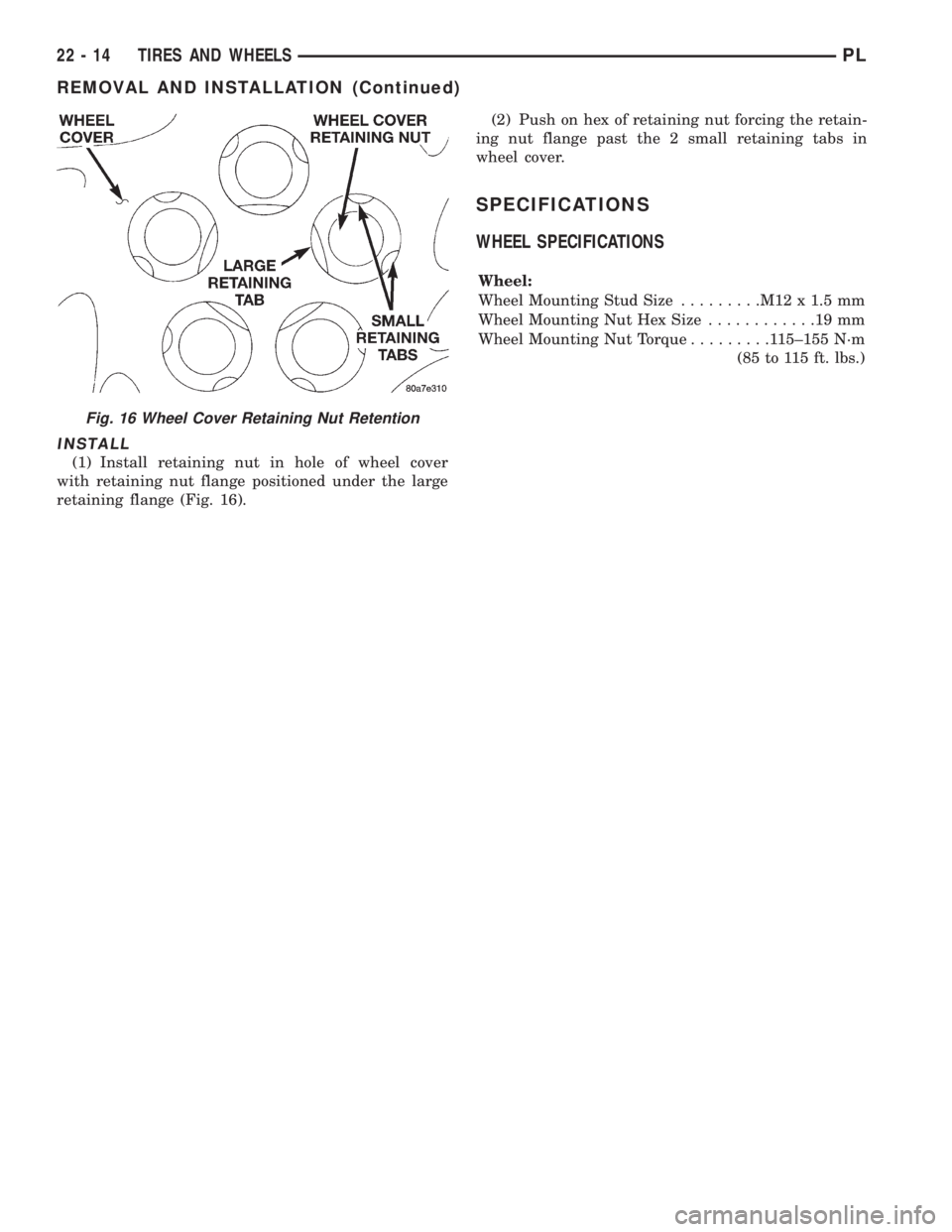
(1) Install retaining nut in hole of wheel cover
with retaining nut flange positioned under the large
retaining flange (Fig. 16).(2) Push on hex of retaining nut forcing the retain-
ing nut flange past the 2 small retaining tabs in
wheel cover.
SPECIFICATIONS
WHEEL SPECIFICATIONS
Wheel:
Wheel Mounting Stud Size.........M12 x 1.5 mm
Wheel Mounting Nut Hex Size............19mm
Wheel Mounting Nut Torque.........115±155 N´m
(85 to 115 ft. lbs.)
Fig. 16 Wheel Cover Retaining Nut Retention
22 - 14 TIRES AND WHEELSPL
REMOVAL AND INSTALLATION (Continued)
Page 1092 of 1200
FLOOR CONSOLE
REMOVAL
(1) Fully apply parking brake.
(2) Remove screw cover plugs over screws just
rearward of cupholders.
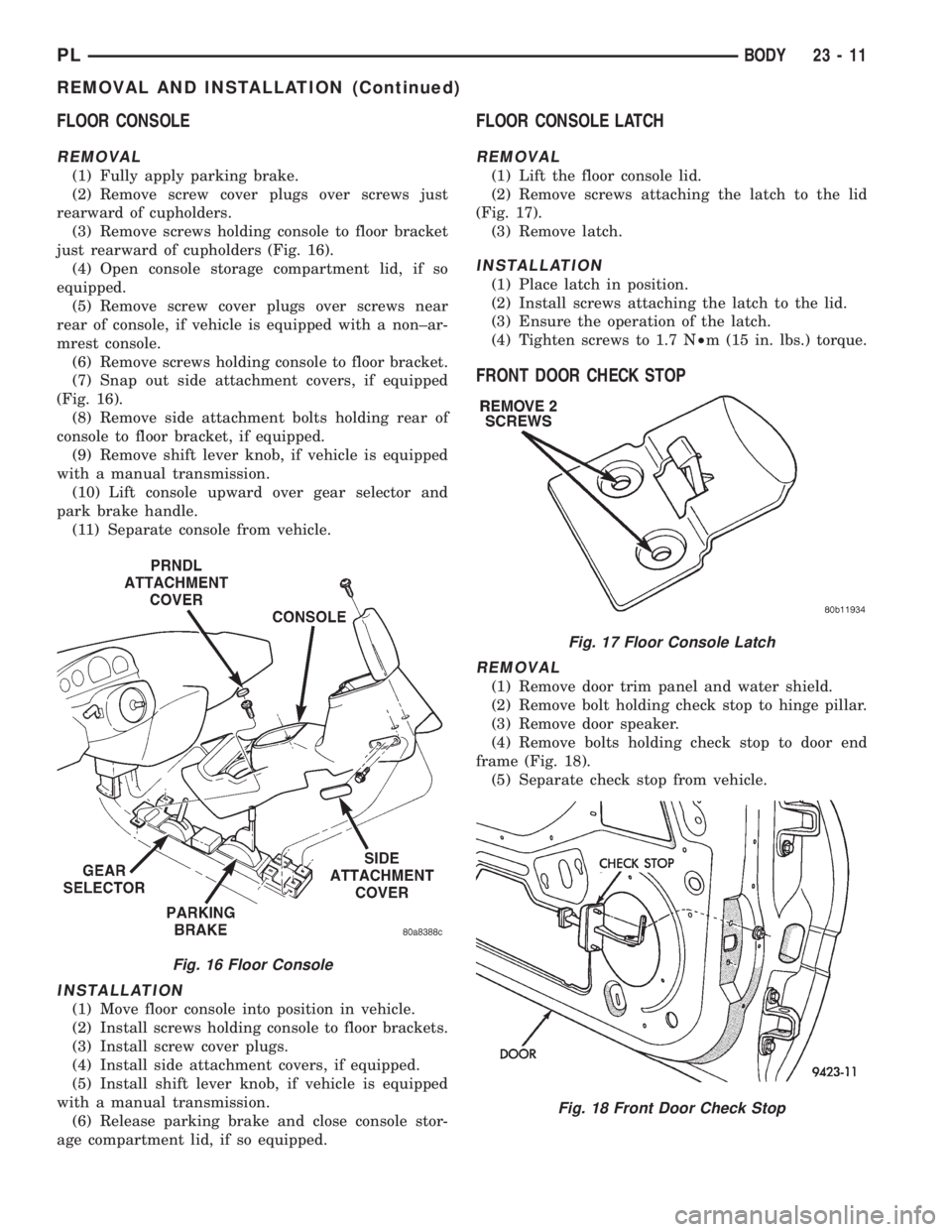
(3) Remove screws holding console to floor bracket
just rearward of cupholders (Fig. 16).
(4) Open console storage compartment lid, if so
equipped.
(5) Remove screw cover plugs over screws near
rear of console, if vehicle is equipped with a non±ar-
mrest console.
(6) Remove screws holding console to floor bracket.
(7) Snap out side attachment covers, if equipped
(Fig. 16).
(8) Remove side attachment bolts holding rear of
console to floor bracket, if equipped.
(9) Remove shift lever knob, if vehicle is equipped
with a manual transmission.
(10) Lift console upward over gear selector and
park brake handle.
(11) Separate console from vehicle.
INSTALLATION
(1) Move floor console into position in vehicle.
(2) Install screws holding console to floor brackets.
(3) Install screw cover plugs.
(4) Install side attachment covers, if equipped.
(5) Install shift lever knob, if vehicle is equipped
with a manual transmission.
(6) Release parking brake and close console stor-
age compartment lid, if so equipped.
FLOOR CONSOLE LATCH
REMOVAL
(1) Lift the floor console lid.
(2) Remove screws attaching the latch to the lid
(Fig. 17).
(3) Remove latch.
INSTALLATION
(1) Place latch in position.
(2) Install screws attaching the latch to the lid.
(3) Ensure the operation of the latch.
(4) Tighten screws to 1.7 N²m (15 in. lbs.) torque.
FRONT DOOR CHECK STOP
REMOVAL
(1) Remove door trim panel and water shield.
(2) Remove bolt holding check stop to hinge pillar.
(3) Remove door speaker.
(4) Remove bolts holding check stop to door end
frame (Fig. 18).
(5) Separate check stop from vehicle.
Fig. 16 Floor Console
Fig. 17 Floor Console Latch
Fig. 18 Front Door Check Stop
PLBODY 23 - 11
REMOVAL AND INSTALLATION (Continued)
Page 1099 of 1200
NOTE: The tightening specification for all front seat
retaining bolts is 55 N´m (40 ft. lbs.) torque.
FRONT SEAT BELT BUCKLE
REMOVAL
(1) Move front seat to the forward position.
(2) Remove bolt holding seat belt buckle to seat.
(3) Separate seat belt buckle from seat.
INSTALLATION
Reverse the preceding operation.
FRONT SEAT BELT RETRACTOR
REMOVAL
(1) Remove B-pillar trim.
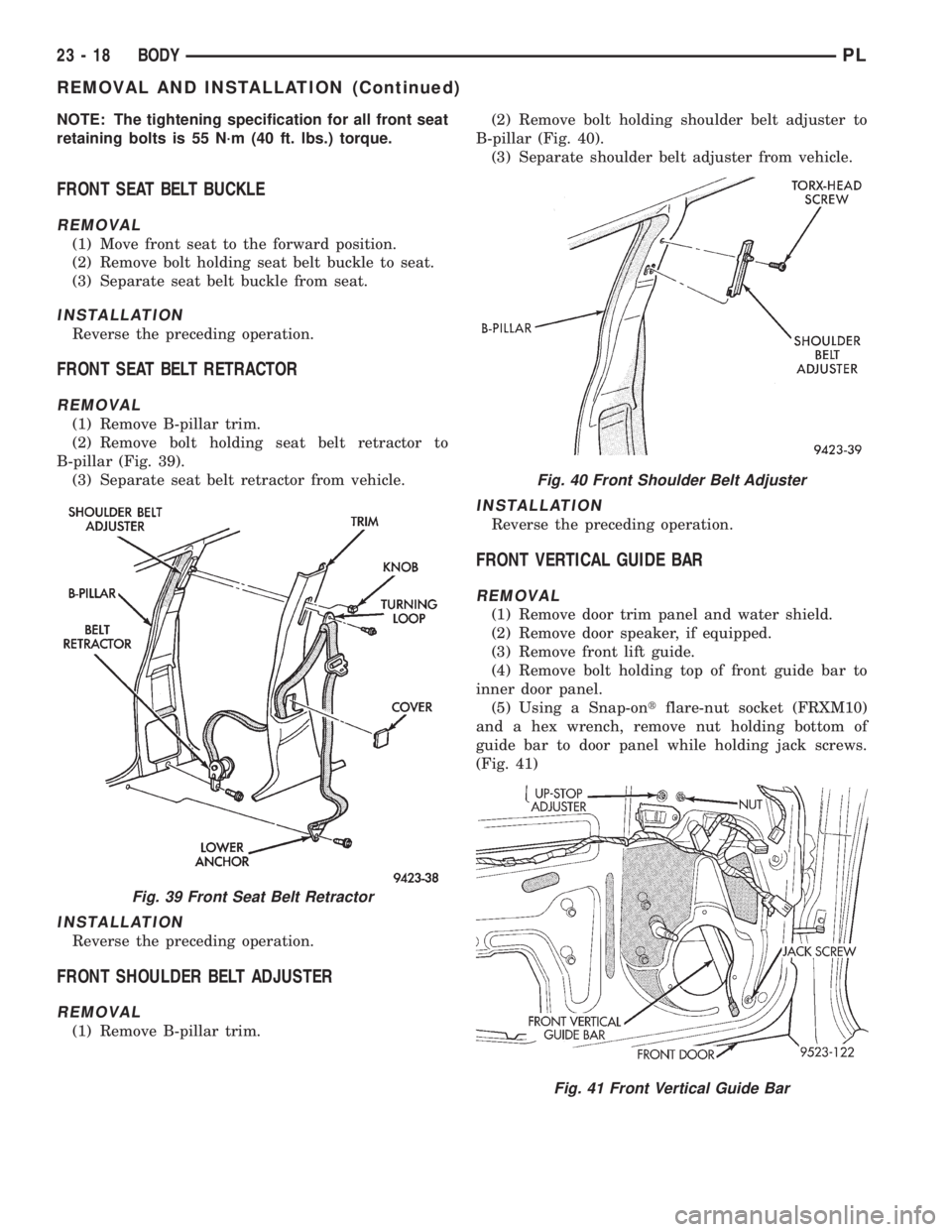
(2) Remove bolt holding seat belt retractor to
B-pillar (Fig. 39).
(3) Separate seat belt retractor from vehicle.
INSTALLATION
Reverse the preceding operation.
FRONT SHOULDER BELT ADJUSTER
REMOVAL
(1) Remove B-pillar trim.(2) Remove bolt holding shoulder belt adjuster to
B-pillar (Fig. 40).
(3) Separate shoulder belt adjuster from vehicle.
INSTALLATION
Reverse the preceding operation.
FRONT VERTICAL GUIDE BAR
REMOVAL
(1) Remove door trim panel and water shield.
(2) Remove door speaker, if equipped.
(3) Remove front lift guide.
(4) Remove bolt holding top of front guide bar to
inner door panel.
(5) Using a Snap-ontflare-nut socket (FRXM10)
and a hex wrench, remove nut holding bottom of
guide bar to door panel while holding jack screws.
(Fig. 41)
Fig. 39 Front Seat Belt Retractor
Fig. 40 Front Shoulder Belt Adjuster
Fig. 41 Front Vertical Guide Bar
23 - 18 BODYPL
REMOVAL AND INSTALLATION (Continued)
Page 1107 of 1200
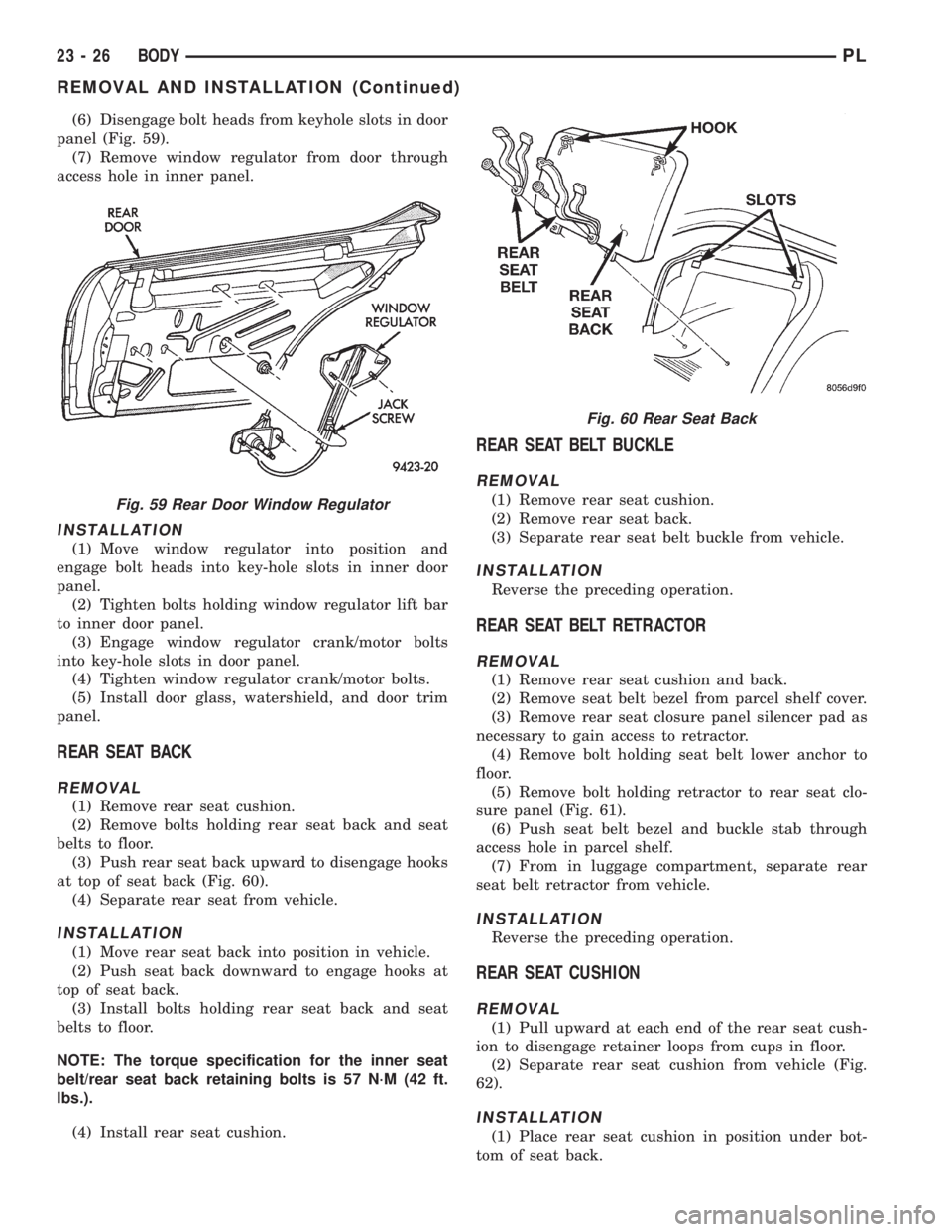
(6) Disengage bolt heads from keyhole slots in door
panel (Fig. 59).
(7) Remove window regulator from door through
access hole in inner panel.
INSTALLATION
(1) Move window regulator into position and
engage bolt heads into key-hole slots in inner door
panel.
(2) Tighten bolts holding window regulator lift bar
to inner door panel.
(3) Engage window regulator crank/motor bolts
into key-hole slots in door panel.
(4) Tighten window regulator crank/motor bolts.
(5) Install door glass, watershield, and door trim
panel.
REAR SEAT BACK
REMOVAL
(1) Remove rear seat cushion.
(2) Remove bolts holding rear seat back and seat
belts to floor.
(3) Push rear seat back upward to disengage hooks
at top of seat back (Fig. 60).
(4) Separate rear seat from vehicle.
INSTALLATION
(1) Move rear seat back into position in vehicle.
(2) Push seat back downward to engage hooks at
top of seat back.
(3) Install bolts holding rear seat back and seat
belts to floor.
NOTE: The torque specification for the inner seat
belt/rear seat back retaining bolts is 57 N´M (42 ft.
lbs.).
(4) Install rear seat cushion.
REAR SEAT BELT BUCKLE
REMOVAL
(1) Remove rear seat cushion.
(2) Remove rear seat back.
(3) Separate rear seat belt buckle from vehicle.
INSTALLATION
Reverse the preceding operation.
REAR SEAT BELT RETRACTOR
REMOVAL
(1) Remove rear seat cushion and back.
(2) Remove seat belt bezel from parcel shelf cover.
(3) Remove rear seat closure panel silencer pad as
necessary to gain access to retractor.
(4) Remove bolt holding seat belt lower anchor to
floor.
(5) Remove bolt holding retractor to rear seat clo-
sure panel (Fig. 61).
(6) Push seat belt bezel and buckle stab through
access hole in parcel shelf.
(7) From in luggage compartment, separate rear
seat belt retractor from vehicle.
INSTALLATION
Reverse the preceding operation.
REAR SEAT CUSHION
REMOVAL
(1) Pull upward at each end of the rear seat cush-
ion to disengage retainer loops from cups in floor.
(2) Separate rear seat cushion from vehicle (Fig.
62).
INSTALLATION
(1) Place rear seat cushion in position under bot-
tom of seat back.
Fig. 59 Rear Door Window Regulator
Fig. 60 Rear Seat Back
23 - 26 BODYPL
REMOVAL AND INSTALLATION (Continued)
Page 1154 of 1200
(4) Install pulley assembly retaining snap ring
(bevel side outward) with Snap Ring Pliers. Press the
snap ring to make sure it is properly seated in the
groove.
(5) If the original front plate assembly and pulley
assembly are to be reused, the old shim(s) can be
used. If not, place a trial stack of shims, 2.54 mm
(0.10 in.) thick, on the shaft against the shoulder.
(6) Install front plate assembly onto shaft.
(7) If installing a new front plate and/or pulley
assembly, the gap between front plate and pulley face
must be checked. Use the following procedure:
(a) Attach a dial indicator to front plate so that
movement of the plate can be measured.
(b) With the dial indicator zeroed on the front
plate, energize the clutch and record the amount of
movement.
(c) The readings should be 0.35 to 0.65 mm
(0.014 to 0.026 in.). If proper reading is not
obtained, add or subtract shims until desired read-
ing is obtained.
(8) Install compressor shaft bolt. Tighten to 17.5
62 N´m (155620 in. lbs.) torque.
NOTE: Shims may compress after tightening shaft
nut. Check air gap in four or more places to verify if
air gap is still correct. Spin pulley for final check.
CLUTCH BREAK-IN
After new clutch installation, cycle the A/C clutch
20 times (5 seconds on and 5 seconds off). During
this procedure, set the system to the A/C mode,
engine rpm at 1500 - 2000, and high blower speed.
This procedure (burnishing) will seat the opposing
friction surfaces and provide a higher clutch torque
capability.
CONDENSATION DRAIN TUBE
REMOVAL
(1) Raise vehicle.
(2) Locate rubber drain tube on right side of dash
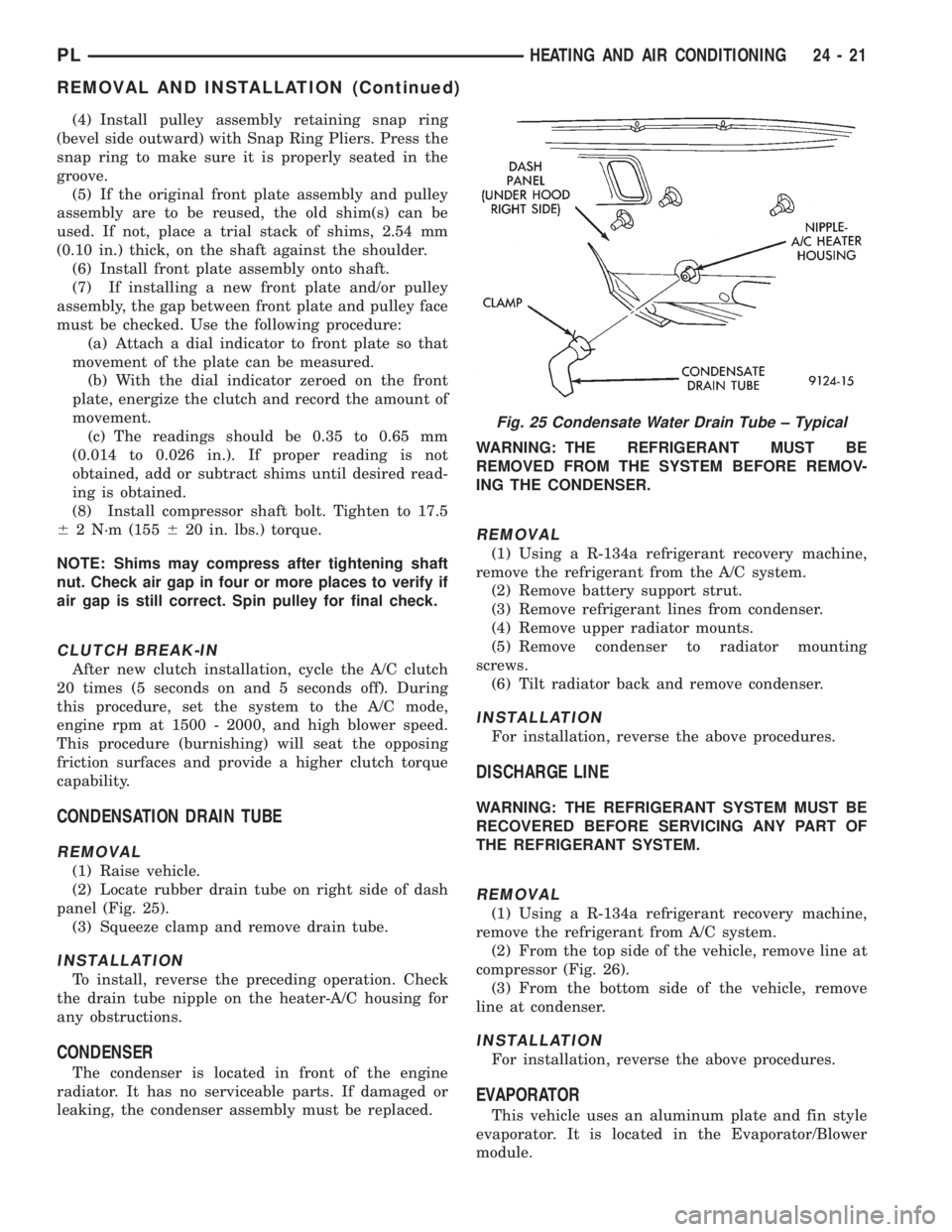
panel (Fig. 25).
(3) Squeeze clamp and remove drain tube.
INSTALLATION
To install, reverse the preceding operation. Check
the drain tube nipple on the heater-A/C housing for
any obstructions.
CONDENSER
The condenser is located in front of the engine
radiator. It has no serviceable parts. If damaged or
leaking, the condenser assembly must be replaced.WARNING: THE REFRIGERANT MUST BE
REMOVED FROM THE SYSTEM BEFORE REMOV-
ING THE CONDENSER.
REMOVAL
(1) Using a R-134a refrigerant recovery machine,
remove the refrigerant from the A/C system.
(2) Remove battery support strut.
(3) Remove refrigerant lines from condenser.
(4) Remove upper radiator mounts.
(5) Remove condenser to radiator mounting
screws.
(6) Tilt radiator back and remove condenser.
INSTALLATION
For installation, reverse the above procedures.
DISCHARGE LINE
WARNING: THE REFRIGERANT SYSTEM MUST BE
RECOVERED BEFORE SERVICING ANY PART OF
THE REFRIGERANT SYSTEM.
REMOVAL
(1) Using a R-134a refrigerant recovery machine,
remove the refrigerant from A/C system.
(2) From the top side of the vehicle, remove line at
compressor (Fig. 26).
(3) From the bottom side of the vehicle, remove
line at condenser.
INSTALLATION
For installation, reverse the above procedures.
EVAPORATOR
This vehicle uses an aluminum plate and fin style
evaporator. It is located in the Evaporator/Blower
module.
Fig. 25 Condensate Water Drain Tube ± Typical
PLHEATING AND AIR CONDITIONING 24 - 21
REMOVAL AND INSTALLATION (Continued)
Page 1166 of 1200
DIAGNOSTIC TROUBLE CODE DESCRIPTIONS
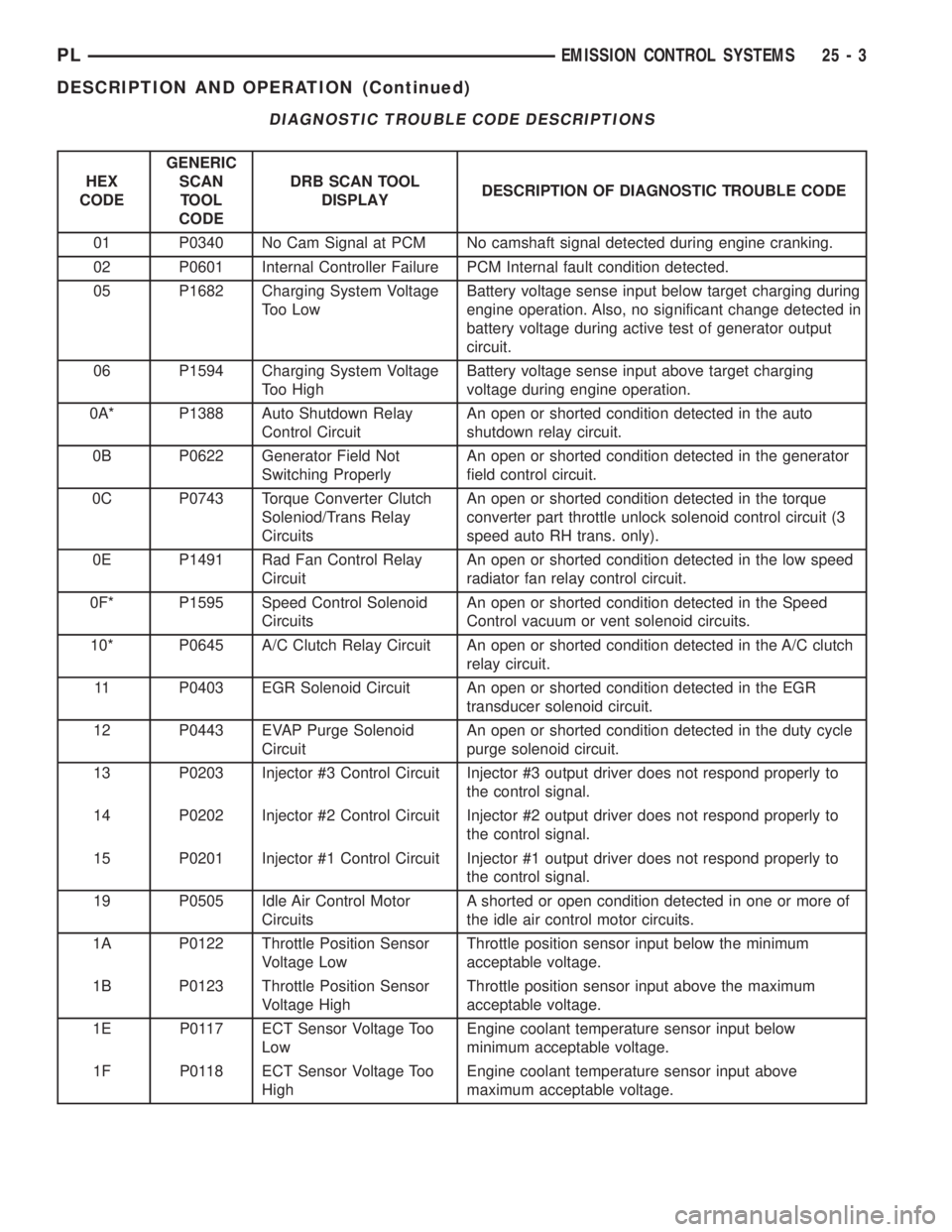
HEX
CODEGENERIC
SCAN
TOOL
CODEDRB SCAN TOOL
DISPLAYDESCRIPTION OF DIAGNOSTIC TROUBLE CODE
01 P0340 No Cam Signal at PCM No camshaft signal detected during engine cranking.
02 P0601 Internal Controller Failure PCM Internal fault condition detected.
05 P1682 Charging System Voltage
Too LowBattery voltage sense input below target charging during
engine operation. Also, no significant change detected in
battery voltage during active test of generator output
circuit.
06 P1594 Charging System Voltage
Too HighBattery voltage sense input above target charging
voltage during engine operation.
0A* P1388 Auto Shutdown Relay
Control CircuitAn open or shorted condition detected in the auto
shutdown relay circuit.
0B P0622 Generator Field Not
Switching ProperlyAn open or shorted condition detected in the generator
field control circuit.
0C P0743 Torque Converter Clutch
Soleniod/Trans Relay
CircuitsAn open or shorted condition detected in the torque
converter part throttle unlock solenoid control circuit (3
speed auto RH trans. only).
0E P1491 Rad Fan Control Relay
CircuitAn open or shorted condition detected in the low speed
radiator fan relay control circuit.
0F* P1595 Speed Control Solenoid
CircuitsAn open or shorted condition detected in the Speed
Control vacuum or vent solenoid circuits.
10* P0645 A/C Clutch Relay Circuit An open or shorted condition detected in the A/C clutch
relay circuit.
11 P0403 EGR Solenoid Circuit An open or shorted condition detected in the EGR
transducer solenoid circuit.
12 P0443 EVAP Purge Solenoid
CircuitAn open or shorted condition detected in the duty cycle
purge solenoid circuit.
13 P0203 Injector #3 Control Circuit Injector #3 output driver does not respond properly to
the control signal.
14 P0202 Injector #2 Control Circuit Injector #2 output driver does not respond properly to
the control signal.
15 P0201 Injector #1 Control Circuit Injector #1 output driver does not respond properly to
the control signal.
19 P0505 Idle Air Control Motor
CircuitsA shorted or open condition detected in one or more of
the idle air control motor circuits.
1A P0122 Throttle Position Sensor
Voltage LowThrottle position sensor input below the minimum
acceptable voltage.
1B P0123 Throttle Position Sensor
Voltage HighThrottle position sensor input above the maximum
acceptable voltage.
1E P0117 ECT Sensor Voltage Too
LowEngine coolant temperature sensor input below
minimum acceptable voltage.
1F P0118 ECT Sensor Voltage Too
HighEngine coolant temperature sensor input above
maximum acceptable voltage.
PLEMISSION CONTROL SYSTEMS 25 - 3
DESCRIPTION AND OPERATION (Continued)
Page 1168 of 1200
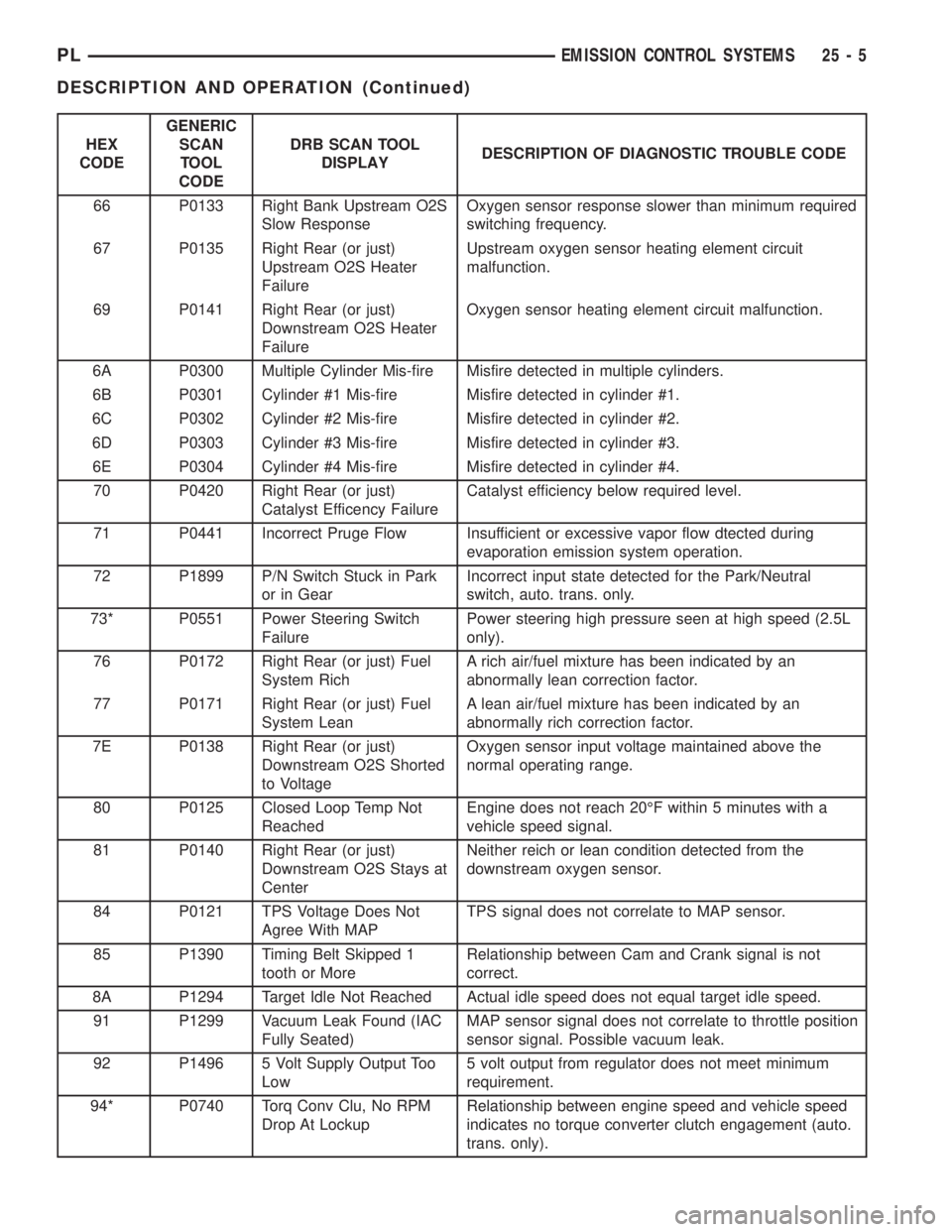
HEX
CODEGENERIC
SCAN
TOOL
CODEDRB SCAN TOOL
DISPLAYDESCRIPTION OF DIAGNOSTIC TROUBLE CODE
66 P0133 Right Bank Upstream O2S
Slow ResponseOxygen sensor response slower than minimum required
switching frequency.
67 P0135 Right Rear (or just)
Upstream O2S Heater
FailureUpstream oxygen sensor heating element circuit
malfunction.
69 P0141 Right Rear (or just)
Downstream O2S Heater
FailureOxygen sensor heating element circuit malfunction.
6A P0300 Multiple Cylinder Mis-fire Misfire detected in multiple cylinders.
6B P0301 Cylinder #1 Mis-fire Misfire detected in cylinder #1.
6C P0302 Cylinder #2 Mis-fire Misfire detected in cylinder #2.
6D P0303 Cylinder #3 Mis-fire Misfire detected in cylinder #3.
6E P0304 Cylinder #4 Mis-fire Misfire detected in cylinder #4.
70 P0420 Right Rear (or just)
Catalyst Efficency FailureCatalyst efficiency below required level.
71 P0441 Incorrect Pruge Flow Insufficient or excessive vapor flow dtected during
evaporation emission system operation.
72 P1899 P/N Switch Stuck in Park
or in GearIncorrect input state detected for the Park/Neutral
switch, auto. trans. only.
73* P0551 Power Steering Switch
FailurePower steering high pressure seen at high speed (2.5L
only).
76 P0172 Right Rear (or just) Fuel
System RichA rich air/fuel mixture has been indicated by an
abnormally lean correction factor.
77 P0171 Right Rear (or just) Fuel
System LeanA lean air/fuel mixture has been indicated by an
abnormally rich correction factor.
7E P0138 Right Rear (or just)
Downstream O2S Shorted
to VoltageOxygen sensor input voltage maintained above the
normal operating range.
80 P0125 Closed Loop Temp Not
ReachedEngine does not reach 20ÉF within 5 minutes with a
vehicle speed signal.
81 P0140 Right Rear (or just)
Downstream O2S Stays at
CenterNeither reich or lean condition detected from the
downstream oxygen sensor.
84 P0121 TPS Voltage Does Not
Agree With MAPTPS signal does not correlate to MAP sensor.
85 P1390 Timing Belt Skipped 1
tooth or MoreRelationship between Cam and Crank signal is not
correct.
8A P1294 Target Idle Not Reached Actual idle speed does not equal target idle speed.
91 P1299 Vacuum Leak Found (IAC
Fully Seated)MAP sensor signal does not correlate to throttle position
sensor signal. Possible vacuum leak.
92 P1496 5 Volt Supply Output Too
Low5 volt output from regulator does not meet minimum
requirement.
94* P0740 Torq Conv Clu, No RPM
Drop At LockupRelationship between engine speed and vehicle speed
indicates no torque converter clutch engagement (auto.
trans. only).
PLEMISSION CONTROL SYSTEMS 25 - 5
DESCRIPTION AND OPERATION (Continued)
Page 1170 of 1200
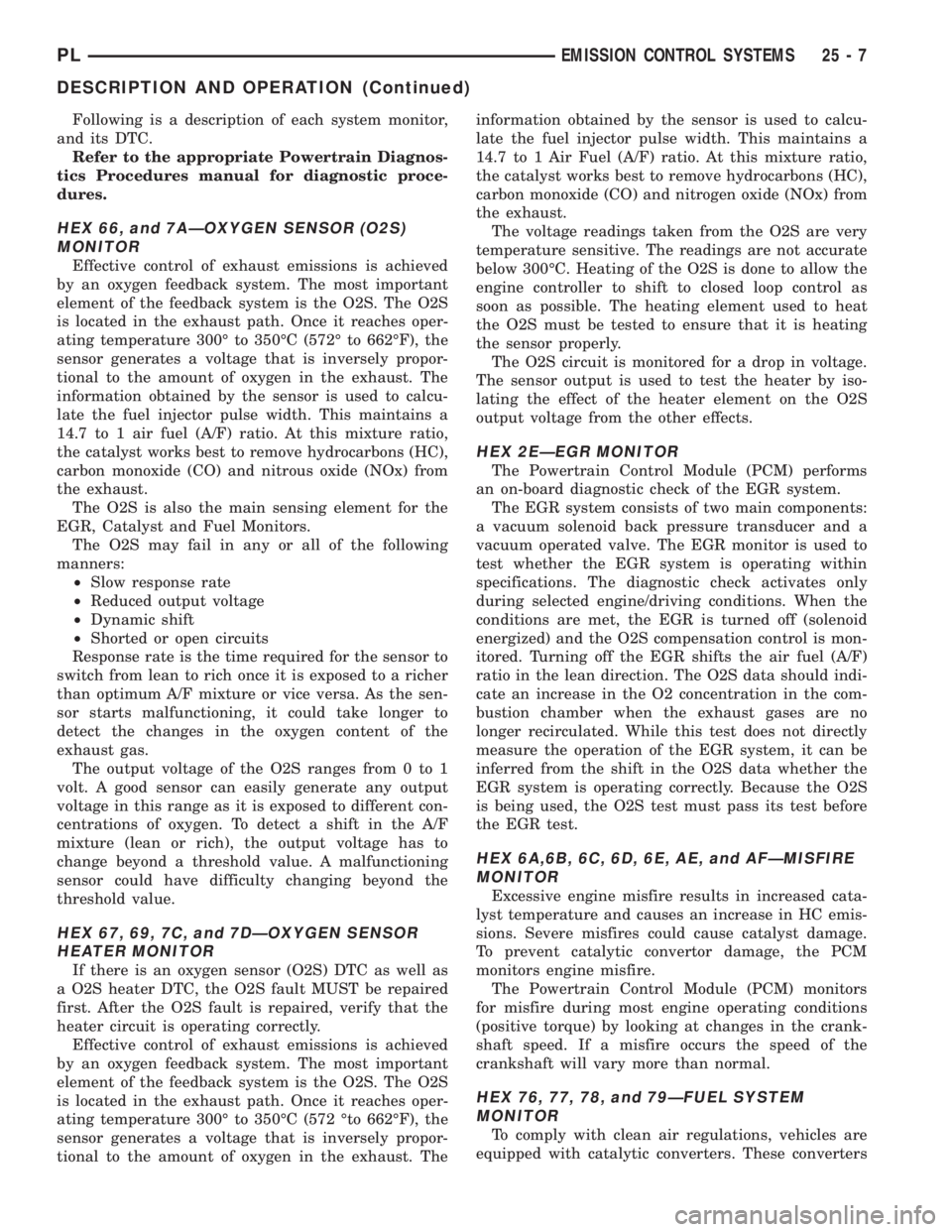
Following is a description of each system monitor,
and its DTC.
Refer to the appropriate Powertrain Diagnos-
tics Procedures manual for diagnostic proce-
dures.
HEX 66, and 7AÐOXYGEN SENSOR (O2S)
MONITOR
Effective control of exhaust emissions is achieved
by an oxygen feedback system. The most important
element of the feedback system is the O2S. The O2S
is located in the exhaust path. Once it reaches oper-
ating temperature 300É to 350ÉC (572É to 662ÉF), the
sensor generates a voltage that is inversely propor-
tional to the amount of oxygen in the exhaust. The
information obtained by the sensor is used to calcu-
late the fuel injector pulse width. This maintains a
14.7 to 1 air fuel (A/F) ratio. At this mixture ratio,
the catalyst works best to remove hydrocarbons (HC),
carbon monoxide (CO) and nitrous oxide (NOx) from
the exhaust.
The O2S is also the main sensing element for the
EGR, Catalyst and Fuel Monitors.
The O2S may fail in any or all of the following
manners:
²Slow response rate
²Reduced output voltage
²Dynamic shift
²Shorted or open circuits
Response rate is the time required for the sensor to
switch from lean to rich once it is exposed to a richer
than optimum A/F mixture or vice versa. As the sen-
sor starts malfunctioning, it could take longer to
detect the changes in the oxygen content of the
exhaust gas.
The output voltage of the O2S ranges from 0 to 1
volt. A good sensor can easily generate any output
voltage in this range as it is exposed to different con-
centrations of oxygen. To detect a shift in the A/F
mixture (lean or rich), the output voltage has to
change beyond a threshold value. A malfunctioning
sensor could have difficulty changing beyond the
threshold value.
HEX 67, 69, 7C, and 7DÐOXYGEN SENSOR
HEATER MONITOR
If there is an oxygen sensor (O2S) DTC as well as
a O2S heater DTC, the O2S fault MUST be repaired
first. After the O2S fault is repaired, verify that the
heater circuit is operating correctly.
Effective control of exhaust emissions is achieved
by an oxygen feedback system. The most important
element of the feedback system is the O2S. The O2S
is located in the exhaust path. Once it reaches oper-
ating temperature 300É to 350ÉC (572 Éto 662ÉF), the
sensor generates a voltage that is inversely propor-
tional to the amount of oxygen in the exhaust. Theinformation obtained by the sensor is used to calcu-
late the fuel injector pulse width. This maintains a
14.7 to 1 Air Fuel (A/F) ratio. At this mixture ratio,
the catalyst works best to remove hydrocarbons (HC),
carbon monoxide (CO) and nitrogen oxide (NOx) from
the exhaust.
The voltage readings taken from the O2S are very
temperature sensitive. The readings are not accurate
below 300ÉC. Heating of the O2S is done to allow the
engine controller to shift to closed loop control as
soon as possible. The heating element used to heat
the O2S must be tested to ensure that it is heating
the sensor properly.
The O2S circuit is monitored for a drop in voltage.
The sensor output is used to test the heater by iso-
lating the effect of the heater element on the O2S
output voltage from the other effects.
HEX 2EÐEGR MONITOR
The Powertrain Control Module (PCM) performs
an on-board diagnostic check of the EGR system.
The EGR system consists of two main components:
a vacuum solenoid back pressure transducer and a
vacuum operated valve. The EGR monitor is used to
test whether the EGR system is operating within
specifications. The diagnostic check activates only
during selected engine/driving conditions. When the
conditions are met, the EGR is turned off (solenoid
energized) and the O2S compensation control is mon-
itored. Turning off the EGR shifts the air fuel (A/F)
ratio in the lean direction. The O2S data should indi-
cate an increase in the O2 concentration in the com-
bustion chamber when the exhaust gases are no
longer recirculated. While this test does not directly
measure the operation of the EGR system, it can be
inferred from the shift in the O2S data whether the
EGR system is operating correctly. Because the O2S
is being used, the O2S test must pass its test before
the EGR test.
HEX 6A,6B, 6C, 6D, 6E, AE, and AFÐMISFIRE
MONITOR
Excessive engine misfire results in increased cata-
lyst temperature and causes an increase in HC emis-
sions. Severe misfires could cause catalyst damage.
To prevent catalytic convertor damage, the PCM
monitors engine misfire.
The Powertrain Control Module (PCM) monitors
for misfire during most engine operating conditions
(positive torque) by looking at changes in the crank-
shaft speed. If a misfire occurs the speed of the
crankshaft will vary more than normal.
HEX 76, 77, 78, and 79ÐFUEL SYSTEM
MONITOR
To comply with clean air regulations, vehicles are
equipped with catalytic converters. These converters
PLEMISSION CONTROL SYSTEMS 25 - 7
DESCRIPTION AND OPERATION (Continued)
Page 1181 of 1200
EXHAUST GAS RECIRCULATION (EGR) SYSTEM
INDEX
page page
DESCRIPTION AND OPERATION
EXHAUST GAS RECIRCULATION (EGR)
SYSTEM............................. 18
DIAGNOSIS AND TESTING
EGR GAS FLOW TEST................... 19
EGR SYSTEM ON-BOARD DIAGNOSTICS..... 19
EGR SYSTEM TEST..................... 19EGR VALVE CONTROL (TRANSDUCER) TEST . 20
EGR VALVE LEAKAGE TEST............... 20
REMOVAL AND INSTALLATION
EGR TUBE............................. 22
EGRVALVE ............................ 21
SPECIFICATIONS
TORQUE.............................. 22
DESCRIPTION AND OPERATION
EXHAUST GAS RECIRCULATION (EGR) SYSTEM
Refer to Monitored Systems - EGR Monitor in this
group for more information.
The EGR system reduces oxides of nitrogen (NOx)
in engine exhaust and helps prevent detonation
(engine knock). Under normal operating conditions,
engine cylinder temperature can reach more than
3000ÉF. Formation of NOx increases proportionally
with combustion temperature. To reduce the emission
of these oxides, the cylinder temperature must be
lowered. The system allows a predetermined amount
of hot exhaust gas to recirculate and dilute the
incoming air/fuel mixture. The diluted air/fuel mix-
ture reduces peak flame temperature during combus-
tion.
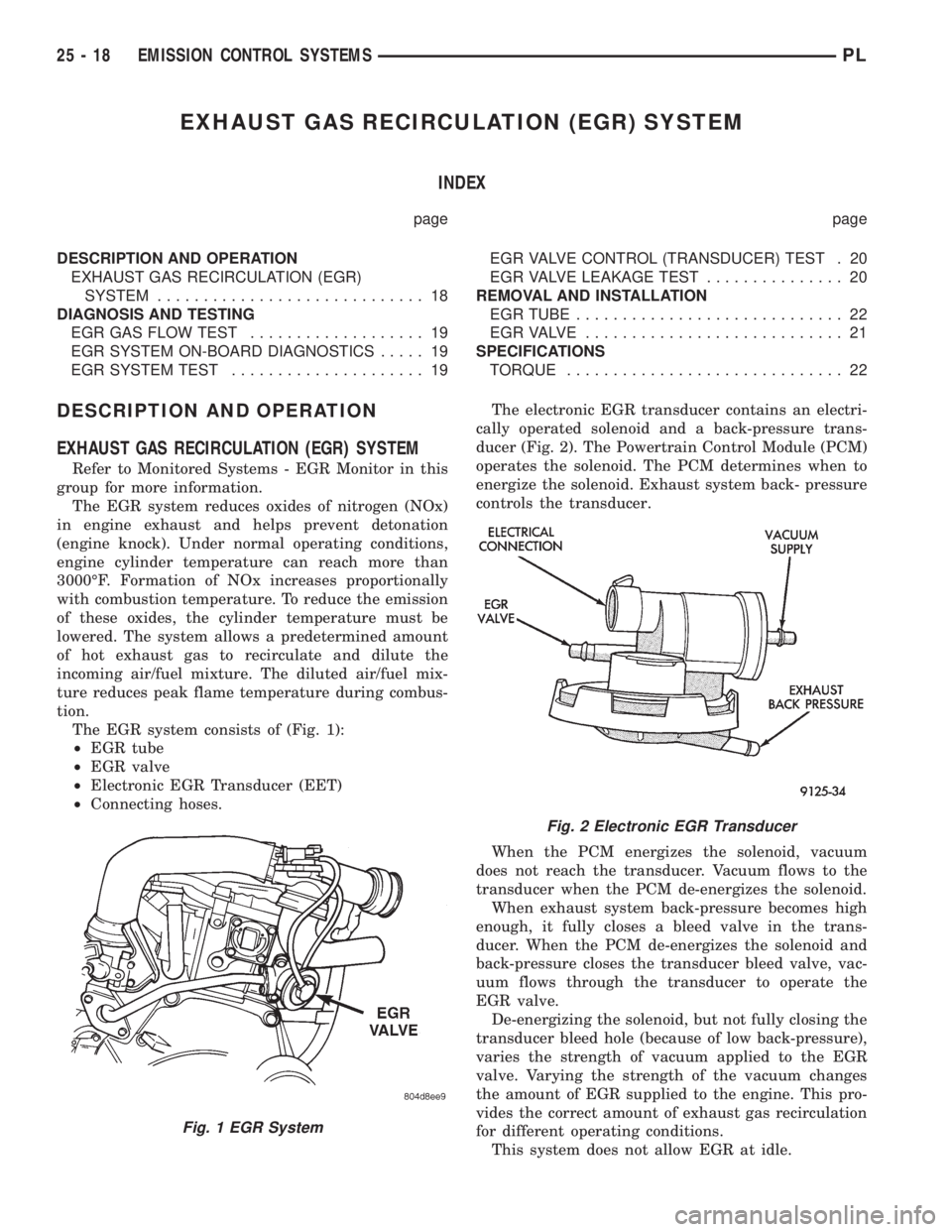
The EGR system consists of (Fig. 1):
²EGR tube
²EGR valve
²Electronic EGR Transducer (EET)
²Connecting hoses.The electronic EGR transducer contains an electri-
cally operated solenoid and a back-pressure trans-
ducer (Fig. 2). The Powertrain Control Module (PCM)
operates the solenoid. The PCM determines when to
energize the solenoid. Exhaust system back- pressure
controls the transducer.
When the PCM energizes the solenoid, vacuum
does not reach the transducer. Vacuum flows to the
transducer when the PCM de-energizes the solenoid.
When exhaust system back-pressure becomes high
enough, it fully closes a bleed valve in the trans-
ducer. When the PCM de-energizes the solenoid and
back-pressure closes the transducer bleed valve, vac-
uum flows through the transducer to operate the
EGR valve.
De-energizing the solenoid, but not fully closing the
transducer bleed hole (because of low back-pressure),
varies the strength of vacuum applied to the EGR
valve. Varying the strength of the vacuum changes
the amount of EGR supplied to the engine. This pro-
vides the correct amount of exhaust gas recirculation
for different operating conditions.
This system does not allow EGR at idle.
Fig. 1 EGR System
Fig. 2 Electronic EGR Transducer
25 - 18 EMISSION CONTROL SYSTEMSPL
Page 1184 of 1200
of the test will determine if engine vacuum (full-man-
ifold) is flowing from the inlet to the outlet side of
the valve. This is not to be used as a complete test of
the EGR system.
(1) Disconnect the rubber back-pressure hose from
the fitting at the bottom of EGR valve (Fig. 3).
(2) Connect a hand-held vacuum pump to this fit-
ting.
(3) Apply 10 inches of vacuum to this fitting.
(4) If vacuum falls off, the valve diaphragm is
leaking.
(5) Replace the Complete EGR valve assembly.
Proceed to next step for further testing.
(6) Reconnect hose to EGR valve.
(7) Remove the vacuum supply hose at the vacuum
inletfitting (Fig. 3) on the EGR solenoid.
(8) Connect a vacuum gauge to this disconnected
vacuum line.
(9) Start the engine and bring to operating tem-
perature. Hold engine speed at approximately 1500
rpm.
(10) Check for steady engine vacuum (full-mani-
fold) at this hose.
(11) If engine vacuum (full-manifold) is not
present, check vacuum line to engine and repair as
necessary before proceeding to next step.
(12) Reconnect the rubber hose to the vacuum
inletfitting (Fig. 3) on the EGR valve.
(13) Disconnect the rubber hose at the vacuum
outletfitting (Fig. 3) on the EGR valve.
(14) Connect a vacuum gauge to this fitting.
(15) Disconnect the electrical connector (Fig. 3) at
the valve control. This will simulate an open circuit
(no ground from the PCM) at the valve, activating
the valve. A DTC will be set in the PCM that must
be erased after testing is complete.
(16) Start the engine and bring to operating tem-
perature.
(17) Hold the engine speed to approximately 2000
rpm while checking for engine vacuum (full-manifold)
at this fitting.To allow full manifold vacuum to
flow through the valve, exhaust back-pressure
must be present at valve. It must be high
enough to hold the bleed valve in the trans-
ducer portion of the valve closed.Have a helper
momentarily (a second or two) hold a rag over the
tailpipe opening to build some exhaust back-pressure
while observing the vacuum gauge. Heavy gloves
should be worn.Do not cover the tailpipe open-
ing for an extended period of time as damage to
components or overheating may result.(18) As temporary back-pressure is built, full man-
ifold vacuum should be observed at the vacuum out-
let fitting. Without back-pressure, and engine at
approximately 2000 rpm, the gauge reading will be
low. This low reading is normal. At idle speed, the
gauge reading may be erratic. This is also normal.
(19) If full manifold vacuum is not present at the
outlet fitting, but was present at the inlet fitting,
replace the valve. Note: The EGR valve, valve control
and attaching hoses are serviced as one assembly.
Refer to EGR Valve Removal/Installation in this
group.
REMOVAL AND INSTALLATION
EGR VALVE
If the EGR system operates incorrectly, replace the
entire EGR valve and transducer together. The EGR
valve and electrical transducer are calibrated
together.
REMOVAL
The EGR valve attaches to the rear of the cylinder
head (Fig. 5). EGR transducer is attached to the air
inlet duct.
(1) Remove EGR transducer from air inlet duct.
(2) Disconnect vacuum supply tube from EGR
transducer solenoid.
(3) Disconnect electrical connector from solenoid.
(4) Remove air inlet duct.
(5) Remove EGR tube to EGR valve screws.
(6) Remove EGR valve mounting screws. Remove
EGR valve and transducer.
(7) Clean gasket surfaces. Discard old gaskets. If
necessary, clean EGR passages.
INSTALLATION
(1) Loosely install EGR valve with new gaskets.
(2) Finger tighten EGR tube fasteners.
(3) Tighten EGR tube fasteners to 11 N´m (95 in.
lbs.) torque.
(4) Tightening EGR valve mounting screws to 22
N´m (200 in. lbs.) torque.
(5) Install air inlet duct.
(6) Connect vacuum supply tube to solenoid.
(7) Attach electrical connector to solenoid.
(8) Install EGR transducer onto air inlet duct.
PLEMISSION CONTROL SYSTEMS 25 - 21
DIAGNOSIS AND TESTING (Continued)