lock DODGE NEON 1999 Service Owner's Guide
[x] Cancel search | Manufacturer: DODGE, Model Year: 1999, Model line: NEON, Model: DODGE NEON 1999Pages: 1200, PDF Size: 35.29 MB
Page 127 of 1200
INSTALL
(1) Position power brake booster onto dash panel.
(2) Install and torque the 4 power brake vacuum
booster mounting nuts (Fig. 121) to 29 N´m (250 in.
lbs.) torque.
(3) Using lubriplate, or equivalent, coat the sur-
face of the brake pedal pin where it contacts the
brake vacuum booster input rod.
(4) Connect power brake vacuum booster input rod
to brake pedal pin and install a NEW retaining clip.
Use only a new retainer clip DO NOT USE the
old clip.
(5) Connect all previously removed vacuum hoses
onto power brake vacuum booster check valve (Fig.
119).
(6) If vehicle is equipped with ABS, install HCU.
Refer to Antilock Brake System Hydraulic Control
Unit in the Removal And Installation Section of the
Antilock Brake System Section of this service manual
for the required procedure.
CAUTION: When replacing the power brake vac-
uum booster on a vehicle equipped with ABS, a
NEW vacuum seal MUST be installed in the power
brake vacuum booster. Use only the procedure
detailed below for installing vacuum seal into power
brake vacuum booster. If old vacuum seal came out
with master cylinder when it was removed from
power brake vacuum booster, be sure it is removed
from master cylinder before attempting to install
master cylinder into power brake vacuum booster.
CAUTION: When lubricating master cylinder push
rod, use only Mopar Silicone Dielectric Compound.
Using any other type of grease or lubricant on the
push rod, will not provide adequate long term lubri-
cation of the push rod.
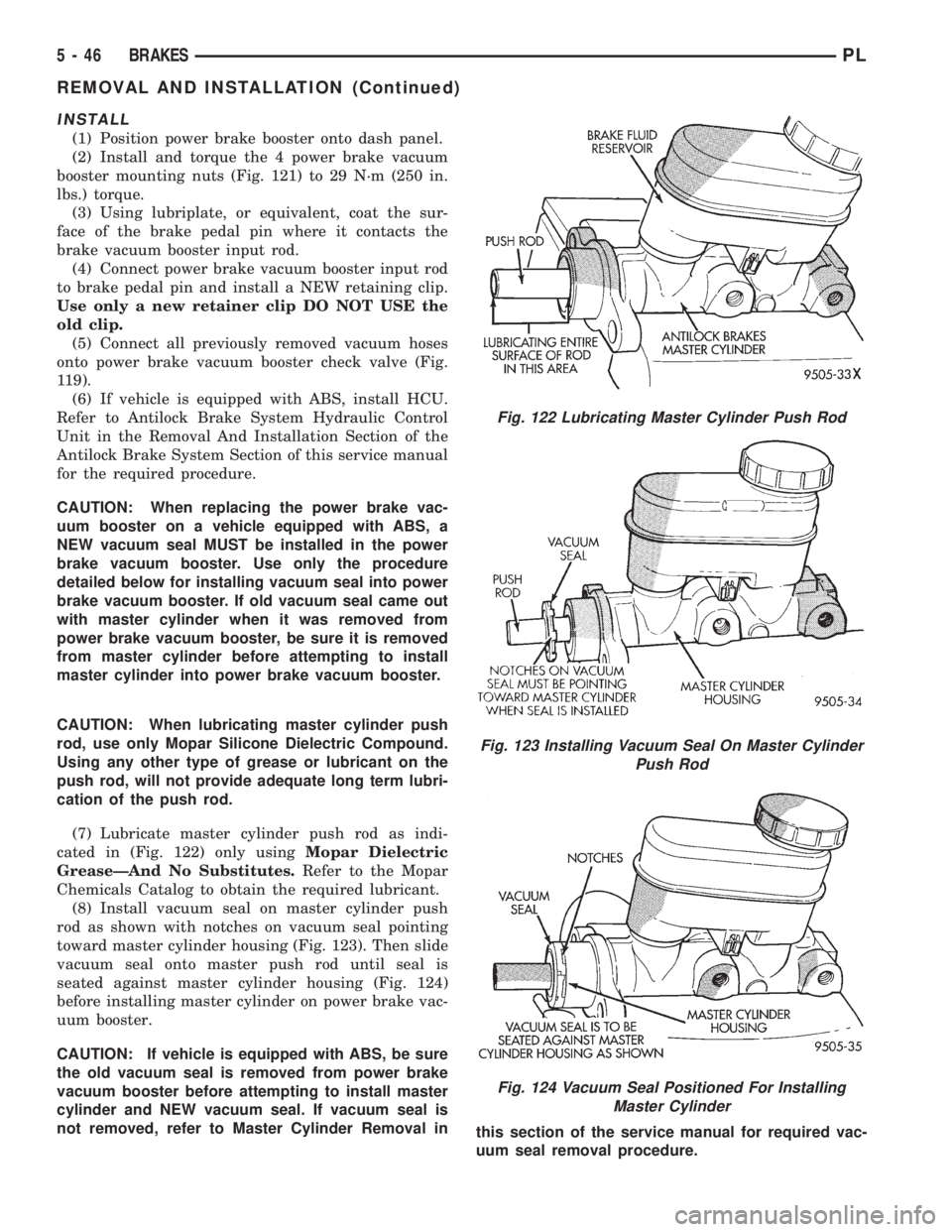
(7) Lubricate master cylinder push rod as indi-
cated in (Fig. 122) only usingMopar Dielectric
GreaseÐAnd No Substitutes.Refer to the Mopar
Chemicals Catalog to obtain the required lubricant.
(8) Install vacuum seal on master cylinder push
rod as shown with notches on vacuum seal pointing
toward master cylinder housing (Fig. 123). Then slide
vacuum seal onto master push rod until seal is
seated against master cylinder housing (Fig. 124)
before installing master cylinder on power brake vac-
uum booster.
CAUTION: If vehicle is equipped with ABS, be sure
the old vacuum seal is removed from power brake
vacuum booster before attempting to install master
cylinder and NEW vacuum seal. If vacuum seal is
not removed, refer to Master Cylinder Removal in
this section of the service manual for required vac-
uum seal removal procedure.
Fig. 122 Lubricating Master Cylinder Push Rod
Fig. 123 Installing Vacuum Seal On Master Cylinder
Push Rod
Fig. 124 Vacuum Seal Positioned For Installing
Master Cylinder
5 - 46 BRAKESPL
REMOVAL AND INSTALLATION (Continued)
Page 129 of 1200
PARK BRAKE LEVER ASSEMBLY
WARNING: THE AUTO ADJUSTING FEATURE OF
THIS PARKING BRAKE LEVER ASSEMBLY CON-
TAINS A CLOCK SPRING LOADED TO APPROXI-
MATELY 20 POUNDS. DO NOT RELEASE THE AUTO
ADJUSTER LOCKOUT DEVICE BEFORE INSTALL-
ING CABLES INTO THE EQUALIZER. KEEP HANDS
OUT OF AUTO ADJUSTER SECTOR AND PAWL
AREA. FAILURE TO OBSERVE CAUTION IN HAN-
DLING THIS MECHANISM COULD LEAD TO SERI-
OUS INJURY.
REMOVE
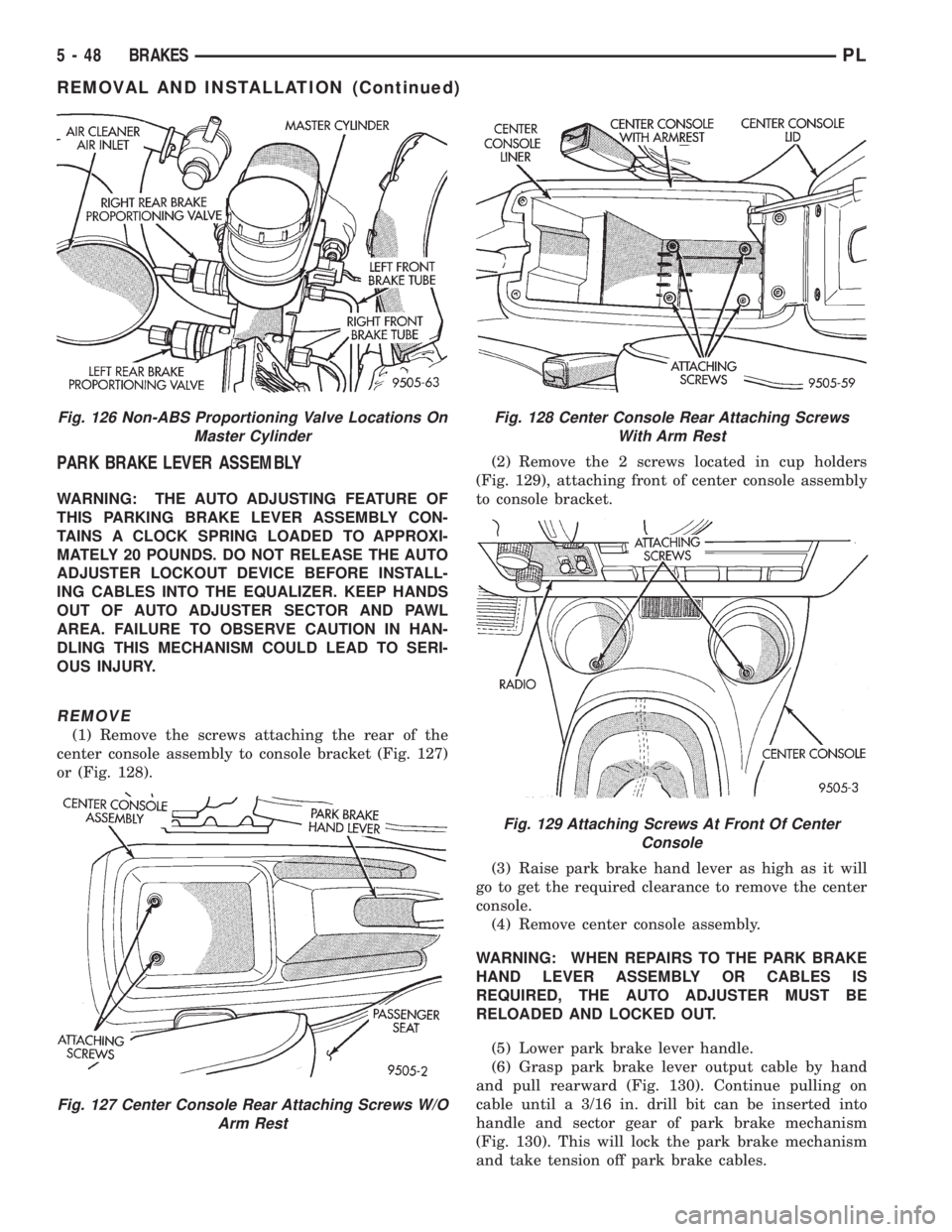
(1) Remove the screws attaching the rear of the
center console assembly to console bracket (Fig. 127)
or (Fig. 128).(2) Remove the 2 screws located in cup holders
(Fig. 129), attaching front of center console assembly
to console bracket.
(3) Raise park brake hand lever as high as it will
go to get the required clearance to remove the center
console.
(4) Remove center console assembly.
WARNING: WHEN REPAIRS TO THE PARK BRAKE
HAND LEVER ASSEMBLY OR CABLES IS
REQUIRED, THE AUTO ADJUSTER MUST BE
RELOADED AND LOCKED OUT.
(5) Lower park brake lever handle.
(6) Grasp park brake lever output cable by hand
and pull rearward (Fig. 130). Continue pulling on
cable until a 3/16 in. drill bit can be inserted into
handle and sector gear of park brake mechanism
(Fig. 130). This will lock the park brake mechanism
and take tension off park brake cables.
Fig. 126 Non-ABS Proportioning Valve Locations On
Master Cylinder
Fig. 127 Center Console Rear Attaching Screws W/O
Arm Rest
Fig. 128 Center Console Rear Attaching Screws
With Arm Rest
Fig. 129 Attaching Screws At Front Of Center
Console
5 - 48 BRAKESPL
REMOVAL AND INSTALLATION (Continued)
Page 130 of 1200
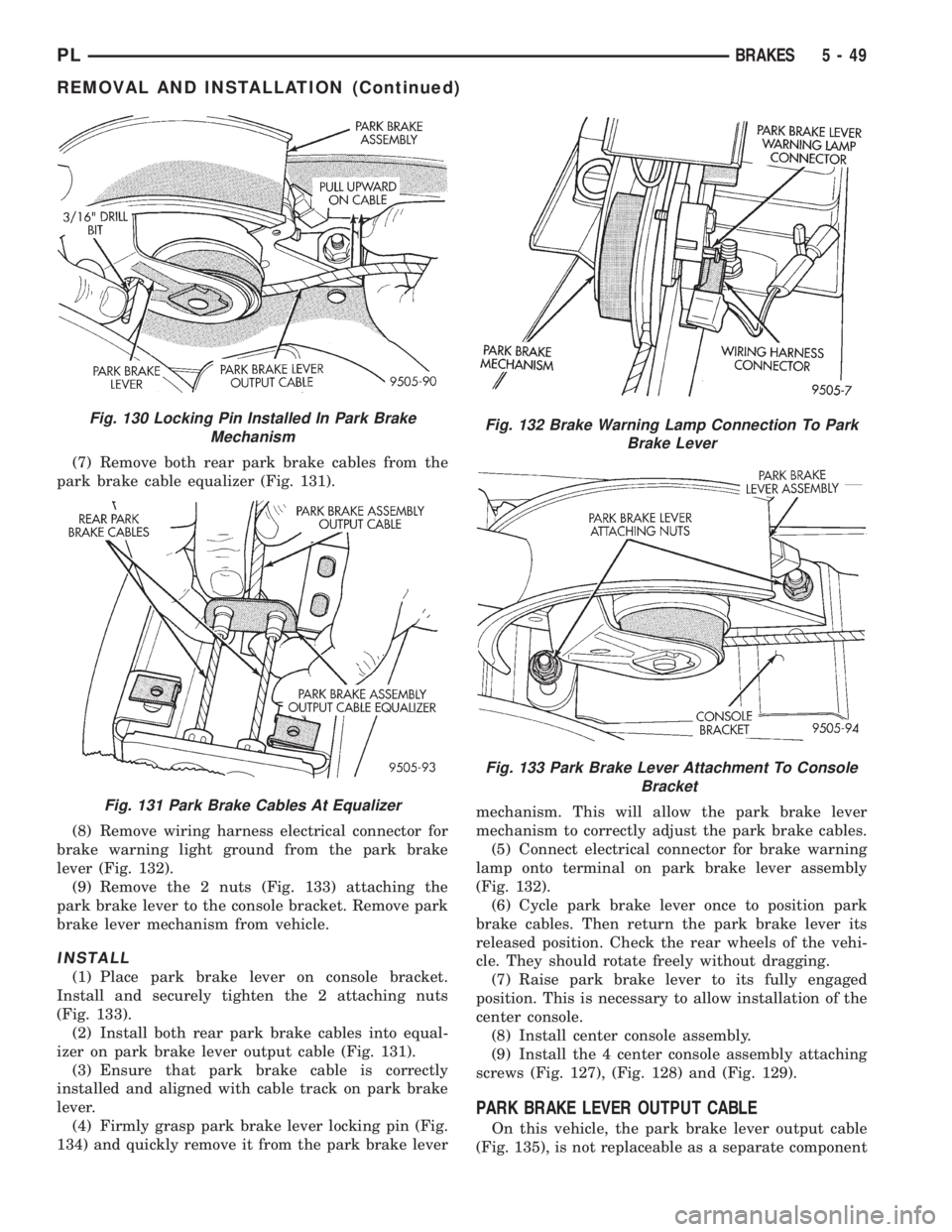
(7) Remove both rear park brake cables from the
park brake cable equalizer (Fig. 131).
(8) Remove wiring harness electrical connector for
brake warning light ground from the park brake
lever (Fig. 132).
(9) Remove the 2 nuts (Fig. 133) attaching the
park brake lever to the console bracket. Remove park
brake lever mechanism from vehicle.
INSTALL
(1) Place park brake lever on console bracket.
Install and securely tighten the 2 attaching nuts
(Fig. 133).
(2) Install both rear park brake cables into equal-
izer on park brake lever output cable (Fig. 131).
(3) Ensure that park brake cable is correctly
installed and aligned with cable track on park brake
lever.
(4) Firmly grasp park brake lever locking pin (Fig.
134) and quickly remove it from the park brake levermechanism. This will allow the park brake lever
mechanism to correctly adjust the park brake cables.
(5) Connect electrical connector for brake warning
lamp onto terminal on park brake lever assembly
(Fig. 132).
(6) Cycle park brake lever once to position park
brake cables. Then return the park brake lever its
released position. Check the rear wheels of the vehi-
cle. They should rotate freely without dragging.
(7) Raise park brake lever to its fully engaged
position. This is necessary to allow installation of the
center console.
(8) Install center console assembly.
(9) Install the 4 center console assembly attaching
screws (Fig. 127), (Fig. 128) and (Fig. 129).
PARK BRAKE LEVER OUTPUT CABLE
On this vehicle, the park brake lever output cable
(Fig. 135), is not replaceable as a separate component
Fig. 130 Locking Pin Installed In Park Brake
Mechanism
Fig. 131 Park Brake Cables At Equalizer
Fig. 132 Brake Warning Lamp Connection To Park
Brake Lever
Fig. 133 Park Brake Lever Attachment To Console
Bracket
PLBRAKES 5 - 49
REMOVAL AND INSTALLATION (Continued)
Page 131 of 1200
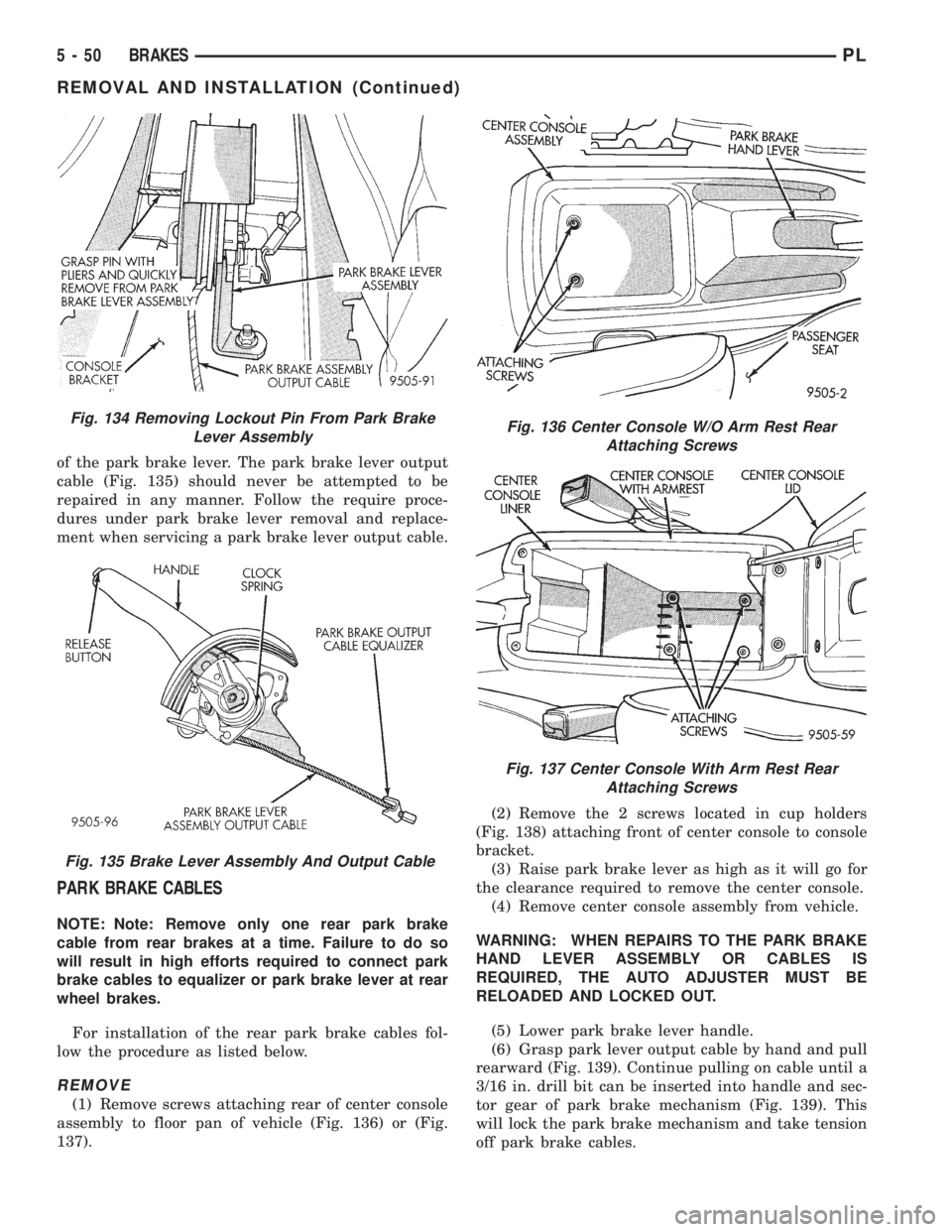
of the park brake lever. The park brake lever output
cable (Fig. 135) should never be attempted to be
repaired in any manner. Follow the require proce-
dures under park brake lever removal and replace-
ment when servicing a park brake lever output cable.
PARK BRAKE CABLES
NOTE: Note: Remove only one rear park brake
cable from rear brakes at a time. Failure to do so
will result in high efforts required to connect park
brake cables to equalizer or park brake lever at rear
wheel brakes.
For installation of the rear park brake cables fol-
low the procedure as listed below.
REMOVE
(1) Remove screws attaching rear of center console
assembly to floor pan of vehicle (Fig. 136) or (Fig.
137).(2) Remove the 2 screws located in cup holders
(Fig. 138) attaching front of center console to console
bracket.
(3) Raise park brake lever as high as it will go for
the clearance required to remove the center console.
(4) Remove center console assembly from vehicle.
WARNING: WHEN REPAIRS TO THE PARK BRAKE
HAND LEVER ASSEMBLY OR CABLES IS
REQUIRED, THE AUTO ADJUSTER MUST BE
RELOADED AND LOCKED OUT.
(5) Lower park brake lever handle.
(6) Grasp park lever output cable by hand and pull
rearward (Fig. 139). Continue pulling on cable until a
3/16 in. drill bit can be inserted into handle and sec-
tor gear of park brake mechanism (Fig. 139). This
will lock the park brake mechanism and take tension
off park brake cables.
Fig. 134 Removing Lockout Pin From Park Brake
Lever Assembly
Fig. 135 Brake Lever Assembly And Output Cable
Fig. 136 Center Console W/O Arm Rest Rear
Attaching Screws
Fig. 137 Center Console With Arm Rest Rear
Attaching Screws
5 - 50 BRAKESPL
REMOVAL AND INSTALLATION (Continued)
Page 132 of 1200
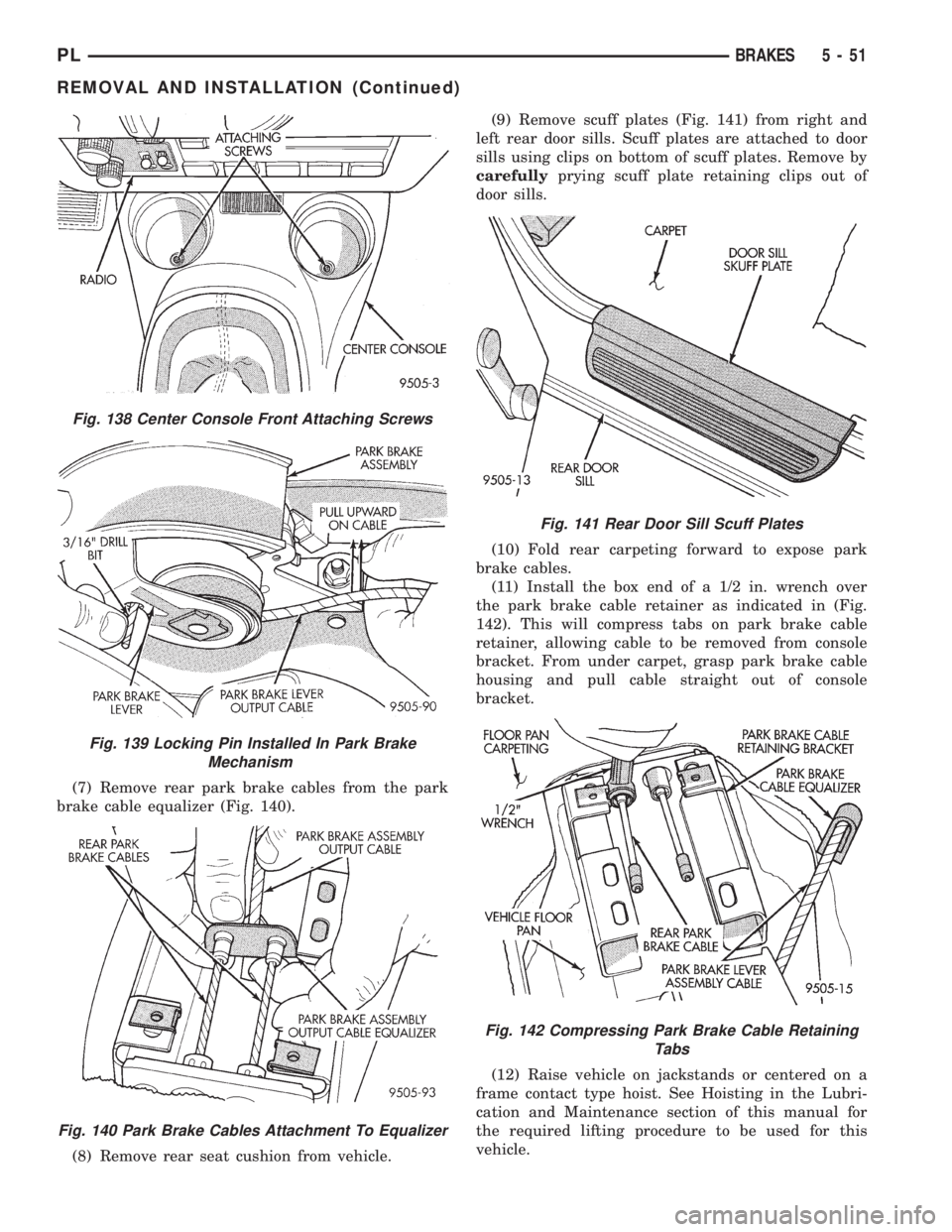
(7) Remove rear park brake cables from the park
brake cable equalizer (Fig. 140).
(8) Remove rear seat cushion from vehicle.(9) Remove scuff plates (Fig. 141) from right and
left rear door sills. Scuff plates are attached to door
sills using clips on bottom of scuff plates. Remove by
carefullyprying scuff plate retaining clips out of
door sills.
(10) Fold rear carpeting forward to expose park
brake cables.
(11) Install the box end of a 1/2 in. wrench over
the park brake cable retainer as indicated in (Fig.
142). This will compress tabs on park brake cable
retainer, allowing cable to be removed from console
bracket. From under carpet, grasp park brake cable
housing and pull cable straight out of console
bracket.
(12) Raise vehicle on jackstands or centered on a
frame contact type hoist. See Hoisting in the Lubri-
cation and Maintenance section of this manual for
the required lifting procedure to be used for this
vehicle.
Fig. 138 Center Console Front Attaching Screws
Fig. 139 Locking Pin Installed In Park Brake
Mechanism
Fig. 140 Park Brake Cables Attachment To Equalizer
Fig. 141 Rear Door Sill Scuff Plates
Fig. 142 Compressing Park Brake Cable Retaining
Tabs
PLBRAKES 5 - 51
REMOVAL AND INSTALLATION (Continued)
Page 134 of 1200
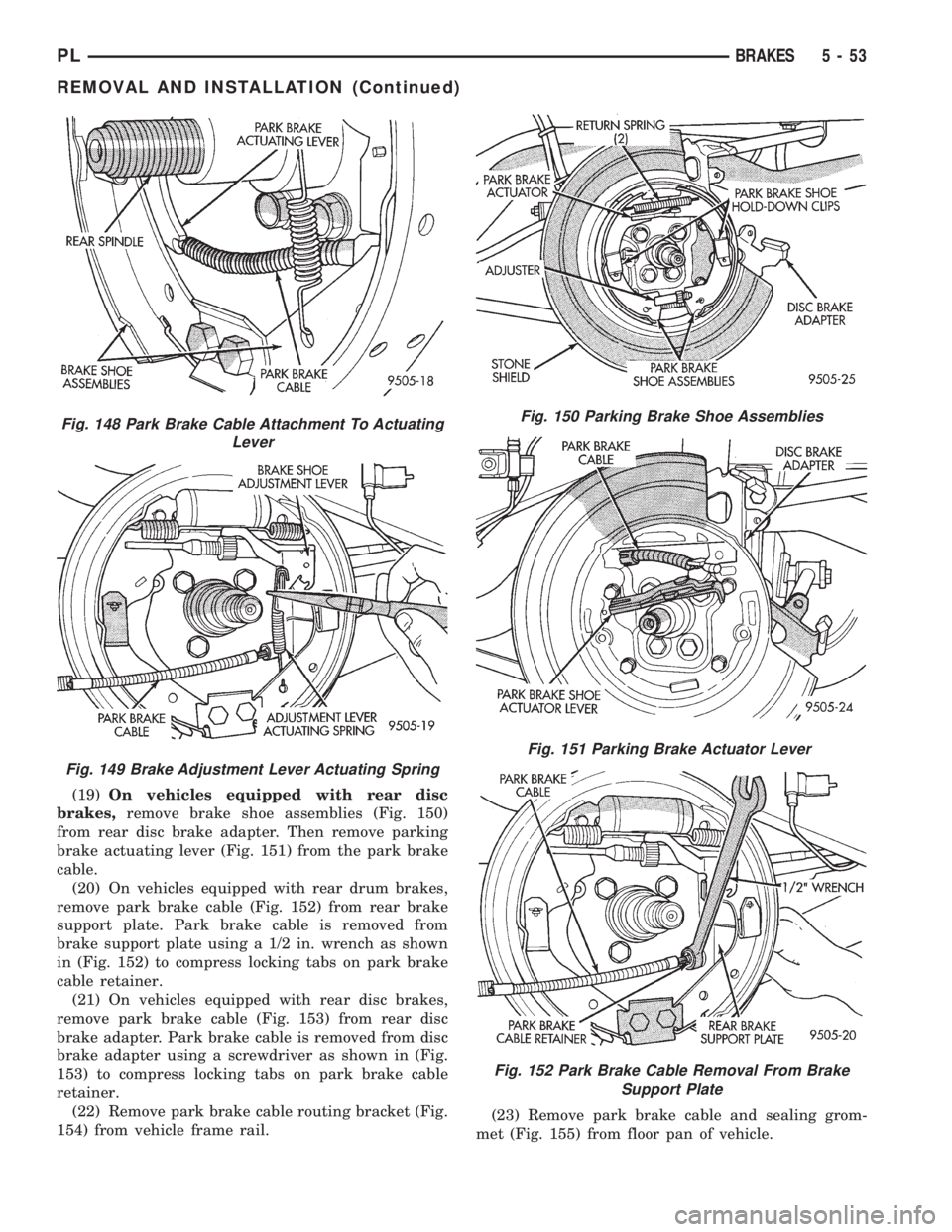
(19)On vehicles equipped with rear disc
brakes,remove brake shoe assemblies (Fig. 150)
from rear disc brake adapter. Then remove parking
brake actuating lever (Fig. 151) from the park brake
cable.
(20) On vehicles equipped with rear drum brakes,
remove park brake cable (Fig. 152) from rear brake
support plate. Park brake cable is removed from
brake support plate using a 1/2 in. wrench as shown
in (Fig. 152) to compress locking tabs on park brake
cable retainer.
(21) On vehicles equipped with rear disc brakes,
remove park brake cable (Fig. 153) from rear disc
brake adapter. Park brake cable is removed from disc
brake adapter using a screwdriver as shown in (Fig.
153) to compress locking tabs on park brake cable
retainer.
(22) Remove park brake cable routing bracket (Fig.
154) from vehicle frame rail.(23) Remove park brake cable and sealing grom-
met (Fig. 155) from floor pan of vehicle.
Fig. 148 Park Brake Cable Attachment To Actuating
Lever
Fig. 149 Brake Adjustment Lever Actuating Spring
Fig. 150 Parking Brake Shoe Assemblies
Fig. 151 Parking Brake Actuator Lever
Fig. 152 Park Brake Cable Removal From Brake
Support Plate
PLBRAKES 5 - 53
REMOVAL AND INSTALLATION (Continued)
Page 135 of 1200
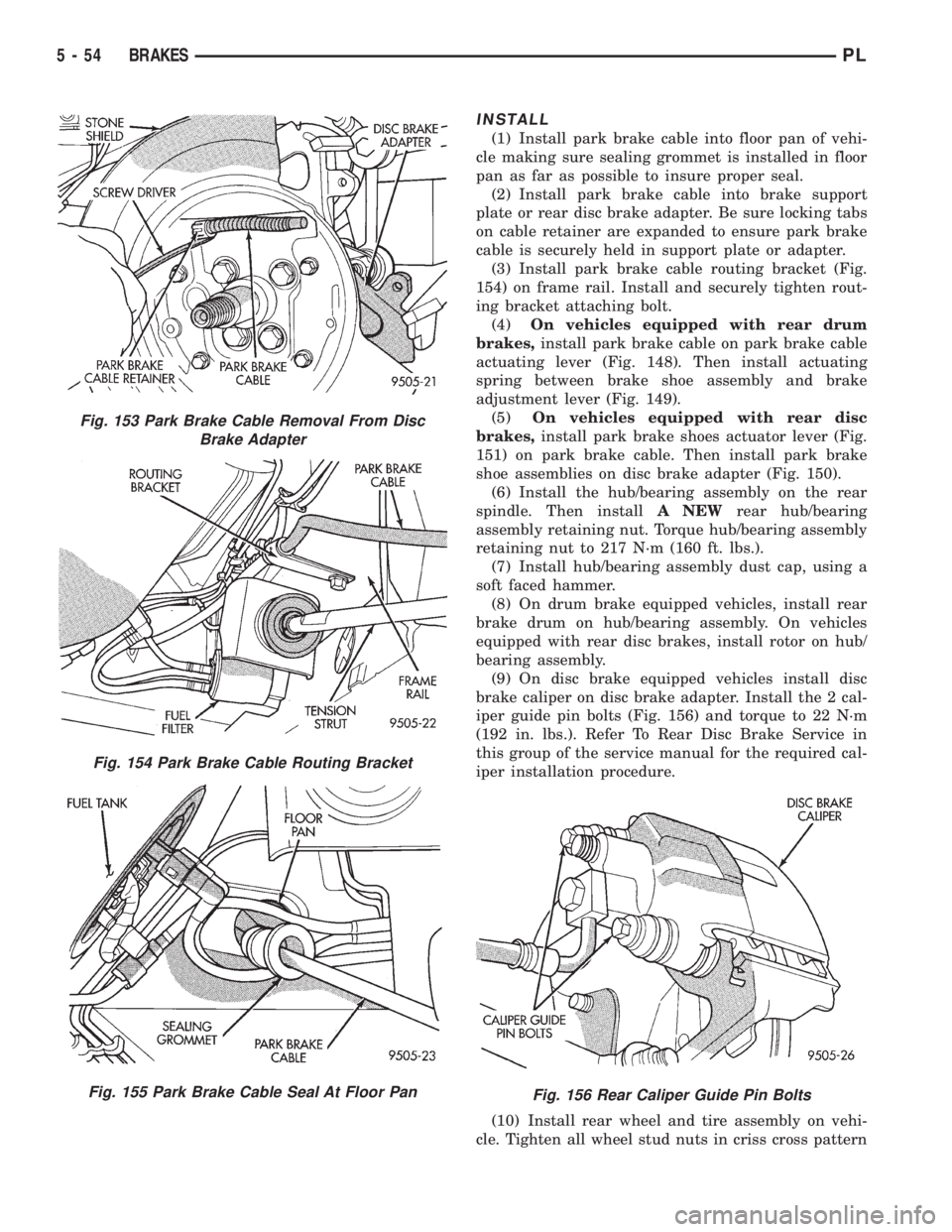
INSTALL
(1) Install park brake cable into floor pan of vehi-
cle making sure sealing grommet is installed in floor
pan as far as possible to insure proper seal.
(2) Install park brake cable into brake support
plate or rear disc brake adapter. Be sure locking tabs
on cable retainer are expanded to ensure park brake
cable is securely held in support plate or adapter.
(3) Install park brake cable routing bracket (Fig.
154) on frame rail. Install and securely tighten rout-
ing bracket attaching bolt.
(4)On vehicles equipped with rear drum
brakes,install park brake cable on park brake cable
actuating lever (Fig. 148). Then install actuating
spring between brake shoe assembly and brake
adjustment lever (Fig. 149).
(5)On vehicles equipped with rear disc
brakes,install park brake shoes actuator lever (Fig.
151) on park brake cable. Then install park brake
shoe assemblies on disc brake adapter (Fig. 150).
(6) Install the hub/bearing assembly on the rear
spindle. Then installA NEWrear hub/bearing
assembly retaining nut. Torque hub/bearing assembly
retaining nut to 217 N´m (160 ft. lbs.).
(7) Install hub/bearing assembly dust cap, using a
soft faced hammer.
(8) On drum brake equipped vehicles, install rear
brake drum on hub/bearing assembly. On vehicles
equipped with rear disc brakes, install rotor on hub/
bearing assembly.
(9) On disc brake equipped vehicles install disc
brake caliper on disc brake adapter. Install the 2 cal-
iper guide pin bolts (Fig. 156) and torque to 22 N´m
(192 in. lbs.). Refer To Rear Disc Brake Service in
this group of the service manual for the required cal-
iper installation procedure.
(10) Install rear wheel and tire assembly on vehi-
cle. Tighten all wheel stud nuts in criss cross pattern
Fig. 153 Park Brake Cable Removal From Disc
Brake Adapter
Fig. 154 Park Brake Cable Routing Bracket
Fig. 155 Park Brake Cable Seal At Floor PanFig. 156 Rear Caliper Guide Pin Bolts
5 - 54 BRAKESPL
Page 136 of 1200
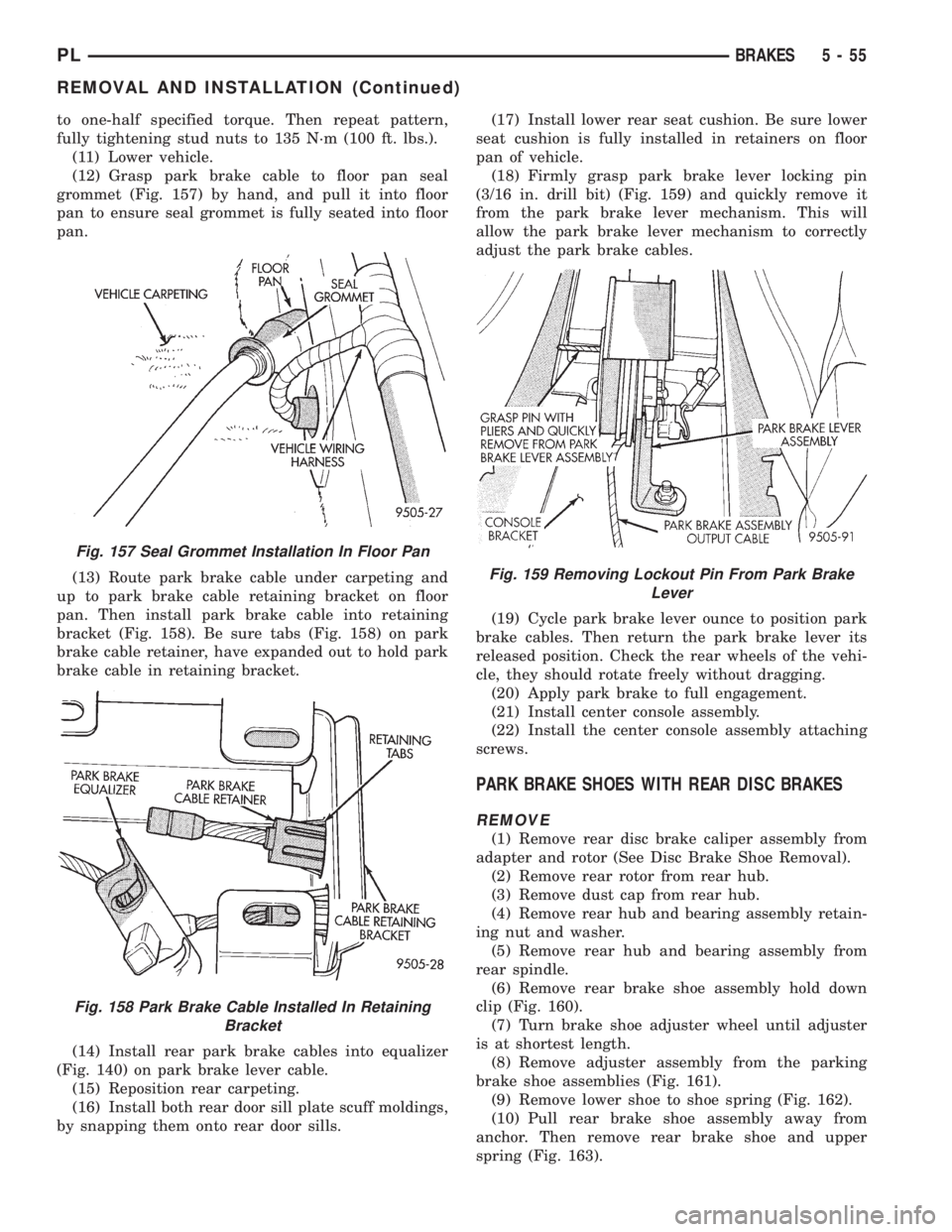
to one-half specified torque. Then repeat pattern,
fully tightening stud nuts to 135 N´m (100 ft. lbs.).
(11) Lower vehicle.
(12) Grasp park brake cable to floor pan seal
grommet (Fig. 157) by hand, and pull it into floor
pan to ensure seal grommet is fully seated into floor
pan.
(13) Route park brake cable under carpeting and
up to park brake cable retaining bracket on floor
pan. Then install park brake cable into retaining
bracket (Fig. 158). Be sure tabs (Fig. 158) on park
brake cable retainer, have expanded out to hold park
brake cable in retaining bracket.
(14) Install rear park brake cables into equalizer
(Fig. 140) on park brake lever cable.
(15) Reposition rear carpeting.
(16) Install both rear door sill plate scuff moldings,
by snapping them onto rear door sills.(17) Install lower rear seat cushion. Be sure lower
seat cushion is fully installed in retainers on floor
pan of vehicle.
(18) Firmly grasp park brake lever locking pin
(3/16 in. drill bit) (Fig. 159) and quickly remove it
from the park brake lever mechanism. This will
allow the park brake lever mechanism to correctly
adjust the park brake cables.
(19) Cycle park brake lever ounce to position park
brake cables. Then return the park brake lever its
released position. Check the rear wheels of the vehi-
cle, they should rotate freely without dragging.
(20) Apply park brake to full engagement.
(21) Install center console assembly.
(22) Install the center console assembly attaching
screws.
PARK BRAKE SHOES WITH REAR DISC BRAKES
REMOVE
(1) Remove rear disc brake caliper assembly from
adapter and rotor (See Disc Brake Shoe Removal).
(2) Remove rear rotor from rear hub.
(3) Remove dust cap from rear hub.
(4) Remove rear hub and bearing assembly retain-
ing nut and washer.
(5) Remove rear hub and bearing assembly from
rear spindle.
(6) Remove rear brake shoe assembly hold down
clip (Fig. 160).
(7) Turn brake shoe adjuster wheel until adjuster
is at shortest length.
(8) Remove adjuster assembly from the parking
brake shoe assemblies (Fig. 161).
(9) Remove lower shoe to shoe spring (Fig. 162).
(10) Pull rear brake shoe assembly away from
anchor. Then remove rear brake shoe and upper
spring (Fig. 163).
Fig. 157 Seal Grommet Installation In Floor Pan
Fig. 158 Park Brake Cable Installed In Retaining
Bracket
Fig. 159 Removing Lockout Pin From Park Brake
Lever
PLBRAKES 5 - 55
REMOVAL AND INSTALLATION (Continued)
Page 137 of 1200
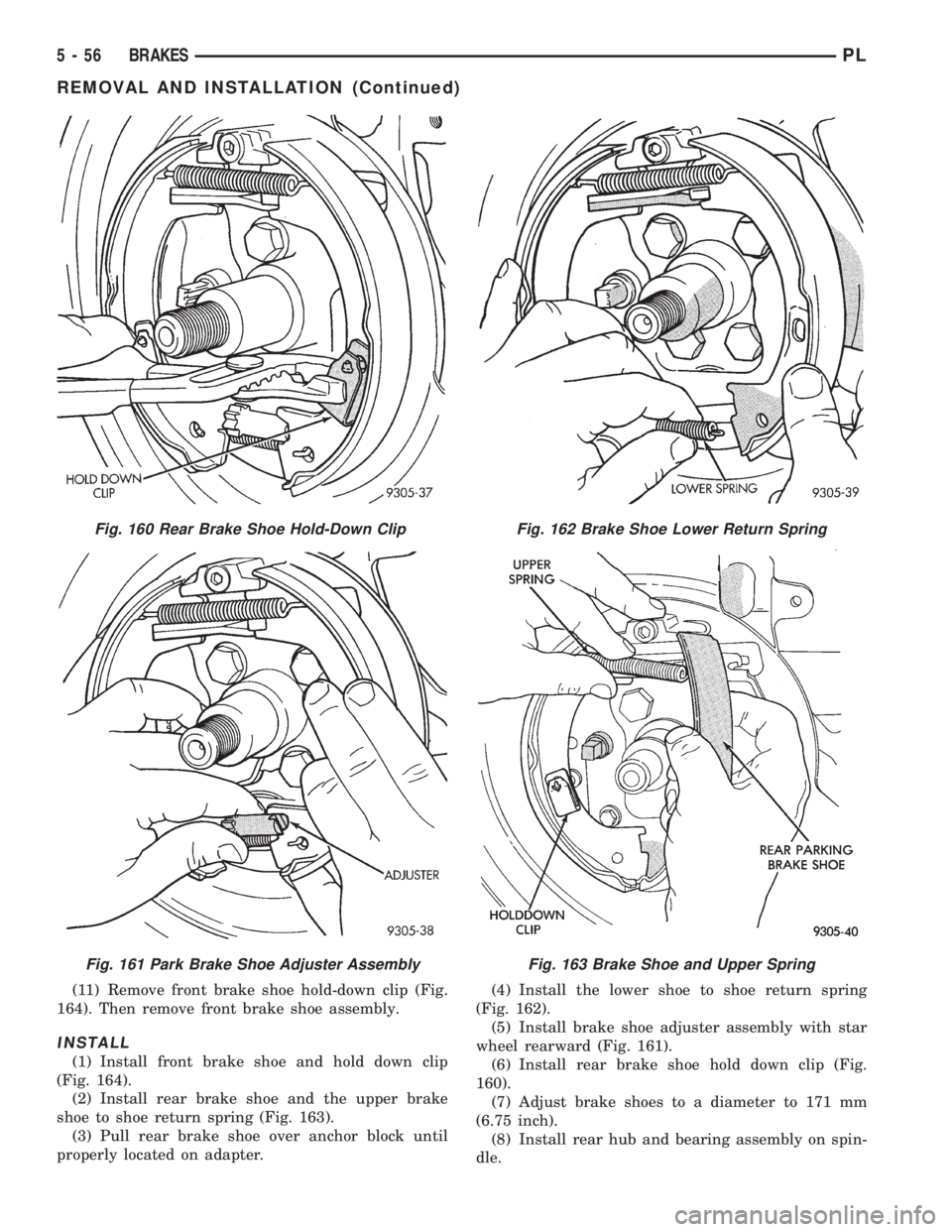
(11) Remove front brake shoe hold-down clip (Fig.
164). Then remove front brake shoe assembly.
INSTALL
(1) Install front brake shoe and hold down clip
(Fig. 164).
(2) Install rear brake shoe and the upper brake
shoe to shoe return spring (Fig. 163).
(3) Pull rear brake shoe over anchor block until
properly located on adapter.(4) Install the lower shoe to shoe return spring
(Fig. 162).
(5) Install brake shoe adjuster assembly with star
wheel rearward (Fig. 161).
(6) Install rear brake shoe hold down clip (Fig.
160).
(7) Adjust brake shoes to a diameter to 171 mm
(6.75 inch).
(8) Install rear hub and bearing assembly on spin-
dle.
Fig. 160 Rear Brake Shoe Hold-Down Clip
Fig. 161 Park Brake Shoe Adjuster Assembly
Fig. 162 Brake Shoe Lower Return Spring
Fig. 163 Brake Shoe and Upper Spring
5 - 56 BRAKESPL
REMOVAL AND INSTALLATION (Continued)
Page 138 of 1200
(9) InstallA NEWhub and bearing assembly
retaining nut. Torque the hub and bearing assembly
retaining nut to 168 N´m (124 ft. lbs.).
(10) Install hub and bearing assembly dust cap.
(11) Install rear rotor.
(12) Install rear disc brake caliper on the adapter
(See Brake Shoe Removal).
(13) Install wheel and tire assemblies.
(14) Tighten wheel stud nuts to 129 N´m (95
ft.lbs.).
STOP LAMP SWITCH
REMOVE
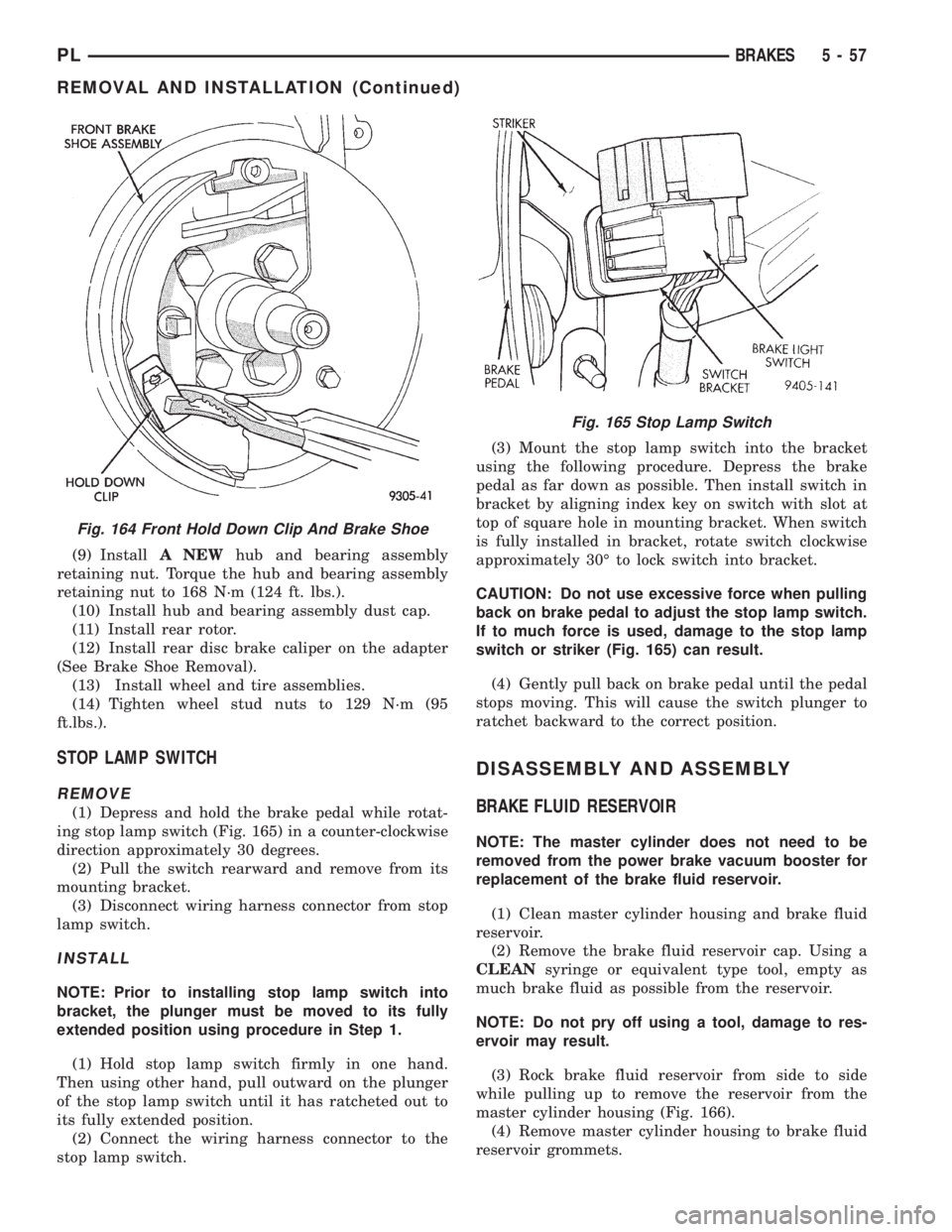
(1) Depress and hold the brake pedal while rotat-
ing stop lamp switch (Fig. 165) in a counter-clockwise
direction approximately 30 degrees.
(2) Pull the switch rearward and remove from its
mounting bracket.
(3) Disconnect wiring harness connector from stop
lamp switch.
INSTALL
NOTE: Prior to installing stop lamp switch into
bracket, the plunger must be moved to its fully
extended position using procedure in Step 1.
(1) Hold stop lamp switch firmly in one hand.
Then using other hand, pull outward on the plunger
of the stop lamp switch until it has ratcheted out to
its fully extended position.
(2) Connect the wiring harness connector to the
stop lamp switch.(3) Mount the stop lamp switch into the bracket
using the following procedure. Depress the brake
pedal as far down as possible. Then install switch in
bracket by aligning index key on switch with slot at
top of square hole in mounting bracket. When switch
is fully installed in bracket, rotate switch clockwise
approximately 30É to lock switch into bracket.
CAUTION: Do not use excessive force when pulling
back on brake pedal to adjust the stop lamp switch.
If to much force is used, damage to the stop lamp
switch or striker (Fig. 165) can result.
(4) Gently pull back on brake pedal until the pedal
stops moving. This will cause the switch plunger to
ratchet backward to the correct position.
DISASSEMBLY AND ASSEMBLY
BRAKE FLUID RESERVOIR
NOTE: The master cylinder does not need to be
removed from the power brake vacuum booster for
replacement of the brake fluid reservoir.
(1) Clean master cylinder housing and brake fluid
reservoir.
(2) Remove the brake fluid reservoir cap. Using a
CLEANsyringe or equivalent type tool, empty as
much brake fluid as possible from the reservoir.
NOTE: Do not pry off using a tool, damage to res-
ervoir may result.
(3) Rock brake fluid reservoir from side to side
while pulling up to remove the reservoir from the
master cylinder housing (Fig. 166).
(4) Remove master cylinder housing to brake fluid
reservoir grommets.
Fig. 164 Front Hold Down Clip And Brake Shoe
Fig. 165 Stop Lamp Switch
PLBRAKES 5 - 57
REMOVAL AND INSTALLATION (Continued)