ECU DODGE NEON 1999 Service Workshop Manual
[x] Cancel search | Manufacturer: DODGE, Model Year: 1999, Model line: NEON, Model: DODGE NEON 1999Pages: 1200, PDF Size: 35.29 MB
Page 1082 of 1200
BODY
CONTENTS
page page
BODY COMPONENTS...................... 2
GENERAL SERVICE INFORMATION........... 1
PAINT................................. 41STATIONARY GLASS...................... 43
SUNROOF.............................. 47
GENERAL SERVICE INFORMATION
INDEX
page
GENERAL INFORMATION
SAFETY PRECAUTIONS AND WARNINGS...... 1
GENERAL INFORMATION
SAFETY PRECAUTIONS AND WARNINGS
WARNING: EYE PROTECTION SHOULD BE USED
WHEN SERVICING GLASS COMPONENTS. PER-
SONAL INJURY CAN RESULT.
USE A OSHA APPROVED BREATHING FILTER
WHEN SPRAYING PAINT OR SOLVENTS IN A CON-
FINED AREA. PERSONAL INJURY CAN RESULT.
AVOID PROLONGED SKIN CONTACT WITH
PETROLEUM OR ALCOHOL± BASED CLEANING
SOLVENTS. PERSONAL INJURY CAN RESULT.
DO NOT STAND UNDER A HOISTED VEHICLE
THAT IS NOT PROPERLY SUPPORTED ON SAFETY
STANDS. PERSONAL INJURY CAN RESULT.
CAUTION: When holes must be drilled or punched
in an inner body panel, verify depth of space to the
outer body panel, electrical wiring, or other compo-
nents. Damage to vehicle can result.
Do not weld exterior panels unless combustible
material on the interior of vehicle is removed from
the repair area. Fire or hazardous conditions, can
result.
Always have a fire extinguisher ready for use
when welding.
Disconnect the negative (-) cable clamp from the
battery when servicing electrical components that
are live when the ignition is OFF. Damage to electri-
cal system can result.Do not use abrasive chemicals or compounds on
painted surfaces. Damage to finish can result.
Do not use harsh alkaline based cleaning sol-
vents on painted or upholstered surfaces. Damage
to finish or color can result.
Do not hammer or pound on plastic trim panel
when servicing interior trim. Plastic panels can
break.
Chrysler Corporation uses many different types of
push-in fasteners to secure the interior and exterior
trim to the body. Most of these fasteners can be
reused to assemble the trim during various repair
procedures. At times, a push-in fastener cannot be
removed without damaging the fastener or the com-
ponent it is holding. If it is not possible to remove a
fastener without damaging a component or body, cut
or break the fastener and use a new one when
installing the component. Never pry or pound on a
plastic or pressed-board trim component. Using a
suitable fork-type prying device, pry the fastener
from the retaining hole behind the component being
removed. When installing, verify fastener alignment
with the retaining hole by hand. Push directly on or
over the fastener until it seats. Apply a low-force pull
to the panel to verify that it is secure.
When it is necessary to remove components to ser-
vice another, it should not be necessary to apply
excessive force or bend a component to remove it.
Before damaging a trim component, verify hidden
fasteners or captured edges holding the component in
place.
PLBODY 23 - 1
Page 1085 of 1200
WIND NOISE
Wind noise is the result of most air leaks. Air leaks
can be caused by poor sealing, improper body compo-
nent alignment, body seam porosity, or missing plugs
in the engine compartment or door hinge pillar areas.
All body sealing points should be airtight in normal
driving conditions. Moving sealing surfaces will not
always seal airtight under all conditions. At times,
side glass or door seals will allow wind noise to be
noticed in the passenger compartment during high
crosswinds. Over compensating on door or glass
adjustments to stop wind noise that occurs under
severe conditions can cause premature seal wear and
excessive closing or latching effort. After a repair pro-
cedure has been performed, test vehicle to verify
noise has stopped before returning vehicle to use.
Wind noise can also be caused by improperly fitted
exterior moldings or body ornamentation. Loose
moldings can flutter, creating a buzzing or chattering
noise. An open cavity or protruding edge can create a
whistling or howling noise. Inspect the exterior of the
vehicle to verify that these conditions do not exist.
VISUAL INSPECTION BEFORE TESTS
Verify that floor and body plugs are in place and
body components are aligned and sealed. If compo-
nent alignment or sealing is necessary, refer to the
appropriate section of this group for proper proce-
dures.
ROAD TESTING WIND NOISE
(1) Drive the vehicle to verify the general location
of the wind noise.
(2) Apply 50 mm (2 in.) masking tape in 150 mm
(6 in.) lengths along weatherstrips, weld seams or
moldings. After each length is applied, drive the vehi-
cle. If noise goes away after a piece of tape is applied,
remove tape, locate, and repair defect.
POSSIBLE CAUSE OF WIND NOISE
²Moldings standing away from body surface can
catch wind and whistle.
²Gaps in sealed areas behind overhanging body
flanges can cause wind-rushing sounds.
²Misaligned movable components.
²Missing or improperly installed plugs in pillars.
²Weld burn through holes.
SERVICE PROCEDURES
HEAT STAKING
(1) Remove trim panel.
(2) Bend or move the trim panel components at
the heat staked joints. Observe the heat staked loca-
tions and/or component seams for looseness.(3) Heat stake the components.
(a) If the heat staked or component seam loca-
tion is loose, hold the two components tightly
together and using a soldering gun with a flat tip,
melt the material securing the components
together. Do not over heat the affected area, dam-
age to the exterior of the trim panel may occur.
(b) If the heat staked material is broken or miss-
ing, use a hot glue gun to apply new material to
the area to be repaired. The panels that are being
heat staked must be held together while the apply-
ing the glue. Once the new material is in place, it
may be necessary to use a soldering gun to melt
the newly applied material. Do not over heat the
affected area, damage to the exterior of the trim
panel may occur.
(4) Allow the repaired area to cool and verify the
repair.
(5) Install trim panel.
REMOVAL AND INSTALLATION
A-PILLAR TRIM
REMOVAL
(1) Remove instrument panel top cover.
(2) Disengage clips holding trim to A-pillar.
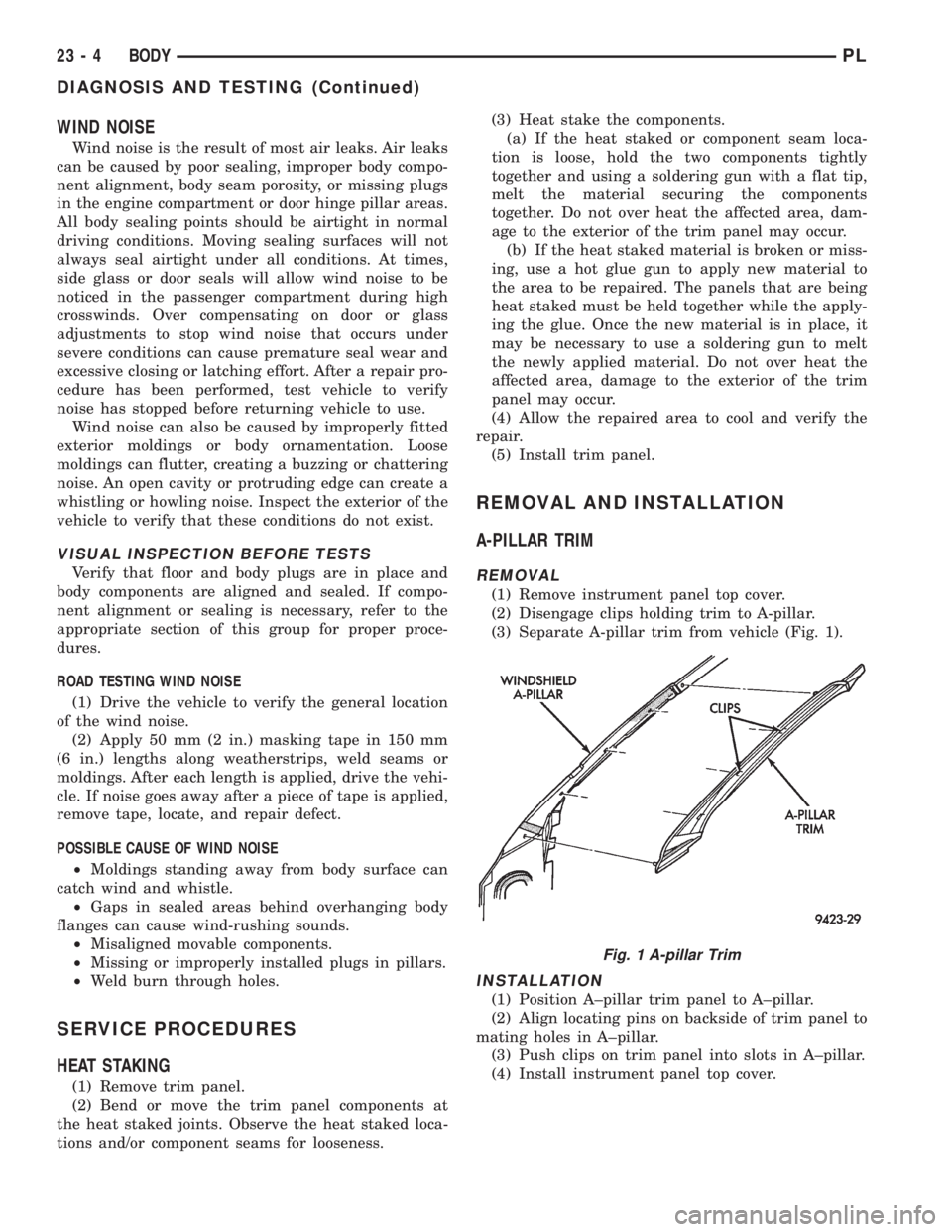
(3) Separate A-pillar trim from vehicle (Fig. 1).
INSTALLATION
(1) Position A±pillar trim panel to A±pillar.
(2) Align locating pins on backside of trim panel to
mating holes in A±pillar.
(3) Push clips on trim panel into slots in A±pillar.
(4) Install instrument panel top cover.
Fig. 1 A-pillar Trim
23 - 4 BODYPL
DIAGNOSIS AND TESTING (Continued)
Page 1094 of 1200
FRONT DOOR GLASSÐ4 DOOR
REMOVAL
(1) Remove door trim panel and water shield.
(2) Remove inner door belt weatherstrip.
(3) Loosen window inner belt stabilizer.
(4) Lower door glass to bottom of door to gain
access to attaching bolts.
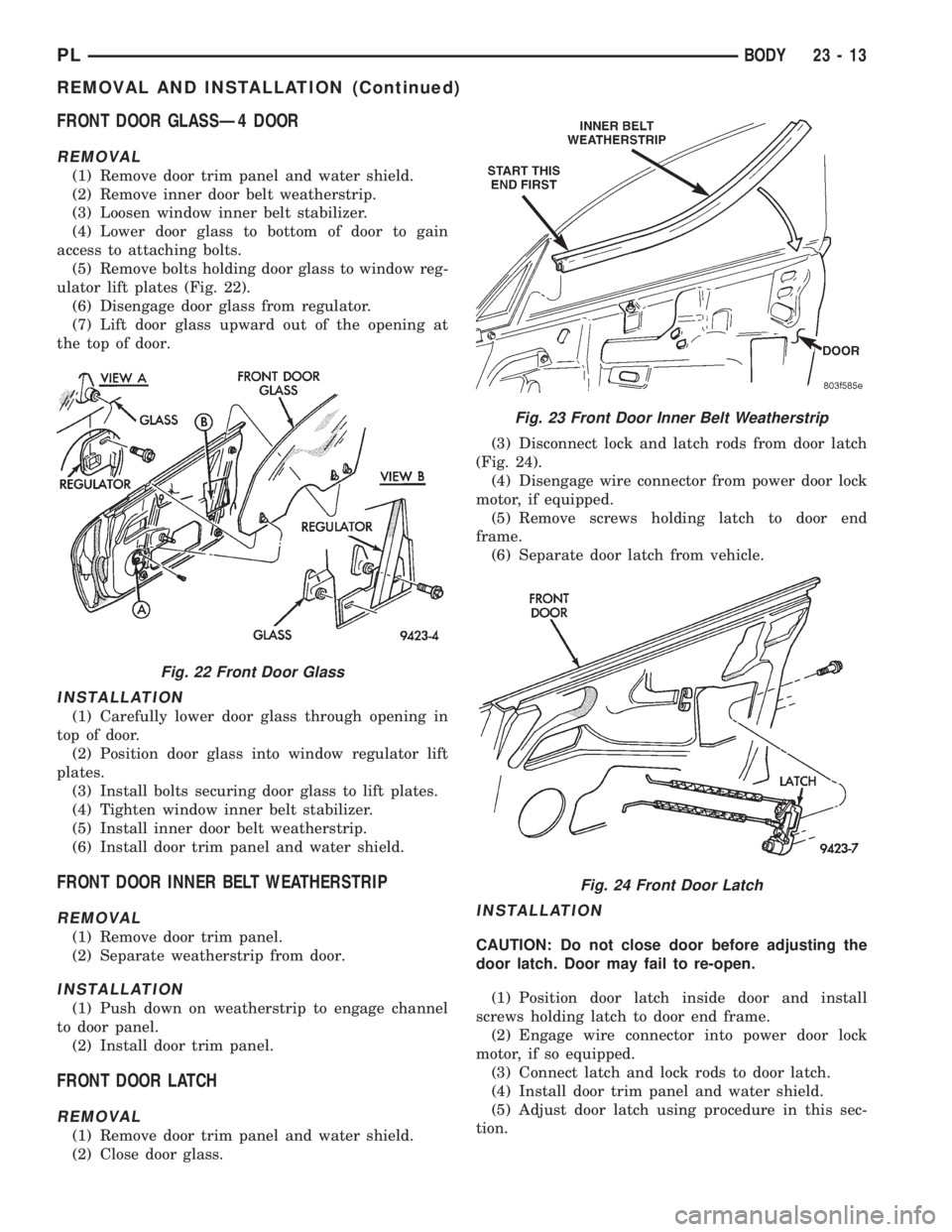
(5) Remove bolts holding door glass to window reg-
ulator lift plates (Fig. 22).
(6) Disengage door glass from regulator.
(7) Lift door glass upward out of the opening at
the top of door.
INSTALLATION
(1) Carefully lower door glass through opening in
top of door.
(2) Position door glass into window regulator lift
plates.
(3) Install bolts securing door glass to lift plates.
(4) Tighten window inner belt stabilizer.
(5) Install inner door belt weatherstrip.
(6) Install door trim panel and water shield.
FRONT DOOR INNER BELT WEATHERSTRIP
REMOVAL
(1) Remove door trim panel.
(2) Separate weatherstrip from door.
INSTALLATION
(1) Push down on weatherstrip to engage channel
to door panel.
(2) Install door trim panel.
FRONT DOOR LATCH
REMOVAL
(1) Remove door trim panel and water shield.
(2) Close door glass.(3) Disconnect lock and latch rods from door latch
(Fig. 24).
(4) Disengage wire connector from power door lock
motor, if equipped.
(5) Remove screws holding latch to door end
frame.
(6) Separate door latch from vehicle.
INSTALLATION
CAUTION: Do not close door before adjusting the
door latch. Door may fail to re-open.
(1) Position door latch inside door and install
screws holding latch to door end frame.
(2) Engage wire connector into power door lock
motor, if so equipped.
(3) Connect latch and lock rods to door latch.
(4) Install door trim panel and water shield.
(5) Adjust door latch using procedure in this sec-
tion.
Fig. 22 Front Door Glass
Fig. 23 Front Door Inner Belt Weatherstrip
Fig. 24 Front Door Latch
PLBODY 23 - 13
REMOVAL AND INSTALLATION (Continued)
Page 1097 of 1200
INSTALLATION
(1) Replace any damaged or missing push±in fas-
teners with original equipment push-in fasteners.
(2) Place trim panel near door.
(3) Engage wire connectors to power lock switch,
mirror switch, and power window switch, if equipped.
(4) Insert latch rod into inside latch release.
(5) Engage clip holding door latch linkage to back
of inside door handle.
(6) Engage trim panel into retainer channel at top
of door and push down to seat.
(7) Locate door trim panel to inner door panel by
aligning locating pins on backside of trim panel to
mating holes in inner door panel. Gently shift panel
forward or rearward if necessary.
(8) Engage hidden push±in fasteners holding trim
panel to door from around perimeter of trim panel.
(9) With the window in the down position, orien-
tate the window regulator crank handle appropri-
ately. Install the right handle at the 10 o'clock
position and the left handle at the 2 o'clock position,
if equipped.
(10) Install screw holding trim panel to door from
behind inside latch release handle.
(11) Install screw inside pull cup holding door trim
panel to bracket.
FRONT DOOR WATER SHIELD
REMOVAL
(1) Remove door trim panel.
(2) Remove Door speaker, if equipped.
(3) Remove door trim pull cup mount bracket.
(4) Disengage clip holding lock linkage to lock but-
ton bell crank.
(5) Peel water shield away from adhesive around
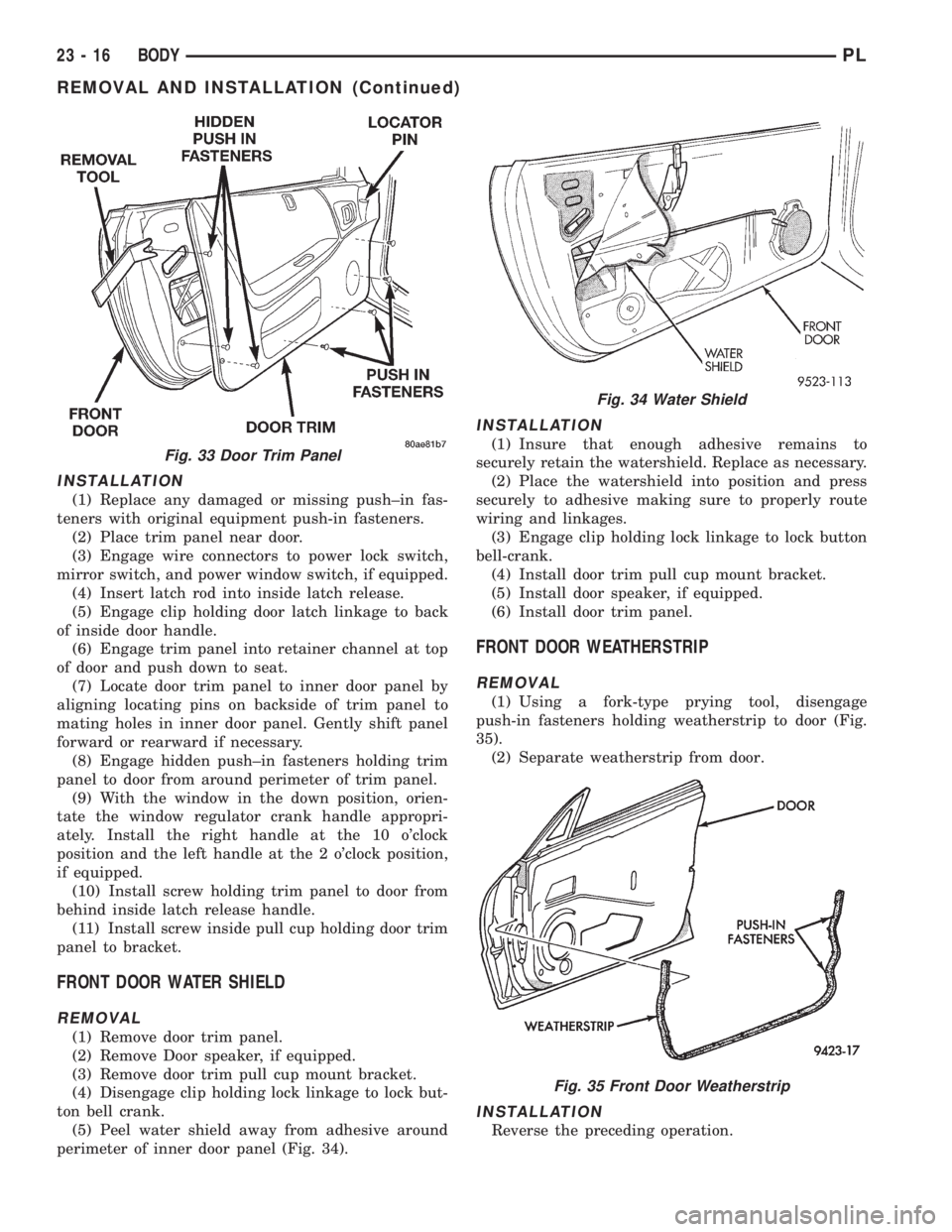
perimeter of inner door panel (Fig. 34).
INSTALLATION
(1) Insure that enough adhesive remains to
securely retain the watershield. Replace as necessary.
(2) Place the watershield into position and press
securely to adhesive making sure to properly route
wiring and linkages.
(3) Engage clip holding lock linkage to lock button
bell-crank.
(4) Install door trim pull cup mount bracket.
(5) Install door speaker, if equipped.
(6) Install door trim panel.
FRONT DOOR WEATHERSTRIP
REMOVAL
(1) Using a fork-type prying tool, disengage
push-in fasteners holding weatherstrip to door (Fig.
35).
(2) Separate weatherstrip from door.
INSTALLATION
Reverse the preceding operation.
Fig. 33 Door Trim Panel
Fig. 34 Water Shield
Fig. 35 Front Door Weatherstrip
23 - 16 BODYPL
REMOVAL AND INSTALLATION (Continued)
Page 1101 of 1200
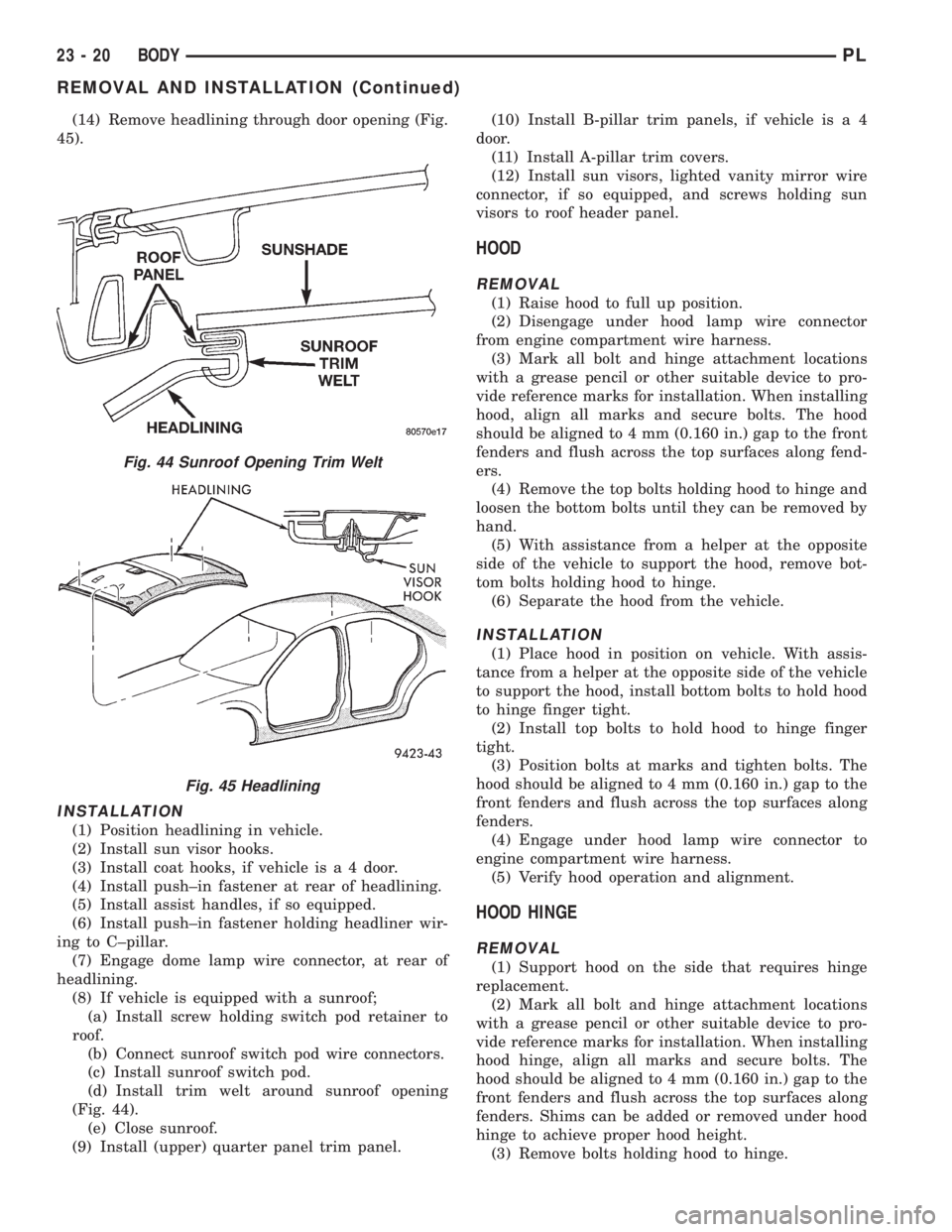
(14) Remove headlining through door opening (Fig.
45).
INSTALLATION
(1) Position headlining in vehicle.
(2) Install sun visor hooks.
(3) Install coat hooks, if vehicle is a 4 door.
(4) Install push±in fastener at rear of headlining.
(5) Install assist handles, if so equipped.
(6) Install push±in fastener holding headliner wir-
ing to C±pillar.
(7) Engage dome lamp wire connector, at rear of
headlining.
(8) If vehicle is equipped with a sunroof;
(a) Install screw holding switch pod retainer to
roof.
(b) Connect sunroof switch pod wire connectors.
(c) Install sunroof switch pod.
(d) Install trim welt around sunroof opening
(Fig. 44).
(e) Close sunroof.
(9) Install (upper) quarter panel trim panel.(10) Install B-pillar trim panels, if vehicle is a 4
door.
(11) Install A-pillar trim covers.
(12) Install sun visors, lighted vanity mirror wire
connector, if so equipped, and screws holding sun
visors to roof header panel.
HOOD
REMOVAL
(1) Raise hood to full up position.
(2) Disengage under hood lamp wire connector
from engine compartment wire harness.
(3) Mark all bolt and hinge attachment locations
with a grease pencil or other suitable device to pro-
vide reference marks for installation. When installing
hood, align all marks and secure bolts. The hood
should be aligned to 4 mm (0.160 in.) gap to the front
fenders and flush across the top surfaces along fend-
ers.
(4) Remove the top bolts holding hood to hinge and
loosen the bottom bolts until they can be removed by
hand.
(5) With assistance from a helper at the opposite
side of the vehicle to support the hood, remove bot-
tom bolts holding hood to hinge.
(6) Separate the hood from the vehicle.
INSTALLATION
(1) Place hood in position on vehicle. With assis-
tance from a helper at the opposite side of the vehicle
to support the hood, install bottom bolts to hold hood
to hinge finger tight.
(2) Install top bolts to hold hood to hinge finger
tight.
(3) Position bolts at marks and tighten bolts. The
hood should be aligned to 4 mm (0.160 in.) gap to the
front fenders and flush across the top surfaces along
fenders.
(4) Engage under hood lamp wire connector to
engine compartment wire harness.
(5) Verify hood operation and alignment.
HOOD HINGE
REMOVAL
(1) Support hood on the side that requires hinge
replacement.
(2) Mark all bolt and hinge attachment locations
with a grease pencil or other suitable device to pro-
vide reference marks for installation. When installing
hood hinge, align all marks and secure bolts. The
hood should be aligned to 4 mm (0.160 in.) gap to the
front fenders and flush across the top surfaces along
fenders. Shims can be added or removed under hood
hinge to achieve proper hood height.
(3) Remove bolts holding hood to hinge.
Fig. 44 Sunroof Opening Trim Welt
Fig. 45 Headlining
23 - 20 BODYPL
REMOVAL AND INSTALLATION (Continued)
Page 1102 of 1200
(4) Remove bolts holding hood hinge to front
fender flange and separate hinge from vehicle. If nec-
essary, paint new hinge before installation.
INSTALLATION
(1) If necessary, paint new hinge before installa-
tion.
(2) Place hinge in position on vehicle.
(3) Install bolts to hold hood hinge to front fender
flange.
(4) Install bolts to hold hood to hinge.
(5) Align all marks and secure bolts. The hood
should be aligned to 4 mm (0.160 in.) gap to the front
fenders and flush across the top surfaces along fend-
ers. Shims can be added or removed under hood
hinge to achieve proper hood height.
(6) Remove support from under hood and verify
hood operation.
HOOD LATCH
REMOVAL
(1) Release hood latch and open hood.
(2) Support hood on prop rod.
(3) Remove grille.
(4) Remove screws holding hood latch to radiator
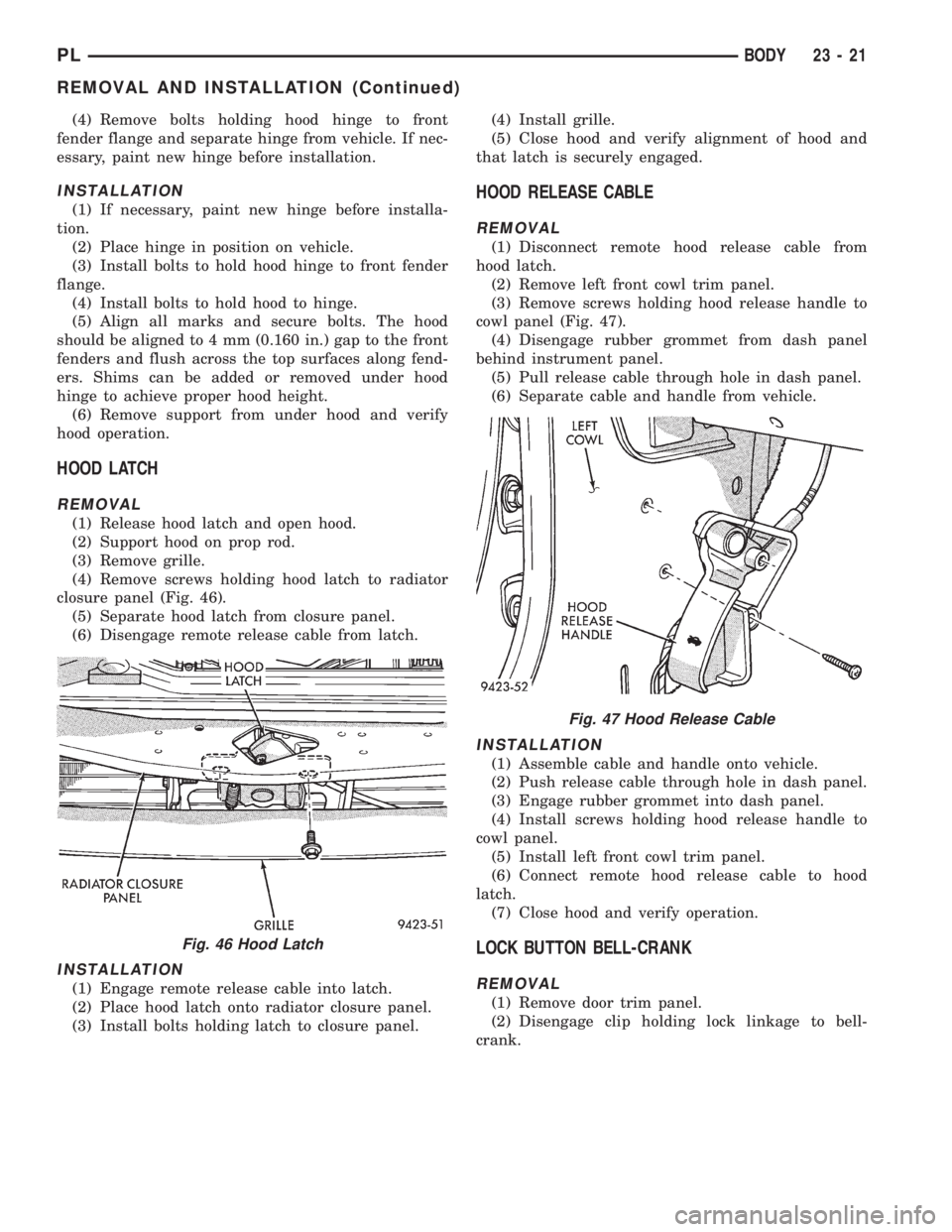
closure panel (Fig. 46).
(5) Separate hood latch from closure panel.
(6) Disengage remote release cable from latch.
INSTALLATION
(1) Engage remote release cable into latch.
(2) Place hood latch onto radiator closure panel.
(3) Install bolts holding latch to closure panel.(4) Install grille.
(5) Close hood and verify alignment of hood and
that latch is securely engaged.
HOOD RELEASE CABLE
REMOVAL
(1) Disconnect remote hood release cable from
hood latch.
(2) Remove left front cowl trim panel.
(3) Remove screws holding hood release handle to
cowl panel (Fig. 47).
(4) Disengage rubber grommet from dash panel
behind instrument panel.
(5) Pull release cable through hole in dash panel.
(6) Separate cable and handle from vehicle.
INSTALLATION
(1) Assemble cable and handle onto vehicle.
(2) Push release cable through hole in dash panel.
(3) Engage rubber grommet into dash panel.
(4) Install screws holding hood release handle to
cowl panel.
(5) Install left front cowl trim panel.
(6) Connect remote hood release cable to hood
latch.
(7) Close hood and verify operation.
LOCK BUTTON BELL-CRANK
REMOVAL
(1) Remove door trim panel.
(2) Disengage clip holding lock linkage to bell-
crank.
Fig. 46 Hood Latch
Fig. 47 Hood Release Cable
PLBODY 23 - 21
REMOVAL AND INSTALLATION (Continued)
Page 1104 of 1200
(2) Position trim panel near inner quarter panel.
(3) Align locating pins on backside of trim panel to
mating holes in inner quarter panel.
(4) Push clips on trim panel into slots in inner
quarter panel starting with the clips located near
locating pins.
(5) Install screw holding coat hook to top of quar-
ter trim panel.
(6) Install bolt securing seat belt anchor to floor.
(7) Slide lower seat belt anchor cover down to
cover anchor bolt.
(8) Install rear seat cushion and seat back.
REAR DOOR GLASS
REMOVAL
(1) Remove door trim panel and water shield.
(2) Remove inner door belt weatherstrip.
(3) Loosen door glass jounce bumper.
(4) Lower door glass to bottom of door.
(5) Remove nuts holding door glass to window reg-
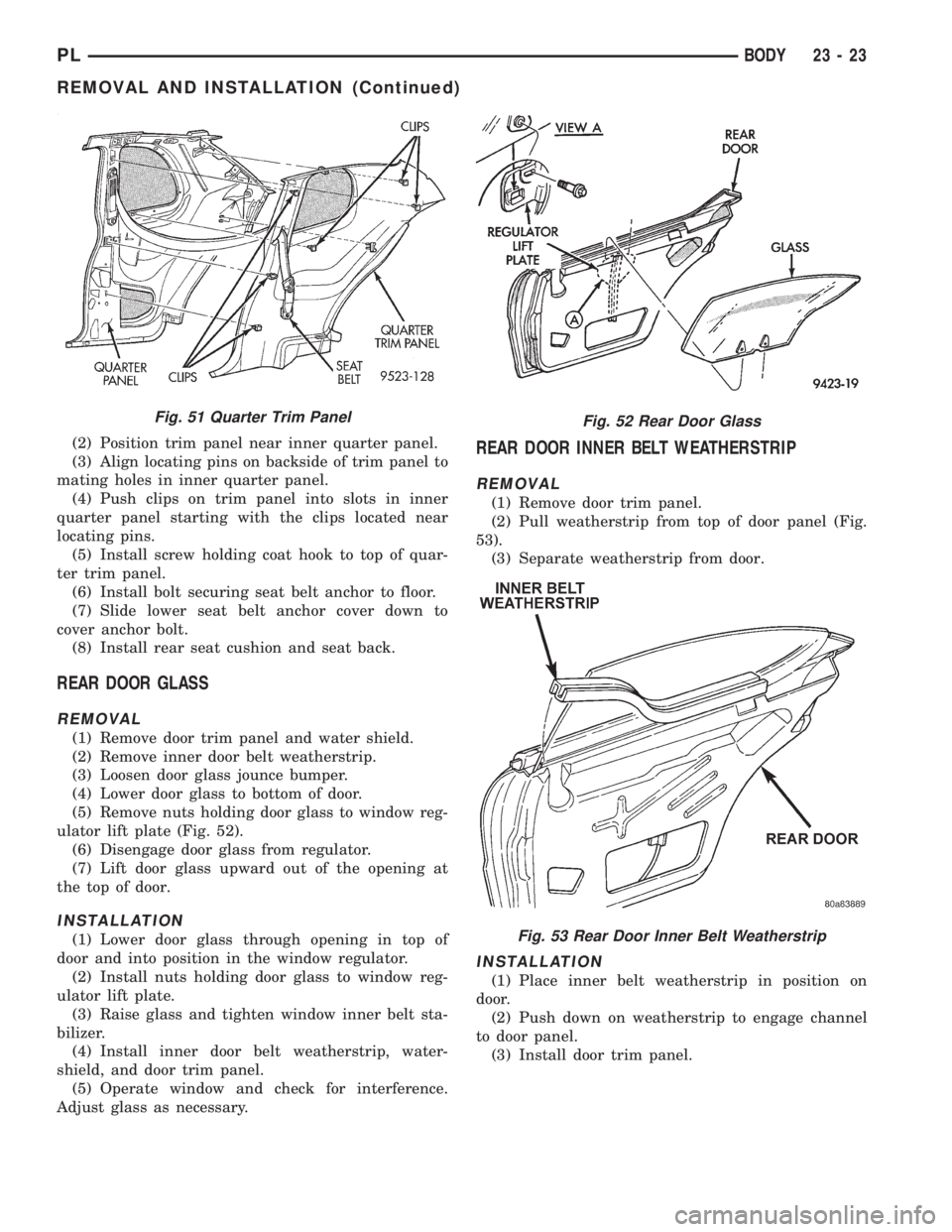
ulator lift plate (Fig. 52).
(6) Disengage door glass from regulator.
(7) Lift door glass upward out of the opening at
the top of door.
INSTALLATION
(1) Lower door glass through opening in top of
door and into position in the window regulator.
(2) Install nuts holding door glass to window reg-
ulator lift plate.
(3) Raise glass and tighten window inner belt sta-
bilizer.
(4) Install inner door belt weatherstrip, water-
shield, and door trim panel.
(5) Operate window and check for interference.
Adjust glass as necessary.
REAR DOOR INNER BELT WEATHERSTRIP
REMOVAL
(1) Remove door trim panel.
(2) Pull weatherstrip from top of door panel (Fig.
53).
(3) Separate weatherstrip from door.
INSTALLATION
(1) Place inner belt weatherstrip in position on
door.
(2) Push down on weatherstrip to engage channel
to door panel.
(3) Install door trim panel.
Fig. 51 Quarter Trim PanelFig. 52 Rear Door Glass
Fig. 53 Rear Door Inner Belt Weatherstrip
PLBODY 23 - 23
REMOVAL AND INSTALLATION (Continued)
Page 1109 of 1200
ROOF APERTURE (RAP) MOLDING
The RAP molding is set in urethane adhesive. The
RAP molding is difficult to salvage during removal.
Verify part availability before proceeding with
removal procedure. The temperature in the work
area and the vehicle should be at least 21ÉC (70ÉF) to
avoid damaging the rear window and windshield
moldings. Apply masking tape to surrounding area of
the RAP molding to protect the finish.
REMOVAL
(1) Using a trim stick, gently lift rear window
molding upward to gain access to end of RAP mold-
ing.
(2) Using a sharp hook tool, pierce the rear end of
the molding.
(3) Lift the rear of the RAP molding upward until
it clears the rear window molding.
(4) Using a common plier, pull the RAP molding
forward to separate molding from urethane bonding.
(5) Separate RAP molding from vehicle.
INSTALLATION
(1) Using a sharpened trim stick, scrape urethane
bonding material from the roof seam trough.
(2) Using touch-up paint, repair scratches in roof
seam trough to prevent corrosion.
(3) Inspect the bottom of the roof seam trough for
gaps in caulking. Repair gaps with suitable seam
sealer following manufacturers instructions.
(4) Apply black-out primer to bottom of roof seam
trough. Allow at lease three minutes before bonding
is applied.
(5) Install RAP molding into the roof seam trough
and position molding so both ends are covered by the
glass moldings. If the molding will not lay flat on the
bottom of the trough, trim the ends of the molding
until proper fit achieved.
(6) Using a suitable marking pencil, mark an
index line across the RAP molding and the adjacent
surfaces.
(7) Remove the RAP molding from the roof seam
trough.
(8) Applya5mm(0.2 in.) bead of urethane adhe-
sive on the bottom/center of the trough along the
entire length.
(9) Place RAP molding in position in roof seam
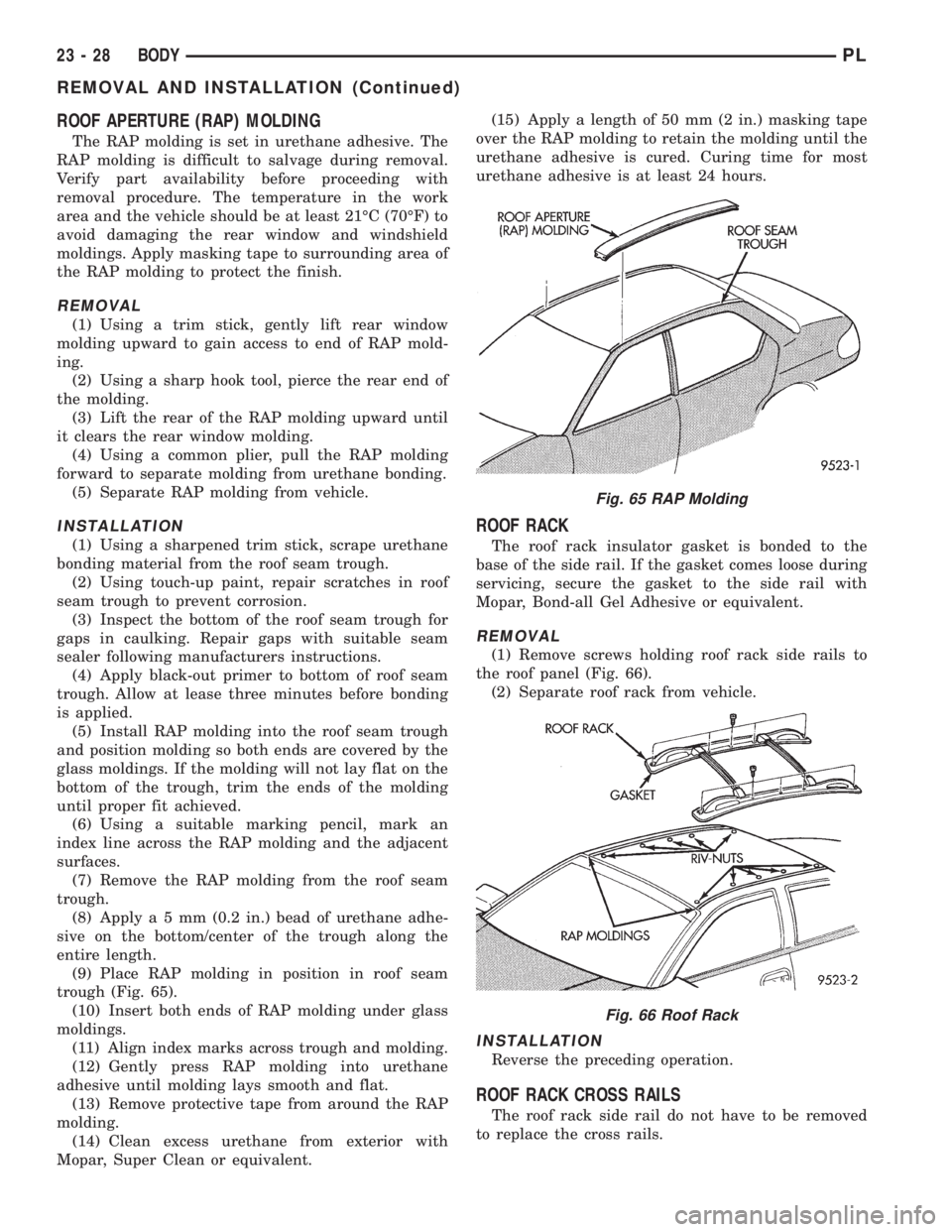
trough (Fig. 65).
(10) Insert both ends of RAP molding under glass
moldings.
(11) Align index marks across trough and molding.
(12) Gently press RAP molding into urethane
adhesive until molding lays smooth and flat.
(13) Remove protective tape from around the RAP
molding.
(14) Clean excess urethane from exterior with
Mopar, Super Clean or equivalent.(15) Apply a length of 50 mm (2 in.) masking tape
over the RAP molding to retain the molding until the
urethane adhesive is cured. Curing time for most
urethane adhesive is at least 24 hours.
ROOF RACK
The roof rack insulator gasket is bonded to the
base of the side rail. If the gasket comes loose during
servicing, secure the gasket to the side rail with
Mopar, Bond-all Gel Adhesive or equivalent.
REMOVAL
(1) Remove screws holding roof rack side rails to
the roof panel (Fig. 66).
(2) Separate roof rack from vehicle.
INSTALLATION
Reverse the preceding operation.
ROOF RACK CROSS RAILS
The roof rack side rail do not have to be removed
to replace the cross rails.
Fig. 65 RAP Molding
Fig. 66 Roof Rack
23 - 28 BODYPL
REMOVAL AND INSTALLATION (Continued)
Page 1113 of 1200
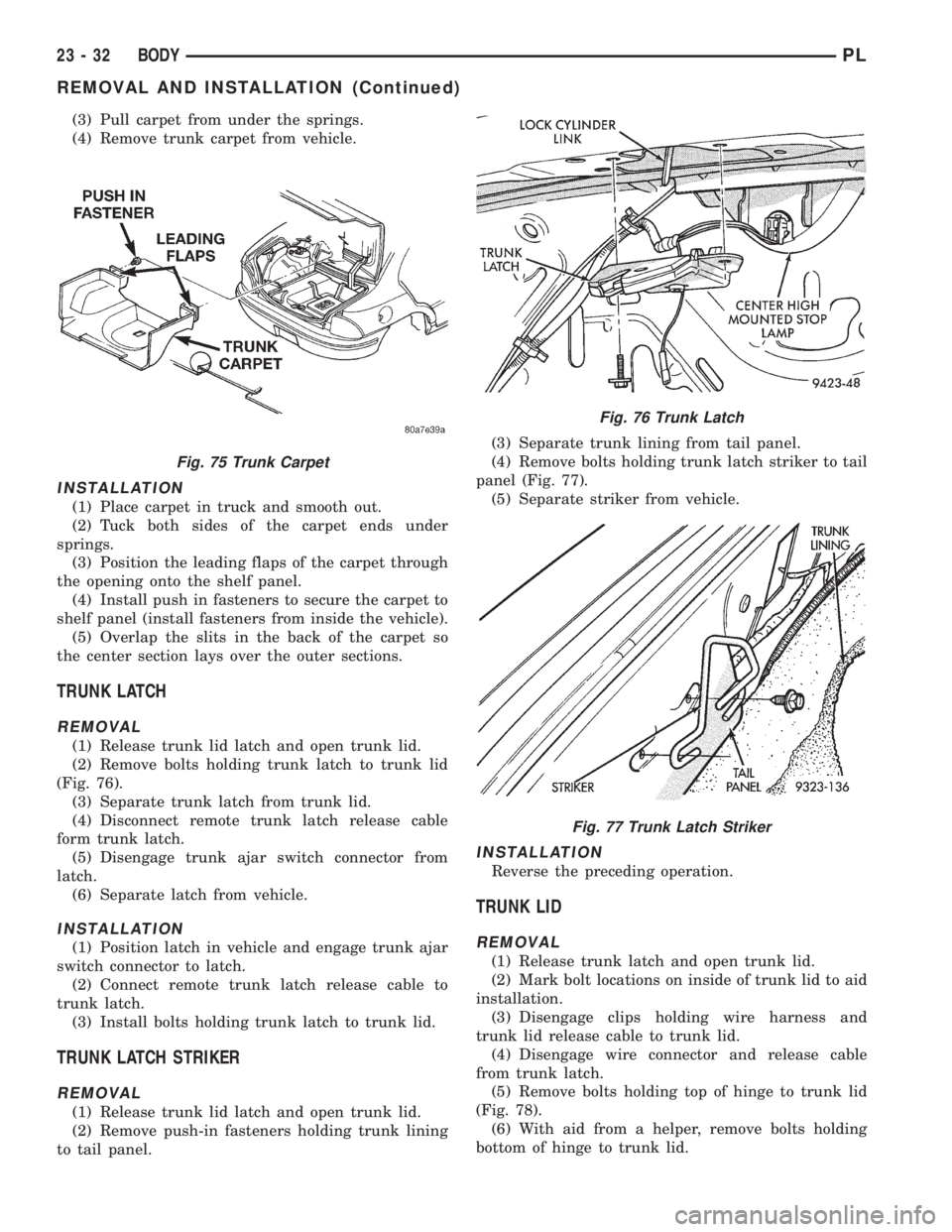
(3) Pull carpet from under the springs.
(4) Remove trunk carpet from vehicle.
INSTALLATION
(1) Place carpet in truck and smooth out.
(2) Tuck both sides of the carpet ends under
springs.
(3) Position the leading flaps of the carpet through
the opening onto the shelf panel.
(4) Install push in fasteners to secure the carpet to
shelf panel (install fasteners from inside the vehicle).
(5) Overlap the slits in the back of the carpet so
the center section lays over the outer sections.
TRUNK LATCH
REMOVAL
(1) Release trunk lid latch and open trunk lid.
(2) Remove bolts holding trunk latch to trunk lid
(Fig. 76).
(3) Separate trunk latch from trunk lid.
(4) Disconnect remote trunk latch release cable
form trunk latch.
(5) Disengage trunk ajar switch connector from
latch.
(6) Separate latch from vehicle.
INSTALLATION
(1) Position latch in vehicle and engage trunk ajar
switch connector to latch.
(2) Connect remote trunk latch release cable to
trunk latch.
(3) Install bolts holding trunk latch to trunk lid.
TRUNK LATCH STRIKER
REMOVAL
(1) Release trunk lid latch and open trunk lid.
(2) Remove push-in fasteners holding trunk lining
to tail panel.(3) Separate trunk lining from tail panel.
(4) Remove bolts holding trunk latch striker to tail
panel (Fig. 77).
(5) Separate striker from vehicle.
INSTALLATION
Reverse the preceding operation.
TRUNK LID
REMOVAL
(1) Release trunk latch and open trunk lid.
(2) Mark bolt locations on inside of trunk lid to aid
installation.
(3) Disengage clips holding wire harness and
trunk lid release cable to trunk lid.
(4) Disengage wire connector and release cable
from trunk latch.
(5) Remove bolts holding top of hinge to trunk lid
(Fig. 78).
(6) With aid from a helper, remove bolts holding
bottom of hinge to trunk lid.
Fig. 75 Trunk Carpet
Fig. 76 Trunk Latch
Fig. 77 Trunk Latch Striker
23 - 32 BODYPL
REMOVAL AND INSTALLATION (Continued)
Page 1116 of 1200
INSTALLATION
Reverse the preceding operation. Adjust inner belt
stabilizer against glass with enough tension to allow
free up and down movement.
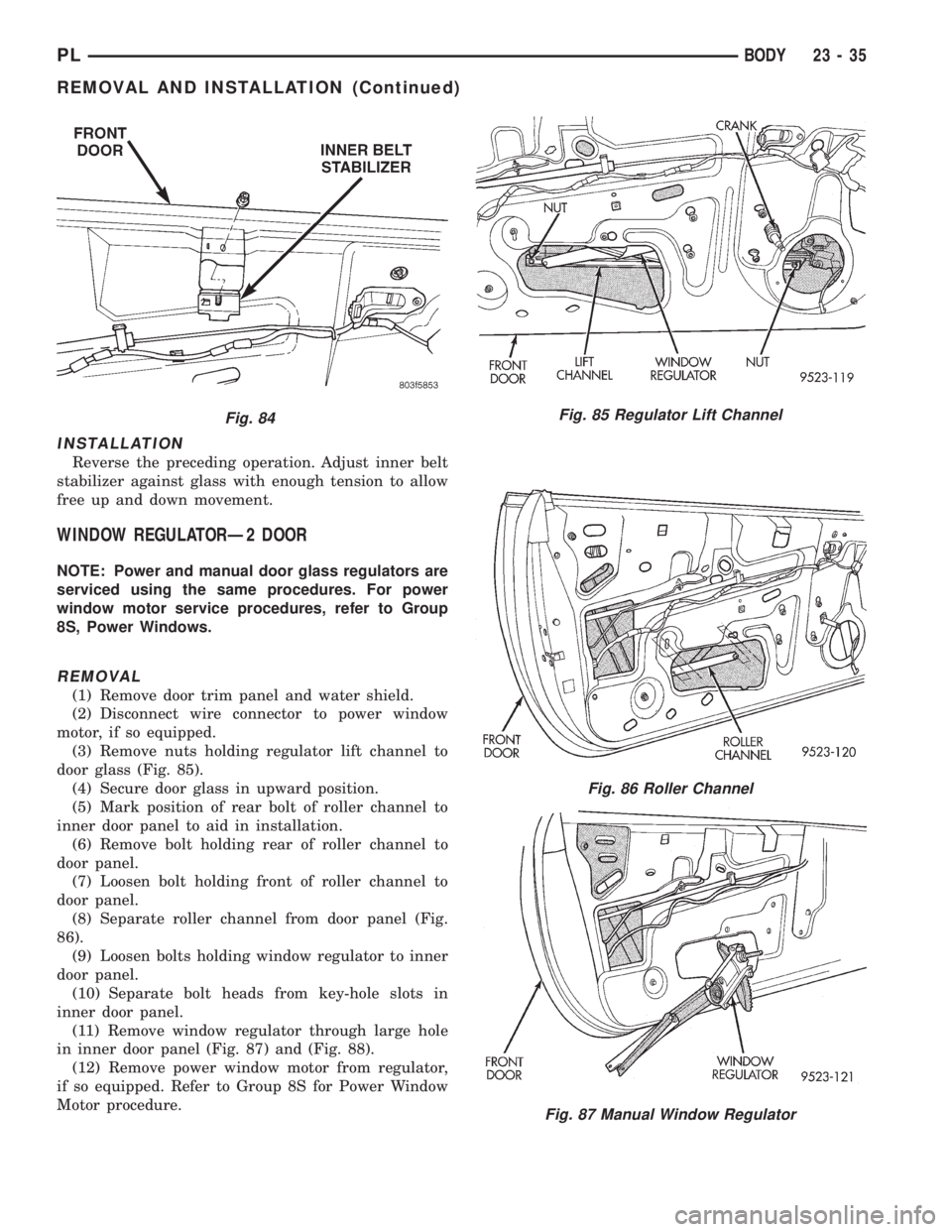
WINDOW REGULATORÐ2 DOOR
NOTE: Power and manual door glass regulators are
serviced using the same procedures. For power
window motor service procedures, refer to Group
8S, Power Windows.
REMOVAL
(1) Remove door trim panel and water shield.
(2) Disconnect wire connector to power window
motor, if so equipped.
(3) Remove nuts holding regulator lift channel to
door glass (Fig. 85).
(4) Secure door glass in upward position.
(5) Mark position of rear bolt of roller channel to
inner door panel to aid in installation.
(6) Remove bolt holding rear of roller channel to
door panel.
(7) Loosen bolt holding front of roller channel to
door panel.
(8) Separate roller channel from door panel (Fig.
86).
(9) Loosen bolts holding window regulator to inner
door panel.
(10) Separate bolt heads from key-hole slots in
inner door panel.
(11) Remove window regulator through large hole
in inner door panel (Fig. 87) and (Fig. 88).
(12) Remove power window motor from regulator,
if so equipped. Refer to Group 8S for Power Window
Motor procedure.
Fig. 84Fig. 85 Regulator Lift Channel
Fig. 86 Roller Channel
Fig. 87 Manual Window Regulator
PLBODY 23 - 35
REMOVAL AND INSTALLATION (Continued)