hose DODGE NEON 2000 Service Owners Manual
[x] Cancel search | Manufacturer: DODGE, Model Year: 2000, Model line: NEON, Model: DODGE NEON 2000Pages: 1285, PDF Size: 29.42 MB
Page 831 of 1285
(3) Squeeze retainer tabs together and pull fuel
tube/quick-connect fitting assembly off of fuel tube
nipple. The retainer will remain on fuel tube.
INSTALLATION
CAUTION: Never install a quick-connect fitting
without the retainer being either on the fuel tube or
already in the quick-connect fitting. In either case,
ensure the retainer locks securely into the quick-
connect fitting by firmly pulling on fuel tube and fit-
ting to ensure it is secured.
(1) Using a clean lint free cloth, clean the fuel tube
nipple and retainer.
(2) Prior to connecting the fitting to the fuel tube,
coat the fuel tube nipple with clean 30 weight engine
oil.
(3) Push the quick-connect fitting over the fuel
tube until theretainer seats and a click is heard.
(4) The plastic quick-connect fitting has windows
in the sides of the casing. When the fitting com-
pletely attaches to the fuel tube, the retainer locking
ears and the fuel tube shoulder are visible in the
windows. If they are not visible, the retainer was not
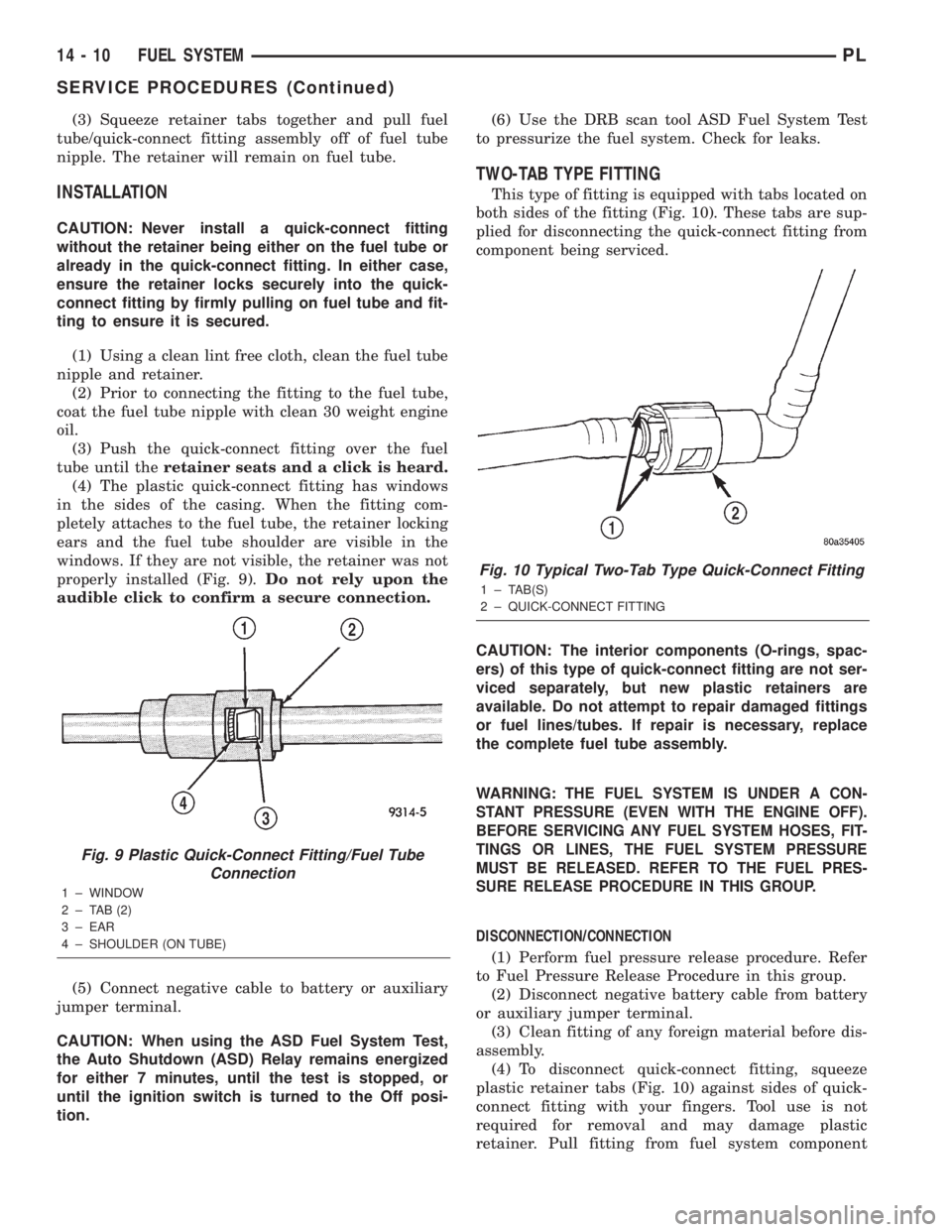
properly installed (Fig. 9).Do not rely upon the
audible click to confirm a secure connection.
(5) Connect negative cable to battery or auxiliary
jumper terminal.
CAUTION: When using the ASD Fuel System Test,
the Auto Shutdown (ASD) Relay remains energized
for either 7 minutes, until the test is stopped, or
until the ignition switch is turned to the Off posi-
tion.(6) Use the DRB scan tool ASD Fuel System Test
to pressurize the fuel system. Check for leaks.
TWO-TAB TYPE FITTING
This type of fitting is equipped with tabs located on
both sides of the fitting (Fig. 10). These tabs are sup-
plied for disconnecting the quick-connect fitting from
component being serviced.
CAUTION: The interior components (O-rings, spac-
ers) of this type of quick-connect fitting are not ser-
viced separately, but new plastic retainers are
available. Do not attempt to repair damaged fittings
or fuel lines/tubes. If repair is necessary, replace
the complete fuel tube assembly.
WARNING:
THE FUEL SYSTEM IS UNDER A CON-
STANT PRESSURE (EVEN WITH THE ENGINE OFF).
BEFORE SERVICING ANY FUEL SYSTEM HOSES, FIT-
TINGS OR LINES, THE FUEL SYSTEM PRESSURE
MUST BE RELEASED. REFER TO THE FUEL PRES-
SURE RELEASE PROCEDURE IN THIS GROUP.
DISCONNECTION/CONNECTION
(1) Perform fuel pressure release procedure. Refer
to Fuel Pressure Release Procedure in this group.
(2) Disconnect negative battery cable from battery
or auxiliary jumper terminal.
(3) Clean fitting of any foreign material before dis-
assembly.
(4) To disconnect quick-connect fitting, squeeze
plastic retainer tabs (Fig. 10) against sides of quick-
connect fitting with your fingers. Tool use is not
required for removal and may damage plastic
retainer. Pull fitting from fuel system component
Fig. 9 Plastic Quick-Connect Fitting/Fuel Tube
Connection
1 ± WINDOW
2 ± TAB (2)
3 ± EAR
4 ± SHOULDER (ON TUBE)
Fig. 10 Typical Two-Tab Type Quick-Connect Fitting
1 ± TAB(S)
2 ± QUICK-CONNECT FITTING
14 - 10 FUEL SYSTEMPL
SERVICE PROCEDURES (Continued)
Page 832 of 1285
being serviced. The plastic retainer will remain on
component being serviced after fitting is discon-
nected. The O-rings and spacer will remain in quick-
connect fitting connector body.
(5) Inspect quick-connect fitting body and compo-
nent for damage. Replace as necessary.
CAUTION:
When the quick-connect fitting was dis-
connected, the plastic retainer will remain on the com-
ponent being serviced. If this retainer must be
removed, very carefully release the retainer from the
component with two small screwdrivers. After removal,
inspect the retainer for cracks or any damage.
(6) Prior to connecting quick-connect fitting to
component being serviced, check condition of fitting
and component. Clean parts with a lint-free cloth.
Lubricate with clean engine oil.
(7) Insert quick-connect fitting to component being
serviced and into plastic retainer. When a connection
is made, a click will be heard.
(8) Verify a locked condition by firmly pulling on
fuel tube and fitting (15-30 lbs.).
(9) Connect negative cable to battery or auxiliary
jumper terminal.
(10) Start engine and check for leaks.
PLASTIC RETAINER RING TYPE FITTING
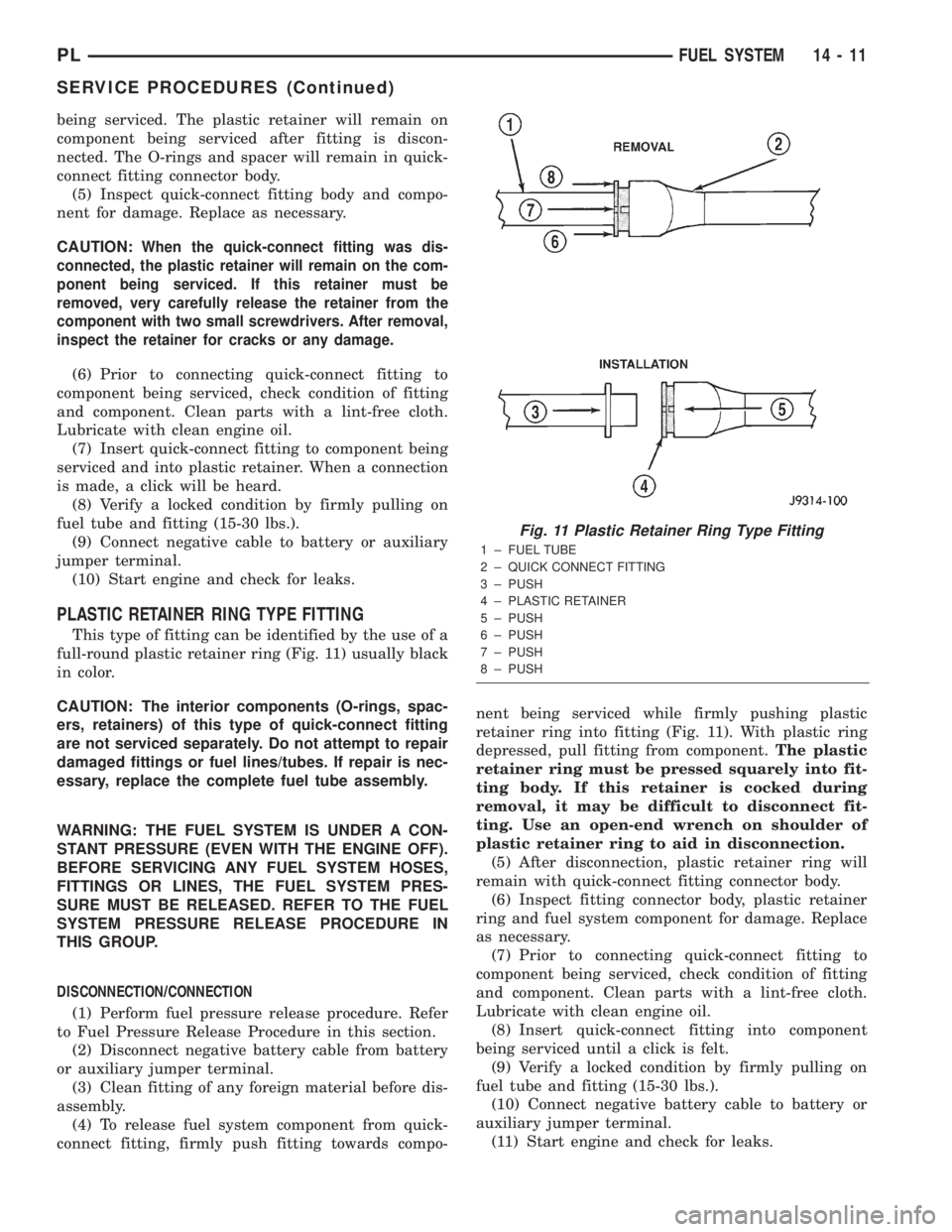
This type of fitting can be identified by the use of a
full-round plastic retainer ring (Fig. 11) usually black
in color.
CAUTION: The interior components (O-rings, spac-
ers, retainers) of this type of quick-connect fitting
are not serviced separately. Do not attempt to repair
damaged fittings or fuel lines/tubes. If repair is nec-
essary, replace the complete fuel tube assembly.
WARNING: THE FUEL SYSTEM IS UNDER A CON-
STANT PRESSURE (EVEN WITH THE ENGINE OFF).
BEFORE SERVICING ANY FUEL SYSTEM HOSES,
FITTINGS OR LINES, THE FUEL SYSTEM PRES-
SURE MUST BE RELEASED. REFER TO THE FUEL
SYSTEM PRESSURE RELEASE PROCEDURE IN
THIS GROUP.
DISCONNECTION/CONNECTION
(1) Perform fuel pressure release procedure. Refer
to Fuel Pressure Release Procedure in this section.
(2) Disconnect negative battery cable from battery
or auxiliary jumper terminal.
(3) Clean fitting of any foreign material before dis-
assembly.
(4) To release fuel system component from quick-
connect fitting, firmly push fitting towards compo-nent being serviced while firmly pushing plastic
retainer ring into fitting (Fig. 11). With plastic ring
depressed, pull fitting from component.The plastic
retainer ring must be pressed squarely into fit-
ting body. If this retainer is cocked during
removal, it may be difficult to disconnect fit-
ting. Use an open-end wrench on shoulder of
plastic retainer ring to aid in disconnection.
(5) After disconnection, plastic retainer ring will
remain with quick-connect fitting connector body.
(6) Inspect fitting connector body, plastic retainer
ring and fuel system component for damage. Replace
as necessary.
(7) Prior to connecting quick-connect fitting to
component being serviced, check condition of fitting
and component. Clean parts with a lint-free cloth.
Lubricate with clean engine oil.
(8) Insert quick-connect fitting into component
being serviced until a click is felt.
(9) Verify a locked condition by firmly pulling on
fuel tube and fitting (15-30 lbs.).
(10) Connect negative battery cable to battery or
auxiliary jumper terminal.
(11) Start engine and check for leaks.
Fig. 11 Plastic Retainer Ring Type Fitting
1 ± FUEL TUBE
2 ± QUICK CONNECT FITTING
3 ± PUSH
4 ± PLASTIC RETAINER
5 ± PUSH
6 ± PUSH
7 ± PUSH
8 ± PUSH
PLFUEL SYSTEM 14 - 11
SERVICE PROCEDURES (Continued)
Page 838 of 1285
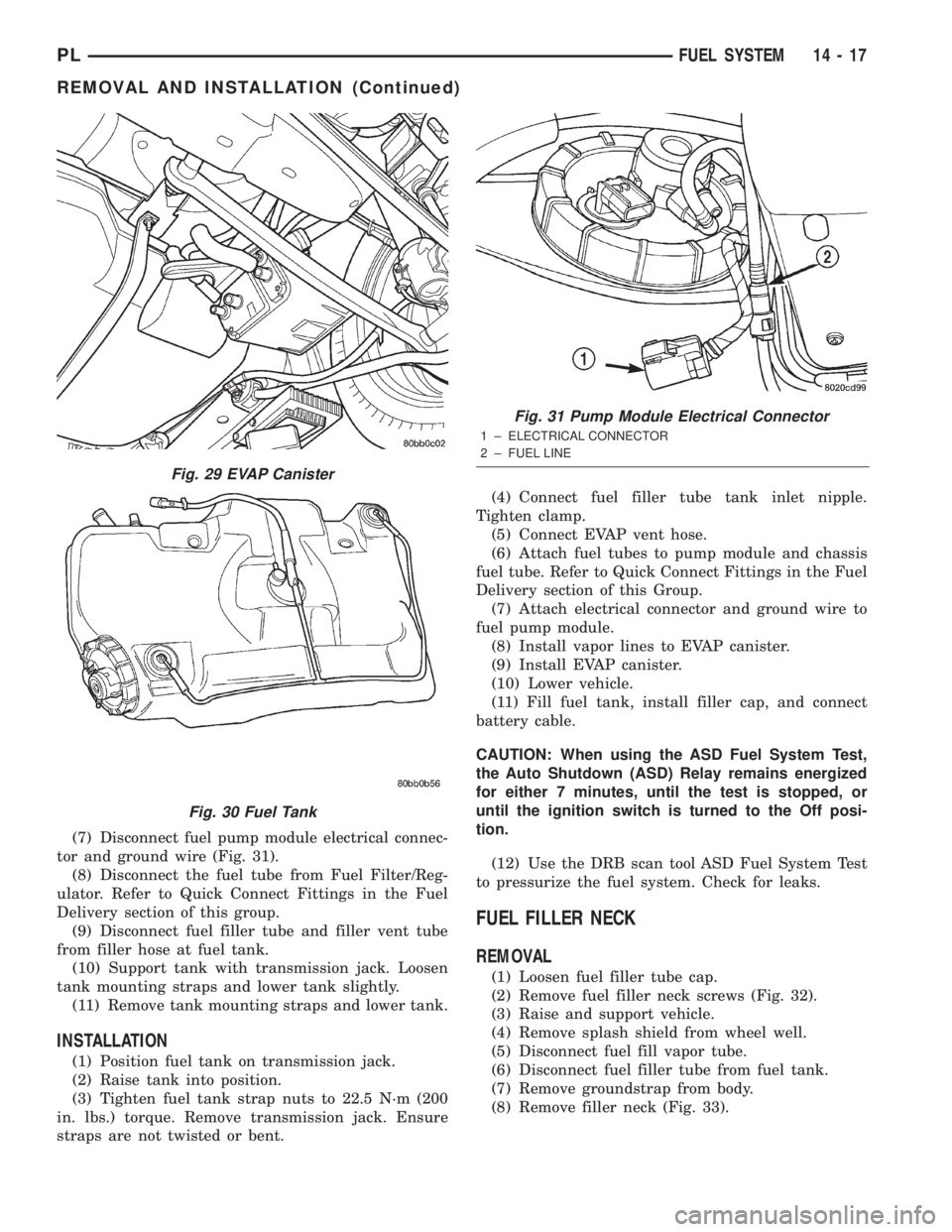
(7) Disconnect fuel pump module electrical connec-
tor and ground wire (Fig. 31).
(8) Disconnect the fuel tube from Fuel Filter/Reg-
ulator. Refer to Quick Connect Fittings in the Fuel
Delivery section of this group.
(9) Disconnect fuel filler tube and filler vent tube
from filler hose at fuel tank.
(10) Support tank with transmission jack. Loosen
tank mounting straps and lower tank slightly.
(11) Remove tank mounting straps and lower tank.
INSTALLATION
(1) Position fuel tank on transmission jack.
(2) Raise tank into position.
(3) Tighten fuel tank strap nuts to 22.5 N´m (200
in. lbs.) torque. Remove transmission jack. Ensure
straps are not twisted or bent.(4) Connect fuel filler tube tank inlet nipple.
Tighten clamp.
(5) Connect EVAP vent hose.
(6) Attach fuel tubes to pump module and chassis
fuel tube. Refer to Quick Connect Fittings in the Fuel
Delivery section of this Group.
(7) Attach electrical connector and ground wire to
fuel pump module.
(8) Install vapor lines to EVAP canister.
(9) Install EVAP canister.
(10) Lower vehicle.
(11) Fill fuel tank, install filler cap, and connect
battery cable.
CAUTION: When using the ASD Fuel System Test,
the Auto Shutdown (ASD) Relay remains energized
for either 7 minutes, until the test is stopped, or
until the ignition switch is turned to the Off posi-
tion.
(12) Use the DRB scan tool ASD Fuel System Test
to pressurize the fuel system. Check for leaks.
FUEL FILLER NECK
REMOVAL
(1) Loosen fuel filler tube cap.
(2) Remove fuel filler neck screws (Fig. 32).
(3) Raise and support vehicle.
(4) Remove splash shield from wheel well.
(5) Disconnect fuel fill vapor tube.
(6) Disconnect fuel filler tube from fuel tank.
(7) Remove groundstrap from body.
(8) Remove filler neck (Fig. 33).
Fig. 29 EVAP Canister
Fig. 30 Fuel Tank
Fig. 31 Pump Module Electrical Connector
1 ± ELECTRICAL CONNECTOR
2 ± FUEL LINE
PLFUEL SYSTEM 14 - 17
REMOVAL AND INSTALLATION (Continued)
Page 863 of 1285
Control Module (PCM) receives data from the DRB
through the SCI Receive circuit.
TACHOMETERÐPCM OUTPUT
OPERATION
The PCM operates the tachometer on the instru-
ment panel. The PCM calculates engine RPM from
the crankshaft position sensor input. Sends the infor-
mation to the cluster across the bus.
TORQUE CONVERTOR CLUTCH SOLENOIDÐ
PCM OUTPUT
OPERATION
Three-speed automatic transaxles use a torque con-
verter clutch solenoid. The PCM controls the engage-
ment of the torque converter clutch through the
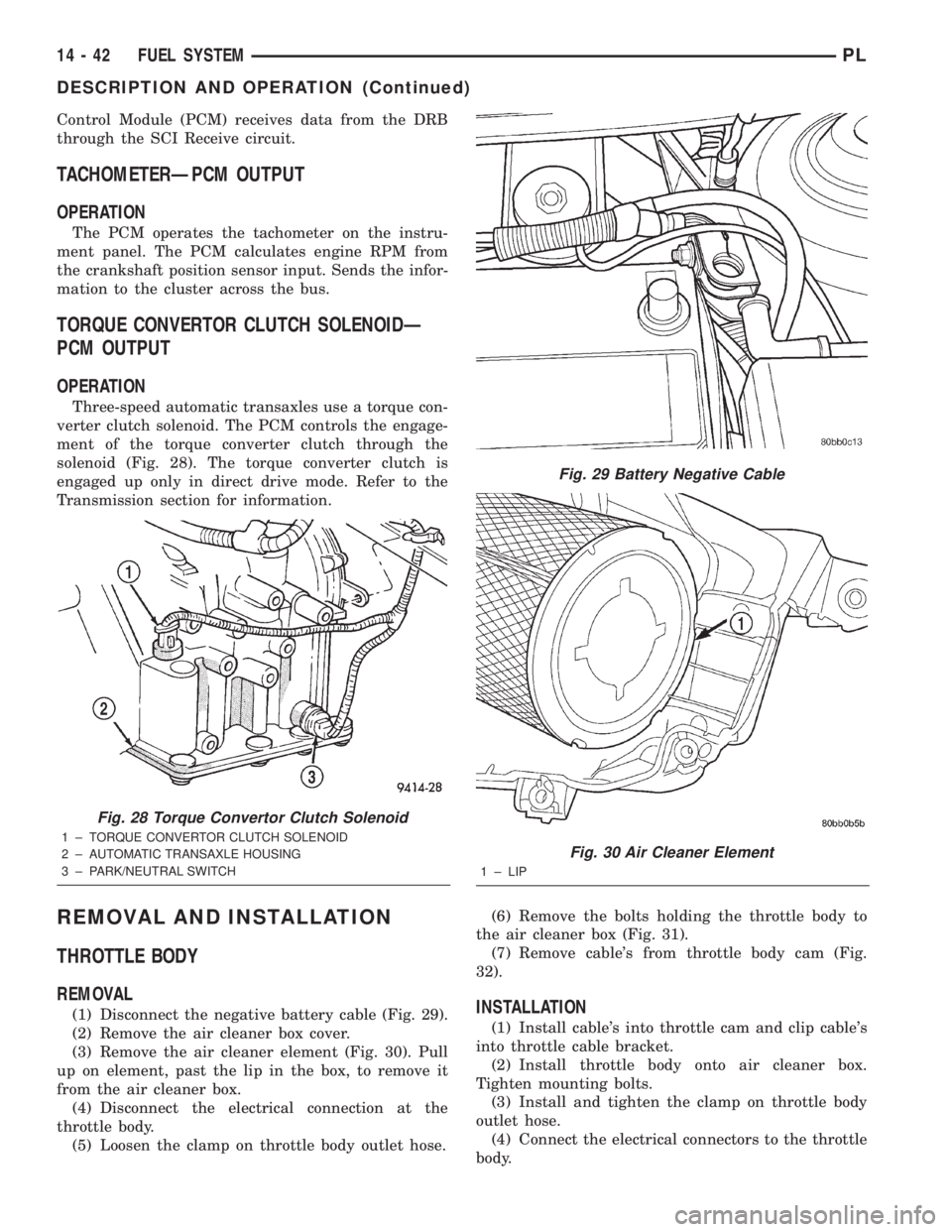
solenoid (Fig. 28). The torque converter clutch is
engaged up only in direct drive mode. Refer to the
Transmission section for information.
REMOVAL AND INSTALLATION
THROTTLE BODY
REMOVAL
(1) Disconnect the negative battery cable (Fig. 29).
(2) Remove the air cleaner box cover.
(3) Remove the air cleaner element (Fig. 30). Pull
up on element, past the lip in the box, to remove it
from the air cleaner box.
(4) Disconnect the electrical connection at the
throttle body.
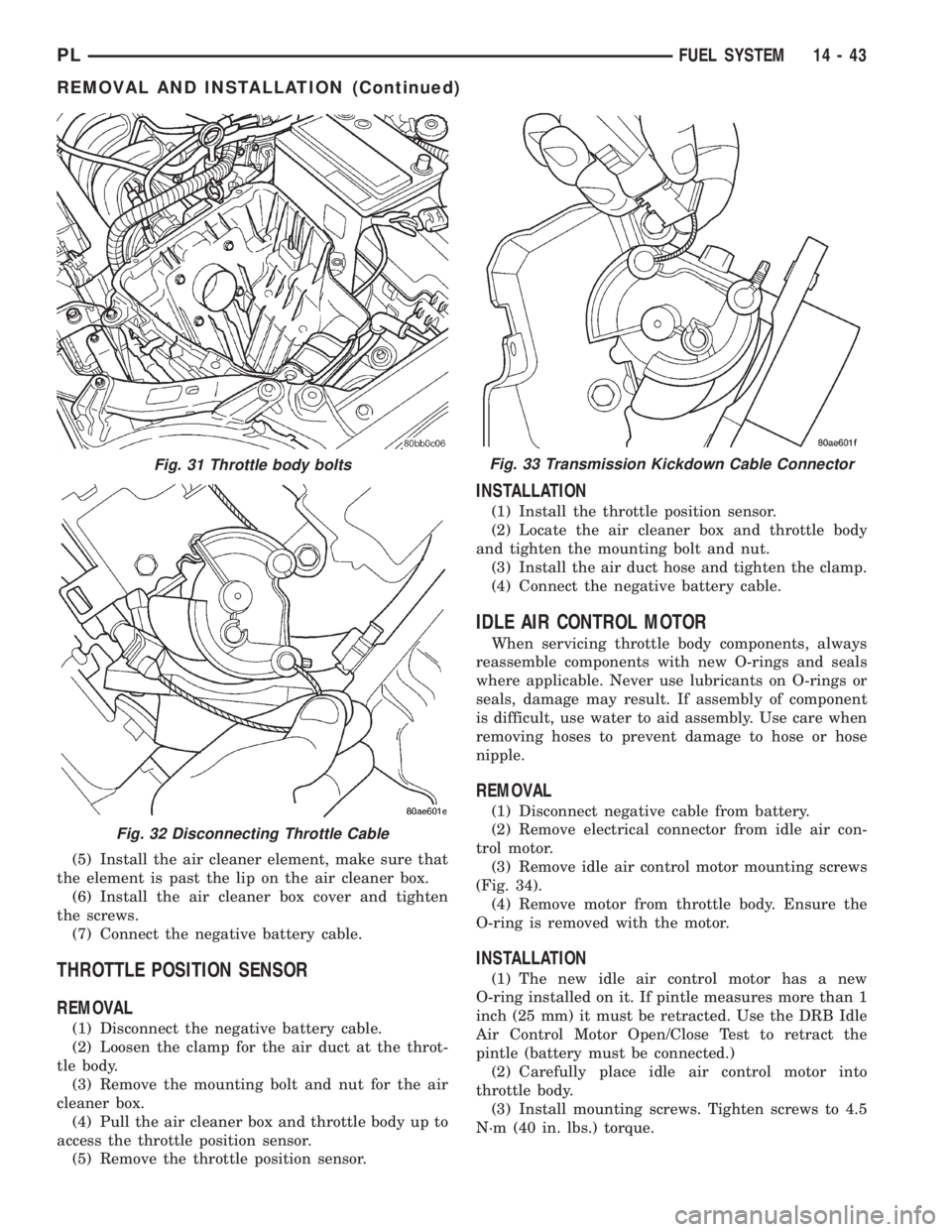
(5) Loosen the clamp on throttle body outlet hose.(6) Remove the bolts holding the throttle body to
the air cleaner box (Fig. 31).
(7) Remove cable's from throttle body cam (Fig.
32).INSTALLATION
(1) Install cable's into throttle cam and clip cable's
into throttle cable bracket.
(2) Install throttle body onto air cleaner box.
Tighten mounting bolts.
(3) Install and tighten the clamp on throttle body
outlet hose.
(4) Connect the electrical connectors to the throttle
body.
Fig. 28 Torque Convertor Clutch Solenoid
1 ± TORQUE CONVERTOR CLUTCH SOLENOID
2 ± AUTOMATIC TRANSAXLE HOUSING
3 ± PARK/NEUTRAL SWITCH
Fig. 29 Battery Negative Cable
Fig. 30 Air Cleaner Element
1 ± LIP
14 - 42 FUEL SYSTEMPL
DESCRIPTION AND OPERATION (Continued)
Page 864 of 1285
(5) Install the air cleaner element, make sure that
the element is past the lip on the air cleaner box.
(6) Install the air cleaner box cover and tighten
the screws.
(7) Connect the negative battery cable.
THROTTLE POSITION SENSOR
REMOVAL
(1) Disconnect the negative battery cable.
(2) Loosen the clamp for the air duct at the throt-
tle body.
(3) Remove the mounting bolt and nut for the air
cleaner box.
(4) Pull the air cleaner box and throttle body up to
access the throttle position sensor.
(5) Remove the throttle position sensor.
INSTALLATION
(1) Install the throttle position sensor.
(2) Locate the air cleaner box and throttle body
and tighten the mounting bolt and nut.
(3) Install the air duct hose and tighten the clamp.
(4) Connect the negative battery cable.
IDLE AIR CONTROL MOTOR
When servicing throttle body components, always
reassemble components with new O-rings and seals
where applicable. Never use lubricants on O-rings or
seals, damage may result. If assembly of component
is difficult, use water to aid assembly. Use care when
removing hoses to prevent damage to hose or hose
nipple.
REMOVAL
(1) Disconnect negative cable from battery.
(2) Remove electrical connector from idle air con-
trol motor.
(3) Remove idle air control motor mounting screws
(Fig. 34).
(4) Remove motor from throttle body. Ensure the
O-ring is removed with the motor.
INSTALLATION
(1) The new idle air control motor has a new
O-ring installed on it. If pintle measures more than 1
inch (25 mm) it must be retracted. Use the DRB Idle
Air Control Motor Open/Close Test to retract the
pintle (battery must be connected.)
(2) Carefully place idle air control motor into
throttle body.
(3) Install mounting screws. Tighten screws to 4.5
N´m (40 in. lbs.) torque.
Fig. 31 Throttle body bolts
Fig. 32 Disconnecting Throttle Cable
Fig. 33 Transmission Kickdown Cable Connector
PLFUEL SYSTEM 14 - 43
REMOVAL AND INSTALLATION (Continued)
Page 872 of 1285
STEERING
TABLE OF CONTENTS
page page
POWER STEERING......................... 1
POWER STEERING PUMP.................. 16STEERING GEAR.......................... 21
STEERING COLUMN....................... 29
POWER STEERING
TABLE OF CONTENTS
page page
DESCRIPTION AND OPERATION
POWER STEERING SYSTEM................1
POWER STEERING FLUID HOSES............2
POWER STEERING FLUID COOLER...........2
POWER STEERING FLUID PRESSURE
SWITCH...............................3
DIAGNOSIS AND TESTING
STEERING SYSTEM DIAGNOSIS CHARTS......4
POWER STEERING SYSTEM FLOW AND
PRESSURE TEST........................9
SERVICE PROCEDURES
POWER STEERING SYSTEM FLUID LEVEL
CHECK...............................11REMOVAL AND INSTALLATION
SERVICE WARNINGS AND CAUTIONS........11
POWER STEERING FLUID PRESSURE HOSE . . . 11
POWER STEERING FLUID RETURN HOSE.....12
POWER STEERING FLUID COOLER..........13
POWER STEERING FLUID PRESSURE
SWITCH..............................14
SPECIFICATIONS
POWER STEERING FASTENER TORQUE
SPECIFICATIONS.......................15
SPECIAL TOOLS
POWER STEERING.......................15
DESCRIPTION AND OPERATION
POWER STEERING SYSTEM
Turning of the steering wheel is converted into lin-
ear travel through the meshing of the helical pinion
teeth with the rack teeth within the steering gear.
Power assist steering is provided by an open-cen-
ter, rotary-type control valve. It is used to direct
power steering fluid from the power steering pump to
either side of the integral steering rack piston. Road
feel is controlled by the diameter of a torsion bar
which initially steers the vehicle. As steering effort
increases as in a turn, the torsion bar twists, causing
relative rotary motion between the rotary valve body
and valve spool. This movement directs fluid behind
the integral rack piston, which in turn builds up
hydraulic pressure and assists in the turning effort.
This vehicle comes with power steering as stan-
dard equipment and it is the only steering systemavailable. The power steering system consists of
these major components:
²POWER STEERING PUMP
²POWER STEERING GEAR
²POWER STEERING FLUID RESERVOIR
(mounted on the pump)
²POWER STEERING FLUID PRESSURE HOSE
²POWER STEERING FLUID RETURN HOSE
²POWER STEERING FLUID COOLER (on some
models)
For information on the first two components, refer
to their respective sections within this service man-
ual group. Information on the third component can
be found in POWER STEERING PUMP. Information
on all other components can be found in this section
of this service manual group.
PLSTEERING 19 - 1
Page 873 of 1285
POWER STEERING FLUID HOSES
The power steering fluid hoses connect the compo-
nents of the power steering system. They transfer
fluid from one component to the next.
The power steering fluid pressure hose is a high
pressure hose that connects the power steering pump
to the gear. At both ends of the flexible hose portion
are steel fittings that are pressure crimped to the
flexible hose. A standard tube nut fitting with an
O-ring is used at each end to connect it to either the
power steering pump or the gear.
The power steering fluid return hose is a special
rubber hose that connects the power steering gear or
the power steering fluid cooler on some models, back
to the fluid reservoir mounted on the power steering
pump. The power steering gear has a steel fitting
attached to its outlet port that the return hose is
pushed onto. On vehicles equipped with a power
steering fluid cooler, the return hose attaches to the
cooler outlet tube instead of the steering gear steel
fitting. The hose is secured to either component using
a standard adjustable clamp. The other end of the
power steering fluid return hose attaches to the
power steering fluid reservoir on the power steering
pump using a standard adjustable clamp.
POWER STEERING FLUID COOLER
Some models of this vehicle are equipped with a
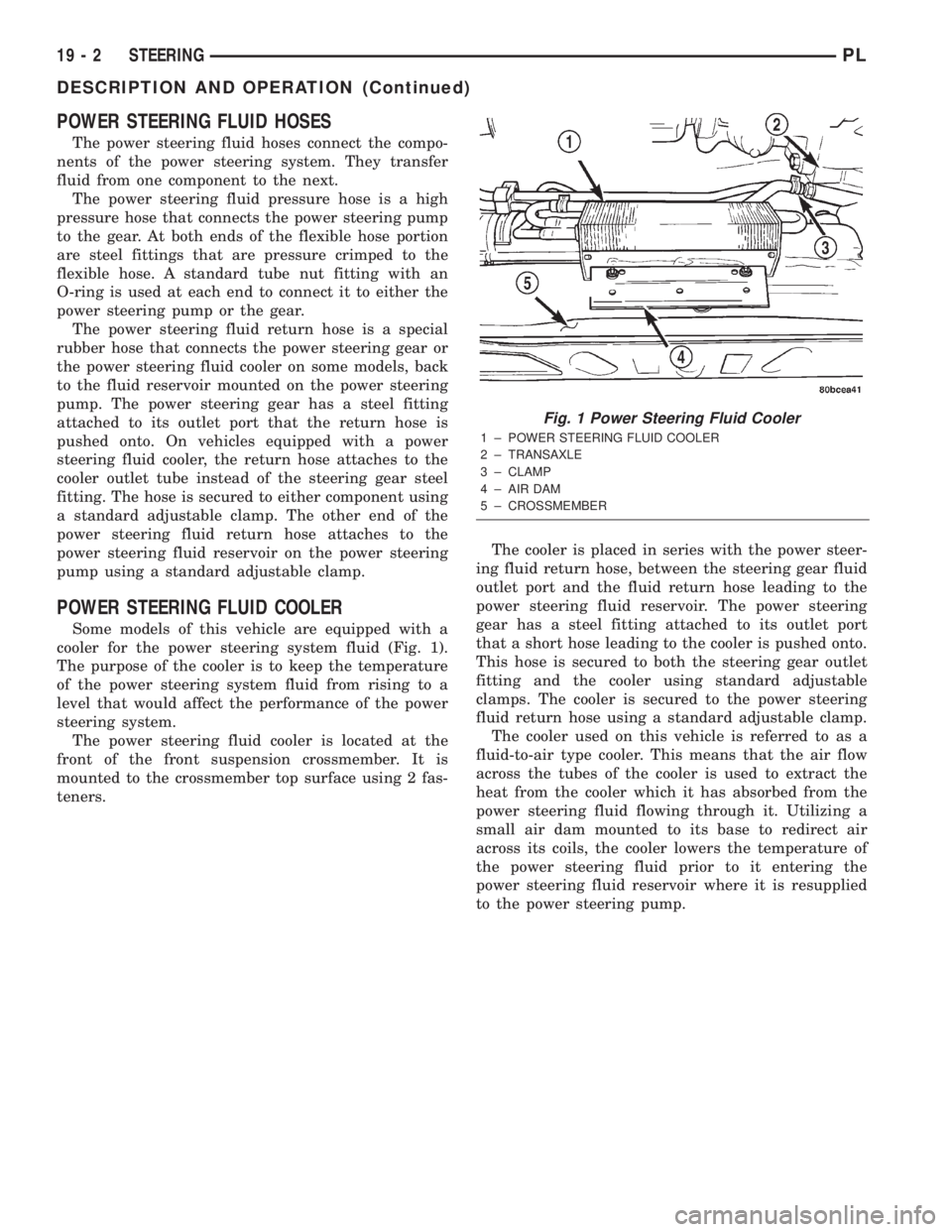
cooler for the power steering system fluid (Fig. 1).
The purpose of the cooler is to keep the temperature
of the power steering system fluid from rising to a
level that would affect the performance of the power
steering system.
The power steering fluid cooler is located at the
front of the front suspension crossmember. It is
mounted to the crossmember top surface using 2 fas-
teners.The cooler is placed in series with the power steer-
ing fluid return hose, between the steering gear fluid
outlet port and the fluid return hose leading to the
power steering fluid reservoir. The power steering
gear has a steel fitting attached to its outlet port
that a short hose leading to the cooler is pushed onto.
This hose is secured to both the steering gear outlet
fitting and the cooler using standard adjustable
clamps. The cooler is secured to the power steering
fluid return hose using a standard adjustable clamp.
The cooler used on this vehicle is referred to as a
fluid-to-air type cooler. This means that the air flow
across the tubes of the cooler is used to extract the
heat from the cooler which it has absorbed from the
power steering fluid flowing through it. Utilizing a
small air dam mounted to its base to redirect air
across its coils, the cooler lowers the temperature of
the power steering fluid prior to it entering the
power steering fluid reservoir where it is resupplied
to the power steering pump.
Fig. 1 Power Steering Fluid Cooler
1 ± POWER STEERING FLUID COOLER
2 ± TRANSAXLE
3 ± CLAMP
4 ± AIR DAM
5 ± CROSSMEMBER
19 - 2 STEERINGPL
DESCRIPTION AND OPERATION (Continued)
Page 875 of 1285
DIAGNOSIS AND TESTING
STEERING SYSTEM DIAGNOSIS CHARTS
POWER STEERING NOISE
CONDITION POSSIBLE CAUSES CORRECTION
OBJECTIONABLE HISS OR
WHISTLE*1. Damaged or mispositioned
steering column shaft/coupling dash
panel seal.1. Reposition or replace steering
column shaft/coupling dash panel
seal.
2. Noisy valve in power steering
gear.2. Replace power steering gear.
RATTLE OR CLUNK 1. Power steering gear loose on
front suspension crossmember.1. Inspect power steering gear
mounting bolts. Replace as
necessary. Tighten to the specified
torque.
2. Front suspension crossmember
mounting fasteners loose at frame.2. Tighten the front suspension
crossmember mounting fasteners to
the specified torque.
3. Loose tie rod (outer or inner). 3. Check tie rod pivot points for
wear. Replace worn/loose parts as
required.
4. Loose lower control arm mounting
bolts at front suspension
crossmember.4. Tighten control arm mounting
bolts to the specified torques.
5. Loose strut assembly mounting
fasteners at strut tower.5. Tighten strut assembly fasteners
to the specified torques.
6. Power steering fluid pressure
hose touching the body of the
vehicle.6. Adjust hose to proper position by
loosening, repositioning, and
tightening fitting to specified torque.
Do not bend tubing.
7. Internal power steering gear
noise.7. Replace power steering gear.
8. Damaged front suspension
crossmember.8. Replace front suspension
crossmember.
CHIRP OR SQUEAL (POWER
STEERING PUMP)1. Loose power steering pump drive
belt.1. Check and replace automatic belt
tensioner as necessary. Replace belt
if worn or glazed.
19 - 4 STEERINGPL
Page 876 of 1285
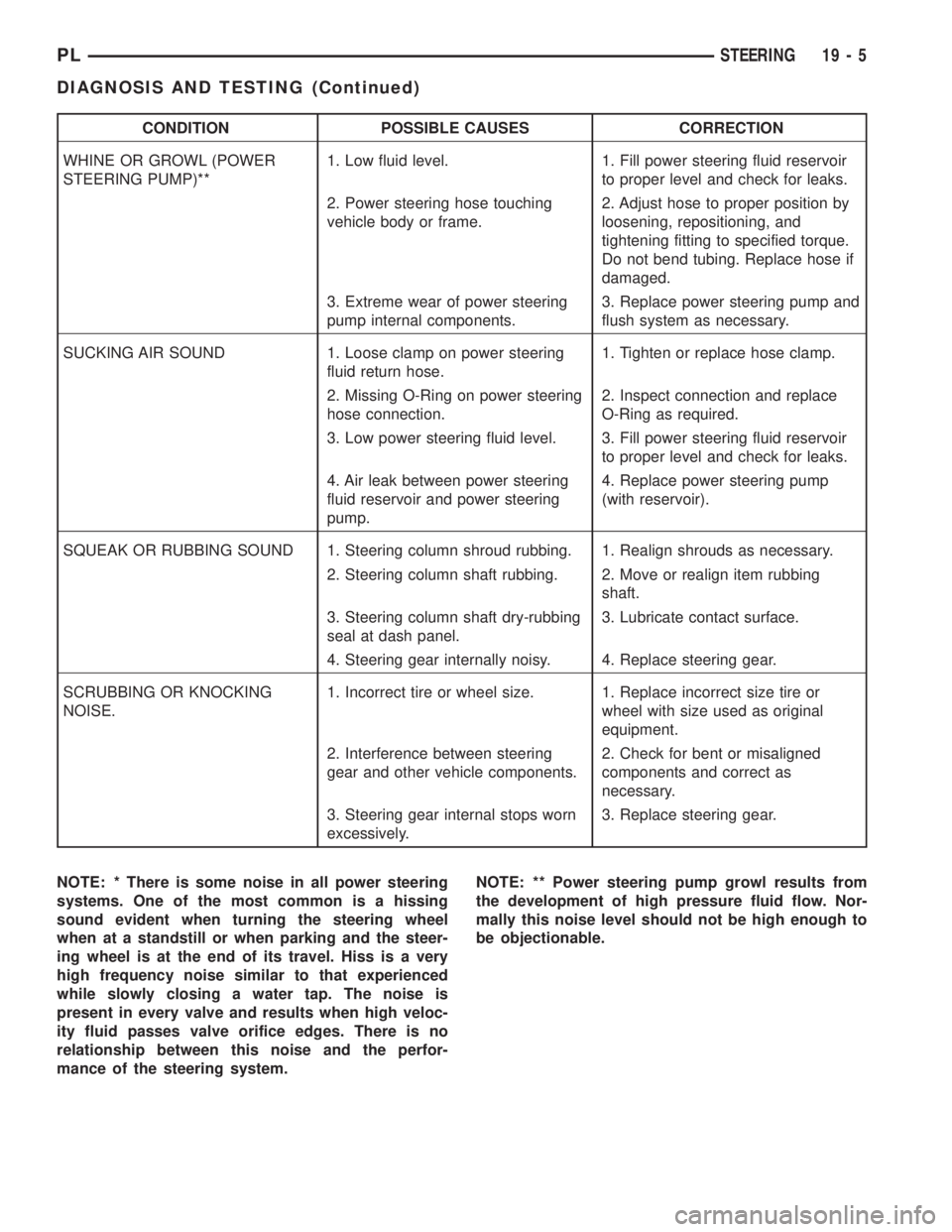
CONDITION POSSIBLE CAUSES CORRECTION
WHINE OR GROWL (POWER
STEERING PUMP)**1. Low fluid level. 1. Fill power steering fluid reservoir
to proper level and check for leaks.
2. Power steering hose touching
vehicle body or frame.2. Adjust hose to proper position by
loosening, repositioning, and
tightening fitting to specified torque.
Do not bend tubing. Replace hose if
damaged.
3. Extreme wear of power steering
pump internal components.3. Replace power steering pump and
flush system as necessary.
SUCKING AIR SOUND 1. Loose clamp on power steering
fluid return hose.1. Tighten or replace hose clamp.
2. Missing O-Ring on power steering
hose connection.2. Inspect connection and replace
O-Ring as required.
3. Low power steering fluid level. 3. Fill power steering fluid reservoir
to proper level and check for leaks.
4. Air leak between power steering
fluid reservoir and power steering
pump.4. Replace power steering pump
(with reservoir).
SQUEAK OR RUBBING SOUND 1. Steering column shroud rubbing. 1. Realign shrouds as necessary.
2. Steering column shaft rubbing. 2. Move or realign item rubbing
shaft.
3. Steering column shaft dry-rubbing
seal at dash panel.3. Lubricate contact surface.
4. Steering gear internally noisy. 4. Replace steering gear.
SCRUBBING OR KNOCKING
NOISE.1. Incorrect tire or wheel size. 1. Replace incorrect size tire or
wheel with size used as original
equipment.
2. Interference between steering
gear and other vehicle components.2. Check for bent or misaligned
components and correct as
necessary.
3. Steering gear internal stops worn
excessively.3. Replace steering gear.
NOTE: * There is some noise in all power steering
systems. One of the most common is a hissing
sound evident when turning the steering wheel
when at a standstill or when parking and the steer-
ing wheel is at the end of its travel. Hiss is a very
high frequency noise similar to that experienced
while slowly closing a water tap. The noise is
present in every valve and results when high veloc-
ity fluid passes valve orifice edges. There is no
relationship between this noise and the perfor-
mance of the steering system.NOTE: ** Power steering pump growl results from
the development of high pressure fluid flow. Nor-
mally this noise level should not be high enough to
be objectionable.
PLSTEERING 19 - 5
DIAGNOSIS AND TESTING (Continued)
Page 880 of 1285
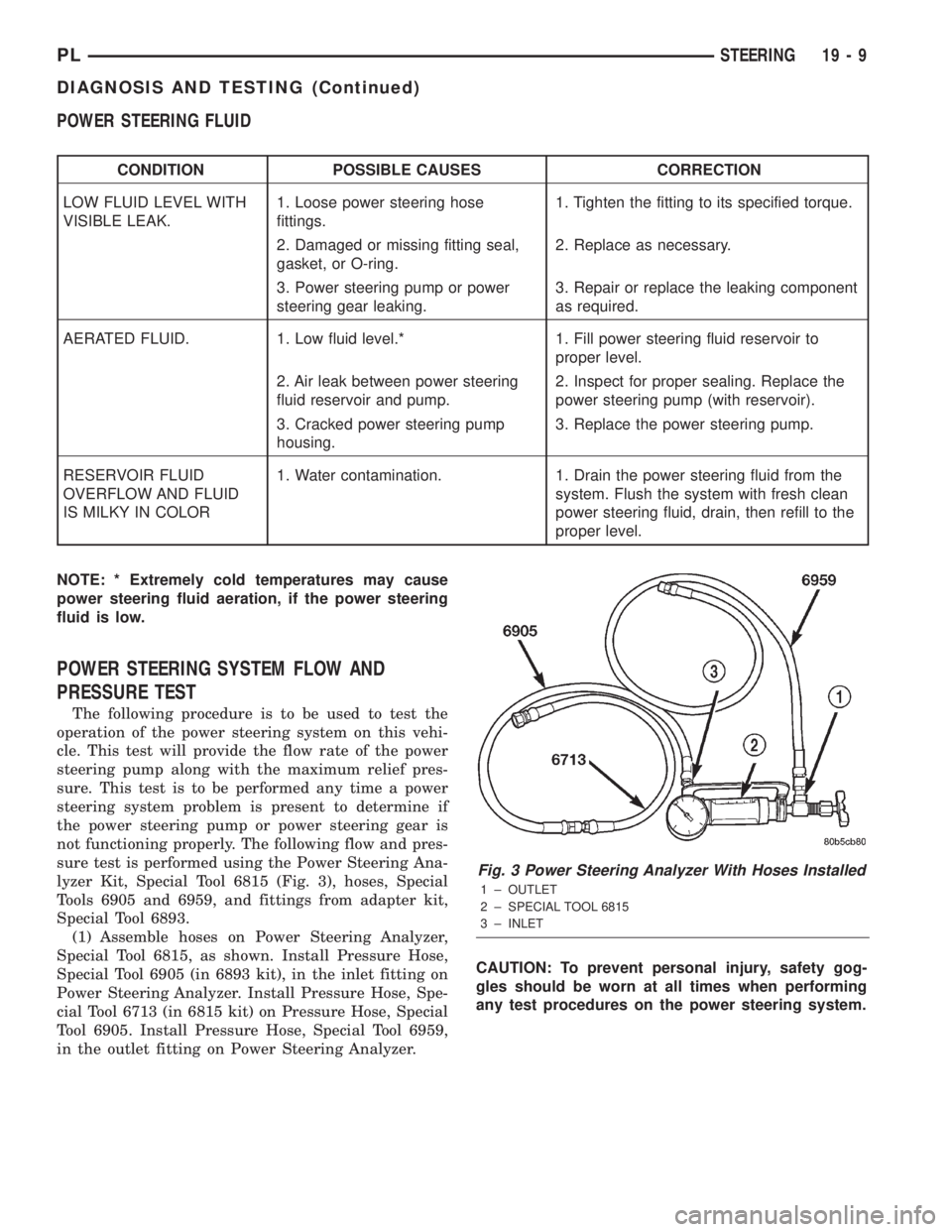
POWER STEERING FLUID
CONDITION POSSIBLE CAUSES CORRECTION
LOW FLUID LEVEL WITH
VISIBLE LEAK.1. Loose power steering hose
fittings.1. Tighten the fitting to its specified torque.
2. Damaged or missing fitting seal,
gasket, or O-ring.2. Replace as necessary.
3. Power steering pump or power
steering gear leaking.3. Repair or replace the leaking component
as required.
AERATED FLUID. 1. Low fluid level.* 1. Fill power steering fluid reservoir to
proper level.
2. Air leak between power steering
fluid reservoir and pump.2. Inspect for proper sealing. Replace the
power steering pump (with reservoir).
3. Cracked power steering pump
housing.3. Replace the power steering pump.
RESERVOIR FLUID
OVERFLOW AND FLUID
IS MILKY IN COLOR1. Water contamination. 1. Drain the power steering fluid from the
system. Flush the system with fresh clean
power steering fluid, drain, then refill to the
proper level.
NOTE: * Extremely cold temperatures may cause
power steering fluid aeration, if the power steering
fluid is low.
POWER STEERING SYSTEM FLOW AND
PRESSURE TEST
The following procedure is to be used to test the
operation of the power steering system on this vehi-
cle. This test will provide the flow rate of the power
steering pump along with the maximum relief pres-
sure. This test is to be performed any time a power
steering system problem is present to determine if
the power steering pump or power steering gear is
not functioning properly. The following flow and pres-
sure test is performed using the Power Steering Ana-
lyzer Kit, Special Tool 6815 (Fig. 3), hoses, Special
Tools 6905 and 6959, and fittings from adapter kit,
Special Tool 6893.
(1) Assemble hoses on Power Steering Analyzer,
Special Tool 6815, as shown. Install Pressure Hose,
Special Tool 6905 (in 6893 kit), in the inlet fitting on
Power Steering Analyzer. Install Pressure Hose, Spe-
cial Tool 6713 (in 6815 kit) on Pressure Hose, Special
Tool 6905. Install Pressure Hose, Special Tool 6959,
in the outlet fitting on Power Steering Analyzer.CAUTION: To prevent personal injury, safety gog-
gles should be worn at all times when performing
any test procedures on the power steering system.
Fig. 3 Power Steering Analyzer With Hoses Installed
1 ± OUTLET
2 ± SPECIAL TOOL 6815
3 ± INLET
PLSTEERING 19 - 9
DIAGNOSIS AND TESTING (Continued)