tow DODGE NEON 2000 Service User Guide
[x] Cancel search | Manufacturer: DODGE, Model Year: 2000, Model line: NEON, Model: DODGE NEON 2000Pages: 1285, PDF Size: 29.42 MB
Page 26 of 1285
(6) Remove the two bolts attaching the strut to the
steering knuckle (Fig. 1).
(7) Lower the vehicle just enough to open the
hood, but without letting the tires touch the floor.
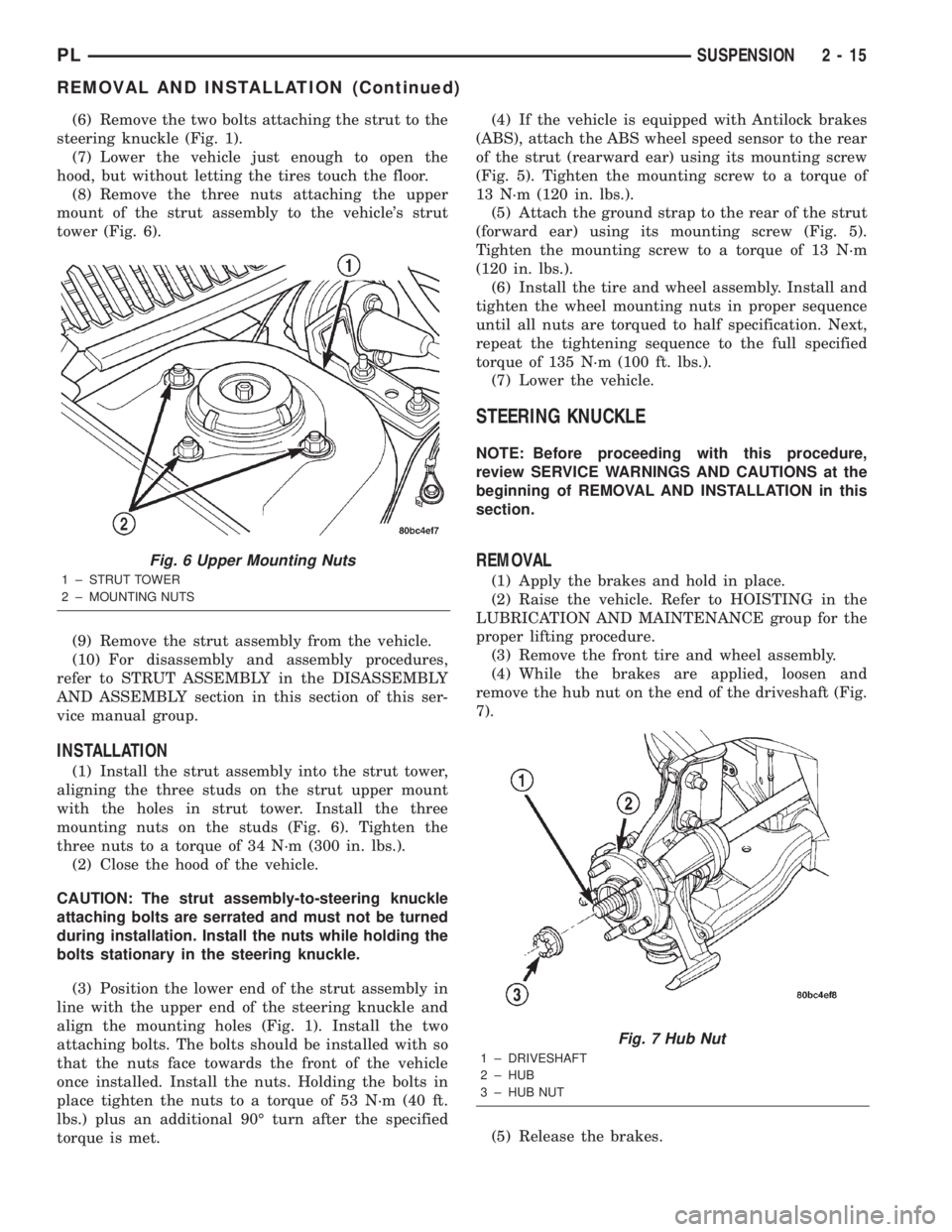
(8) Remove the three nuts attaching the upper
mount of the strut assembly to the vehicle's strut
tower (Fig. 6).
(9) Remove the strut assembly from the vehicle.
(10) For disassembly and assembly procedures,
refer to STRUT ASSEMBLY in the DISASSEMBLY
AND ASSEMBLY section in this section of this ser-
vice manual group.
INSTALLATION
(1) Install the strut assembly into the strut tower,
aligning the three studs on the strut upper mount
with the holes in strut tower. Install the three
mounting nuts on the studs (Fig. 6). Tighten the
three nuts to a torque of 34 N´m (300 in. lbs.).
(2) Close the hood of the vehicle.
CAUTION: The strut assembly-to-steering knuckle
attaching bolts are serrated and must not be turned
during installation. Install the nuts while holding the
bolts stationary in the steering knuckle.
(3) Position the lower end of the strut assembly in
line with the upper end of the steering knuckle and
align the mounting holes (Fig. 1). Install the two
attaching bolts. The bolts should be installed with so
that the nuts face towards the front of the vehicle
once installed. Install the nuts. Holding the bolts in
place tighten the nuts to a torque of 53 N´m (40 ft.
lbs.) plus an additional 90É turn after the specified
torque is met.(4) If the vehicle is equipped with Antilock brakes
(ABS), attach the ABS wheel speed sensor to the rear
of the strut (rearward ear) using its mounting screw
(Fig. 5). Tighten the mounting screw to a torque of
13 N´m (120 in. lbs.).
(5) Attach the ground strap to the rear of the strut
(forward ear) using its mounting screw (Fig. 5).
Tighten the mounting screw to a torque of 13 N´m
(120 in. lbs.).
(6) Install the tire and wheel assembly. Install and
tighten the wheel mounting nuts in proper sequence
until all nuts are torqued to half specification. Next,
repeat the tightening sequence to the full specified
torque of 135 N´m (100 ft. lbs.).
(7) Lower the vehicle.
STEERING KNUCKLE
NOTE: Before proceeding with this procedure,
review SERVICE WARNINGS AND CAUTIONS at the
beginning of REMOVAL AND INSTALLATION in this
section.
REMOVAL
(1) Apply the brakes and hold in place.
(2) Raise the vehicle. Refer to HOISTING in the
LUBRICATION AND MAINTENANCE group for the
proper lifting procedure.
(3) Remove the front tire and wheel assembly.
(4) While the brakes are applied, loosen and
remove the hub nut on the end of the driveshaft (Fig.
7).
(5) Release the brakes.
Fig. 6 Upper Mounting Nuts
1 ± STRUT TOWER
2 ± MOUNTING NUTS
Fig. 7 Hub Nut
1 ± DRIVESHAFT
2 ± HUB
3 ± HUB NUT
PLSUSPENSION 2 - 15
REMOVAL AND INSTALLATION (Continued)
Page 28 of 1285
(12) Remove the tie rod heat shield.
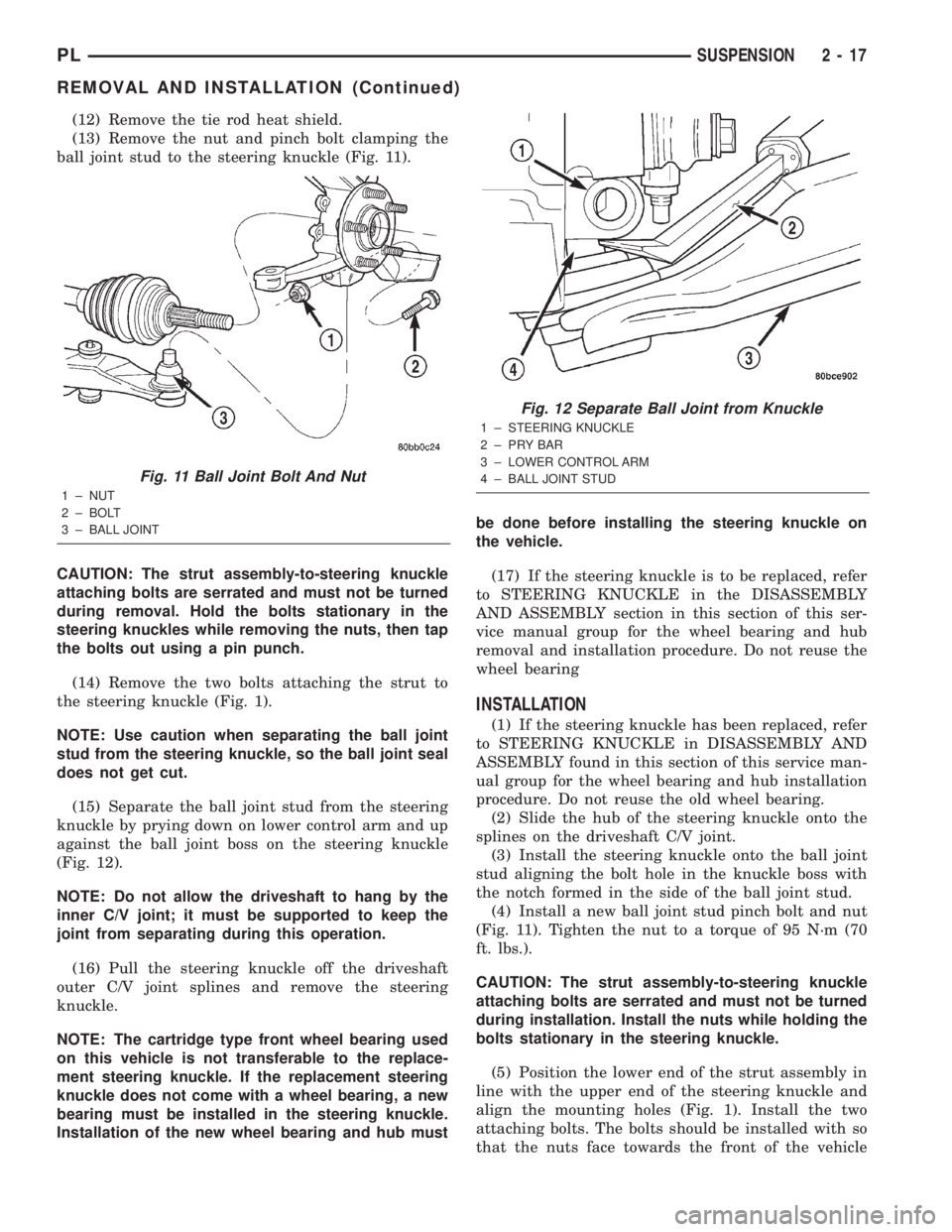
(13) Remove the nut and pinch bolt clamping the
ball joint stud to the steering knuckle (Fig. 11).
CAUTION: The strut assembly-to-steering knuckle
attaching bolts are serrated and must not be turned
during removal. Hold the bolts stationary in the
steering knuckles while removing the nuts, then tap
the bolts out using a pin punch.
(14) Remove the two bolts attaching the strut to
the steering knuckle (Fig. 1).
NOTE: Use caution when separating the ball joint
stud from the steering knuckle, so the ball joint seal
does not get cut.
(15) Separate the ball joint stud from the steering
knuckle by prying down on lower control arm and up
against the ball joint boss on the steering knuckle
(Fig. 12).
NOTE: Do not allow the driveshaft to hang by the
inner C/V joint; it must be supported to keep the
joint from separating during this operation.
(16) Pull the steering knuckle off the driveshaft
outer C/V joint splines and remove the steering
knuckle.
NOTE: The cartridge type front wheel bearing used
on this vehicle is not transferable to the replace-
ment steering knuckle. If the replacement steering
knuckle does not come with a wheel bearing, a new
bearing must be installed in the steering knuckle.
Installation of the new wheel bearing and hub mustbe done before installing the steering knuckle on
the vehicle.
(17) If the steering knuckle is to be replaced, refer
to STEERING KNUCKLE in the DISASSEMBLY
AND ASSEMBLY section in this section of this ser-
vice manual group for the wheel bearing and hub
removal and installation procedure. Do not reuse the
wheel bearing
INSTALLATION
(1) If the steering knuckle has been replaced, refer
to STEERING KNUCKLE in DISASSEMBLY AND
ASSEMBLY found in this section of this service man-
ual group for the wheel bearing and hub installation
procedure. Do not reuse the old wheel bearing.
(2) Slide the hub of the steering knuckle onto the
splines on the driveshaft C/V joint.
(3) Install the steering knuckle onto the ball joint
stud aligning the bolt hole in the knuckle boss with
the notch formed in the side of the ball joint stud.
(4) Install a new ball joint stud pinch bolt and nut
(Fig. 11). Tighten the nut to a torque of 95 N´m (70
ft. lbs.).
CAUTION: The strut assembly-to-steering knuckle
attaching bolts are serrated and must not be turned
during installation. Install the nuts while holding the
bolts stationary in the steering knuckle.
(5) Position the lower end of the strut assembly in
line with the upper end of the steering knuckle and
align the mounting holes (Fig. 1). Install the two
attaching bolts. The bolts should be installed with so
that the nuts face towards the front of the vehicle
Fig. 11 Ball Joint Bolt And Nut
1 ± NUT
2 ± BOLT
3 ± BALL JOINT
Fig. 12 Separate Ball Joint from Knuckle
1 ± STEERING KNUCKLE
2±PRYBAR
3 ± LOWER CONTROL ARM
4 ± BALL JOINT STUD
PLSUSPENSION 2 - 17
REMOVAL AND INSTALLATION (Continued)
Page 31 of 1285
with the notch formed in the side of the ball joint
stud.
(4) If the right lower control arm has been ser-
viced, install the engine torque strut (Fig. 16). Follow
the procedure described in the ENGINE service man-
ual group to properly align and tighten the torque
strut.
(5) Install a new ball joint stud pinch bolt and nut
(Fig. 15). Tighten the nut to a torque of 95 N´m (70
ft. lbs.).
(6) Rotate the forward ends of the stabilizer bar
into mounting position.
(7) Install both stabilizer bar links back on vehicle
(Fig. 14). Start each stabilizer bar link bolt with
bushing from the bottom, through the stabilizer bar,
inner link bushings, lower control arm, and into the
upper retainer/nut and bushing (Fig. 1). Do not fully
tighten the link assemblies at this time.
(8) Lower the vehicle to ground level.
NOTE: It may be necessary to put the vehicle on a
platform hoist or alignment rack to gain access to
the stabilizer bar mounting bolts with the vehicle at
curb height.
(9) Tighten each stabilizer bar link by holding the
upper retainer/nut with a wrench and turning the
link bolt. Tighten each link bolt to a torque of 23
N´m (200 in. lbs.).
(10) If previously loosened, tighten the stabilizer
bar cushion retainer bolts to a torque of 28 N´m (250
in. lbs.).
STABILIZER BAR (FRONT)
NOTE: Before proceeding with this procedure,
review SERVICE WARNINGS AND CAUTIONS at the
beginning of REMOVAL AND INSTALLATION in this
section.
REMOVAL
(1) Raise the vehicle. Refer to HOISTING in the
LUBRICATION AND MAINTENANCE group for the
proper lifting procedure.
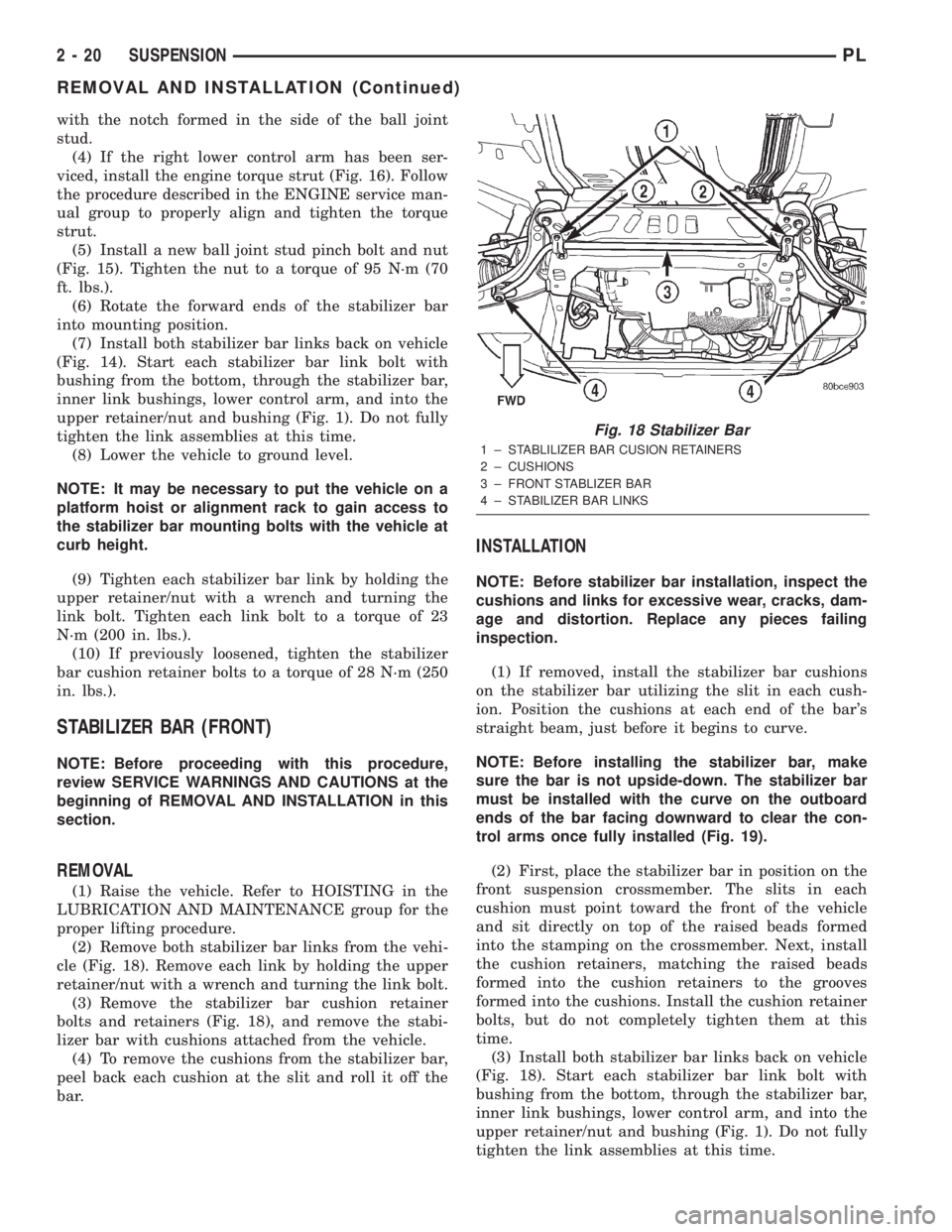
(2) Remove both stabilizer bar links from the vehi-
cle (Fig. 18). Remove each link by holding the upper
retainer/nut with a wrench and turning the link bolt.
(3) Remove the stabilizer bar cushion retainer
bolts and retainers (Fig. 18), and remove the stabi-
lizer bar with cushions attached from the vehicle.
(4) To remove the cushions from the stabilizer bar,
peel back each cushion at the slit and roll it off the
bar.
INSTALLATION
NOTE: Before stabilizer bar installation, inspect the
cushions and links for excessive wear, cracks, dam-
age and distortion. Replace any pieces failing
inspection.
(1) If removed, install the stabilizer bar cushions
on the stabilizer bar utilizing the slit in each cush-
ion. Position the cushions at each end of the bar's
straight beam, just before it begins to curve.
NOTE: Before installing the stabilizer bar, make
sure the bar is not upside-down. The stabilizer bar
must be installed with the curve on the outboard
ends of the bar facing downward to clear the con-
trol arms once fully installed (Fig. 19).
(2) First, place the stabilizer bar in position on the
front suspension crossmember. The slits in each
cushion must point toward the front of the vehicle
and sit directly on top of the raised beads formed
into the stamping on the crossmember. Next, install
the cushion retainers, matching the raised beads
formed into the cushion retainers to the grooves
formed into the cushions. Install the cushion retainer
bolts, but do not completely tighten them at this
time.
(3) Install both stabilizer bar links back on vehicle
(Fig. 18). Start each stabilizer bar link bolt with
bushing from the bottom, through the stabilizer bar,
inner link bushings, lower control arm, and into the
upper retainer/nut and bushing (Fig. 1). Do not fully
tighten the link assemblies at this time.
Fig. 18 Stabilizer Bar
1 ± STABLILIZER BAR CUSION RETAINERS
2 ± CUSHIONS
3 ± FRONT STABLIZER BAR
4 ± STABILIZER BAR LINKS
2 - 20 SUSPENSIONPL
REMOVAL AND INSTALLATION (Continued)
Page 35 of 1285
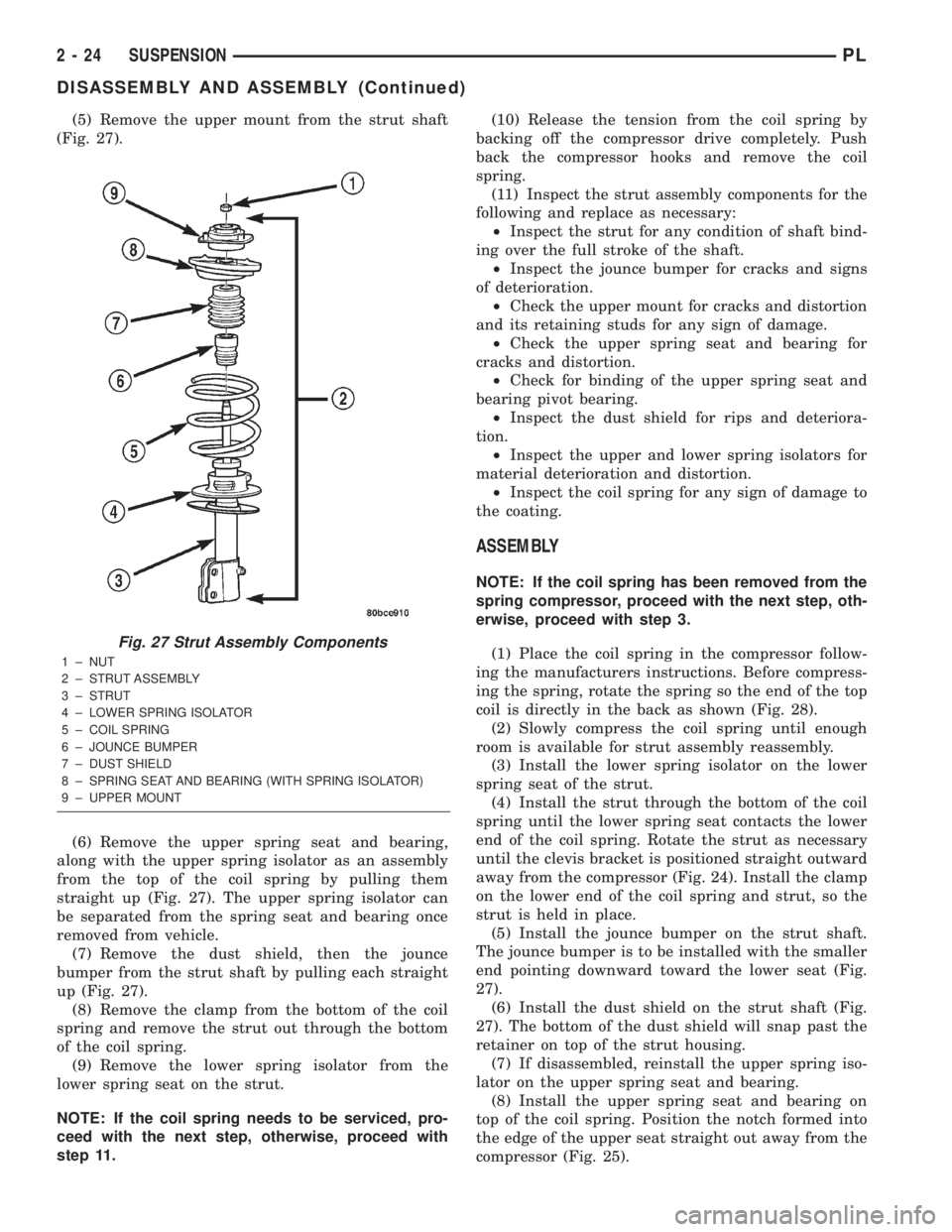
(5) Remove the upper mount from the strut shaft
(Fig. 27).
(6) Remove the upper spring seat and bearing,
along with the upper spring isolator as an assembly
from the top of the coil spring by pulling them
straight up (Fig. 27). The upper spring isolator can
be separated from the spring seat and bearing once
removed from vehicle.
(7) Remove the dust shield, then the jounce
bumper from the strut shaft by pulling each straight
up (Fig. 27).
(8) Remove the clamp from the bottom of the coil
spring and remove the strut out through the bottom
of the coil spring.
(9) Remove the lower spring isolator from the
lower spring seat on the strut.
NOTE: If the coil spring needs to be serviced, pro-
ceed with the next step, otherwise, proceed with
step 11.(10) Release the tension from the coil spring by
backing off the compressor drive completely. Push
back the compressor hooks and remove the coil
spring.
(11) Inspect the strut assembly components for the
following and replace as necessary:
²Inspect the strut for any condition of shaft bind-
ing over the full stroke of the shaft.
²Inspect the jounce bumper for cracks and signs
of deterioration.
²Check the upper mount for cracks and distortion
and its retaining studs for any sign of damage.
²Check the upper spring seat and bearing for
cracks and distortion.
²Check for binding of the upper spring seat and
bearing pivot bearing.
²Inspect the dust shield for rips and deteriora-
tion.
²Inspect the upper and lower spring isolators for
material deterioration and distortion.
²Inspect the coil spring for any sign of damage to
the coating.
ASSEMBLY
NOTE: If the coil spring has been removed from the
spring compressor, proceed with the next step, oth-
erwise, proceed with step 3.
(1) Place the coil spring in the compressor follow-
ing the manufacturers instructions. Before compress-
ing the spring, rotate the spring so the end of the top
coil is directly in the back as shown (Fig. 28).
(2) Slowly compress the coil spring until enough
room is available for strut assembly reassembly.
(3) Install the lower spring isolator on the lower
spring seat of the strut.
(4) Install the strut through the bottom of the coil
spring until the lower spring seat contacts the lower
end of the coil spring. Rotate the strut as necessary
until the clevis bracket is positioned straight outward
away from the compressor (Fig. 24). Install the clamp
on the lower end of the coil spring and strut, so the
strut is held in place.
(5) Install the jounce bumper on the strut shaft.
The jounce bumper is to be installed with the smaller
end pointing downward toward the lower seat (Fig.
27).
(6) Install the dust shield on the strut shaft (Fig.
27). The bottom of the dust shield will snap past the
retainer on top of the strut housing.
(7) If disassembled, reinstall the upper spring iso-
lator on the upper spring seat and bearing.
(8) Install the upper spring seat and bearing on
top of the coil spring. Position the notch formed into
the edge of the upper seat straight out away from the
compressor (Fig. 25).
Fig. 27 Strut Assembly Components
1 ± NUT
2 ± STRUT ASSEMBLY
3 ± STRUT
4 ± LOWER SPRING ISOLATOR
5 ± COIL SPRING
6 ± JOUNCE BUMPER
7 ± DUST SHIELD
8 ± SPRING SEAT AND BEARING (WITH SPRING ISOLATOR)
9 ± UPPER MOUNT
2 - 24 SUSPENSIONPL
DISASSEMBLY AND ASSEMBLY (Continued)
Page 39 of 1285
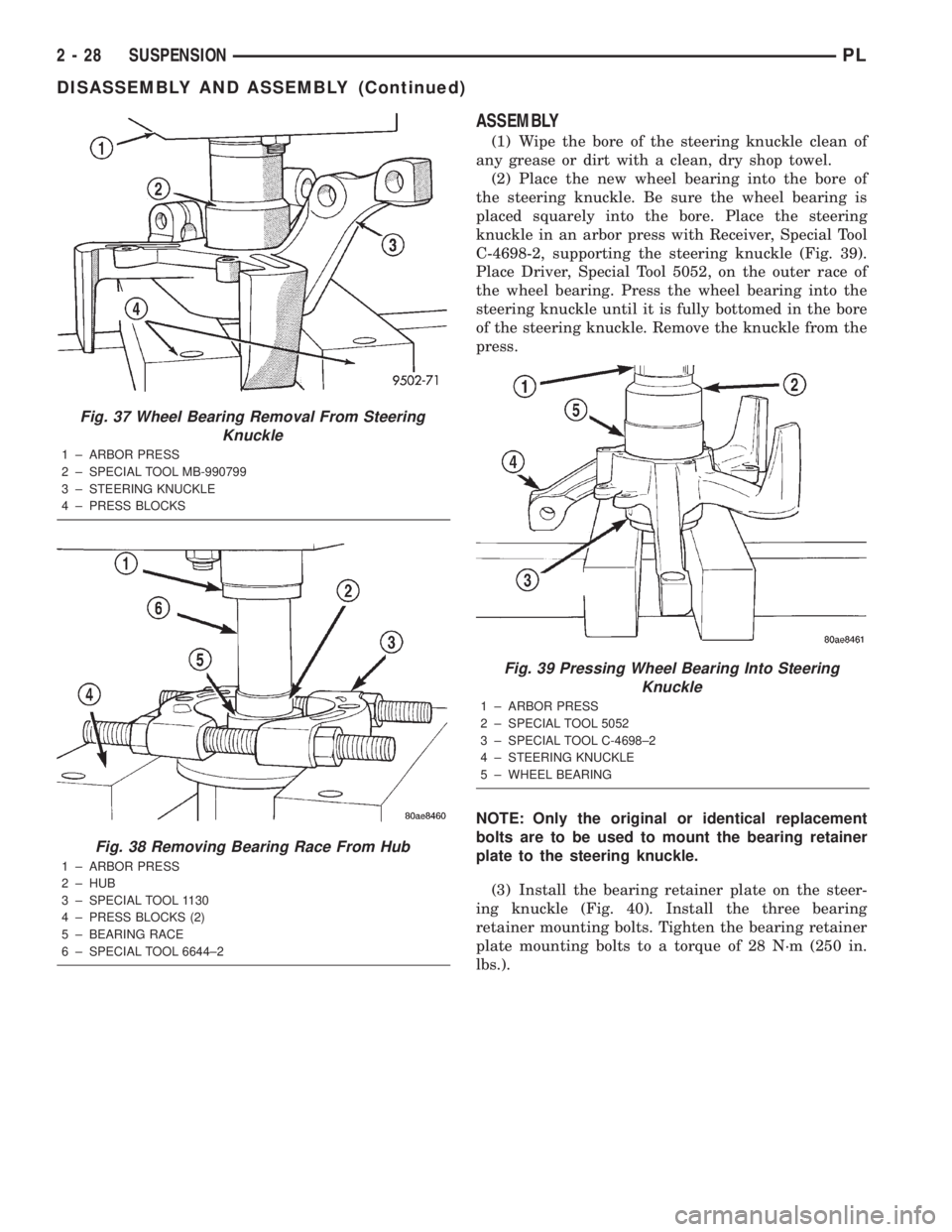
ASSEMBLY
(1) Wipe the bore of the steering knuckle clean of
any grease or dirt with a clean, dry shop towel.
(2) Place the new wheel bearing into the bore of
the steering knuckle. Be sure the wheel bearing is
placed squarely into the bore. Place the steering
knuckle in an arbor press with Receiver, Special Tool
C-4698-2, supporting the steering knuckle (Fig. 39).
Place Driver, Special Tool 5052, on the outer race of
the wheel bearing. Press the wheel bearing into the
steering knuckle until it is fully bottomed in the bore
of the steering knuckle. Remove the knuckle from the
press.
NOTE: Only the original or identical replacement
bolts are to be used to mount the bearing retainer
plate to the steering knuckle.
(3) Install the bearing retainer plate on the steer-
ing knuckle (Fig. 40). Install the three bearing
retainer mounting bolts. Tighten the bearing retainer
plate mounting bolts to a torque of 28 N´m (250 in.
lbs.).
Fig. 37 Wheel Bearing Removal From Steering
Knuckle
1 ± ARBOR PRESS
2 ± SPECIAL TOOL MB-990799
3 ± STEERING KNUCKLE
4 ± PRESS BLOCKS
Fig. 38 Removing Bearing Race From Hub
1 ± ARBOR PRESS
2 ± HUB
3 ± SPECIAL TOOL 1130
4 ± PRESS BLOCKS (2)
5 ± BEARING RACE
6 ± SPECIAL TOOL 6644±2
Fig. 39 Pressing Wheel Bearing Into Steering
Knuckle
1 ± ARBOR PRESS
2 ± SPECIAL TOOL 5052
3 ± SPECIAL TOOL C-4698±2
4 ± STEERING KNUCKLE
5 ± WHEEL BEARING
2 - 28 SUSPENSIONPL
DISASSEMBLY AND ASSEMBLY (Continued)
Page 44 of 1285
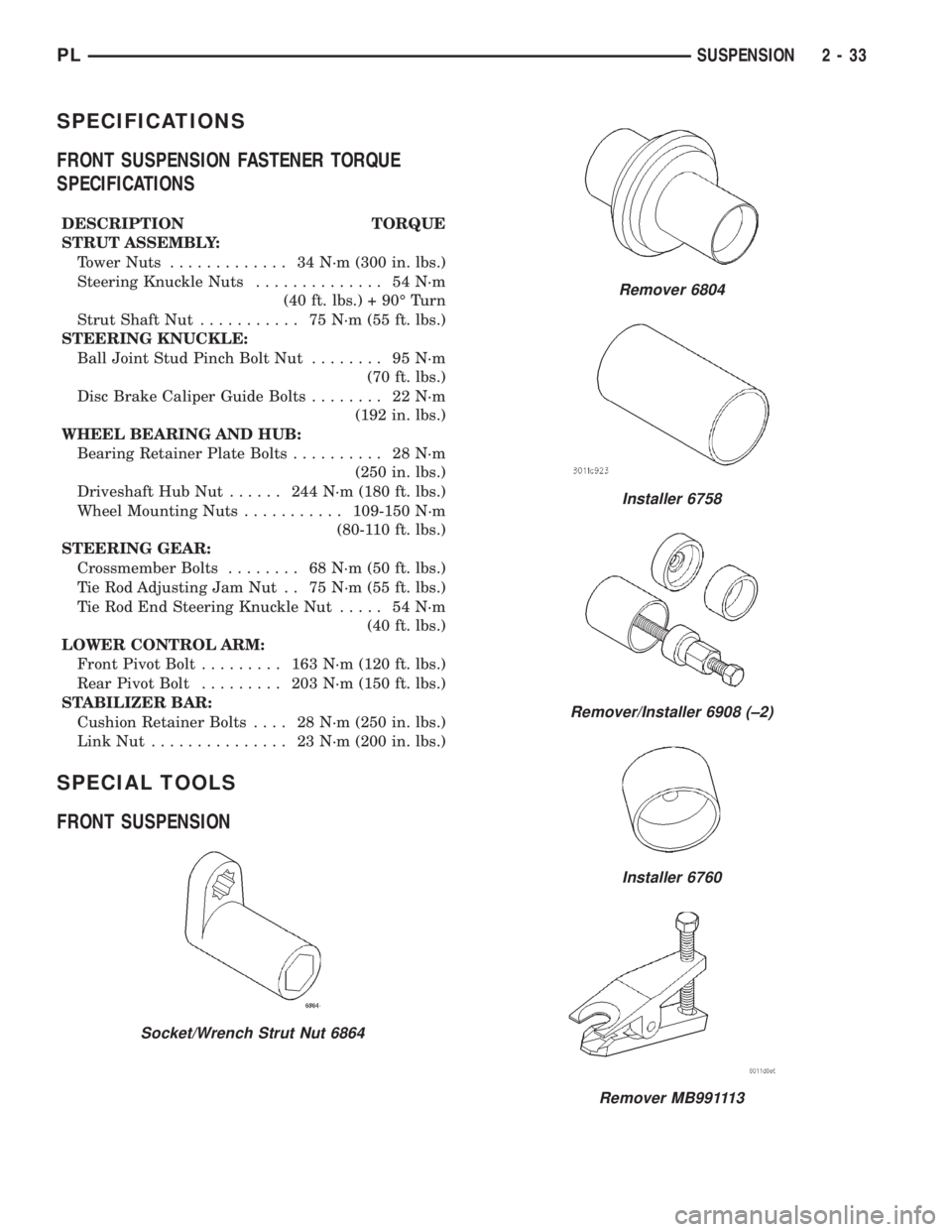
SPECIFICATIONS
FRONT SUSPENSION FASTENER TORQUE
SPECIFICATIONS
DESCRIPTION TORQUE
STRUT ASSEMBLY:
Tower Nuts............. 34N´m(300 in. lbs.)
Steering Knuckle Nuts.............. 54N´m
(40 ft. lbs.) + 90É Turn
Strut Shaft Nut........... 75N´m(55ft.lbs.)
STEERING KNUCKLE:
Ball Joint Stud Pinch Bolt Nut........ 95N´m
(70 ft. lbs.)
Disc Brake Caliper Guide Bolts........ 22N´m
(192 in. lbs.)
WHEEL BEARING AND HUB:
Bearing Retainer Plate Bolts.......... 28N´m
(250 in. lbs.)
Driveshaft Hub Nut...... 244N´m(180 ft. lbs.)
Wheel Mounting Nuts...........109-150 N´m
(80-110 ft. lbs.)
STEERING GEAR:
Crossmember Bolts........ 68N´m(50ft.lbs.)
Tie Rod Adjusting Jam Nut . . 75 N´m (55 ft. lbs.)
Tie Rod End Steering Knuckle Nut..... 54N´m
(40 ft. lbs.)
LOWER CONTROL ARM:
Front Pivot Bolt......... 163N´m(120 ft. lbs.)
Rear Pivot Bolt......... 203N´m(150 ft. lbs.)
STABILIZER BAR:
Cushion Retainer Bolts.... 28N´m(250 in. lbs.)
Link Nut............... 23N´m(200 in. lbs.)
SPECIAL TOOLS
FRONT SUSPENSION
Socket/Wrench Strut Nut 6864
Remover 6804
Installer 6758
Remover/Installer 6908 (±2)
Installer 6760
Remover MB991113
PLSUSPENSION 2 - 33
Page 48 of 1285
For more information on the description and oper-
ation of an individual component, refer to the appli-
cable component heading in this section.
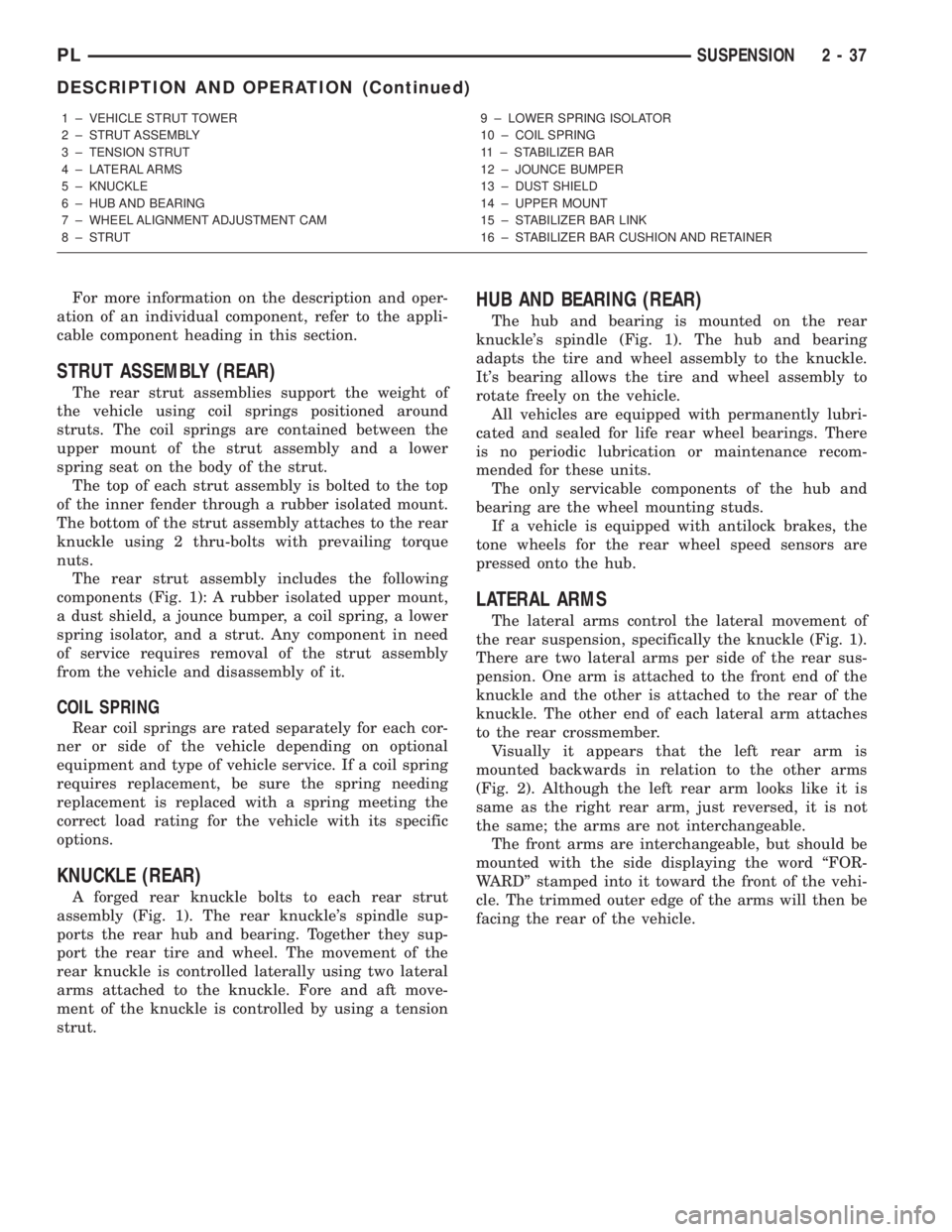
STRUT ASSEMBLY (REAR)
The rear strut assemblies support the weight of
the vehicle using coil springs positioned around
struts. The coil springs are contained between the
upper mount of the strut assembly and a lower
spring seat on the body of the strut.
The top of each strut assembly is bolted to the top
of the inner fender through a rubber isolated mount.
The bottom of the strut assembly attaches to the rear
knuckle using 2 thru-bolts with prevailing torque
nuts.
The rear strut assembly includes the following
components (Fig. 1): A rubber isolated upper mount,
a dust shield, a jounce bumper, a coil spring, a lower
spring isolator, and a strut. Any component in need
of service requires removal of the strut assembly
from the vehicle and disassembly of it.
COIL SPRING
Rear coil springs are rated separately for each cor-
ner or side of the vehicle depending on optional
equipment and type of vehicle service. If a coil spring
requires replacement, be sure the spring needing
replacement is replaced with a spring meeting the
correct load rating for the vehicle with its specific
options.
KNUCKLE (REAR)
A forged rear knuckle bolts to each rear strut
assembly (Fig. 1). The rear knuckle's spindle sup-
ports the rear hub and bearing. Together they sup-
port the rear tire and wheel. The movement of the
rear knuckle is controlled laterally using two lateral
arms attached to the knuckle. Fore and aft move-
ment of the knuckle is controlled by using a tension
strut.
HUB AND BEARING (REAR)
The hub and bearing is mounted on the rear
knuckle's spindle (Fig. 1). The hub and bearing
adapts the tire and wheel assembly to the knuckle.
It's bearing allows the tire and wheel assembly to
rotate freely on the vehicle.
All vehicles are equipped with permanently lubri-
cated and sealed for life rear wheel bearings. There
is no periodic lubrication or maintenance recom-
mended for these units.
The only servicable components of the hub and
bearing are the wheel mounting studs.
If a vehicle is equipped with antilock brakes, the
tone wheels for the rear wheel speed sensors are
pressed onto the hub.
LATERAL ARMS
The lateral arms control the lateral movement of
the rear suspension, specifically the knuckle (Fig. 1).
There are two lateral arms per side of the rear sus-
pension. One arm is attached to the front end of the
knuckle and the other is attached to the rear of the
knuckle. The other end of each lateral arm attaches
to the rear crossmember.
Visually it appears that the left rear arm is
mounted backwards in relation to the other arms
(Fig. 2). Although the left rear arm looks like it is
same as the right rear arm, just reversed, it is not
the same; the arms are not interchangeable.
The front arms are interchangeable, but should be
mounted with the side displaying the word ªFOR-
WARDº stamped into it toward the front of the vehi-
cle. The trimmed outer edge of the arms will then be
facing the rear of the vehicle.
1 ± VEHICLE STRUT TOWER
2 ± STRUT ASSEMBLY
3 ± TENSION STRUT
4 ± LATERAL ARMS
5 ± KNUCKLE
6 ± HUB AND BEARING
7 ± WHEEL ALIGNMENT ADJUSTMENT CAM
8 ± STRUT9 ± LOWER SPRING ISOLATOR
10 ± COIL SPRING
11 ± STABILIZER BAR
12 ± JOUNCE BUMPER
13 ± DUST SHIELD
14 ± UPPER MOUNT
15 ± STABILIZER BAR LINK
16 ± STABILIZER BAR CUSHION AND RETAINER
PLSUSPENSION 2 - 37
DESCRIPTION AND OPERATION (Continued)
Page 52 of 1285
CAUTION: The strut-to-knuckle attaching bolts are
serrated and must not be turned during removal.
Hold the bolts stationary in the steering knuckle
while removing the nuts, then tap the bolts out
using a pin punch.
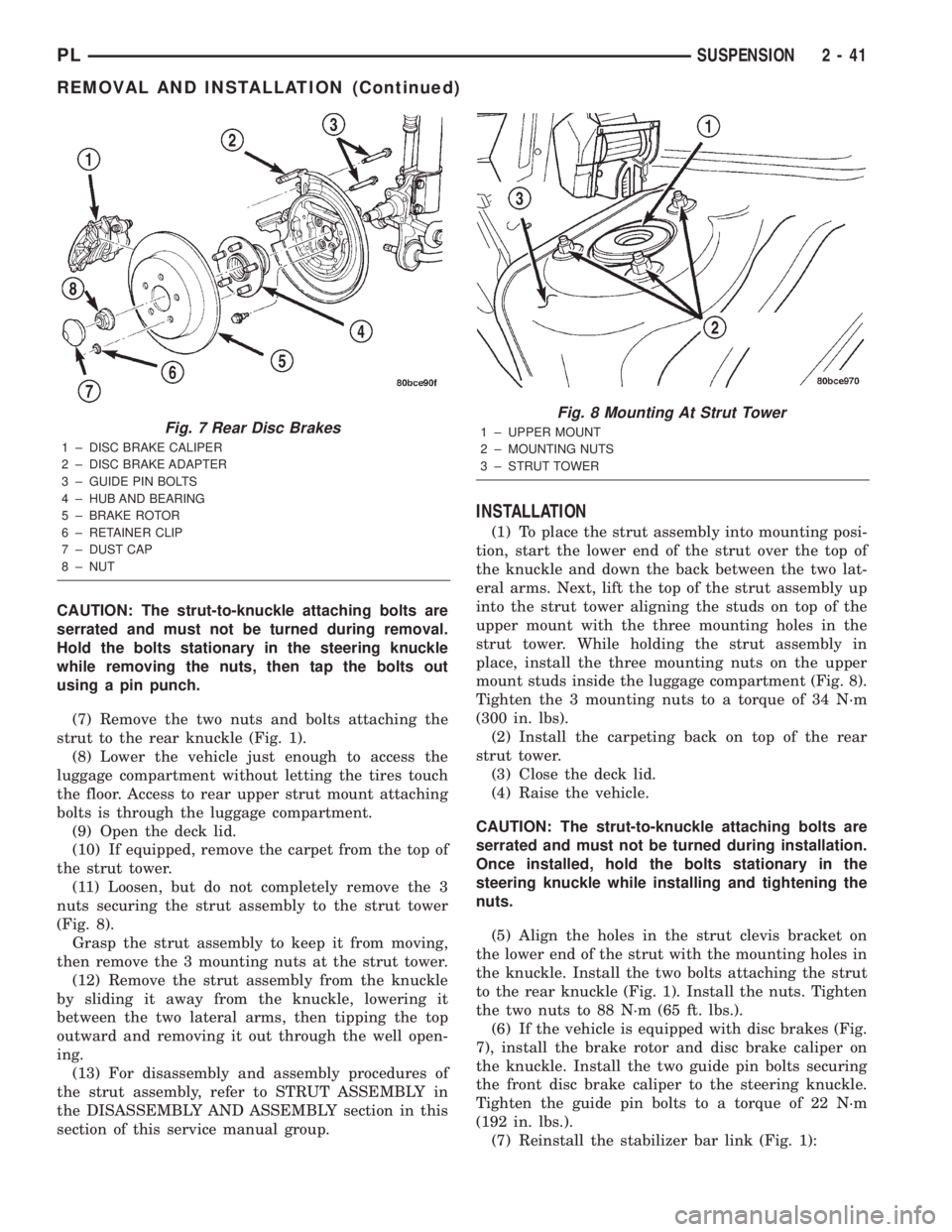
(7) Remove the two nuts and bolts attaching the
strut to the rear knuckle (Fig. 1).
(8) Lower the vehicle just enough to access the
luggage compartment without letting the tires touch
the floor. Access to rear upper strut mount attaching
bolts is through the luggage compartment.
(9) Open the deck lid.
(10) If equipped, remove the carpet from the top of
the strut tower.
(11) Loosen, but do not completely remove the 3
nuts securing the strut assembly to the strut tower
(Fig. 8).
Grasp the strut assembly to keep it from moving,
then remove the 3 mounting nuts at the strut tower.
(12) Remove the strut assembly from the knuckle
by sliding it away from the knuckle, lowering it
between the two lateral arms, then tipping the top
outward and removing it out through the well open-
ing.
(13) For disassembly and assembly procedures of
the strut assembly, refer to STRUT ASSEMBLY in
the DISASSEMBLY AND ASSEMBLY section in this
section of this service manual group.
INSTALLATION
(1) To place the strut assembly into mounting posi-
tion, start the lower end of the strut over the top of
the knuckle and down the back between the two lat-
eral arms. Next, lift the top of the strut assembly up
into the strut tower aligning the studs on top of the
upper mount with the three mounting holes in the
strut tower. While holding the strut assembly in
place, install the three mounting nuts on the upper
mount studs inside the luggage compartment (Fig. 8).
Tighten the 3 mounting nuts to a torque of 34 N´m
(300 in. lbs).
(2) Install the carpeting back on top of the rear
strut tower.
(3) Close the deck lid.
(4) Raise the vehicle.
CAUTION: The strut-to-knuckle attaching bolts are
serrated and must not be turned during installation.
Once installed, hold the bolts stationary in the
steering knuckle while installing and tightening the
nuts.
(5) Align the holes in the strut clevis bracket on
the lower end of the strut with the mounting holes in
the knuckle. Install the two bolts attaching the strut
to the rear knuckle (Fig. 1). Install the nuts. Tighten
the two nuts to 88 N´m (65 ft. lbs.).
(6) If the vehicle is equipped with disc brakes (Fig.
7), install the brake rotor and disc brake caliper on
the knuckle. Install the two guide pin bolts securing
the front disc brake caliper to the steering knuckle.
Tighten the guide pin bolts to a torque of 22 N´m
(192 in. lbs.).
(7) Reinstall the stabilizer bar link (Fig. 1):
Fig. 7 Rear Disc Brakes
1 ± DISC BRAKE CALIPER
2 ± DISC BRAKE ADAPTER
3 ± GUIDE PIN BOLTS
4 ± HUB AND BEARING
5 ± BRAKE ROTOR
6 ± RETAINER CLIP
7 ± DUST CAP
8 ± NUT
Fig. 8 Mounting At Strut Tower
1 ± UPPER MOUNT
2 ± MOUNTING NUTS
3 ± STRUT TOWER
PLSUSPENSION 2 - 41
REMOVAL AND INSTALLATION (Continued)
Page 56 of 1285
LATERAL ARMS
NOTE: Before proceeding with this procedure,
review SERVICE WARNINGS AND CAUTIONS at the
beginning of REMOVAL AND INSTALLATION in this
section.
Use the following procedure for removal and instal-
lation of one or both lateral arms on one side of the
vehicle's rear suspension.
REMOVAL
(1) Raise the vehicle. Refer to HOISTING in the
LUBRICATION AND MAINTENANCE group for the
proper lifting procedure.
(2) Remove the rear tire and wheel assembly.
(3) Remove the nut, bolt and washers attaching
both lateral arms to the knuckle (Fig. 1).
(4) Remove nut, washer, bolt and wheel alignment
cam attaching the lateral arms to the rear crossmem-
ber (Fig. 1).
(5) Remove the lateral arms from vehicle.
INSTALLATION
NOTE: Both lateral arms when being installed,
must be specifically positioned and orientated on
the vehicle. The lateral arm that has the same size
bushing sleeves on both ends must be mounted on
the forward side of the crossmember and knuckle
with the trimmed outer edge facing rearward. This
front arm is also marked with the word ªFOR-
WARDº. The side of the arm displaying this must
face forward.
The lateral arm with two different size bushing
sleeves must be mounted on the rearward side of
the crossmember and knuckle. Position the smaller
bushing sleeve end at the knuckle and the larger
bushing sleeve end at the rear crossmember (the
larger bushing sleeve is necessary to accommodate
the rear wheel alignment adjustment cam). If the
rear arm is to be mounted on the right side, the
trimmed outer edge must face rearward. If the rear
arm is to be mounted on the left side, the trimmed
outer edge must face forward.
(1) Following the note above, place the forward lat-
eral arm against the leading end of the knuckle, and
then install the short lateral arm mounting bolt with
a washer through the lateral arm and knuckle and
out the trailing end of the knuckle (Fig. 1).
(2) Following the note above, install the small
bushing sleeved end of the rear lateral arm onto the
end of the bolt just installed through the knuckle
(Fig. 1). Install a washer and nut onto the end of the
mounting bolt, but do not completely tighten the bolt
at this time.(3) Install a wheel alignment adjustment cam on
the long arm mounting bolt.
(4) Hold the rear lateral arm up against the cross-
member and install the long mounting bolt with the
adjustment cam through the lateral arm bushing and
rear crossmember (Fig. 1). The bolt must be installed
with the notch in the adjustment cam pointing
straight up.
(5) Position the forward lateral arm against the
rear crossmember hole. Pass the long mounting bolt
through the lateral arm bushing sleeve.
(6) Install a washer and nut onto the end of lateral
arm mounting bolt at the rear crossmember, but do
not completely tighten the bolt at this time.
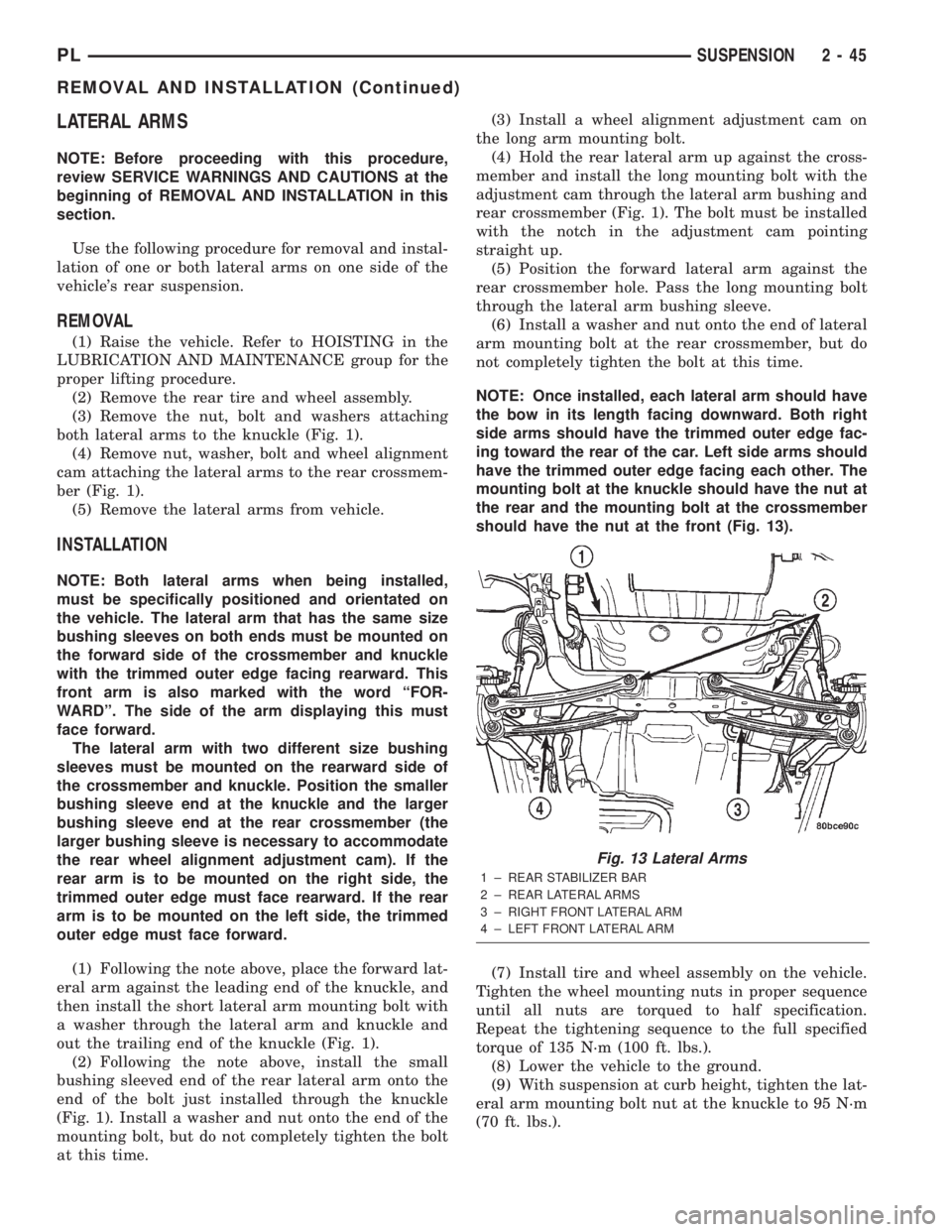
NOTE: Once installed, each lateral arm should have
the bow in its length facing downward. Both right
side arms should have the trimmed outer edge fac-
ing toward the rear of the car. Left side arms should
have the trimmed outer edge facing each other. The
mounting bolt at the knuckle should have the nut at
the rear and the mounting bolt at the crossmember
should have the nut at the front (Fig. 13).
(7) Install tire and wheel assembly on the vehicle.
Tighten the wheel mounting nuts in proper sequence
until all nuts are torqued to half specification.
Repeat the tightening sequence to the full specified
torque of 135 N´m (100 ft. lbs.).
(8) Lower the vehicle to the ground.
(9) With suspension at curb height, tighten the lat-
eral arm mounting bolt nut at the knuckle to 95 N´m
(70 ft. lbs.).
Fig. 13 Lateral Arms
1 ± REAR STABILIZER BAR
2 ± REAR LATERAL ARMS
3 ± RIGHT FRONT LATERAL ARM
4 ± LEFT FRONT LATERAL ARM
PLSUSPENSION 2 - 45
REMOVAL AND INSTALLATION (Continued)
Page 58 of 1285
nuts are torqued to half specification. Repeat the
tightening sequence, this time, to full specified
torque of 135 N´m (100 ft. lbs.).
(8) Lower the vehicle to ground level.
(9) Set the rear toe on the vehicle to the required
specification if necessary. Refer to WHEEL ALIGN-
MENT in this service manual group.
STABILIZER BAR (REAR)
NOTE: Before proceeding with this procedure,
review SERVICE WARNINGS AND CAUTIONS at the
beginning of REMOVAL AND INSTALLATION in this
section.
REMOVAL
(1) Raise the vehicle. Refer to HOISTING in the
LUBRICATION AND MAINTENANCE group for the
proper lifting procedure.
(2) Remove both rear wheel and tire assemblies
from the vehicle.
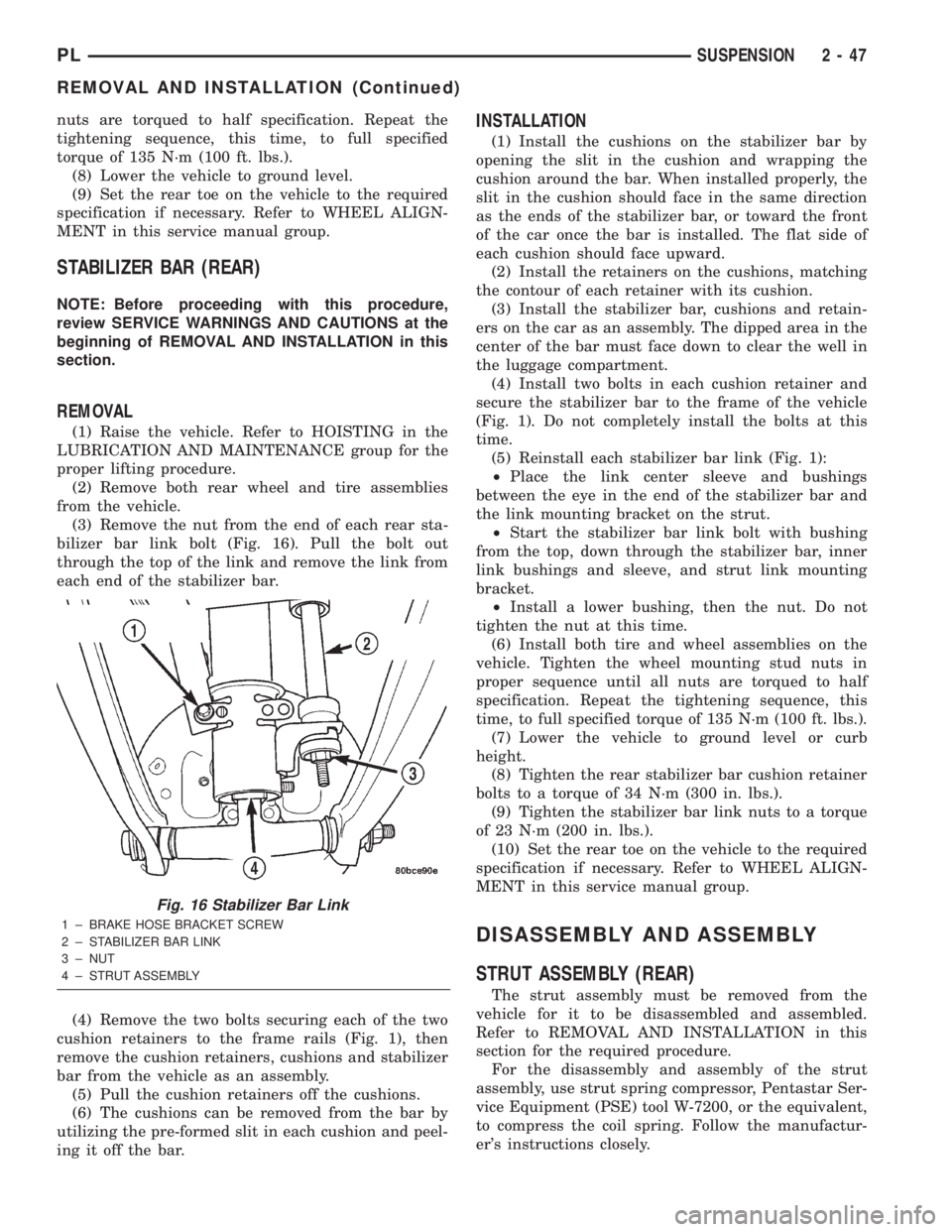
(3) Remove the nut from the end of each rear sta-
bilizer bar link bolt (Fig. 16). Pull the bolt out
through the top of the link and remove the link from
each end of the stabilizer bar.
(4) Remove the two bolts securing each of the two
cushion retainers to the frame rails (Fig. 1), then
remove the cushion retainers, cushions and stabilizer
bar from the vehicle as an assembly.
(5) Pull the cushion retainers off the cushions.
(6) The cushions can be removed from the bar by
utilizing the pre-formed slit in each cushion and peel-
ing it off the bar.
INSTALLATION
(1) Install the cushions on the stabilizer bar by
opening the slit in the cushion and wrapping the
cushion around the bar. When installed properly, the
slit in the cushion should face in the same direction
as the ends of the stabilizer bar, or toward the front
of the car once the bar is installed. The flat side of
each cushion should face upward.
(2) Install the retainers on the cushions, matching
the contour of each retainer with its cushion.
(3) Install the stabilizer bar, cushions and retain-
ers on the car as an assembly. The dipped area in the
center of the bar must face down to clear the well in
the luggage compartment.
(4) Install two bolts in each cushion retainer and
secure the stabilizer bar to the frame of the vehicle
(Fig. 1). Do not completely install the bolts at this
time.
(5) Reinstall each stabilizer bar link (Fig. 1):
²Place the link center sleeve and bushings
between the eye in the end of the stabilizer bar and
the link mounting bracket on the strut.
²Start the stabilizer bar link bolt with bushing
from the top, down through the stabilizer bar, inner
link bushings and sleeve, and strut link mounting
bracket.
²Install a lower bushing, then the nut. Do not
tighten the nut at this time.
(6) Install both tire and wheel assemblies on the
vehicle. Tighten the wheel mounting stud nuts in
proper sequence until all nuts are torqued to half
specification. Repeat the tightening sequence, this
time, to full specified torque of 135 N´m (100 ft. lbs.).
(7) Lower the vehicle to ground level or curb
height.
(8) Tighten the rear stabilizer bar cushion retainer
bolts to a torque of 34 N´m (300 in. lbs.).
(9) Tighten the stabilizer bar link nuts to a torque
of 23 N´m (200 in. lbs.).
(10) Set the rear toe on the vehicle to the required
specification if necessary. Refer to WHEEL ALIGN-
MENT in this service manual group.
DISASSEMBLY AND ASSEMBLY
STRUT ASSEMBLY (REAR)
The strut assembly must be removed from the
vehicle for it to be disassembled and assembled.
Refer to REMOVAL AND INSTALLATION in this
section for the required procedure.
For the disassembly and assembly of the strut
assembly, use strut spring compressor, Pentastar Ser-
vice Equipment (PSE) tool W-7200, or the equivalent,
to compress the coil spring. Follow the manufactur-
er's instructions closely.
Fig. 16 Stabilizer Bar Link
1 ± BRAKE HOSE BRACKET SCREW
2 ± STABILIZER BAR LINK
3 ± NUT
4 ± STRUT ASSEMBLY
PLSUSPENSION 2 - 47
REMOVAL AND INSTALLATION (Continued)