tow DODGE NEON 2000 Service Owner's Manual
[x] Cancel search | Manufacturer: DODGE, Model Year: 2000, Model line: NEON, Model: DODGE NEON 2000Pages: 1285, PDF Size: 29.42 MB
Page 59 of 1285
DISASSEMBLY
(1) If both struts are being serviced at the same
time, mark the coil spring and strut assembly accord-
ing to which side of the vehicle the strut was
removed from, and which strut the coil spring was
removed from.
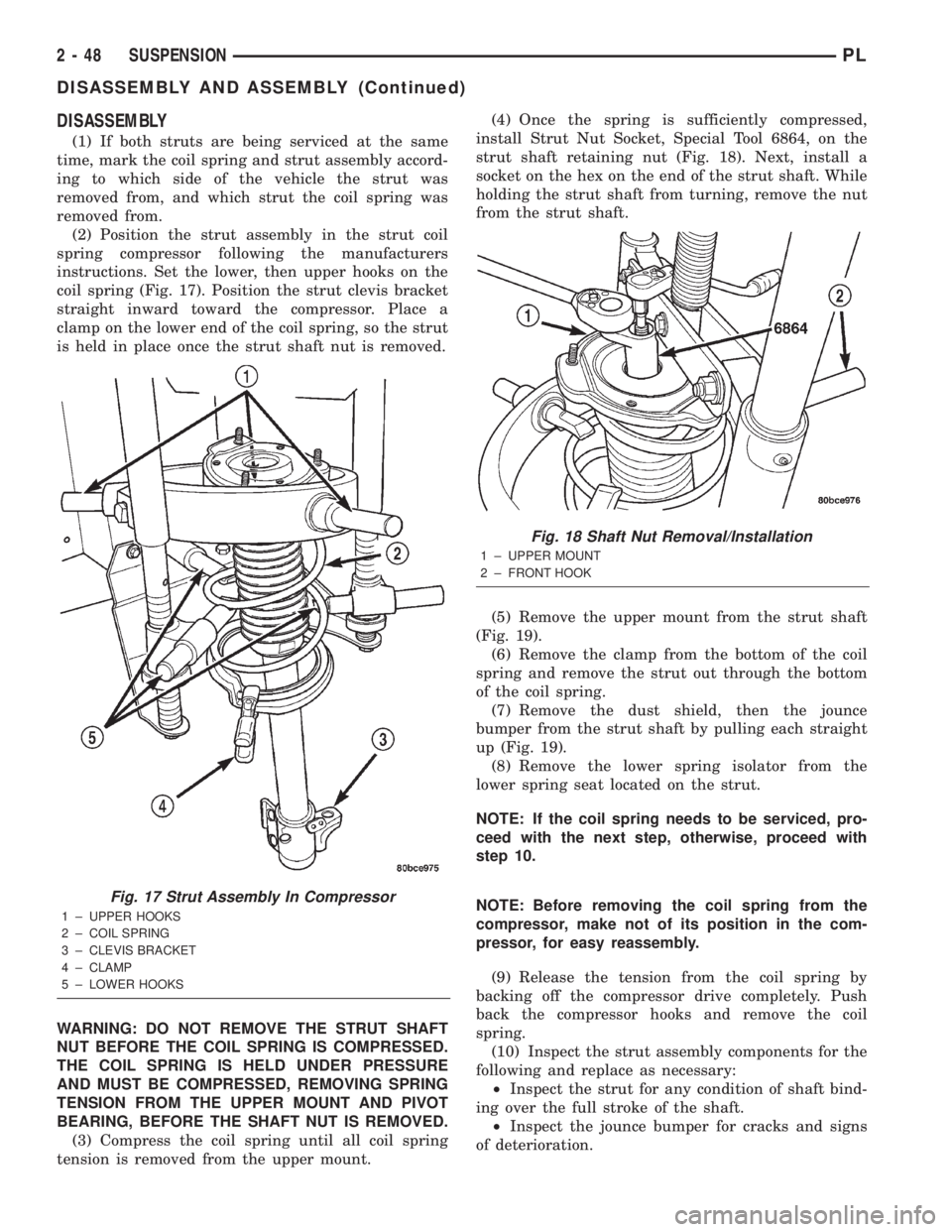
(2) Position the strut assembly in the strut coil
spring compressor following the manufacturers
instructions. Set the lower, then upper hooks on the
coil spring (Fig. 17). Position the strut clevis bracket
straight inward toward the compressor. Place a
clamp on the lower end of the coil spring, so the strut
is held in place once the strut shaft nut is removed.
WARNING: DO NOT REMOVE THE STRUT SHAFT
NUT BEFORE THE COIL SPRING IS COMPRESSED.
THE COIL SPRING IS HELD UNDER PRESSURE
AND MUST BE COMPRESSED, REMOVING SPRING
TENSION FROM THE UPPER MOUNT AND PIVOT
BEARING, BEFORE THE SHAFT NUT IS REMOVED.
(3) Compress the coil spring until all coil spring
tension is removed from the upper mount.(4) Once the spring is sufficiently compressed,
install Strut Nut Socket, Special Tool 6864, on the
strut shaft retaining nut (Fig. 18). Next, install a
socket on the hex on the end of the strut shaft. While
holding the strut shaft from turning, remove the nut
from the strut shaft.
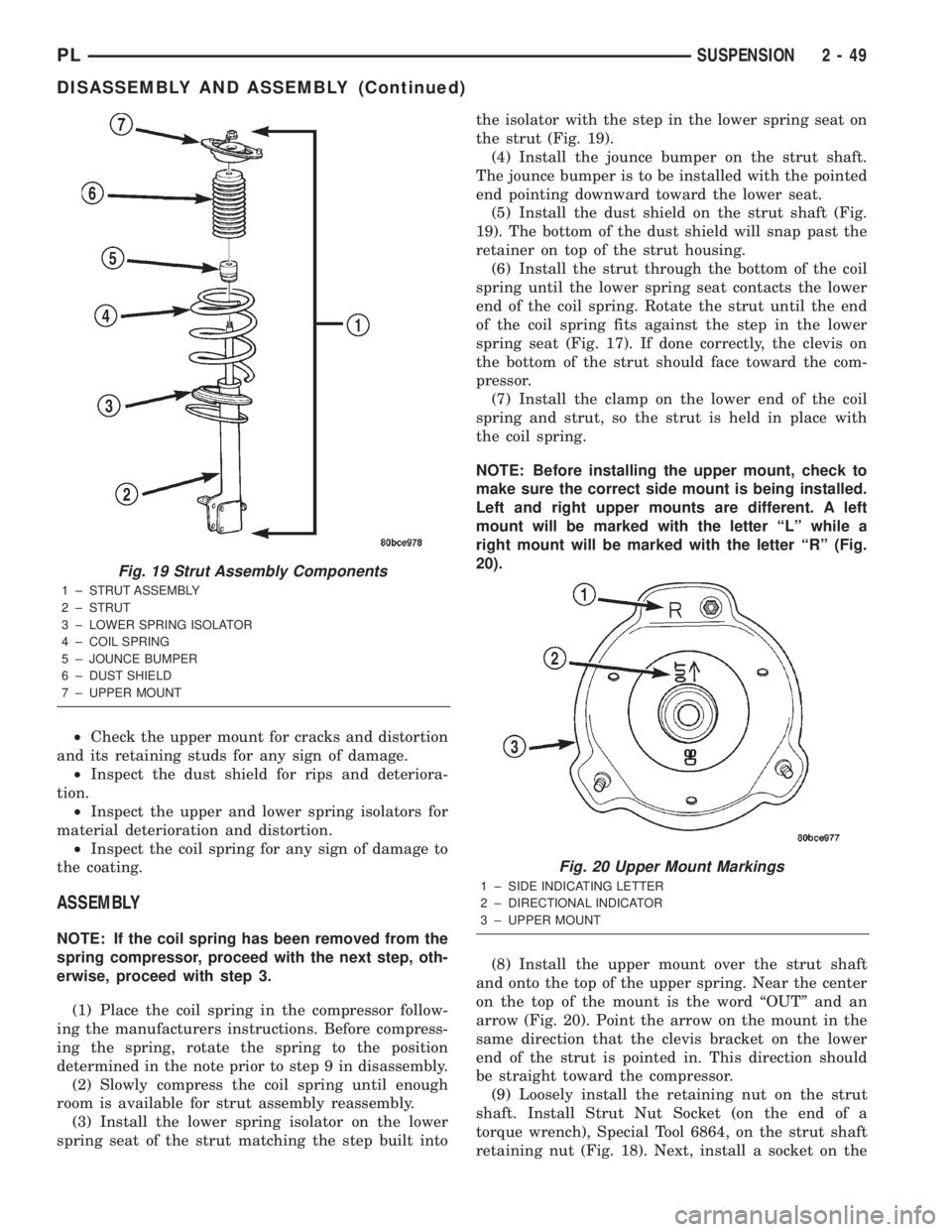
(5) Remove the upper mount from the strut shaft
(Fig. 19).
(6) Remove the clamp from the bottom of the coil
spring and remove the strut out through the bottom
of the coil spring.
(7) Remove the dust shield, then the jounce
bumper from the strut shaft by pulling each straight
up (Fig. 19).
(8) Remove the lower spring isolator from the
lower spring seat located on the strut.
NOTE: If the coil spring needs to be serviced, pro-
ceed with the next step, otherwise, proceed with
step 10.
NOTE: Before removing the coil spring from the
compressor, make not of its position in the com-
pressor, for easy reassembly.
(9) Release the tension from the coil spring by
backing off the compressor drive completely. Push
back the compressor hooks and remove the coil
spring.
(10) Inspect the strut assembly components for the
following and replace as necessary:
²Inspect the strut for any condition of shaft bind-
ing over the full stroke of the shaft.
²Inspect the jounce bumper for cracks and signs
of deterioration.
Fig. 17 Strut Assembly In Compressor
1 ± UPPER HOOKS
2 ± COIL SPRING
3 ± CLEVIS BRACKET
4 ± CLAMP
5 ± LOWER HOOKS
Fig. 18 Shaft Nut Removal/Installation
1 ± UPPER MOUNT
2 ± FRONT HOOK
2 - 48 SUSPENSIONPL
DISASSEMBLY AND ASSEMBLY (Continued)
Page 60 of 1285
²Check the upper mount for cracks and distortion
and its retaining studs for any sign of damage.
²Inspect the dust shield for rips and deteriora-
tion.
²Inspect the upper and lower spring isolators for
material deterioration and distortion.
²Inspect the coil spring for any sign of damage to
the coating.
ASSEMBLY
NOTE: If the coil spring has been removed from the
spring compressor, proceed with the next step, oth-
erwise, proceed with step 3.
(1) Place the coil spring in the compressor follow-
ing the manufacturers instructions. Before compress-
ing the spring, rotate the spring to the position
determined in the note prior to step 9 in disassembly.
(2) Slowly compress the coil spring until enough
room is available for strut assembly reassembly.
(3) Install the lower spring isolator on the lower
spring seat of the strut matching the step built intothe isolator with the step in the lower spring seat on
the strut (Fig. 19).
(4) Install the jounce bumper on the strut shaft.
The jounce bumper is to be installed with the pointed
end pointing downward toward the lower seat.
(5) Install the dust shield on the strut shaft (Fig.
19). The bottom of the dust shield will snap past the
retainer on top of the strut housing.
(6) Install the strut through the bottom of the coil
spring until the lower spring seat contacts the lower
end of the coil spring. Rotate the strut until the end
of the coil spring fits against the step in the lower
spring seat (Fig. 17). If done correctly, the clevis on
the bottom of the strut should face toward the com-
pressor.
(7) Install the clamp on the lower end of the coil
spring and strut, so the strut is held in place with
the coil spring.
NOTE: Before installing the upper mount, check to
make sure the correct side mount is being installed.
Left and right upper mounts are different. A left
mount will be marked with the letter ªLº while a
right mount will be marked with the letter ªRº (Fig.
20).
(8) Install the upper mount over the strut shaft
and onto the top of the upper spring. Near the center
on the top of the mount is the word ªOUTº and an
arrow (Fig. 20). Point the arrow on the mount in the
same direction that the clevis bracket on the lower
end of the strut is pointed in. This direction should
be straight toward the compressor.
(9) Loosely install the retaining nut on the strut
shaft. Install Strut Nut Socket (on the end of a
torque wrench), Special Tool 6864, on the strut shaft
retaining nut (Fig. 18). Next, install a socket on the
Fig. 19 Strut Assembly Components
1 ± STRUT ASSEMBLY
2 ± STRUT
3 ± LOWER SPRING ISOLATOR
4 ± COIL SPRING
5 ± JOUNCE BUMPER
6 ± DUST SHIELD
7 ± UPPER MOUNT
Fig. 20 Upper Mount Markings
1 ± SIDE INDICATING LETTER
2 ± DIRECTIONAL INDICATOR
3 ± UPPER MOUNT
PLSUSPENSION 2 - 49
DISASSEMBLY AND ASSEMBLY (Continued)
Page 61 of 1285
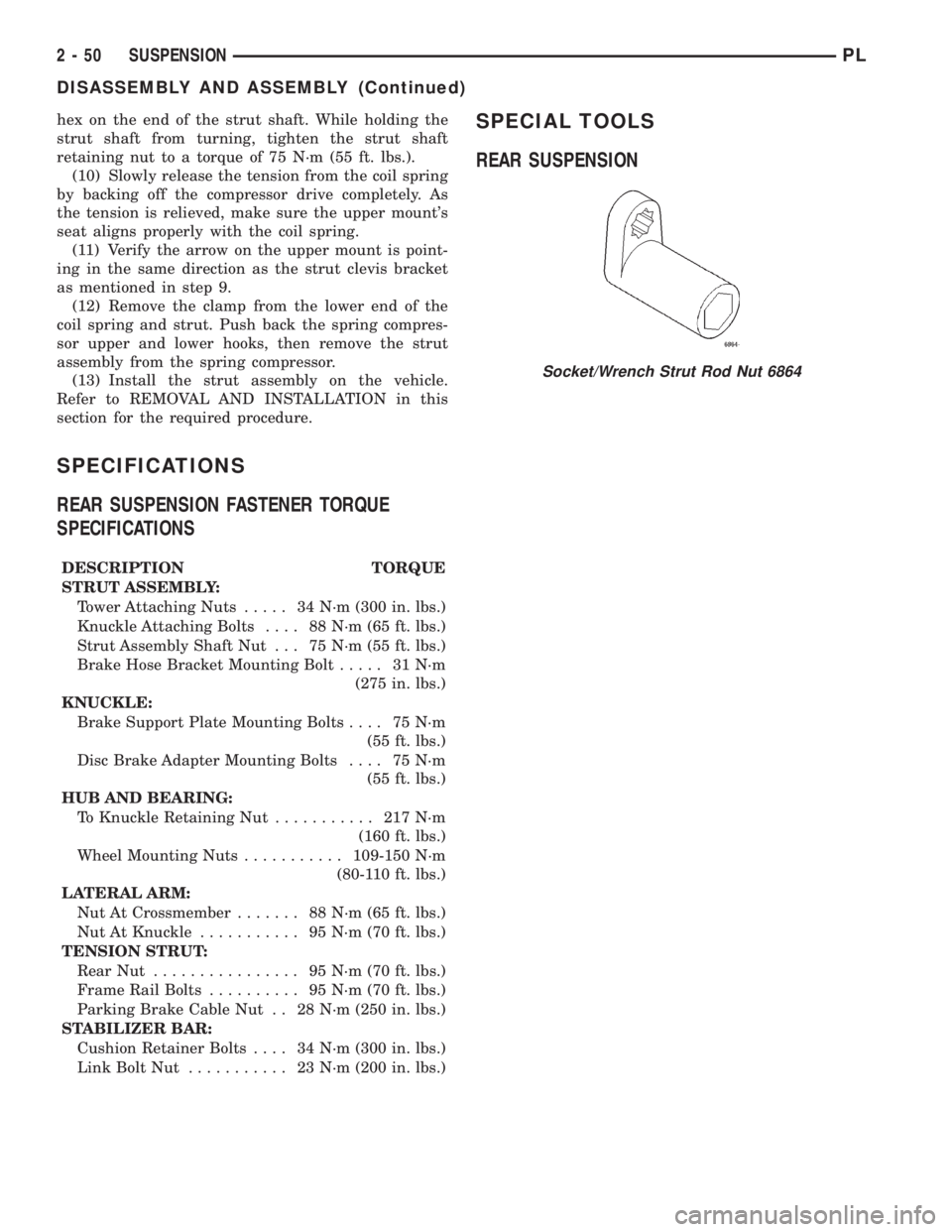
hex on the end of the strut shaft. While holding the
strut shaft from turning, tighten the strut shaft
retaining nut to a torque of 75 N´m (55 ft. lbs.).
(10) Slowly release the tension from the coil spring
by backing off the compressor drive completely. As
the tension is relieved, make sure the upper mount's
seat aligns properly with the coil spring.
(11) Verify the arrow on the upper mount is point-
ing in the same direction as the strut clevis bracket
as mentioned in step 9.
(12) Remove the clamp from the lower end of the
coil spring and strut. Push back the spring compres-
sor upper and lower hooks, then remove the strut
assembly from the spring compressor.
(13) Install the strut assembly on the vehicle.
Refer to REMOVAL AND INSTALLATION in this
section for the required procedure.
SPECIFICATIONS
REAR SUSPENSION FASTENER TORQUE
SPECIFICATIONS
DESCRIPTION TORQUE
STRUT ASSEMBLY:
Tower Attaching Nuts..... 34N´m(300 in. lbs.)
Knuckle Attaching Bolts.... 88N´m(65ft.lbs.)
Strut Assembly Shaft Nut . . . 75 N´m (55 ft. lbs.)
Brake Hose Bracket Mounting Bolt..... 31N´m
(275 in. lbs.)
KNUCKLE:
Brake Support Plate Mounting Bolts.... 75N´m
(55 ft. lbs.)
Disc Brake Adapter Mounting Bolts.... 75N´m
(55 ft. lbs.)
HUB AND BEARING:
To Knuckle Retaining Nut........... 217N´m
(160 ft. lbs.)
Wheel Mounting Nuts...........109-150 N´m
(80-110 ft. lbs.)
LATERAL ARM:
Nut At Crossmember....... 88N´m(65ft.lbs.)
Nut At Knuckle........... 95N´m(70ft.lbs.)
TENSION STRUT:
Rear Nut................ 95N´m(70ft.lbs.)
Frame Rail Bolts.......... 95N´m(70ft.lbs.)
Parking Brake Cable Nut . . 28 N´m (250 in. lbs.)
STABILIZER BAR:
Cushion Retainer Bolts.... 34N´m(300 in. lbs.)
Link Bolt Nut........... 23N´m(200 in. lbs.)
SPECIAL TOOLS
REAR SUSPENSION
Socket/Wrench Strut Rod Nut 6864
2 - 50 SUSPENSIONPL
DISASSEMBLY AND ASSEMBLY (Continued)
Page 71 of 1285
INSTALLATION
NOTE: The inner tripod joint sealing boots are
made from two different types of material. High±
temperature applications use silicone rubber
whereas standard temperature applications use
Hytrel plastic. The silicone sealing boots are soft
and pliable. The Hytrel sealing boots are stiff and
rigid. The replacement sealing boot MUST BE the
same type of material as the sealing boot that was
removed.
(1) Slide inner tripod joint seal boot retaining
clamp, onto interconnecting shaft. Then slide the
replacement inner tripod joint sealing boot onto
interconnecting shaft.Inner tripod joint seal boot
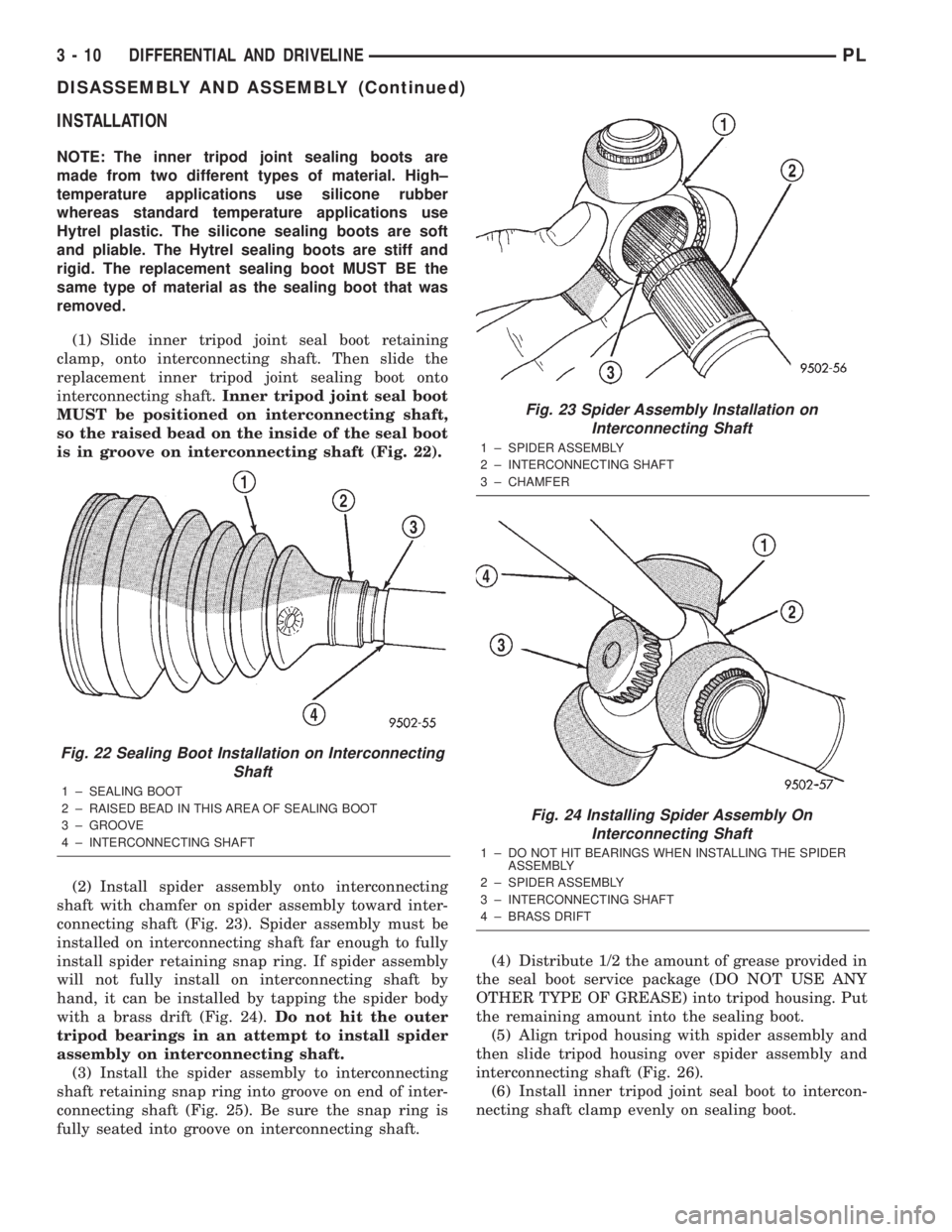
MUST be positioned on interconnecting shaft,
so the raised bead on the inside of the seal boot
is in groove on interconnecting shaft (Fig. 22).
(2) Install spider assembly onto interconnecting
shaft with chamfer on spider assembly toward inter-
connecting shaft (Fig. 23). Spider assembly must be
installed on interconnecting shaft far enough to fully
install spider retaining snap ring. If spider assembly
will not fully install on interconnecting shaft by
hand, it can be installed by tapping the spider body
with a brass drift (Fig. 24).Do not hit the outer
tripod bearings in an attempt to install spider
assembly on interconnecting shaft.
(3) Install the spider assembly to interconnecting
shaft retaining snap ring into groove on end of inter-
connecting shaft (Fig. 25). Be sure the snap ring is
fully seated into groove on interconnecting shaft.(4) Distribute 1/2 the amount of grease provided in
the seal boot service package (DO NOT USE ANY
OTHER TYPE OF GREASE) into tripod housing. Put
the remaining amount into the sealing boot.
(5) Align tripod housing with spider assembly and
then slide tripod housing over spider assembly and
interconnecting shaft (Fig. 26).
(6) Install inner tripod joint seal boot to intercon-
necting shaft clamp evenly on sealing boot.
Fig. 22 Sealing Boot Installation on Interconnecting
Shaft
1 ± SEALING BOOT
2 ± RAISED BEAD IN THIS AREA OF SEALING BOOT
3 ± GROOVE
4 ± INTERCONNECTING SHAFT
Fig. 23 Spider Assembly Installation on
Interconnecting Shaft
1 ± SPIDER ASSEMBLY
2 ± INTERCONNECTING SHAFT
3 ± CHAMFER
Fig. 24 Installing Spider Assembly On
Interconnecting Shaft
1 ± DO NOT HIT BEARINGS WHEN INSTALLING THE SPIDER
ASSEMBLY
2 ± SPIDER ASSEMBLY
3 ± INTERCONNECTING SHAFT
4 ± BRASS DRIFT
3 - 10 DIFFERENTIAL AND DRIVELINEPL
DISASSEMBLY AND ASSEMBLY (Continued)
Page 102 of 1285
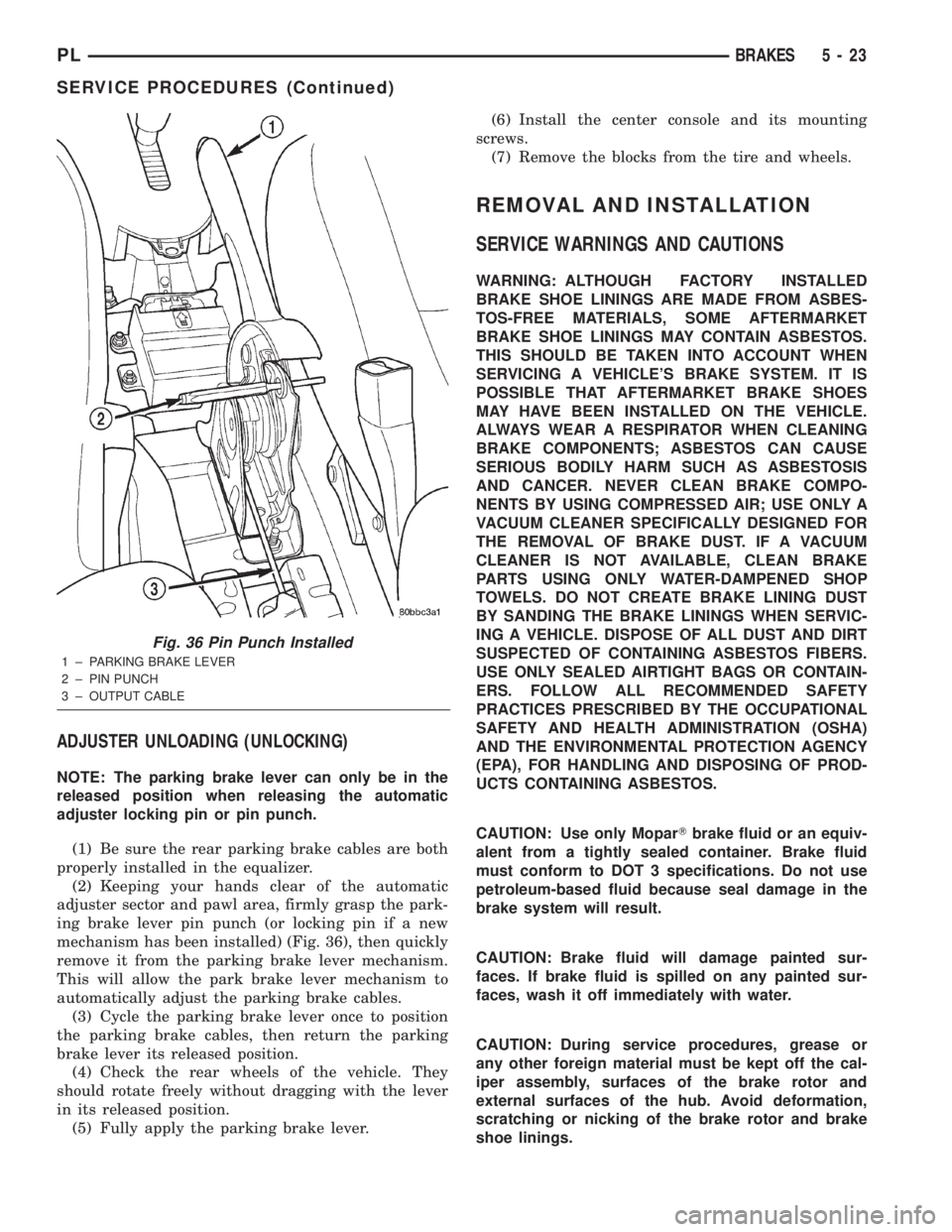
ADJUSTER UNLOADING (UNLOCKING)
NOTE: The parking brake lever can only be in the
released position when releasing the automatic
adjuster locking pin or pin punch.
(1) Be sure the rear parking brake cables are both
properly installed in the equalizer.
(2) Keeping your hands clear of the automatic
adjuster sector and pawl area, firmly grasp the park-
ing brake lever pin punch (or locking pin if a new
mechanism has been installed) (Fig. 36), then quickly
remove it from the parking brake lever mechanism.
This will allow the park brake lever mechanism to
automatically adjust the parking brake cables.
(3) Cycle the parking brake lever once to position
the parking brake cables, then return the parking
brake lever its released position.
(4) Check the rear wheels of the vehicle. They
should rotate freely without dragging with the lever
in its released position.
(5) Fully apply the parking brake lever.(6) Install the center console and its mounting
screws.
(7) Remove the blocks from the tire and wheels.
REMOVAL AND INSTALLATION
SERVICE WARNINGS AND CAUTIONS
WARNING: ALTHOUGH FACTORY INSTALLED
BRAKE SHOE LININGS ARE MADE FROM ASBES-
TOS-FREE MATERIALS, SOME AFTERMARKET
BRAKE SHOE LININGS MAY CONTAIN ASBESTOS.
THIS SHOULD BE TAKEN INTO ACCOUNT WHEN
SERVICING A VEHICLE'S BRAKE SYSTEM. IT IS
POSSIBLE THAT AFTERMARKET BRAKE SHOES
MAY HAVE BEEN INSTALLED ON THE VEHICLE.
ALWAYS WEAR A RESPIRATOR WHEN CLEANING
BRAKE COMPONENTS; ASBESTOS CAN CAUSE
SERIOUS BODILY HARM SUCH AS ASBESTOSIS
AND CANCER. NEVER CLEAN BRAKE COMPO-
NENTS BY USING COMPRESSED AIR; USE ONLY A
VACUUM CLEANER SPECIFICALLY DESIGNED FOR
THE REMOVAL OF BRAKE DUST. IF A VACUUM
CLEANER IS NOT AVAILABLE, CLEAN BRAKE
PARTS USING ONLY WATER-DAMPENED SHOP
TOWELS. DO NOT CREATE BRAKE LINING DUST
BY SANDING THE BRAKE LININGS WHEN SERVIC-
ING A VEHICLE. DISPOSE OF ALL DUST AND DIRT
SUSPECTED OF CONTAINING ASBESTOS FIBERS.
USE ONLY SEALED AIRTIGHT BAGS OR CONTAIN-
ERS. FOLLOW ALL RECOMMENDED SAFETY
PRACTICES PRESCRIBED BY THE OCCUPATIONAL
SAFETY AND HEALTH ADMINISTRATION (OSHA)
AND THE ENVIRONMENTAL PROTECTION AGENCY
(EPA), FOR HANDLING AND DISPOSING OF PROD-
UCTS CONTAINING ASBESTOS.
CAUTION: Use only MoparTbrake fluid or an equiv-
alent from a tightly sealed container. Brake fluid
must conform to DOT 3 specifications. Do not use
petroleum-based fluid because seal damage in the
brake system will result.
CAUTION: Brake fluid will damage painted sur-
faces. If brake fluid is spilled on any painted sur-
faces, wash it off immediately with water.
CAUTION: During service procedures, grease or
any other foreign material must be kept off the cal-
iper assembly, surfaces of the brake rotor and
external surfaces of the hub. Avoid deformation,
scratching or nicking of the brake rotor and brake
shoe linings.
Fig. 36 Pin Punch Installed
1 ± PARKING BRAKE LEVER
2 ± PIN PUNCH
3 ± OUTPUT CABLE
PLBRAKES 5 - 23
SERVICE PROCEDURES (Continued)
Page 104 of 1285
(10) If the vehicle is equipped with antilock
brakes, carefully push the power brake booster for-
ward until the booster contacts the ABS ICU mount-
ing bracket.
(11) If the vehicle does not have antilock brakes,
carefully push the power brake booster forward one
to two inches being careful not to stretch the brake
lines from the master cylinder to the brakes.
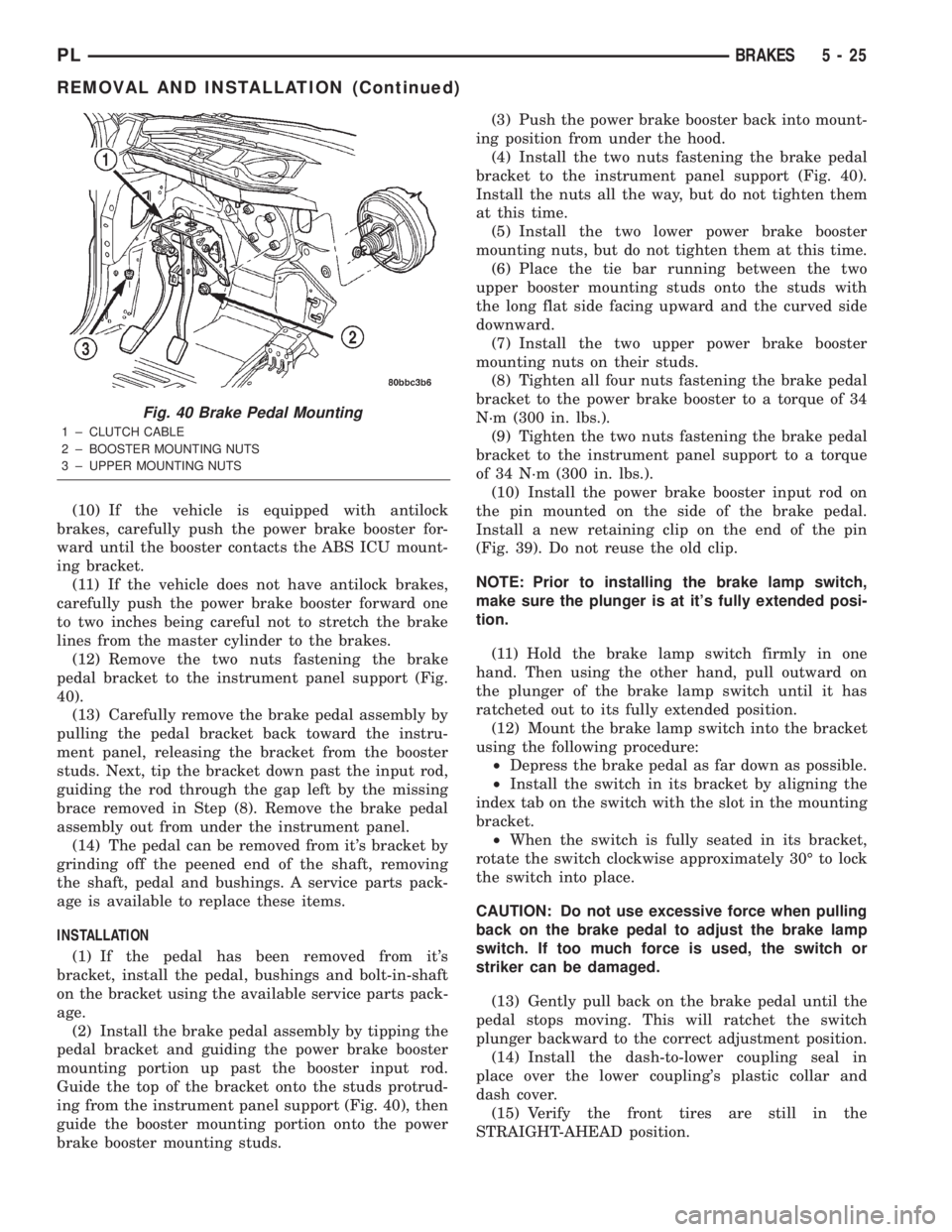
(12) Remove the two nuts fastening the brake
pedal bracket to the instrument panel support (Fig.
40).
(13) Carefully remove the brake pedal assembly by
pulling the pedal bracket back toward the instru-
ment panel, releasing the bracket from the booster
studs. Next, tip the bracket down past the input rod,
guiding the rod through the gap left by the missing
brace removed in Step (8). Remove the brake pedal
assembly out from under the instrument panel.
(14) The pedal can be removed from it's bracket by
grinding off the peened end of the shaft, removing
the shaft, pedal and bushings. A service parts pack-
age is available to replace these items.
INSTALLATION
(1) If the pedal has been removed from it's
bracket, install the pedal, bushings and bolt-in-shaft
on the bracket using the available service parts pack-
age.
(2) Install the brake pedal assembly by tipping the
pedal bracket and guiding the power brake booster
mounting portion up past the booster input rod.
Guide the top of the bracket onto the studs protrud-
ing from the instrument panel support (Fig. 40), then
guide the booster mounting portion onto the power
brake booster mounting studs.(3) Push the power brake booster back into mount-
ing position from under the hood.
(4) Install the two nuts fastening the brake pedal
bracket to the instrument panel support (Fig. 40).
Install the nuts all the way, but do not tighten them
at this time.
(5) Install the two lower power brake booster
mounting nuts, but do not tighten them at this time.
(6) Place the tie bar running between the two
upper booster mounting studs onto the studs with
the long flat side facing upward and the curved side
downward.
(7) Install the two upper power brake booster
mounting nuts on their studs.
(8) Tighten all four nuts fastening the brake pedal
bracket to the power brake booster to a torque of 34
N´m (300 in. lbs.).
(9) Tighten the two nuts fastening the brake pedal
bracket to the instrument panel support to a torque
of 34 N´m (300 in. lbs.).
(10) Install the power brake booster input rod on
the pin mounted on the side of the brake pedal.
Install a new retaining clip on the end of the pin
(Fig. 39). Do not reuse the old clip.
NOTE: Prior to installing the brake lamp switch,
make sure the plunger is at it's fully extended posi-
tion.
(11) Hold the brake lamp switch firmly in one
hand. Then using the other hand, pull outward on
the plunger of the brake lamp switch until it has
ratcheted out to its fully extended position.
(12) Mount the brake lamp switch into the bracket
using the following procedure:
²Depress the brake pedal as far down as possible.
²Install the switch in its bracket by aligning the
index tab on the switch with the slot in the mounting
bracket.
²When the switch is fully seated in its bracket,
rotate the switch clockwise approximately 30É to lock
the switch into place.
CAUTION: Do not use excessive force when pulling
back on the brake pedal to adjust the brake lamp
switch. If too much force is used, the switch or
striker can be damaged.
(13) Gently pull back on the brake pedal until the
pedal stops moving. This will ratchet the switch
plunger backward to the correct adjustment position.
(14) Install the dash-to-lower coupling seal in
place over the lower coupling's plastic collar and
dash cover.
(15) Verify the front tires are still in the
STRAIGHT-AHEAD position.
Fig. 40 Brake Pedal Mounting
1 ± CLUTCH CABLE
2 ± BOOSTER MOUNTING NUTS
3 ± UPPER MOUNTING NUTS
PLBRAKES 5 - 25
REMOVAL AND INSTALLATION (Continued)
Page 108 of 1285
(4) Position the master cylinder on the studs of the
power brake booster, aligning the push rod of the
power brake booster with master cylinder piston
push rod. Carefully push the master cylinder onto
the studs until it contacts the face of the booster.
(5) Install the two master cylinder mounting nuts
and tighten each to a torque of 28 N´m (250 in. lbs.).
(6) Connect the four brake tubes to the master cyl-
inder and proportioning valve ports (Fig. 45). Tighten
all tube nuts to a torque of 17 N´m (145 in. lbs.).
(7) Connect the brake fluid level switch wiring
connector.
(8) Install the battery and clamp it in place.
(9) Connect the positive, then the negative
(ground) cable on the battery.
(10) Fill the master cylinder to the proper level.
(11) Road test the vehicle to ensure proper opera-
tion of the brakes.
BRAKE FLUID RESERVOIR
NOTE: Before proceeding with this procedure,
review SERVICE WARNINGS AND CAUTIONS at the
beginning of REMOVAL AND INSTALLATION in this
section.
NOTE: The master cylinder does not need to be
removed from the power brake booster for removal
and installation of the brake fluid reservoir.
REMOVAL
(1) Clean the master cylinder housing and brake
fluid reservoir exterior surfaces.
(2) Remove the brake fluid reservoir cap. Using a
clean syringe or siphoning tool, empty as much brake
fluid as possible from the reservoir.
(3) Remove the vehicle wiring harness connector
from brake fluid level switch in master cylinder
brake fluid reservoir (Fig. 44).
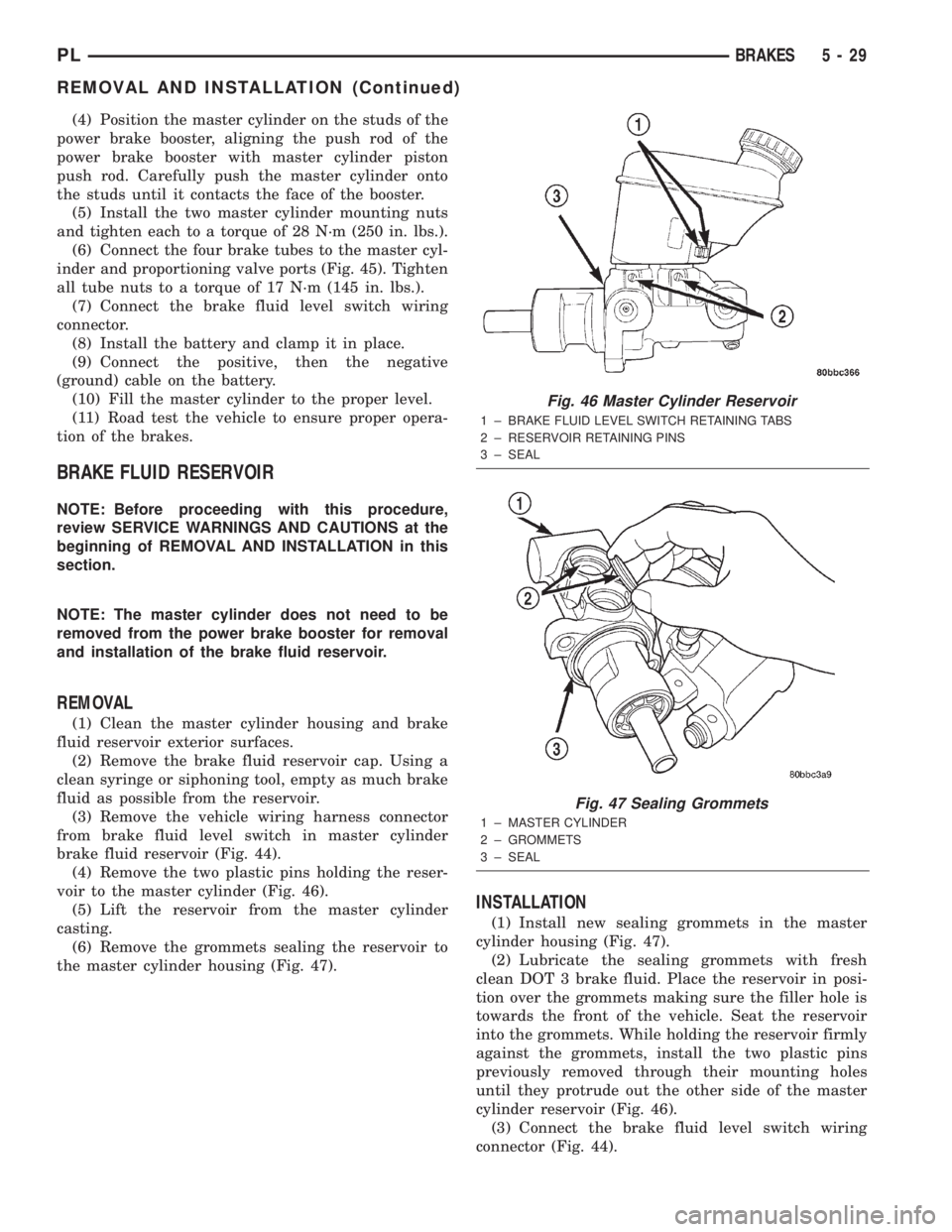
(4) Remove the two plastic pins holding the reser-
voir to the master cylinder (Fig. 46).
(5) Lift the reservoir from the master cylinder
casting.
(6) Remove the grommets sealing the reservoir to
the master cylinder housing (Fig. 47).
INSTALLATION
(1) Install new sealing grommets in the master
cylinder housing (Fig. 47).
(2) Lubricate the sealing grommets with fresh
clean DOT 3 brake fluid. Place the reservoir in posi-
tion over the grommets making sure the filler hole is
towards the front of the vehicle. Seat the reservoir
into the grommets. While holding the reservoir firmly
against the grommets, install the two plastic pins
previously removed through their mounting holes
until they protrude out the other side of the master
cylinder reservoir (Fig. 46).
(3) Connect the brake fluid level switch wiring
connector (Fig. 44).
Fig. 46 Master Cylinder Reservoir
1 ± BRAKE FLUID LEVEL SWITCH RETAINING TABS
2 ± RESERVOIR RETAINING PINS
3 ± SEAL
Fig. 47 Sealing Grommets
1 ± MASTER CYLINDER
2 ± GROMMETS
3 ± SEAL
PLBRAKES 5 - 29
REMOVAL AND INSTALLATION (Continued)
Page 110 of 1285
CAUTION: Discard the used retaining clip, it is not
to be reused. Replace the clip with a new one on
reassembly.
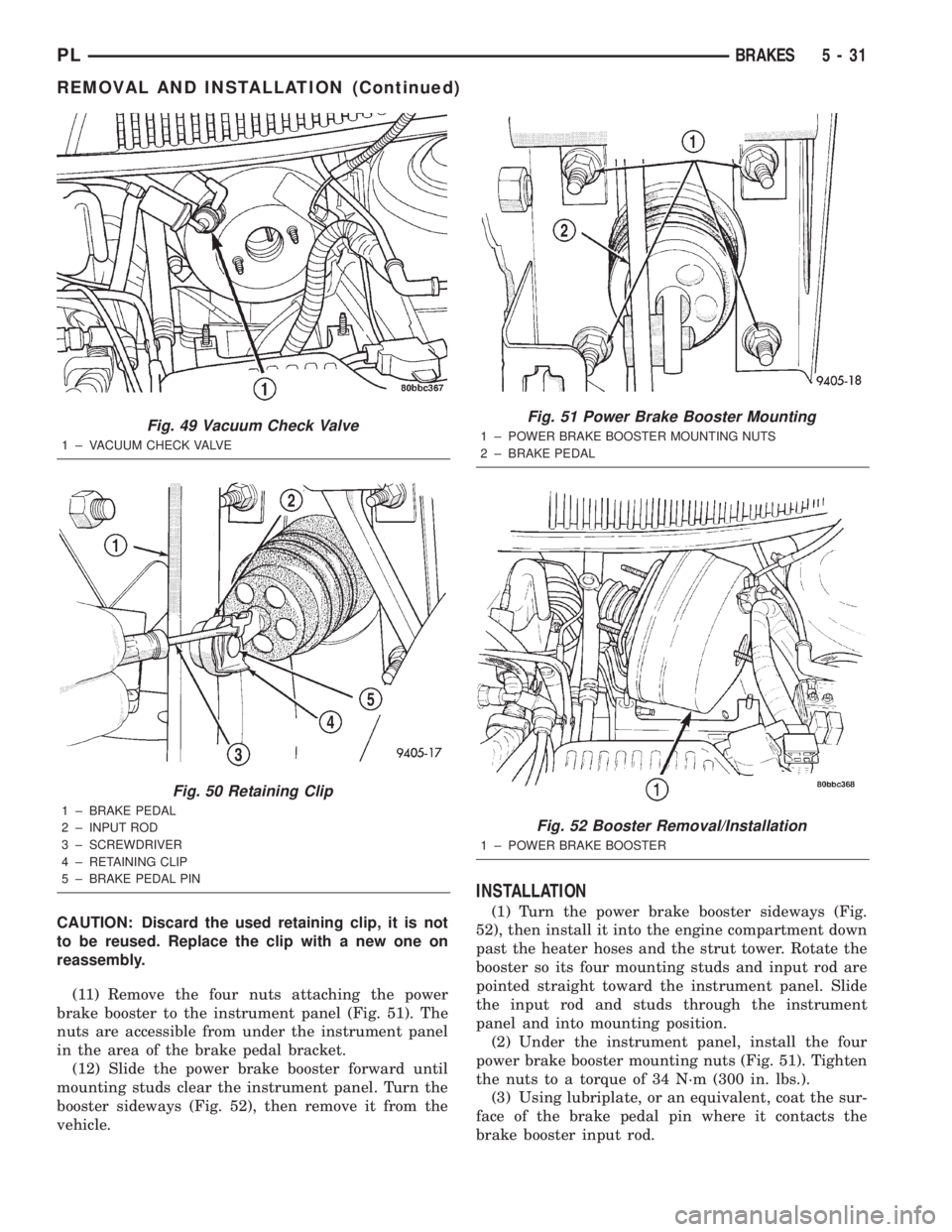
(11) Remove the four nuts attaching the power
brake booster to the instrument panel (Fig. 51). The
nuts are accessible from under the instrument panel
in the area of the brake pedal bracket.
(12) Slide the power brake booster forward until
mounting studs clear the instrument panel. Turn the
booster sideways (Fig. 52), then remove it from the
vehicle.
INSTALLATION
(1) Turn the power brake booster sideways (Fig.
52), then install it into the engine compartment down
past the heater hoses and the strut tower. Rotate the
booster so its four mounting studs and input rod are
pointed straight toward the instrument panel. Slide
the input rod and studs through the instrument
panel and into mounting position.
(2) Under the instrument panel, install the four
power brake booster mounting nuts (Fig. 51). Tighten
the nuts to a torque of 34 N´m (300 in. lbs.).
(3) Using lubriplate, or an equivalent, coat the sur-
face of the brake pedal pin where it contacts the
brake booster input rod.
Fig. 49 Vacuum Check Valve
1 ± VACUUM CHECK VALVE
Fig. 50 Retaining Clip
1 ± BRAKE PEDAL
2 ± INPUT ROD
3 ± SCREWDRIVER
4 ± RETAINING CLIP
5 ± BRAKE PEDAL PIN
Fig. 51 Power Brake Booster Mounting
1 ± POWER BRAKE BOOSTER MOUNTING NUTS
2 ± BRAKE PEDAL
Fig. 52 Booster Removal/Installation
1 ± POWER BRAKE BOOSTER
PLBRAKES 5 - 31
REMOVAL AND INSTALLATION (Continued)
Page 133 of 1285
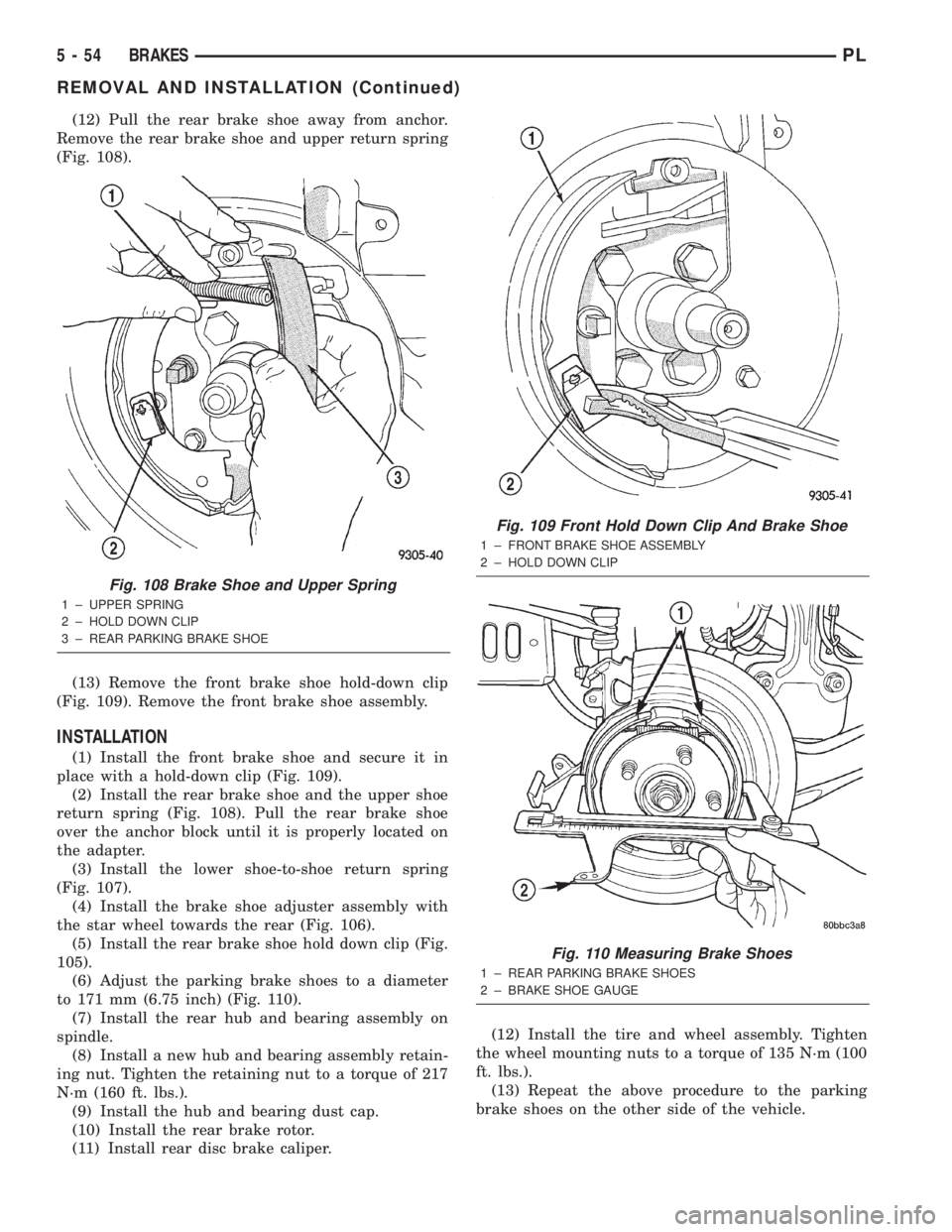
(12) Pull the rear brake shoe away from anchor.
Remove the rear brake shoe and upper return spring
(Fig. 108).
(13) Remove the front brake shoe hold-down clip
(Fig. 109). Remove the front brake shoe assembly.
INSTALLATION
(1) Install the front brake shoe and secure it in
place with a hold-down clip (Fig. 109).
(2) Install the rear brake shoe and the upper shoe
return spring (Fig. 108). Pull the rear brake shoe
over the anchor block until it is properly located on
the adapter.
(3) Install the lower shoe-to-shoe return spring
(Fig. 107).
(4) Install the brake shoe adjuster assembly with
the star wheel towards the rear (Fig. 106).
(5) Install the rear brake shoe hold down clip (Fig.
105).
(6) Adjust the parking brake shoes to a diameter
to 171 mm (6.75 inch) (Fig. 110).
(7) Install the rear hub and bearing assembly on
spindle.
(8) Install a new hub and bearing assembly retain-
ing nut. Tighten the retaining nut to a torque of 217
N´m (160 ft. lbs.).
(9) Install the hub and bearing dust cap.
(10) Install the rear brake rotor.
(11) Install rear disc brake caliper.(12) Install the tire and wheel assembly. Tighten
the wheel mounting nuts to a torque of 135 N´m (100
ft. lbs.).
(13) Repeat the above procedure to the parking
brake shoes on the other side of the vehicle.
Fig. 108 Brake Shoe and Upper Spring
1 ± UPPER SPRING
2 ± HOLD DOWN CLIP
3 ± REAR PARKING BRAKE SHOE
Fig. 109 Front Hold Down Clip And Brake Shoe
1 ± FRONT BRAKE SHOE ASSEMBLY
2 ± HOLD DOWN CLIP
Fig. 110 Measuring Brake Shoes
1 ± REAR PARKING BRAKE SHOES
2 ± BRAKE SHOE GAUGE
5 - 54 BRAKESPL
REMOVAL AND INSTALLATION (Continued)
Page 134 of 1285
(14) Adjust the parking brake shoes as necessary.
Refer to ADJUSTMENTS in this section of this ser-
vice manual group.
(15) Lower the vehicle.
DISASSEMBLY AND ASSEMBLY
DISC BRAKE CALIPER (FRONT AND REAR)
Before disassembling the brake caliper, clean and
inspect it. Refer to CLEANING AND INSPECTION
in this section of this service manual group.
CALIPER GUIDE PIN BUSHING
REMOVAL
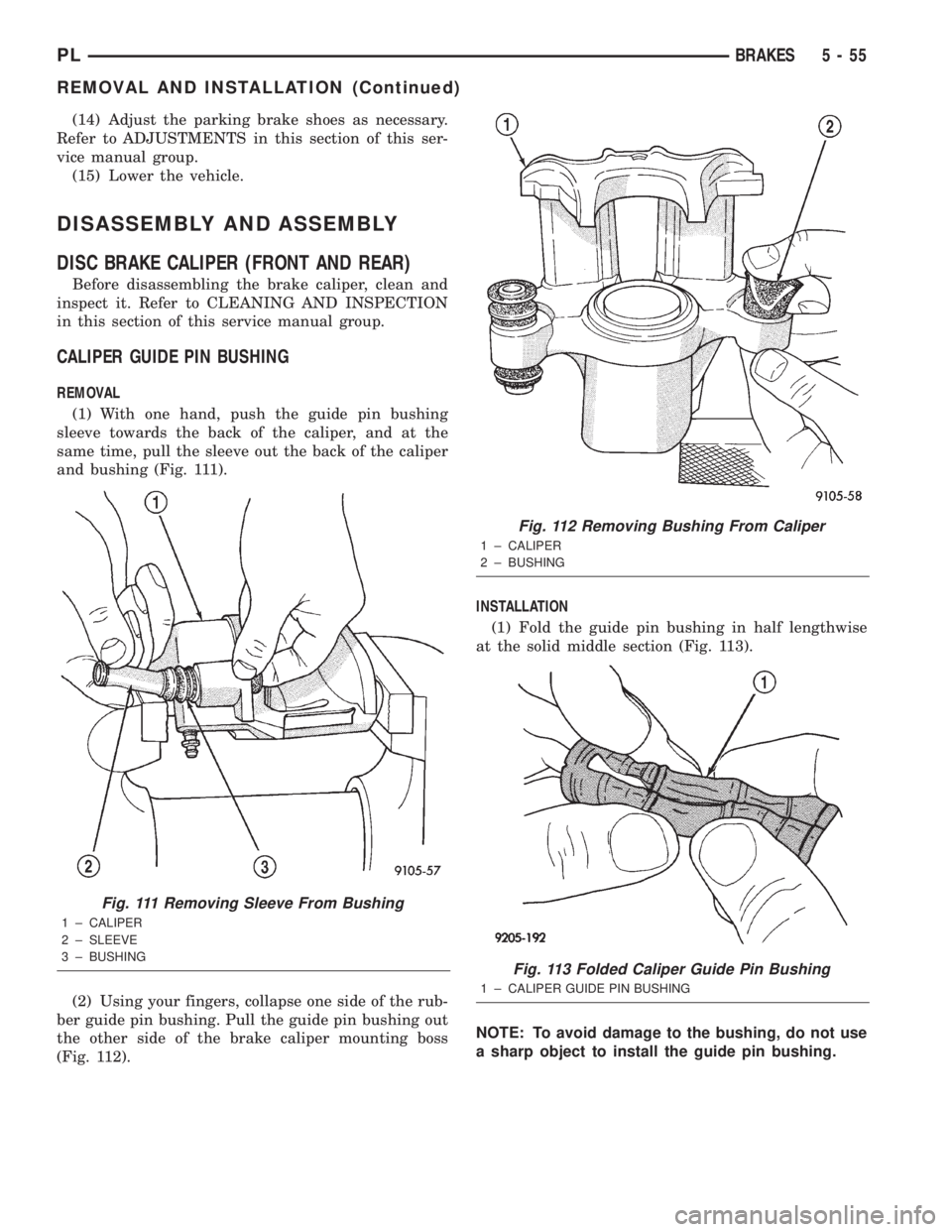
(1) With one hand, push the guide pin bushing
sleeve towards the back of the caliper, and at the
same time, pull the sleeve out the back of the caliper
and bushing (Fig. 111).
(2) Using your fingers, collapse one side of the rub-
ber guide pin bushing. Pull the guide pin bushing out
the other side of the brake caliper mounting boss
(Fig. 112).INSTALLATION
(1) Fold the guide pin bushing in half lengthwise
at the solid middle section (Fig. 113).
NOTE: To avoid damage to the bushing, do not use
a sharp object to install the guide pin bushing.
Fig. 111 Removing Sleeve From Bushing
1 ± CALIPER
2 ± SLEEVE
3 ± BUSHING
Fig. 112 Removing Bushing From Caliper
1 ± CALIPER
2 ± BUSHING
Fig. 113 Folded Caliper Guide Pin Bushing
1 ± CALIPER GUIDE PIN BUSHING
PLBRAKES 5 - 55
REMOVAL AND INSTALLATION (Continued)